Background: Autologous hamstring grafts are commonly used for anterior cruciate ligament reconstruction. The
injury of infrapatellar branch of saphenous nerve is one of the concerns leading to various pattern of sensory loss in
the operated leg. An oblique incision to harvest the graft has been reported to be better than the vertical one.The aim
of this study was to compare the incidence, recovery of nerve injury and final outcome in patients with hamstring
harvest of vertical or oblique incision.
Methods: A total of 146 patients who underwent hamstring graft harvest for anterior cruciate
ligament reconstruction, were included in the study. They were randomized into two (Vertical and Oblique) groups
as per the incisions used. The sensory loss along the Infra Patellar Branch of Saphenous Nerve was documented on
3
rdday. Recovery of the nerve injury was monitoredat three, six and 12 months follow-ups. At final follow up Tegner
Lysholm score and scale was recorded to compare between two groups.
Results: The incidence of infrapatellar branch of saphenous nerve injury was 25% in vertical group and 16.36%
in oblique group. Recovery of nerve injury started earlier in oblique group compared to vertical group. The mean
TegnerLyshom score was not significantly different in both the groups.
Conclusions: Oblique incision to harvest hamstring graft has lesser incidence of infrapatellar branch of saphenous
nerve injury, recovers earlier and does not have any adverse effect on final outcome compared to the vertical incision.
Keywords: Anterior Cruciate Ligament; hamstring; harvest; infrapatellar branch; infra patellar branch of
saphenous nerve.
Infra Patellar Branch of Saphenous Nerve Injury
during Hamstring Graft Harvest: Vertical versus
Oblique Incisions
Amit Joshi,1 Nirab Kayasth,1 Sailendra Shrestha,2 Bachchu Ram KC1
1Shree Birendra Hospital, Nepalese Army Institute of Health Sciences, Chhauni, 2Armed Police Force
Hospital, Kathmandu, Nepal.
Correspondence:
Dr Amit Joshi,
Shree Birendra Hospital, Nepalese Army Institute of
Health Sciences, Email: [email protected].
ABSTRACT
INTRODUCTION
Anterior Cruciate Ligament (ACL) reconstruction is one of the most commonly performed surgery.1 Among the
various grafts used for ACL reconstruction, autologous hamstring grafts have become very popular because of its simplicity in harvest and graft management.2
Although autologous hamstring seems ideal graft to our context,3,4 it is not free from complications.5,6 Infra
Patellar Branch of Saphenous Nerve (IPBSN) injury is one of the commonest complications, incidence of which ranges from 12-84%.7 Injury of IPBSN leads to alteration
in sensation in and around lateral part of the operated leg. The injury of IPBSN have been attributed to the vertical incision, which runs perpendicular to the course of nerve.8 In an anatomical study, variation in anatomy
of IPBSN was found and it has recommended oblique
incision to harvest hamstring over vertical incision, as oblique incision is parallel to the course of IPBSN and have less chances of injury in their population.9
No anatomic studies have been conducted in our population hence the exact course of IPBSN is not known and we don’t know which incision has higher incidence of injury. The aim of this study was to compare the incidence of IPBSN injury between vertical and oblique incision. We also aimed to evaluate the recovery potential and its effect on final outcome.
METHODS
This was a prospective randomized control trial conducted at a tertiary referral center Shree Birendra Hospital for over a period of 2 years (between May
J Nepal Health Res Counc 2016 Sep - Dec;14(34):180-5
Original
2014 to June 2016). Approval from Institutional Review Board was obtained. Advantages and disadvantages of vertical and oblique incision were explained to all the patients requiring ACL reconstruction with Hamstring graft. Patients providing informed written consent were randomized in to two groups (Vertical and Oblique group) using random number generating software. Odd numbers were assigned to Vertical Group (VG) and even numbers were assigned to Oblique Group (OG). Patient’s demographic data were obtained and surgery was performed.
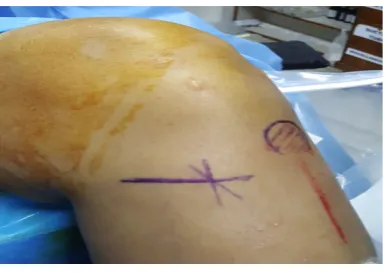
The principle author harvested all the grafts. Both the groups VG (Figure 1) and OG (Figure 2) received a 3 cm long incision centering over the palpable gracilis tendon. The vertical incision is parallel to shin and the oblique incision was about 450 angled to the shin (Figure 3).3
Blunt dissection up to the sartorial fascia was done, and then fascia was lifted from medial collateral ligament using Elli’s forceps catching the gracilis (Figure 4). An opening was made on sartorial fascia above the gracilis. The opening was extended in L-pattern, by cutting the fascia along the gracilis and base perpendicular to the tendons (Figure 5) by cutting both the tendons at its attachment. Sartorial fascia was lifted andright-angled forceps was used to separate the tendons from the Sartorius fascia. Accessory slips were cut near the tendon. Whipstitch was applied and closed end stripper was used to harvest both the gracilis and semitendinosus tendon one by one.Sartorial fascia was closed at its attachment using absorbable suture. A formal trans portal quadruple hamstring ACL reconstruction was performed. A common rehabilitation protocol was used for both the groups. Patients requiring alteration in physiotherapy protocol, e.g. meniscal repair, treatment for osteo-chondral fractures were excluded from the study. They were followed up at 3rd post op day and loss of sensation over lateral aspect of operated leg was recorded. The patients were then followed up at two weeks for suture removal, three month, six month and one year to record improvement in area of abnormal sensation. At one-year follow up Tegner Lysholm score and scale were also recorded.
A total of 146 patients underwent ACL reconstruction with hamstring graft and provided informed written consent during the study period. Using block randomization and random number generating software, 73 cases each were allocated to VG and OG. After surgery, 23 patients were excluded, 16 underwent meniscal repair, four had micro fracture for osteochondral defect and three lost to follow up. Since the rehabilitation differs in meniscal repair and micro fracture cases and the recovery pattern is different, they were excluded from the study. After
excluding all the cases, 123 patients were available for final analysis (Vertical group 68; Oblique group 55). See flow chart of methodology (Figure 6).
Data were imported to SPSS version 16 for analysis. Student’s t-test and chi-square test were used for parametric and nonparametric data respectively.
Figure 1. Vertical Incision.
Figure 2. Oblique Incision
Figure 4. Marking of L–Incision on Sartorial fascia.
Figure 5. limb of L-Incision on sartorial fascia parallel to Gracilis tendon.
Figure 6. Flow chart of methodology.
RESULTS
The demographic statistics were comparable in both the groups (Table 1). Male were predominant in both the groups.
Table 1. Comparisons of Demographic parameters.
Parameters Vertical Group (n=68)
Oblique Group (n=55)
P
value Age(years) 26.6±5.6 25.2±8.3
>0.05 Sex
Male Female
61 7
51 4 Height (cm) 173.7±13.3 161±6.7 Weight (kg) 61.7±6.2 59.6±7.1 BMI 20.4±4.5 23±5.2
Out of 123 cases enrolled in this study 26 (21.1%) had developed IPBSN injury. Seventeen (25%) out of 68 in vertical group and nine (16.36%) out of 55 in oblique group had loss of sensation over lateral aspect of operated leg consistent with IPBSN injury on third day of examination during first dressing (p=0.031) (Table 2).
Table 2. IPBSN (Sensory loss) injury detected on third day.
Loss of Sensation
Vertical Group (n=68)
Oblique Group
(n=55) p value Yes 17 (25%) 9 (16.36%)
0.031
No 51 (75%) 46 (83.6%)
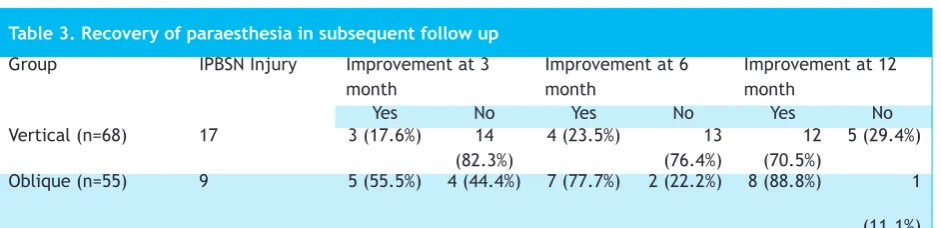
Among nine IPBSN injury in OG, five (55%) had improvement in sensation at three months compared to only three (17.6%) out of 17 in VG. At six month follow up 23.5% in VG and 77.7% in OG improved. However, 70.5% in VG and 88.8% in OG reported recovery of paraesthesia at 12 months follow up (Table 3).
At one year follow up themean Tegner Lysholm score was 90.3±23 in VG compared to 90.8±2.8 in OG (p=0.71). The comparison of Tegner Lysholm score between those who have IPBSN injury and who didn’t have IPBSN injury were also not significantly different (Table 4).
DISCUSSION
Harvesting and managing hamstring graft for ACL reconstruction is relatively easy and the outcomes are comparable to other grafts.10 This may be the reason for
increasing popularity of Hamstring graft in recent past. Complications associated with harvesting of hamstring grafts are few. IPBSN injury is one of the commonest complications leading to paraesthesia around lateral aspect of leg.11 Although it is unclear if damage to this
sensory branch is clinically important, it can cause significant concern and problem in a few cases.12
Anatomical studies have described oblique course of the nerve. However, the pattern of branching in one of the studies varied in number and location of branching. There were single nerves, two branches and three branches of the IPBSN found in their study.13 A detailed
anatomical study suggested oblique course of the nerve with variation in its branching and crossing the midline. They suggested oblique or horizontal incision would have less chance of damaging the nerve as it runs parallel to the course of the nerve. We have been using a vertical incision and many considered it as gold standard for hamstring harvest. Horizontal incision is less appropriate as entry of tibial tunnel may vary according to the graft size. So, an extra incision may be required for tibial tunnel placement. Oblique incision and mobilization of skin can be done to accommodate tibial tunnel entry if it is above the incision site. Hence we have compared incidence of IPBSN injury in vertical incision with the
oblique incision.
The distribution of patients in vertical incision (VG) and oblique incision group (OG) were similar (Table 1) indicating that both the groups were comparable. The incidence of IPBSN injury in VG group was 25% and it was only 16.3% in OG (p=0.031). This indicated that incidence of IPBSN was higher in VG (Table 2).
A study has reported the highest incidence of IPBSN injury. It has found an incidence of 88% and also mentioned that the incidence does not significantly reduced by making the incision oblique.11 In another
study, IPBSN injury was electromagnetically detected in 68%, however it was found that 77% of the patients have altered sensation.14 Another study also compared
the incidence of IPBSN injuries between oblique and vertical incisions to harvest the hamstring graft. In the study nerve injury rate was 24% for oblique and 56% for vertical incisions.5 In another study, the incidence of
nerve injury was 37.5%, where only the semitendinosus was harvested.15 The incidence of IPBSN injury in our
study was lower in comparison to most of these studies except for the study where the incidence of IPBSN injury was only 12%.16 In a large series 39.7% incidence of IPBSN
injury was found when hamstring was harvested with a vertical incision, and 14.9% with an oblique incision, which was very similar to our study.17 It is difficult to
explain the lower incidence of IPBSN injury in our series. However, a blunt dissection after the skin incision and
Table 3. Recovery of paraesthesia in subsequent follow up
Group IPBSN Injury Improvement at 3 month
Improvement at 6 month
Improvement at 12 month
Yes No Yes No Yes No
Vertical (n=68) 17 3 (17.6%) 14 (82.3%)
4 (23.5%) 13 (76.4%)
12 (70.5%)
5 (29.4%)
Oblique (n=55) 9 5 (55.5%) 4 (44.4%) 7 (77.7%) 2 (22.2%) 8 (88.8%) 1
(11.1%)
*IPBSN – Infra Patellar Branch of Saphenous Nerve.
Table 4. Tegner Lysholm Score at 12 months follow up.
Mean Score IPBSN Group(n=26) Non IPBSN (n=97) p value
90.4±3.6 90.2±4.1 0.52
Table 5. Tegner Lysholm Scale at 12 months follow-up.
Scale IPBSN Group (n=26) Non IPBSN (n=97) p value Poor <65 0 (0%) 0 (0%)
0.21 Fair 65-83 1 (3.84%) 1 (1.03%)
an L shaped incisions to lift the sartorial fascia may be the reason for the lower incidence. We still believe that an oblique incision runs parallel to the course of the nerve and have lesser chance of damaging the nerve. This has been supported by significantly lower incidence of nerve injury when an oblique incision was used to harvest the graft. This hypothesis has further been supported by the fact that most of the patients of IPBSN injuries in oblique group have recovered early compared to the vertical group (Table 3). We further hypothesize that, IPBSN injury in Oblique group was a neuropraxia which recovered early in contrast to the vertical group, where the injury was neurotomesis. Although majority of IPBSN injuries recovered at one year follow up, the recovery was slow. This may be because the nerves have not regenerated, but the overlapping sensory branches have compensated the sensation. None of the previous studies have tried to explain type of nerve injuries. A detailed neurophysiological study may be necessary to elaborate this hypothesis.
The Tegner Lysholm score and scale on both the groups were similar. This proves that the type of incision does not have any adverse effect on final outcome. Sabat and Kumar also mentioned that whatever the type of incision, it does not have any effect on final outcome of ACL reconstruction.8 We also compared outcome
between patients with IPBSN injury and without injury. The mean Tegner Lysholm score in IPBSN injured patients was 90.4±3.6, compared to 90.2±4.1 in patients without IPBSN injury (p=0.52). The Tegner Lysholm scale was also comparable in both the groups. This indicated that neither incision nor IPBSN injury affects the final functional outcome after ACL reconstruction.Most of the studies that correlated IPBSN injuries and incision with the final outcome of ACL reconstruction, have unanimously agreed that IPBSN injury have no adverse effect on final outcome.6,8,12,15,16 However, loss of
paraesthesia on lateral aspect of operated leg may be a matter of concern to the patient.
CONCLUSIONS
Incidence of IPBSN injury was significantly higher in vertical compared to oblique incision group. Majority of these injuries recover over the period and does not have any effect on final outcome.