WWJMRD 2017; 3(11): 337-342 www.wwjmrd.com
International Journal Peer Reviewed Journal Refereed Journal Indexed Journal UGC Approved Journal Impact Factor MJIF: 4.25 e-ISSN: 2454-6615
Nitika
M. Tech (Student)/PG Scholar Department of Computer Science, Engineering GZS Campus College of Engineering, Technology, Bathinda, India
Paramjit Singh Professor
Department of Computer Science, Engineering GZS Campus College of Engineering, Technology, Bathinda, India
Correspondence: Nitika
M. Tech (Student)/PG Scholar Department of Computer Science, Engineering GZS Campus College of Engineering, Technology, Bathinda, India
Performance Enhancement with Hybridization of
proactive and reactive protocols.
Nitika,
Paramjit Singh
Abstract
MANET is mobile ad-hoc network. Consists of various wireless nodes. Each node moves from one position to the other position with different speed. As there will be heterogeneous type of nodes. This includes vehicle nodes as well as pedestrian nodes. While moving nodes communicates to each other. There will be fast change in the neighbour list. Sometime nodes moves with less speed so there will be less change in the neighbour list. In both the situation if one protocol will be used will be less efficient. While slow moving node network we can select proactive protocol and while fast moving nodes we can select reactive category of protocol. This will make system more efficient. Also there will a consideration of mobility model for the nodes. In proposed technique there will be enhancement in the performance. All the performance parameters like end to end delay, Throughput has shown the improvement.
Keywords: Proactive, Reactive, Hybrid.
Introduction
MANET is mobile ad-hoc network. It includes various wireless nodes inter communicating to each other. These nodes are mobile in nature. These nodes will send and receives the data. While in MANET each node is mobile in nature. Nodes moves from one position to the other position. They move in random direction. Each node has the ability to send and receives the signal either directly or by keeping one node in between. This mobile network has dynamic topology. Because the mobile nodes are moving in nature. They moves randomly from one position to the other position.
In MANET there is no central controller which can control the authenticity of the node. This network is infrastructure less network. As each node also works as switch element. Which routes the packets from source to the destination. It is the network having higher level of vulnerability to various types of attacks. Because in this network any node can be malicious node. Which can destroy the network traffic. It is the network having no ability to connect the network traffic reliably to be sent from source to the destination.
There are various routing protocols which will be used for routing the traffic from source to the destination. We can categories these protocols into three categories.
1. Reactive category.
2. Proactive category.
3. Hybrid category.
In reactive category each time source identifies the path for the destination. This path established will be of ad-hoc in nature. It is the type of network protocol basically identifies the route from source to the destination. That path will be selected which has minimum number of hops.
In proactive category when nodes are slow moving, rather than identifying the new path. It checks the existing path into the buffer. These paths are already used path. So that path will be selected which is active path. So that existing path which was declared safe will be selected. So that path selected will be on the merits.
path will be either dynamically identified or it is identified based on table. This provides the option of selecting the path based on network traffic. If the network traffic is fast moving then reactive category of protocol will be selected. But if the nodes are slow moving then proactive category of protocol will be selected.
Characteristics of Manet
Dynamictopologies: Manet is mobile ad-hoc network of various mobile nodes moves in short area. It is the network where various nodes move from one position to other position with different speed and different direction. Because they have different speed and mobility they build a dynamic topology.
Self-organized: MANET is mobile ad-hoc network. It has the ability to send and receives the data amongst each other. These nodes are moving in nature. While moving they inter communicates to each other. This intercommunication is either direct or by keeping one node in between. That means it is infrastructure less network. There is no central controller which can control the access. So every node is self-organizer. Organizes them self.
Scalability: MANET is the network works in small area. So it is very scalable. That means is understandably lies in small area like 1 km radius. There is no central tower which can control the incoming and outgoing frequency.
Multihop : while MANET is mobile ad-hoc network has various mobile nodes. Each node moves from one position to other position. While when source sends the data packets to the destination, it may be chance that destination does not lies in the direct range to the source. So for sending the data from source to the destination source considers intermediate node as relay node. Through which it sends the data. This way multiple hops will be generated. These multiple hops are in the form of relay nodes.
Device heterogeneity: MANET is mobile ad-hoc network consists of various wireless nodes moves from one position to other position. These nodes are mobile and builds the dynamic topologies. The nodes can be laptops, hand held devices or any type of communication devices through which communication can be taken place..
Cooperating: MANET is the network consists of various heterogeneous nodes. These nodes are mobile in nature. These nodes move at specific speed from
one position to the other position. While
communication source and destination may not be in direct range to each other. So considers one or two intermediate node as relay node. This relay node considers in data from source and forward it in the direction of the destination [3].
Applications of Manet
Tactical networks: Manet is mobile ad-hoc network works in small range. It is very easy to setup. Because for it there is no need to have heavy type of infrastructure. So it can be used in various tactical fields like military operations.
Emergency services: MANET is easy to layout network. It does not require a heavy type of machines. It is wireless type of network so easy to set and easy to
communicate. It can be used in various emergency services like flood relief and hospitals etc.
Transport and aviation industry: MANET can be used as communication devices for various vehicles and transport services. While running on the road, various wireless devices can be used to communicate to these devices. So that road condition and other type of status information can be communicated.
Entertainment: MANET is wireless network where various nodes can communicates to each other in real time. It is the type of network where fast and reliable communication can be taken place. So this type of network utility can be used for outdoor games.
Sensor networks: MANET is used as wireless network. Can be used for as sensing network. In which sensor node senses the environment factor and sends the collected data to the base station. This way large area can be vigil led without the human intervention. SOHO environment: MANET is small area network
is used as office network. Where various devices like printer, PC etc can be linked together so that they can perform office related utilities.
Limitations of Manet
Energy constraint: MANET is the network where various nodes communicated to each other. As there is no central tower in between so for connecting the source and destination there requires relay node. The node itself works as relay node. Each node while sending the data from source to the destination uses its limited battery power. As a relay node it has to receive the data from one side and send that data to the destination node. Due to limited battery power each node life time is limited.
Decentralized: In MANET each node is
communicated to each other. There is no central controller which can control the whole network. Each node control itself. So this type of network is called decentralized network.
Routing overhead: In this type of network there is large amount of network overhead. Because every solution for congestion and security is provided at the protocol level. So extra data has to be traveled while sending the request, data or even the reply.
Limited Resources: Ad-hoc network has limited resources. These limited resources are in the form of less amount of resources in hardware terms. Each time decentralized control will be taken place. Which controls the network?
Environment impact: In this type of network because a small area is there and low level radio signals are used for transmitting the signal from source node to the destination node. Sometime due to the harsh environmental conditions there network performance can be deteriorates.
Literature Review
Deepak Kumar Sharma et al (2016) this paper has proposed a routing scheme known as Epidemic routing protocol. It is the scheme where node while routing or forwarding the packet in the network to its neighbor which lies in the path list priority is considered. Those messages will be forwarded first which has higher priority. First in first out criteria is the most prevalent criteria for forwarding the packets. This scheme of forwarding the packet is to announce that any packet which has higher priority should be forwarded the message or packet [5].
Sun-kyum kim et al(2016) This paper has proposed a scheme called as higher probabilities to forward the packet from source to the destination. It is the way of transforming the data from source to destination. It is the way to keep security of the members and node and packets. It is the system of security and management of the system. This paper has proposed a scheme for centrally controlled and betweenness so that any node which is in direct connection to each other will be considered as trusted node. It is the way of key management [12].
Neelam Sharma et al (2016) this paper has proposed a scheme for congestion control. Generally MANET is self-managed network where large numbers of nodes are forwarding the packets from source to destination. Some time in between nodes has packets beyond its capacity. In that case congestion will be resulted. In such situation congestion control mechanism is required. This way the system management is required where large number of packets will be forwarded through that path which has less traffic to follow [6].
Flowchart
Algorithm
Step1 Build a network of given number of nodes in specified size of network size.
Step2 Send the route request from source node to its neighbor for specific destination.
Step3 If the any neighbor is the destination will send the route reply to the requesting node.
Step4 else will forward the route request to its neighbor. Step5 while route reply each node build a table at itself where previous nodes in between to itself and the destination is stored. This stored information builded into the table is non-sharable. So there is no need to send the hello message like proactive to the neighbor node for knowing the activeness of the node.
Step6 When any node has to send the data to the destination will first check into the table at itself for the latest path to the destination. If latest path exists then use this path for sending the data packet from itself to the destination.
The Structure of The Routing Table Dest. Destination node of packet.
Next hop: Next hop on the path to destination.
Hop count: hop distance to destination from current node. BID: broadcast ID.
The format of RREQ Src: source of packet.
Dest: Destination of the packet. Prev Node: pRevious node address.
Hop Count: Number of hops traversed by the packet. BDID: Broadcast Id.
Results Analysis
In current research a network with mobile wireless nodes is established. This network consists of heterogeneous nodes. These heterogeneous nodes are vehicle nodes or the pedestrian nodes. They move with different speed. These nodes moves with specific mobility model depending upon the requirements. While communication adaptive network is established. In this network specific protocol based on speed is selected for example when nodes are fast moving there will be rapid change in the neighbor list. So AODV protocols need to be established. But when the nodes are slow moving there will OLSR protocol. Because there will be hardly any change in the topology in the network. This will help in performance enhancement. This will increase the throughput as well as reduction in end to end delay.
Performance Metrics
Three important performance metrics are evaluated:
End to End Delay
It is the total delay that packet has taken while being arrived from source to the destination.
End to End delay=end time-start time.
Throughput
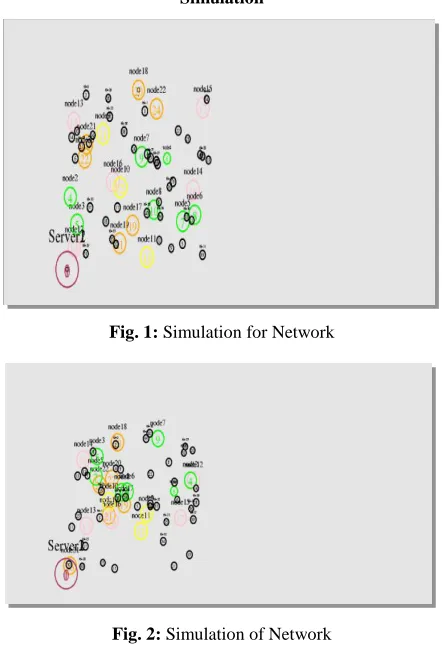
Simulation
Fig. 1: Simulation for Network
Fig. 2: Simulation of Network
Throughput comparison for all protocol with node density 20
Throughput comparison for all protocol with node density 40
Throughput comparison for all protocol with node density 60
End to End Delay comparison for all protocol with node density 20.
\
End to End Delay comparison for all protocol with node density 40.
Throughput comparison for all protocol with node density 20
Throughput comparison for all protocol with node density 40
Throughput comparison for all protocol with node density 60
End to End Delay comparison for all protocol with node density 20
End to End Delay comparison for all protocol with node density 40.
End to End Delay comparison for all protocol with node density 60.
Improvement Table
ADOV DSDV DSR OLSR Hybrid Throughput at Density 20 Nodes 4.81 4.40 4.71 3.92 5.20
Throughput at Density 40 Nodes 5.15 4.43 3.76 4.73 4.49
Throughput at Density 60 Nodes 3.89 4.12 4.42 4.069 4.19
End to End Delay at 20 Density 1.001 0.60 1.001 1.002 .0.54
End to End Delay at 40 Density 1.0001 0.81 1.001 1.0001 .0.80
End to End Delay at 60 Nodes 1 1 1 1 1
Conclusion
MANET is mobile ad-hoc network. Consists of various wireless nodes. Each node moves from one position to the other position with different speed. As there will be heterogeneous type of nodes. This includes vehicle nodes as well as pedestrian nodes. While moving nodes
reactive category of protocol. So naturally hybridization of the network protocols will enhance the work by using positives of both reactive and proactive routing protocols.
Future Work
In current research two speed and two mobility models are being considered. In future we can more refine in terms of speed and mobility model. So that more adaptive model can be established. This model can be more suitable for real life situation.
References
1. Andrea Lupia, Floriano De Rango, “Energy
Consumption Evaluation of SAODV with Trust Management Scheme under Gray-Hole Attacks”, International Journal of Information Technology and Knowledge Management, Vol 2(2), pp. 545-548, 2015.
2. C. E. Perkins and P. Bhagwat, “Highly Dynamic
Destination-Sequenced Distance-VectorRouting
(DSDV) for Mobile Computers,” Computer
Communications Review, pp. 234-244, October 1994.
3. C.Perkins and E. Belding-Royer, “Ad-hoc On-Demand
Distance Vector (AOVD) Routing”, IETF RFC 3561, 2015.
4. Charles E. Perkins, and Elizabeth M. Royer, “Ad-hoc
On-Demand Distance Vector (AODV) routing,” Internet Draft, November 2002
5. Deepak Kumar Sharma1, Sanjay K. Dhurandher1,
Mohammad S. Obaidat2, Sahil Pruthi and Balqies Sadoun,” A Priority Based Message Forwarding Scheme for Opportunistic Networks”, 2016 IEEE
6. David B. Johnson, and David A. Maltz, “Dynamic
Source Routing in Ad Hoc Wireless Networks,” Mobile Computing, edited by Tomasz Imielinski and Hank Korth, Kluwer Academic Publishers, 1996. 7. Haiyun Luo, Petros Zerfos, Jiejun Kong, Songwu Lu
and Lixia Zhang,
“Self-securingAdHocWirelessNetworks,”http://www.cs.ucla. edu/~jkong/publications/ISCC02.pdf.
8. Hongmei Deng, Wei Li, and Dharma P. Agrawal,
“Routing Security in Wireless Ad Hoc Network,” IEEE Communications
9. Kimaya Sanzgiri, Bridget Dahill, Brian Neil Leviney, Clay Shieldsz, Elizabeth M. Belding-Royer, “A Secure Routing Protocol for Ad Hoc Networks”, 10th IEEE International Conference on Network Protocols, 2002
10. Lidong Zhou, and Zygmunt J. Haas, “Securing Ad Hoc
Networks,” IEEE Network Magazine,vol. 13, no.6, November/December 1999.
11. Prachatos MitraThe journal of Military Electronic & Computing, “Mobile Ad Hoc Networking Revamps Military Communications”.
12. SUN-KYUM KIM,” Effective Forwarding Scheme for
Opportunistic Networks Based on Refined Contact Probability and Betweenness Centrality”, JOURNAL
OF INFORMATION SCIENCE AND
ENGINEERING(2016)
13. Sonam Kashyap1, Jasvir Singh2,” Survey on Latest Routing Algorithms in Opportunistic Networks”, International Journal of Science and Research (IJSR),2014
14. Srdjan Capkuny, Levente Butty´an, and Jean-Pierre
Hubaux, “Self-Organized Public-KeyManagement for Mobile Ad Hoc Networks,” Technical Report at EPFL.
15. Siddlingappagouda Biradar, “Enhancing the quality of
service using MAODV protocol in MANET’s”, Swedish Defence Research Agency Command and Control System Sweden, 2015.
16. Sunil J. Soni, P.Kanungo “Performance analysis of AODV, DSR, OLSR and DSDV Routing Protocols using NS2Simulator”, Procedia Engineering Vol. 23, pp.229–234, 2015.
17. Vijay Erramilli, Mark Crovella, “Forwarding in
Opportunistic Networks with Resource Constraints”, 2012.
18. Y. Zhang, W. Lee, “Intrusion Detection in Wireless Ad
Hoc Networks,” 6th Int’l.
19. Yongxuan Lai, Guilin Li,” PBQ: A Priority-Based