Building a golden collection of parallel Multi-Language Word Alignments
Jo˜ao Grac¸a, Joana Paulo Pardal, Lu´ısa Coheur and Diamantino Caseiro
L2F – INESC-ID Lisboa/IST {javg,joana,lcoheur,dcaseiro}@l2f.inesc-id.pt
Abstract
This paper reports an experience on producing manual word alignments over six different language pairs (all combinations between Portuguese, English, French and Spanish) (Grac¸a et al., 2008). Word alignment of each language pair is made over the first 100 sentences of the common test set from the Europarl corpora (Koehn, 2005), corresponding to 600 new annotated sentences. This collection is publicly available athttp://www.l2f.inesc-id.pt/resources/translation/. It contains, to our knowledge, the first word alignment gold set for the Portuguese language, with three other languages. Besides, it is to our knowledge, the first multi-language manual word aligned parallel corpus, where the same sentences are annotated for each language pair. We started by using the guidelines presented at (Lambert et al., 2005) and performed several refinements. Some due to under-specifications on the original guidelines, others because of disagreement on some choices. This lead to the development of an extensive new set of guidelines for multi-lingual word alignment annotation that, we believe, makes the alignment process less ambiguous. We evaluate the inter-annotator agreement obtaining an average of 91.6% agreement between the different language pairs.
1.
Introduction
The concept of word alignment, introduced in (Brown et al., 1990) for statistical machine translation, consists in an object representing which words in a source language cor-respond to translations of other words in a foreign language, between two parallel sentences. A word alignment can be seen as a matrix ofn∗mentries, wherenis a position on the source sentence, andmis a position on the target sen-tence. An entry in that matrixan,mspecifies if the word at positionnis part of a translation of the word at positionm on the target language.
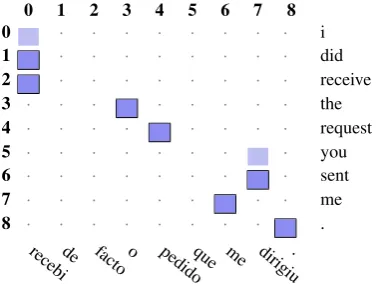
Figure 1 shows a possible word alignment between the En-glish sentenceEN“i did receive the request you sent me.” and the Portuguese sentenceP T“recebi de facto o pedido
que me dirigiu”. A word alignment may contain a single link between two words, normally referred as a 1-1 link, meaning that the words are translated of each other, or n-m block, meaning that an expression is the translation of an-other expression. These block may be discontinuous as the order on which words appear in both languages may be sig-nificantly different. Furthermore, each alignment point may be marked assure, meaning that both words are a transla-tion of each other in any context, orpossible, meaning that the words are a translation of each other in some contexts. The full semantics of the alignment points will be detailed further ahead.
These characteristics of word alignment makes it a very dif-ficult task, and many works have addressed this issue in re-cent years.
Although the main use of word alignments is statistical ma-chine translation, directly on a translation system as origi-nally proposed in (Brown et al., 1990), as a primary re-source for phrase base machine translation (Och and Ney, 2004) or syntax base machine translation (Galley et al., 2004), other applications of word alignments have been suggest in recent literature such as annotations’ projections or extraction of bilingual lexica.
In fact, in the last years, the increase of freely available digitalized parallel texts led to a huge development in
sta-0 1 2 3 4 5 6 7 8 0 • · · · i 1 • · · · did
2 • · · · receive
3 · · · • · · · the
4 · · · · • · · · · request
5 · · · • · you 6 · · · • · sent
7 · · · • · · me
8 · · · • .
recebide facto o pedidoque me dirigiu.
Figure 1: Word alignment between a Portuguese and an English sentence. Full dark blue box indicates a sure align-ment point. Empty light blue box represents a possible alignment point.
tistical machine translation systems. Many workshops and evaluation tasks were dedicated to multi-language word alignment1, as well as some projects. For example, the Blinker project2 aimed at aligning words between French
and English texts. Also, many word alignments guidelines (Melamed, 1998; Och and Ney, 2000; Lambert et al., 2005; Kruijff-Korbayov´a et al., 2006) have been suggested. Nevertheless, despite the growing number of available multi-language sentence aligned parallel corpora and word alignment tools, the number of publicly available manual word alignments is restricted to a few language pairs. Man-ual word alignments are a much desired resource, since they allow the evaluation of word alignment algorithms, training of supervised and semi-supervised algorithms, and tuning of parameters for all kinds of models. For instance, using posterior decoding instead of the usual Viterbi decoding has been showed to increase the quality of word alignment
al-1
For instance, http://www.cse.unt.edu/
∼rada/wpt/, http://www.statmt.org/wpt05 or
http://www.lpl.univ-aix.fr/projects/arcade.
2http://nlp.cs.nyu.edu/blinker/
gorithms. However, this decoding type requires the tuning of a threshold, requiring some amount, even if small, of annotated data.
This work provides six gold alignments sets, freely available at https://www.l2f.inesc-id.pt/ resources/translation/. To the best of our knowledge, four of them are the first freely available for their language pairs (PT-EN, PT-ES, PT-FR, ES-FR), one for an existing language but a different domain (EN-FR), the Europarl corpus, since the existing and freely available ones are based on the Hansard corpus (Och and Ney, 2000) and on the Bible (Melamed, 1998); and a new set for the Europarl corpus (EN-ES). Alignments results can be directly comparable since they are performed over the same sentences and using the same alignment guidelines, making it easier to compare methods across language pairs. Besides the gold alignment sets, this work contributes by providing guidelines for multi-language manual word alignments (also available at the same site). These guide-lines were evaluated twice for inter-annotator agreement and the last evaluation resulted in an average result of 91.6% of agreement. The guidelines were further improved after the last evaluation.
We also develop a specific metric for word alignments where one can mark an alignment as possible and sure, that allows to rank different types of errors performed by the annotators.
The paper is organized as follows: in section 2. we de-scribed the used corpus; in section 3. we describe the align-ment process and present a brief overview of some of the guidelines; in section 4. we describe the evaluation process and in section 5. we presents some statistics of the produced set. Finally, in 6. we conclude and provide direction for fu-ture work.
2.
Corpus
We used the publicly available Europarl Corpus (Koehn, 2005) that contains proceedings of the European parliament in the different official languages.
The golden collection is built over the first 100 sentences of the common test set defined in (Koehn et al., 2003), which is taken from Q4/2000 portion of the data (10 to 2000-12). The common test set can be download from Europarl archives3. The common test set is already tokenized and lowercased.
Table 1 presents some general statistics about the gold stan-dard corpus.
3.
Building the golden collection
Our starting point were the guidelines developed in (Lam-bert et al., 2005) for Spanish/English: general alignment rules were defined and then refined according to particular situations. The main goal was to leave the manual align-ment process as unambiguous as possible. During this pro-cess a detailed manual alignment guideline was produced. Annotations were performed by using the annotation tool described in (Callison-Burch et al., 2004). The tool is very3http://www.statmt.org/europarl/archives.
html
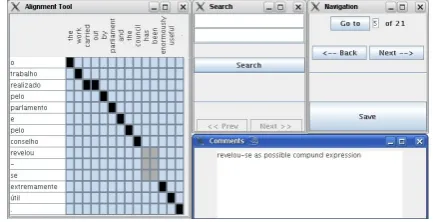
intuitive and allows the annotation of possible and sure alignments as required. A very useful feature consists in associating a comment with each word alignment. Figure 2 shows a screenshot of the tool.
Figure 2: Screenshot of the tool used to produce the align-ments. On the right: alignment for a given sentence. Black points correspond to a sure alignment point. Grey points correspond to a possible alignment point. On top the search interface, allows to find a sentence containing a given word. Also on the top the navigation toolbar that allows to navi-gate over different sentences. Left bottom, the comment window, allows to add comments associated with each sen-tence.
In what follows, all the examples that can be illustrated with English as one of the languages are preferred against the other possible pairs to ease the reading of the paper.
3.1. The alignment process
The process begun by annotating the first 20 sentences of each language pair using the existing guidelines (Lambert et al., 2005) by two annotators (h1,h2). During this first phase a new guideline was created containing many refine-ments to the existing ones, adding several examples, and changing some decisions.
h1 h2
h3 EN-PT EN-FR PT-FR
h4 EN-ES PT-ES ES-FR
Table 2: Language pairs given to each annotator.
The second step included the four annotators and consisted in using the produced guidelines to annotate the next 20 sentences of the test set. In this step, each language pair was annotated twice (by two different annotators as shown in Table 2). The resulting alignments were compared and the differences discussed. The results of this process are described in the evaluation section. The feedback of the previous step was incorporated into the guidelines. In the next step, each annotator was given 3 sets of 20 sen-tences (40-60) in different languages to be annotated using the improved guidelines. Again, each set was annotated twice. These alignments were the ones used to report a 91.6 % inter annotator agreement. The differences were corrected and the guidelines were again improved.
Number of sentences 100
Language English Portuguese French Spanish
Words 1072 1131 1227 1106
Types 466 513 474 472
Aveg. Sent. size 10.72 11.31 12.27 11.06
Table 1: Test Corpus information
Each annotator was given three sets of 20 sentences. Ta-ble 3 resumes the annotation procedure.
At the end one of the annotators reviewed all 100 sentences sets for all language pairs to correct existing differences due to guidelines changes or specializations.
1-20 20-40 40-60 60-80 80-100
EN-PT h1 h1&h3 h1&h3 h1 h3 EN-ES h1 h1&h4 h1&h4 h1 h4 EN-FR h2 h2&h3 h2&h3 h2 h3 PT-ES h1 h1&h4 h1&h4 h1 h4 PT-FR h2 h2&h3 h2&h3 h2 h3 ES-FR h2 h2&h4 h2&h4 h2 h4
Table 3: Annotations performed by each annotator. Anno-tations from sentence 20 to 60 were done twice for evalu-ation purposes. The guidelines were improved after each step.
We have to mention that in the early beginning of the align-ment process, we found that aligning the same sentence across language pairs at the same time simplified the task, as it allowed to easier decide which were the minimal an-notation units, since typically these were shared between different language pairs. These was the default annotation procedure that all annotators used. On the final correction of the 100 alignments, each sentence was done in turn for all language pairs to increase consistency.
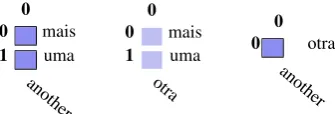
When creating the final version of the golden collection, an interesting situation occurred that illustrates the differ-ences in the writing style used by different translators: some words have a S-alignment in two languages but on a third language they only align as a Possible. For example,
EN“another” can be translated intoES“otra” andP T“mais
uma”, but ES“otra” cannot be translated into P T“mais
uma” in all contexts (see Figure 3).
0 0 • mais
1 • uma
another
0 0 • mais 1 • uma
otra
0 0 • otra
another
Figure 3: Alignments strength is not regular across lan-guages.
3.2. Some guidelines
In the following we present some of the guidelines that drive the annotation process.
3.2.1. S-alignment and P-alignment semantics Regarding the use of S-alignments and P-alignments we decided to give them the following semantics: an S-alignments is used when a translation is possible in every context, such as compound expressions that are always in-terchangeable (see again figure 1). On the other hand, we considered P-alignments when a translation was possible in certain contexts or in the presence of functional words that might be absent in one of the languages of a language pair. Notice that we do not use P-alignments for annotators dis-agreement. As we want guidelines to be as unambiguous as possible, if annotators disagree, they need to come up with an annotation solution in order to provide a precise guide-line under that disagreement topic, as explained previously.
3.2.2. Aligning incorrect or incomplete translations The first option we took was not to align the incor-rect/incomplete parts of the translations. That is, if a se-quence of words only appears in one language and has no correspondence in the others, we do not align it. For in-stance, consider the following sequences: P T“j´a foi
dis-tribu´ıda” and EN“have been distributed”. In this exam-ple, the wordP T“j´a” (EN“already”) has no correspondence in the English sentence and a correct translation would be something likeEN“have already been distributed”; as so, it is not aligned. For another example, consider again Figure 1: the Portuguese wordsP T“de facto” (which can be trans-lated asEN“indeed”) was left unaligned because it has no counterpart in the English sentence.
The difficulty related with these decisions is shown here too: it is arguable if the EN“did” is used to highlight the fact that the report was distributed, as the particle could be omitted. In that case, P T“de facto” could be aligned as Possible with it.
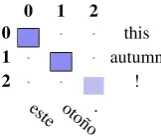
The same happens with words which are incorrectly trans-lated: they are left non aligned. Although they do not change the semantic of the sentence, they would put weight on an incorrect translation pair. An example from the golden collection are the following chunks: P T“este
semestre”, ES“este oto˜no”, EN“this autumn”. A correct translation of the PortugueseP T“este semestre” would be
EN“this semester”. As shown on Figure 4, we did not aligned Portuguese with English nor Portuguese with ish. However it was aligned between English and Span-ish as they both use the same expression: ES“oto˜no” and
EN“autumn” that, can be aligned in all contexts.
3.2.3. Aligning compound expressions
Compound expressions are aligned in different ways:
0 1 0 • · este
1 · · semestre
this autumn
0 1 0 • · este
1 · · semestre
este oto ˜no
0 1 0 • · este
1 · • oto˜no
this autumn
Figure 4: Incorrect word translation left unaligned.
many other contexts, we translate it as a block of S-alignments. For exampleP T“est´a carregada” which literally translates toEN“is loaded” but is better trans-lated by the used expression EN“bears the weight”. Note that a compound expression may not behave as such in different language pairs. For instance, the translation ofP T“est´a carregada” translates in a one to one monotonic mapping toES“est´a cargada” (see Figure 5).
0 1
0 • • • est´a
1 • • • carregada
bears the weight
0 1 0 • · est´a
1 · • carregada
est
´a cargada
Figure 5: Compound expressions: different behavior in dif-ferent pairs.
• If compound expressions are a translation of each other, but only in some contexts they are aligned as a block of possible alignments. Notice that within a block of possible alignments, it is possible to have some sure alignments. Figure 6 shows an example where the expressionES“orden del dia” is aligned as a P-block withP T“ordem dos trabalhos” and the two first words are aligned as Sure
0 1 2 0 • • • orden 1 • • • del 2 • • • dia ordemdos trabalhos
Figure 6: Possible compound term with sure links.
• In the case that a compound term has also a word to
word correspondence between each language, then we align it as a block of S-alignments. For instance, con-sider the compoundP T“m´edio oriente”. It translates asEN“middle east”, ES“oriente medio”,F R“
moyen-orient”, but there is also a one-to-one word alignment. We take it as S-alignments where there are no hyphen, and as a block when there is (check Figure 7).
0 1
0 • · m´edio
1 · • oriente
middleeast
0 1
0 • • moyen 1 • • -2 • • orient
middleeast
Figure 7: Compound expressions: when there are hyphens a block is needed.
Notice that non contiguous compound expressions can also occur and previous guidelines are followed. For example, consider the following sequences:ES“no ayudaxen
abso-luto”,EN“in no way helpsx”,P T“em nada contribuix” and
F R“ne favorisexen rien”. In these situations, expressions are capture as possible expressions, but words appearing in
xare not part of the alignment.
3.2.4. Linguistic details
Here we describe some decisions regarding certain morpho-syntactic categories:
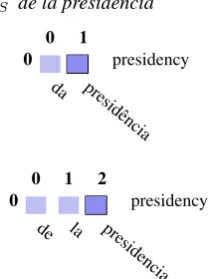
• Prepositions and Pronouns: sometimes different writing styles lead to the occurrence of preposition or pronouns in only one language. In these situa-tions they are taken as P-alignments with the corre-sponding noun/verb. Figure 8 shows the case where
EN“presidency” is translated intoP T“da presidˆencia” and intoES“de la presidencia”
0 1
0 • • presidency
da presid
ˆencia
0 1 2
0 • • • presidency
de la presidencia
Figure 8: Compound expressions: different behavior in dif-ferent pairs.
• Contractions: contractions are aligned as sure align-ments to the not contracted parts in the other language. For instance, considering the preposition contraction
P T“da”, which corresponds toP T“de a” (andES“de
0 1 0 • • da
de la
0 1 0 • • da
of the
Figure 9: Contractions are aligned as S-blocks.
• Date and Time follow the same rules as fixed ex-pressions. Figure 10 shows an example of a constant difference between dates description in Portuguese and English where Portuguese determiners are used. This should be aligned with a possible link. Also when translating times, we have Possible links con-necting the elements that are omitted across the lan-guages: English uses “PM”, while in Portuguese the “h” between the number of hours and minutes refers to the omitted word “horas” (in English “hours”), while the Spanish includes the word “horas” (in English “hours”).
0 1 2 0 • · · 21
1 · • • September
21 de Setembro
0 1 2 0 • · · at
1 · • · 12.30
2 · • · p.m.
3 · · • .
`as 12h30.
0 1 2 3 4 0 • • · · · at
1 · · • • · 12.30
2 · · • • · p.m.
3 · · · · • .
a las 12.30 horas .
Figure 10: Alignment of dates and times.
• Acknowledgments are also treated as individual words whenever it is possible to keep the alignment blocks minimal. Figure 11 shows the alignments taken from the corpus betweenP T“muito obrigado” and the equivalent expression in English: EN“thank you very
much”.
0 1 0 · • thank
1 · • you
2 • · very
3 • · much
muitoobrig ado
Figure 11: Acknowledgment expressions.
• Wrong punctuationis aligned with possible when a different symbol is used but means the same in the cur-rent context as shown on Figure 12.
0 1 2 0 • · · this
1 · • · autumn
2 · · • ! este oto
˜no.
Figure 12: Wrong Punctuation.
3.2.5. Language-specific phenomena
• Special constructions: Certain types of ambiguity appear whenever we are aligning some constructions from some language with all the other languages. Examples of this are the English possessives like in
EN“John’s car” (see Figure 13); or the French con-structions like inF R“il n’y a pas” (see Figure 14).
0 1 2 0 · · • John
1 · • · ’s
2 • · · car
carro do Jo
˜ao
Figure 13: Contraction linked with head element example: common construction in English.
0 1 2 3 4 5 0 • · · · there
1 · · · · • · are
2 · • • • · • not
il n ’ y a pas
Figure 14: Negation particles: common construction in French.
• Gender and Number variation: In the vicinity of words that translate into words with different gen-der or number, articles, pronouns and adjectives also differ. For example, the noun phrase ES“el ´unico
obst´aculo” translates into P T“o ´unico obst´aculo” which is aligned word by word, but can also be trans-lated into P T“a ´unica barreira”. In the later case, that means that ES“el” that, as word, translates into
P T“o” is aligned withP T“a” and the same happens withES“´unico” that is translated intoP T“´unica” (see Figure 15). The same occurs with number variations, specially in fixed expressions. We decided to ignore this kind of variations and align the words as Sure. To cope with this phenomena, another two different ap-proaches could be used: align as Possible or create a new type of alignment (“Sure-Gender”, for example) to represent this situations.
0 1 2 0 • · · o
1 · • · ´unico
2 · · • obst´aculo
el ´unico obst
´aculo 0 1 2 0 • · · a
1 · • · ´unica
2 · · • barreira
el ´unico obst
´aculo
Figure 15: Gender variation is ignored.
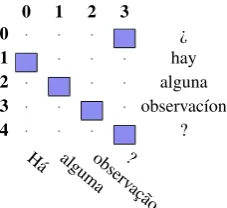
beginning of the sentence. These pairs are translated as sure and as an indivisible token (Figure 16).
0 1 2 3 0 · · · • ¿
1 • · · · hay
2 · • · · alguna
3 · · • · observac´ıon
4 · · · • ?
H´a algumaobserv
ac¸˜ao ?
Figure 16: Spanish question mark as indivisible symbol.
4.
Evaluation
While building a gold collection for word alignment each annotator has to decide for each two words in a sentence if they should be aligned (sure or possible) or unaligned. Most of the word pairs are unaligned, since in most cases each word aligns to another word in the corresponding language. Since this is a structured problem one can-not measure inter-ancan-notator agreement by counting how many times the annotators agree for each possible decision link, since this value would be highly optimistic and over-whelmed by agreement on unaligned links. So we only con-sider alignments links where at least one of the annotators decided to place an alignment.
In order to measure agreement we studied two approaches. For illustration proposes, take the example from Figure 17 and ignore by now that there are sure and possible align-ment points.
0 1 2 0 · · • S1
1 · • · S2
2 • · · S3
T1 T2 T3
0 1 2 0 · · • S1
1 · • · S2
2 · • · S3
T1 T2 T3
Figure 17: Two example annotations perform by different annotators.
One could calculate the disagreement by dividing the ber of points in which the annotators agree by the total num-bers of points that both annotators aligned. So agreement would be calculate by |I1−2|
|A1|+|A2|, where|I1−2|is the
num-ber of alignment points in which the annotators agree and |Ax|is the total number of aligned points from annotator X. Using this metric the inter-annotator agreement for this example would be of 50%. This metric is pessimistic in the sense that in assumes that the errors are independent of each other. Another approach used previously in other annotation projects (Melamed, 1998; Kruijff-Korbayov´a et al., 2006) is to count twice the points in which the anno-tators agree. This metric is calculated by 2∗|I1−2|
|A1|+|A2|.
Us-ing this metric the inter-annotator agreement for this exam-ple would be of 66%. In our opinion this a more realistic metric, since it double counts the correct points as well as the incorrect points, and is the one we adopt in our work. However this metric does not take into account the types of alignment points. We think that different alignment errors have different weights. So it is worst to have a Sure point marked by one annotator and not aligned by the other, than to have a Sure point aligned by an annotator and aligned as Possible by the other.
To cope with this differences we defined the following agreement/disagreement types:
• Strong agreement (SA), which means that both anno-tators had the same alignment marked as sure or pos-sible;
• Weak agreement (WA) meaning that one annotator had marked the alignment as sure and the other as possible;
• Weak disagreement (WD) meaning that one annotator had marked an alignment as possible and the other did not mark it;
• Strong disagreement (SD) where one annotator had marked the alignment with sure and the other did not mark it.
The percentages for each of the groups are calculated as follows:
• Strong Agreement- 2∗(|Is−s|+|Ip−p|) |A1|+|A2|
• Weak Agreement-2∗(|Ip−s|+|Is−p|) |A1|+|A2|
• Weak Disagreement-2∗(|Ip−0|+|I0−p|) |A1|+|A2|
• Strong Disagreement- 2∗(|Is−0|+|I0−s|) |A1|+|A2|
Where:
• |Ax|means the number of element in the gold set pro-duced by annotator X;
• |Ix−y|means the number of points in the intersection of alignment of type X and Y (sure, possible, null) on each set.
4.1. Inter-Annotation Agreement
In order to evaluate the developed guidelines we per-formed two inter-annotator agreement evaluations on dif-ferent parts of the final gold sets. The first evaluation was performed using the first version of the guidelines in the following way: each one of the four annotators (h1toh4) was asked to read the guidelines. In this phase two of the annotators (h3andh4) had no experience with annotation and had never seen the guidelines before. Then each an-notate sentences 21 to 40 of three different language pairs. This produced two distinct annotations for each language pair. Table 4 presents the results of this evaluation using the metric presented above.
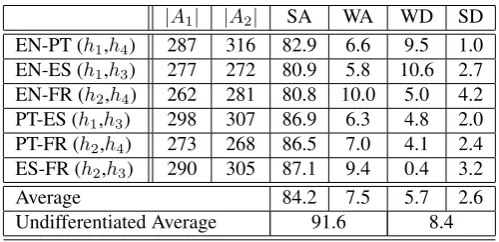
After performing this evaluation the annotators gathered and analyzed the differences between their annotations. This led to a refined version of the guidelines and to a cor-rected version of sentences 21-40 which where then con-sidered final versions. It is interesting to mention that most of the errors found on this phase were related with different interpretation of the current guidelines. For instance, most of the Sure/Empty pairs were related to a misleading indi-cation of the guidelines concerning the annotation of com-pound nouns. Some annotators considered that a comcom-pound noun should always be annotated as a sure block, while oth-ers consider that this was only the case if the meaning of the compound noun could not be subdivided into the parts, in which case only the parts would be aligned to each other. Another recurrent problem was the alignment of a noun as a sure or possible alignment. It was not clear in the guide-lines how they should handle these cases. This led to an heuristic where one uses the synonyms of each word on both languages. If they have a big intersection one uses sure, if it’s just on that specific case then one uses possible. Using the improved guidelines each annotator was given three different language pairs – sentences 41 to 60. The same evaluation process was carried out, to produce the fi-nal annotator agreement. Table 5 reports the results of this evaluation.
Although there were improvements over the intermediate evaluation, we were not completely satisfied with the final results. The first thing we notice was that this alignment set contained much bigger and harder sentences than the previous one. After this evaluation, the annotators gath-ered again and corrected their differences. The resulting annotations where considered final. The guidelines were refined. Whenever there was a question about how an ample should be done, a new rule was derived and the ex-ample was added to the guidelines. Nevertheless our av-erage inter-annotator agreement was of 91.6% if we only count alignment points (no sure and possible distinction), which is in line with the results from previous projects. The Czech-English project (Melamed, 1998; Kruijff-Korbayov´a et al., 2006) that used the same metric was of 93%. We did not perform another evaluation after this last im-provement although we expect the results to be even better.
5.
Some Statistics
The overall percentage of sure alignments versus possible alignments is a relevant characteristic of the gold set, since the common used metrics for word alignments tend not to
penalize the absence of possible alignments. For reference purpose, the percentage of sure alignment for the Hansard (Och and Ney, 2000) corpus of English/French is 28.6% while for the EPPS corpus (Lambert et al., 2005) of En-glish/Spanish is 69%. One possible explanation for this huge difference is that in the Hansards corpus the seman-tics of the possible alignments was broader. Possible align-ments where used when two annotators disagreed on what an alignment point should be. Both in EPPS and in our corpus the semantics is not the same.
Mean Fertilitymeasures the amount of words that have fer-tility bigger than one (align to more than one word). Fer-tility is a known difficulty for word alignment models, so serves as a good indicator of the difficulty of the corpus. We measure fertility by counting the total number of words that have fertility bigger than one over the total number of words.
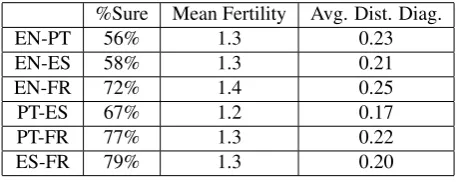
Finally the last indicator we used for corpus difficulty is the average distance to diagonal. This is related with the reordering of words from one language to the other. Table 6 shows some statistics of the 100 alignments for each language pair.
%Sure Mean Fertility Avg. Dist. Diag.
EN-PT 56% 1.3 0.23
EN-ES 58% 1.3 0.21
EN-FR 72% 1.4 0.25
PT-ES 67% 1.2 0.17
PT-FR 77% 1.3 0.22
ES-FR 79% 1.3 0.20
Table 6: Gold Corpus statistics
6.
Conclusions and Future Work
In this paper we described the experience of building a golden collection of word alignments over 6 different lan-guage pairs (all combinations between Portuguese, English, French and Spanish), where word alignment of each lan-guage pair is made over the first 100 sentences of the com-mon test set from the Europarl corpora, corresponding to 600 new annotated sentence pairs. During the development of the gold sets, a detailed manual containing guidelines for multi-language annotation was produced and a new metric for inter-annotator agreement was proposed.
As both the golden collection and the guidelines are avail-able on-line, we hope that this effort can be the seed for the development of new methods for word alignments us-ing various languages, and that people find the guidelines useful and help extending them with examples for specific languages.
|A1| |A2| SA WA WD SD EN-PT (h1,h4) 269 196 67.0 11.2 15.3 6.5 EN-ES (h1,h3) 271 314 73.2 13.3 7.9 5.6 EN-FR (h2,h4) 332 256 61.9 19.0 9.3 9.7 PT-ES (h1,h3) 260 259 78.6 8.9 6.7 5.8 PT-FR (h2,h4) 331 260 73.8 10.2 9.1 6.9 ES-FR (h2,h3) 324 349 75.8 11.0 3.3 10.0
Average 71.7 12.3 8.6 7.4
Undifferentiated Average 84.0 16.0
Table 4: Results of the inter-annotator intermediary evaluation.
|A1| |A2| SA WA WD SD
EN-PT (h1,h4) 287 316 82.9 6.6 9.5 1.0 EN-ES (h1,h3) 277 272 80.9 5.8 10.6 2.7 EN-FR (h2,h4) 262 281 80.8 10.0 5.0 4.2 PT-ES (h1,h3) 298 307 86.9 6.3 4.8 2.0 PT-FR (h2,h4) 273 268 86.5 7.0 4.1 2.4 ES-FR (h2,h3) 290 305 87.1 9.4 0.4 3.2
Average 84.2 7.5 5.7 2.6
Undifferentiated Average 91.6 8.4
Table 5: Results of the inter-annotator final evaluation.
Acknowledgments
Jo˜ao Grac¸a is supported by a fellowship from Fundac¸˜ao para a Ciˆencia e Tecnologia (SFRH/BD/27528/2006). Joana Paulo Pardal is supported by a fellowship from Fundac¸˜ao para a Ciˆencia e Tecnologia (SFRH/BD/ 30791/2006).
7.
References
Peter F. Brown, John Cocke, Stephen Della Pietra, Vin-cent J. Della Pietra, Frederick Jelinek, John D. Lafferty, Robert L. Mercer, and Paul S. Roossin. 1990. A sta-tistical approach to machine translation. Computational Linguistics, 16(2):79–85.
Chris Callison-Burch, David Talbot, and Miles Osborne. 2004. Statistical machine translation with word- and sentence-aligned parallel corpora. InProceedings of the 42nd Annual Meeting of the Association for Computa-tional Linguistics (ACL-2004), Barcelona.
Michel Galley, Mark Hopkins, Kevin Knight, and Daniel Marcu. 2004. What’s in a translation rule? In Pro-ceedings of the Human Language Technology and North American Association for Computational Linguistics Conference (HLT/NAACL-04), Boston, USA, May. Jo˜ao Grac¸a, Joana Paulo Pardal, Lu´ısa Coheur, and
Diamantino Caseiro. 2008. Multi-language word alignments annotation guidelines. Technical Report TR/38/2008, L2F – INESC-ID Lisboa/IST, Lisboa, Por-tugal, April.
Philipp Koehn, Franz Josef Och, and Daniel Marcu. 2003. Statistical phrase-based translation. InNAACL ’03: Pro-ceedings of the 2003 Conference of the North American Chapter of the Association for Computational
Linguis-tics on Human Language Technology, pages 48–54, Mor-ristown, NJ, USA. Association for Computational Lin-guistics.
Philipp Koehn. 2005. Europarl: A parallel corpus for sta-tistical machine translation. In Proceedings of the MT Summit X, Phuket, Thailand.
Ivana Kruijff-Korbayov´a, Kl´ara Chv´atalov´a, and Oana Pos-tolache. 2006. Annotation guidelines for Czech-English word alignment. In Proceedings of the 5th Interna-tional Conference on Language Resources and Evalua-tion (LREC 2006), pages 1256–1261.
Patrik Lambert, Adri`a De Gispert, Rafael Banchs, and Jos´e B. Mari˜no. 2005. Guidelines for word alignment evaluation and manual alignment. In Language Re-sources and Evaluation, Volume 39, Number 4, pages 267–285.
I. Dan Melamed. 1998. Annotation style guide for the Blinker project. Technical report, IRCS.
Franz Josef Och and Hermann Ney. 2000. Improved sta-tistical alignment models. In Proceedings of the 38th Annual Meeting on Association For Computational Lin-guistics, Hong Kong.