Issue 1Northwest Journal of Teacher Education ONLINE
Article 1
January 2015
Opening the Door to the Whirlwind” of British Gothic Literature:
Exploring Risk-Taking Practices in the Preservice Classroom
Syndie Allen
University of Idaho
Let us know how access to this document benefits you.
Follow this and additional works at:https://pdxscholar.library.pdx.edu/nwjte
Part of theEducation Commons
Recommended Citation
Allen, Syndie (2015) "Opening the Door to the Whirlwind” of British Gothic Literature: Exploring Risk-Taking Practices in the Preservice Classroom,"Northwest Journal of Teacher Education: Vol. 12 : Iss. 1 , Article 1.
DOI: 10.15760/nwjte.2015.12.1.1
“Opening the Door to the Whirlwind” of British Gothic Literature:
Exploring Risk-Taking Practices in the Preservice Classroom
Syndie Allen
University of Idaho
“Opening the Door to the Whirlwind” of British Gothic Literature: Exploring Risk-Taking Practices in the Preservice Classroom
Abstract
This study explores the connections, reflections, and risk-taking practices of elementary preservice teachers (n=15) enrolled in a Teaching Writing/Language Arts Methods course at a Pacific Northwest University as they engaged in a 4-week thematic unit focused on British Gothic Literature. The big questions asked about the connections and moves made both as student and beginning teacher. The study then looked at how new knowledge was infused into teaching practices. Inductive, phenomenological analysis of reading responses, informal quick-writing, narratives, lesson plans, reflections, and field notes reveal that the preservice teachers participated in the unit with enthusiasm and curiosity as students, arrived at cautious acceptance as future teachers, and then demonstrated nuanced risk-taking with the material as actual
At the intersection of beginning teacher and veteran student, preservice teachers wear
both hats as they make the sometimes-challenging transition from primarily being taught to
primarily teaching. They have a profound responsibility to their future students to send them into
the world as thinking and empathetic members of our citizenry, an endeavor that requires a fair
amount of risk as well as a healthy amount of willingness to make mistakes and even to outright
fail. The college instructors that lead the preservice classroom are charged with the same
responsibility, but as the more seasoned professionals should possess a variety of strategies and
tools that provide preservice teachers space for taking chances in all areas of their academic and
teaching lives.
The primary objectives of this study were to first explore preservice teacher experiences
with a thematic unit focused on using unfamiliar literature, in this case British Gothic literature.
And secondly, to examine how the resulting experiences shape and influence risk-taking
activities as the students practice being teachers. In other words, the big research questions were
(1) what are preservice teachers’ perceptions of, connections to, and experiences with a British
Gothic literature-focused thematic unit that includes a variety of reading and writing activities?
And (2) does engaging with a British Gothic literature-focused thematic unit prompt preservice
teachers to implement this type and other types of literature into their teaching practice and if so,
how?
The Power of Literature
Literature as an effective tool in the classroom is well supported. While some have
argued more generally that the value of literature is intrinsic and therefore unquestionably
belongs in every teacher’s toolkit (Kiefer, Hepler, & Hickman, 2007), there is also abundant
perceptions of and attitudes toward reading (Eldredge & Butterfield,1986; Morrow, 2003;) and
promotes reading achievement (Cohen, 1968; Galda & Cullinan, 2003). And because reading
and writing are inextricably linked, literature has been shown to influence writing ability
(DeFord, 1984; Lancia, 1997) and increase knowledge of written language and written linguistic
features (Purcell-Gates, McIntyre, & Freppon, 1995). It has also been shown to deepen language
development (Chomsky, 1972; Morrow, 1992) as well as understanding of and engagement with
content (Bean, 2000).
In addition, literature can provide spaces where “readers encounter imaginative and
compelling situations;” where they “discover stories of prudence, justice, fortitude, and
temperance, tales of faith, hope, and charity as well as narratives that depict pride, envy, anger,
sloth, avarice, gluttony, and lust” and it is through these encounters that readers develop a more
“differentiated grasp of life as well as a wider and more nuanced moral compass” (Roche, 2004,
p. 21). Using literature in such a manner is not a new concept, in fact, there is a vast amount of
rich and valuable research showing how multicultural education is dramatically and positively
enhanced when students are introduced to ethnically unfamiliar texts.
For example, Christensen (2006) determined that students enrolled in a social studies
class were more amenable to critical conversations after reading and discussing graphic novels
about social conflicts in places such as Bosnia. Later, Burns (2009) discovered that first graders,
after engaging with stories about war, were able to reflect on their own visions of what a
peaceful world looks like. Such texts and the interactions with them offer readers new pathways
into understanding their role in the perpetuation of stereotypes (Glenn, 2012), how systems
rather than the individual influence society, (Williams, 2004), and the consequences of
classroom, it is then reasonable to consider literature as a potential tool that might promote
risk-taking in the teaching practices of preservice teachers.
Theoretical Framework
This project is rooted in experienced-based learning theories that argue knowledge is
heavily shaped by life and worldly experiences (Foucault, 1989; Phillips, 1995) and in the
sociocultural perspectives from Vygotsky (1978) and Dewey (1916) that maintain learners
construct knowledge and make meaning through their social interactions with others.
Additionally, it is grounded in adult learning theories (Knox, 1977) that argue adult learners have
developed a frame of reference or “a coherent body of experience, associations, concepts, values,
feelings, [and] conditioned responses that define their life world” (Mazirow, 1997, p. 5). The
purpose of the resulting knowledge then is not to equip learners with the ability to describe a
universal reality, but rather it is to help them function in the world (Dewey, 1929/1960; Rorty,
1979) and to complicate their established paradigms and morphing them into more inclusive and
self-reflective spaces (Mazirow, 1997).
Learners become active participants as they interact with each other and with the
instructor, articulating, clarifying, and reflecting on their ideas through classroom conversation
and through their writing. Good classroom discussion, like writing, can “engage students in
interactions to promote analysis, reflection, and critical thinking” (Goldenberg, 1993, p. 317) and
provide the dialogic interaction necessary for learning to occur. Learners begin to recognize and
critically think about myriad, and oftentimes conflicting, interpretations that exist around a
particular text, after which they can make the move towards understanding how multiple
construction and apply strategies to ameliorate misconstructions and misunderstandings when
they occur” (Henderson & Buskist, 2011, p. 234).
Arriving at the Teaching Table
Preservice teachers coming to teacher education programs do not arrive as blank slates;
rather they enter with countless experiences and a wealth of background knowledge about a wide
variety of ideas. They also arrive with well-developed personal feelings, attitudes, and opinions
about what it means to be a teacher, how a classroom should be managed, and how learning
happens (Calderhead & Robson, 1991; Borko & Putnam, 1996; Collinson 1996; Tomlinson,
1999). Some of these predetermined thoughts are formed in the later high school years and
during the first few years of college (Yoo, 2005) and some are formed through interactions with
other teachers along the way (Lortie, 2002). Because preservice teachers come well equipped
with their own beliefs, their willingness to try something new may not be a priority let alone a
primary goal.
Given their fixed notions about teaching, it is understandable that preservice teachers are
inclined to teach the way they have been taught and the way they have observed other teachers
teaching (Holt-Reynolds, 1992; Korthagen & Kessels, 1999) unless their preconceived ideas are
directly addressed and challenged in their teacher education programs (Rath, 2001). There is also
evidence pointing to the inability to change their minds and to promote risk-taking in their
teaching practices (Zimpher, DeVoss, & Nott, 1980). It has also been argued that changing a
preservice teacher’s mind is a daunting and sometimes insurmountable challenge (Bramald,
Hardman, & Leat, 1995). Johnson (1994) asserts that “asking preservice teachers to test out
alternative models of teaching means asking them to take major risks” (p. 451) and for many of
preservice teacher instructors, we need to encourage them to venture outside of their comfort
zones and accept a certain amount of risk. Without such daring moves, there is increased danger
of stunted growth and underdeveloped learning in preservice teachers (Elliott & Calderhead,
1993; Stanulis & Russell, 1999), which could then be inherited by elementary and secondary
students.
Returning to more secure materials –texts, methods, and the like- can partially be
attributed to what has been traditionally privileged in the classroom. For example, canonical
literature tends to take precedence (Glenn, 2013) and at times, functions as a failsafe for new
teachers given that it is largely accepted as appropriate for use inside a P-12 class setting. It is
also helpful that an abundance of supplemental materials exist for well-known texts. Looking for
supporting material such as discussion questions, activities, or other teaching ideas for The
Raven (Poe, 1845) or The Tale-Tell Heart (Poe, 1843) are much easier to locate than
supplemental material for something written by Le Fanu or Polidori, even though most of the
contexts and tools for the more traditional texts can be adapted to suit the unfamiliar and
lesser-known texts.
A new teacher, perhaps anxious about staying ahead of their students and/or getting it
right, may be more likely to use literature that comes ready to teach and has already proven
“tried and true” in other classrooms by other teachers. The present study examines risk-taking
activity on the part of preservice teachers, not merely as students, but also as future teachers in
the field. During a Teaching Writing/Language Arts Methods course, preservice teachers were
asked to take a chance and read, engage with, and implement literature most of them had never
Methods
The study was conducted in a Writing and Language Arts Methods course at a rural,
land-grant university in the Pacific Northwest. During the third month of the semester, the
preservice teachers enrolled were introduced to a British Gothic Literature thematic unit
designed to introduce them to new literature, and to provide them with new methods and tools
with which to teach writing and language arts. Every Monday for three hours, during October
2013, 15 preservice teachers engaged and wrestled with Gothic short stories while participating
in various discussions, writing, and teaching around unfamiliar and challenging texts.
The Thematic Unit
The thematic unit texts included three required short stories: The Vampyre (Poldori,
1819), The Sandman (Hoffmann, 1844), and Green Tea (Le Fanu, 2008). In addition, preservice
teachers also participated in a literature circle where they read and presented on one additional
story. The options for this assignment included The Old Nurse’s Story (Gaskell, 1852), The
Strange Case of Dr. Jekyll and Mr. Hyde (Stevenson, 1886), Fatal Jealousy (Anonymous, 1807),
and Carmilla (Le Fanu, 2008). A small sampling of short stories and film excerpts that provided
a brief but intense exploration of the many themes and conventions associated with British
Gothic literature were included as part of in-class activities.
The readings were supplemented with formal reading responses where preservice
teachers responded to questions about their experience with the text or with the activities. Three
of the four days included short, informal quick writing about the day’s discussion or activities.
The final piece of writing asked preservice teachers to take a significant moment in their lives
and turn it into a mini Gothic short story. Their stories were accompanied by reflections on
teaching. The final assignment required them to prepare one literature-focused writing lesson
plan, with accompanying reflection detailing the specific choices made within the lesson plan. A
second lesson plan with reflection was required as part of the course and was also collected as
part of the study.
Before the unit officially began, the preservice teachers were given a copy of the thematic
unit. Titled, “A Character of Malignity – Unfathomable Malignity,” it consisted of a rationale,
goals, text list, daily lesson plans, grade scale, assignments, rubrics, discussion questions, a
glossary of British Gothic themes and terms, an image cache, and a reference list. The Reading
Response Prompts as well as the Narrative Assignment are included in the Appendix. The
purpose for delivering a copy of the unit to the participants was to keep them apprised of the
activities as well as to provide them with a model for their own thematic unit construction.
Participants
Eighteen elementary (K-8) preservice teachers registered for and completed the course, of
which 15 signed and returned the consent form to participate in the study. There were 13 females
and two males, and all identified as White. Thirteen arrived as Elementary Education Majors,
and two as Early Childhood Majors doing a blended certificate. They were a mix of juniors and
seniors within one year of entering into their student teaching, and they were simultaneously
enrolled in Reading Methods, Arts Methods, and Field Work Practicum courses. The Elementary
Majors were also enrolled in a Children’s Dance course.
The researcher was also the instructor of the course and had completed a graduate-level
British Gothic Literature course the previous semester. The texts and several discussion threads
appearing in the unit came from that course. The researcher also has an extensive background in
student attended each class session as a participant observer (Spradley, 1980). Each class day, for
three hours, she observed and took field notes of the overall tenor of the classroom, the
preservice teachers, and the instructor. The field notes, focused specifically on student
engagement, participation, and questions, provided necessary context for each of the lessons
listed in the unit.
Data Collection
To examine the preservice teachers’ perceptions, experiences, and connections with
British Gothic literature, reading responses, narratives, reflections, quick-writes, and field notes
were collected. To answer the question of how preservice teachers’ perceptions, experiences, and
connections influenced and shaped teaching practices and risk-taking within those practices,
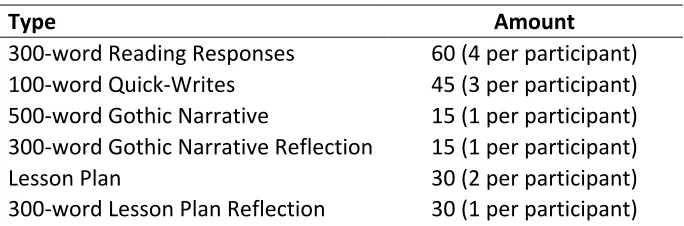
lesson plans and reflections on the lesson plans were collected. Table 1 summarizes the type and
amount of data collected. All data was scanned into the computer as images and subsequently
returned to the preservice teachers after assessment and evaluation were completed. After data
collection ended, names were removed, and each preservice teacher was assigned a unique
alphanumeric code so as to be able to track them individually, if necessary.
Data Analysis
Using a phenomenological approach, data analysis was initially concerned with the lived
experiences of the preservice teachers (Kvale, 1996; Greene, 1997; Maypole & Davies, 2001).
During the first phase of analysis, the preservice teacher writings were read thoroughly two
times. On the second read through, the pages were cut into paragraph-sized pieces since most of
the paragraphs generally contained a single unit of thought. The pieces were then pasted the onto
large index cards. Moments of summary, specific textual analysis, and literature circle attitudes
Instead, attention was paid to the reflective and narrative moments that addressed either British
Gothic literature and/or literature in general, classroom use, choice justification, and personal
anecdotes. This process yielded 352 cards.
The second phase of analysis involved re-reading and re-viewing the data and assigning a
code that appropriately described the writing of the preservice teachers. Common codes that
began to appear included “Text-to-Text Connection” and “Personal Anecdote.” The second
phase of analysis yielded 139 cards. The third and final phase of analysis separated the cards into
three general categories: Student Practice, Possible Teacher Practice, and Actual Teacher
Practice. Student Practice is here defined as the moves and risks taken as a student/preservice
teacher inside the teacher education program. Possible Teacher Practice is defined as what the
preservice teachers, still operating on some level as students, assume they will do in the
classroom regarding literature and the teaching of such. And finally, Actual Teacher Practice is
taken from the two lesson plans preservice teachers crafted while participating in the unit and the
course in general.
Findings
Three overarching themes emerged from the data set. The first theme included the
practices of the preservice teachers as they engaged with the unit as a student. The second theme
was their possible teacher practices as they reflected on how they might use this type of literature
in the classroom. The third, and final theme was their actual teacher practices as they crafted two
lesson plans. (1) As students, they generally enjoyed their encounter with something new, (2) as
possible teachers, they mostly considered the use of such literature fine as long as it was adapted,
and (3), when acting as actual teachers, they largely reverted to safer content and did not include
Student Practice
The time period for the required texts is the 19th century, and they, therefore, contain
language that is not as familiar to these particular preservice teachers as texts with more modern
language might be. As the unit progressed, and the reading embarked upon, the preservice
teachers found the literature difficult to read and digest. When describing the readings, they used
descriptors such as “wordy,” “long,” “boring,” “tough,” and “thick.” One student lamented in a
quick write how they wished they could have “selected their own literature circle book” due to
the difficulty of The Strange Case ofJekyll and Hyde (Stevenson, 1886). However, even though
they found the language challenging and unfamiliar, they were still amenable to fully
participating with the thematic unit.
Overall, through their quick writing, narrative reflections, and reading responses the
preservice teachers enjoyed participating in the unit for many reasons. The quick writes revealed
many comments about loving the exposure to a new and unfamiliar genre of literature. All of
them said they had either never heard of or thought about British Gothic Literature, and although
a few claimed they were familiar with Edgar Allen Poe and even fewer with Flannery O’Connor,
they had little to no experience with anything outside of American Gothic writers. They were,
however, eager to learn more. The final quick write revealed that many found the exploration of
British Gothic literature “interesting,” “exciting,” and according to one student, “fabulous.”
In the reflections on their narratives, most were pleased with not only the assignment, but
with their ability to navigate and complete it successfully. Although there were two preservice
teachers who did not find the assignment purposeful, the majority were pleased with the creative
freedom the assignment allowed and found it purposeful for various reasons such as that it
said they thought that “the door was wide open and that they were ready to go through.” Another
student claimed they “surprised themselves” with their creativity. Still others found space to
revise and edit their work and to practice writing in general. The narratives themselves
demonstrated knowledge of British Gothic elements (such as castles, labyrinths, frightful
weather, omens, vampires, and so forth) discussed and used in class. The assessments, which
were based on a predetermined rubric, showed successful convention implementation across the
board.
According to their reading responses asking them about the specific texts, all were able to
find a pathway to and connect with the stories. The Vampyre (Polidori, 1819) sparked interest
and memories as they remembered that they did “like vampire stories” and most of them made
connections to other authors such as Stephanie Meyers and Anne Rice, and to other texts such as
Dracula (Stoker, 1897) and even the old television show Dark Shadows (Costello, 1966). Two
reminisced about Halloweens past and “hanging out with family members who loved everything
Gothic and dark.” After reading The Sandman (Hoffmann, 1844), they pondered over whom they
empathized with, Nathaniel or Klara, making connections to our present love of technology as
well as to negative experiences with former significant others. In addition, following our
discussions of GreenTea (Le Fanu, 2008) where poor Reverend Jennings is menaced by an evil
monkey, every student had a story about a time when either they or someone they knew were
terrorized by an animal, be it a dog, cat, crow, or squirrel.
The final reading response asked them to talk about their experiences and connections in
terms of the overall unit. The same words appeared repeatedly and included descriptors such as
“exciting,” “rewarding,” “educational,” “beautiful,” “spectacular,” and “intriguing.” Although
wrote statements like “I developed an appreciation of Gothic Literature,” “I want to read more,”
“It actually wasn’t that bad,” and one student even lamented their birth in this time period
claiming, “I was born in the wrong era. I feel I would fit in better in 18th/19th century London.”
Clearly, the preservice teachers, in regard to their own personal learning as students, were
deepening their understanding of and engagement with the content of the unit.
Possible Teacher Practice
As the teachers they think themselves to be, the preservice teachers considered how their
learning during the unit impacted their future teaching practices. In the final quick write, many
addressed the possible use of British Gothic literature in the classroom. They wrote sentiments
such as “it was so fun and will be great to bring into the classroom with some adaptations of
course.” Three thought that Halloween was a great time to talk about this kind of literature and
one student “really thought it was useful for students to get at their own stories.” Not everyone
was pleased with the unit activities. There were two who decided the unit was “not applicable in
any way to their own future teaching” and that “religious beliefs and risk of parent offense would
never allow them to bring this kind of literature into their classroom.”
In the final reading response, they were asked about the possibility of bringing literature
into the classroom and all but three were enthusiastic about the possibility of teaching with
literature, saying not only that it was “possible” but also “desirable.” The reasons for such a
move included “important messages,” “building vocabulary,” “contributing to a student’s
well-rounding,” “building a love of reading,” ”sparking interest in new things,” “connecting to the
lives of students,” and “introducing students to new perspectives and cultures.” Most attached
“if it is age-appropriate,” “but it would have to adapted,” or “but it is more appropriate in the
upper grades.”
There was also concern about future students’ attitudes about English and literature.
Some of them remembered the boring classes they took in middle school and high school and
vowed to remedy this issue in their own classrooms, claiming that early exposure to literature
and more specifically, unfamiliar literature that connects to students’ lives, will help decrease the
“dread” and “boredom” that kept them from loving and understanding older stories and other
texts. Two did not share the above sentiments, and as Early Childhood majors they disapproved
of most literature in the classroom because it had too high a potential of being too mature or too
complex for children. They cited fear of “angry parents,” “developmental issues,” and an
anecdote about a scary story heard in a first-grade classroom that did not go well.
According to field notes from the first day’s discussion, much excitement was generated
over the possibility of using age-appropriate scary stories in their lesson plans. One student
claimed that teachers “need to teach them about real life.” However, subsequent writings suggest
a reconsideration as well as a demonstration of a deep anxiety around the type of literature and
the age of the students- ideas that may have been already firmly implanted as they entered the
course and the unit, as researchers such as Borko & Putnam (1996), Calderhead & Robson
(1991) and Tomlinson (1999) have argued.
Actual Teacher Practice
Of the 30 lesson plans collected, 21 plans included the use of literature to teach a writing
concept. Nine plans did not and instead, implemented other tools such as technology and
drawing. Of the 21 that included the use of literature, four included a type of Gothic literature
lessons used an unnamed Edward Gorey image that was part of a larger exhibit, “Elegant
Enigmas: The Art of Edward Gorey,” held in Boston, 2011. The second one brought in a grade
school-friendly video adaptation of Frankenstein (Vaughn, 2010). The clip is part of a YouTube
series titled Speakaboos, where readers tell truncated versions of popular stories and poems.
Their mission, according to their Facebook page is to “inspire a love of reading in children
through storytelling,” and Frankenstein is one of many clips available.
Of the remaining lesson plans that employed a type of literature, Fairy Tales and
Children’s Literature were the most often used types. The fairy tales included unspecified
selections such as “Cinderella,” “Jack and the Beanstalk,” and a few paragraphs from the original
version of The Little Mermaid (Anderson, 1837). There were also other stories that might be
considered more fable than fairy tale such as unspecified versions of “The Three Little Pigs” and
“The Princess and the Pea.” A few preservice teachers also selected from Fractured Fairy Tales
(Scieszka, 1996) as companion pieces. The Children’s Literature category included Junie B.
Jones and a Little Monkey Business (1993), and Flying Over Brooklyn (2003) as well as
selections from The Wonderful Wizard of Oz (1990) and Alice’s Adventures in Wonderland
(1865) appropriate for elementary school children. One preservice teacher created a lesson that
used Anansi the Spider (2009), a children’s book about a West African trickster deity.
Of the three who chose poetry, two used selections from Shel Silverstein (2000/2006)-
Hug-O-War and Noise Day- and one used Skippyjon Jones and the Big Bones (Schachner, 2007).
For the Young Adult literature, select passages from Harry Potter and the Deathly Hallows
(Rowling, 2009) appeared. In the “Other” category, the texts were small samples from the U.S.
multiple genres.” In addition, one preservice teacher used the science fiction short story, There
Will Come Soft Rains (Bradbury, 1950).
The reflections that accompanied the lesson plans revealed preservice teachers’ insights
about their specific literature choices and overall ideas about using literature in their teaching.
There were several who did not provide reasoning and justification for their text selection, but
many indicated they had selected their texts because of either their or their student’s previous use
or knowledge of the texts, as the following responses indicate.
Emily: “I love Shel Silverstein’s poems. They are fun and entertaining and most students
are aware of him.”
Catherine: “I am using fairy tales because students love fairy tales.”
Isabella: “I picked Anasi because I have used it before and I knew what I could do with it
and had seen good ways and not so good ways to approach it.”
Jonathan: “Last semester, I had the opportunity to read Frankenstein in one of my classes.
Frankenstein is a classic and was a fun read. The obvious hurdle was the difficult
language to read and length of the writing. I found a YouTube video that
addressed both concerns.”
Manfred: “The constitution is something that most people are familiar, but most students
don’t understand how powerful the writing is.”
It would appear that although a few beginning teachers reverted to more familiar literature, there
were moves being made that demonstrate more careful thinking about its inclusion.
Also present was commentary about literature in general and its place in the classroom.
Most responses included descriptors such as “fun,” “balance,” “imagination,” and
interest,” and “inspiring creativity.” The following responses capture the pervasive positive
attitude that appeared in the reflections.
Agnes: “By teaching a lesson using fiction, where the students can use their favorite
characters, I am hoping to develop a love for writing.”
Antonia: “With all of my new found knowledge on how to teach literature I can honestly
say I am extremely excited. When I have my own class I will definitely be
creative when teaching literature. There is so much that I can do with it and so
many genres that I would like to cover. When I was in school I can't remember
ever going over sci-fi or horror. These two genres were always fascinating to me
and I assume [would be] interesting to other students. I want my students to have
the opportunity to learn about a variety of genres, so that when they go to the
library they will have a richer understanding of what to look for and what they
like.”
Based on their lesson plan reflections, most of these particular preservice teachers were heading
in the right direction with the overall, big idea of incorporating literature into their teaching
practices.
Discussion
It is important to note that while only two future teachers used British Gothic literature in
their lesson plans, most of their discussion and teaching practices were indicative of deep
thinking in two areas: (1) how to bring literature into the classroom and (2) how their own
experiences compared to the experiences they wish for their future students. They engaged in
and at times, wrestled with British Gothic literature, writing about their insights and struggles
them, all while reading some admittedly dense prose. They made strong connections between the
presented material and their authentic, lived experiences and then made beginning moves to
incorporate similar material into their own teaching practices.
This work is just a small piece of the picture wherein preservice teachers connected on a
personal level, which is demonstrative of their open and curious minds. In addition, these
particular preservice teachers are beginning to develop an understanding of and appreciation for
trying something new. Being aware of their own past as well as their less positive, or “boring,”
experiences in the classroom has put them in a position to think critically about and analyze what
they want for their own students.
Pratt (2002) argues for places of “social and intellectual spaces where groups can
constitute themselves as horizontal, homogeneous, sovereign communities with high degrees of
trust, shared understandings, and temporary protection from legacies of oppression” (p. 17).
Expanding on Pratt’s thinking, Gomes and Carter (2010) suggest that an awareness of
stereotypes has to exist before critical discussion can occur. As a parallel, awareness of their own
pasts might need to be more thoroughly developed in the preservice teachers before they can take
risks with different genres and writing activities. The following students (names have been
changed) concisely sum up the awareness that developed:
Emilia: “I think that if we were exposed to more literature, we would have a better
attitude about it later.”
Julia: “It’s important to get students out of their comfort zones. Later in life,
students will be reading and analyzing all sorts of things so in order to prepare
also allows students to see different perspectives. I want my students to
understand that the world is seen through different eyes in different ways.”
Some of the attitudes and comments could be attributed to the researcher’s own
background and experience with the subject. Five students wrote that their favorite part was the
“passion for and knowledge of the subject.” The second researcher noted at least once per class
session that “students looked engaged” and “students seemed receptive” as they moved through
each three-hour session of literature and methods. When asked to define “engaged” and
“receptive,” the second researcher explained that students looked alert, were making eye contact,
and endeavored to include their own connections and insights into the discussion. She also noted
on the second day that the instructor “sounded very knowledgeable about the topic” as they were
provided examples and specific details about related texts.
Their text selections can be attributed to a variety of reasons. As referenced above, some
picked what they liked or what they or their students were or might be comfortable with. The
abundance of fairy-tale themed lessons may have been the result of their concurrent Children’s
Literature course where they were fully enmeshed in various versions of fairy tales and their
fractured offspring. Connecting and adapting course material to fit different needs is a good use
of time for busy beginning teachers. The science fiction loving preservice teacher who was so
excited to “finally introduce Ray Bradbury,” has since been the researcher’s office to
breathlessly explain how she is not only taking a British Literature course but has received
permission from the course professor to craft and present a thematic unit as her final project. As
she turned to leave, she happily exclaimed, “And I’m totally using Gothic Literature!”
British Gothic literature presented these future teachers with a scaffolded space with
transfer to their reading of and reflection on more diverse and multicultural texts. There were
certainly a few who were relieved to have the unit come to a close and who plan on never using
this type or any type of literature in the future. Such reactions were expected, and through
self-reflection, a level of comfort was reached with the fact that not everyone has to be as enamored
of the material as the instructor is. Nevertheless, the rest of the future teachers provided good
evidence that they have come to a more nuanced understanding and that they have expanded
their thinking as well as their repertoire of strategies for their future classrooms.
Future Directions
One month of instruction does not a risk-taking teacher make and, as Johnson (2011)
argues, if “teachers seek to change students’ initial negative perceptions about classroom
materials, [then] they must offer them in-depth, repeated experiences that contradict their
misconceptions” (p. 218) and it is reasonable to suggest that the same holds true for preservice
teachers. Regardless, one month provided a good starting point, although in the future, it may be
better idea to more fully embed such instruction rather than having it stand alone as an isolated
and rather stark unit of instruction.
Incorporating different literary genres also provides a place for future direction and
would also allow spaces for preservice teachers to connect their personal experiences with the
material. For example, Contemporary Literature could also be embedded into a course to open
spaces for discussions about marginalized voices or Historical Fiction where students entertain
alternative interpretations and constructions of historical events and figures. The student, who
was excited about bringing in Science Fiction, connected her work with her own passion about
literature with futuristic settings and time travel. And finally, it is difficult to draw solid,
interaction. Tracking and talking with them as well as collecting artifacts and interviews as they
move into their student teaching and beyond would help provide a bigger, more accurate picture
of their risk-taking activities as far as literature is concerned.
Conclusion
Ruminating on the subject of risk-taking, the vampire Lestat tells readers “very few
beings really seek knowledge in this world. Mortal or immortal, few really ask. On the contrary,
they try to wring from the unknown the answers they have already shaped in their own minds --
justifications, confirmations, forms of consolation without which they can't go on. To really ask
is to open the door to the whirlwind” (Rice, 2004, p. 380). What an eloquent phrase for precisely
what teacher educators want from their preservice teachers as they embark on their own teaching
journey where it is imperative that they foster creativity and innovation in themselves and in
Appendix
Additional Texts and Materials
• Mama (2012)trailerhttp://www.youtube.com/watch?v=74sTGp6kVro
• TheSandman (1992) http://www.youtube.com/watch?v=UjgHbRrnjhU
• Buffy vs. Edward: Twilight Remixed (2009)
http://www.rebelliouspixels.com/2009/buffy-vs-edward-twilight-remixed
• Hyde and Hare (1955)
http://www.ulozto.net/live/xtuDbDZ/bugs-bunny-hyde-and-hare-1955-avi
• Brontë Sister Power Dolls http://www.youtube.com/watch?v=-NKXNThJ610
Reading Response Prompts
1. What do you know about vampires? Are they something you have ever been or currently are
interested in? Polidori’s The Vampyre is considered the first literary vampire story. Do you
like it? Why or why not? This is considered the first vampire novel. What is it doing and why
might it be considered “gothic”? How does Lord Ruthvayne compare to other vampires you
know of? Would you have done what Aubrey did? Why or why not?
2. What major themes do you see at work in this text? Pick one and expand on how Hoffman
explores this theme. Weigh in on how effective Hoffman is at this task. Who do you, if at all,
feel bad for in this story? What makes it scary? Or not? Does it have relevance to
contemporary issues? Does this story remind you of any other tales you’ve heard?
3. Thus far, we have read three stories and watched a few movie clips. What is your take thus
far on the British Gothic tradition? Why do you think this way? Do you think that all types of
literature can be integrated into a P-12 classroom? Why or why not? What types of benefits
or limitations do you foresee by attempting this move?
4. Does this story remind you of anything you have read before? If so, what and why? If not,
how is this text similar and different from the texts we have read thus far? Why do you think
this? The monkey in this story is quite menacing. Can you think of a time when you were
menaced by an animal? If not, what about someone you know? How did you react? How did
Gothic Narrative Assignment
Narrative is a significant way in which humans interact with each other and make meaning or sense out of their lived or personal experience. Stories shape our identities and while often told for entertainment, they can also create a sense of shared history, linking people together; they can provide psychological healing. Reading or listening to the narrative of someone who faced a life crisis similar to one you are experiencing can help you through the crisis. They can also help the writer deal with the crisis they can provide insight, facilitating the discovery of values, the exploration of options, and the examination of motives. Whatever the reasons, one of the worst reasons is to fulfill an assignment, so take care in selecting the period for this one so that you are not merely “doing your assignment.” This space is for you to demonstrate your knowledge of gothic conventions and to write about a day in your life that you found especially moving, challenging, enlightening, troublesome, etc.
Assignment: Think of one day that was especially interesting or eventful and turn it into a 500-word Gothic short story. Make use of the themes and conventions we have discussed in class, borrowing the language and tone of the novels and texts we have encountered during this unit. Be specific and concrete and include sensory detail. The story should have a clear purpose and only span the course of one day or less.
Reflection: Spend some time re-reading your narrative when it is all finished and ready for
submission. Why did you pick the day you did? Were there other days you considered? Why didn’t you pick them? What strategies did you use to complete this assignment and why? Was this
Table 1
Collected Data
Type Amount
300-‐word Reading Responses 60 (4 per participant) 100-‐word Quick-‐Writes 45 (3 per participant) 500-‐word Gothic Narrative 15 (1 per participant) 300-‐word Gothic Narrative Reflection 15 (1 per participant)
Lesson Plan 30 (2 per participant)
References
Anderson, H. (1837). Fairy tales of Hans Christian Anderson. Retrieved from
http://www.gutenberg.org/files/27200/27200-h/27200-h.htm.
Anonymous. (1807). Fatal jealousy or blood will have blood. Retrieved from
http://epublications.marquette.edu/english_gothic/1/.
Austen, J. (1813). Pride and prejudice. Retrieved from
http://www.gutenberg.org/files/1342/1342-h/1342-h.htm.
Baum, F. (1900). The wonderful wizard of Oz. Retrieved from
http://www.gutenberg.org/files/55/55-h/55-h.htm.
Bean, T.W. (2000). Reading in the content areas: Social constructivist dimensions. In M.L.
Kamil, P.B. Mosenthal, P.D. Pearson, & R. Barr (Eds.), Handbook of reading research:
Volume III (pp. 629-644). Mahwah, NJ: Erlbaum.
Borko, H., & Putnam, R. (1996). Learning to teach. In D. Berliner & R. Calfee (Eds.), Handbook
of educational psychology (pp. 673-708). New York, NY: Macmillan.
Bradbury, R. (1950). The Martian chronicles. New York, NY: Doubleday.
Bramald, R., Hardman, F., & Leat, D. (1995). Initial teacher trainees and their views of teaching
and learning. Teaching and Teacher Education, 73(1), 23-31.
Burns, T. J. (2009). Searching for peace: Exploring issues of war with young children. Language
Arts, 86(6), 421–430.
Calderhead, J., & Robson, M. (1991). Images of teaching: Student teachers' early conceptions of
classroom practice. Teaching and Teacher Education, 7(1), 1-8.
Carroll, L. (1865). Alice’s adventures in wonderland. Retrieved from
Christensen, L. L. (2006). Graphic global conflict: Graphic novels in the
high school social studies classroom. Social Studies, 97(6), 227–230.
Chomsky, C. (1972). Stages in language development and reading exposure. Harvard
Educational Review, 42, 1-34.
Cohen, D.H. (1968) "The Effect of Literature on Vocabulary and Reading Achievement,"
Elementary English, 45, 209-213, 217.
Collinson, V. (1996, October). Becoming an exemplary teacher: Integrating professional,
interpersonal, and intrapersonal knowledge. Paper presented at the annual meeting of the
Japan-United States Teacher Education Consortium, Naruto, Japan.
Costello, R. (Producer). (1966). Dark shadows. [Television series]. Hollywood: American
Broadcasting Company.
DeFord, D. E. (1984). Classroom context for literacy learning. In T. E. Raphael (Ed.), The
contexts of school based literacy (pp. 163-182). New York, NY: Random House.
Dewey, J. (1916). Democracy and education: An introduction to the philosophy of education.
New York, NY: Macmillan.
Dewey, J. (1929). The quest for certainty. New York, NY: Minton, Balch.
Dewey, J., (1960), On experience, nature, and freedom. Indianapolis, IN: Bobbs-Merrill.
Eldredge, J.L., & Butterfield, D. (1986). Alternatives to traditional reading instruction. The
Reading Teacher, 40, 32-37.
Elliott, B., & Calderhead, J. (1993). Mentoring for teacher development: Possibilities and
caveats. In D. Mclntyre, H. Hagger, & M. Wilkin (Eds.), Mentoring: Perspectives on
school-based teacher education (pp. 166-189). London, UK: Kogan Page.
New York, NY: The New Press.
Galda, L. & Cullinan, B. E. (2003). Literature for literacy: What research says about the benefits
of using trade books in the classroom. In J. Flood, J. Jensen, D. Lapp, & J. Squire (Eds.),
Handbook of Research on Teaching the English Language Arts (2nd ed., pp. 640-648).
New York, NY: Macmillan.
Gaskell, E. (1852). Curious, if true strange tales. Retrieved from
http://www.gutenberg.org/files/24879/24879-h/24879-h.htm
George, M, A. (2002). Living on the edge: Confronting social injustices. Voices from the middle,
9(4), 39-44.
Glenn, W. J. (2012). Developing understandings of race: Preservice teachers’ counter-narrative
(re)constructions of people of color in young adult literature. English Education, 44(4),
326–353.
Glenn, W. J. (2013). Ethnicity and the literary aesthetic: White preservice teachers developing
cultural competence through story. Unpublished manuscript.
Goldenberg, C. (1993). Instructional conversations: Promoting comprehension through
discussion. Reading Teacher, 46, 316-326.
Gomes, C. & Carter, J.B. (2010). Navigating through social norms, negotiating place: How
“American Born Chinese” motivates struggling learners. The English Journal, 100(2).
68-76.
Greene, M. (1997). The lived world, literature and education. In D. Vandenberg (ed.),
Phenomenology and education discourse (pp. 169-190). Johannesburg, SA: Heinemann.
Harcourt School Publishers. (2009). Anansi the spider: A tale from the Ashanti. New York, NY:
Henderson, S. & Buskist, C. (2011). Promoting the comprehension of teachers and students
using young adult literature. Theory into Practice, 50, 231-238.
Hoffmann, E.T.A. (1844). “The sandman.” In Tales from the German: Comprising specimens
form the most celebrated authors. Trans. John Oxenford and C.A. Feiling. Retrieved
from http://www.gutenberg.org/files/32046/32046-h/32046-h.htm#sandman.
Holt-Reynolds, D. (1992). Personal history-based beliefs as relevant prior knowledge in course
work. American Educational Research Journal, 2(29), 325-350.
Johnson, A.B. (2011). Multiple selves and multiple sites of influence: Perceptions of young adult
literature in the classroom. Theory into Practice, 50, 215-222.
Johnson, K. (1994). The emerging beliefs and instructional practices of preservice English as
second language teachers. Teaching and Teacher Education, 10, 439-45.
Kiefer, B., Hepler, S., & Hickman, J. (2007). Charlotte Huck’s children’s literature (9th ed.).
New York, NY: McGraw Hill.
Knox, A. B. (1977). Adult development and learning: A handbook on individual growth and
competence in the adult years for education and the helping professions. San Francisco,
CA: Jossey-Bass.
Korthagen, F., & Kessels, J. (1999). Linking theory and practice: Changing the pedagogy of
teacher education. Educational Researcher, 28(4), 4-17.
Kvale, S. (1996). Interviews: An introduction to qualitative research interviewing. Thousand
Oaks, CA: Sage.
Lancia, P. J. (1997). Literary borrowing: The effects of literature on children’s writing. The
Reading Teacher, 50(6), 470-475.
Lortie, D. (2002). Schoolteacher: A sociological study (2nd ed.) Chicago, IL: University of
Chicago Press.
Maypole, J., & Davies, T. G. (2001). Students’ perceptions of constructivist learning in a
community college American History II. Community College Review, 29(2), 54-80.
Mazirow, J. (1997). Transformative learning: Theory to practice. New Directions for Adult and
Continuing Education, 74, 5-12.
Morrow, L.M. (1992). The impact of a literature-based program on literacy achievement, use of
literature, and attitudes of children from minority backgrounds. Reading Research
Quarterly, 27, 250-275.
Morrow, L.M. (2003). Motivating lifelong voluntary readers. In J. Flood, D. Lapp, J.R. Squire, &
J.M. Jensen (Eds.), Handbook of Research on Teaching the English Language Arts (2nd
ed., pp. 640-648). New York, NY: Macmillan.
Park, B. (1993). Junie B. Jones and a little monkey business. New York, NY: Random House.
Phillips, D. C. (1995). The good, the bad, and the ugly: the many faces of constructivism.
Educational Researcher, 24, 5–12.
Poe, E.A. (1843). The tell-tale heart. In The Works of Edgar Allen Poe. Retrieved from
http://www.gutenberg.org/files/25525/25525-h/25525-h.htm.
Poe, E.A. (1845). The raven. In The Works of Edgar Allen Poe. Retrieved from
http://www.gutenberg.org/files/25525/25525-h/25525-h.htm.
Polidori, J. (1819). The vampire: A tale. Retrieved from
http://www.gutenberg.org/files/6087/6087-h/6087-h.htm
Pratt, M.L. (2002). Arts of the contact zone. In J. Wolfe (Ed.), Professing in the contact zone:
Purcell-Gates, V., Mclntyre, E., & Freppon, P. A. (1995). Learning written storybook language
in school: A comparison of low-SES children in skills-based and whole language
classrooms. American Educational Research Journal, 32, 659-685.
Rath, J. (2001). Teachers' beliefs and teaching beliefs. Early Childhood Research and Practice,
3(1), 1-11.
Rice, A. (1991). The vampire Lestat. New York, NY: Ballantine Books.
Roche, M.W. (2004). Why literature matters in the 21st century. New Haven, CT: Yale UP.
Rorty, R. (1979). Philosophy and the Mirror of Nature. Princeton, NJ: Princeton University
Press.
Rosenblatt, L. M. (1978). The reader, the text, the poem: The transactional theory of the literary
work. Carbondale, IL: Southern Illinois University Press.
Rowling, J.K. (2009). Harry Potter and the deathly hallows. New York, NY: Arthur A. Levine.
Schachner, J. (2007). Skippyjon Jones and the big bones. New York, NY: Dutton.
Schwartz, A. (1981). Scary stories to tell in the dark. New York, NY: Scholastic.
Schwartz, A. (1984). In a dark dark room. New York, NY: Scholastic.
Scieszka, J. (1996). The true story of the three little pigs. New York, NY: Puffin.
Shelley, M.W. (1818). Frankenstein, or the modern Prometheus. Retrieved from
http://www.gutenberg.org/files/84/84-h/84-h.htm.
Silverstein, S. (2000). Where the sidewalk ends. New York, NY: HarperCollins.
Silverstein, S. (2006). Falling up. New York, NY: HarperCollins.
Spradley, J. (1980). Participant observation. New York, NY: Holt, Rinehart & Winston.
Stanulis R., & Russell, D. (1999). Jumping in: Trust and communication in mentoring student
Stevenson, R. L. (1886). The strange case of Dr. Jekyll and Mr. Hyde. New York, NY: Dover.
Stoker, B. (1897). Dracula. Retrieved from
http://www.gutenberg.org/files/345/345-h/345-h.htm.
Tomlinson, P. (1999) Conscious reflection and implicit learning in teacher preparation. Part II:
Implications for a balanced approach. Oxford Review of Education, 25, 533-544.
Uhlberg, M. (2003). Flying over Brooklyn. New York, NY: Peachtree.
Vaughn, G. [Speakaboos]. (2010, October 24). Story: Frankenstein read by Greg Vaughn for
Speakaboos. [Video file]. Retrieved from
https://www.youtube.com/watch?v=wceiheS-IaI.
Vygotsky, L. (1978). Mind in society: The development of higher psychological processes.
Cambridge, MA: Harvard University Press.
Wells, G. (1999). Dialogic inquiry: Toward a sociocultural practice and theory of education.
New York, NY: Random House.
Williams, B. T. (2004). The truth in the tale, race and “counter-storytelling” in the classroom.
Journal of Adolescent and Adult Literacy, 48(2), 164–169.
Wolk, S. (2004). Using picture books to teach for democracy. Language Arts, 82(1), 26–35.
Yoo, S. (2005). The study of early childhood teachers' beliefs related to children's literacy at
South Korea. Reading Improvement, 42, 137.
Zimpher, N.L., DeVoss, G., & Nott, D. (1980). A closer look at university student teacher