ISSN: 2334-2366 (Print), 2334-2374 (Online) Copyright © The Author(s). 2014. All Rights Reserved. Published by American Research Institute for Policy Development
Harnessing Collective Intelligence for the Learning Communities;
a Review of Web 2.0 and Social Computing Technologies
R. K. Sungkur1 and D. Rungen1
Abstract
Web 2.0 and Social Computing is based upon the knowledge of connecting people globally using adequate technologies to increase people interaction. Technology has always played a key role for innovation in education, and with the advent of Web 2.0 and social computing, educators have been quick in recognizing the great potential that this represents. There has been a dramatic shift of information power and everything is decentralized, participatory and collaborative. Properly filtering and harnessing ‘user-generated content’ in web 2.0 and social computing can represent a valuable repository of knowledge for the learning communities. Nowadays, the number of people accessing social websites is rising exponentially and educators are seriously contemplating the option of using these social websites to reach the learners, especially youngsters. The Facebook phenomenon is particularly true in this situation where we find many learners sharing notes, uploading learning materials, discussing on a particular topic related to learning and education. So in a way, we find that these social websites are no longer being used only for entertainment but also for learning purposes. This is limited not only to Facebook. So many social websites together with the accompanying web 2.0 tools and features if properly used, can represent an interesting repository of knowledge. This paper outlines some key features of web 2.0 and social computing.
Keywords: Collective Intelligence, Web 2.0, Blog, Wiki, RSS Feeds
Characteristics of Web 2.0
Web 2.0 and Social Computing is based upon the knowledge of connecting people globally using adequate technologies to increase people interaction. Nowadays, people are more into interaction than before. Web 2.0 mainly consists of collective intelligence which relies upon managing, understanding, and responding to large volumes of data generated by the user in real time.
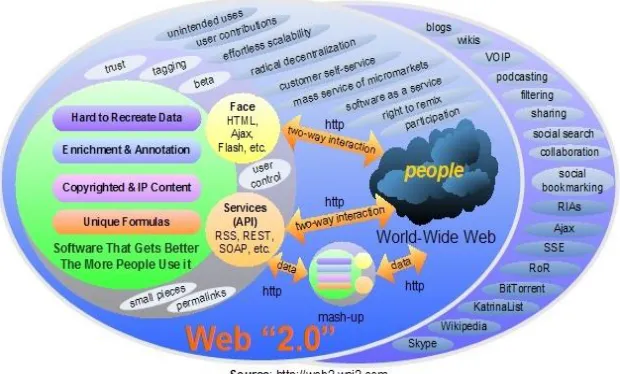
The “subsystems” of the rising of internet operating system are a rising data subsystem that is place, people, products and the complexity of meanings that tie them together which results to new levels of competitive benefits consisting of data being the core of the next generation of computer applications [1]. Web 1.0 was released in the early 1993 to 2001. The term www occurred due to the boom in 2001 of the DOT-com bubble. Web 2.0 was used for current designing of the web, business models and methods for branding of sites on the World Wide Web, since 2004. Web 2.0 as a web application facilitates sharing of information interactively, interoperability, user-centered design and collaboration [2]. Tim O’Reilly defined it as being a gravitational core rather than a hard boundary. It can be seen as a group of principles and practices attached to each other as a veritable solar system of sites that show some or all of those principles, at a varying distance from that core [3].
Web 2.0 websites allow users to do more than just retrieve information. By increasing what was already possible in "Web 1.0", they provide the user with more user-interface, software and storage facilities, all through their browser. This has been called "Network as platform" computing. Users can provide the data that is on a Web 2.0 site and exercise some control over that data
Some of the most important characteristics of Web 2.0 are discussed below [4].
User-centered Design.
A web design is created to fulfill every possible need of the end user, empowering the user when doing certain customizations within the design. Designs which are user-centered are cleaner, usually based on Ajax and navigation is easier. Special preference is given to the design during its creation. One example is iGoogle, a customizable Google.
Crowd-sourcing.
Web as Platform.
Web 2.0 nowadays is not dependant on the OS and does not require a client download condition for accessing various web applications.
Collaboration.
Wikipedia is the best example of collaboration in terms of content quantity.
Power Decentralization.
Web 2.0 is not more administrator dependent but rather follows a self service model. For example, Google Adsense provides a platform whereby users get to deployAds on their site/blog without the administrator allowing or rejecting them. Same goes for social bookmarking services such as Digg, Reddit, Stumbleupon etc.
Dynamic Content.
Web 2.0 services need to be highly dynamic and proactive where the blogosphere has overpowered the conventional mainstream media. If crowd sourcing is there then dynamicity follows by default.
SaaS.
SasS (Software as a service) is whereby web service are not platform dependant with the intrusion of cloud computing.
Rich User Experience.
Social Computing form parts of Web 2.0 era. It is a combination of both social behavior and computational systems. It became the key concept of business nowadays. In simpler term, it uses social conventions to make people interact with each other across the world using software and technology. For better interaction we make use of blogs, email, instant messaging, social network services, wikis, social bookmarking and other instances. In a broader term, it includes collaborative filtering, online auctions, prediction markets, reputation systems, computational social choice, tagging and verification games [5].
Figure1: Web 2.0 Meme Map [3]
Social Computing Architecture
Social computing architectures have five basic concepts [6]:
User Profile
Mostly ever companies have a LDAP that stores basic information of all users while for social sites this problem has been gone with the profile storing of users in Microsoft® SharePoint™.
User Connections.
There are two types of user connections: one-to-one connections or to express that users are related to each other in some way. The main function of social computing is to specify these connections.
A Community concept has been developed to allow users to create and join groups. It consist of a Microsoft® SharePoint™ team site which make use of a standard but extensible interface and various key additional features. Storing of membership by Social Sites in public communities is performed on separated servers. SharePoint™ does not originally have this concept of joining an open team site, so it was added on a separate platform. Since Social Sites create Communities, users get easy discovery and recommendation of appropriate Communities to join. Similarly, activities within Communities are automatically tracked and presented to users who join them.
Content
Companies nowadays are trying to increase content creation capabilities for the right user to have the right information based upon social computing goals but in the long run content creation tools will have to be “socially aware” that is understanding the social graph and emit and consume events.
Events
An events store was included in the design when the architectural approach was taken into consideration for Social Sites. The Microsoft® SharePoint™ Colleague Tracker API was extended for capturing of more colleague events. Events are generated from our communities, and events are captured from (foreign) content updates by users. Events are pulled into the repository to have the possibility of distributing them back to appropriate places.
Security and Privacy.
So the creation of content in any new social computing platform which will be implemented will follow the same path. Likewise, the same security context should be applied for any technologies which is distributing that content (like RSS). The risk of security issues increases with every new authentication or authorization system added to the enterprise architecture.
Usage of Web 2.0 and Social Computing
Social Information Processing is the process of collecting human actions to manage knowledge. Analysis of the information processing power of social systems is performed [7]. Some computer tools examples are:
Authoring tools: e.g., blogs
Collaboration tools: e.g., wikis, in particular, e.g., Wikipedia
Tagging systems(social bookmarking):e.g., del.icio.us, Flickr, CiteULike
Social networking: e.g., Facebook, MySpace, Essembly, LinkedIn
Collaborative filtering: e.g., Digg, the Amazon Mechanical Turk, Yahoo answers, Urtak
Social Information Aggregation: e.g., scratchmysoul.com
Microblogging: e.g. Twitter, Yammer
Photo Sharing:e.g. Picasa, Flickr
Video Sharing:e.g: Youtube, Google Video
Figure 2: Elements of the Web's Next Generation
Web 2.0 brings together the capabilities of client- and server-side software, content syndication and the usage of network protocols. Thereby making use of plug-ins by standards-oriented web browsers and software extensions to handle the content and the user interactions. Web 2.0 sites allow users to store information, create, and the capability to disseminate that was not possible in the environment now known as "Web 1.0".
Web 2.0 websites usually contain some of the following features and techniques. Andrew McAfee used the acronym SLATES to refer to them [8]:
Search: To find information through keyword search.
Links: It provides low barrier social tools and connects information together into a meaningful information ecosystem using the model of the Web.
Tags: Categorization of content by users adding tags to facilitate searching, without reliance on pre-made categories. Collections of tags within a single system which are created by users may be referred to as "folksonomies" (folk taxonomies).
Extensions: The software which makes the Web an application platform and a document server.
Signals: Usage of syndication technology such as RSS to notify users of changed in the content.
Transition of Web 1.0 to Web 2.0
Web 2.0 started with the conference session between O'Reilly and MediaLive International. The web pioneer, Dale Dougherty and O'Reilly VP, make notice of the fact that far from having being crashed, the web with its new applications and sites popping up was more important than ever. The dot-com collapse could have marked the turning point of the web to the Web 2.0 era. The conference was held from the 5th -7th of October in 2004 in the Hotel Nikki in San Francisco, California.
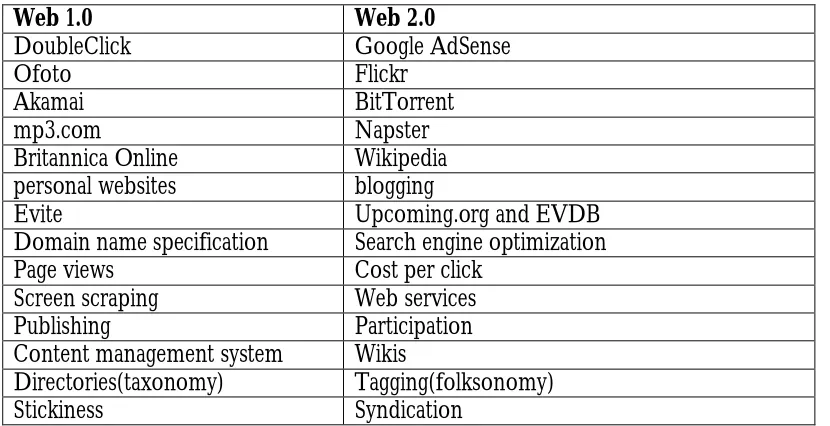
Table 1: Web 2.0 Transitions Examples
Web 1.0 Web 2.0
DoubleClick Google AdSense
Ofoto Flickr
Akamai BitTorrent
mp3.com Napster
Britannica Online Wikipedia personal websites blogging
Evite Upcoming.org and EVDB
Domain name specification Search engine optimization Page views Cost per click
Screen scraping Web services Publishing Participation Content management system Wikis
Directories(taxonomy) Tagging(folksonomy) Stickiness Syndication
Web 2.0 Network Map
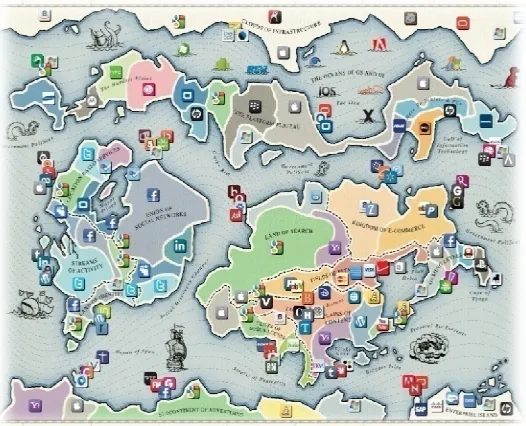
At the same time, those who are against both large and small are hoping to gain footholds or take ground in new territories. This is a Points of Control related to the map below.
Figure 3: Web 2.0 World Map
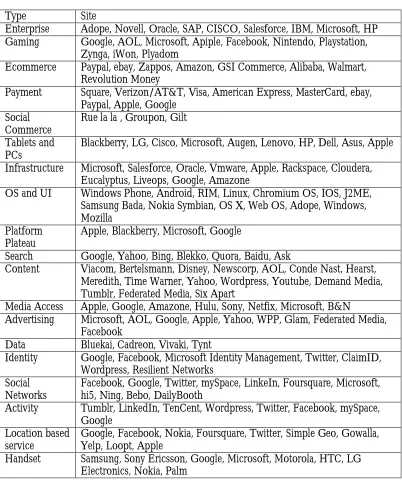
Table 2: Types of Sites
Type Site
Enterprise Adope, Novell, Oracle, SAP, CISCO, Salesforce, IBM, Microsoft, HP Gaming Google, AOL, Microsoft, Apiple, Facebook, Nintendo, Playstation,
Zynga, iWon, Plyadom
Ecommerce Paypal, ebay, Zappos, Amazon, GSI Commerce, Alibaba, Walmart, Revolution Money
Payment Square, Verizon/AT&T, Visa, American Express, MasterCard, ebay, Paypal, Apple, Google
Social Commerce
Rue la la , Groupon, Gilt
Tablets and PCs
Blackberry, LG, Cisco, Microsoft, Augen, Lenovo, HP, Dell, Asus, Apple
Infrastructure Microsoft, Salesforce, Oracle, Vmware, Apple, Rackspace, Cloudera, Eucalyptus, Liveops, Google, Amazone
OS and UI Windows Phone, Android, RIM, Linux, Chromium OS, IOS, J2ME, Samsung Bada, Nokia Symbian, OS X, Web OS, Adope, Windows, Mozilla
Platform Plateau
Apple, Blackberry, Microsoft, Google
Search Google, Yahoo, Bing, Blekko, Quora, Baidu, Ask
Content Viacom, Bertelsmann, Disney, Newscorp, AOL, Conde Nast, Hearst, Meredith, Time Warner, Yahoo, Wordpress, Youtube, Demand Media, Tumblr, Federated Media, Six Apart
Media Access Apple, Google, Amazone, Hulu, Sony, Netfix, Microsoft, B&N
Advertising Microsoft, AOL, Google, Apple, Yahoo, WPP, Glam, Federated Media, Facebook
Data Bluekai, Cadreon, Vivaki, Tynt
Identity Google, Facebook, Microsoft Identity Management, Twitter, ClaimID, Wordpress, Resilient Networks
Social Networks
Facebook, Google, Twitter, mySpace, LinkeIn, Foursquare, Microsoft, hi5, Ning, Bebo, DailyBooth
Activity Tumblr, LinkedIn, TenCent, Wordpress, Twitter, Facebook, mySpace, Google
Location based service
Google, Facebook, Nokia, Foursquare, Twitter, Simple Geo, Gowalla, Yelp, Loopt, Apple
Handset Samsung, Sony Ericsson, Google, Microsoft, Motorola, HTC, LG Electronics, Nokia, Palm
Bringing together experts from various disciplines like: anthropology, cognitive science, computer science, economics, linguistics, mathematics, neuroscience, political science, psychology, sociology, statistics, and theology. Social computing is where there is the intersection of social behavior and computational systems. It is also referred to as modeling complex human interactions that are expressed on a variety of social media. Social media, or mostly known as the Social Web, consists of an ant-colony of services including blogs, media sharing, micro blogging, social bookmarking, social news, social friendship networking websites, and wikis. Different social media sites could be similar or different in terms of functionality. We briefly describe each category and the functionalities [9]:
Blogs or web logs, is a collection of articles arranged in reverse chronological order. These articles are known as blog posts. Blogosphere is the referred to the collection of all blogs. Blogs allow sharing of views, expressing of opinions, interaction and discussion through the linking to other blogs or posting comments. A blog can be maintained by an individual known as an individual blog or by a group of people known as a community blog. The authors of blogs are known as bloggers. Some blogs such as BlogCatalog (http://www.blogcatalog.com/) also allow users to create their friendship networks.
Media Sharing sites allow the uploading and sharing of multimedia content on the web, including, images, videos, audio, etc. with other people. People can watch the content shared by others, enrich them with tags, and share their thoughts through comments. Some media sharing sites allow users to create friendship networks.
Micro Blogging sites are similar to blogs except that the articles can only be of certain length. In case of Twitter (http://www.twitter.com/), the articles can be 140 characters in length. As they are of short length, the articles are called messages. Besides posting messages people can also create friendship networks. They can follow or become followers of other users.
Social Friendship Networks allow people to interact with their friends and having new friends. Individuals hereby create their profile on these sites based on their interests, location, education, work, etc. Usually there are non-directional ties, which means that between two nodes there is a need to reciprocate the friendship.
Social News sites allow the sharing of news among people and provide voting possibility of these stories. Most voted news emerges as the most popular news stories. Tagging of various news stories is possible.
Wikis are publicly edited encyclopedias. However, there moderation of the wikis to avoid vandalism. Wikis provide a great technology for content management, where people with a very basic knowledge of formatting contribute and produce rich sources of information. Wikis also maintain changes of the history and have the possibility to go back to any previous version. Popular wiki likeWikipedia (http://www.wikipedia.org/) also allow people to classify the articles under one of the following categories: Featured, Good, Cleanup, and Stub.
Table3: Categories of Social Sites
Category Social Sites
Blogs Wordpress, Blogger, Blogcatalog, MyBlogLog
Media Sharing Flickr, Photobucket, YouTube, Multiply, Justin.tv, Ustream Micro Blogging Twitter, SixApart
Social Bookmarking Del.icio.us, StumbleUpon
Social Network MySpace, Facebook, Friendfeed, Bebo, Orkut, LinkedIn, PatientsLikeMe, DailyStrength
Social News Digg, Reddit
Wikis Wikipedia, Wikiversity, Scholarpedia, Ganfyd, AskDrWiki
Web 2.0 Tools
AJAX
AJAX is probably the one that revolutionized the way web applications and services are delivered, a term which is accredited to Jesse James Garrett and stands for Asynchronous JavaScript + XML. It is not a new web-based programming language, but it’s a group of technologies combined together, having as a base the Ajax engine, creating a new experience for users and their interaction with web applications. The technologies that it incorporates are already mature, stable, and popular web-based programming languages and script languages and include (X) HTML, CSS, XML, XSLT, JSON, DOM, XMLHttpRequest, Javascript, VBScript, Adobe’s Flash, Flex and AIR and Microsoft’s Silverlight.
SOAP & REST Architectures.
SOAP is the traditional, standards-based approach; it was developed by Microsoft in 1998 and since then has become the most popular standard in exchanging XMLbased messages between applications. It has become so popular, because it was the first architecture that enabled the usage of new technologies like AJAX and being introduced by a major corporation as Microsoft is, it was bound to become a success.
From a technical point of view, SOAP is a protocol architecture for delivering the necessary interoperability between message-based middleware tools across the entire industry.
REST was developed by Roy Fielding and simply provides communications interface using XML and HTTP, using commands, such as POST, GET and PUT. It relies on simplicity, ubiquity and scalability, since it can support small, simple services and complex services, offered by large service providers, such as Amazon and Google.
Adobe Flash - Adobe Flex - AIR & Microsoft Silverlight.
Adobe Flex is package for the development of such applications and offers a separate IDE for developers to create their RIAs based on the Flash platform. AIR is another development of Adobe, which is a cross-operating system runtime that enables you to use your existing HTML/Ajax, Flex, or Flash web development skills and tools to build and deploy rich Internet applications to the desktop.
Silverlight is an alternative way to create multimedia applications for the web. Cross-browser, cross-platform and cross-device browser plug-in which helps companies in designing, developing and delivering applications and experiences on the Web.
Open APIs & Mashups.
Application Programming Interface (API) mechanism provides the usage of functionality of a set of modules without having access to the source code. Open APIs are free and open for all programmers to make use of and taking advantage of certain features in their own projects.
Mostly major web service providers giving out APIs for developers, most notably Facebook and the Facebook Apps API, Flickr and Google with various APIs, with the likes of the Google Maps API being rather popular.
In Web 2.0 era this has become really popular, which has been triggered with the rise in the number of mashups. Mashups are application that can be customized taking disparate data sets which can be both static and real time.
RSS feed, Microformats & Semantics.
Since the social aspect of Web 2.0 is rather crucial, we have seen many technologies that give users the opportunity to have personalized information right on their desktop or mobile phone (RSS), personalize their accounts at websites (Microformats) and even to be able to get information specifically for them, based on their interests or previous browsing (Semantics).
According to specifications of RSS 2.0, it is a syndication of web content format. It is a dialect of XML. As mentioned what RSS does, is give users the opportunity to receive information they have selected as interesting and to be instantly notified about new updates on their favorite subjects, from their preferred blogs or websites.
Microformats could be placed one step above RSS, since technologically it
provides developers with a way of adding simple markup to human-readable data items such as events, contact details or locations, on web pages, so that the information in them can be extracted by software and indexed, searched for, saved, cross-referenced or combined.
Social Computing Tools both Technologically and Socially Oriented.
Technologically Oriented
Open Platform
Lightweight Models
When talking about lightweight models, flexibility and agility ways of developing a product, thus being able to update, change and reuse much faster than the classic development methods. This is common for a web based service, “…it requires an agile business model, which can handle such a fast update rate…” and it also helps to reduce the costs in organizational change, a process that is expensive in terms of energy usage as well as investments.
Enabling Services
Differentiation of online services that follow the model of SaaS - Software as a Service, a model used extensively, by services such as the applications by Google e.g. Gmail and Google Docs. Characteristics of these services are flexibility, openness, scalability and re-usability. These characteristics enable the creation of mashups, faster updating, online management of data and lower transaction costs.
Intuitive Usability
Usability is key when it comes to interfaces, which is a main element of all web services. Consequently, interfaces must be easy and simple for all types of users, according to the walk up ‘n’ use mentality, but at the same time to offer expert users more options to personalize their side of the service according to their liking.
For example, with introduction of the term of Rich Internet Applications in Macromedia as described in the previous section, but things became even more usable when AJAX was introduced, exploiting the graphic environment offered by JavaScript.
Socially Oriented
Long Tail
To achieve this, services must attract users of all orientations, having Amazon as an example which manages to gain a lot of profit from this group of customers, by offering niche products, exclusively from their online store.
Unbounded Collaboration
Social computing is all about collaboration and communication, between users and between services. This can be achieved, by giving developers the ability to create mashups, through the Open Platform principle, for example by using Open APIs (as described in Web 2.0 Technologies). Additionally, users are meeting, are interacting and communicating in online communities [11]. Within these communities there is user contributions which add value to these services or to the organizations that have created the service.
Collective Intelligence
When talking about Social Computing and Unbounded Collaboration of users, then we also have to take into consideration the knowledge, which is created by these communities, whether they work in groups or individually.
Trust amongst users is the major issues of this principle, since this decentralization of the web suffers from lack of control. Web services that want to harness the vast amounts of information generated by all these users, it is important attract as many as possible to contribute, since the 1% rule applies in these communities.
Network Effects
Due to the limited number of users spending time and effort contributing to an application, attracting users is an ongoing race, where the rule of first-mover-wins does not apply, since we constantly encounter new services that make competition harder.
User Generated Content
Social Computing contains all of the previously mentioned principles and technologies, but in its core, data is the main driver of social computing and the owner of the data is key. Managing all this data is a difficult task, since there are many issues regarding this matter; authorship, privacy and security. The usage of content and protection by service providers is a major issue thereby influencing how popular a service is.
Mapping of both Web 2.0 and Social Computing Technologies
Figure 4: Mapping of Technologies
Conclusion
Learning becomes more interesting and efficient with web 2.0 features and tools. The use of social computing for learning purpose will continue to increase, especially when we know how ‘connected’ our youngsters are. Another major topic of discussion is Semantics, since many analysts and scientists mention another web (web 3.0), called the Semantic Web. This would represent some virtual blending of online and offline worlds. It might be that your computer remembers your tastes, interests and styles, so that your browser becomes like a personal assistant when you look or search for learning materials. This whole notion of personalization that web 3.0 will bring arouses tremendous excitement in the learning communities.
References
Tim O’Reilly and John Battelle," Web Squared: Web 2.0 Five Years On " [Accessed 16th of April 2014]
Web 2.0-Wikipedia Available at: http://en.wikipedia.org/wiki/Web_2.0 [Accessed 26th of April 2014]
What is Web 2.0? Design Patterns and Business Models for the Next Generation of Software Available at:
http://oreilly.com/web2/archive/what-is-web-20.html [Accessed 26th of April 2014]
Core Characteristics of Web 2.0 services- TechPluto Available at:
http://www.techpluto.com/web-20-services/ [Accessed 31th of August]
Social Computing-Wikipedia Available at: http://en.wikipedia.org/wiki/Social_computing [Accessed 26th of April 2014]
Architecting Enterprise Social Computing For Business Value Available at:
http://www.cxo.eu.com/article/Architecting-Enterprise-Social-Computing-for-Business-Value/ [Accessed 2nd of September 2013]
Social Information Processing-Wikipedia Available at:
http://en.wikipedia.org/wiki/Social_Information_Processing [Accessed 26th of April 2014]
McAfee, A. (2006). Enterprise 2.0: The Dawn of Emergent Collaboration. MIT Sloan Management review. Vol. 47, No. 3, p. 21–28
Cachia R. (2012) ,Social Computing: Study on the Use and Impact of Online Social Networking IPTS Exploratory Research on the Socio-economic Impact of Social Computing
Kormaris G and Spruit M (2013), Bridging the gap between Web 2.0 Technologies and Social Computing Principles, Department of Information & Computer Sciences, Utrecht University