Forestry & Natural-Resource Sciences Last Correction: Feb. 28, 2011
PROGETTOBOSCO:
A DATA-DRIVEN DECISION SUPPORT SYSTEM FOR FOREST PLANNING
F. Ferretti
1, C. Dibari
2, I. De Meo
3, P. Cantiani
4, M. Bianchi
5 1Researcher, ARC – CRA-SFA, Italy. Ph./Fax: (39)0865-4145742Ph.D. Student c/o Di.P.S.A., D.P.S.E.S., University of Florence, Italy. Ph./Fax: (39)055-3288257/332472 3Resercher,5Senior Resercher, ARC – CRA-MPF, Italy. Ph./Fax: (39)0461-381111/381131
4Researcher, ARC – CRA-SEL, Italy. Ph./Fax: (39)0575-353021/353490
Abstract.As a consequence of the spread of technology, also the forest sector needs to develop methods
and tools capable to integrate the new available technology (Geographical Information Systems, databases, Decision Support Systems, GPS, satellite imaging, laser etc.) with the traditional tools.
In specific the present paper refers to the context of forest planning and management and to the imple-mentation of a nationally standardized method and tool for monitoring and supporting forest planning and forest policy choices from a local to a national scale.
Within this framework and according to the definition of a Data-Driven Decision Support Systems, a method aimed at optimising the data collection on forest and forest management of Italy was developed. With ProgettoBosco a unique, participated and shared information system effective for all forest typologies existing in Italy was accomplished.
The paper focuses on the working methodology which is innovative and original for the sector of forest planning. The methodology, characterized by a bottom-up approach, is structured in three main steps: cooperation, successive approximation and experimentation.
Keywords:Data-driven DSS; sustainable forest management; Italy
1
Introduction
Clear and reliable definition of all resources compris-ing a forest management unit, irrespective of ownership or control, is a critically important element of forestry planning.
According to FAO definition (1998) “planning is an active process requiring careful thought about what could or should happen in the future and involves the coordina-tion of all relevant activities for the purpose of achieving specified goals and objectives. Planning is an integral component of forest management that translates forest policies into a coordinated programme for a forest man-agement unit and for regulating production, environmen-tal and social activities for a set period of time through the use of prescriptions specifying targets, action and control arrangements”.
Specific forest resources information on wood volumes and growth is needed at the forest management unit level in order to determine sustainable yields of wood
pro-duction and for the formulation of sound forest policies. Moreover, effective forest management relies on the use of good quality information on forest types, wood vol-umes and growth, on local community and wider social relationships and on environmental and economic issues. In a society based on information, the role of technol-ogy has become more and more important; consequently, also forest research needs to focus on methods and tools which are able to combine the new available technol-ogy (e.g. Geographical Information Systems, databases, Decision Support Systems, GPS, satellite imaging, laser etc.) with traditional planning and management tools.
Moreover, international research keeps on develop-ing indicators which may be very helpful to decision-makers within the above mentioned issues concerning forest management (Baskent & Keles 2005, Vacik & Lexer 2001, Loh et al. 1994, Orland 1994).
Another important issue being debated within the scientific community is represented by the demands in terms of goods and services requested by the forests,
with the increasing need to define new and more ap-propriate methods and tools aimed at supporting forest planning (Varma et al. 2000, Lexer et al. 2005, Baskent et al. 2008, Vacik et al. 2001).
The need of having a multi-purpose and sustainable management – whose importance has been also sanc-tioned by many international agreements and initia-tives (ITTO 1992, FAO 1997, Montreal Process 1995) – started a wide debate on how to achieve efficient for-est management tools and a concrete evaluation of forfor-est plans.
As reported by scientific literature, the majority of de-cision support or rule-based expert systems implemented so far for landscape ecology forest planning, wood pro-duction, forest protection and sustainable forest man-agement, have been applied only to a very local con-texts (Farrell & Maness 2005, Kangas et al. 2000, Vacik & Lexer 2001), or oriented to forest spatial and growth projection models (Andersson et al. 2005, Baskent & Keles 2005, Baskent et al. 2008, Loh et al. 1994, Loh et al. 1998, Orland 1994, Varma et al. 2000) or even to silvicultural planning (Lexer et al. 2005).
Several are the research projects dealing with forest information systems and database at European level, mainly carried out by the EFI (European Forest In-stitute) which plays a prominent role within this topic by its fourth activity sector named “Forest Resources and Information”. Among these EFI databases, can be reminded the EEFR (EFISCEN European Forest Resource Database) which is for instance a database based on a large number of forest inventories, the EFI/WFSE (Word Forests, Society and Environment Program) which is also a database on forest products trade flow, while both the forest information service net-works CIS (Certification Information Service) and FINE (Forest Information Services Network for Europe) em-bed national and European information concerning for-est laws and regulations in order to provide “value added information for policy and decision making” (Sterba 2003). None of the above cited database specifically defines standard criteria for data collection and man-agement for forest planning.
It must be taken into account that standardized for-est planning issue has a common transnational origin and is strongly related to each Country’s juridical sys-tem. Therefore, a consistent domestic standardisation among local territory management systems - for instance in what concerns detailed data collection and working out of plans - is necessary to be implemented at the level of forest management plan.
Due to the considerably forestry self-government of the twenty administrative Regions, Italian forests are characterized by a wide heterogeneity range of planning systems and rules, which are rather unfeasible to be
com-pared in time and space under a unique perspective, of-ten also within the same administrative Region.
Within this context and according to Data-Driven De-cision Support Systems definition (Power 2008), “Pro-gettoBosco” (Bianchi et al. 2006) aims at optimising the collection of all data concerning with Italian forests and forest management, by implementing a nationally standardized method and tool for monitoring and sup-porting forest planning and forest policy choices from a local to a national scale.
This means: i) to attain the comparison in time and space of all the collected information; ii) to facilitate data reading also at higher scales; iii) to make much easier the control of forest plans; iv) to standardise on field training education of experts by improving their competences; v) to facilitate the control on the applica-tion of the plan’s disposals and rules; vi) to easily keep update forest management plan database.
For this reason, for ProgettoBosco was a priority:
• the definition of a minimum and common informa-tion level for describing forest areas under a unique technical and management perspective;
• the implementation of an information system in or-der to facilitate the comparison in space and time of basic forest management data;
• to provide public administrators and policy makers with a fast and efficient tool to cope with regional, national or international rules (e.g. EU-financing, agreements on biodiversity, sustainability, carbon stock).
2
Data And Methods
2.1 Italian forest context According to the Na-tional Forest Inventory (INFC 2007), Italian forests ex-tend over 10 million ha (the 35,4% of the total land area) and several forest environments are distributed over all the Italian regions. The flora is characterized by more than 5,600 plant species (Pignatti 1982), out of total of 10,500 in whole Europe (Tutin et al. 2001). Five of the main forest types are spread along the peninsula and about 200 forest typologies are officially defined at national level (Del Favero 2004, Del Favero 2008).
other functions (tourism, recreational activities, land-scape, etc.).
In the marginal forested areas the industry is very lim-ited, agriculture and forestry are not wealthy economic activities. The major income of local population relies basically on other sectors such as tourism and quality farm products.
Italian forest land is quite fragmented: the 60% be-longs to private owners and the 40% to public adminis-trations, where the 68% belong to the local administra-tive municipalities (Regions or “Comunit`a Montane”1).
Moreover, according to the General Census of Agricul-ture (2000), the mean size of the private-owned forest property averages out at 7,51 hectares usually scattered and seldom managed within a unique coordinated forest management plan (Nocentini 2006).
Furthermore, in Italian forest plans, which address both forests and pastures, the smallest management unit level is the forest compartment which usually ranges from 1-5 up to 20-40 ha (sometimes from 1 up to 40 ha) of surface.
2.2 Methods One of the main constraint of Ital-ian forest management plans concerns the implementa-tion of a common and as wide as possible participated method at a national scale, in order to define a mini-mum and shared information level for describing Italian forests and to develop an unique nationally standard-ized forest planning information system. Besides, the system must assure the comparison in space and time of basic forest management data in order to provide public administrations and policy makers with a common tool to cope with EU-financing, agreements on biodiversity, sustainability, carbon stock topics, etc..
Daniels and Walker (1996) reject the following per-spective: “A phrase common among natural resource professionals is that ‘if public only knew what we know, they would agree with us; how can they be taught that what we are doing is right?’ Such a statement certainly has a learning emphasis, but is based on a presumption that the worldview of the agency professional is both fully informed and somehow ‘right’; therefore the only partic-ipants needing to learn are the public. It also implies a narrow, unidirectional view of communication“. Pro-gettoBosco also reject this perspective since is one of the key aspect for the project that both researchers and software engineers have much to learn from local tech-nicians and forest managers, the definite potential users of the method. For this reason, one of the main goals of ProgettoBosco concern a strong integration between
1The “Comunit`a Montana” is the Italian administrative body
that coordinates the municipalities located in the mountainous areas and is responsible for administration and economic develop-ment
the wide knowledge of local forester technicians and the needs requested by the final users of forest plans, often not very familiar with new technologies.
The ProgettoBosco working methodology - devel-oped in the framework of a forest-management research project - consists of three main steps: cooperation, suc-cessive approximations and experimentation. The aim was to use a bottom-up approach to encompass a broad range of forest standings of the country and to produce a technician-ready-to-use DSS.
Specific procedures have been thus developed and tested on experimental plans, working into two main di-rections: a close and multidisciplinary interdependence studies on one hand and specific field trials setting up, on the other.
Specifically, bottom-up approaches aimed at identify-ing core business information and developidentify-ing DSS func-tionalities have been then used. A focus was given on social and organizational planning processes rather than just on the technical planning ones.
In fact, along ten years, more than 150 scientists and experts (among researchers, forest managers, technicians belonging to Regional Forest Services) have been tak-ing part of the research project jointak-ing a “collaborative learning method” (Buttoud & Yunusova 2002, Daniels & Walker 1996, Daniels & Walker 2001). A step-by-step choice of common or at least shareable conceptual features were defined and put into an analytical form in order to deliver the basic theoretical and information structures of the system. The applied method assumed semi-structured interviews and further discussions with different stakeholders in order to capture the common essential elements referred to a specific topic. The in-terviews were carried out during periodical meetings, by a reiteration process based on the assumption that each forest technician had the non-structured knowledge to “read” the territory of his competence and to recognize a wide range of forest environmental features and man-agement practices.
In order to achieve a wide and complete vision of the state of art within forest planning, a preliminary study on Italian forest planning regulations was carried out, aiming at gathering all the rules and laws applied by Ital-ian Regions and defining all forest management methods and constraints of the nation.
The key features of ProgettoBosco working method-ology can be summarised in the following: cooperation, successive approximations andexperimentation.
by researchers, technicians of the public administrations - directly involved in the experimental definition of the system - and professionals in charge of drawing up the pilot plans. This working method allowed to investigate a wide range of situations in a relatively short amount of time and in accordance with the available financial resources.
The Italian context, for which the system was devel-oped, is characterized by an extreme variability of forest formations in terms of administration, culture, vegeta-tion and structure. This results in a high heterogeneity of management constraints and in the remarkably dif-ferentiated experience acquired by the technicians. Ad-ditionally, it frequently happens that some operators tended to focus their attention on certain aspects and some on certain others. Furthermore, even when they are describing the same subject matter, they may use a different terminology, thus making extremely difficult, where not impossible, a comparison among the plan con-tents. This heterogeneity sheds light on the importance of a careful analysis of the operations and processes car-ried out in the different contexts in order to make a correct use of the information needed in forest planning. The successive approximation approach was adopted to connect in a single and shared system such a varie-gate and complex frame and to define the structure of the system itself. The “collaborative learning method” was applied at this stage. The method made possible to gradually select the conceptual common elements and give them an analytical form to be used in the identifi-cation of the structure of the Information System. An iterative process was activated through periodical meet-ings where all the participants contributed to define a series of common elements related to a certain subject.
Semi-structured interviews were addressed contempo-rary to more participants during the meetings. This enabled to enhance a common discussion in order to fo-cus the attention on elements considered essential. The assumption is that any technician with experience in the field of forest plan management had in his professional background specific competences, even if non structured or formalized, that could help him to “read” and in-terpret the territory, build scenarios and find practical solutions. The global record of the situations was thus achieved only thanks to the manifold contributions of the actors that had experimented various situations concern-ing forest management and land plannconcern-ing. The ability to retrieve and formalize this knowledge, in some cases latent, was a key point for the construction of Proget-toBosco Information System. The result obtained by applying the collaborative learning method was not the mere sum of the expertise of each individual. In fact the system joins and combines the different positions in an integrated vision and through a real adaptive process,
whose aim was the consensus among the people involved (Buttoud & Yunusova 2002).
Following the above cited approach, field surveys and investigative methods were developed specifically for each every topic considered in the project. Whenever possible, a scale ranging of the variable to be described was ri-elaborated, if needed. This scale was of primary importance both for the representation of the all kinds of forests and the relevant management choices. It proved to be easily applicable as it was based on overall sight evaluations.
Theexperimentation phase was the last phase of the method and was carried out by testing the system in several experimental forest management plans. Special attention was given to the selection of the plans in order to the encompass a variety of cultural and management conditions that could be found in Italy.
A part of the project concerned also the integration of the Criteria and Indicators of Sustainable Forest Man-agement into the Information System. Hence, the future plans drawn with this method will contain the requested information to demonstrate that the adopted manage-ment practices are consistently associated to the key re-quirements identified in the Principles, Criteria and In-dicators of Sustainable Forest Management (Lammerts van Bueren & Blom 1997).
The PC&I (Principles, Criteria and Indicators) of sus-tainable forest management taken into consideration for the definition of the method were four: a) PC&I of Forest Stewardship Council (FSC) formulated at na-tional level for woods and plantations (arboriculture and poplar plantations) of the alpine area; b) Criteria and In-dicators of the Program for Endorsement of Forest Cer-tification schemes (PEFC) proposed for Italian woods and forest plantations; c) Indicators formulated by the National Agency for Environmental Protection (APAT) at national level; d) Apennine and Mediterranean Stan-dards issued for forests located in these environments.
The working method used in the definition of the set of indicators to be integrated in the system provided that experts coming from different thematic areas would operate in sub-group. Such an approach enhanced the comprehension and facilitated the consultation of the experts (Sheppard 2005), since each sub-group worked exclusively on those Criteria and Indicators related to its field of interest.
transparency of the methodology that is applied (Lexer et al 2005; Vacik & Lexer 2001).
3
Results
Through ProgettoBosco Project, for the first time, in Italy an unique, participated and shared information system, effective for all forest typologies existing in the country, was accomplished. A big effort concerned the definition of standardized and specific criteria for select-ing and zonselect-ing forest compartment units. The codifi-cation of most all the qualitative features necessary to provide an exhaustive description of the forest provide a solution to one of the main and central constraint related to a forest management plan. Standardised dendromet-ric sampling and data processing were also implemented including forest management map plan outputs (reports, graphs and maps). A specific software and geodatabase for data collection and analysis, based on MS ACCESS and ESRI-ArcGIS, were also developed.
Furthermore, ProgettoBosco was conceived according to the criteria and indicators of sustainable forest man-agement (FSC, PEFC and two Italian national stan-dards) as a preliminary step on certification process.
3.1 Standardisation of forest compartments tracing out – the forest-cultural unit In order to programme efficient and effective schedules of forest treatments in terms of time and space, it is necessary to define the fundamental criteria to identify forest com-partments. Forest compartments is the permanent, geo-graphically recognizable unit of forest land, forming the basis of prescription and permanent record of all forest operations (including silviculture treatments) refereed to a forest management plan (Bagnaresi et al. 1986).
A basic principle of forest management is a clear and permanent definition of forest compartment boundaries. Forest compartments should be located according to cri-teria as objective as possible, in order to be univocally evident and permanent on the ground. Unfortunately, this occurs rather often .
In Progettobosco (Bianchi et al 2006) it was decided to relate all the information of the plan to the single forest compartment, therefore standardised criteria have been settled down.
For this purpose, it was defined the “forest-cultural unit” as an area of the forest, where at least one of the following features can be discriminated:
1. land cover type (forest, bushes and shrubs, pasture, cultivations);
2. forest stand species composition;
3. forest function;
4. silviculture treatment.
As general rule, the change in just one of these element may discern a different forest compartment unit.
ProgettoBosco defines also the cartographic tracing out phase, which should be linked as much as possible to physiographical features easily recognizable both on field and on maps. It assures the retrieval of the com-partments by different people and different times. These features can be natural lines such as rivers, ditches, im-pluviums or infrastructures such as streets, paths, duct, etc., (Bagnaresi et al. 1986).
Whether is not feasible to create an homogeneous for-est compartment on the basis of physiographical ground features, in ProgettoBosco the compartment can be split in one ore more temporary sub-divisions according to one of the four criteria which define the “forest cultural unit”.
The “forest cultural unit” definition and the criteria of forest compartment mapping assure in ProgettoBosco the objective, transparent and retrievable chance to zone the forest in the same way within a management plan.
compared.
Two main groups of information have been thus agreed and coded within ProgettoBosco database: one related to management and environmental features of forest compartment and the other one to specific bioe-cological management information referred to the forest stand. These data set have been organised in 2 main field forms:
• Form A: concerning environmental and manage-ment features;
• Form B: concerning bio-ecological management fea-tures of the forest cultural unit.
Form B is extra divided in three sub-forms depending from the forest stand of the compartment:
• Sub-form B1: for forest stand;
• Sub-form B2: for tree plantations;
• Sub-form B3: for shrubs and pasture.
In order to give as much freedom as possible to the forester technicians to record all other forest description attributes not included within the survey form codes, a wide space has been given to notes and memos. It al-lows to better describe forest stand compartment. By this approach a base set of data is always ensured but more exhaustive and comprehensive description can be always integrated in the form if whenever needed.
3.3 ProgettoBosco Geodatabase According to Data-Driven Decision Support Systems definition (Power 2008), in ProgettoBosco Geodatabase data can be easily managed, queried, summarized,ad hoc filtered and retrieved also through the help of specific alerts and triggers and a very user-friendly interface. Specific data displays can be also created within report design, genera-tion and storage. A very good integragenera-tion with MS Excel software, one of the broader software used by foresters to analyze field data, is also ensured.
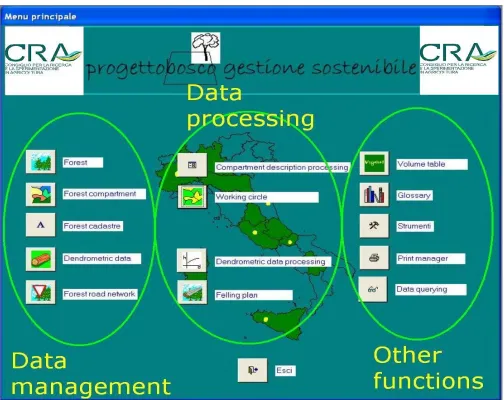
Figure 1 shows ProgettoBosco’s main menu. This menu is divided in three parts: by the first - the left but-tons - different data management macro-functions can be activated. The central tools activate data process-ing macro-functions. By the last one buttons, on the right, other auxiliary macro-functions can be processed mainly referred to output print manager, data querying and forest volume stand computing macro-functions.
Aiming at supporting the technicians, final users of the implemented method and DSS (and not the “vice versa”), an user friendly interface was developed so that even computer no-experts can be comfortable in the use of the software.
Moreover, concerning the forest management practises (i.e. construction of yield tables and growth models, sil-vicultural systems, etc.), within ProgettoBosco the data are processed by “trial and error”. By this, the user can test several management scenarios and then choose the one which looks to be the best.
This data processing approach provides the users with as much freedom as possible to identify the most efficient forest management practises and, besides, all data anal-ysis are fully transparent and retrievable by everyone.
Furthermore, specific alerts have been implemented in order to assure the right entry of all data requested by the software to make the analysis.
4
Conclusions
ProgettoBosco represents the first attempt of imple-menting a standardized supporting information system in forest planning in Italy. All the data collected within forest plans produced with ProgettoBosco method can be compared and aggregated for further investigations.
ProgettoBosco methodology and tools have been ap-plied, so far, in more than 250 management plans, cov-ering about 200.000 ha of managed forest areas placed in twelve Italian Regions. By this, a wide range of Ital-ian forest contexts could have been tested in terms of ecological and silvicultural features as well as social and economic issues. As a consequence an experimental val-idation of the information system capability could have been also checked.
Moreover, the very easy user-friendly interface of the software and the clearness of method can be exploited both by technical personnel and by forest decision mak-ers. ProgettoBosco also allows a quicker and more ef-ficient answer to public administration within given re-gional, national or international rules (i.e. EU-financing, agreements on biodiversity, sustainability, carbon stock, etc.).
According to what reported by the technicians who were in charge of testing and validating the method, main ProgettoBosco’s strengthening concerns:
1. standardization of procedures and methods;
2. management of data collecting and processing;
3. standardization of information of major importance within an extra-regional context;
4. triggering of accessory information so as to meet requirements by single Regions;
5. unequivocality and simplicity of interactive proce-dures;
6. modularity of the system components;
Figure 1: Figure 1 - ProgettoBosco’s main menu interface. On the left the data management macro-functions, in the centre data- processing macro-functions, on the right other auxiliary functions (e.g. print manager, data querying, etc.)
Acknowledgement
This research was supported by MIPAF (Ministry for agriculture and forestry policy) - National Research Project Ri.Selv.Italia (Subproject 4.2 – Forest Plan-ning).
The authors have contributed to this study and paper in equal parts.
References
Andersson, M., B. Dahlin, and M. Mossberg. 2005. The Forest Time Machine - a multi-purpose forest manage-ment decision-support system. Computers and Elec-tronics in Agriculture 49 (1): 114-128
Bagnaresi U., G. Bernetti, M. Cantiani, B. Hellrigl. 1986. Nuove metodologie nella elaborazione dei piani di assestamento dei boschi. ISEA, Bologna. 1133 p. Available on line at
Baskent, E. Z., . Bakaya, and S. Terziolu. 2008. Devel-oping and implementing participatory and ecosystem based multiple use forest management planning ap-proach (ETC¸ AP): Yalnız¸cam case study. Forest Ecol-ogy and Management 256 (4, 10): 798-807
Baskent, E. Z., and S. Keles. 2005. Spatial forest plan-ning: a review. Ecological Modelling 188 (2-4): 145-173
la pianificazione e la gestione dei boschi in Emilia Romagna. Annali Istituto Sperimentale per la Selvi-coltura. Special Number, Arezzo Year 2001, Volume 32
Buttoud, G., and I. Yunusova. 2002. Negotiation con-cepts, methods and procedures for IMP formulation. P. 135-147 in Proc. of the Research Course “The For-mulation of Integrated Management Plans (IMPs) for Mountain Forests” Bardonecchia, Italy, 30 June – 5 July 2002
Daniels, S. E., and G.B. Walker. 1996. Collaborative learning: Improving public deliberation in ecosystem-based management. Environ. Impact Asses. Rev. 16:71-102
Daniels, S. E., and G.B. Walker. 2001. Working Through Environmental Conflicts: The Collaborative Learning Approach. Westport CT: Praeger Publishers. 328 p.
Del Favero, R. 2004. I boschi delle regioni alpine d’Italia. Tipologia, funzionamento, selvicoltura. CLEUP, Padova Italia. 600 p.
Del Favero, R. 2008. I boschi delle regioni meridion-ali e insulari d’Itmeridion-alia. Tipologia, funzionamento, selvi-coltura. CLEUP, Padova, Italia. 470 p.
FAO. 1997. The Helsinki Process of 1995 European crite-ria and indicators for sustainable forest management adopted by the expert level follow-up meetings of the Helsinki Conference in Geneva (24 June 1994) and in Antalya (23 January 1995). Vol. 6, 51-70 in Proc. of the XI world forestry congress, Turkey
FAO. 1998. Guidelines for the management of tropical forests. Series title: FAO Forestry Paper - 135 1998. 307 p.
Farrell, R. R., and T. C. Maness. 2005. A relational database approach to a linear programming-based de-cision support system for production planning in sec-ondary wood product manufacturing. Decision Sup-port Systems 40 (2): 183-196
Kangas J., R. Store, P. Leskinen, and L. Meht¨atalo. 2000. Improving the quality of landscape ecological forest planning by utilising advanced decision-support tools. Forest Ecology and Management 132 (2-3): 157-171
INFC. 2007. Le stime di superficie 2005 – Prima parte. - MiPAF – Ispettorato Generale Corpo Forestale dello Stato, CRA - ISAFA, Trento. [on line] URL: http://www.infc.it
-ISTAT. 2002. 5˚ Censimento Generale dell’Agricoltura. Caratteristiche strutturali delle aziende agricole. Anno 2000 Veneto, Roma
ITTO. 1992. Criteria for the Measurement of Sustain-able Tropical Forest Management. International Trop-ical Timber Organisation. Yokohama. 5 p.
Lammerts van Bueren E.M. and E.M. Blom. 1997. Hi-erarchical Framework for the Formulation of Sustain-able Forest Management Standards. The Tropenbos Foudation, Leiden, NL. 82 p.
Lexer, M.J., H. Vacik, D. Palmetzhofer, and G. Oitzinger. 2005. A decision support tool to improve forestry extension services for small private landown-ers in southern Austria. Computlandown-ers and electronics in agriculture 49: 81-102
Loh, D. K., D. R. Holtfrerich, and S. E. P.Van Stip-donk. 1998. Automated construction of rulebases for forest resource planning. Computers and Electronics in Agriculture 21 (2): 117-133
Loh, D. K., Y. C. Hsieh, Y. K. Choo, and D. R. Holt-frerich. 1994. Integration of a rule-based expert system with GIS through a relational database management system for forest resource management. Computers and Electronics in Agriculture 11 (2-3): 215-228
Montreal Process. 1995. Criteria and Indicators for the Conservation and Sustainable Management of Tem-perate and Boreal Forests. Canadian Forest Service, Hull, Quebec. 27 p.
Nocentini, S. 2006. Forest and forestry in individual European Union – Italy. P. 282-293 in Forests and Forestry in European Union Countries, the Guide to forests and forest issues
Orland B. 1994. Visualization techniques for incorpo-ration in forest planning geographic information sys-tems. Landscape and Urban Planning 30 (1-2): 83-97
Pignatti, S. 1982. Flora d’Italia. Edagricole. Bologna. 3 vols.
Power, D. J. 2008. Understanding Data-Driven Decision Support Systems. Information Systems Management 25 (2): 149 – 154
Sterba, H. 2003. Diamonds in EFI’s forest resource and information research. Forest Policy and Economics 5: 135 – 139.
Tutin, T. G., V. H. Heywood, N. A. Burges, D. H. Valen-tine, S. M. Walters, and D. A.Webb. 2001. Flora Eu-ropaea. Cambridge University Press. 5 vols
Vacik, H., and M. J. Lexer. 2001. Application of a
spa-tial decision support system in managing the protec-tion forests of Vienna for sustained yield of water re-sources. Forest Ecology and Management 143 (1-3): 65-76