Journal of Engineered Fibers and Fabrics 127 http://www.jeffjournal.org
A Novel Weave/Color Repeat Extraction
Method with Error Tolerance
Di Zhou, PhD, Luoqing Zhou, Xinyi Sheng, PhD, Jun Sun
Jiangnan University, Wuxi, Jiangsu CHINA
Correspondence to:
Di Zhou email: [email protected]
ABSTRACT
In this paper, we propose a simple but efficient method to identify the correct repeat unit in a yarn-dyed fabric weave pattern and color pattern automatically, especially when they contain error pattern recognitions. With only the color pattern of the fabric to be detected, our method can solve three problems simultaneously, even though there are errors in color pattern recognition. The method extracts the weave/color repeat unit, identifies the full weave pattern, and locates and rectifies the misrecognition in color pattern if there is one. The layout of color yarns is obtained by statistical solution. The weave pattern is partly determined by the correlation between color pattern and weave pattern, while that left can be identified by tentative grouping. In this process, the weave repeat unit is obtained when every group achieves internal uniformity; moreover the misrecognition in color pattern can be located and rectified simultaneously. Finally, the color repeat unit can also be extracted in the same way. Experiments on real fabrics validate the effectiveness of our method in extracting weave/color repeat unit from color pattern which contains errors.
INTRODUCTION
Weave pattern and color pattern are essential information for the production of yarn-dyed fabric. Weave pattern is the predefined structure according to which the warp and weft yarns interlace with each other to assemble the final woven fabric, while color pattern is the layout of color yarns in the fabric. However, in automatic manufacture, weave repeat has higher practical value compared with the weave pattern. It is defined as a specific rectangle of a certain number of warp and weft points that repeats itself in the width and length directions to form the weave pattern. The same applies with color pattern and color repeat. In the traditional method, weave repeat and color repeat are identified by extracting the individual warp or weft yarns manually from the fabric and determining the color as well as whether it is warp over weft or vice versa at each crossing point.
Obviously, these manual-based methods are very tedious and time-consuming and are therefore replaced by some computer-aided methods utilizing image processing.
In most previous works, the extraction of weave repeat and color repeat were carried out separately. These existing methods were known to have some disadvantages. Put it in detail, [1-3] were usually unable to deal with the complicated patterns, [4-6] required the previous recognition of the weave/color pattern to be absolutely correct, while [7, 8] needed an extra pattern database containing all the common patterns as the precondition for the repeat unit extraction.
In this study, we propose a very simple method to identify the repeat unit in weave pattern and color pattern simultaneously, which has three features: 1. It has no need of any prior knowledge such as pattern database. 2. It has a certain tolerance for the misrecognition of weave pattern and color pattern. 3. It is totally automatic.
Literature Review
spectrum in the Fourier domain. In [1], by using Fourier transform, the authors employed the lines and their directions for the discrimination of three basic weave patterns including plain, twill, and satin. In [9], the inverse of Fourier transform and thinning operator were used to obtain the borders of the yarns, but identifying only the plain weave. These frequency-spectrum-analysis-based methods were most widely used and usually effective when identifying the regular textures
The second type of approaches extracted the weave repeat after the weave pattern of the fabric had been correctly recognized [4-6, 14-18]. In [16], the authors determined the warp and weft crossed states by analyzing the normalized aspect ratio of an ellipse-shaped image at crossed points of the fabric. If the ratio is greater than 1, the warp is over the weft and vice versa. The method in [15] shared some common place with that in [16] to a certain extend: it measured the gray level distributions in the vertical and horizontal directions at each crossover point in one weave repeat, and then obtained the relative lengths from the line profiles in the respective direction. The ratio between them was used as the measure to recognize the fabric pattern. In [18], the values of four pattern characteristics of each cross area were calculated to determine the warp or weft floats, including first-order statistics of mean and standard deviation and second-order statistics of contrast and homogeneity of the co-occurrence matrix [1, 17]. In [14], the authors calculated the maximum and minimum of the sum of pixels along the warp and weft directions to determine crossover points, and then geometric features were used to identify warp and weft floats. In [5], a geometrical model AGM was employed to identify the wave pattern. The method proposed in [4] filtered the fabric’s image was also by steerable vertical filters and segmented it into blocks showing whether a warp or a weft point. Some different algorithms were also proposed for the warp and weft yarns segmentation and identification respectively, taking full consideration of their own characters [6].
These two types of weave repeat extraction methods have some disadvantages. For the frequency-spectrum-analysis-based methods, they were very sensitive to gray value changes in both horizontal and vertical directions, and not so effective with those fabrics with complicated patterns[5]. While the most crippling weakness of the structure-properties-based methods is the potential unavoidable misjudgments in weave pattern, mainly caused by the low quality of the image or the inevitable irregular arrangement that
exists in woven fabrics. The weave pattern with error inside will result in further incorrect extraction of weave repeat. However, not even one of them mentioned how to deal with this problem.
In weave/color-repeat-extraction-separately-methods, the color repeat was also usually extracted after the recognition of color pattern. For color pattern identification, the existing methods mainly follow a similar procedure [4, 7]: 1. Acquire the fabric image as well as removing the noises. 2 Locate the boundaries of warp and weft yarns to form a blocked image through steerable filters or gradients. 3. Identify the colors of each block by clustering algorithms [19, 20]. Similar to the works for weave pattern recognition, none mention how to process the unavoidable situation when misrecognition happens. That is, since all the existing pattern recognition methods cannot guarantee the accuracy, therefore it is entirely possible to extract the wrong repeat unit based on these existing methods. Moreover, recognizing the weave pattern and color pattern separately would increase the error recognition rate.
Besides the methods mentioned above, Pan et al. extracted the weave repeat and the color repeat simultaneously based on the correlation between them [7, 8, 19] They extracted the color repeat by the Su-index-method after the identification of color pattern, then inferred the weave pattern according to the color pattern, leaving those crossover points whose warp and weft yarns have the same color undecided. Finally, the weave repeat was recognized by comparison with a common pattern database. The most significant contribution of the Pan et al work was to make full use of the correlation between weave pattern and color pattern. However, their method also had deficiency: 1.The Su-index-method only worked under the assumption of no error in the recognized result of the color pattern [7]. 2. A database containing all the existing weave patterns in the world is impossible to establish, so it’s not suitable to handle complicated fabrics.
To the best of the present authors’ knowledge; no automatic method capable of extracting repeat unit without any prior knowledge from the weave/color pattern, as well as rectifying the wrong identification in weave/color pattern simultaneously; has been developed at this point in time.
METHODS
Journal of Engineered Fibers and Fabrics 129 http://www.jeffjournal.org color pattern has error inside. Therefore, the
identification of color pattern from a fabric is not discussed in this paper.
There are three steps in our method:
Step 1. Infer the rough partly determined weave pattern from the recognized color pattern, whether it has error or not, leaving those crossover points with the same colored warp and weft yarns undecided.
Step 2. Extract the weave repeat from the partly determined weave pattern, as well as the location all the wrong recognized crossover points in the previous color pattern.
Step 3. If error recognitions exist, rectify them, and extract the color repeats by the same method as in Step 2.
Obtain Partly Determined Weave Pattern
In most cases, yarn-dyed fabrics have complex color patterns, while the weave patterns are uncomplicated, usually plain or twill. By investigating 31 yarn-dyed fabric samples, we found a regularity that, without exception, the warp/weft yarn color of a column/row in the yarn-dyed fabric color pattern is just the color with the highest frequency in this column/row. Our method is based on this statistical regularity. The experiment results in [21] supported this regularity. [21] used a series of typical yarn-dyed fabrics to verify the effectiveness of detecting the layout of color yarns by genetic algorithm. The results showed that these fabrics all confirm this regularity.
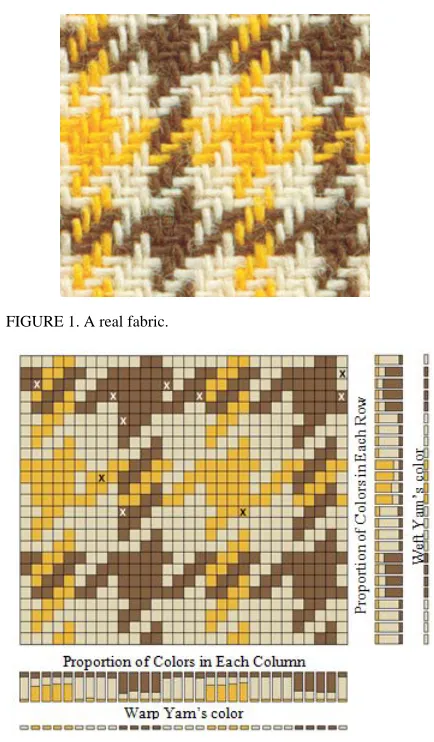
We used a real fabric which is shown in Figure 1 as an example to expound our proposed method. With the size of 232×254 pixels, it could be observed that this fabric is 2/2 right twill. After being processed by the simplified method in [19], the color pattern of this real fabric could be obtained as Figure 2. Notice that the 10 floats’ of misrecognized color are marked by “×”. The misjudgment rate is about 10/(25×30)=1.33%. The proportion of colors that appear in each row and column is calculated; the colors which appear frequently as shown on the far right and the bottom of Figure 2 are considered as the color of each weft and warp yarn.
FIGURE 1. A real fabric.
FIGURE 2. Color pattern and the yarns’ layout.
As [5, 7], the float type of each crossover point can be inferred as follows:
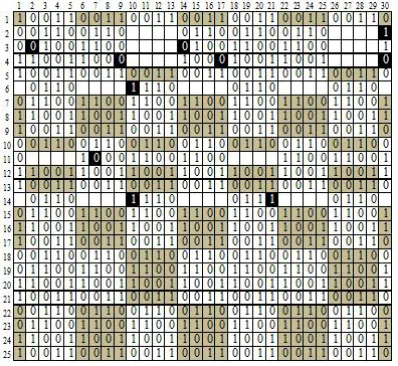
According to the rules mentioned above, its corresponding partly determined weave pattern can be illustrated by Figure 3, in which “0” and “1” represent the weft float and warp float respectively. Those crossover points with misjudgment color certainly generate the wrong weave pattern values, such as the black background elements in Figure 3.
FIGURE 3. The rough partly determined weave pattern.
EL (Extraction and Location) Method
In regard to recognizing the whole weave pattern, or in another words, filling all the blanks in the partly determined weave pattern, [7] used a pattern-database-method, and obtained the weave repeat by the Su-index-based method. As mention in [7], to use this Su-index-based method, there is an important assumption that should be satisfied firstly: no error in the recognized color pattern. That is, the Su-index-based method becomes useless in dealing with the error-inside-color-patter such as Figure 2.
Therefore, we propose an EL method (demonstrated by Figure 4) to find the repeat unit from the error-inside partly determined weave pattern like Figure 3. It can be observed from Figure 4 that, the EL method is based on cycle attempts. For each vector needed to extract the repeat unit, we assume the length of the repeat unit in this vector to be a certain value gn, and detect whether this assumption is right. If not right, the EL method will go to another cycle: the value of gn will be reset, and the correctness of this new gn will be redetected. The criteria for judging the
correctness of gn is, when separating the vector into gn groups like Figure 5, whether all the elements in each group are identical. Once this criterion is satisfied, the EL method stops circulation. Since the repeat unit is always longer than 2 crossover points, this loop unit’s length gn could be set as 2 at first and increased by each iteration. However, the value of gn should be set with an upper limit. Because if there are misrecognitions in this vector, no matter how long this loop unit length is set, all the elements in each group cannot be identical. Generally speaking, the fabric image for testing at least contains three weave repeat units in horizontal and vertical, so the upper limit of gn (referred as MAX) could be set as one third of the vector length.
When processed by the EL method, any vector needed to detect the repeat unit can only reach these two possible ends:
1. If no error recognition had arisen in this vector in the previous color pattern, End I will be reached so that the weave repeat could be extracted as the combination of the first numbers of each group.
2. If there is error in color recognition in this vector, it will come to End II so that the weave repeat should be extracted by the subsequent procedure in Step 3.
Taking the fifth row R5 (r1,r2,…,r30) in Figure 3 as an example; as shown in Figure 6, R5 here also contains some blanks which cannot be determined as 0 or 1 in the previous step. In each iteration, R5 should be divided into gn groups. That is, when gn=2, R5 will be divided into two groups: G1=(r1,r3,r5,…,r29) and G2=(r2,r4,r6,…,r30); If gn=3, R5 will be divided into 3 groups: G1=(r1,r4,r7,…,r28), G2=(r2,r5,r8,…,r29) and G3=(r3,r6,r9,…,r30). According to the the EL method, the iteration will stop when for each group Gi, all the numbers except for the blanks in this group are identical. In the case in Figure 6, the iteration stops when gn=4, with G1 only exists 1, G2 only exists 0, G3 only exists 0 and G4 only exists 1, which
means the weave repeat in
R
5 is 1001. Then all theJournal of Engineered Fibers and Fabrics 131 http://www.jeffjournal.org FIGURE 4. The diagram of EL method.
FIGURE 5. Illustration of the EL method.
FIGURE 6. Weave pattern after EL method.
Rectify the Misrecognition
In the weave pattern obtained from the end of the last step, all the “complete” rows without blanks are regarded as having no error inside. Therefore, each “incomplete” row with blanks and errors can be compared with all the “complete” rows to find out the one with the smallest difference on the non-empty elements. Take the 2ed row R2 in Figure 6 as an
example, there are 8 blanks (r10, r11, r12, r13, r26, r27,
r28, r29) and 1 error (r30). After comparing with all the
“complete” rows (R1, R5, R7~10, R12, R13, R15~25), R2
has the smallest difference with three identical rows (R10, R18, R22) on all the non-empty elements (r1~9,
r14~25, r30). Select random one from (R10, R18, R22) to
replace R2. That is, the final R2 is
(001100110011001100110011001100). The procedure could be demonstrated as Figure 7.
After this processing, we could obtain the final weave pattern as Figure 8. And detected by the EL method again, the repeat units of rows in Figure 8 are presented as follows: 1001,0011,0110,1100. It’s easy to figure out that these four repeat units are the same. Similarly, the repeat units of columns detected by EL method are also four kinds: 1001,0011,0110,1100. Therefore, the weave repeat of Figure 1 could be obtained as Figure 9.
FIGURE 7. Rectify the error.
FIGURE 8. Final weave pattern.
FIGURE 9. Weave repeat.
Since the color pattern and weave pattern are corresponding to each other, the error recognition in color pattern can also be corrected after the rectification of weave pattern here. For every element in weave pattern, do as follows:
When the element equals 1, the crossover point in the according position in color matrix should be the same color with its warp yarn. If not, change it in color matrix.
When the element equals 0, the crossover point in the according position in color matrix should be the same color with its weft yarn. If not, change it in color matrix.
Journal of Engineered Fibers and Fabrics 133 http://www.jeffjournal.org FIGURE 11. Color repeat.
The color pattern after the above processing could be shown as Figure 10. It could be observed that, all 10 wrong recognized elements are rectified which presented by “O”. Similarly, after replacing each color by a number, the color repeat can also be obtained easily by EL method.
RESULTS
In this section, three real fabrics are used to validate the error-tolerance of EL method. The experiment environment is matlab2012b.
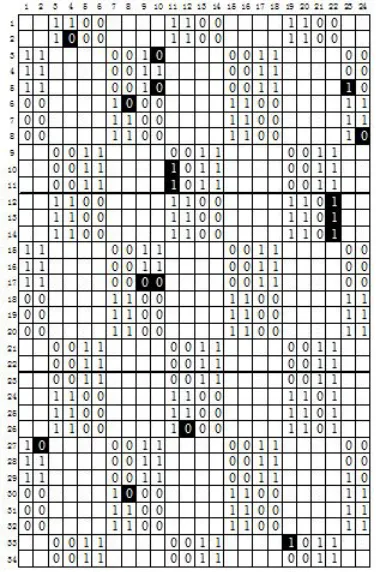
The fabric in Figure 12 has twisted warp yarns which leads to a large potential of error recognition in color pattern. Being processed by the similar method in [19], we obtain a rough color pattern as shown in Figure 13, which containing 17 misrecognition crossover points. Figure 14 is the rough weave pattern directly inferred from color pattern, while Figure 15 is the partly determined weave pattern after processing by EL method. The same as discussed above, all the rows without error recognition are filled completely. The final weave pattern after rectifying is shown in Figure 16, and the automatic-obtained repeat units of weft and warp yarns are 1001 and 001110 respectively, demonstrated by Figure 17. The final color pattern in Figure 18 has no error recognition at all, while the color repeat can also be obtained automatically as Figure 19.
FIGURE 12. A real fabric.
FIGURE 14. Partly determined weave pattern.
FIGURE 15. After EL method.
FIGURE 16. Final weave pattern.
Journal of Engineered Fibers and Fabrics 135 http://www.jeffjournal.org FIGURE 18. Final color pattern
FIGURE 19. Color repeat.
Figure 20 is another real fabric containing 242×499 pixels. The misrecognition rate for this fabric researches 38/(25×39)=3.8974%, as shown in Figure 21. Figure 22, Figure 23, and Figure 24 are the rough weave pattern directly inferred from the color pattern, the partly determined weave pattern after processing by EL method, and the final weave pattern after rectifying respectively. Notice that, the 10th,11th,20th,21st and 22nd rows have misrecognitions but without blanks, the EL method figured them out and marked as yellow background as shown in Figure 23 and Figure 24. Meanwhile the repeat unit was automatically detected as Figure 25, which is a typical plain unit. All those 38 wrong recognized elements are rectified which presented by “O” in Figure 26.
FIGURE 20. A real fabric.
FIGURE 21. Rough color pattern.
FIGURE 22. Partly determined weave pattern.
FIGURE 24. Final weave pattern.
FIGURE 25. Weave repeat.
FIGURE 26. Final color pattern.
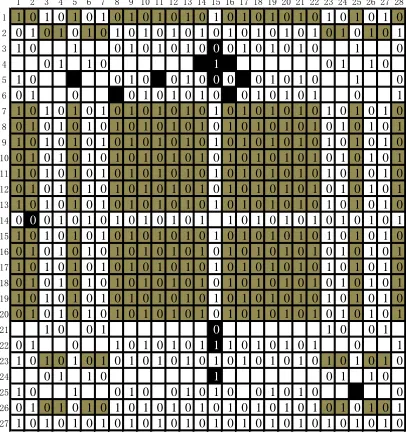
The fabric in Figure 27 contains 197×159 pixels. It could be observed from the rough color pattern in Figure 28 that, the misrecognition mainly caused by the similarity between the white yarns and the yellow yarns. Therefore, there are 8 crossover points (those who are black blanks in Figure 29 and Figure 30) are misrecognized as yellow, neither the color of theirs warp yarns, nor their weft yarns’. The same as previous experiments, all those 14 misrecognition elements are rectified in Figure 31.
FIGURE 27. A real fabric.
X X X X
X X X X
X X
X
X X
X
X
FIGURE 28. Rough color pattern.
1 2 3 4 5 6 7 8 9 10 11 12 13 14 15 16 17 18 19 20 21 22 23 24 25 26 27 28
1 1 0 0 1 1 1 0 0 1
2 0 1 0 1 0 1 0 1 0 1 0 1 0 1 0 1 0 1 0 1 3 1 0 1 0 1 0 1 0 1 0 0 0 1 0 1 0 1 0 1 0
4 0 1 1 0 1 0 1 1 0
5 1 0 0 1 0 0 1 0 0 0 0 1 0 1 0 1 0 6 0 1 0 0 1 0 1 0 1 0 0 1 0 1 0 1 0 1
7 1 0 0 1 1 1 0 0 1
8 0 1 1 0 0 0 1 1 0
9 1 0 0 1 1 1 0 0 1
10 0 1 1 0 0 0 1 1 0
11 1 0 0 1 1 1 0 0 1
12 0 1 1 0 0 0 1 1 0
13 1 0 0 1 1 1 0 0 1
1400 0 1 0 1 0 1 0 1 0 1 0 1 1 0 1 0 1 0 1 0 1 0 1 0 1
15 1 0 0 1 1 1 0 0 1
16 0 1 1 0 0 0 1 1 0
17 1 0 0 1 1 1 0 0 1
18 0 1 1 0 0 0 1 1 0
19 1 0 0 1 1 1 0 0 1
20 0 1 1 0 0 0 1 1 0
21 1 0 0 1 0 1 0 0 1
220 1 0 1 0 1 0 1 0 1 1 1 0 1 0 1 0 1 0 1 231 0 1 0 1 0 1 0 1 0 1 0 1 0 1 0 1 0 1 0
24 0 1 1 0 1 0 1 1 0
251 0 1 0 1 0 0 1 0 1 0 0 1 0 1 0 0 260 1 0 1 0 1 0 1 0 1 0 1 0 1 0 1 0 1 0 1
27 1 0 0 1 1 1 0 0 1
Journal of Engineered Fibers and Fabrics 137 http://www.jeffjournal.org
1 2 3 4 5 6 7 8 9 10 11 12 13 14 15 16 17 18 19 20 21 22 23 24 25 26 27 28 1 1 0 1 0 1 0 1 0 1 0 1 0 1 0 1 0 1 0 1 0 1 0 1 0 1 0 1 0 2 0 1 0 1 0 1 0 1 0 1 0 1 0 1 0 1 0 1 0 1 0 1 0 1 0 1 0 1 3 1 0 1 0 1 0 1 0 1 0 0 0 1 0 1 0 1 0 1 0
4 0 1 1 0 1 0 1 1 0
5 1 0 0 1 0 0 1 0 0 0 0 1 0 1 0 1 0 6 0 1 0 0 1 0 1 0 1 0 0 1 0 1 0 1 0 1 7 1 0 1 0 1 0 1 0 1 0 1 0 1 0 1 0 1 0 1 0 1 0 1 0 1 0 1 0 8 0 1 0 1 0 1 0 1 0 1 0 1 0 1 0 1 0 1 0 1 0 1 0 1 0 1 0 1 9 1 0 1 0 1 0 1 0 1 0 1 0 1 0 1 0 1 0 1 0 1 0 1 0 1 0 1 0 100 1 0 1 0 1 0 1 0 1 0 1 0 1 0 1 0 1 0 1 0 1 0 1 0 1 0 1 111 0 1 0 1 0 1 0 1 0 1 0 1 0 1 0 1 0 1 0 1 0 1 0 1 0 1 0 120 1 0 1 0 1 0 1 0 1 0 1 0 1 0 1 0 1 0 1 0 1 0 1 0 1 0 1 131 0 1 0 1 0 1 0 1 0 1 0 1 0 1 0 1 0 1 0 1 0 1 0 1 0 1 0 1400 0 1 0 1 0 1 0 1 0 1 0 1 1 0 1 0 1 0 1 0 1 0 1 0 1 151 0 1 0 1 0 1 0 1 0 1 0 1 0 1 0 1 0 1 0 1 0 1 0 1 0 1 0 160 1 0 1 0 1 0 1 0 1 0 1 0 1 0 1 0 1 0 1 0 1 0 1 0 1 0 1 171 0 1 0 1 0 1 0 1 0 1 0 1 0 1 0 1 0 1 0 1 0 1 0 1 0 1 0 180 1 0 1 0 1 0 1 0 1 0 1 0 1 0 1 0 1 0 1 0 1 0 1 0 1 0 1 191 0 1 0 1 0 1 0 1 0 1 0 1 0 1 0 1 0 1 0 1 0 1 0 1 0 1 0 200 1 0 1 0 1 0 1 0 1 0 1 0 1 0 1 0 1 0 1 0 1 0 1 0 1 0 1
21 1 0 0 1 0 1 0 0 1
220 1 0 1 0 1 0 1 0 1 1 1 0 1 0 1 0 1 0 1 231 0 1 0 1 0 1 0 1 0 1 0 1 0 1 0 1 0 1 0 1 0 1 0 1 0 1 0
24 0 1 1 0 1 0 1 1 0
251 0 1 0 1 0 0 1 0 1 0 0 1 0 1 0 0 260 1 0 1 0 1 0 1 0 1 0 1 0 1 0 1 0 1 0 1 0 1 0 1 0 1 0 1 271 0 1 0 1 0 1 0 1 0 1 0 1 0 1 0 1 0 1 0 1 0 1 0 1 0 1 0
FIGURE 30. After EL method.
1 2 3 4 5 6 7 8 9 10 11 12 13 14 15 16 17 18 19 20 21 22 23 24 25 26 27 28 1 1 0 1 0 1 0 1 0 1 0 1 0 1 0 1 0 1 0 1 0 1 0 1 0 1 0 1 0 2 0 1 0 1 0 1 0 1 0 1 0 1 0 1 0 1 0 1 0 1 0 1 0 1 0 1 0 1 3 1 0 1 0 1 0 1 0 1 0 1 0 1 0 10 1 0 1 0 1 0 1 0 1 0 1 0 4 0 1 0 1 0 1 0 1 0 1 0 1 01 0 1 0 1 0 1 0 1 0 1 0 1 0 1 5 1 0 1 0 1 0 1 0 1 0 10 1 0 10 1 0 1 0 1 0 1 0 1 0 1 0 6 0 1 0 1 0 1 0 10 1 0 1 0 1 0 1 0 1 0 1 0 1 0 1 0 1 0 1 7 1 0 1 0 1 0 1 0 1 0 1 0 1 0 1 0 1 0 1 0 1 0 1 0 1 0 1 0 8 0 1 0 1 0 1 0 1 0 1 0 1 0 1 0 1 0 1 0 1 0 1 0 1 0 1 0 1 9 1 0 1 0 1 0 1 0 1 0 1 0 1 0 1 0 1 0 1 0 1 0 1 0 1 0 1 0 100 1 0 1 0 1 0 1 0 1 0 1 0 1 0 1 0 1 0 1 0 1 0 1 0 1 0 1 111 0 1 0 1 0 1 0 1 0 1 0 1 0 1 0 1 0 1 0 1 0 1 0 1 0 1 0 120 1 0 1 0 1 0 1 0 1 0 1 0 1 0 1 0 1 0 1 0 1 0 1 0 1 0 1 131 0 1 0 1 0 1 0 1 0 1 0 1 0 1 0 1 0 1 0 1 0 1 0 1 0 1 0 1401 0 1 0 1 0 1 0 1 0 1 0 1 0 1 0 1 0 1 0 1 0 1 0 1 0 1 151 0 1 0 1 0 1 0 1 0 1 0 1 0 1 0 1 0 1 0 1 0 1 0 1 0 1 0 160 1 0 1 0 1 0 1 0 1 0 1 0 1 0 1 0 1 0 1 0 1 0 1 0 1 0 1 171 0 1 0 1 0 1 0 1 0 1 0 1 0 1 0 1 0 1 0 1 0 1 0 1 0 1 0 180 1 0 1 0 1 0 1 0 1 0 1 0 1 0 1 0 1 0 1 0 1 0 1 0 1 0 1 191 0 1 0 1 0 1 0 1 0 1 0 1 0 1 0 1 0 1 0 1 0 1 0 1 0 1 0 200 1 0 1 0 1 0 1 0 1 0 1 0 1 0 1 0 1 0 1 0 1 0 1 0 1 0 1 211 0 1 0 1 0 1 0 1 0 1 0 1 0 10 1 0 1 0 1 0 1 0 1 0 1 0 220 1 0 1 0 1 0 1 0 1 0 1 0 1 01 0 1 0 1 0 1 0 1 0 1 0 1 231 0 1 0 1 0 1 0 1 0 1 0 1 0 1 0 1 0 1 0 1 0 1 0 1 0 1 0 240 1 0 1 0 1 0 1 0 1 0 1 0 1 01 0 1 0 1 0 1 0 1 0 1 0 1 251 0 1 0 1 0 1 0 1 0 1 0 1 0 1 0 1 0 1 0 1 0 1 0 10 1 0 260 1 0 1 0 1 0 1 0 1 0 1 0 1 0 1 0 1 0 1 0 1 0 1 0 1 0 1 271 0 1 0 1 0 1 0 1 0 1 0 1 0 1 0 1 0 1 0 1 0 1 0 1 0 1 0
FIGURE 31. Final weave pattern.
FIGURE 32. Weave repeat.
CONCLUSION
Since the extraction of weave/color repeat unit is based on the weave/color pattern recognition, while the recognition accuracy of weave/color pattern could not be guaranteed by the existing methods, we proposed a simple but efficient method to identify the repeat unit in weave/color automatically. Only with the color pattern of the fabric to be detected, our method can solve three problems simultaneously, even though there are errors in color pattern recognition. Our method extracts the weave/color repeat unit, identifies the full weave pattern, and rectifies the misrecognition in color pattern if there is one.
When given the color pattern of a fabric, whether with error recognition or not, the layout of color yarns is obtained by a statistical solution in our method: each warp/weft yarn color is considered as the color appearing most frequently in this column/row. Then a rough weave pattern is partly determined according to the correlation between color pattern and weave pattern, only leaving the float state of those crossover points whose weft and warp yarns have the same color undecided. The repeat unit of each row in this rough partly determined weave pattern can be extracted through a procedure of tentative grouping. When every group achieves internal uniformity, the repeat unit is obtained and as all float states of those previous undecided crossover points are set identically with others in the same group. Otherwise, if even only one group could not reach internal uniformity, there must be wrong color recognition in this row, which can be fixed by comparing with other rows without misrecognition. Finally, the color repeat unit can also be extracted in the same way from the rectified color pattern.
ACKNOWLEDGEMENT
The authors are grateful for the financial supported by Jiangsu Province Nature Science funds (BK20130160) and the Self-Determined Research Program of Jiangnan University (1232050205120960).
REFERENCES
[2] J. Escofet, M. S. Millán, and M. Ralló, “Modeling of woven fabric structures based on Fourier image analysis,” Applied Optics, vol. 40, no. 34, pp. 6170-6176, 2001.
[3] S. A. H. Ravandi, and K. Toriumi, “Fourier transform analysis of plain weave fabric appearance,” Textile Research Journal, vol. 65, no. 11, pp. 676-683, 1995.
[4] F. Ajallouian, H. Tavanai, M. Palhang, S. Hosseini, S. Sadri, and K. Matin, “A novel method for the identification of weave repeat through image processing,” The Journal of The Textile Institute, vol. 100, no. 3, pp. 195-206, 2009.
[5] B. Xin, J. Hu, G. Baciu, and X. Yu, “Investigation on the classification of weave pattern based on an active grid model,” Textile Research Journal, vol. 79, no. 12, pp. 1123-1134, 2009.
[6] H. Wu, M. Zhang, Z. Pan, and H. Yin, "Automatic identifying weave patterns for double-layer weft woven fabric." pp. 117-122.
[7] R. Pan, W. Gao, J. Liu, H. Wang, and X. Zhang, “Automatic detection of structure parameters of yarn-dyed fabric,” Textile Research Journal, vol. 80, no. 17, pp. 1819-1832, 2010.
[8] R. Pan, W. Gao, J. Liu, and H. Wang, “Automatic recognition of woven fabric patterns based on pattern database,” Fibers and Polymers, vol. 11, no. 2, pp. 303-308, 2010.
[9] A. Lachkar, R. Benslimane, L. D'Orazio, and E. Martuscelli, “Textile woven fabric recognition using Fourier image analysis techniques: Part II–texture analysis for crossed-states detection,” Journal of the Textile Institute, vol. 96, no. 3, pp. 179-183, 2005.
[10] T. Matsuyama, S. I. Miura, and M. Nagao, “Structural analysis of natural textures by Fourier transformation,” Computer vision, graphics, and image processing, vol. 24, no. 3, pp. 347-362, 1983.
[11] M. S. Millán, and J. Escofet, “Fourier-domain-based angular correlation for quasiperiodic pattern recognition. Applications to web inspection,” Applied optics, vol. 35, no. 31, pp. 6253-6260, 1996.
[12] M. Ralló, J. Escofet, and M. S. Millán, “Weave-repeat identification by structural analysis of fabric images,” Applied optics, vol. 42, no. 17, pp. 3361-3372, 2003. [13] E. J. Wood, “Applying Fourier and
associated transforms to pattern characterization in textiles,” Textile Research Journal, vol. 60, no. 4, pp. 212-220, 1990.
[14] C. C. Huang, S. C. Liu, and W. H. Yu, “Woven fabric analysis by image processing Part I: identification of weave patterns,” Textile Research Journal, vol. 70, no. 6, pp. 481-485, 2000.
[15] B. S. Jeon, J. H. Bae, and M. W. Suh, “Automatic recognition of woven fabric patterns by an artificial neural network,” Textile Research Journal, vol. 73, no. 7, pp. 645-650, 2003.
[16] T. J. Kang, C. H. Kim, and K. W. Oh, “Automatic recognition of fabric weave patterns by digital image analysis,” Textile Research Journal, vol. 69, no. 2, pp. 77-83, 1999.
[17] J. J. Lin, “Applying a co-occurrence matrix to automatic inspection of weaving density for woven fabrics,” Textile research journal, vol. 72, no. 6, pp. 486-490, 2002. [18] C. Y. Shih, and J. Y. Lee, “Automatic
recognition of fabric weave patterns by a fuzzy C-means clustering method,” Textile Research Journal, vol. 74, no. 2, pp. 107-111, 2004.
[19] R. Pan, W. Gao, J. Liu, and H. Wang, “Automatic detection of the layout of color yarns for yarn-dyed fabric via a FCM algorithm,” Textile Research Journal, vol. 80, no. 12, pp. 1222-1231, 2010.
[20] P. Ruru, G. Weidong, and L. Jihong, "Skew rectification for yarn-dyed fabric via FFT in HSL color space." pp. 481-485.
Journal of Engineered Fibers and Fabrics 139 http://www.jeffjournal.org
AUTHORS’ ADDRESSES Di Zhou, PhD
Luoqing Zhou Xinyi Sheng PhD Jun Sun