WWJMRD 2017; 3 (11): 10-16 www.wwjmrd.com
International Journal Peer Reviewed Journal Refereed Journal Indexed Journal UGC Approved Journal Impact Factor MJIF: 4.25 e-ISSN: 2454-6615
Manpreet Kaur
Research Scholar, M.Tech Computer Engineering Yadavindra College of Engineering Talwandi Sabo, Bathinda, PB, India
Ashok Kumar Bathla Assistant Professor, Computer Department, Yadavindra College of Engineering, Talwandi Sabo, Bathinda, PB, India
Correspondence: Manpreet Kaur
Research Scholar, M.Tech Computer Engineering Yadavindra College of Engineering
Talwandi Sabo, Bathinda, PB, India
Detection of Bus Driver Fatigue Based on Robust
Visual Analysis of Eye and Face State
Manpreet Kaur,
Ashok Kumar Bathla
Abstract
Driver Fatigue is usually caused by four main factors: sleep, work, time of day, and physical. Usually individuals try and do a lot of in a very day and that they lose precious sleep thanks to this. Usually by taking caffein or alternative stimulants individuals still stay up. The dearth of sleep builds up over variety of days and also the next issue that happens is that the body finally collapses and also the person falls asleep. Time of day factors will usually have an effect on the body. The human brain is trained to suppose there are times the body ought to be asleep. of these issues are resolved with the assistance of SVM and another technique. In this work we are getting the maximum result and maximum accuracy with HOG and SVM. In the Base paper they are getting maximum 80% eye closure, but here the eye closure is 90%. So we can say the maximum accuracy is the 90% of this work.
Keywords: Driver Fatigue, IR, EOG, ECG &EEG etc
Introduction
Fatigue, somnolence and somnolence area unit typically used synonymously in driving state description [1]. Involving multiple human factors, it's two-dimensional in nature that researchers have found troublesome to outline over past decades [2]–[5]. Despite the anomaly encompassing fatigue, it's a crucial issue for driving safety. Studies have shown that fatigue is one amongst the leading conducive factors in traffic accidents worldwide [6]. it's notably crucial for activity drivers, like drivers of buses and serious trucks, thanks to the very fact that they will need to beat up a protracted length of the driving task, throughout the height somnolence periods (i.e., 2:00 A.M. to 6:00 A.M. and 2:00 P.M. to 4:00 P.M.), and below monotonous or dissatisfaction operating conditions [7], [8]. Analysis to observe driver somnolence is classified into 3 categories: 1) vehicle-based approaches, 2) behavior-based approaches, and 3) physiological-signal based mostly approaches (see [7], [9] for an honest review). In physiological approaches, the physiological signals from a body, like EEG (EEG) for brain activity, electrooculogram (EOG) for eye movement, and cardiogram (ECG) for pulse rate, area unit evaluated to observe driver somnolence [10]–[ 5]. Recent studies show that the strategies victimization physiological signals (specially the graphical record signal) can do higher responsibility and accuracy of driver somnolence detection compared to alternative strategies [6]. However, the intrusive nature of measure physiological signals will hinder driving, particularly for prolonged driving periods. Vehicle based mostly approaches collect signal knowledge from sensors in vehicles to judge driver’s performance. These strategies monitor the variations of hand wheel angle, lane position, speed, acceleration, and braking to predict the motive force fatigue [7]–[2-1]. It’s convenient to gather vehicle signals. However, these approaches could be too slow to observe driver somnolence [7]. Behavior-based approaches depend upon vision analysis to watch driver’s behavior, together with eye-closure, eye-blinking, yawning, head pose, hand gesture, etc., through a camera directed to driver’s face [2]–[7]. The motive force is alerted if a somnolence symptom is detected. The vision-based systems on behavior analysis area unit enticing to automobile industries since {they area unit they’re non-intrusive to the motive force and therefore the measures are effective and reliable to predict driver fatigue [8].
~ 11 ~ A drowsy driver displays variety of symptoms, together with frequent eye-closure, speedy and constant blinking, cernuous or swinging head, and frequent yawning [9]. Within the last decade, varied vision systems are developed to observe such behaviors of somnolence for driving safety. Most of the present systems need the installation of a camera directly toward the driver’s face to capture high-resolution face pictures, and a few of them use specifically designed infra-red (IR) cameras [3], [10] or stereo cameras. The vision algorithms area unit designed for high-resolution front-view face and eye pictures (e.g., the peak
of the face is over hour of image height in input pictures over 640 × 480 pixels). This configuration isn't applicable for buses and enormous vehicles. A bus largely incorporates a massive front glass window to let the motive force have a wide-field-view of scene for safe driving since it's a lot of wider than cars. Putting a camera on the front glass window isn't sensible, which additionally blocks the drivers’ read. If the camera is put in on the frame round the window, the camera isn't ready to capture the frontal read of driver’s face, in order that existing vision algorithms aren't applicable [9].
Fig.1: Existing dome camera in the bus and example images of bus drivers captured by the dome cameras in buses. Only an oblique view of low-resolution face images can be captured by the existing dome cameras for normal driving poses. (Images came from open sources of bus
service companies with face portions of the drivers being pixelated for keeping anonymity.)[1]
Driver basic cognitive process may well be the results of a scarcity of alertness once driving attributable to driver temporary state and distraction. Driver distraction happens once associate in nursing object or event attracts a person’s attention far away from the driving task. Not like driver distraction, driver temporary state involves no triggering event however, instead, is characterised by a progressive withdrawal of attention from the road and traffic demands. each driver temporary state and distraction, however, may need an equivalent effects, i.e., minimized driving performance, longer latency, Associate in Nursingd an multiplied risk of crash involvement[11]. Driving may be a complicated task wherever the driving force is accountable of observance the road, taking the proper call on time and at last responding to alternative driver's actions and totally different road conditions. “Fig.1.2”, shows the diagram of overall system. supported Acquisition of video from the camera that's ahead of driver perform real-time operation of Associate in Nursing incoming video stream so as to infer the driver’s level of fatigue if the temporary state is calculable then the output is send to the warning device and alarm is activated. There are units several strategies for police work the driving force temporary state. The signs of the driving force temporary state are [12].
Driver is also yawn oftentimes.
Driver is unable to stay eyes open.
The driving force cannot bear in mind driving the previous few miles.
Drift into the opposite lane or onto the shoulder of the road
Defining Drowsiness
The term "drowsy" is substitutable with asleep, that merely suggests that Associate in Nursing inclination to go to sleep. The stages of sleep is classified as awake, non-rapid
eye movement sleep(NREM),and speedy eye movement sleep(REM).The second stage, NREM, is subdived into the subsequent 3 stages. Stage
1: Transition from attentive to asleep (drowy) stage 2: Light sleep stage
3: Deep sleep
• Factors inflicting Driving sleepiness
Driver Fatigue is commonly caused by four main factors: sleep, work, time of day, and physical. Usually folks try and do abundant during a day and that they lose precious sleep as a result of this. Usually by taking alkaloid or alternative stimulants folks still not blink. The dearth of sleep builds up over variety of days and therefore the next issue that happens is that the body finally collapses and therefore the person falls asleep. Time of day factors will usually have an effect on the body. The human brain is trained to suppose there are a unit times the body ought to be asleep. This area unit usually related to seeing the sunrise and sunset. Between the hours of two AM and half-dozen AM, the brain tells the body it ought to be asleep. Extending the time awake can eventually result in the body bally. the ultimate issue may be a person’s wholeness. Folks typically area unit on medications that make sleepiness or have physical ailments that cause these problems. Being physically unfit, by being either below or overweight can cause fatigue. To boot, being showing emotion stressed can cause the body to urge played out faster.
connected Study sleepiness detection is divided into 3 main classes
”Fig.2”, shows the 3 completely different approaches for sleepiness detection. Sleepiness detection relies on these 3 parameters. an in depth review on these measures can give insight on this systems, problems related to them and therefore the enhancements that require to be done to form a sturdy system[7].
Fig.2: Different Approaches for Drowsiness Detection and Warnings [2]
Perclos
PERCLOS (percent Eye Closure) is a video-based method that measures eye closure. One of the strengths of PERCLOS is that tries have been made to establish its validity as a fatigue detection device. First-rate relationships have been obtained between eye closure and lapses in attention, presenting some convergent evidence. While a measure correlates with different exams believed to degree the equal and construct of the gadget’s capability to stumble on the cutting-edge kingdom of the driver. Furthermore, PERCLOS confirmed the clearest courting with performance on a riding simulator in comparison to a number of different capability drowsiness detection devices inclusive of electroencephalographic (EEG) algorithms, a head tracker device, and two wearable eye-blink video display units among many drowsiness detection measures consistent with a study completed through [11], drivers in an car simulator showcase positive characteristics while drowsy, that may be without problems observed in the attention and facial changes [11]. Alert drivers had been stated to have a normal facial tone, and rapid eyes blinks with brief everyday glances. Drowsy drivers have been stated to have reduced facial tone and slower eyelid.
Support Vector Machine
In system mastering, help vector machines (SVMs, also assist vector networks [1]) are supervised mastering fashions with related getting to know algorithms that analyze statistics used for category and regression analysis.
Given a fixed of training examples, every marked as belonging to 1 or the alternative of categories, an SVM training algorithm builds a model that assigns new examples to 1 class or the other, making it a non-probabilistic binary linear classifier (although methods such as Platt scaling exist to use SVM in a probabilistic classification putting). An SVM version is a representation of the examples as points in area, mapped in order that the examples of the separate classes are divided through a clear hole this is as huge as viable. New examples are then mapped into that identical area and anticipated to belong to a class primarily based on which side of the gap they fall. In addition to appearing linear type, SVMs can effectively carry out a non-linear class the usage of what's called the kernel trick, implicitly mapping their inputs into excessive-dimensional function areas.
when information aren't classified, supervised studying is not feasible, and an unmanaged gaining knowledge of method is needed, which attempts to find natural clustering of the statistics to companies, after which map new facts to these fashioned businesses. The clustering algorithm which affords an development to the help vector machines is
known as guide vector clustering[2] and is
frequently[citation needed] used in commercial
applications both when statistics are not classified or when only a few statistics are categorized as a preprocessing for a class bypass.
Behavioral Measures
~ 13 ~ which include connected factor evaluation, Cascade of Classifiers or Hough remodel, Gabor filter out, Haar algorithm are carried out to come across the face, eye or mouth. After localizing the unique location of interest within the photograph, capabilities inclusive of PERCLOS, yawning frequency and head perspective, are extracted the use of an green feature extraction approach, together with Wavelet Decomposition, Gabor Wavelets, Discrete Wavelet remodel or Condensation set of rules. The behavior is then analyzed and classified as both ordinary, slightly drowsy, fantastically drowsy through the usage of category methods inclusive of help vector machine, fuzzy classifier, neural classifier and linear discriminant analysis. However, it has been observed that the price of detecting the right characteristic, or the percentage of success amongst some of detection attempts, varies depending at the application and wide variety of classes. The determination of drowsiness the use of PERCLOS and Eye Blink has an achievement charge of near a hundred% [13] and ninety eight% [15], respectively. However it must be referred to that, the high positive detection rate carried out via [13] turned into whilst the topics didn’t wear glasses. Likewise, as most researchers performed their experiments in simulated environment they completed a higher success fee.
Methodology
A novel vision system is proposed to deal with these challenges, which integrates upper-body detection, face detection, eye detection, eye openness estimation, fusion, and symptom measure estimation. The framework is illustrated in Fig. The core innovative algorithms are eye-openness estimation and fusion. We propose a manifold learning algorithm which can learn a mapping from a low-resolution eye image (e.g., 32 ×24 pixels) to a 1-dimensional continuous level of eye-openness. There are two advantages of this approach. First, there is no need to detect eye feature points for symptom estimation that often fails on low-resolution face images. Second, it avoids classifying the ambiguous partially closed eyes into open or close state for binary state (0/1) classification. This improves the accuracy of identifying “drowsy” state between “normal” and “sleepy” states. To obtain an accurate and robust estimate of eye openness, a novel fusion algorithm is proposed which adaptively integrates the results of eye openness estimations on the multi-model eye detections for both eyes. Based on the innovative techniques, the system achieves robust performance on the challenging scenarios where the existing approaches often fail.
Proposed Algorithm
In this work the real time person images are taken to process the detection of driver fatigue problem. The Proposed Steps are given below:
Step 1: Start the webcam for image acquisition.
Step 2: Store all the images in one folder for making database.
Step 3: Create a object detector to detect face, Eyes, Mouth and Neck of the Person.
Step 4: Apply the Row Segmentation to segment the face, Eyes, Mouth and Neck of the Person.
Step 5: Apply the feature extraction to extract the fatigue and Non fatigue features.
Step 6: Apply SVM Classifier for train and testing the extracted features.
Step 7: Identify the fatigue and non-fatigue message based on extracted features.
Step 8: Calculate False Positive Rate (FPR) and False Negative Rate (FNR).
Step 9: Compare the existing results.
Step 10: Stop and Repeat for multiple person’s data.
Result & Discussion
In this the different snap shorts are defined to solve the above problem and objective of the research work. These are given below :
Fig. 4: right eye segmentation
Fig. 5: Right eye processing with SVM
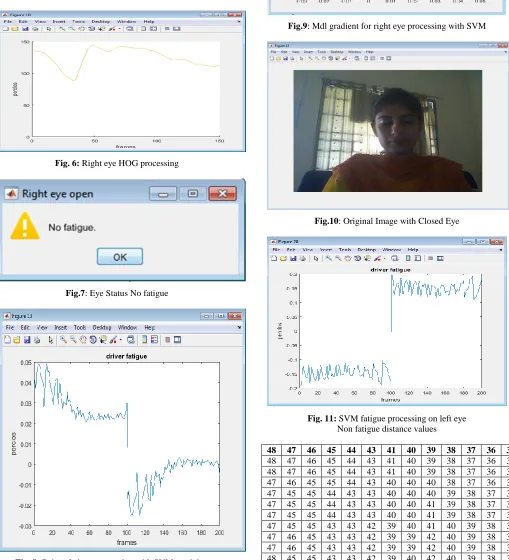
The figure 3 is the original image of the person and the figure 4 is the segmented image, in which right eye is segmented. The figure 5 is the SVM processing of image.
Fig. 6: Right eye HOG processing
Fig.7: Eye Status No fatigue
Fig. 8: Driver fatigue processing with SVM on right eye
Fig.9: Mdl gradient for right eye processing with SVM
Fig.10: Original Image with Closed Eye
Fig. 11: SVM fatigue processing on left eye Non fatigue distance values
48 47 46 45 44 43 41 40 39 38 37 36 35
48 47 46 45 44 43 41 40 39 38 37 36 35 48 47 46 45 44 43 41 40 39 38 37 36 35 47 46 45 45 44 43 40 40 40 38 37 36 35 47 45 45 44 43 43 40 40 40 39 38 37 36 47 45 45 44 43 43 40 40 41 39 38 37 36 47 45 45 44 43 43 40 40 41 39 38 37 37 47 45 45 43 43 42 39 40 41 40 39 38 37 47 46 45 43 43 42 39 39 42 40 39 38 38 47 46 45 43 43 42 39 39 42 40 39 38 38 48 45 45 43 43 42 39 40 42 40 39 38 38
~ 15 ~
38 37 36 35 34 33 32 31 30 29 28 27 38 37 36 35 34 33 32 31 30 29 28 27 38 37 36 35 34 33 32 31 30 29 28 27 37 36 35 34 33 32 31 30 29 28 27 27 36 35 34 33 33 32 31 30 29 28 26 26 35 34 33 32 32 31 30 29 28 27 26 26 34 33 32 31 31 30 29 28 27 26 26 26 33 32 31 30 30 30 29 28 27 26 25 26 31 31 30 29 29 29 28 27 26 25 25 26 31 31 30 29 29 29 28 27 26 25 25 26 30 30 29 28 28 28 27 26 26 25 25 26
Conclusion
The increasing number of traffic accidents due to a diminished driver’s vigilance level has become a serious problem for society. Statistics show that 20% of all the traffic accidents are due to drivers with a diminished vigilance level. Furthermore, accidents related to driver hypo-vigilance are more serious than other types of accidents, since sleepy drivers often do not take correct action prior to a collision. For this reason, developing systems for monitoring driver’s level of vigilance and alerting the driver, when he is drowsy and not paying adequate attention to the road, is essential to prevent accidents. The prevention of such accidents is a major focus of effort in the field of active safety research. People in fatigue show some visual behaviors easily observable from changes in their facial features like eyes, head, mouth and face. Computer vision can be a natural and non-intrusive technique to monitor driver’s vigilance. Faces as the primary part of human communication have been a research target in computer vision for a long time. The driver fatigue detection is considered as one of the most prospective commercial applications of automatic facial expression recognition. Automatic recognition (or analysis) of facial expression consists of three levels of tasks: face detection, facial expression information extraction, and expression classification. In these tasks, the information extraction is the main issue for the feature based facial expression recognition from an image sequence. It involves detection, identification and tracking facial feature points under different illuminations, face orientations and facial expressions. In this research work SVM Classifier is applied to detect the fatigue problem and getting the different results. Here the accuracy of the work is 70%.
Future Scope
The driver fatigue is the major problem in today’s world, because due to the downiness problem day by day accidents are increased. In the future work it further implemented with the help of Neural Network and other real time sensor devices. So that more accuracy is achieved.
References
1. Mbouna, Ralph Oyini, Seong G. Kong, and
Myung-Geun Chun. "Visual analysis of eye state and head
pose for driver alertness monitoring." IEEE
transactions on intelligent transportation systems 14, no. 3 (2013): 1462-1469.
2. Sigari, Mohamad-Hoseyn, Muhammad-Reza
Pourshahabi, Mohsen Soryani, and Mahmood Fathy. "A review on driver faces monitoring systems for fatigue and distraction detection." (2014).
3. Rafeeq, Md, And B. Upender. "Implementation of Eye
State and Head Pose For Driver Alertness Monitoring System." (2014).
4. Ghimire, Deepak, Sunghwan Jeong, Sunhong Yoon,
Sanghyun Park, and Juhwan Choi. "Real-time sleepiness detection for driver state monitoring system." Adv. Sci. Technol. Lett 120 (2015): 1-8. 5. Kaur, Harinder. "Driver Drowsiness Detection System
Using Image Processing." International Journal On
Advanced Computer Theory And Engineering
(IJACTE) ISSN (Print): 23192526, Volume 4, Issue -5, 2015.
6. Engelbrecht, Jarret, Marthinus Johannes Booysen,
Gert-Jan van Rooyen, and Frederick Johannes Bruwer. "Survey of smartphone-based sensing in vehicles for intelligent transportation system applications." IET Intelligent Transport Systems 9, no. 10 (2015): 924-935.
7. Yu, Jiadi, Zhongyang Chen, Yanmin Zhu, Yingying
Chen, Linghe Kong, and Minglu Li. "Fine-grained
Abnormal Driving Behaviors Detection and
Identification with Smartphones." IEEE Transactions on Mobile Computing (2016).
8. Mandal, Bappaditya, Liyuan Li, Gang Sam Wang, and
Jie Lin. "Towards Detection of Bus Driver Fatigue Based on Robust Visual Analysis of Eye State." IEEE
Transactions on Intelligent Transportation
Systems (2016).
9. Ohn-Bar, Eshed, and Mohan Manubhai Trivedi.
"Looking at humans in the age of self-driving and highly automated vehicles." IEEE Transactions on Intelligent Vehicles 1, no. 1 (2016): 90-104.
10. Dong, Weishan, Ting Yuan, Kai Yang, Changsheng
Li, and Shilei Zhang. "Autoencoder Regularized
Network For Driving Style Representation
Learning." arXiv preprint arXiv: 1701.01272 (2017). 11. May, Jennifer F., and Carryl L. Baldwin. "Driver
fatigue: The importance of identifying causal factors of
fatigue when considering detection and
countermeasure technologies." Transportation
Research Part F: Traffic Psychology and Behaviour 12, no. 3 (2009): 218-224.
12. M.-H. Sigari, M.-R. Pourshahabi, M. Soryani, and M. Fathy, “A review on driver face monitoring systems for fatigue and distraction detection,” Int. J. Adv. Sci. Technol., vol. 64, pp. 73–100, 2014.
13. C. Zhang, H. Wang, and R. Fu, “Automated detection
of driver fatigue based on entropy and complexity measures,” IEEE Trans. Intell. Transp. Syst., vol. 15, no. 1, pp. 168–177, Feb. 2014.
14. E. Ohn-Bar and M. Trivedi, “Hand gesture recognition
in real time for automotive interfaces: A multimodal vision-based approach and evaluations,”IEEE Trans. Intell. Transp. Syst., vol. 15, no. 6, pp. 2368–2377, Dec. 2014.
15. P. Forsman, B. Vila, R. Short, C. Mott, and H. van Dongen, “Efficient driver drowsiness detection at moderate levels of drowsiness,” Accid. Anal. Prevent vol. 50, pp. 341–350, 2013.
16. R. Mbouna, S. Kong, and M.-G. Chun, “Visual
analysis of eye state and head pose for driver alertness monitoring,” IEEE Trans. Intell. Transp.Syst., vol. 14, no. 3, pp. 1462–1469, Sep. 2013.
17. A. Dasgupta, A. George, S. Happy, and A. Routray, “A
18. A. Sahayadhas, K. Sundaraj, and M. Murugappan, “Detecting driver drowsiness based on sensors: A review,” Sensors, vol. 12, pp. 16 937–16 953, 2012. 19. M. Patel, S. Lal, D. Kavanagh, and P. Rossiter,
“Applying neural network analysis on heart rate variability data to assess driver fatigue,” Exp. Syst. Appl., vol. 38, pp. 7235–7242, 2011.
20. S. Kar, M. Bhagat, and A. Routary, “EEG signal analysis for the assessment and quantification of drivers fatigue,” Transp. Res. F, Traffic Psychol. Behav., vol. 13, no. 5, pp. 297–306, 2010.
21. S. Hu and G. Zheng, “Driver drowsiness detection with
eyelid related parameters by support vector machine,” Exp. Syst. Appl., vol. 36, pp. 7651–7658, 2009.
22. M. Kurt, N. Sezgin,M. Akin, G. Kirbas, and M.
Bayram, “The ANN-based computingof drowsy level,”Exp. Syst. Appl., vol. 36, pp. 2534–2542, 2009. 23. C. Liu, S. Hosking, and M. Lenne, “Predicting driver