IJSRSET1841172 | Received : 15 January 2018 | Accepted : 02 February 2018 | January-February-2018 [(4) 1 : 983-988]
© 2018 IJSRSET | Volume 4 | Issue 1 | Print ISSN: 2395-1990 | Online ISSN : 2394-4099 Themed Section : Engineering and Technology
983
Role of Smart Cities in Urbanization of Haryana : A Case Study
Dr. Balwan SinghAssociate Professor, Department of Geography, Government College, Karnal, Haryana, India
ABSTRACT
Though a boon, urbanization also brings along with it several challenges that can act as a barrier to growth achieved over a period of time. It is a proven fact, that the trend has a straight correlation with growth. However, if not efficiently managed, it can lead to a negative proposition. In the recent past, Haryana has seen a natural progression in its development story, with its villages turning into towns, and towns transforming into cities. Now, the time has arrived for the state to transform its cities into smart cities and achieve vision of smart urbanization.
Keywords : Urbanization, Population, Smart City
I.
INTRODUCTION
1.1 About Haryana
Haryana is among the northern most states in India and adjacent to national capital Delhi. It is surrounded by Uttar Pradesh in the east, Punjab in the west, Himachal Pradesh in the north and Rajasthan in the south. The state surrounds the national capital city, New Delhi, from three sides. Historically an agrarian state, Haryana today is a well-developed industrial state.
The state is one of India's largest automobile hubs and accounts for two thirds of passenger cars, 50 per cent of tractors and 60 per cent of motorcycles manufactured in the country. The state has also emerged as a base for the knowledge industry, including IT and biotechnology. Haryana is the third-largest exporter of software and one of the preferred destinations for IT/ITeS facilities.
Fig 1
Although Haryana has an area covering just 1.3 per cent of the country, Haryana contributes nearly 3.58 per cent to India's GSDP. During FY12-17, the state’s GSDP grew at a compound annual growth rate (CAGR) of 12.96 per cent. At current prices, the total GSDP of Haryana was about US$ 85 billion in 2016-17.
The state has attracted Foreign Direct Investment (FDI) equity inflows worth US$ 70.39 billion during the period April 2000 to June 2017, according to data released by Department of Industrial Policy and Promotion (DIPP).
for businesses under the Industrial and Investment Policy, 2011. Haryana stands 14th among Indian states in rankings based on ease of doing business and reforms implementation, according to a study by the World Bank and KPMG.
1.2 Recent Developments:
The Government of Haryana has signed a memorandum of understanding (MoU) with Verbind in November 2017. As per the memorandum, a logistics and trading hub is to be built in the state which will attract investments of around Rs 20,000 crore (US$ 3.1 billion).
Amazon, the Seattle-headquartered e-commerce company that operates an online marketplace opened its 22nd fulfilment centre in Sonipat, Haryana.
A medical college will be set up in each district of Haryana to meet the rising healthcare requirements.
Walmart India Private Limited plans to open its chain of stores in Haryana, while Micromax also has plans to set up a mobile handset manufacturing unit in the National Capital Region.
A Swedish organisation Kunskapsskolan is working with the government to improve vocational education at 100 state run schools. 1.3 Key Sectors:
Haryana is a preferred destination for auto majors and auto-component manufacturers. The state is host to many large automotive players.
Gurgaon has emerged as a preferred destination for the IT industry in North India, with more than 400 IT and ITeS companies.
Haryana aggressively promotes organic farming; financial assistance is provided to farmers for production and use of vermicompost.
Abundant availability of raw materials gives Haryana a competitive advantage in the textile sector. The total cotton production in Haryana during FY17 was around 2 million bales.
Exchange Rate Used: INR 1 = US$ 0.0155 as on
1.4 GSDP of Haryana
Haryana is a leading state in the country on both the industrial and agricultural front. Haryana is one of the leading states in terms of industrial production, especially passenger cars, two-wheelers, mobile cranes and tractors. Haryana is the second-largest contributor of food grains to India’s central pool and accounts for more than 60 per cent of the export of Basmati rice in the country, third-largest exporter of software and one of the preferred destinations for IT/ITeS facilities.
During FY12-17, the state’s GSDP grew at a compound annual growth rate (CAGR) of 12.96 per cent. At current prices, the total GSDP of Haryana was about US$ 85 billion in 2016-17. The state accounted for 7 per cent of India’s agricultural exports in 2016-17.
Fig 2
Haryana is a preferred destination for auto majors and auto-component manufacturers. The state is host to many large automotive players. The state produces two-thirds of passenger cars, 50 per cent of tractors, 60 per cent of motorcycles and 50 per cent of the refrigerators manufactured in the country.
corridor and Delhi- Mumbai Industrial Corridor (DMIC). Haryana enjoys a locational advantage, with nearly one-third of the state’s area under the National Capital Region (NCR), a prominent trade and consumption centre.
The state offers a wide range of fiscal and policy incentives for businesses under the Industrial and Investment Policy, 2011. Moreover, it has sector-specific policies, particularly for IT and tourism. The Haryana State Industrial and Infrastructure Development Corporation Ltd (HSIIDC) is the state's premier industrial promotion and investment facilitation agency, responsible for providing reliable and efficient facilities for entrepreneurs investing in the state.
The state has taken a number of steps for developing industrial infrastructure to achieve consistent economic growth. The following are some of the initiatives:
HSIIDC has developed a number of industrial estates, industrial model townships (IMT) and specialized parks for cluster development.
An industrial model township is under-construction at Manesar, near Gurgaon. The region is being developed as an automotive and engineering hub.
The government is developing sector specific theme parks and sub-cities along the KMP Expressway.
Single-window clearance mechanism was established under the Haryana Industrial Promotion Act, 2005. It has a three-tier structure to grant exemption/relaxation from any of the provisions/rules of the Act.
The state government acquired 1,000 acres of land for a dedicated pharma park in the KMP express global economic corridor.
The state invested in the development of world class infrastructure facilities such as special economic zones (SEZs), Kundli-Manesar-Palwal (KMP) global corridor and Delhi-Mumbai Industrial Corridor (DMIC).
The International Centre for Automotive Technology (ICAT) has been set up at Manesar as a part of the National Automotive Testing and R&D Infrastructure Project (NATRiP). It provides testing and R&D services to the industry.
As of September 2017, the state had 7 operational SEZs, 23 formally approved SEZs, 3 SEZs with principal approval and 20 notified SEZs.
The state government has proposed a sliding railway and logistic centre in IMT Manesar for smoother transportation and more effective inventory management.
The state government has extended various incentives to companies within the sector, including relaxation in floor area ratio, rebate on registration, transfer of property charges and exemption under the Haryana Shop & Commercial Act.
Haryana is the first state to have implemented its State Wide Area Network (SWAN) for voice, data and video transmission.
The state government has established a Regional Centre for Biotechnology (RCB), Gurgaon under the guidance of UNESCO as a Category II Centre. The Government of Haryana has signed a
memorandum of understanding (MoU) with Verbind in November 2017. As per the memorandum, a logistics and trading hub is to be built in the state which will attract investments of around Rs 20,000 crore (US$ 3.1 billion).
II.
URBANIZATION TOWARDS SMART CITY
Fig 3
Haryana has shown a positive growth pattern since its formation years. However, it has also led to rapid urbanization as per the global trend. Urban growth has increased much after state formation in 1966. In the 1981 Census, urban population touched 22% and as per the 1991 Census, it increased to around 25%. The establishment of Haryana Urban Development Authority (HUDA) also promoted the process of urbanisation as it launched new industrial projects and developed residential sectors in some districts. This led to urbanisation figures reaching 28.92% in 2001 and touching 34.79% in the 2011 Census. As per the 2011 Census, Faridabad is the most urbanized district (79.44%) followed by Gurgaon (68.82%), Panchkula (54.87%), Panipat (45.47%) on account of industrial development, strategic location, administrative function and close proximity to NCR.
2.1 Future Urbanization Trend of Haryana
Fig.4. Source: CII-PWC Report
Fig 5
Source: CII-PWC Report
Urbanization is vital for a nation’s economic development. It brings with it opportunities for economic growth and provides additional prospects of entrepreneurship as well as employment to the population. This enables faster inclusion of more people within the growth story and is therefore more inclusive.
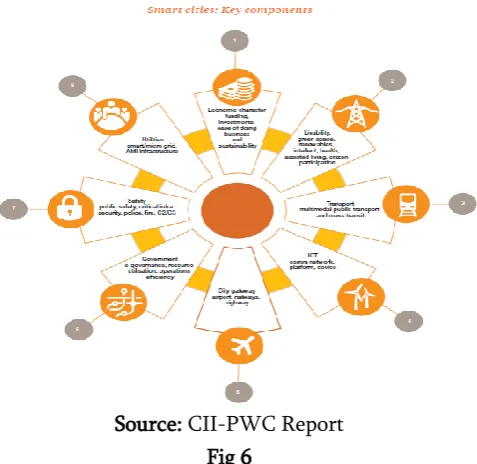
2.2 Smart Cities: Key Components
Source: CII-PWC Report Fig 6
infrastructure set up so as to enhance the quality of life of its citizens, provides a positive investment climate for businesses, and equips governments to maximize resource utilization and provide transparency. They can be considered as organic integration of various systems which includes IT, physical, social and business infrastructure. These systems collectively work together in order to generate intelligent and actionable information for decision-makers.
2.3 Shift from a traditional to a smart city model
The inclination to adopt the smart city model is driven by the need to surpass the challenges posed by traditional cities. Overcoming these critical challenges in a systematic manner is critical for cities exploring a shift towards more sustainable city development measures among all stakeholders: citizens, businesses and the government. The quality of delivery from foundational elements of traditional cities is enhanced by leveraging technology.
Source: CII-PWC Report\ Fig 7
2.4 Framework for sustainable city development
Merely investing in enhancing a city’s infrastructure is not sufficient. Projects that primarily focus on expanding capacity are not necessarily the most effective way of serving community needs, and neither are they sustainable in the long run. Absence of a viable business model and oversight will challenge the economic feasibility as well as the effectiveness of such investments. Such projects will
constantly require funds and assistance from the government and external agencies, and still not ensure quality. For urbanization to be successful, three goals need to be achieved where the benefits have to be the following:
• Socially equitable • Economically viable
• Environmentally sustainable
III. ASSESSING THE SMART CITY AGENDA AND
SHORT LISTING THE KEY AREAS OF FOCUS
3.1 Water and sewage
24x7 supply of water
Metering of water connections, billing and collection efficiency
Online payment facility
Households connected to the waste water/sewerage network
Treatment of waste water, use of treated water
3.2 Solid waste Management
City population with regular solid waste collection
Collection and recycling of municipal solid waste
City solid waste that is disposed in a sanitary Landfill/open dump/burnt
Hazardous waste recycling 3.3 Transport
Traffic management system
City parking management
Access to paratransit
Availability and frequency of mass transport
Traffic violation detection/ speed violation detection/ red light violation detection
Availability of bicycle tracks 3.4 Public Safety
City surveillance
Online FIR, complaints etc. registration
Verification/validations/clearance
3.5 Health
Number of hospitals based on population density requirement
Healthcare facilities
Emergency response facilities
Ambulance, emergency ward etc and response time
3.6 Education
Primary and secondary education Facilities
School for specially abled
Student teacher ratio
Number of schools and colleges based on population density requirement
3.7 Power
24x7 quality electricity supply
Metering, collection and billing
Low distribution losses
Energy efficiency, street lightening projects 3.8 Fire and Disaster Management
Fire station basis population density
Efficient fire fighting systems and special materials
Disaster prediction system- earthquake etc – early warning system, disaster alarm and response System
IV. CONCLUSION
City governments as well as administrators need to develop an implementable strategy on ways to achieve the future development goals of a sustainable and competitive urbanisation that can address social, environmental and economic issues in an integrated manner. However, the most pressing challenge for many cities and their respective administrators is the implementation of these goals and transforming city strategies into reality.
The starting point for a city is formulating a clear vision that captures its strategic ambition. In order to channelise all resources towards accomplishing this vision, the city’s management has to develop multiple internal capabilities: a competent leadership, a resilient city brand and the ability to
needs to manage its finances effectively. It also needs to have the capability to manage its key programmes as well as projects, performance risks and assets, including the human capital employed in performing any of the city’s functions. All of these initiatives need to be executed in a sustainable manner, and through collaboration and partnering with citizens, the private sector, academia and non-governmental organizations (NGOs).