Protecting against Multidimensional Linear and
Truncated Differential Cryptanalysis by
Decorrelation
C´eline Blondeau1, Aslı Bay, and Serge Vaudenay2
1 Department of Computer Science, School of Science, Aalto University, Finland 2
EPFL, Lausanne, Switzerland
Abstract. The decorrelation theory provides a different point of view on the security of block cipher primitives. Results on some statistical at-tacks obtained in this context can support or provide new insight on the security of symmetric cryptographic primitives. In this paper, we study, for the first time, the multidimensional linear attacks as well as the trun-cated differential attacks in this context. We show that the cipher should be decorrelated of order two to be resistant against some multidimen-sional linear and truncated differential attacks. Previous results obtained with this theory for linear, differential, differential-linear and boomerang attacks are also resumed and improved in this paper.
Keywords:decorrelation theory, multidimensional linear cryptanalysis, truncated differential cryptanalysis.
1
Introduction
In the last 25 years many statistical attacks have been proposed and implemented on different symmetric key cryptographic primitives. Nowadays, new symmetric primitives are not considered secure until evaluation by the community. But it is often difficult to evaluate the security of a cipher due to the large number of known attacks.
In 1998, Vaudenay [18,21] introduced the decorrelation theory to prevent this long and tedious security evaluation. When a cipher is designed and proved secure up to a certain degree of decorrelation, it is secure against a wide range of statistical attacks. Among statistical attacks, differential cryptanalysis [8], linear cryptanalysis [17] and their generalizations have been prominent. For instance, we know that a cipher decorrelated of order two is resistant to the classical differential and linear cryptanalysis. Recently [7], it has been shown that the primitives should be decorrelated of order four to be protected against differential-linear [13,3] and boomerang [22] attacks.
different differentials or linear approximations has not yet been studied in the context of decorrelation theory. In this paper, we study the decorrelation order of the multidimensional linear and truncated differential attacks. In particular, we show that a cipher is protected against multidimensional linear attacks if it is decorrelated of order two. Some elements of the proof are related to the link between multidimensional linear attacks and truncated differential attacks which was discovered by Blondeau and Nyberg [9,10]. Using the result obtained for a special truncated differential distinguisher, we have been able to determine that the truncated differential attacks involving a large number of input differences are also decorrelated of order two. Using the decorrelation theory, in this paper, we provide for the first time an intuition on the power of truncated differen-tial and multidimensional linear attacks as a function of the number of involved differential or linear approximations used in the attack.
Outline. In Sect. 2, we recall some basic definitions and previous works in the context of the decorrelation theory. In Sect. 3 we study the multidimensional linear attack in this context. In Sect. 4, we study the decorrelation order of the truncated differential attack. In Sect. 5, we provide some improvement of the previous results for the well known differential, linear, differential-linear and boomerang attacks. Sect. 6 concludes this paper.
2
Preliminaries
2.1 Statistical Attacks
We recall in this section some basic definitions related to the statistical attacks studied in this paper.
Linear cryptanalysis [17] uses a linear relation between bits from plaintexts, corresponding ciphertexts, and the encryption key. Given a permutation Enc
over {0,1}`, the strength of the linear relation is measured by its correlation.
Thecorrelationof a functionEnc:F`
2→F`2 at point (α, β)∈F`2×F`2is defined as
cor(α, β) = 2−`h#x∈F2`|α·x⊕β·Enc(x) = 0 − #
x∈F`2|α·x⊕β·Enc(x) = 1
i
,
where the quantity within brackets can be computed as the Walsh transform of
α·x⊕β·Enc(x) evaluated at zero.
Through this paper, the square correlation at pointv= (α, β)∈F22` will be denoted byLPEnc(v) and corresponds toLPEnc(v) =cor2(α, β).
For the generalizations of linear cryptanalysis, such as multidimensional lin-ear cryptanalysis [14], a quantity C, called capacity, is used for evaluating the non-uniformity of the set of linear approximations.
(αj, βj) masks. In the context of multidimensional linear attacks, we define the
capacity
capEnc(V) = X
v∈V,v6=0
LPEnc(v).
In the following of this paper, we denote bykthe dimension ofV.
In differential cryptanalysis [8], the attacker is interested in finding and ex-ploiting non-uniformity in occurrences of plaintext and ciphertext differences. Given the differences ∆ ∈ F`2 and Γ ∈ F`2, the probability DP
Enc(∆, Γ) of the differential (∆, Γ) is defined as
DPEnc(∆, Γ) = 2−`#{x∈F`2|Enc(x)⊕Enc(x⊕∆) =Γ}.
The power of the generalization of differential cryptanalysis involving multiple differentials is measured by a sum or average of these probabilities. For the truncated differential attacks [15] with differences (∆, Γ) in the vector space
V⊥⊂F22` we define
PEncSTD(V⊥) = 2−2`#{(x, x0)∈F`2×F
`
2|(x⊕x
0,Enc(x)⊕Enc(x0))∈V⊥}.
We can show that,
PEncSTD(V⊥) = 2−`
X
(∆,Γ)∈V⊥
DPEnc(∆, Γ).
Derived from the general link between differential probability and linear cor-relations [12], the authors of [10,11] show a general link between multidimen-sional linear attacks and truncated differential attacks. To derive in Sect. 3 the decorrelation order of a multidimensional linear attack, we will use this link. Using our notations, Th. 1 of [11] corresponds to the following one.
Theorem 1. Let V⊥ be the set of allusuch that u·v= 0 for allv∈V. Using the previous notation, we obtain the following relation between PSTD
Enc (V⊥) and
capEnc(V):
2−kcapEnc(V) =pEncSTD(V⊥)−2−k.
Proof. We provide the proof with our settings. We have 1 +capEnc(V) =
X
v∈V
LPEnc(v)
=X
v∈V
2−`X
u
(−1)u·vDPEnc(u)
= 2−`X
u
DPEnc(u)X
v∈V
Since v 7→u·v is a group homomorphism from V toZ2, either it is balanced, or identically equal to 0 (whenu∈V⊥, by definition). We have
1 +capEnc(V) = 2k−`
X
u∈V⊥
DPEnc(u).
So,pSTD
Enc(V⊥) = 2−
k+ 2−kcap
Enc(V). ut Splitting the spaceV⊥of involved differentials to the spacesVin⊥andVout⊥ of input and output differences, we can define the truncated differential probabilityPTD Enc as follows
PEncTD(V⊥) = 2−` 1 |Vin⊥|
X
∆∈V⊥
in
#{x∈F`2|Enc(x)⊕Enc(x⊕∆)∈V
⊥
out}.
Differential-Linear Cryptanalysis. Differential and linear attacks were used to-gether for the first time by Langford and Hellman [13]. This was differential-linear cryptanalysis. The basic idea is to split the cipher under consideration into a composition of two parts. The split should be such that, for the first part of the cipher there should exist a strong truncated differential with input dif-ference ∆ and for the second part there should exist a strongly biased linear approximation with output maskβ. In [13], the particular case where the differ-ential over the first part holds with probability one has been introduced. Later on, Biham et al. [3] generalized this attack using a probabilistic truncated differ-ential on the first rounds of the distinguisher. In [11], Blondeau et al presented a general model for this attack.
pDLEnc(∆, β) = 2−`#{x|β·(Enc(x)⊕Enc(x⊕∆)) = 0}.
Boomerang Attack. In the boomerang attack, introduced in 1999 by Wagner [22], the advantage is taken from both the encryption and decryption. Given a differ-ence∆between two plaintextsxandx0, the attacker is taking advantage of the probability
pBooEnc(∆,∇) = 2−`#
x|Enc−1(Enc(x)⊕ ∇)⊕Enc−1(Enc(x⊕∆)⊕ ∇) =∆ ,
where∇ is a ciphertext difference.
2.2 The Decorrelation Theory
We consider a permutationEnc over {0,1}`. Sometimes,Enc will be a random
permutation with uniform distribution and will be denoted by C∗. Sometimes, it will be a permutation defined by a random keyK and will be denoted byCK.
Decorrelation was first presented in [18]. The non-adaptive (resp. adaptive) decorrelation ofCK of orderdis denoted byk[CK]d−[C∗]dk∞(resp.k[CK]d−
[C∗]dka). It is thek · k∞- (resp.k · ka-) distance between the matrices [CK]d and
[C∗]d. Given a randomEnc, we define [Enc]d, thed-wise distribution matrix by [Enc]d(x
Thek · k∞-norm is defined by
kMk∞= max
x1,...,xd
X
y1,...,yd
|M(x1,...,xd),(y1,...,yd)|.
A random variable can be considered as a random function from a set of cardinal-ity 1, so itsd-wise distribution matrix is a row vector and thek · k∞matrix-norm
corresponds to thek · k1vector-norm. For distributions, thek · k1-distance is also called thestatistical distance. Thek · ka-norm was defined in [20] by
kMka = max x1
X
y1
· · ·max
xd
X
yd
|M(x1,...,xd),(y1,...,yd)|.
Here is the fundamental link between the best advantage of a distinguisher and decorrelation.
Theorem 2 (Best advantage and decorrelation, Th. 10–11 of [21]).The k · k∞-decorrelation of order d of CK, k[CK]d−[C∗]dk∞, is twice the best
ad-vantage of a non-adaptive unbounded distinguisher betweenCK andC∗ which is
allowed to make dencryption queries.
Thek · ka-decorrelation of orderdofCK,k[CK]d−[C∗]dka, is twice the best
advantage of an adaptive unbounded distinguisher between CK andC∗ which is
allowed to make dencryption queries.
We sayCK isdecorrelated if its decorrelation is small. We haveperfect
decorre-lation when the decorrelation is 0. I.e., [CK]d = [C∗]d, meaning
Pr[y1=CK(x1), . . . , yd=CK(xd)] = Pr[y1=C∗(x1), . . . , yd=C∗(xd)]
for allx1, . . . , xd, y1, . . . , yd.
For instance, decorrelation of order d = 2 corresponds to that Pr[y1 =
CK(x1), y2 = CK(x2)] is always close to 2`(21`−1) for x1 6= x2 and y1 6= y2. This is the notion of pairwise independenceby Wegman and Carter [23].
Given a permutationEncover{0,1}`, we defineQ
Enc, a function from{0,1}× {0,1}`to {0,1}` by
QEnc(0, x) =Enc(x) and QEnc(1, y) =Enc−1(y).
To study distinguishers which can make encryption and decryption queries, we just consider the decorrelation of QEnc instead of the decorrelation of Enc. For this, we study the distance between [QCK]
d and [Q C∗]d.
We review some general security results below.
Distinguisher Iter: 1: fori= 1 tondo
2: pick (x1, . . . , xd)∈({0,1}`)d following distributionD
3: set yj=Enc(xj) forj= 1, . . . , d
4: set bi=T(x1, . . . , xd, y1, . . . , yd)
5: end for
6: outputf(b1, . . . , bn)
For such distinguisher, the following results have been derived in [19].
Theorem 3 (Advantage of Iter bounded by decorrelation [19], Th. 18 of [21]). For the Boolean functionT, we have
E(pIterCK)−E(pIterC∗)≤53 s
n2
2δ+ 5d 2 2×2` +
3 2k[CK]
2d−[C∗]2dk
∞
+nk[CK]2d−[C∗]2dk∞
where δ is an upper bound on the probability that the distinguisher picks a plaintext in common between any two iterations. I.e., δ = Pr[∃i, j xi = x0j :
(x1, . . . , xd)←D,(x01, . . . , x0d)←D].
Note that it was proven in [6,7] that we cannot have a general security result whenδis high or when we only have a decorrelation of order 2d−1.
Th. 3 was generalized in [19] to the case where the range ofT hasselements instead of 2:
Theorem 4 (Advantage of Iter bounded by decorrelation, Th. 7 of [19]).
If T maps onto a set of selements, we have
E(pIterC
K)−E(p Iter
C∗)≤3s3 s
n2
2δ+2d 2 2` +
d3 2`(2`−d)+
3 2k[CK]
2d−[C∗]2dk
∞
+ns 2 k[CK]
2d−[C∗]2dk
∞
where δ is an upper bound on the probability that the distinguisher picks a plaintext in common between any two iterations. I.e., δ = Pr[∃i, j xi = x0j :
(x1, . . . , xd)←D,(x01, . . . , x0d)←D].
Distinguisher AIter: 1: fori= 1 tondo
2: pick a uniformly distributed sequenceρof random coins 3: forj= 1 toddo
4: set zj=qj(QEnc(z1), . . . , QEnc(zj−1);ρ) 5: end for
6: set bi=T(QEnc(z1), . . . , QEnc(zd);ρ)
7: end for
8: outputf(b1, . . . , bn)
Theorem 5 (Advantage of AIter bounded by decorrelation [5], Th. 5 of [7]). We have
E(pAIterC
K )−E(p AIter
C∗ )≤53 s
n2
2δ+e8d22−` +2d
2 2` +
3 2k[QCK]
2d−[Q
C∗]2dk∞
+nk[QCK] 2d−[Q
C∗]2dk∞
whereδis an upper bound on the probability that the distinguisher picks a query in common between any two iterations.
In what follows we give tighter results for specific classes of iterated attacks for which we can get rid ofδand sometimes rely on a lower decorrelation order.
2.3 Previous Results in the Context of Decorrelation Theory
To obtain the decorrelation order as well as the order of the different statisti-cal attacks we have to describe the distinguishers we are working with. In this section, we describe the differential, linear, differential-linear and boomerang attacks, and recall the different results obtained for these distinguishers. A com-parison with the results obtained for the multidimensional linear and truncated differential attacks will be presented later in this paper.
Differential Cryptanalysis. Given an encryption functionEnc, adifferential dis-tinguisher (Distinguisher DC) is characterized by two differences∆ andΓ and a Boolean function f. Withniterations, it works as follows:
Distinguisher DC: 1: fori= 1 tondo
2: pickx∈ {0,1}` uniformly
3: set x0 =x⊕∆
4: set y=Enc(x) andy0=Enc(x0) 5: set bi= 1y⊕y0=Γ
6: end for
7: outputf(b1, . . . , bn)
Theorem 6 (Advantage of DC bounded by decorrelation, Th. 13 of [21]).
For the function f(b1, . . . , bn) = maxibi, we have
E(pDCCK)−E(pDCC∗)≤
n
2`−1+
n
2k[CK]
2−[C∗]2k
∞.
Linear Cryptanalysis. Given an encryption function Enc, a linear distinguisher (Distinguisher LC) is characterized by two masksαandβ, and a Boolean func-tionf. Withniterations, it works as follows:
Distinguisher LC: 1: fori= 1 tondo
2: pickx∈ {0,1}` uniformly
3: set y=Enc(x) 4: set bi=α·x⊕β·y
5: end for
6: outputf(b1, . . . , bn)
This is a non-adaptive iterated attack of order 1.
Theorem 7 (Advantage of LC bounded by decorrelation, Th. 17 of [21]).
We have
E(pLCCK)−E(p LC
C∗)≤33 r
nk[CK]2−[C∗]2k∞+
n
2`−1+ 3
3
r n
2`−1.
Differential-Linear Cryptanalysis. Given a functionEnc, adifferential-linear dis-tinguisher is characterized by a difference∆, a maskβ, and a Boolean function
f. Withniterations, it works as follows:
Distinguisher DL: 1: fori= 1 tondo
2: pickx1∈ {0,1}` uniformly 3: set x2=x1⊕∆
4: set y1=Enc(x1) andy2=Enc(x2) 5: set bi=β·(y1⊕y2)
6: end for
7: outputf(b1, . . . , bn)
This is a non-adaptive iterated attack of order 2.
Theorem 8 (Advantage of DL bounded by decorrelation, Th. 7 of [7]).
We have
E(pDLC
K)−E(p DL
C∗)≤33 s
nk[CK]4−[C∗]4k∞+n
2×2`−5
(2`−1)(2`−3)+
33
s
n 2×2
`−5
This results say that if a cipher is decorrelation to the order 4, it is protected against differential- linear cryptanalysis. It was further proven in [1, pp. 77–78] that some ciphers decorrelated to the order 3 can have a high advantage with DL. Which means that the decorrelation of order 4 is really what is needed.
Remark 9. The result from [7] was stated for a function f based on a counter
b1+· · ·+bn but it is easy to see that the proof holds for a more generalf as it
is very similar to that of Th. 7.
Boomerang Cryptanalysis. Given an encryption functionEnc, aboomerang dis-tinguisher is characterized by two differences ∆and ∇and a Boolean function
f. Withniterations, it works as follows:
Distinguisher Boo: 1: fori= 1 tondo
2: pickx1∈ {0,1}` uniformly 3: set x2=x1⊕∆
4: set y1=Enc(x1) andy2=Enc(x2) 5: set y3=y1⊕ ∇andy4=y2⊕ ∇ 6: set x3=Enc−1(y3) andx4=Enc−1(y4) 7: set bi= 1x3⊕x4=∆
8: end for
9: outputf(b1, . . . , bn)
This is anadaptive plaintext-ciphertext iterated attack of order 4.
Theorem 10 (Advantage of Boo bounded by decorrelation, Th. 8 of [7]).
For the function f(b1, . . . , bn) = maxibi, we have
E(pBooC
K)−E(p Boo
C∗)≤n
2×2`−5
(2`−1)(2`−3)+
n
2k[CK]
4−[C∗]4k
a.
It was further proven in [1, pp. 79–80] that some ciphers decorrelated to the order 3 can have a high advantage with Boo. We deduce that decorrelation of order 4 is really what is needed.
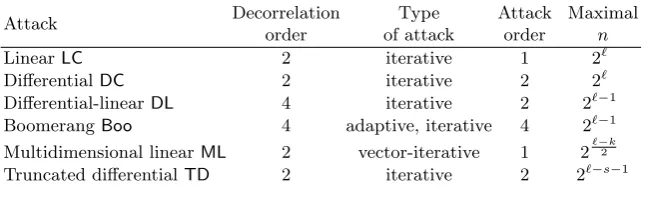
A summary of the results presented in this section (and new ones) is given in Table 1.
3
Multidimensional Linear Cryptanalysis
Distinguisher ML: 1: fori= 1 tondo
2: pick a randomx∈ {0,1}`
3: set y=Enc(x) 4: forj= 1 tokdo
5: set bi,j= (αj·x)⊕(βj·y)
6: end for
7: set bi= (bi,1, . . . , bi,k)
8: end for
9: outputf(b1, . . . , bn)
I.e., we look at the observed distribution of the bits (b1,1, . . . , bn,k) and we take
a decision by following a function f. According to this algorithm, this attack looks like a non-adaptive iterated attack of order 1, except that a vector bi is
kept instead of a bit at each iteration. We want to bound the advantage of this distinguisher for any function f. We let pML
Enc be the probability (over the selection of the random x’s) to output 1 by using the fixed function Enc. We want to bound
E(pMLCK)−E(pMLC∗)
where K is a random key,CK is the encryption under the keyK, andE(pMLCK) is the expected value over the distribution of K, and where C∗ is a uniformly distributed random permutation andE(pML
C∗) is the expected value over the
dis-tribution ofC∗.
ForEnc fixed, all vectorsbi are independent and identically distributed. We
letDEnc be the distribution of the vectorbi.
We letV be the vector space spanned by the (αj, βj) masks. We recall that
kdenotes the dimension of V.
We could apply Th. 4 withd= 1,s= 2k,δ= 2−`, and obtain
E(pMLCK)−E(p ML
C∗)≤3×2k 3 s
n2
4
2` +
1 2`(2`−1)+
3 2k[CK]
2−[C∗]2k
∞
+n2
k
2 k[CK] 2
−[C∗]2k∞.
With a negligible decorrelation, we would obtain a security for a data complexity
nup to approximately 2`2−3k. Nevertheless, this is meaningless when the dimen-sion k ofV is such thatk > `6. With the technique to develop in this section, we aim atn≈2`−2k. This makes sense untilk is close to`.
We note that ifk > `, there exists a Boolean functionbit(y) on the ciphertext and a mapping from bi = (bi,1, . . . , bi,k) to (x,bit(y)). For n relatively small,
the vectors (b1, . . . , bn) uniquely identify the keyK. So, there exists a function
f (maybe with high complexity) leading to a very high advantage. Hence, we cannot prove any security without assuming any complexity onf.
Fork=`−cste, we could have cases in which there is a mapping frombi to
which none of these xlead to bit(y). This eliminates a fraction 2−2cste+1 of the keys. So, for nwithin the order of magnitude of 22cste+1
, we uniquely determine the key. So, no information-theoretic security is feasible for these values ofn. Remark 11 (Relation with [14] and [10,11]).In [14], the functionf used to eval-uate the multidimensional linear approximation is based on LLR orχ2statistical test. In [10,11], where the relation between the truncated differential and mul-tidimensional linear key-recovery attacks is derived, the functionf is based on theχ2 test.
To provide a bound onpMLEnc−pMLEnc∗ we consider the following distinguisher,
which is a special truncated differential (STD) distinguisher:
Distinguisher STD:
1: pick two plaintextsxandx0 at random 2: set y=Enc(x) andy0=Enc(x0) 3: output 1(x0−x,Enc(x0)−Enc(x))∈V⊥
This distinguisher is a known plaintext truncated differential distinguisher using only one pair of samples. It corresponds to a non-adaptive attack using two queries.
LetpSTD
Enc be the probability that the output is 1 with Encfixed. Clearly, as given in Sect. 2.1, we have
pSTDEnc = X (∆,Γ)∈V⊥
2−`DPEnc(∆, Γ).
Lemma 12 (Euclidean distance vs. capacity). We let U be the uniform distribution. We have
kDEnc−Uk22= 2
−kcap
Enc(V). Proof. Ifv∈V, we can writev=P
jλj(αj, βj). Then,
LPEnc(v) =E(−1)v·(x,Enc(x)) 2
=E(−1)Pjλj(αj,βj)·(x,Enc(x)) 2
=E(−1)Pjλjbj 2
=E(−1)Pjλj(bj+b0j)
so,
X
v∈V
LPEnc(v) = 2kPr[b1=b01, . . . , bk=b0k] = 2 k X
b1,...,bk
from which we deduce
X
v∈V,v6=0
LPEnc(v) = 2kkDEnc−Uk22.
u t
Lemma 13 (Statistical distance of iterated distribution). Let n be an integer and Dβ be a probability distribution for β ∈ {0,1}. Let Dβ⊗n be the
distributions of vectors of nindependent samples followingDβ. We have
kD⊗0n−D1⊗nk1≤nkD0−D1k1. Proof. We use
aa0−bb0= (a−b)a
0+b0
2 + (a
0−b0)a+b
2 . We have
kD0⊗n−D⊗1nk1= 1 2
X
u,v
|D0(u)D
⊗(n−1)
0 (v)−D1(u)D
⊗(n−1) 1 (v)|
≤ 1 2
X
u
|D0(u)−D1(u)|
X
v
D0⊗(n−1)(v) +D⊗1(n−1)(v)
2 +
1 2
X
v
|D⊗0(n−1)(v)−D1⊗(n−1)(v)|X
u
D0(u) +D1(u) 2 =kD0−D1k1+kD
⊗(n−1)
0 −D
⊗(n−1) 1 k1.
We conclude by proving the result by induction. ut
Lemma 14 (Advantage of ML vs. Euclidean distance).For any fixedEnc
andEnc∗, we have
pMLEnc−pMLEnc∗≤
n2k2
2 kDEnc−DEnc∗k2.
Proof. Thanks to Th. 2, we have pMLEnc−pMLEnc∗ ≤ 12kDEnc⊗n−D⊗Encn∗k1. Then, we
have kD⊗Encn −D⊗Encn∗k1 ≤ nkDEnc −DEnc∗k1 due to Lemma 13. Next, we use
kDEnc−DEnc∗k1≤2k2kDEnc−DEnc∗k2 due to the Cauchy-Schwarz Inequality.
u t
Remark 15. Fork= 1 (linear cryptanalysis), we havecapEnc(V) =LPEnc(α1, β1). From Lemma 12 and Lemma 14, we obtain
|pMLEnc−pMLEnc∗| ≤
n
2
q
LPEnc(α1, β1) +
n
2
q
for any fixed Enc and Enc∗. From [21, Lemma 15], we know that there is a constantp0such that for any fixedEnc, we have|pMLEnc−p0| ≤2
q
nLPEnc(α1, β1). So,
|pMLEnc−pMLEnc∗| ≤2 q
nLPEnc(α1, β1) + 2
q
nLPEnc∗(α1, β1).
As we can see, the bound obtained from Lemma 14 is not tight in the case where
k= 1. We are loosing a factor√n. The loss comes from Lemma 13 which is far from being tight.
Lemma 16 (Link between ML and STD). For any fixedEncandEnc∗, we have
pMLEnc−pMLEnc∗≤
n2k2 2
q
pSTD
Enc −2−k+
n2k2 2
q
pSTD Enc∗−2−k.
Proof. We apply Th. 1, Lemma 12, Lemma 14, and the triangular inequality kDEnc−DEnc∗k2≤ kDEnc−Uk2+kDEnc∗−Uk2. ut
Lemma 17 (Using decorrelation in STD). We have
E(pSTDCK)≤E(pSTDC∗ ) +
1 2k[CK]
2−[C∗]2k
∞.
Proof. E(pSTD
CK)−E(p STD
C∗ ) expresses as the advantage of STD, a non-adaptive
distinguisher limited to two queries. We conclude by using Th. 2. ut
Lemma 18 (The ideal case in STD). We have
E(pSTDC∗ −2−k)≤2−`
1−2−k
1−2−`.
Assuming that allαj are linearly independent and that all βj are linearly
inde-pendent, we further have
E(pSTDC∗ −2−k) = 2−`
1−2−k
1−2−`.
Proof. From Th. 1, we have
pSTDEnc = 2−k+ 2−k X
v∈V,v6=0
LPEnc(v).
There are exactly 2k−1 vectors v which are non-zero. When all α
j resp. all
βj are linearly independent, neither the left half nor the right half of v is zero.
Based on [21, Lemma 14], we deduceE(LPC∗(v)) = 2`1−1 and obtain
E(pSTDC∗ ) = 2−k+ 2−k
2k−1
Without the assumption of independence, there are some of the vectors v 6= 0 such that either the left half or the right half is zero but not both. Therefore, we have LPC∗(v) = 0. Since this satisfiesE(LPC∗(v))≤ 1
2`−1, we still have
E(pSTDC∗ )≤2−k+ 2−k
2k−1
2`−1.
u t
Theorem 19 (Advantage of ML bounded by decorrelation). We have
E(pMLCK)−E(p ML
C∗)≤n q
2k−`+ 2k−1k[C
K]2−[C∗]2k∞.
Proof. We first apply Lemma 16. Then, since√·is concave, the Jensen inequality says that
E
q
pSTD Enc −2−k
≤
q
E(pSTD
Enc −2−k). By using Lemma 17 and Lemma 18, we obtain
E(pMLCK)−E(pMLC∗)≤n s
2k−`1−2
−k
1−2−` + 2 k−1k[C
K]2−[C∗]2k∞.
The bound in Th. 19 is trivial for k > `. Fork ≤`, we bound 11−−22−−k` ≤1 and
conclude. ut
4
Truncated Differential Attack
As in [10,11], we restrict to V of form Vin×Vout with Vin and Vout subspaces of {0,1}` of dimension s and q, respectively. We have V⊥ = V⊥
in ×Vout⊥. The dimension ofV⊥is 2`−k=`−s+`−q. We consider the following distinguisher:
Distinguisher TD: 1: fori= 1 tondo
2: pick (x, x0)∈({0,1}`)2uniformly such that x⊕x0∈V⊥
in 3: set y=Enc(x) andy0=Enc(x0)
4: set bi= 1((x,y)⊕(x0,y0))∈V⊥
5: end for
6: outputf(b1, . . . , bn)
The function f which computes the output depending on the vector b is left arbitrary. For instance, with f(b1, . . . , bn) = b1· · ·bn, this captures impossible
differentials [2]. This is a non-adaptive iterated attack of order 2.
Lemma 20 (Link between TD and STD). For any fixed EncandEnc∗, we have
Proof. We letp1denote the best distinguisher with sameDandn= 1. We apply Lemma 13 and we obtain
|pTDEnc−pTDEnc∗| ≤n|p1Enc−p1Enc∗|.
Clearly, depending on the sign ofp1 Enc−p
1
Enc∗, eitherp1is the probability that a
differential is found, or it is the probability that it is not found. In any case, we have 2−s|p1
Enc−p 1
Enc∗|=|pSTDEnc −pSTDEnc∗|, and we obtain the result. ut
Theorem 21 (Advantage of TD bounded by decorrelation).For the TD differential distinguisher described in this section, we have
E(pTDCK)−E(pTDC∗)≤n21+s−`
1−2−k 1−2−` +n2
s−1k[C
K]2−[C∗]2k∞.
Proof. Due to Lemma 20, we have
pTDEnc−pTDEnc∗≤n2s|pSTDEnc −2−k|+n2s|pSTDEnc∗−2−k|
=n2s pSTDEnc −2−k+n2s pSTDEnc∗−2−k
since we know from Th. 1 thatpSTD
Enc −2−k is positive. Based on Lemma 17, we have,E(pSTDC
K)−E(p STD
C∗ )≤ 12k[CK]2−[C∗]2k∞. So,
E(pTDC
K)−E(p TD
C∗)≤2n2s E(pSTDC∗ )−2−k
+n2s−1k[CK]2−[C∗]2k∞.
Due to Lemma 18, we obtain the result. ut
Remark 22. The critical term for ML in Th. 19 isn22k−1k[C
K]2−[C∗]2k∞. The
one for TD in Th. 21 is n2s−1k[C
K]2−[C∗]2k∞. Presumably, we have lost a
factornin Th. 19 and the difference between ML and TD should only bekvs.
s, the dimension ofV vs. the one ofVin.
Remark 23. Fors=`−1 andq= 1,Vin⊥has a single non-zero vector (which can be seen as a difference vector ∆) andVout has a single non-zero vector (which can be seen as a mask Γ). However, our bound is useless in that case since 21+s−` = 1. Here, we used again the loose bound of Lemma 13, but changing
n into√nwould not change this fact. Actually, TD becomes equivalent to DL in this case, and it is known that 4-decorrelation is needed to protect against DL [1]. Since our TD-security results uses 2-decorrelation, improving this bound to get a more useful one in the case of DL would require to use 4-decorrelation. Except for the equivalence to DL, these observations extend to all values ofq.
5
Improvement of Previous Results
5.1 Improvement in the Linear and Differential-Linear Contexts
If k[CK]2−[C∗]2k∞ ≈ 2−`, the bound derived in Th. 7, for linear attacks, is
approximately equal to 3(1 +√3
take advantage of up to 2`/311 plaintext-ciphertext pairs. For a 64-bit cipher,
it would corresponds to attacks with data complexity less than 255.71. In this section we provide a new bound, for linear attacks, useful fornup to 2`/24 which
is 259.42.
Th. 7, which is given in Sect. 2.1, has been originally derived in 2003 [21]. The following result consists of an improvement of the upper bound ofE(pLCCK)−
E(pLC
C∗). This improvement is obtained thanks to the Jensen equality.
Theorem 24 (Advantage of LC bounded by decorrelation, improve-ment of Th. 7). For the linear distinguisher of Sect. 2.3, we have
E(pLCCK)−E(p LC
C∗)≤2 r
nk[CK]2−[C∗]2k∞+
n
2`−1+ 2
r n
2`−1.
Proof. Based on [21, Lemma 15], we know that there is some p0 such that for every Enc, we have|pEnc−p
0| ≤2
q
nLPEnc(a, b).
To prove Th. 7, the method used in [21] consisted in getting for anyAthat3
E(pLC
Enc)−p0≤2·A √
n+A12E(LP
Enc(α, β)) and then in minimizing the sum in terms ofA. In [21],A=n−16 3
q
E(LPEnc(α, β)) was taken, to getE(pLCEnc)−p0≤ 3q3
nE(LPEnc(α, β)).
To derive the improved bound, instead, we use the Jensen inequality to obtain |E(pEnc)−p0| ≤2qnE(LPEnc(α, β)).
We consider the elementary non-adaptive distinguisher pickingxandx0 and checking ifα·(x⊕x0) =β·(Enc(x)⊕Enc(x0)). The probability of the equality is p2 + (1−p)2 = 1
2(2p−1) 2+ 1
2 where p = Pr[α·x = β ·Enc(x)]. There-fore, it is 12LPEnc(α, β) + 12 and LPEnc(α, β) expresses the advantage of a non-adaptive distinguisher using two queries. From Th. 2, we haveE(LPCK(α, β))≤
E(LPC∗(α, β)) +k[CK]2−[C∗]2k∞. From [21, Lemma 14] we obtain that
E(LPC∗(α, β)) = 1 2`−1.
u t
In the same way the bound derived for the differential-linear attack, in Th. 8 is approximately equal to 3(√3
3 +√3
2)√3n2−`and is useful for an attacker which
can take advantage to up to 2`/532 plaintext-ciphertext pairs. Using the same
technique, meaning the Jensen inequality, we can improve Th. 8 and derive a new bound in the differential-linear context which is valid for any attack using up to 2`/39 plaintext-ciphertext pairs.
3
Theorem 25 (Advantage of DL bounded by decorrelation, improve-ment of Th. 8). For the differential-linear distinguisher of Sect. 2.3, we have
E(pDLC
K)−E(p DL
C∗)≤2 s
nk[CK]4−[C∗]4k∞+n
2×2`−5
(2`−1)(2`−3)+
2
s
n 2×2
`−5
(2`−1)(2`−3).
5.2 In the Context of Differential and Boomerang Attacks, Extension of Th. 6 and Th. 10
Before providing, in this section, an extension of Th. 6 and Th. 10, we present an extension of [21, Lemma 15] for the following iterative distinguisher:
Distinguisher Dist: 1: fori= 1 tondo
2: pick a bit bi with expected valuepEnc 3: end for
4: outputf(b1, . . . , bn)
Lemma 26. Let pEnc be a probability depending on a cipher Enc. We have |E(pDist
CK )−E(p Dist
C∗ )| ≤n.max(E(pCK), E(pC∗)).
Proof. Iff(0, . . . ,0) = 0, thenpDistEnc ≤npEnc andE(pDistCK)−E(p Dist
C∗)≤E(pDistC
K)≤
nE(pCK). Similarly, we have E(p Dist
C∗)−E(pDistC
K)≤E(p Dist
C∗)≤nE(pC∗), and the
result holds in this case.
Iff(0, . . . ,0) = 1, we changef to 1−f without changing|E(pDist
C∗)−E(pDistC
K)|
and go back to the previous case. ut
Differential Distinguisher. In Sect. 2.1, the differential distinguisher is defined for a given Boolean functionf corresponding tof(b1,· · ·bn) = maxibi. In practice,
for many differential attacks more than one valid pair is necessary to distin-guish the cipher from a random permutation. In this section we generalize this distinguisher to any Boolean functionf.
Theorem 27 (Advantage of DC bounded by decorrelation, improved Th. 6). For the distinguisher DC, we have
E(pDCCK)−E(p DC
C∗)≤
n
2`−1+
n
2k[CK]
2−[C∗]2k
∞.
Boomerang Distinguisher. In the same way, we can improve the boomerang distinguisher by considering any Boolean function f. As for Th. 10, we can prove the following result.
Theorem 28 (Advantage of Boo bounded by decorrelation, improved Th. 10). For the distinguisher Boo, we have
E(pBooCK)−E(pBooC∗)≤n
2×2`−5 (2`−1)(2`−3)+
n
2k[CK]
4−[C∗]4k
a.
6
Conclusion
In this paper, we studied the multidimensional linear and truncated differential attacks in the context of the decorrelation theory. We showed that these attacks are non-adaptive iterated attacks of order 2. Table 1 summarizes the considered attacks. In particular, we obtained three types of results:
– we improved the bounds for the linear and differential-linear distinguishers (Th. 7 and Th. 8 are improved by Th. 24 and Th. 25, respectively);
– we generalized the differential and boomerang distinguishers to allow an arbitrary functionf (Th. 6 and Th. 10 are improved by Th. 27 and Th. 28, respectively);
– we proved the security for multidimensional linear and truncated differential with decorrelation (Th. 19 and Th. 21).
We let as open problems the seek for an improved Lemma 13 with√ninstead ofnas suggested in Rem. 15. This would allow for better bounds in Th. 19 and Th. 21. We shall also find better bounds based on a higher order of decorrelation, in particular to link Th. 21 to Th. 25 (see Rem. 23).
Table 1.The decorrelation order of some statistical attacks.
Attack Decorrelation Type Attack Maximal
order of attack order n
LinearLC 2 iterative 1 2`
DifferentialDC 2 iterative 2 2`
Differential-linearDL 4 iterative 2 2`−1 BoomerangBoo 4 adaptive, iterative 4 2`−1 Multidimensional linearML 2 vector-iterative 1 2`−2k Truncated differentialTD 2 iterative 2 2`−s−1
References
2. E. Biham, A. Biryukov, A. Shamir. Cryptanalysis of Skipjack Reduced to 31 Rounds Using Impossible Differentials, In Advances in Cryptology EURO-CRYPT’99, Prague, Czech Republic, Lecture Notes in Computer Science 1592, pp. 12–23, Springer-Verlag, 1999.
3. E. Biham, O. Dunkelman, N. Keller. Enhancing Differential-Linear Cryptanalysis. In Advances in Cryptology ASIACRYPT’02, Queenstown, New Zeland, Lecture Notes in Computer Science 2501, pp. 254–266, Springer-Verlag, 2002.
4. A. Bogdanov, G. Leander, K. Nyberg, M. Wang. Integral and Multidimensional Linear Distinguishers with Correlation Zero. In Advances in Cryptology ASI-ACRYPT’12, Beijing, China, Lecture Notes in Computer Science 7658, pp. 244– 261, Springer-Verlag, 2012.
5. A. Bay, A. Mashatan, S. Vaudenay. Resistance against Adaptive Plaintext-Ciphertext Iterated Distinguishers. In Progress in Cryptology INDOCRYPT’12, Kolkata, India, Lecture Notes in Computer Science 7668, pp. 528–544, Springer-Verlag, 2012.
6. A. Bay, A. Mashatan, S. Vaudenay. Resistance against Iterated Attacks by Decorre-lation Revisited. InAdvances in Cryptology CRYPTO’12, Santa Barbara, Califor-nia, U.S.A., Lecture Notes in Computer Science 7417, pp. 741–757, Springer-Verlag, 2012.
7. A. Bay, A. Mashatan, S. Vaudenay. Revisiting Iterated Attacks in the Context of Decorrelation.Cryptography and Communications, vol. 6, pp. 279–311, 2014. 8. E. Biham, A. Shamir. Differential Cryptanalysis of DES-like Cryptosystems. In
Advances in Cryptology CRYPTO’90, Santa Barbara, California, U.S.A., Lecture Notes in Computer Science 537, pp. 2–21, Springer-Verlag, 1991.
9. C. Blondeau, K. Nyberg. New Links between Differential and Linear Cryptanalysis. In Advances in Cryptology EUROCRYPT’13, Athens, Greece, Lecture Notes in Computer Science 7881, pp. 388–404, Springer-Verlag, 2013.
10. C. Blondeau, K. Nyberg. Links Between Truncated Differential and Multidimen-sional Linear Properties of Block Ciphers and Underlying Attack Complexities. In
Advances in Cryptology EUROCRYPT’14, Copenhaguen, Denmark, Lecture Notes in Computer Science 8441, pp. 165–182, Springer-Verlag, 2014.
11. C. Blondeau, G. Leander, K. Nyberg. Differential-Linear Cryptanalysis Revisited. To appear in the proceedings of FSE’14.
12. F. Chabaud, S. Vaudenay. Links Between Differential and Linear Cryptanalysis. In
Advances in Cryptology EUROCRYPT’94, Perugia, Italy, Lecture Notes in Com-puter Science 950, pp. 356–365, Springer-Verlag, 1995.
13. S.K. Langford, M.E. Hellman. Differential-Linear Cryptanalysis. InAdvances in Cryptology CRYPTO’94, Santa Barbara, California, U.S.A., Lecture Notes in Com-puter Science 839, pp. 17-25, Springer-Verlag, 1994.
14. M. Hermelin,J.Y. Cho,K. Nyberg. Multidimensional Extension of Matsui’s Algo-rithm 2. InFast Software Encryption’09, Leuven, Belgium, Lecture Notes in Com-puter Science 5665, pp. 209-227, Springer-Verlag, 2009.
15. L.R. Knudsen. Truncated and Higher Order Differentials. InFast Software Encryp-tion’93, Cambridge, United Kingdom, Lecture Notes in Computer Science 809, pp. 196–211, Springer-Verlag, 1994.
17. M. Matsui. Linear Cryptanalysis Method for DES Cipher. InAdvances in Cryptol-ogy EUROCRYPT’93, Lofthus, Norway, Lecture Notes in Computer Science 765, pp. 386-397, Springer-Verlag, 1994.
18. S. Vaudenay. Provable Security for Block Ciphers by Decorrelation. InSTACS’98, Paris, France, Lecture Notes in Computer Science 1373, pp. 249–275, Springer-Verlag, 1998.
19. S. Vaudenay. Resistance Against General Iterated Attacks. InAdvances in Cryptol-ogy EUROCRYPT’99, Prague, Czech Republic, Lecture Notes in Computer Science 1592, pp. 255–271, Springer-Verlag, 1999.
20. S. Vaudenay. Adaptive-Attack Norm for Decorrelation and Super-Pseudorandomness. In Selected Areas in Cryptography’99, Kingston, Ontario, Canada, Lecture Notes in Computer Science 1758, pp. 49–61, Springer-Verlag, 2000.
21. S. Vaudenay. Decorrelation: a Theory for Block Cipher Security.Journal of Cryp-tology, vol. 16, pp. 249–286, 2003.
22. D. Wagner. The Boomerang Attack. InFast Software Encryption’99, Roma, Italy, Lecture Notes in Computer Science 1636, pp. 156–170, Springer-Verlag, 1999. 23. M.N. Wegman, J.L. Carter. New Hash Functions and Their Use in Authentication