Original Research Article
Prevalence and pattern of social media use and its effect on social
health among Fayoum university students
Mohamed Masoud
1*, Ahmed K. Abdeltawab
2, Mohamed Abd Elmonem
2,
Ahmed T. Masoud
2, Omar M. Mohammed
2INTRODUCTION
Social media (SM) are caused a revolution in the last century. Almost everyone has access to Social media with different ways. The rapid growth and availability of network and technology as smartphones and personal computers (PCs) have made social media accessible to everyone. Social media are online platforms that enhance global and interpersonal communication and sharing amongst their users.1,2
It becomes a part of our daily lives affect people engagement and socialization with each other whatever their age, educational, cultural and economic background. Sites of social media such as Facebook, what’s up and twitter are the most widely used by students to communicate with each other’s and get information. The use of social media grew faster among youth as social media is fascinating world reduces feelings of loneliness by easy way of making friends, as well as set an excellent direction of freeing pressure.3,4
ABSTRACT
Background: Social media social media are caused a revolution in the last century. Almost everyone has access to social media with different ways. Many students use Social media for contact with each other, following updating news, and help them in their study. The study aimed to estimate the prevalence, pattern of Social media and its effects on social health of Fayoum university students.
Methods: This is a cross-sectional descriptive study involving 633 students at Fayoum university.
Results: As regards social media use, the majority of the student (94.2%) was using at least one type of SM. More than half of them (55.5%) visit (3-5) SM sites. About one third of the students (30.9%) stated that they spend (3-4) hours daily. Regarding effect of social media, one third of the students (30.2%) thought that SM sites decrease friendship level, (73.0%) limit sport time, and has a negative effect on the learning process (62.4%). The motivations for using social media were the search for news (38.1%) and making friendship (31.2%). Multiple logistic regression for factors associated with using social media revealed that age more than 20 years and male gender were significantly associated with using social media (p=0.003 and 0.016, respectively).
Conclusions: The majority of students use Social media for different reasons. Social media reduced social interrelations of the students may set down their study. So, increase awareness about the hazards of social media among students including their physical and psychosocial health. Highlighted the balanced use of social media for proper improving the learning process through prompt uses of information and communication.
Keywords: Social media, Prevalence, Social health, University students
1
Public Health Department, Faculty of Medicine, Fayoum University, Fayoum, Egypt
2
Faculty of Medicine, Fayoum University, Fayoum, Egypt
Received: 09 January 2019
Revised: 02 February 2019
Accepted: 04 February 2019
*Correspondence:
Dr. Mohamed Masoud,
E-mail: [email protected]
Copyright: © the author(s), publisher and licensee Medip Academy. This is an open-access article distributed under the terms of the Creative Commons Attribution Non-Commercial License, which permits unrestricted non-commercial use, distribution, and reproduction in any medium, provided the original work is properly cited.
Many students use social media for contact with each other, following updating news, and help them in their study all these items are the positive consequences of social media. However, there is also some negative effects of social media such as decrease interest of reading books among students and it may lead to lose some valuable information affecting students’ effectiveness as well as their grades, it lowers concentration and switch off the attention to another task and decrease the motivational level of students.5,6
The study aimed to estimate the prevalence, pattern of use social media of Fayoum university students. Also, to explore the student’s beliefs about its effect on some aspects of social health as friendship development and socialization, sports-time, and academic performance.
METHODS
Study design and population
A cross-sectional descriptive study was conducted among Fayoum University students during the academic year 2018 (The total number of students were 25,000). The study was carried out during a period of 2 months from October 2018 to November 2018. A total sample size of 385 students was calculated using Epi Info 7 based on a prevalence of 50% with a precision of 5%, and a confidence interval of 95%. Then the calculated sample size was doubled to increase the study precision. Finally, the study sample was increased by 10% to overwhelmed problems related to non-responses and missing data to reach 847 participants.
Two faculties were chosen randomly of two main types: theoretical (Faculty of Art) and practical faculty (Faculty of Medicine). Inclusion criteria were Fayoum university students aged from 18-30 years. Out of 850 distributed questionnaires (425 for each faculty), only 633 questionnaires were completely filled with a response rate was (74.5%).
The study tool
The current study was based on a self-administered, English structured questionnaire developed after several literature review and questionnaires to suite target group. It was translated into Arabic and translated back to English to be sure that the original meaning had not been lost. The questionnaire was pre-tested for refinement of the questions in order to minimize leading or confusing questions. The questionnaires were administered and collected in the same setting. It consists of questions about socio-demographics characteristics (regarding: age, sex, residency and type of faculty). The second part of questions assess prevalence of social media, pattern and its effects on social health of the students. These questions addressed the following: type of used social media, number of social media, number of hours spent, reasons for use/not use. The last part included students’
opinions about the impact of social media on friendships level, social interactions, sport-time, and it’s using in education and potential benefit in studying.
Ethical consideration
This study was reviewed and approved by the Fayoum Faculty of Medicine Research Ethical Committee. Before distributing the questionnaire, the students informed about the aim of the study. The confidentiality of their data was expressed. All participants had the right not to participate in the study.
Statistical analysis
The collected data was organized, tabulated and statistically analyzed using SPSS software statistical computer package version 18 (SPSS Inc, USA). The data was displayed as number and percentage. The chi-squared test was used as a test of significance and p≤0.05 was considered statistically significant. Multiple logistic regression analyses were performed to identify socio-demographic factors related to social media usage and negative effect of the social media on students learning.
RESULTS
This study was carried out on 633 university students; regarding their age, two third of students 453 (71.6%) were >20 years, while 180 (28.4%) were 18-20 years. Regarding gender, most students 425 (67.1%) were females and 180 (32.9%) were males. As regards the types of education, more than half 357 (56.4%) of the students were studying in a theoretical faculty while 276 (43.6%) in a practical faculty. In relation to their residence, near half 347 (54.8%) were from urban areas while the other 286 (45.2%) were inhabitants of rural areas.
As regards using social media, the majority of the student (94.2%) reported that they use at least one type of social media. Age was statistically significantly associated with using social media, (p<0.0001). Prevalence of using social media was higher among student aged more than 20 years old (96.2%) with p=0.003 also higher among males (98.1%) than females (92.2%).
Table 1: Socio-demographic factors related to prevalence and pattern of using (SM).
Prevalence (SM) using
Number of (SM) Number of hours spend daily
1-2 3-5 6-10 >10 1-2 3-4 5-8 >8 N (%)
All
students 596 (94.2) 188 (31.5) 331 (55.5) 61 (10.2) 13 (3.0) 147 (24.7) 184 (30.9) 156 (26.2) 109 (18.3) Age (years)
18-20 160 (88.9) 73 (43.6) 70 (43.8) 14 (8.8) 3 (1.9) 49 (30.6) 54 (33.8) 29 (18.1) 28 (17.5) Older than
20 436 (96.2) 115 (26.4) 261 (59.9) 47 (10.8) 13 (3.0) 98 (22.5) 130 (29.8) 127 (29.1) 81 (18.6)
P value <0.0001* <0.0001* 0.026*
Sex
Male 204 (98.1) 47 (23.0) 120 (58.8) 27 (13.2) 10 (4.9) 58 (28.4) 73 (35.8) 39 (19.1) 34 (16.7) Female 392 (92.2) 141 (36.0) 211 (53.8) 34 (8.7) 6 (1.5) 89 (22.7) 111 (28.3) 117 (29.8) 75 (19.1)
P value 0.003* 0.001* 0.014*
Education
Theoretical
faculty 339 (95.0) 110 (32.4) 188 (55.5) 30 (8.8) 11 (3.2) 84 (24.8) 100 (29.5) 85 (25.1) 70 (20.6) Practical
faculty 257 (93.1) 78 (30.4) 143 (55.6) 31 (12.1) 5 (1.9) 63 (24.59) 84 (32.7) 71 (27.6) 39 (15.2)
P value 0.327 0.458 0.356
Residence
Rural 266 (93.0) 114 (42.9) 130 (48.9) 16 (6.0) 6 (2.3) 91 (34.2) 84 (31.6) 65 (24.4) 26 (9.8) Urban 330 (95.1) 74 (22.4) 201 (60.9) 45 (13.6) 10 (3.0) 56 (17.0) 100 (30.3) 91 (27.6) 83 (25.2)
P value 0.264 <0.0001* <0.0001*
*Significant.
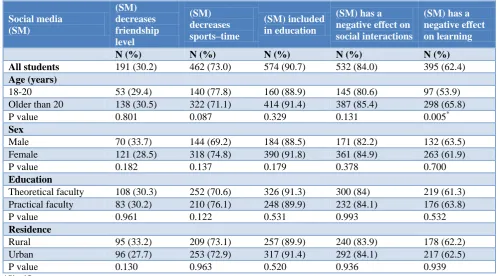
Table 2: Socio-demographic factors associated with beliefs of the students about (SM).
Social media (SM)
(SM) decreases friendship level
(SM) decreases sports–time
(SM) included in education
(SM) has a negative effect on social interactions
(SM) has a negative effect on learning
N (%) N (%) N (%) N (%) N (%)
All students 191 (30.2) 462 (73.0) 574 (90.7) 532 (84.0) 395 (62.4)
Age (years)
18-20 53 (29.4) 140 (77.8) 160 (88.9) 145 (80.6) 97 (53.9)
Older than 20 138 (30.5) 322 (71.1) 414 (91.4) 387 (85.4) 298 (65.8)
P value 0.801 0.087 0.329 0.131 0.005*
Sex
Male 70 (33.7) 144 (69.2) 184 (88.5) 171 (82.2) 132 (63.5)
Female 121 (28.5) 318 (74.8) 390 (91.8) 361 (84.9) 263 (61.9)
P value 0.182 0.137 0.179 0.378 0.700
Education
Theoretical faculty 108 (30.3) 252 (70.6) 326 (91.3) 300 (84) 219 (61.3)
Practical faculty 83 (30.2) 210 (76.1) 248 (89.9) 232 (84.1) 176 (63.8)
P value 0.961 0.122 0.531 0.993 0.532
Residence
Rural 95 (33.2) 209 (73.1) 257 (89.9) 240 (83.9) 178 (62.2)
Urban 96 (27.7) 253 (72.9) 317 (91.4) 292 (84.1) 217 (62.5)
P value 0.130 0.963 0.520 0.936 0.939
*Significant.
In relation to number of hours spent on social media, More than half of the users (55.6%) reported that they spend (1-4) hours daily and (26.2%) of student spend
residence, (p<0.05). Out of students older than 20 years, (29.1%) spent (5-8) hours versus (18.1%) for those 18-20 years old. About one third of females (29.8%) spent (5-8) hours daily versus (19.1%) for males. Also, among urban residents (27.6%) spend (5-8) hours on social media sites compared with (24.4%) for students in the rural areas, as shown in Table 1.
Regarding different beliefs of the students about (SM), (30.2%) thought that (SM) sites decrease friendship level. Most of the students believed that (SM) sites can negatively influence the social interactions (84%) and the learning process (62.4%), also decrease sport-time (73.0%). On the other hand, majority of them believed that social media was included in their study (90.7%).
Table 3: Motives for using and did not using the social media in the students in descending manner.
N %
Motives for using (SM) (n=596) *
Events and news 227 38.1
Friendship 186 31.2
Education 184 30.9
Entertainment 157 26.3
Get new information 153 25.7
Communication 140 23.5
Working 47 7.9
Playing 42 7
Motives for not using (SM) (n=37)*
Not interested 34 91.8
No privacy 6 16.2
Against culture 3 8.1
*Not mutually exclusive
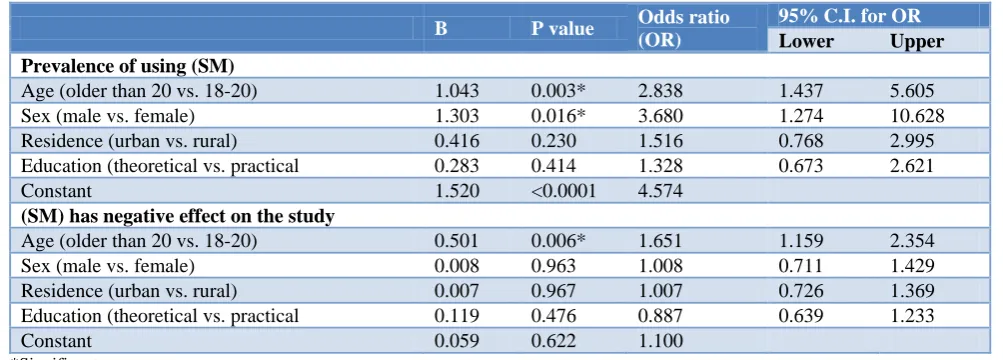
Table 4: Multiple regression analysis for factors associated with prevalence of social media use.
B P value Odds ratio
(OR)
95% C.I. for OR
Lower Upper Prevalence of using (SM)
Age (older than 20 vs. 18-20) 1.043 0.003* 2.838 1.437 5.605
Sex (male vs. female) 1.303 0.016* 3.680 1.274 10.628
Residence (urban vs. rural) 0.416 0.230 1.516 0.768 2.995
Education (theoretical vs. practical 0.283 0.414 1.328 0.673 2.621
Constant 1.520 <0.0001 4.574
(SM) has negative effect on the study
Age (older than 20 vs. 18-20) 0.501 0.006* 1.651 1.159 2.354
Sex (male vs. female) 0.008 0.963 1.008 0.711 1.429
Residence (urban vs. rural) 0.007 0.967 1.007 0.726 1.369
Education (theoretical vs. practical 0.119 0.476 0.887 0.639 1.233
Constant 0.059 0.622 1.100
*Significant.
Proportion of students who believed that social media has a negative effect on academic performance was higher in students older than 20 years than in those aged 18-20 years (65.8% vs. 53.9%), which was statistically significant, (p=0.005). In contrast, there was no a statistically significant relation between socio-demographic factors and the remaining beliefs of the student about social media, Table 2.
The most motivations for using social media among the students were the search for event and news (38.1%), making friendship (31.2%), education (30.9%), entertainment (26.3%), getting information (25.7%) and communication (23.5%).
On the other hand, as regards motives for not using social media, majority of the non social media users stated that they were not interested in social media (91.8%), Table 3.
Regarding students’ beliefs about the negative effect of social media on academic performance, only age >20 was significantly associated, p=0.006. The possibility of this belief increased about one and half fold when participants were above 20 years [OR 1.651–95% CI (1.159; 2.354)], Table 4.
DISCUSSION
The prevalence or effects of Social media on social health of Egyptian university students were reported by few studies. In our study, about (94.2%) of students use social media, these results were compatible with the findings of El-Khouly who stated that all the students used one or more social networking sites. This study was conducted among 387 students of a practical faculty (faculty of Computers and information, Helwan University) and estimates the effect of Facebook on political awareness, private lives and learning skills of students.7 Also, Kang et al, found that social media was wide spread among medical students.8 The most significant strong point of our study is the comprehensive assessment of prevalence and pattern of social media and related socio-demographic factors and the large numbers of students from theoretical and practical faculties were included.
The current study identified that the most common used device was the computer (85.5%) while (15%) used the cell phone to access websites of social media. Our results were similar to the findings of a study conducted by El-Khouly in which 62% used both their personal computers and cell phone.7
The most visited site in our research was Facebook (84.7%), WhatsApp (79.9%) and YouTube (52.9%). These findings were similar to a study conducted by Hussain, (2012) among University student in Pakistan which revealed that majority (90%) of the students used Facebook.9 Also, AlFaris et al, demonstrated that social media was also commonly used among medical students especially WhatsApp (87.8%), YouTube (60.8%) and Twitter (51.8%) for general use; while You tube (83.5%), WhatsApp (35.5%) and Twitter (35.3%) for learning purposes.10 As well, Aljabri et al, showed that the most common used sites among medical students in Jizan University in Saudi Arabia was Facebook (53%).11
With regard to time spent on social media, in the current research, more than half of social media users (55.6%) spent less than 5 hours. These results were in agreement with results of the two-conducted study in Egypt; first El-Khouly study which revealed that more than half of the university students spent time range from 2 to 5 hours and the other study conducted by Albert and divulged that (55.9%) of Facebook users spend from 1-5 hours daily.6,7 Also, Aljabri et al, detected that 58.5% of students in Saudi Arabia uses these sites for 2 to 4 hours.11
The present study revealed that prevalence of using social media was higher in males (98.1%) than in females (92.2%). Our findings were comparable to Aljabri et al, who stated that male students tended to use Facebook and WhatsApp (63.4% and 35.6% respectively) more than females.11
The most motivations for using social media among the students in the study were the search for event and news (38.1%), making friendship (31.2%), education (30.9%), entertainment (26.3%), getting information (25.7%) and communication (23.5%). Hussain demonstrated that University students used such media for sharing their learning experiences with their colleagues and international community.9 Ezeah et al, study conducted in Nigeria found out that students use social media for purposes of getting entertainment, education/ information.12
In the current study, (84%) believed that social media may lead to a decrease in social interactions. In Aljabri et al, study (45.7% and 38.7%) of the students stated that social media use led to neglect of social duties and decrease of visiting relatives/face-to-face-interaction, respectively.11
Our study showed that about one third (30.2%) thought that social media sites may reduce friendship level. On the other hand, Albert, revealed that user of Facebook did not tend to feel lonely with their lives.6
A study conducted by Okyeadie et al, among Malaysians students revealed that social media could either had positive, negative or neutral effect on the academic performance of the students depending on the reason of use.13 This study illustrated that (62.4%) of the students reported a negative effect of social media on their study. Our results showed that near half of the students spent more than 4 hours per day in accessing these sites, which has a great impact on their studies. According to Aljabri et al, results, there were (47%) of the students reported that social media made their study results to decrease.11
In contrast to these findings, Mowafy study conducted in Egypt identified a negative correlation between the students’ academic grade point average (GPA) and the time they spend on social media. Furthermore, the majority of the participants of the previous Egyptian study use social media for academic related purposes as a mean of communication.14
CONCLUSION
Recommendations
Increase awareness about the hazards of social media among students including effect on their physical and psychosocial health also to warn about the social media addiction subject. Highlighted the balanced use of social media for proper improving the learning process through prompt uses of information and communication.
Limitations
The major limitations of the current study were assessing the social media effect on the students’ education was based on their opinion, not an academic grade based system. Other factors were not taken into consideration, such as social media-related jobs.
ACKNOWLEDGEMENTS
The authors express their gratitude to Prof. Naglaa A. El-sherbiny Head of public Health Dept., Fayoum University for her professional advice, excellent guidance and continuous encouragement for the team, which lead to the success of the work.
Funding: No funding sources Conflict of interest: None declared
Ethical approval: The study was approved by the Institutional Ethics Committee
REFERENCES
1. Mushtaq AJ, Benraghda A. The Effects of Social Media on the Undergraduate Students’ Academic Performances. Library Philosophy and Practice. 2018: 1779.
2. Kietzmann, JJH, Hermkens K, McCarthy IPI, Silvestre BSB. Social media? get serious! understanding the functional building blocks of social media. Bus Horiz. 2011;54(3):241–51. 3. Ellison NB, Steinfield C, Lampe C. The benefits of
facebook “friends:” Social capital and college students’ use of online social network sites. J Comput Commun. 2007;12(4):1143–68.
4. Mattanah JF, Ayers JF, Brand BL, Brooks LJ, Quimby JL, McNary SW. A Social Support Intervention to Ease the College Transition: Exploring Main Effects and Moderators. J Coll Stud Dev. 2010;51(1):93–108.
5. Wohn DY, Larose R. Effects of loneliness and differential usage of Facebook on college adjustment of first-year students. Comput Educ. 2014;76:158–67.
6. Albert A. The Effects of Facebook on Egyptian Students' Social Well-being. Scientific Report 2012;1(10):493.
7. El-Khouly MM. Study on the Use and Impact of Online Social Networking in Egypt. J Emerging Technologies Web Intelligence 2015;7(1):1-8. 8. Kang J, Djafari Marbini H, Patel P, Fawcett N,
Leaver L. Survey of medical students’ use of social media. Clin Teach. 2015;12(6):373–7.
9. Hussain I. A Study to Evaluate the Social Media Trends among University Students. Procedia Social Behavioral Sci. 2012;64:639–45.
10. AlFaris E, Irfan F, Ponnamperuma G, Jamal A, Van der Vleuten C, Al Maflehi N. The pattern of social media use and its association with academic performance among medical students. Med Teach. 2018;40(1):S77–82.
11. Aljabry AM, Jaafari AAA, Salawi MAM, Majrabi FAT, Nagi Hazzazi MA, Khormi AHA, et al. Effect of Social Media Network on Social Relations and Academic Achievement Among Medical Students. Egyptian J Hospital Med. 2017;69(7):2910-7. 12. Ezeah GH, Asogwa CE, Edogor, Obiorah i. Social
Media Use among Students of Universities in South-East Nigeria. IOSR J Humanities Social Sci. 2013;16(3):23-32.
13. Okyeadie Mensah S, Nizam DI. the Impact of Social Media on Students’ Academic. Int J Educ Learn Train. 2016;1(1):14–21.
14. Moawfy G. Social media effects on the academic performance of Nile University students (Master thesis) retrieved from digital archive and research repository, The American University in Cairo; 2018. Available at http://dar.aucegypt.edu/handle/10526/ 5414. Accessed on 4 December 2018.