Original Research Article
Knowledge and practices regarding antenatal care among mothers of
infants in an urban area of Amritsar, Punjab
Amanpreet Kaur
1*, Jagdeep Singh
2, Harpreet Kaur
1, Harpreet Kaur
1,
Priyanka Devgun
1, Vikram K. Gupta
3INTRODUCTION
Worldwide, approximately 830 women died every single day due to complications during pregnancy or childbirth in 2015. Reducing the global maternal mortality ratio (MMR) from 216 per 100 000 live births in 2015 to less than 70 per 100 000 live births by 2030 (SDG Target 3.1) will require a global annual rate of reduction of at least 7.5% – which is more than triple the annual rate of reduction that was achieved between 1990 and 2015. Most maternal deaths are preventable as the necessary
medical interventions are well known. It is therefore crucially important to increase women’s access to quality care before, during and after childbirth. In 2016, millions of births globally were not assisted by a trained midwife, doctor or nurse, with only 78% of births were in the presence of a skilled birth attendant.1
At the country level, two countries account for a third of global maternal deaths; India at 17 percent (50,000) and Nigeria at 14 percent (40,000).2
ABSTRACT
Background: Worldwide, approximately 830 women died every single day due to complications during pregnancy or childbirth in 2015. Most maternal deaths are preventable as the necessary medical interventions are well known. So the present study was conducted to find the knowledge and practices regarding antenatal care among the mothers of infants.
Methods: The mothers having less than one year child according to the annual report of year 2017 were included in the study. A pre-designed questionnaire, which was pre tested was used to collect the information. Out of 332 mothers 327 were willing to participate in the study. House to house survey was done to collect the information. Statistical analysis was done by using SPSS 20.0.
Results: Regarding the knowledge about the antenatal care 22.0% mothers had poor knowledge while 45.6% and 32.4% had average and good knowledge respectively. Age and education status of the mother had significant relation with the knowledge regarding ANC (p=0.00). 96% of mothers started ANC in first trimester. 79.5% of mothers had regular ANC visits during pregnancy. Regarding post natal visits 86.5% of the mothers visited for the same.
Conclusions: Considerable gaps were found in the knowledge and practices regarding ANC. Health care workers play an important role in motivating the woman and her family to utilize the ANC services. The health workers should be trained adequately about the available ANC services. Community IEC activities should be increased to create awareness about the ANC services which are available free of cost in our country.
Keywords: Knowledge, Practices, ANC, Infant, Mothers, Urban
1
Department of Community Medicine, 2Department of Medicine, Sri Guru Ram Das Institute of Medical Sciences and Research, Amritsar, Punjab, India
3
Department of Community Medicine, Dayanand Medical College and Hospital, Ludhiana, Punjab, India
Received: 24 August 2018
Accepted: 11 September 2018
*Correspondence:
Dr. Amanpreet Kaur,
E-mail: [email protected]
Copyright: © the author(s), publisher and licensee Medip Academy. This is an open-access article distributed under the terms of the Creative Commons Attribution Non-Commercial License, which permits unrestricted non-commercial use, distribution, and reproduction in any medium, provided the original work is properly cited.
The care of women during pregnancy is called Antenatal care. It includes pregnant woman’s visit to antenatal clinic, examination, investigations, immunization, supplements (iron, folic acid, calcium), and the required interventions. This is a comprehensive approach to medical care and psychological support to the family that ideally begins at conception and ends with onset of labor. It envisages on-going assessment of risk, identifying and managing problems through education, counselling and medical interventions. The goal of ANC is to have a healthy mother and healthy baby at the end of pregnancy.3
The World Health Organization (WHO) envisions a world where every pregnant woman and newborn receives quality care throughout the pregnancy, childbirth and the postnatal period. Within the continuum of reproductive health care, antenatal care (ANC) provides a platform for important health-care functions, including health promotion, screening and diagnosis, and disease prevention. It has been established that by implementing timely and appropriate evidence-based practices, ANC can save lives.4
NFHS 4 highlights that in India 58.6% of mothers had antenatal check up in the first trimester, 51.2% of mothers had at least 4 antenatal care visits and 30.3% of mothers consumed IFA for 100 days or more when they were pregnant. While in Punjab figures are 75.6%, 68.5% and 42.6% for the same.5
Keeping in view the above statistics the present study was conducted to find the knowledge and practices regarding antenatal care among the mothers of infants.
METHODS
A community based cross-sectional study was conducted in the urban field practice area of the Department of Community Medicine, SGRD Institute of Medical Sciences and Research from April to June 2018. The mothers having less than one year child according to the annual report of year 2017 were included in the study. A pre-designed questionnaire, which was pre tested was used to collect the information. The basic information was collected in terms of age, education, occupation and no of children. Total 17 questions were framed on the knowledge regarding various aspects of Ante natal care and other questions were regarding practices related to ANC. For knowledge score one mark was given for a correct response, while no mark was given for a wrong response or no response. Based on the tool used, poor knowledge was implied when respondent scored <9, average knowledge if score was 9 to 13 and good knowledge if score was 14 to 17.
Verbal consent was taken from the mothers after explaining the purpose of the study. Out of 332 mothers 327 were willing to participate in the study. House to house survey was done to collect the information.
Statistical analysis was done by using SPSS 20.0. p<0.05 and p<0.01 were considered to be significant and highly significant respectively.
RESULTS
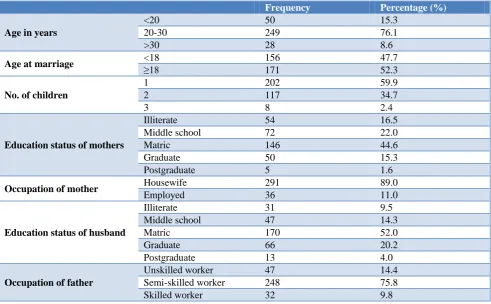
The study was a cross-sectional study conducted in the urban field practice area of the Department of Community Medicine, SGRDIMSAR, Amritsar. There were total of 327 mothers who consented for the study. Out of total mothers 76.1% were in age group of 20-30 years, while 15.3% and 8.6% were <20 and >30 year old. 52.3% of the mothers were married at the age of ≥18 years and remaining i.e. 47.7% were married at <18 years of age. Out of the total 61.8%, 35.8% and 2.4% were having 1, 2 and 3 children respectively. Regarding the education status 44.6% were studied up to matric and 16.5% were illiterate. 89% of the respondents were housewives while 11% were employed. Education profile of the fathers revealed that 52% were educated up to matric, 20.2% and 4% had done graduation and post graduation respectively. Only 9.5% were illiterate. Majority of the fathers (75.8%) were semiskilled workers, 9.8% were skilled and 14.4% were unskilled workers.
81% of the mothers had institutional delivery and rest (19%) had home delivery. Among the mothers who had hospital delivery reasons were to have safe delivery
(77.7%), motivated by health worker (15.1%),
encouraged by family (5.3%) and for free care (1.9%). Regarding the knowledge about the antenatal care 22.0% mothers had poor knowledge while 45.6% and 32.4% had average and good knowledge respectively. Age and education status of the mother had significant relation with the knowledge regarding ANC (p=0.00). 52% of the mothers knew the importance of ANC visits. 89% of the mothers could tell the correct number of minimum ANC visits. Correct no. of TT doses was known to 21.7% of mothers.
96% of mothers started ANC in first trimester. On asking about the regularity of ANC visits 79.5% of mothers had the same. As shown in Table 3 knowledge score had significant association with the starting of ANC and regular ANC (p=0.00). Among the mothers who didn’t have regular ANC visits the reasons were didn’t feel the need for ANC (50.8%), transport problem (46.3%) and family refusal (2.9%). Majority of the mothers i.e. 92% had received 2 TT doses during pregnancy.
Table 1: Socio-demographic profile of the respondents.
Frequency Percentage (%)
Age in years
<20 50 15.3
20-30 249 76.1
>30 28 8.6
Age at marriage <18 ≥18 156 47.7
171 52.3
No. of children
1 202 59.9
2 117 34.7
3 8 2.4
Education status of mothers
Illiterate 54 16.5
Middle school 72 22.0
Matric 146 44.6
Graduate 50 15.3
Postgraduate 5 1.6
Occupation of mother Housewife 291 89.0
Employed 36 11.0
Education status of husband
Illiterate 31 9.5
Middle school 47 14.3
Matric 170 52.0
Graduate 66 20.2
Postgraduate 13 4.0
Occupation of father
Unskilled worker 47 14.4
Semi-skilled worker 248 75.8
Skilled worker 32 9.8
Table 2: Association between demographic characteristics of mothers with the knowledge score.
Socio-demographic variables Knowledge score
Poor Average Good P value
Age of mother (in years)
<20 31 14 5
0.000
20-30 39 127 83
>30 2 8 18
Education of mother
Illiterate 44 5 5
0.000
Middle 28 35 9
Matric 0 99 47
Graduate 0 10 40
postgraduate 0 0 5
Occupation of mother Housewife 60 148 83 0.001
employed 12 1 23
Education of father
Illiterate 22 4 5
0.000
Middle 28 13 6
Matric 22 109 39
Graduate 0 18 48
postgraduate 0 5 8
Table 3: Association between knowledge score and practices regarding ANC.
Practice regarding ANC number (%)
P value Early registration of pregnancy
No Yes
Knowledge score
Poor 12 (16.7) 60 (83.3) 0.000
Average 1 (0.7) 148 (99.3)
Good 0 106 (100)
Practice regarding ANC number (%)
P value
No Yes Regular ANC visits
0.000
Poor 56 (77.8) 16 (22.2)
Average 11 (7.4) 138 (92.6)
Good 0 106 (100)
Full course of TT
0.000
Poor 25 (34.7) 47 (65.3)
Average 0 149 (100)
Good 1 (0.9) 105 (99.1)
Delivery place Hospital Home
0.000
Poor 28 (38.9) 44 (61.1)
Average 137 (91.9) 12 (8.1)
Good 100 (94.3) 6 (5.7)
DISCUSSION
The study was conducted among the mothers of infants. In the study majority (76.1%) of the mothers were in age group of 20-30 years. In a study conducted in Uttarakhand 77.7% of the respondents were in age group of 20-30 years.6 Out of the total 61.8%, 35.8% and 2.4% were having 1, 2 and 3 children respectively. Regarding the education status 44.6% were studied up to matric and 16.5% were illiterate. 89% of the respondents were housewives while 11% were employed. Education profile of the fathers revealed that 52% were educated up to matric, 20.2% and 4% had done graduation and post-graduation respectively. Only 9.5% were illiterate. Majority of the fathers (75.8%) were semiskilled workers.
In the present study 52% of the mothers knew the importance of ANC visits. 89% of the mothers could tell the correct number of minimum ANC visits. In a study done in Manipur majority of the respondent knew that pregnant women need to go for ante-natal check-up (97.9%), but only 55.2% knew correctly about the minimum antenatal check-up during pregnancy.7 Correct number of TT doses was known to 21.7% of mothers. In a study done among mothers in rural area of Aligarh 50% of the mothers knew the correct doses of TT injection.8 In the present study 97.2% of the mothers knew that BP is checked in pregnancy. 90.5% of the respondents told that hospital is better place of delivery. Similarly in other study it was found to be 80%.8 60% of the mothers knew about the danger signs and 96.9% knew that they should report to a doctor during that. In another study it was found that 64.18% knew the warning signs and 92.5% knew to report to a doctor.9 It was found that knowledge score increased with the education status of mothers. Similarly in another study it was found that maternal education level is a significant factor in determining the knowledge about ANC.7
Regarding the practices of mothers it was revealed that 96% of mothers started ANC in first trimester but 79.5% of mothers had minimum 4 visits. According to NFHS 4, 66.4% of the mothers had at least 4 antenatal visits.5 81%
of the mothers had institutional delivery and rest (19%) had home delivery. Similarly in a study done in rural area of North India majority (79.1%) were institutional deliveries.10
Among the mothers who didn’t have regular ANC visits the reasons were didn’t feel the need for ANC (50.8%), transport problem (46.3%) and family refusal (2.9%). In a study conducted in Jaipur reasons for not attending regularly for ANC were dependency on family members (26.5%), transport problems (20.6%) and tiring process of ANC (20.6%).11 Majority of the mothers i.e. 92% had received 2 TT doses during pregnancy.
Adequate no. of Iron folic acid tablets (≥100) were taken by 28.1% of mothers. In another study it was found that 55.4% of the mothers took full course of IFA tablets.12 71.9% of mothers preferred to visit a doctor on having problem during pregnancy. 89.3% of mothers said that they benefitted from ANC visit and they will recommend it to others. Regarding post natal visits 86.5% of the mothers visited for the same. Among those who visited 49.5% visited for immunization of the child while the rest (50.5%) visited for health check-up, immunization of the child and for contraceptive advice.
CONCLUSION
Considerable gaps were found in the knowledge and practices regarding ANC. Literacy is an important factor in the utilization of ANC services. Health care workers play an important role in motivating the woman and her family to utilize the ANC services. The health workers should be trained adequately about the available ANC services. Community IEC activities should be increased to create awareness about the ANC services which are available free of cost in our country.
ACKNOWLEDGEMENTS
Funding: No funding sources Conflict of interest: None declared
Ethical approval: The study was approved by the Institutional Ethics Committee
REFERENCES
1. World Health Statistics 2017. Monitoring health for SDG’s. WHO 2017. Available at: http://apps.who. int/iris/bitstream/handle/10665/255336/9789241565 486-eng.pdf;jsessionid=4F5742D588FDBBE00 CD1C15923E610B9?sequence=1. Accessed on 3 June 2018.
2. Park K. Preventive Medicine in Obstetrics, Paediatrics and Geriatrics. Park’s Textbook of Preventive and Social Medicine. Banarasi Das Bhanot Publishers. 23rd edition. 2015: 558.
3. Bhalwar R, Dudeja P, Jindal AK. Health care of the mothers. Textbook of Community Medicine. 2nd edition. 2018: 327.
4. WHO recommendations on antenatal care for a positive pregnancy experience. WHO 2016. Available at: http://apps.who.int/iris/bitstream/
handle/10665/250796/9789241549912-eng.pdf?sequence=1. Accessed on 3 June 2018. 5. National Family Health Survey, India. Key findings
from NFHS 4. Available at: http://rchiips.org/ NFHS/factsheet_NFHS-4.shtml. Accessed on 3 June 2018.
6. Arya A, Mehra N, Mehra JS. To study the knowledge, attitude and practices regarding Antenatal Care among Pregnant women in Haldwani Block, District Naintal (Uttarakhand). J Med Sci Clin Res. 2017;5(4):20093.
7. Laishram J, Thounajam UD, Panmei J, Mukhia S, Devi HS. Knowledge and practice of Antenatal Care in an Urban area. Indian Medical Gazette, 2013.
8. Eram U, Anees A, Tamanna Z. Knowledge
regarding Antenatal Care services in Mothers (15-49 years) in Rural Areas of Aligarh. Int J of Sci Stud. 2016;4(9):67-70.
9. Ahirwar N. Study to assess knowledge, attitude and practices of antenatal care among Antenatal women attending outdoor clinic in tertiary care hospital. Int J Gynecol. 2018;7(5):1754-9.
10. Gupta RK, Shora TN, Verma AK, Jan R.
Knowledge regarding antenatal care services, its utilization, and delivery practices in mothers (aged 15-49 years) in a rural area of North India. Trop J Med Res. 2015;18:89-94.
11. Mishra D, Nagar P, Rajoria, Rabinder, Sharma N. Knowledge, attitude and practices of antenatal care among pregnant women attending antenatal clinic at SMS Medical College Jaipur. Int J Sci Applied Res. 2017;4(7):8-12.
12. Gyawali K, Paneru DP, Jnawali B, Jnawali K. Knowledge and practices on maternal health care among mothers: A Cross sectional study from rural areas of mid-western development region Nepal. J Sci Soc. 2013;40:9-13.