Abstract—A lot of logging information (logging and logging interpretation results) have been acquired in borehole of Chinese Continent Scientific Drilling (CCSD). The general management method about these logging information are not satisfied with the need of CCSD logging engineering. In order to manage efficiently, insert and inquiry rapidly, and use efficiently logging information, logging database of CCSD will need be specially established and it’s management software system will need be made. We introduce logging database design, logging database structure, logging information Inquiry, logging database software management system function and structure of CCSD. Logging database software management system of CCSD has excellences such as function perfectly, interface friendly and use expediently. The system provides convenience for logging data management, logging interpretation, files management and etc.
Index Terms—CCSD, logging database, software management system, logging information inquiry.
I. INTRODUCTION
Geophysical well logging (referred to as logging) surveys continuously by a variety of advanced equipment in the borehole, and can obtain the drilling profile of physics, chemistry, geometry in situ, it is one of important parts and the key technologies of scientific drilling project [1], [2].Chinese Continental Scientific Drilling (CCSD) Logging engineering have obtained a variety of geophysical and geochemical logging information. Logging data including: comprehensive logging (laterolog, microspheres focus, spontaneous potential, natural gamma, natural gamma ray spectrometry, lithology density, neutron porosity and so on), full wave sonic log, three-component magnetic survey, magnetic susceptibility log, oxidation log, ultrasound image log, array sonic log, formation micro-resistivity image (FMI) log etc. Logging results data includes: ultrasound image, array sonic image, FMI, core spatial location, formation parameters, rock mechanics parameters, lithological stratification results, fracture characteristics statistics and so on.
Logging data processing system is mostly the dedicated software package which is used for logging data processing and interpretation. Data the data management of intermediate preparation and processing is generally done manually. So it is inefficient, cumbersome, and error-prone. To effectively manage, fast access and efficient use logging information, it
Manuscript received June 15, 2013; revised August 20, 2013.
The authors are with the Institute of Geophysics and Geomatics, China University of Geosciences, Wuhan, 430074, HB, PRC (e-mail: panpinge@ 163.com, fangsinan@163. com).
is necessary to establish specialized logging database and management software system [3]-[5]. In this paper, we introduce logging database design, logging database structure, logging information Inquiry, CCSD logging database software management system function and structure.
II.DATABASE STRUCTURE
According to the characteristics of the logging information, it is necessary to devise the data structure of the different log information and to establish log database, and to manage the massive logging information. The different type of log information can be summarized as: relational data mode, large amount of data mode and graphics information pattern.
Many log data (include log original data and log interpretation results data) are the form of a single curve, one depth point corresponding to one logging data, and graphic is a depth-dependent curve. For example, rock mechanics parameters (log interpretation result data) database, rock mechanics parameters include: depth, bulk modulus, shear modulus, Poisson's ratio, volume compressibility constant, fracture pressure gradient, formation pressure gradient, overburden pressure gradient, Young's modulus, compressive strength, horizontal maximum principal stress, the horizontal maximum principal stress, inherent shear strength, and so on.
These data can be expressed from of the relational mode and stored in relational data tables (database) so as to manage. We can devise the following relational data table (see Table I).
Many logging data are not one depth point corresponding to one logging data, but one depth point corresponding to multiple ones, and have large amount of information, such as the logging information of ultrasonic image, acoustic array, and micro-resistivity image and so on. Therefore, the management ideas of these image log data is that the data file of one well section acts as a field value (file name). When inquiring data, we can get the data file name from table of well name, start and end depth, after that, open this file using data decoding software, show the title information and log data, and write title information and log data into a output file.
The log graphics, such as ultrasound image, array acoustic image and FMI, can use image management mode. We regard an image file of one well section as a field value (file name), when inquiring the image, we can get this image file name by its well name, start and end depth. After inquiring this image file, the system will open it directly, and show the graphic and related information.
Chinese Continental Scientific Drilling Logging Database
System
TABLEI:THE STRUCTURE OF LOGGING ORIGINAL DATABASE Filed name Filed explanation Type
WELLNAME Well name TEXT
DEPTH Depth Float
bmod Bulk modulus Float
smod Shear modulus Float
Pois Poisson's ratio Float
Cb Volume compressibility constant Float Pf Fracture pressure gradient Float porg Formation pressure gradient Float Potg Overburden pressure gradient Float
Ymod Young's modulus Float
UR Compressive strength Float
sd1 Horizontal maximum principal stress Float sd2 Horizontal minimum principal stress Float Tour Inherent shear strength Float AC Compressional wave slowness Float DTST Stoneley time difference Float DTS Shear wave time difference Float Rhs Relative level of stress Float sxbmod Shear x modulus Float
… … …
Fig. 1. Rock mechanics parameters database access path.
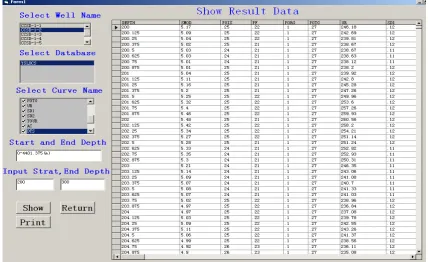
Fig. 2. Data inquiry process, example and interface.
III. DATA ACCESS PATH
Database structure design belongs to the logical design of database, data access belongs to the physical design of database, these two kinds of design for database system design is very important [6]-[8].
The data information access includes storage and takes two aspects, the meaning of storage is put the data information into the database, and take is extract data from the database. The former is usually referred to data entry (or insert), and the later is usually called data Inquiry [9]-[10].
All the data are put into database by the way of batch entry because of the large amount of logging data information. We should organize data information into the data file whose
format is pretyped, called data entry interface file, then input data program open the file and batch entry. Therefore, we introduce mainly the technical ideas of Inquiry data, as follow:
Take the rock mechanics parameters (log interpretation result data) database for example, the process of data Inquiry are as follow:
1) Inquiring the well name from well information table, displayed on the screen (shown in Fig. 1 (a)), choose one well, such as ZK1-1.
3) Inquiring the fields information (curve names), displayed on the screen (shown in Fig. 1 (b)), select one or more logging curve names.
4) Display all logging data information when the conditions of given well name, the Start and end depth, the number of curves, curve names.
The idea of Inquiry step by step is shown in Fig. 1. What the figure shows is three two-dimensional data tables: well name information table, curve information table, data information table. Three tables are connected with key field. Data Inquiry process is shown in Fig. 2.
Fig. 3. The function and structure of CCSD logging database software management system.
Image log data information including: FMI and ultrasound image log, array sonic log data so on. The data Inquiry idea is to inquiry image log data file name (according to well name, start and end depth of the well section), program open this file, display the file header information and data information and can write data forming output text file.
Fig. 4. User management.
Graphic log information including: FMI log and ultrasound
image log graphics, array sonic log graphics and so on. The graphical inquiry idea is to inquiry log graphic file name (similar to inquiry image log data file name), the program open this file and display graphic.
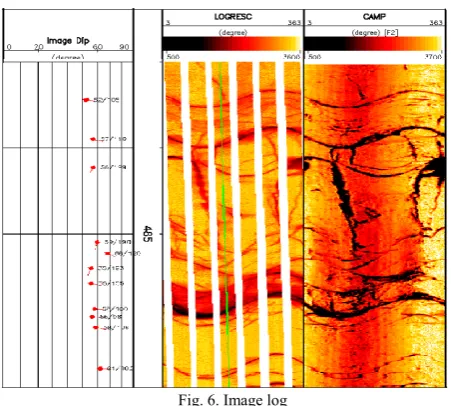
Fig. 6. Image log
IV. OVERVIEW OF CCSDLOG DATABASE MANAGEMENT SOFTWARE SYSTEM FUNCTIONS
CCSD logging database is in the Windows environment, the system software was developed by Visual Basic language and Access DBMS language. Database management software system structure and function is showed in Fig. 3. The database management software system includes the following functions:
1) Users Management: Only the system administrator can do maintenance privileges. Permissions maintenance including (Fig. 4): (1) add users, for legitimate users to provide a user name, password, (2) delete users, non-legitimate users can not access the database. 2) Data input (or insert): according to the interface data file
of predetermined data format, management software system can open the interface file to input data.
3) Data inquiry: The user can select one well name from screen output well information, input start and end depth in screen given the depth range, select log curve number and curve name from screen output curve information, and inquiry all log data.
4) Data modification: When user select database name, well name, input start and end depth, select curve names, you can modify the data under above given conditions. The modification becomes effective after the submission of the data modification.
5) Data deletion: administrator can delete all data or graphics information in all database, administrator can delete the data in some database when database name, well name were given. (note: Only the system administrator permission).
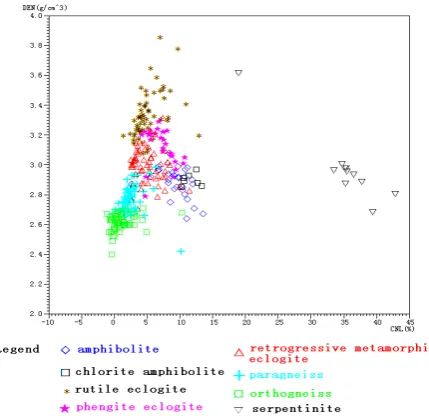
6) Data interface: Users can inquiry log information from log database to form a data interface file, and then use the interface file data to do log interpretation. For example: (1) well logs stratification, (2) computing of formation parameters, (3) drawn logging crossplot (Fig. 5), (4) draw logging histogram, (5)computing mechanics and stress-parameter, and so on.
7) Graphics browser: The system can display log graphic (Fig. 6) under giving database name, well name, start and end depth.
V.CONCLUSION
From CCSD logging database management software system design and development, we have following understanding and conclusions:
1)The CCSD log database software system has a fully functional, user-friendly, easy to use. The system is to provide convenience for the CCSD log data management and interpretation.
2)The logging information data structure and access strategy are the key of designing logging database. According to the different kind of data and information, we should devise it reasonably.
3)The system is not only suitable for the CCSD Project, but also has promotion and reference significance for other research areas. For example, the establishment of the petroleum logging database, coal logging database.
REFERENCES
[1] Y. X. Niu, H. P. Pan, W. X. Wang, L. F. Zhu, and D. H. Xu, “Geophysical well logging in main hole (0-2000m) of Chinese Continental Scientific Drilling,” Acta Petrologica Sinica, vol. 20, no. 1, pp. 165-178, Feb. 2004.
[2] H. P. Pan, Y. X. Niu, and W. X. Wang, “CCSD well logging program,” Journal of China University of Geosciences, vol. 13, no.1, pp. 91-94, Mar. 2002.
[3] H. P. Pan, “Well logging original curve database,” Computing Techniques for Geophysical and Geochemical Exploration, vol. 13, no. 1, pp. 77-80, Feb. 1991
[4] H. P. Pan, “Reservoir description database used in Jianghan oil field and its application,” Petroleum Exploration and Development, vol. 19, no.1, pp. 101-107, Mar. 1992.
[5] J. Xu, Y. C. Xu, Y. L. Yu, and W. D. Jin, “Application of database technique to log data analysis,” Journal of Jilin University (Earth Science Edi ion), vol. 37, pp. 118-120, Nov. 2007.
[6] X. L. Wang, J. Gun, Y. Wang, and G. J. Zhang, “Daqing oil field logging database system design,” Oil and Gas Field Surface Engineering, vol. 26, no. 2, pp. 46-47, Feb. 2007.
[7] X. Zhou, “Shengli oil field exploration database construction and application,” Petroleum Geophysics, vol. 1, no. 4, pp. 8-11, Oct. 2003. [8] Q. L. Han, “Field logging database system construction,” Inner Mongolia Petroleum & Chemical industry, vol. 20, pp. 53-55, Nov. 2008.
[9] Z. A. Jin, L. M. Yang, and D. Xie, “Research on fuzzy queries in relational database,” Computer Engineering, vol. 35, no. 13, pp. 63-65, July 2009.
[10] A. J. Wang, “Introducing an optimized design in database query process,” Journal of UEST of China, vol. 32, no. 2, pp. 192-194, Apr. 2003.
Heping Pan was born in September 1953 in Huangshi, Hubei Province, China. He graduated from Institute of Geophysics and Geomatics, China University of Geosciences (Wuhan) in 1978, and got Phd degree in 1999 during his teaching, mainly engaged in logging and geophysical data processing and interpretation.
He was once the vice president of Institute of Geophysics and Geomatics, China University of Geosciences (Wuhan) and once held the deputy director of the China Continental Scientific Drilling (CCSD) logging technology room. Now he is professor and doctoral supervisor, working in China University of Geosciences (Wuhan). He has published more than 50 articles in domestic and foreign journals (include conferences) and 4 monographs. The paper “Lateral Contrast and Prediction of Carboniferous Reservoirs using Logging data in Tahe Oil Field” was accepted by Journal of Earth Science, “Jianghan reservoir description database system and its application” was accepted by Petroleum Exploration and Development. The book “Geophysical Logging and borehole geophysical exploration” is the major teaching material of graduates and postgraduates. Now he is interested in the evaluation of CBM and shale gas reservoir.
miles” published by prof. Pan was selected the first national “three hundred” original works of science and technology in 2007. And the project “CCSD metaorphic logging new technology and application” achieved the second prize by the Ministry of Land and Resources Science and Technology.
Sinan Fang was born in December 1987 in Wuhan,
Hubei Province, China. He graduated from Institute of Geophysics and Geomatics, China University of Geosciences (Wuhan) in June. 2010, majored in applied geophysics. And now he is in a continuous academic program that involves postgraduate and doctoral study at China University of Geosciences, majoring in well logging and interpretation, from Sep. 2011 to Jun. 2016.