Original Research Article
An epidemiological study of risk factors of cardiovascular diseases
among medical students in a metropolitan city
Sudam R. Suryawanshi, Sharon S. Sonawane*
INTRODUCTION
Life-style related risk factors are mainly implicated for increased burden of cardiovascular diseases globally. These risk factors develop early in life, at a young age and unless taken care of, often progress to give rise to chronic diseases like cardiovascular diseases (CVDs) over a period of years. In 2008 CVDs deaths represented 30% of all global deaths with 80% of those taking place in low and middle income countries.1 Cardiovascular diseases are responsible for 10% DALYs in low and
middle income countries.2 In India, 21.1% total deaths in 2010 were due to CVDs.3 CVDs are expected to be the fastest growing chronic illness in India by 2015 growing at 9.2% annually from 2000 onwards.4
CVDs include diseases of the heart, vascular diseases of the brain and diseases of blood vessels. Some common preventable risk factors underlie cardiovascular diseases. The major risk factors together account for approximately 80% of deaths from heart disease and stroke. The major modifiable behavioural risk factors are tobacco use,
ABSTRACT
Background: Life-style related risk factors are mainly implicated for increased burden of cardiovascular diseases (CVDs) globally. In India, 21.1% total deaths in 2010 were due to CVDs. Compelling evidence shows that India stands to lose $2.17 trillion (of 2010 dollars) between 2012- 2030 due to CVDs. A study related to cardiovascular risk behaviour among medical students is essential, considering their role as future physicians and role models in public health intervention programs. There are very few studies among the budding physicians, especially in India.
Methods: This cross sectional study was carried out among 240 undergraduate MBBS medical students in a metropolitan city. Data was collected by using a semi-structured questionnaire consisting of close and open ended questions. Assessment of demographic profile, medical profile, alcohol use, dietary habits, physical activity and stress (PSS-10) was done. The data was entered in Microsoft Excel and analysed using SPSS 20 statistical software. Descriptive statistical measures like percentage, mean and standard deviations were calculated. An inferential statistical measure like Chi square was applied.
Results: Out of total 9 risk factors, the prevalence of ≤3 risk factors was 56.7% and ˃3 risk factors were 43.3%. 100% medical students had unhealthy dietary habits, 90.8% had stress, 59.6% had pre-hypertension/hypertension and 43.3% had insufficient physical activity. Gender and Hostel dwellers showed significant association with >3 risk factors.
Conclusions: All medical students had one or more risk factors which would lead to early onset of cardiovascular diseases in near future.
Keywords: Lifestyle, Risk factors, Medical students
Department of Community Medicine, Topiwala National Medical College, Mumbai, Maharashtra, India
Received: 11 April 2019
Revised: 07 May 2019
Accepted: 09 May 2019
*Correspondence:
Dr. Sharon S. Sonawane,
E-mail: [email protected]
Copyright: © the author(s), publisher and licensee Medip Academy. This is an open-access article distributed under the terms of the Creative Commons Attribution Non-Commercial License, which permits unrestricted non-commercial use, distribution, and reproduction in any medium, provided the original work is properly cited.
harmful alcohol consumption, unhealthy diet (low fruit and vegetable consumption) and physical inactivity. The major biological risk factors are overweight and obesity, raised blood pressure, raised glucose, abnormal blood lipids and its subset raised total cholesterol. All these factors together create a domino effect, resulting in increased incidence of cardiovascular diseases.5 The rationale for inclusion of these core risk factors is that they have the greatest impact on cardiovascular disease mortality and morbidity and modification is possible through effective prevention at an early stage.
The stark observation of reviewing previous studies showed the rising incidence of cardiovascular diseases in younger age groups. This means that India’s productive population is getting affected causing an economic setback to the country. Compelling evidence shows that India stands to lose $2.17 trillion (of 2010 dollars) between 2012- 2030 due to CVDs.6
A study related to cardiovascular risk behaviour among medical students is essential, considering their role as future physicians and role models in public health intervention programs. As far as a physician is concerned, there is evidence that such lifestyle related behavioural risk factors during medical school predicts later problems in terms of personal suffering of individual doctor and negative impact on patient care. Although many research papers have been published on cardiovascular risk behaviour among young (students), there are very few which study these in budding physicians, especially in India. Hence, the current study was undertaken with the aim to assess the risk factors of cardiovascular diseases among the Medical students in a metropolitan city.
METHODS
Study design
This was a cross sectional study done among MBBS undergraduate students of Topiwala National Medical College in Mumbai city from January 2016 to December 2016.
Inclusion and exclusion criteria
Undergraduate students studying in 1st, 2nd, 3rd, 4th, 5th, 8th and 9th semesters of MBBS course and who gave the
consent were included in the study. Undergraduate
students studying in 6th and 7th semesters were excluded for academic reasons.
Sample size
The strength of all the undergraduate M.B.B.S students in the Medical College was 600. From among these the undergraduate students studying in 6th and 7th semesters were excluded to avoid any participant based bias due to academic reasons thus, reducing the number of students to 480 out of which 50% students were selected for this
study by systematic random sampling. Therefore, sample size was 240.
Study tool
Data was collected after taking written informed consent by using a pre-tested semi-structured questionnaire consisting of close and open ended questions. Assessment of demographic profile, academic performance, alcohol and substance abuse history, dietary habits, physical activity, and stress (PSS-10) was done. Parameters measured were blood pressure, weight, height, BMI, waist circumference, socioeconomic status, dietary habits, addictions and stress level.
Statistical analysis
The data was entered in Microsoft Excel and analysed using SPSS 20 statistical software. Descriptive statistical measures like percentage, mean and standard deviations were calculated. An inferential statistical measure like Chi square was applied.
RESULTS
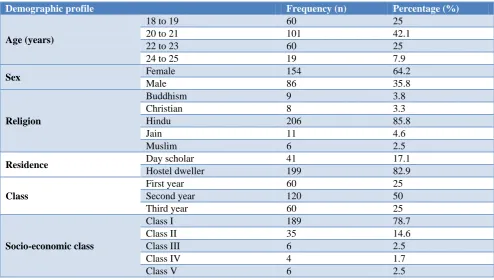
The mean age of medical students was 20.31±1.49 years, 154 (64.2%) were female and 86 (35.8%) were male, Hindu religion was followed by 206 (85.8%), Jain religion by 11 (4.6%), Buddhism by 9 (3.8%), Christianity by 8 (3.3%) and Muslim religion by 6 (2.5%). 199 (82.9%) were hostel dwellers and 41 (17.1%) were day scholars. 60 (25.0%) were in the first year, 120 (50.0%) were in second year and 60 (25.0%) were in the third year of MBBS course. Using modified BG Prasad socioeconomic status classification for 2013, 189 (78.7%) belonged to class I, 35 (14.6%) belonged to class II and 6 (2.5%) belonged to class III, 4 (1.7%) belonged to class IV and 6 (2.5%) belonged to class V (Table 1).
Individual risk factors observed were present as positive family history in 51 (21.3%) medical students, alcohol use in 28 (11.7%) medical students, smoking in 3 (1.3%) medical students and tobacco chewing habit in 3 (1.3%) medical students. Unhealthy diet as risk factor was present in 240 (100.0%) medical students, insufficient physical activity in 104 (43.3%) medical students, stress in 218 (90.8%) medical students, obesity in 43 (17.9%) medical students and high blood pressure (pre-hypertension and (pre-hypertension) in 143 (59.6%) medical students (Table 2).
Table 1: Demographic profile of the medical students (n=240).
Demographic profile Frequency (n) Percentage (%)
Age (years)
18 to 19 60 25
20 to 21 101 42.1
22 to 23 60 25
24 to 25 19 7.9
Sex Female 154 64.2
Male 86 35.8
Religion
Buddhism 9 3.8
Christian 8 3.3
Hindu 206 85.8
Jain 11 4.6
Muslim 6 2.5
Residence Day scholar 41 17.1
Hostel dweller 199 82.9
Class
First year 60 25
Second year 120 50
Third year 60 25
Socio-economic class
Class I 189 78.7
Class II 35 14.6
Class III 6 2.5
Class IV 4 1.7
Class V 6 2.5
Table 2: Distribution as per individual risk factor in the medical students.
Risk factor Frequency (n) Percentage (%)
Family history No 189 78.7
Yes 51 21.3
Alcohol use No 212 88.3
Yes 28 11.7
Smoking habit No 237 98.7
Yes 3 1.3
Tobacco chewing habit No 237 98.7
Yes 3 1.3
Unhealthy diet No 0 0.0
Yes 240 100.0
Insufficient physical activity No 136 56.7
Yes. 104 43.3
Stress No 22 9.2
Yes 218 90.8
Obesity No 197 82.1
Yes 43 17.9
High blood pressure No 97 40.4
Yes 143 59.6
Table 3: Distribution of total number of risk factors in the medical students.
Total number of risk factors Frequency (n) Percentage (%)
0 0 0.0
1 3 1.3
2 33 13.8
3 100 41.7
4 69 28.6
5 26 10.8
Total number of risk factors Frequency (n) Percentage (%)
6 5 2.1
7 4 1.7
8 0 0.0
9 0 0.0
Total 240 100.0
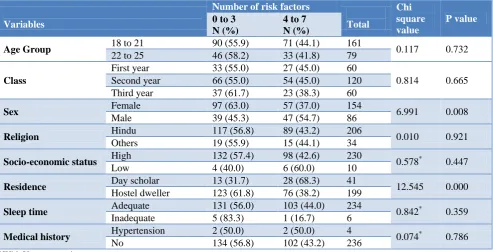
Table 4: Associations between demographic variables and number of risk factors.
Variables
Number of risk factors
Total
Chi square value
P value 0 to 3
N (%)
4 to 7 N (%)
Age Group 18 to 21 90 (55.9) 71 (44.1) 161 0.117 0.732
22 to 25 46 (58.2) 33 (41.8) 79
Class
First year 33 (55.0) 27 (45.0) 60
0.814 0.665
Second year 66 (55.0) 54 (45.0) 120
Third year 37 (61.7) 23 (38.3) 60
Sex Female 97 (63.0) 57 (37.0) 154 6.991 0.008
Male 39 (45.3) 47 (54.7) 86
Religion Hindu 117 (56.8) 89 (43.2) 206 0.010 0.921
Others 19 (55.9) 15 (44.1) 34
Socio-economic status High 132 (57.4) 98 (42.6) 230 0.578* 0.447
Low 4 (40.0) 6 (60.0) 10
Residence Day scholar 13 (31.7) 28 (68.3) 41 12.545 0.000
Hostel dweller 123 (61.8) 76 (38.2) 199
Sleep time Adequate 131 (56.0) 103 (44.0) 234 0.842* 0.359
Inadequate 5 (83.3) 1 (16.7) 6
Medical history Hypertension 2 (50.0) 2 (50.0) 4 0.074* 0.786
No 134 (56.8) 102 (43.2) 236
*With Yates correction.
It was observed that females (57) were having more risk factors compared to male (47) and showed significant statistical association. Also, hostel dwellers (76) had more risk factors compared to day scholars (28) and showed significant statistical association (Table 4).
DISCUSSION
It was observed that majority of medical students were having moderate to high level of stress which is detrimental to health. Lower level of stress was observed by Giri et al in medical students from Nepal where 104 (65.4%) medical students felt stressed out due to medical studies and 55 (34.6%) medical students did not feel stressed out due to medical studies.7 Reports from different parts of the world have shown medical education to be stressful. The Columbia experience states that on average 10-15% students seek consultation and 1/3rd need therapy to deal with conflicts in their personal life.8
Among 240 medical students, 212 (88.3%) did not consume alcohol, 25 (10.4%) consumed alcohol rarely and 3 (1.3%) consumed alcohol 1-2 times/week. Current alcohol users were 10.3% in a study by Amruth and 14% college students in a study by Nair.9,10
Smoking habit was observed in only 1.3% medical students which is an encouraging finding. However, other studies reported higher percentage of smoking among medical students.9,10
Lower intake of fruits and vegetables was reported among all 240 (100.0%) students. Other studies reported a higher intake of fruits and vegetables. In a study by Bundela it was found that only 21.43% of boys and 32.84% of girls were consuming 5 or more servings of fruits and vegetables per day and in a study by Amruth it was found that 50.7% medical students consumed less than 3 servings per day of vegetables and 54.1% medical students consumed less than 2 servings per day of fruits.9,11 This variation in the consumption of fruits and vegetables can be due increased preference for instant food like noodles, fast food and dislike for vegetables. Also, the lack of availability of fruits and vegetables for medical students staying especially in hostel facilities must be considered as an important cause of less consumption of fruits and vegetables.
diabetes mellitus and hypertension respectively.12 In a study by Kurian family history of CAD was present in 12% of subjects which is slightly lower than the present study.13
Among the 240 medical students, 139 (57.9%) indulged in some form of physical activity and 101 (42.1%) did not indulge in any form of physical activity. Similar finding was reported by Bundela where 24.47% boys & 46.26% girls were not doing any kind of physical activity at all.11 As per recommendation no exercise or sports was observed in 163 (35.6%) medical students in South India in a study by Paul et al which is lower than the present study.14
Pre-hypertension/ hypertension was observed in 143 (59.6%) in present study. Lower occurrence of pre-hypertension/ hypertension was observed in other studies. Pre-hypertension/ hypertension was observed in 124 (27.1%) medical students in South India in a study by Paul et aland in 9.0% male and 12.5% female in a study by Jain et al.14,15
43 (17.9%) medical students were obese in the current study. Prevalence of overweight was observed by Amruth et al in 21.3% students, by Giri et al in 15.7% of the students and by Paul et al in 24.7% medical students.7,9,14 Thus, the prevalence of risk factors was found to be 100.0% in the present study with all medical students having unhealthy diet as the common risk factor for cardiovascular diseases, followed by stress in 90.8% medical students, pre-hypertension/ hypertension in 59.6% and insufficient physical activity in 43.3% medical students.
CONCLUSION
All medical students had one or more risk factors that can lead to early onset of cardiovascular diseases in near future which can be easily prevented by taking appropriate life style related measures during their medical studies. The very high prevalence of risk factors among medical students observed must be addressed effectively by early impartation of information and knowledge about risk factors for cardiovascular diseases to medical students from the first year itself.
ACKNOWLEDGEMENTS
Author would like to thank the study participants and the departmental staff for their help.
Funding: No funding sources Conflict of interest: None declared
Ethical approval: The study was approved by the Institutional Ethics Committee
REFERENCES
1. Report from the American Heart Association. Heart
Disease and Stroke statistics – 2015. Available at: https://www.ahajournals.org/doi/pdf/10.1161/CIR.0 000000000000152. Assessed on 10 September 2015
2. The World Health Report 1999 by WHO. Available
at: https://www.who.int/whr/1999/en/whr99_en.pdf? ua=1. Assessed on 7 September 2015.
3. A report by the World Economic Forum and
Harvard School of Public Health. Economics of Non-communicable Diseases in India. November 2014. Available at: http://www3.weforum.org/docs/ WEF_EconomicNonCommunicableDiseasesIndia_ Report_2014.pdf. Assessed on 16 September 2015. 4. Chauhan S, Aeri BT. Prevalence of cardiovascular
disease in India and its economic impact- A review. Int J Sci Res Publications. 2013;3(10):1.
5. ASSOCHAM India. International Heart Protection
Summit. Cardiovascular diseases in India.
Challenges and way ahead. September 2011.
6. Available at: https://www2.deloitte.com/content/
dam/Deloitte/in/Documents/life-sciences-health-care/in-lshc-cardio-noexp.pdf. Assessed on 15 September 2015.
7. WHO STEPS surveillance. Available at: http://
www.who.int/chp/steps/Section%201%20Introducti on.pdf. Assessed on 15 September 2015
8. Giri S, Sharma SR, Timalsina S, Yadav V, Koirala S, Kumar A, et all. Cardiovascular Health Risk Behavior among Medical Students in a Teaching
Hospital. J Nepal Health Res Counc.
2012;10(22):187-91.
9. Lerner BA. Students’ use of psychiatric services, the
Columbia experience. J Am Med Assoc.
1995;274(17):1398-9.
10. Amruth M, Sagorika Mullick, Balakrishna AG,
Prabhudeva MC. Assessment of awareness about cardiovascular disease risk factors and association between overweight and family history of cardiovascular disease among first-year medical students of a medical college in Karnataka. Int J Med Sci Public Health. 2015;4(1):1.
11. Nair LM, Madhu B, Srinath KM, Gopinath A,
Yadav K. Magnitude of behavioural risk factors for cardiovascular diseases among college going young adults (18-25 years) in Mysuru, Karnataka, India. Int J Community Med Public Health. 2017;4(1):65-72.
12. Bundela M, Kumar J, Soni ND, Choudhary R,
Rajnee. Assessment of cardiovascular behavioural risk factors in medical student. Bangladesh J Physiol Pharmacol. 2014;30(2):18.
13. Kulkarni MV. Lifestyle disease risk behaviour
among Medical Students in Central India. Panacea J Med Sci. 2016;6(2):92-5.
15. Paul B, Nayaki V, Sen M, Isaac R. Prevalence of Cardiovascular disease Risk among Medical Students in South India. Indian J Comm Health. 2015;27(2):211-5.
16. Jain V, Adhikari K. Risk factors of
non-communicable diseases among adolescent in Chitwan district of Nepal. Indian J Prev Soc Med. 2014;45:1-2.
Cite this article as: Suryawanshi SR, Sonawane SS. An epidemiological study of risk factors of