Business Model and Marketing: Interaction in
Small Business
Elzo Alves Aranha
Production Engineering and Management Institute Federal University of Itajubá, Brazil
Giovanna Cardoso Deprê
Production Engineering and Management Institute Federal University of Itajubá, Brazil
Abstract
There are few scholarly articles that explore the interaction and operation of the field of business model and field of marketing, particularly from the perspective of business model process configurations. Academic studies on business model process configurations are interesting for innovation practices in companies, especially for small and medium-sized businesses. The paper examines the interaction between the body of knowledge of business model and body of knowledge of marketing, from the perspective of the business model process configurations. Then from the analyzed interaction is illustrated how this interaction operates in small business. The action research was adopted. Discipline, value and co-creation are the three key aspects identified in the interaction between the field of business model and field of marketing. The findings indicate that: (1) in discipline, the actions proposed in the company's action plan involve strategic and operational marketing. These actions are interacting and operating with the segment element of the business models ontology; (2) In value, the implemented actions involve the communication processes of the value of the marketing field. These actions are interacting and operating with the value configuration of the business model ontology; (3) In co-creation, the implemented actions involve new relationships with customers that foster co-creation of new services.These kind of action are set in business model ontology. The findings have innovative contributions and practical implications for business leaders and owners, directors and researchers.
Key Words: Business model; Small Business; Innovation.
1.INTRODUCTION
The growing production of academic articles of business model in the last 10 years is a sign of progress in consolidating a new body of knowledge. The business model theme has received attention from academics and business professionals in several countries and in several companies. The growing interest of researchers and business professionals on theme of business model is not enough to arouse the interest of researchers of the field of marketing to investigate interactions and connections between business model and marketing (Coombes and Nicholson, 2013). Business model lack an acceptable place in organizational and strategic studies and in marketing science (Teece, 2010).
There is a large gap between the body of knowledge of business model and the body of knowledge of marketing. The study conducted by Coombes and Nicholson (2013) reveals that in the period from 1970 to 2011 only eight business model articles were published in marketing journals. This lack of interaction between business model and marketing is considered by Coombes and Nicholson (2013) an anomalous situation that opens several gaps in the academic literature. Here we highlight only two gaps. The first gap refers to the lack of knowledge about how the two fields interact and operate in a small business. There are few academic articles that explore the interaction and operation of the business model and marketing in small business. The second gap is the lack of academic analysis of how these two fields interact and operate in small companies from the perspective of business model process configurations-BMPCs (Taran et al., 2015). Studies on BMPCs are interesting for innovation practices in companies, especially for small and medium-sized businesses. Our research is addressed to fill this second gap mapped in the academic literature and is the first motivation for conducting the research.
This article aims to examine the interaction between business model and marketing in a small business. Then, from the analyzed interactions are illustrated how the interactions operate in small business.
The article is structured in seven sections. The first section is this, introduction. The second section analyzes the interactions between business model and marketing. In the third section are exposed the BMPCs. The fourth section contains the methods and techniques. The fifth section presents the data analysis and the sixth section presents the results. The last section deals with the final considerations.
2. INTERACTIONS BETWEEN BUSINESS MODEL AND MARKETING
Business models are necessary because of the characteristics of market economies where consumer choice, transaction costs, heterogeneity between consumers and producers, and competition (Teece, 2010) are required. The changes of economic, technological, environmental, socio-cultural and demographic nature in domestic and global markets have increasingly strained the business models of the organizations in order to realign them to the new market economies (Teece, 2010). For business professionals, business model changes are primarily aimed at raising business performance by increasing revenues or reducing costs and expenses by creating and capturing value for the customers, partners, shareholders, and society (Chesbrough and Rosenbloom, 2002, Linder and Cantrell, 2000). These changes in the business model have two main implications for management: increasing the focus of the organization and establishing an agile and competitive model (Linder and Cantrell, 2000).
Fielt (2013) analyzed different definitions of business model, its constituent elements, archetypes, and proposes an interesting definition of business model. A business model crafts the value logic of a business in terms of how business creates value, captures value, and delivers value to the customer and how business can be represented in a cohesive, precise, and concise manner by a set of represented, addressed elements as customer value proposition, organizational architecture and economic dimension (Fielt, 2013). The number of elements in the business model and the purpose of each of them vary according to the literature. From a comparison of 18 frameworks and business model configurations, Morris et al. (2005) state that the number of elements varies from four to eight and the total of 26 different elements. These elements are hand out in: 8 customer interface and relationship descriptions, 7 network mentions and partner functions, 6 internal infrastructures and connected activities, and 5 mentions about target markets.
The notion of value creation for customers, partners, shareholders and society, is stated throughout the business model and also emphasized in marketing, which opens up possibilities for interactions between the two fields of knowledge. According to the American Marketing Association approved in 2013, the definition of marketing is the activity, set of institutions and processes that aim at the creation, communication, delivery and exchange of value offering that has value to the customer, partners and society (AMA, 2013). The notion of value is associated with different conceptions, among which we distinguish two, which are the perceived value of the customer, perceived use value, and the value-change associated with the price when the product is sold (Bowman and Ambrosini, 2000).
Coombes and Nicholson (2013) identified three key aspects in the interaction between the body of knowledge of the business model and the body of knowledge of marketing: discipline, centrality of value exchange and co-creation (table 1). The first key aspect is discipline. The business model developed is based on several functional and academic disciplines where there is no overlap of one discipline over another. The field of marketing is a body of knowledge available to academics and business professionals (Coombes and Nicholson, 2013). The second key aspect is the centrality of value exchange. According to the definition of Fielt (2013) the business model specifies the logic of value in terms of creation, value capture and value delivery, which promotes synergy with the marketing field, which highlights the creation and delivery of value to customers, partners and society (AMA, 2013).
Table 1 - Interactions between Business Model and Marketing
Created by the authors from Coombes and Nicholson (2013)
3. BUSINESS MODEL PROCESS CONFIGURATIONS(BMPCS)
BMPCs are ideal-type that express business models or part of business model elements of successful companies, distinguishing the behavior of companies operating in the real world from those that have already been tested in practice (Fielt, 2013; Taran et.al, 2015). Taran et.al, (2015) analyzed more than 60 BMPCs and provide a comprehensive and structured list supported by the best practices of companies, that can be a reference list for fostering innovation activities in small business. The structured list follows the business model ontology (Taran et.al., 2016), according to figure 1, composed of five categories:
(1) Value Propositon - The offer of composite value of products and services that the company proposes to the customers.
(2) Value Segment - The value segment, the most profitable customers who receive the company's value offering.
(3) Value Configuration - Involves the set of material, human, financial, tangible and intangible resources, the key activities that the company performs and the channels necessary to deliver the value proposition to the value segment.
(4) Value Network - Refers to the network of partners that make available and offer the material, human, financial resources and key activities to realize the value proposition. What are the partners and how do they interact with the company in order to achieve the goals.
(5) Value Capture - This is the revenue model adopted by the company and the cost structures.
4. METHODS AND TECHNIQUES
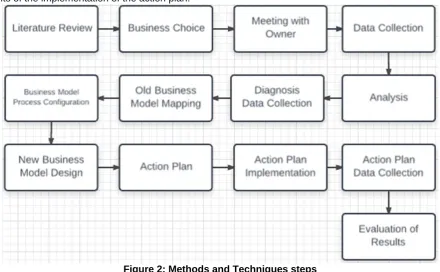
Action research was adopted in the present research (Eden and Huxham, 1996; Donnelly, Simmons, Armstrong and Fearne, 2012). The research was carried out in 13 steps from August to November, 2017. In the first step, the literature review of business model and marketing was carried out. In the second step, the analysis of three small companies was developed and the business "Mangutti Açaí" was selected for the research. In the third step there was an awareness meeting with the company owner highlighting the objectives and stages of the research along with the data collection. The fourth step consists of collecting essential company information data to understand problems and opportunities. The fifth step was the data analysis that made it possible to carry out the subsequent stage of problem diagnosis and identification of gaps and opportunities. In the seventh step, the mapping of the current (now old) business model was performed based on the diagnostic information, using the business model ontology, according to Figure 2. From the mapping of the business model based on the diagnostic data, the eighth step consisted of consulting the structured list of business model process configurations and at the ninth step the new business model (now the current one) was designed. Next, the tenth step was carried out, which consisted in drawing up the action plan based on the new business model design. The eleventh step was the implementation of the action plan, the twelfth consisted of data collection of the implementation of the action plan and the thirteenth and final step was the evaluation of the results of the implementation of the action plan.
Figure 2: Methods and Techniques steps
5. DATA ANALYSIS
Mangutti Açaí is a franchise installed in the downtown of the city of Itajubá, in the state of Minas Gerais - Brazil. The company has an average monthly billing of R$ 65,000, with annual revenue of R$ 780,000, considering the two existing stores in the city. It is important to note that the actions implemented in the action plan and data refer only to one of the stores, which has 9 employees and has the capacity to sell up to 4,800 a year. The menu consists of açaí and its combinations (fruits, sweets and syrups), milkshakes, açaí vitamins and ice creams. Based on the data collection, conducted with 369 people in the city of Itajubá, we identified that the store studied has around 8% of customers, while its main competitor has 66% of customers (figura 3).
Figure 3: Açaí Customers in City of Itajubá
Table 2: Reasons to be a loyal customer
In the analysis of empirical data several problems in the company were found directly linked to the decisions and processes of strategic and operational marketing among which we highlight only three main ones:
• Lack of audience identification: managers today do not know whom their targeting audience, which makes it difficult to define and carry out communication actions.
• The current communication actions (radio and Facebook) are not effective or cannot reach the targeting because the targeting is not defined.
• Idle productive capacity, from Monday to Thursday. During the week, there is plenty of time for employees to do some work, but over the weekend, productive capacity is very close to demand. It did not happened yet, but they are close to lacking human resources and physical space for employees to work, which will certainly reduce the efficiency of the production process and consequently customer satisfaction. Currently the store manages 160 requests of açaí per day.
Table 3: Financial data about how much the company misses because of marketing problems
The lack of identification of the targeting audience causes the company to stop raising its performance, by
Açaí & Cia, 2
Amazon
Açaí, 46
Garagem do Açaí,
10 Mangutti, 28
Mundo do Açaí, 6 O Poderoso, 244
Projeto Sabor, 1 Repúblic
a do
Açaí, 3
Sorveteria do
Mauro, 7
Communication actions currently attract 121 people a week, at an average ticket of R$ 10.17, totaling a gain of R$ 62,759.07. However, if they attracted 220 more people a week, the company would earn R$ 114,107.40. That is, the company is not making R$ 51,348.33 per year.
Finally, idle production capacity is on average 39 orders at R$ 10.17 per day, causing the loss (or lack of gain) to be R$ 142,786.80 per year.
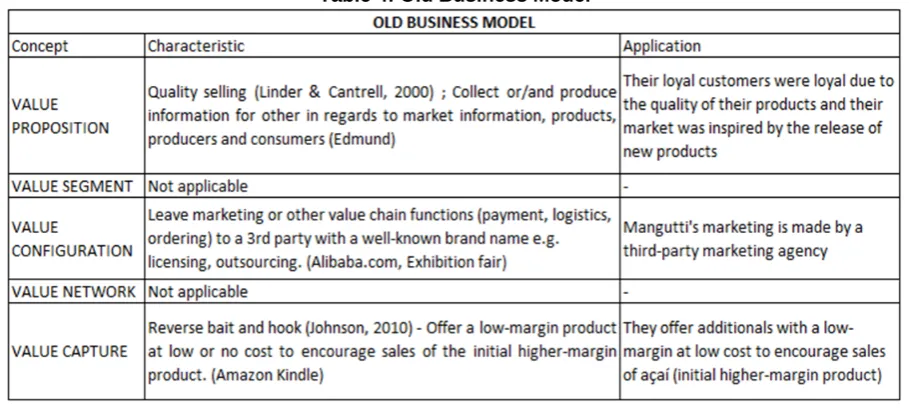
Old Business Model
The old business model (table 4) was designed based on company information and shows key issues and gaps. The business model ontology proposed by Taran et al. (2016) was studied in order to facilitate the understanding more about small business and enables the planning of innovation activities. The business did not present a formal document or tool that could explain and describe its business model. The adoption of the ontology helped in the description of the business model. The old business model represents the company's current situation before the action plan is drawn up, while the design of the new business model and action plan contains the key practices identified in the structured list of BMPCs.
Table 4: Old Business Model
New Business Model
The new business model (table 5) was designed based on diagnosis information, the old business model, and the structured list of best practices of companies. The new business model is intended to eliminate the problems identified in the company and foster innovation practices. From this new business model to the phase of the data collection stage resulting from the implementation, part of the actions foreseen in the action plan were implemented.
Innovation practices in business models were visible. In addition to changing all settings, we added three characteristics to the value segment, double the number of characteristics of the value configuration, and added a configuration to the value network, referring to partnerships with schools that would occur in the action plan.
Crafting and implementation of the action plan
The action plan (table 6) was crafted according to the diagnosis and the new business model. The action plan has improvement actions for the company mainly in relation to the value segment. We have identified the targeting audience according to the initial survey. They are residents of the urban area of Itajubá who are between 15 and 55 years old, who work and / or study near of downtown and who throughout the day pass near the store with their families and enjoy to have a moment of leisure. They are also açaí lovers who at weekends like to go to the square to observe the movement and to walk, because the city is small. They also have monthly income between 4 and 7 thousand reais.
Finally, in order to reduce the problem of excess productivity capacity, particularly, setting the balancing of demand and productivity capacity, we suggest that customers make purchases in advance. The benefit to the customer occurs in the reduction of waiting time and the store then manages to plan for the daily demand, producing in its down time and not overloading at peak times.
Approximately 10,000 açaí cups per month are sold in Itajubá, but although survey participants who are clients of the company are 8%, Mangutti already has 25% of the city's customers. Therefore, if the company intends to reach 30% of the market (the maximum when considering its installed capacity), it will sell another 500 açaí cups a month, which will be equivalent to 125 açaís per week, at an average ticket of R$ 10.17, obtaining revenue of R$ 64,833.75 (= 125 * 51 * 10.17).
In addition, if the company invites 80 children every 15 days to visit the store for an average ticket of R$8.50 due to the discounts, for a year, it will earn R$ 16,320.00 (= 80 * 8.5 * 2 * 12) . When running the "Magic Word" campaign for 22 weeks (autumn / winter), selling 60 more a week to an average ticket of R$8.5, they will earn R$ 11,220.00 (= 60 * 22 * 8.5). Finally, with the anticipated sale of 90 açaí per week, at an average ticket of R$ 10.17, the earnings would be R$ 46,680.30 in a year (= 90 * 51 * 10.17).
Table 5: New Business Model Design
Results of the implementation of the action plan
With the implementation of the action plan, the following results were obtained (table 7):
• Increase of 8.17% in revenue between October 16 and 22, when the action "Magic Word" was implemented, comparing to the period between October 02 and 08, where there were no actions.
• Reduction of 18.09% in revenue in the week between October 23 and 29, where no actions were implemented, compared to the previous week.
• Increase of 4.14% in the week between October 30 and November 5, where there were no actions, but there was a holiday (from November 2nd to 5th), which may have increased sales. And finally, increase of 6.91% in revenue in the last week analyzed compared to the week of October 30th to November 5th.
Table 7: Results of the implementation of the action plan weekly
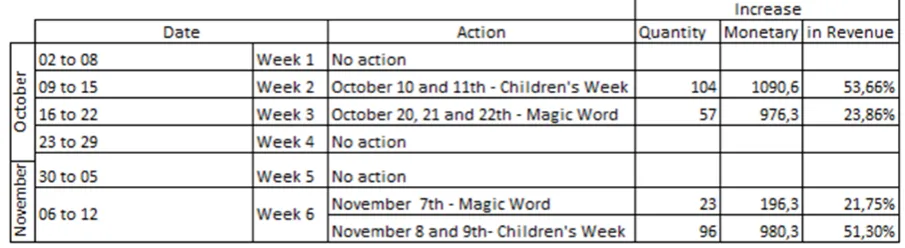
Table 8 shows in terms of quantity, in Brazilian currency and percentage of revenue increase, the comparison between the periods in which actions were implemented and the periods in which sales occurred without implementation of actions.
Table 8: Results of the implementation of the action plan by action and date
6. RESULTS
According to the literature review it can be seen that the key aspects identified, discipline, value and co-creation, are synergistic and interact between the fields of business model and marketing (Coombes and Nicholson, 2013). Based on the findings of the synergistic key aspects mapped in the literature between the two fields and on the analysis of empirical data, it was possible to verify the operation of these key aspects in the small business as follows:
• Discipline key aspect: The actions proposed in the business's action plan (table 6) involve strategic and operational marketing and are interacting and operating with the segment element of the business model ontology. Thus, the design of the business model is supported by several academic and functional disciplines, including marketing discipline. The discipline key aspect operates in the company through strategic and operational marketing actions.
• Value key aspect: The "magic word" and "advance purchase" actions (table 6) involved the communication processes of the marketing field's value proposition aimed at the creation, communication, delivery and exchange of value offering that has value to the customer. These actions create value and are interacting and operating with the ontology value configuration element of the business model. The value key aspect operates in the company through the two proposed actions that are tied to the field of business model and marketing.
7. FINAL CONSIDERATIONS
The business model ontology adopted in the present paper made it possible: (a) to map the business model of a small business to identify problems and business opportunities as lack of identification of targeting, effectiveness of communication actions and excess of installed capacity (productive capacity); (b) to design the new business model from a structured list of business model process configurations to foster innovation activities.
The results of this research have innovative contributions to the fields of business model and marketing. The results fill the gap in the literature that refers to the absence of academic articles examining the interactions and operations between business model and small business marketing, from the perspective of business model process configurations. The key aspects identified and put into operation have broadened the understanding of the interaction and operation between the business model and marketing.
The results have several practical implications and we intend to highlight only three of them. First, business leaders and small business owners can foster business model culture and marketing culture to increase the performance of their operations. Second, business leaders and small business owners can foster business model and marketing training courses from the perspective of business model process configurations. Directors and coordinators of higher courses of Business Administration and Engineering can introduce the concepts of business mModel and marketing and its connections in the disciplines or create new disciplines. Third, researchers can open several avenues of investigations of interactions and operations of the business model and marketing in companies aiming to broaden understanding and comprehension.
REFERENCES
AMA, (2013) - American Marketing Association https://www.ama.org/AboutAMA/Pages/Definition-of-Marketing.aspx
Anderson, J., Narus, J., & Narayandas, D. (2009). Business market management: understanding, creating, and delivering value. 3rd. edition. Upper Saddle River, New Jersey: Prentice Hall.
Bast, Elaine (Ed.), (2015). Três em cada dez desempregados investem no próprio negócio: Eles aproveitam a indenização, o FGTS e o tempo livre para investir. Planejamento é essencial para o negócio dar certo. http://g1.globo.com/jornal-hoje/noticia/2015/03/tres-em-cada-dez-desempregados-investem-no-proprio-negocio.html.
Bowman Cliff and Ambrosini Véronique, (2000). Value creation versus Value capture: towards a coherent definition of value strategy. British Journal of Management, Vol. (11), p.1-15;
Chesbrough, H. and Rosenbloom, R.S. (2002) The role of the business model in capturing value from innovation: Evidence from XEROX Corporation’s technology spinoff companies, Industrial and Corporate Change, 11(3), 529-555
Coombes, Philip H. and Nicholson, John D. (2013), Business Model and their relationship with marketing: A systemactic literature review. Industrial Marketing Management, 42 pag.656-664
Eden Collin and Huxham Chris (1996). Action research for management research. British Journal of Management, vol. 7, 75-86.
Donnelly Christina, Simmons Geoff, Armstrong Gillian and Fearne Andrew (2012). The role of action research in the study of small business marketing and retailer loyald card data. Irish Academy of Management.
Fielt, E. (2013) Conceptualising business models: Definitions, frameworks and classifications, Journal of Business Models, 1(1), 85-105.
Galvagno, Marco and Dalli,Daniele (2014). Theory of value co-creation: a systematic literature review. Managing Service Quality, Vol. 24(6), pp.643-683, https://doi.org/10.1108/MSQ-09-2013-0187
Grönroos, Christian and Annika Ravald (2011). Service as business logic: implication for value creating and marketing. Journal of Service Management, Vol. 22(1), pp.5-22, https://doi.org/10.1108/09564231111106893
Morris, Michael, Schindehutteb, Minet and Allen, Jeffrey (2005). The entrepreneur’s business model: toward a unified perspective. Journal of Business Research, vol.58, pp.726-735.
Linder, J. and Cantrell, S. (2000) Changing business models: Surfing the landscape, Accenture Institute for Strategic Change, Canada.
Lovelock, Christopher and Wirtz Jochen, (2011). Services Marketing: People, technology, strategy, 7º Edition.Pearson. Sebrae Mato Grosso (Org.). (2014). Micro e pequenas empresas geram 27% do PIB do Brasil: Em dez anos, os valores da
produção gerada pelos pequenos negócios saltaram de R$ 144 bilhões para R$ 599 bilhões.
http://www.sebrae.com.br/sites/PortalSebrae/ufs/mt/noticias/micro-e-pequenas-empresas-geram-27-do-pib-do-brasil,ad0fc70646467410VgnVCM2000003c74010aRCRD
Silveira, D., Laporta, T. (2017). Desemprego fica em 12,6% em agosto e atinge 13,1 milhões, diz IBGE: Número de desocupados caiu 4,8% em relação ao trimestre encerrado em maio deste ano. https://g1.globo.com/economia/noticia/desemprego-fica-em-126-em-agosto-diz-ibge.ghtml>.
Taran, Y., Nielsen, C., Thomsen, P., Montemari, M., & Paolone, F. (2015). Business Model Process Configurations: A Mapping Tool For Fostering Innovation. In R&D Management conference Pisa.