Licensed under Creative Common Page 186 http://ijecm.co.uk/
INNOVATION AND ACCESS TO MICROFINANCE - A CASE
STUDY OF K-REP PROGRAMME IN KENYA
Kenneth Majau Mugambi
School of Business and Economics Kenya Methodist University, Meru, Kenya
[email protected], [email protected]
Abstract
Considerable evidence has been given to indicate that in many developing countries, micro and
small enterprises (MSEs) can now access credit from non-conventional lenders through the
group lending mechanism, and they do so with high repayment rates. The group’s ability to
reduce transactions costs of administrating loan and minimising information asymmetry is
passed as the hallmarks of this success over conventional formal lending. Nevertheless, high
successes attributed to group lending cannot be entirely credited to the joint liability aspect
alone. Group lending is just a part of the set of mechanisms employed by micro lenders to aid
credit repayment. This study presents the argument that the successes of group contracts are
driven partly by innovative lending mechanisms - by investigating salient features of a
pioneering micro lending programme in Kenya (K-REP). The study finds that success of group
lending in credit repayment can also be attributed to the program innovativeness the
programme has put in place to in supplementing joint liability in encouraging borrowers to repay
the credit when given. The methods used range from the use of dynamic incentives, regular
credit repayment, supervision and sequential credit lending.
Keywords: Group lending, micro finance, joint liability, monitoring
INTRODUCTION
Licensed under Creative Common Page 187 to explain this success. Chief among them was that group lending mitigated against information asymmetry and reduced the cost of lending substantially (Ghatak & Guinnane (1999), Stiglitz (1990) and Ghatak (2000). This is possible since group lending consolidates many micro-loans into a few large group loans, greatly reducing the cost incurred by the lender in processing and monitoring. In addition, most of the lenders‟ costs incurred in assessing the creditworthiness of the borrowers is passed over to the group (Armendáriz, Aghion & Morduch 2005). Also, the principle of joint liability creates an incentive mechanism where every member has an interest in selecting his/her peers and monitoring their projects to make sure that they have the capacity to pay their portion of the loan.
However, empirical investigations revealed mixed performance on credit repayment in developing countries (Morduch 1999), meaning that high successes attributed to group lending cannot be entirely credited to the joint liability aspect. Group lending is just a part of the set of mechanisms employed by micro lenders to aid credit repayment. Armendáriz de Aghion & Morduch (2000), for example, mention among other things; direct monitoring, regular repayment schedules, and the use of the threat of non-refinancing to influence group repayment. The current study focuses on a pioneering micro credit programme in Kenya- Kenya Rural Enterprise Programme (K-REP) to assist in isolating the specific programme factors aiding high micro lending success. The reminder of the section is as follows,
The role of programme innovation
Licensed under Creative Common Page 188 Rai and Sjöström (2004) argued that joint liability aspect of group lending was unlikely to hold in practice, and that it was in fact dominated by innovative contracts, which elicited truthful information from borrowers through cross-reporting mechanisms, employed and encouraged by the lenders. To encourage high repayment rates, micro-finance institutions employed other mechanisms to supplement joint liability contracts (Rai and Sjöström 2004). The mechanisms included: dynamic incentives, encouraging regular credit repayments and advancing credit sequentially. This section presents the argument that the successes of group contracts were partly driven by innovative lending mechanisms.
Many group lending schemes insist on regular repayments (Yaron 1994; Armendáriz de Aghion and Morduch 2000). Insisting on immediate repayment on a weekly basis meant the micro-finance lender was partially lending against the household‟s stream of “outside” income and not just the proceeds from the financed project. This could have led to high credit repayment by borrowers, not necessarily from their successful projects but because the lender was able to tap the stream of outside income (Armendáriz de Aghion and Morduch 2000). This argument is reinforced by the fact that many borrowers were micro- entrepreneurs who earned their income on a daily basis. Their income was spent as fast as it was earned due to lack of a satisfactory savings mechanism and due to many unfulfilled competing basic needs. This meant that their income erosion rate was very high compared to well-established entrepreneurs who could afford savings facilities (Armendáriz de Aghion and Morduch 2000).
Usually, a problem detected early was easier to solve than a problem detected at a later stage. In this regard, regular credit repayments were used as a screening device for detecting possible delinquent borrowers (Yaron 1994). Early warning enabled the lender to develop early strategies to counter the growth of the problem. Again, close interaction between the lender and the borrowers during regular credit repayment meetings enabled the lender to establish a personal relationship with the borrower. This mutual relationship encouraged openness and eventually decreased repayment default (Armendáriz de Aghion and Morduch 2000). Moreover, in those regular meetings, the borrowers were required to repay their loan instalments and make some savings deposits to their respective group accounts (K-REP 2000). The savings aspect was intended to inculcate a saving culture out of daily competing needs. At the same time, the more the borrower saved the less likely they were to default, since a default may have led to loss of the entire savings. For this reason, a weekly savings scheme had the effect of encouraging prompt repayment from borrowers (Armendáriz de Aghion and Morduch 2000).
Licensed under Creative Common Page 189 subsequent loans to defaulting borrowers (Paxton et al 2000). It has been argued that a lender can enhance the effect of dynamic incentives by promising to extend steadily larger loans to the borrowers who honour their repayment. Armendáriz de Aghion and Morduch (2000), for example, argued that since borrowers typically desire more substantial loans, the promise enhances the borrower‟s loss from being cut off from the subsequent loans. This method motivated them to pay their previous loans as agreed in the contract.
Third, in order to prevent possible collusion and to minimise moral hazard behaviour among the borrowers, many lenders also formulated other mechanisms, which encouraged the borrowers to monitor each other and enforce prompt credit repayment. In some programmes, credit was granted sequentially instead of the widely used simultaneous lending (Varian 1990; Aniket 2004). In simultaneous lending, the lender granted credit to all members of the group at the same time, whereas in sequential lending, members of the same group received credit at different times and in a sequential manner. Subsequent credit was given to the next member in line, on condition that the members who had received the credit earlier were judged to have successfully repaid (Varian 1990; Aniket 2004).
Several reasons explained the superiority of sequential lending. Under simultaneous group lending, borrowers received credit at the same time, and were expected to repay at the same time. This process was prone to ex ante and ex post collusion among members, as in some rare cases, members could collude and apply for credit with the intention of defaulting. In other cases, where the cost of monitoring was higher, simultaneous credit lending could lead to poor monitoring since all members were supposed to be monitoring each other and also be monitored at the same time (Aniket 2004).
Varian (1990) asserted that sequential lending arrangement provided incentives against defaulting by placing various agents in different cycles of credit needs. Thus, borrowers who were being considered for credit exerted pressure on other borrowers who had already obtained loans to repay so that they in turn, could qualify. Second, since borrowers naturally demanded higher credit in the subsequent credit cycle, those who had repaid loans would also exert the same pressure on agents who received later credit.
Licensed under Creative Common Page 190
Choice of K-REP
The study utilises data collected from micro credit groups of the Kenya Rural Enterprise Programme (K-REP) in Nairobi, Kenya, during the month of August 2006. Three reasons underlined the choice of the K-REP programme from the 29 registered programmes in Kenya at the time. First, K-REP had been in existence longer than other programmes; consequently, it possessed a large clientele composed of both relatively new and old groups, which formed an ideal combination for comparative purposes.
Second, as recorded in the literature, a major concern is how to control the influence of unobservable programme attributes that influence group repayments. For example, lender attributes like attitude, strictness and inefficiency can influence group performance (Zeller 1998), making comparison among groups from different programmes inefficient. Consequently, unless such an influence was controlled, it could be difficult to estimate the effects of pertinent group dynamics that contributed to successful loan repayments. Third, K-REP operated more group-based products (schemes) than any other programme in Kenya, an attribute ideal for inter-group comparison purposes.
Background information of K-REP
The K-REP was established in Nairobi in 1984 as an intermediary non-governmental organisation (NGO) providing credit and technical assistance to other NGOs. Its original task was to:
1. empower low-income people (who would otherwise find it extremely difficult to access loans from formal lenders);
2. help them contribute to development processes, and 3. improve their standard of living (K-REP 2000)1.
Although K-REP initially started giving loans to credit constrained poor entrepreneurs via other NGOs, the mode of operation changed in 1990 when K-REP started to deliver credit directly to groups (K-REP 2000). In addition to Nairobi (where K-REP had many operating offices, namely: Kawagware – the headquarters – Kibera, Kenyatta Avenue, Moi Avenue, and Buruburu), this organisation had spread to twenty six other major urban centres in Kenya. K-REP also served both rural and urban clientele with the operating target for an area credit office being 1 800 members (K-REP 2000).
Licensed under Creative Common Page 191 The initial objective of the founders of K-REP was to create a financially sustainable programme to cover its own operating costs and to meet the credit demand of a growing clientele. However, between 1991 and 1995, the programme received a total of KES 352 million in grants (K-REP 2000). Increasingly, K-REP took the approach that their interest rates had to increase to cover operating and financial costs. In 1999, it transformed its financial services operation into a bank that provided access to deposit funds in the areas it serves. The change was motivated by the recognition that the external support the programme received could not be sustained for ever (K-REP 2000).
Formation, structure and conducts of K-REP groups
The success of micro-finance lending in developing countries is also attributed to the lenders‟ innovativeness in coming up with mechanisms of motivating borrowers to repay their loans (Rai and Sjöström 2004). The mechanisms are incorporated in group formation, structure and conduct. This section discusses these aspects with reference to the K-REP programme. It is through analysing the various facets of group lending as practised by this programme that the background against which this study is carried out can be fully understood.
In 2006, K-REP programme funded MSEs through a group-based system, where members accessed credit through joint liability repayment schemes. The loans were provided to entrepreneurs through three group-based schemes, Juhudi, Chikola and Katikati (K-REP 2000). The Juhudi loan system was based on a group-based lending methodology within a stratified type of organisation. The first stratum constituted small groups of between 4 and 8 individuals known as “watano” (a Swahili name denoting five people). Between 3 and 8 Watano groups
were combined to form one bigger group (KIWA). It is through this bigger group that the loan disbursement to individual members was carried out. A Watano group formation started when an individual entrepreneur approached K-REP offices for credit. Once the credit officer was satisfied that the individual satisfied the programme guidelines – in terms of legality of business, age, location and income – the individual was required to identify 4 to 7 other micro- entrepreneurs who was known to him/her and who was willing to be co-guarantors to each other. After the induction meetings with the credit officer, the Watano group elects its own officials and formulates its rules and regulations for its internal operations. This applied also to the KIWA group, albeit in this case all members selected the officials. Group solidarity grew through regular group meetings presided over by programme credit officers.
Licensed under Creative Common Page 192 were formed through a screening process spearheaded by members themselves. People with some similar backgrounds formed groups in which social connections, level of education, type of business and ethnicity helped to bond members together. More often than not, these groups were formed as a means of accessing credit. Groups could have also been formed for other purposes although their primary focus remained that of accessing credit to comply with the lending conditions imposed by lenders. In addition, these groups had to be registered with the relevant government agency (K-REP 2000).
In the process of formation and subsequent registration of Chikola groups, some prospective people were rejected while other people were encouraged by their peers to join because their business attributes were already well-established. Following group formation, group operations and a code of conduct were guided by a constitution that was accepted by all. The constitution defined the leadership roles and selection, purpose of the group, repayment mechanisms and the entry and exit of new and old members respectively. Loan security was provided by group savings and through members‟ co-guarantee mechanisms, where the strength of the loan recovery schemes relied in the cohesiveness of indigenous communities (K-REP 2000).
The third scheme – Katikati – was developed to cater for MSEs who had financial needs beyond the provision of the Juhudi and Watano groups. However, they had one major similarity with Juhudi scheme – the programme credit officers were also instrumental in their formation which had a membership of between 5 and 10 individuals. The security of the loans that were provided for under this scheme was offered by the group‟s members‟ savings which is rooted in the joint liability lending scheme (K-REP 2000).
After they were formed, all groups regardless of their categories, were required to open a bank account and commence depositing the members‟ savings. This requirement was mandatory. Apart from assisting the individual members to develop a solid future capital base, the lender also encouraged compulsory savings as a mechanism for providing partial collateral for the loans given. This was in consideration that the more the borrower saved, the less he/she was likely to default, since a default could lead to loss of the entire savings. Second, compulsory savings cultivated a savings culture despite competing daily needs for funds, and third, it acted as an early warning device in respect of possible repayment default, since members who were likely to default, more often than not, started by defaulting on savings commitments (Armendáriz de Aghion and Morduch 2005).
Licensed under Creative Common Page 193 weekly, fortnightly or monthly basis depending on the agreement with the credit officers. Ordinarily, the meetings were held for purposes of savings mobilisation, election of officials, checking on payment progress, training and sometimes to also assess the commitment levels of group members (K-REP 2000). According to Armendáriz de Aghion and Morduch (2005), one of the early signs of possible default is failure by a member to attend regular meetings.
If a member satisfies the group‟s requirements – based on savings and group meeting attendance – a Juhudi group could receive its first loans 8 weeks after formation. The loans were granted according to an arithmetic progression, where a member under this scheme was entitled to KES. 20 000 in the first round, KES. 40 000 in the second round and subsequent loans were granted at an incremental rate of 25%. Group members received subsequent loans after honouring their previous engagements. The incremental factor for subsequent loans was intended to raise the borrower‟s expectation and increase the disutility of defaulting (K-REP 2000).
Chikola loans were distributed sequentially, 10 weeks after initial introduction of the group. Under this scheme, members of the same group were granted credit at different times and only after their colleagues who had received earlier credit had repaid, or were judged good re-payers. The use of a sequential lending mechanism by K-REP was intended to guard against adverse selection and induce peer monitoring among the members, as well as to prevent possible collusion among the members (K-REP 2000).
The Katikati Scheme administered a higher aggregate value of secured loans than Juhudi and Chikola schemes. Apart from the normal co-guarantee mechanism and compulsory savings employed as collateral, group members were required to make a written repayment commitment before a commissioner of oaths. This agreement outlined the implication in case of default. Under this group category, each member was entitled to receive a minimum of KES. 100 000 as the first loan while subsequent loans were granted with an incremental factor of between 50 to 100%. The loans were also advanced sequentially. Though a group membership of 10 was regarded as ideal by the programme, the actual group number could vary depending on the credit officer‟s recommendation (K-REP 2000).
Licensed under Creative Common Page 194 develop strategies to counter the growth of the problem. Moreover, close interaction between the credit officers and the borrowers during regular credit repayment meetings enabled the officers to establish a personalised relationship with the borrowers which encouraged openness that may have reduced the risk of repayment default (K-REP 2000).
Operationally, K-REP defined default as two missed (weekly) loan instalments in Juhudi Scheme and one missed monthly instalment in Chikola and Katikati schemes. If a default was detected, K-REP utilised a variety of measures to recover the money and to prevent the domino credit default effect. If a member in a Juhudi group could not raise the full instalment, his/her Watano members formed the first line of guarantors. Consequently, the inability of the Watano group to raise the required instalment pushed the burden on to the bigger KIWA group. In cases where Watano or KIWA groups raised the instalment, the members were required to follow the defaulter and ensure that a refund was made before the next repayment date. If the problem persisted, the credit officer issued a demand note first to the defaulting member, then to the Watano group or the entire group in the case of Chikola and Katikati schemes. The notice informed the members about the forfeiture of their savings to the programme and in extreme cases, the credit officer, jointly with members of the group, could attach the defaulter‟s pledged items. Local government representatives were used to enforce compliance where necessary (K-REP 2000).
Licensed under Creative Common Page 195
METHODOLOGY
As mentioned earlier, the survey was conducted on all K-REP groups in Nairobi, albeit with the exception of newly formed groups which were yet to make their first repayment instalment. Although K-REP had a national coverage, Nairobi was purposively selected due to its cosmopolitan nature, involving people from diverse backgrounds and ethnicity. The income composition of Nairobi is also diverse, reflecting an ideal population for comparison of different variables.
The purposive selection of Nairobi was an attempt to control for the homogeneity problem that arises when a population of similar characteristics is studied (Paxton et al.2000). Paxton et al.(2000) for example, noted that the culturally diverse populations with numerous ethnic groups and traditions as experienced in developing countries limited the generalisation of results if the study area included the countryside. Consequently, this study could have produced non-generalisable results if it were based in areas where inherent unobservable factors (such as those caused by cultural factors pertaining to rural areas) were not controlled. Furthermore, the selection of a cosmopolitan set-up also reduced the influence of covariant risk (similar risk) that is prevalent in rural areas of developing countries. This is because the population that engages in similar economic activities is confronted by the same risks (Paxton et al.2000)
The study took the entire month, August 2006, to complete - a month‟s field research period was adequate to capture the repayment cycles of various group categories. A group-level questionnaire was formulated and administered by the researcher and two assistants. Several considerations was undertaken to ensure the reliability of the questionnaire in collecting the data. First, theoretical and empirical literature provided the basis for inclusion of questions contained in the questionnaire. Specifically the research adopted (with substantial amendment to suit the study objectives) a questionnaire used by Paxton (1996) who did a study in a similar background in Burkina Faso. Secondly, the questionnaire was pre-tested with 10 randomly selected groups in Maua Town. Pre-testing in a different location from the study area was intended to prevent respondent fatigue which can arise when a respondent is required to answer the same set of questions twice (during pilot testing and the main study).
Licensed under Creative Common Page 196 experienced an “internal” problem were also included. In total, 147 groups representing about 95% of the total population in Nairobi were interviewed (with the exception of newly formed groups).
ANALYSIS AND FINDINGS
The K-REP programme is one of the oldest group lending programmes in Kenya having commenced its operations in the low-income areas of Nairobi during year 1984 (K-REP 2000). The survey indicated that at the time of these results (2006), the oldest group was about twenty years old. This implies that to-date group lending as a mechanism of advancing credit to the poor started in Kenya about three decades ago.
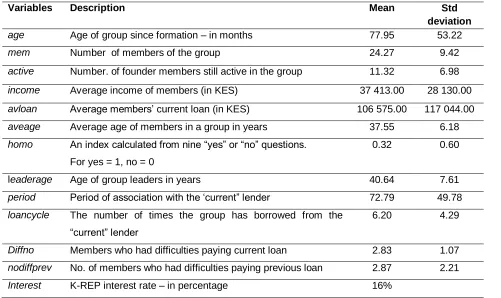
Table 1: Descriptive Statistics for Survey Variables
Variables Description Mean Std
deviation
age Age of group since formation – in months 77.95 53.22
mem Number of members of the group 24.27 9.42
active Number. of founder members still active in the group 11.32 6.98
income Average income of members (in KES) 37 413.00 28 130.00
avloan Average members‟ current loan (in KES) 106 575.00 117 044.00
aveage Average age of members in a group in years 37.55 6.18
homo An index calculated from nine “yes” or “no” questions. For yes = 1, no = 0
0.32 0.60
leaderage Age of group leaders in years 40.64 7.61
period Period of association with the „current” lender 72.79 49.78
loancycle The number of times the group has borrowed from the “current” lender
6.20 4.29
Diffno Members who had difficulties paying current loan 2.83 1.07
nodiffprev No. of members who had difficulties paying previous loan 2.87 2.21
Interest K-REP interest rate – in percentage 16%
Licensed under Creative Common Page 197 groups. This could be explained by the cosmopolitan nature of a city population. Equally, about 80% of the groups indicated that they were required to pay their first instalment at the end of the first week after receiving the loan. This implied that initial repayment by some group members came directly from the borrowed funds.
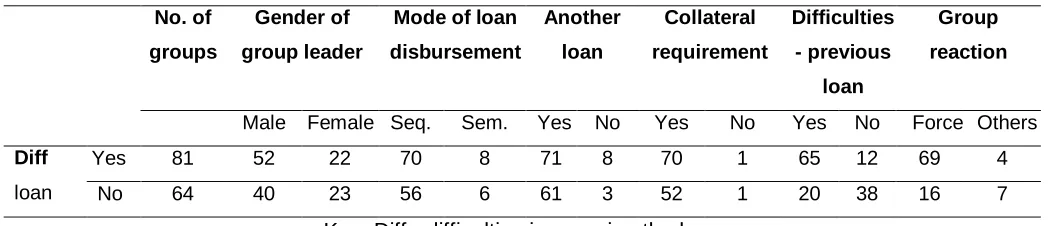
As shown in Table 2, of the 145 groups who answered the “diffcurr” question, 56%
indicated that at least one member in their group had some difficulties meeting their repayment obligations. Among them, the highest percentage was from the groups managed by men. Likewise, there was a positive relationship between previous and current loan repayment difficulties. Out of the 63% of the groups which reported having difficulties in repaying previous
loans, 76% had difficulties paying their current loan. Moreover, most K-REP loans (about 90%) were granted sequentially and about 92% of group members reported that they had no other source of credit.
Table 2: Cross Tabulation: Repayment difficulties vs. other variables (values in percent)
No. of groups
Gender of group leader
Mode of loan disbursement
Another loan
Collateral requirement
Difficulties - previous
loan
Group reaction
Male Female Seq. Sem. Yes No Yes No Yes No Force Others
Diff
loan
Yes 81 52 22 70 8 71 8 70 1 65 12 69 4 No 64 40 23 56 6 61 3 52 1 20 38 16 7
Key: Diff - difficulties in repaying the loan
In addition, and contrary to the general belief that micro-financing does not require collateral, about 98% of the groups were required to offer some form of security in order to access credit. Apart from the group co-guarantee mechanism requirement, other types of collateral required mandatory saving and household assets of the members. This does not; however, seem to have had any impact on repayment. Similarly, all groups reported a willingness to use force to “encourage” to pay the loan. Of all the groups interviewed, about 89% reported having used at least one form of threat to make members comply with the group‟s repayment obligations. The aspects of group collateral requirements and the willingness to use force to force repayments is at odds with the assumption that group solidarity and group co-guarantee mechanisms, alone, drive higher repayments.
Licensed under Creative Common Page 198 arrears meaning that they managed to pay their monthly obligations in full. Moreover, the method of accessing credit seemed to be inconsequential in determining whether a group had arrears since most of the groups were granted loans sequentially.
Leadership of the group was measured using both the level of education and previous experience of leader members. Typically, as expected, the groups who had a large amount in arrears had less educated leaders. Furthermore, the groups led by members with previous leadership experience had lower levels of arrears than those without experience. This demonstrated that strong leadership was instrumental in encouraging repayment and formulation of provisional loan repayment in case of a member defaulting.
It is worth noting that the average income of members under the K-REP group lending programme was KES 38 000 per month. This suggests that, contrary to general belief, K-REP did not necessarily target the poorest segment of the society. In a country where, about 46% of the population was classified as poor (GOK 2007), an average income of KES 38 000 per month was quite high and beyond the reach of many. This is consistent with Morduch‟s (1999) argument that micro-finance programmes, generally, are drifting away from their original purpose which was to fund the poor who cannot otherwise access finance.
It is also notable that the average loan value advanced by K-REP (KES 107 000) was generally beyond the repayment capacity of many poor people. Moreover, micro lenders are assumed to lend at lower interest rates than other conventional lenders. However, K-REP charged a nominal 16% per annum on a flat rate basis. When put into perspective, this rate compared unfavourably with conventional commercial banks‟ rates, which in 2006, was at a maximum of about 18% per annum at a reducing rate (GOK 2007). This implies that K-REP offered credit at a high interest rate to supposedly, the “poor” entrepreneurs.
CONCLUSION
In conclusion, from the standpoint of economic theory, group lending can mitigate information asymmetries in the credit market. In principle, group lending contracts provide a way to achieve outcomes even when a lender is unable to enforce contracts. But if the groups are not properly constituted and are not supported by innovative programme designs, the group may end up worse off than it would if other types of contracts are used, as there are some destabilising factors which can affect group repayment.
Licensed under Creative Common Page 199 information, a situation which leaves little room for cross-referencing sources through formal channels that can be used to confirm the reliability and counter check the accuracy of the information. MSEs and groups also do not enter into contracts that are publicly visible (Cook, 2001). Meaning that group mechanism is based on the application of incomplete contracts theory where smilingly identical outcomes are judged and treated differently by members. This means that trying to clearly understand all the possible group repayment outcomes and model the contributors to be an unfeasible task.
WAY FORWARD
As indicated earlier, the research uses a baseline survey which was compiled in august 2006 from K-REP groups. A considerable limitation that confronts research of this nature is the biased selection of the sample. These surveys take into consideration only the credit groups which existed at that point in time (cross-sectional data). This is a limitation because it does not take into consideration entities that were liquidated before the research was undertaken, meaning that the information obtained from such types of research represents the opinion of a subset of the entire population. This weakness can be mitigated if future studies utilize longitudinal investigations instead of cross-sectional studies.
Lastly, as noted by Paxton et al. (2000), when generalising the results of these studies, a problem might arise when considering group repayments. Developing countries have culturally diverse populations with numerous ethnic groups and traditions (Paxton et al. 2000). These traditions govern the relationship between individuals, including debt repayment (Paxton et al. 2000).These diversities in countries like Kenya often limit the ability to generalise the findings. This study suggest that specific community based studies can provide a more credible results of the determinant affecting group and programme performance.
REFERENCES
Aniket, K. 2004. Sequential group lending with moral hazard. Available: http://www.aniket.co.uk/research/sql.pdf (Accessed 25 February 2014).
Armendáriz de Aghion, B. and Morduch, J. 2005. The Economics of Microfinance. Cambridge, Massachusetts: MIT Press.
Attanasio, O. et al. 2011. Group lending or Individual Lending? Evidence from a Randomised Field Experience in Mongolia, Working paper No. 136. London: European Bank for Reconstruction and Development.
Chunchi, W. and Young, A. 2002. Critical operating problems and survival rates in small firms: A look at small business institutes clients. Journal of Developmental Entrepreneurship, 7(1): 1–23.
Cook, P. 2001. Finance and small and medium-sized enterprises in developing countries. Journal of Developmental Entrepreneurship, 6: 17-31.
Licensed under Creative Common Page 200 Giné, X and Karlan, D. 2010. Group versus Individual Liability: Long-term Evidence in the Philippine Microcredit Lending Groups. Available: http://karlan.yale.edu/p/GroupversusIndividual-May2009.pdf (Accessed: 23 October 2014).
Government of Kenya. 2007. Economic Survey. Kenya National Bureau of Statistics. Nairobi: Government Press. Government of Kenya. 2008. Economic Survey. Kenya National Bureau of Statistics. Nairobi: Government Press. Morduch, J. 1999. The microfinance promise. Journal of Economic Literature, 37(4): 1569-1614.
Paxton, J. 1996. Determinants of successful group loan repayment: an application to Burkina Faso. PhD, University of Ohio.
Paxton, J., Graham, D. and Thraen, C. 2000. Modelling group loan repayment behaviour: New insight from Burkina Faso. Economic Development and Cultural Change, 48 (3): 639-655.
Rai, A. and Sjöström, T. 2004. Is Grameen lending efficient? Repayment incentives and insurance in village economies. Review of Economics Studies, 71(1): 217–234.
Varian, H. 1990. Monitoring agents with other agents. Journal of Institutional and Theoretical Economics, 146(1): 153-174.
Zeller, M. 1998. Determinants of repayment performance in credit groups: The role of programme design, intra-group risk pooling and social cohesion. Economic Development and Cultural Charge, 46(3): 599-620.