Negotiating the Maze: Case based, Collaborative Distance Learning in Dentistry
Sybille K Lechner BDS, MDS FRACDS, FPFA, FICD
*, Peter Kandlbinder BEd (SCAE), MEd
(UTS)
†, Shalinie Gonsalkorale BDS (Hons), FRACDS
*, Michael Bradshaw
‡, Katherine M
Har-ris (Lechner) B Soc Sci, MBA
**, Tracey Winning BDSc (Hons) GradDipHEd PhD
†† *School of Dental Studies, University of Sydney Australia
†
Institute for Teaching and Learning University of Sydney, Australia
‡
Multimedia programmer, Click Here Design Sydney, Australia
**
The Leading Edge Sydney, Australia
††
Dental School, Faculty of Health Sciences, Adelaide University, Australia
Abstract:The module was developed as an elective to give motivated senior dental students an opportunity to expand their horizons in planning oral rehabilitation. It comprised one tutor and 12 students, from five universities world-wide, communicating on the World Wide Web (WWW), to develop oral rehabilitation plans for simulated patients. Trigger material came from one of two Case Profiles and consisted of diagnostic casts and details of the clinical and radiographic exami-nation in WWW/CD-ROM form. No background material was supplied as to the “patient’s” age, sex, history or main concern(s). Students worked in groups of three, each student from a different location. Individual students were given a role within the group: ”Patient”, who developed a “per-sonal background” belonging to the trigger examination material, “Academic” who identified state-of-the-art treatment options available for the dental treatment needs identified by the group and “General Practitioner” who tailored these options to the “patient’s” needs and wants. Student feedback focused on their perception of their experience with the program in response to a ques-tionnaire comprising 11 structured and four “open” questions. All students felt that the program increased their confidence in planning oral rehabilitation. Ten students felt that the “best thing about the program” was the interaction with students from other universities and the exposure to different philosophies from the different schools. Eight students mentioned their increased aware-ness of the importance of patient input into holistic planning. Under the heading "What was the worst thing”, students cited some technical hitches and the snowball effect of two sluggish stu-dents who were not identified early enough and thus impacted negatively on the working of their groups. Student feedback showed that the module succeeded in its aims but needed modification to improve the logistics of working with an extended campus.
Key Words - Dental education, collaborative learning, oral rehabilitation, computer aided learning
The adult patient, who has lost one or more teeth, offers a unique and problem-rich teaching and learning resource. When planning long term reha-bilitation of such a patient, all the decisions made to deal with individual conditions impact on each other and all are further influenced by patient compliance, finances, technical and logistic limitations and other such non-dental factors. The resulting planning pro-cess can thus be likened to finding one's way through a maze. While experts in the field negotiate this maze by using accumulated years of clinical experi-ence, this path is not available to the neophyte. Ob-servation has shown that senior students, who have some clinical background, are willing and able to
discuss possibilities and options in planning reha-bilitation, but that these discussions tend to be form-less, repetitive and rarely progress to a definitive plan of exactly what treatment the patient will receive.
The aim of this project was to develop an elec-tive module for interested senior students, which would give them an opportunity to expand their hori-zons by:
• exposing them to an extended base of treatment options and philosophies from different univer-sities,
• enabling them to form links with overseas stu-dents and
• enhancing their awareness of the patient in the planning process.
The Module•
The twin factors of the simulated patient and group learning are particularly suited to helping stu-dents to learn complex tasks such as planning oral rehabilitation. This module used both these factors. It uses the simulated patient to allow the students latitude in making their own decisions without the possibility of harming a real patient with an inappro-priate choice. The module also uses group learning as a mechanism for promoting in depth approaches to student learning through collaborating on complex problems.1, 2 It involved students organizing their knowledge, building on what they knew, facilitating their processing of information and encouraged deep thinking through elaborating and making their think-ing process explicit. 3
The group included one tutor and 12 final year dental students, from five universities world-wide•• communicating on the WWW to develop oral reha-bilitation plans for computer simulated patients. Key personnel were contacted at the various universities and asked whether they were interested in having their students participate. Students from interested universities were then asked by staff to volunteer for the module as an elective in their final year. Each of six Universities was to supply two students. How-ever, one University dropped out in the final stages of negotiation and Otago University supplied four stu-dents instead of two, to make up the required number. Prerequisites were a good command of written Eng-lish, access to a suitable computer (but not necessar-ily computer literacy), links to the WWW and a willingness to be involved. While no specific re-quirements regarding the sex of the participants was requested, the final numbers comprised six males and six females.
• http://maze.dentistry.usyd.edu.au/
"About the people" is password protected. The rest of the module has open access
•• University of Sydney, Australia; Adelaide University, Australia;
Otago University, New Zealand: Harvard University, USA; Uni-versity of Liverpool, UK
The module ran from February to June 2000, the time given for each assignment varying from two days to three weeks, depending on the amount of "homework" necessary to complete it or the interac-tion required between the participants.
Each student received a Student Manual de-scribing the module, the web site, the assignments and the criteria for assessment. The tutor was a lec-turer in the Faculty of Dentistry, University of Syd-ney, who was very interested in education. A Tutor Manual provided generic guidelines for the tutor's role, which was principally as a facilitator but also to give expert feedback for the finished assignments.
Four main activities provided the scaffold for learning prosthodontic decision-making over eight assignments. In Assignment 1, individuals chose a non-dental decision making scenario; for example, making coffee for a group of friends. The students then detailed the decision-making processes entailed in this activity according to strict guidelines outlined in the manual and on the web.
The second activity was also individual. Stu-dents used and critiqued a CD-ROM “Decision
making”4 which follows a generic framework to
fa-cilitate planning oral rehabilitation for a variety of cases. They were told that if they could describe valid improvements to this generic framework, they could negotiate with the tutor to use the improved framework for their remaining assignments.
The third activity was a series of group assign-ments; the 12 students were divided into four groups of three, each student in a group being from a differ-ent location. For these assignmdiffer-ents, they communi-cated extensively on the web with their fellow group members to develop oral rehabilitation plans for simulated patients, according to an established framework. Trigger material came from one of two Case Profiles and consisted of diagnostic casts and details of the clinical and radiographic examination in WWW/CD-ROM form. No background material was supplied as to the “patient’s” age, sex, history or main concern(s).
The three people in each group were each as-signed a role. These roles were:
re-sponsible for the legal/ethical implications of treatment.
2. “Academic” (A) who identified state-of-the-art treatment options available for the dental treat-ment needs identified by the group. He/she was responsible for the dental validity of treatment in terms of current knowledge.
3. "General practitioner" (G) who identified treat-ment options within the limitations of skill, knowledge, finances and patient commitment of the group and of the patient. He/she was respon-sible for tailoring treatment options to the pa-tient’s personal requirements without jeopardiz-ing oral health.
While individual students were ultimately re-sponsible for their role, all students within a group were expected to interact with each other and the tutor to develop all aspects of the assignments. Stu-dents were assigned these roles in an ad hoc manner, the only proviso being that no two students from the same university had the same role.
An example of the kind of exchange that took place in the third activity is shown below, with the tutor’s feedback printed in red:
PHASE II FORM, FUNCTION AND AESTHETICS
Maxillary denture (immediate denture following extractions to address pa-tient’s chief complaint of “I need to fix the gap in my smile”)
- replacing teeth 17, 16, 23, 24, 26# - made of acrylic
An immediate denture is an excellent idea. You should probably indicate here how long each phase will take. Patients need to have some idea of how many visits and what sort of time period will be involved.
- no coverage of palatine torus (closed horseshoe)
- no occlusal rest (tissue supported due to periodontal status of posterior teeth) - circumferential clasps on 18 and 27 - gingivally approaching clasp 15 - if needed, 25 and 27 can be added to
the acrylic denture in the future.
# Because the module is an international project, teeth are num-bered according to the international FDI system.
Will the fact that he is a semi-professional trombone player make it hard for him to wear dentures?
When all groups had submitted their final plan, they first critiqued each other's decisions and then responded to these critiques. The final activity was an individual evaluation of the module and an as-sessment of their colleagues’ input. Within this highly structured framework students had a great deal of freedom to express their own ideas.
Assessment of student learning was both forma-tive and summaforma-tive. Formaforma-tive assessment was pro-vided through feedback from colleagues and from the tutor during and at the end of each assignment. Summative assessment took two forms: group and individual assessment using clearly defined criteria and standards. 5
Construction of the Web Site
The web site consisted of two main areas: infor-mation pages, which provided details about the course, assignments and clinical cases, and commu-nication forums, which allowed participants to corre-spond with each other. Whereas students' access to forums was limited to their own groups' discussions, the tutor had access to all communication forums to allow for monitoring student progress.
The information pages were constructed using the standard language of the Web, HTML (Hyper Text Markup Language). For the most part, embel-lishment was kept to a minimum and fancy graphics were used very sparingly. The reasons for this were twofold. First, to speed up access to the site for users connected to the Internet through modems, and sec-ond, to keep the site design appropriate for an aca-demic setting.
The exception to the sparing use of graphics oc-curred when presenting photographs of the cases. In this area high resolution photographs were included which illustrated the required clinical detail. Subor-dinate photographs (e.g., close-ups of individual teeth) were usually linked to a “key” photograph (e.g., an anterior view of the patient’s mouth) by means of image map hyperlinks. This meant that the main photograph could be kept on the screen and individual close-ups revealed simply by the user clicking on the appropriate area of this photograph.
connected to the University of Sydney’s Local Area Network through an Ethernet hub, which provided it with high-speed incoming and outgoing Internet ac-cess.
Student Feedback
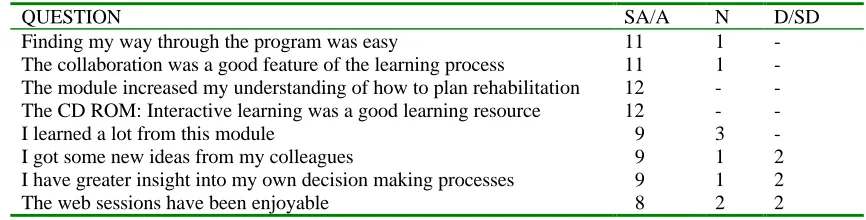
For this module, students were asked to evaluate their experience by means of a survey, which took the form of an agree/disagree rating chart followed by open questions inviting the students' comments. This approach had proved valuable in the develop-ment of other educational software.6,7,8,9 The evalua-tion included eight items asking about satisfacevalua-tion with the module, two items asking about previous computer experience and comfort with computers, an item asking students to relate their experience to various words, and open questions asking about the best and worst aspects of the module, what they had learnt from it and how it could be improved. Overall, responses from the students were positive (Table 1). All students felt that the program increased their con-fidence in planning oral rehabilitation and all felt that the CD-ROM “Interactive Learning in Dentistry” was a good learning resource.
In one part of the evaluation, students were given a list of words (Fun, Informative, Frustrating, Inno-vative, Boring, Irritating, Useless, Enjoyable, Useful, Difficult) and asked to tick those which described their experience of the program. Six checked only positive words. Positive words checked were mostly “useful”, and “informative.” Additional positive words added by the students were “inspirational” and “creative.” Five students checked both positive and negative words (“frustrating”, “difficult”). None
checked only negative words. Altogether 44 positive and eight negative words were checked.
Previous computer experience was evenly di-vided between “little or no computer experience” (four students) to having used computers “11 to 100 times” (four students) to “hundreds of times!” (four students). It was interesting to note that limited computer expertise did not seem to impact on feel-ing “…comfortable usfeel-ing the computer for this learning experience.” Ten students felt comfortable using the program, two felt “not very” comfortable and none felt “uncomfortable”.
Almost all (ten students) responses to the ques-tion “What was the best things about the program?” cited the interaction with students from other Uni-versities and the exposure to different philosophies from the different Schools. Students also liked the realistic approach of the module and the impact that the “patient” had on the ultimate plan. They felt that it was a practical and useful experience, which mimicked “real-life” dentistry. One student added the perceptive idea that “(treatment planning) is something that has to be learned but that cannot
necessarily be taught.” He felt that working with his group helped him to learn “what works for me per-sonally.” Two students were impressed with the constructive feedback given by the tutor. The “worst things” were some technical and logistic factors and the lack of cooperation of two students who did not participate fully in the module, thus impacting badly on the group discussion process.
The “main thing learned” was overwhelmingly an increased awareness of the importance of the pa-Table 1
Response to the Structured Questionnaire
QUESTION SA/A N D/SD
Finding my way through the program was easy 11 1
-The collaboration was a good feature of the learning process 11 1
-The module increased my understanding of how to plan rehabilitation 12 -
-The CD ROM: Interactive learning was a good learning resource 12 -
-I learned a lot from this module 9 3
-I got some new ideas from my colleagues 9 1 2
I have greater insight into my own decision making processes 9 1 2
The web sessions have been enjoyable 8 2 2
SA/A Strongly Agree/Agree
N Neither Agree nor Disagree
tient in developing a successful plan and the cus-tomized, comprehensive and holistic approach to planning (nine students) Most students also felt that the CD-ROM: “Interactive Learning in Den-tistry“ helped them to learn to organize their knowl-edge into a logical sequence of steps. Other things learned were “indications and contraindications for various treatment options for the partially edentu-lous patient”, “the importance of planning” and “the importance of informed consent.”
The tutor enjoyed working in the project and found the module a worthwhile learning experience for herself as well as for the students. She spent ap-proximately four hours responding to all groups on each completed assignment. She was interested in following the different groups as they debated treat-ment options, patient details and the formulation of treatment plans bringing out both the differences and similarities in treatment philosophies. She also found it stimulating to be able to contribute to and promote the exchange of ideas.
However, a few problems did arise. For exam-ple, the communication forums on the web were found to be unsatisfactory as some computers had technical glitches in web communication. This re-sulted in students communicating by e-mail instead, a maneuver, which effectively excluded the tutor from their discussions and did not allow her to identify non-responsive students before it became too late.
Future Directions
The program was originally offered as an elec-tive for various reasons. Primarily it was a pilot pro-gram and there was uncertainty regarding outcomes and logistic issues. Additionally, it was felt that one tutor could not cater to more than twelve students. Since then a modified, face to face version has be-come part of the intramural curriculum. However, the pilot showed that, while the educational value was substantial, the logistic difficulties of the global setting are immense, comprising different time zones, different starts to the academic year, different holiday periods and conflicting examination periods. It re-quires a certain dedication to overcome these chal-lenges. The global module is thus not likely to be used across the board by all students. It is being re-peated in its present restricted form in 2001 with ad-ditional schools participating to give motivated un-dergraduate students an opportunity to expand their horizons in planning oral rehabilitation. The module has also been proposed as a learning experience for
young graduates wishing to sit for their examinations for the Royal Australasian College of Dental Sur-geons. This would entail distance learning across Australasia.
Feedback from the students and tutor has resulted in the following changes being made.
• Increasing staff liaison at the individual univer-sities to help identify non-responsive students sooner.
• Identifying back-up students who could take over in case of mishap.
• Tailoring the module to individual universities' time-table and holiday periods.
• Transferring communication officially to e-mail, leaving the web page as an information resource only.
Discussion
Allowing students to practice on a computer simulated partially edentulous patient in a group-learning environment, promotes deep group-learning by allowing them latitude in practicing to solve “prob-lems” themselves without the danger of harming a real patient with an inappropriate decision. While the simulated patient is ultimately no substitute for a real patient in a clinical setting, it can give students an insight into the planning process, so that subsequent discussions with clinical experts about actual patients can take place at a more meaningful level.
Within the framework of collaborative learning, this module was innovative on two counts. First, students were asked to design their own patient, and second, the exercise involved extramural collabora-tion. The idea of involving students in designing the “patients” themselves was intended to make them more aware of the impact that details of history and patient personality could have on the planning proc-ess. Global collaboration was included to expose students to an extended base of treatment options and philosophies from the different universities. Student feedback shows that they appreciated both these fea-tures, and had gained confidence in planning oral rehabilitation.
References
2. Seely Brown, J. Collins, A. and Duguid, P. Situated cognition and the culture of learning. Educational Research 1989;18(1): 32-42.
3. Johnson SD, Thomas R. Technology education and the cognitive revolution. Technol Teacher 1992;51(4):7-12.
4. Lechner SK, Thomas G, Bradshaw M, Lechner K. Planning oral rehabilitation: case-based com-puter assisted learning in clinical dentistry. Br Dent J (in press)
5. Goldfinch J. Further developments in peer assessment of group projects. Assessment and Evaluation in Higher Education 1994;19 (1):29-35.
6. Oliver R, Omari A. Using online technologies to support problem based learning: Learners re-sponses and perceptions. Austral J Techn1999;15(1):58-79.
7. Lechner SK, Lechner KM, Thomas GA. Evalua-tion of a computer aided learning program in prosthodontics. J Prosthodont 1999;7(2):100-105.
8. Forbes P. http://www.oac.usyd.edu.au/ pfor-bes/cpsm/a01cpsm.htm
9. Nightingale, P., Te Wiata, I., Toohey, S., Ryan, G., Hughes, C. and Magin, D. Assessing learning in universities. University of New South Wales Press; 1996.
Correspondence to:
Associate ProfessorS K Lechner School of Dental Studies United Dental Hospital 2 Chalmers St
Sydney, 2010 AUSTRALIA
Phone: 612 9351 8347
Fax: 612 9211 4958
E-mail [email protected]
Financial Support
Committee for University Teaching and Staff Devel-opment (University of Sydney))
Information technology Committee (University of Sydney)