Preliminary Study Of Physics Teaching Materials
Design Based On Inquiry Based Learning
Integrated Creative Thinking
Mona Trisna Cahyati, Yohandri
Abstract: This article discusses a preliminary study on student characteristics analysis and needs analysis in physics of learning. At SMAN 1 Lengayang, as a preliminary study. This preliminary research was conducted to evaluate student characteristics which are intended to study student characteristics and analyze the need to assess the teacher's response to physics learning activities. This research uses descriptive statistical methods. The findings of the student characteristics analysis showed an analysis of the characteristics of the students, which consisted of several measures of the student competency results which were quite good, good initial motivation, good learning incentive, media and language formats with a better enough plan and good enough encouragement In addition, needs analysis consisting of graduation requirements and learning metrics reveals the outcomes of each with sufficient criteria. To improve students' creativity, it can be done by applying an inquiry-based learning model. Learners will more easily understand the learning material if the material is in accordance with their daily lives. Therefore, a suitable approach used in the development of Inquiry Based teaching materials is the CTL approach. By using appropriate teaching materials, it will be able to develop the abilities of students so that learning will be meaningful, and can improve students' creative thinking abilities. Therefore, Improvements must be made, namely by designing teaching materials that focus on inquiry-based learning models with integrated CTL approaches for innovative physics learning skills.
Index Terms: Contextual teaching and learning, Creative Thinking, Inquiry Based Learning, Teaching Material
—————————— ——————————
1. INTRODUCTION
The 21st century is a century that has intense competition from various fields. Competition is inseparable from all elements of human needs that are always developing all the time. In the 21st century, it is necessary to have human resources who are ready and alert in the face of such competition in order to survive and be competent in a healthy manner. Technological development was felt more quickly because it was triggered by the ease of disseminating information through various media. To answer the challenge in the 21st century, various efforts have been made by the government including providing the necessary facilities andinfrastructure, increasing teacher professionalism as
educators, teacher certification, and by improving the curriculum and now the applicable curriculum, the 2013 curriculum. The 2013 curriculum has a goal that students are able to contribute to social life, the nation and to the world as an active, creative, innovative and effective human being [1]. The 2013 curriculum demands that all aspects of competency be assessed during the learning process both in attitudes, knowledge and skills competencies. Competence is something that is contained in a person and the main component so that it improves performance and contributes to its success in
learning activities [2]. According to the 2013 curriculum student
competencies include three aspects namely attitude
competence, knowledge, and skills. Attitude competencies include attitudes, personality, religious and social students. Knowledge competence includes the level of ability to remember, understand, apply, analyze, evaluate and create. Skills competencies include skills, hard work and student
activities. 21st Century skills or termed 4C (Communication, Collaboration, Critical Thinking and Problem Solving, and Creativity and Innovation) are the real abilities to aim for with the 2013 Curriculum. So, student competency will be well achieved if all learning outcomes are achieved after carrying out activities learning. Learning is a reciprocal relationship between educators and students and in a learning environment, it requires other learning resources. Learning is a continuum of reciprocal relationships between teachers and students and students with students to acquire new information that is facilitated by the use of different media, education materials and methods that suit their needs [3]. Learning activities can take place at the School. One of the compulsory knowledges given to students in high schools is Physics. Physics is a part of Natural Science which is a systematic effort in building and organizing knowledge in the form of explanations that can be tested and able to predict natural phenomena. The most important thing in learning physics is students who actively learn. All teachers‘ efforts must be aimed at supporting and encouraging students to want to learn physics by growing interest in studying objects or
events in the classroom environment [4].
The facts found in the field based on the analysis of characteristics known to be not optimal student competency, can be seen based on the average competency of 67.69%, initial motivation is still quite good. This can be seen from the percentage of students ' initial behaviour 62.87%. Learning ability and learning styles have a percentage of 60% and 65.74%, and the attitude towards learning is quite good, which has the support of students who have a percentage of 72.46% and motivation has a percentage of 72.92%. Media format aspects and language are 64.47% and creative thinking is 66.60%. In addition, observations were also made when students studied with their teachers to emphasize more on the characteristics of these students. Student learning is centered only on the educator and the textbook used. The use of textbooks that are commonly used as learning resources also
does not help students in understanding physical,
————————————————
Mona Trisna Cahyati, Universitas Negeri Padang, Students of physics education post graduate program, Faculty of Mathematics and Natural Sciences. E-mail: [email protected] Yohandri, Universitas Negeri Padang, Lecturer of physics education
284 mathematical meaning, and its application to the concepts of
physics. Less optimal in the development of teaching materials and the limitations of physics teaching materials in supporting learning make students unable to carry out learning according to student characteristics. The importance of developing appropriate and effective teaching materials to meet the needs and characteristics of students in the form of teaching materials in physics subjects. Teaching material is a book written with the aim that students can learn independently without or with the guidance of the teacher, so that the teaching material contains at least all of the basic components of teaching material [5]. In addition, the teacher must use the right model to achieve the objectives of the learning process. One learning model proposed by the 2013 curriculum is the Inquiry-based Learning model (IBL). Learning from an inquiry-based learning model includes learners formulating questions that lead to analysis in a bid to build new information and
meaning [6]. Inquiry learning emphasizes the process of
searching and finding. Information on the subject is not explicitly supplied. In this learning, students ' task is to explore and find their own subject matter, while the teacher acts as a facilitator and guides students to learn. Inquiry learning's primary purpose is the improvement of thinking skills. Therefore, research is not only learning-oriented but also learning-oriented. So, so that students are better able to develop their abilities based on the problems they formulate and find their knowledge, the right teaching material to be developed is inquiry-based learning. The learners can more readily understand the learning material if the content is in line with their daily lives. The CTL approach is therefore an appropriate approach used in the creation of Inquiry-based teaching materials. CTL is a learning framework that allows teachers to connect learning content to the real world and enables students to load the relationship between the information they have in their lives and its application. By using suitable teaching materials, students ' skills will be improved so that learning is meaningful, and the creative thinking abilities of students can be strengthened. Creative thinking is a thinking which aims to create new ideas. The characteristics of the ability to think creatively in accordance with cognition can be seen from aspects of fluent thinking flexible thinking aspects, original thinking aspects and elaboration aspects [7]. But the reality in the creative thinking ability of the students is still weak. Many factors cause the low capacity of creative thinking of the students. Firstly, students tend to wait for the guidance of the teacher to read the material before beginning to learn. This means students still cannot begin their own learning. Furthermore, students must be more active in learning in the 2013 curriculum, so that teachers can only become facilitators. Furthermore, teaching materials used in learning did not use learning measures that allow students to find their own concepts and problems about the studied
material. Responding to these problems‘ researchers are
interested in developing teaching materials to facilitate students in learning. In order for learning activities to run well, the teaching materials developed must be able to make students discover their own knowledge through a contextual approach and integrated creative thinking as one of the skills needed to answer challenges in the 21st century. Solutions that can be provided to help students overcoming these difficulties is the need for teaching materials that can help students learn independently. In this study, teaching materials developed in the form of inquiry-based learning-based learning
with CTL approach integrated creative thinking skills as a learning resource for students. Development of teaching materials is very necessary to improve the competence of students.
2. METHOD
This research is the initial stage of research and development (R&D). This research is also a descriptive study. Descriptive research is research that presents a complete picture of a phenomenon, by describing a number of variables related to the problem under study between the phenomena being
tested [8]. This research also uses a qualitative approach. The
qualitative method is also called the naturalistic method because the research is conducted in natural conditions [9]. Qualitative methods through analyzed data, analyzing data, and interpreting data. The data collection instruments in this study were students' questionnaires. The questionnaire used consisted of a closed questionnaire. Closed questionnaire is an answer-available questionnaire that is available in a questionnaire, so it must be approved, students cannot give free answers [10]. In this analysis the population was all class X MIPA students at SMAN 1 Lengayang. The purposeful random sampling approach was used in the study to assess the research sample so as to generate a class X MIPA 1 as research samples, with a total of 32 students. Techniques for collecting data in questionnaire form. The data analysis technique used is the Likert scale. Likert scale can be used to assess a person's opinion or interpretation of social events or symptoms about a group of people. Likert scale is a scale used to measure a person's beliefs, attitudes or views or groups about a phenomenon or social phenomenon on the basis of the researcher's operational resolutions, and the Likert scale is either an acceptance scale or not a response to the current statement [11]. To get data from the analysis of student characteristics and needs analysis obtained by calculating the score obtained from each respondent divided by the maximum score that must be obtained. Final score obtained by contribution:
%
100
maxx
x
x
S
i k
(1)Where Sk is score received, Xi is score of each responder dan
Xmax maximum score from the questionnaire for each indicator.
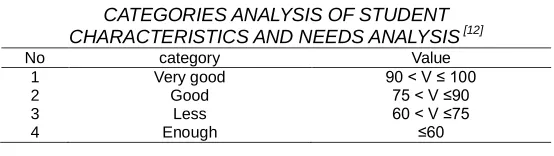
To find out the score categories of analysis of student characteristics and the needs analysis of each component, use the provisions in Table 1.
TABLE 1
CATEGORIES ANALYSIS OF STUDENT
CHARACTERISTICS AND NEEDS ANALYSIS [12]
No category Value
1 Very good 90 < V ≤ 100
2 Good 75 < V ≤90
3 Less 60 < V ≤75
4 Enough ≤60
3. RESULT AND DISCUSSION
In this preliminary study seeing student characteristics and needs analysis. Student characteristics can be seen from multiple indicators consisting of five indicators, each with many
aspects. The following are measures of student
The competency indicator consists of attitude, knowledge and skills. The initial behavioral indicators consist of learning abilities and learning styles. Indicators of attitude towards learning consist of interest and motivation. In the indicators for media and language format consist of media and language. And the last indicator analysed is the creative thinking indicator. Analysis of student characteristics was obtained from the instruments made. Following analysis of student competencies and results can be seen in the Graph in Figure 1.
Based on Figure 1 the results of the analysis of the characteristics of students are seen. Indicator characteristics of students consists of 5 indicators, each of which has several aspects. The first indicator is the competence with the attitude aspect has a percentage of 77.5% is in good criteria, the aspect of knowledge has a percentage of 60.16% which is in sufficient criteria and the aspect of skills that is 64.51% is in sufficient criteria. The average of competency indicators has a percentage of 67.69% with sufficient criteria. This is because students generally already have a curiosity towards learning physics and trying to follow physics learning. And realize that to achieve good physics learning outcomes, it requires seriousness and hard work. Based on the data it can be seen that the competence of knowledge and skills is still low. New standards are needed so students will have the competence needed in the 21st century. Schools are challenged to find ways in order to enable students to succeed in work and life through mastering creative thinking skills, solving flexible problems, collaborating and innovating [13]. This is also in accordance with the inquiry-based learning model. By using the inquiry learning model, the benefits are to improve students' thinking abilities to find and find the material to be learned by themselves, train their self-sensitivity, reduce anxiety, foster self-confidence, increase motivation, and participate in learning, increase positive behavior, increase student achievements and competencies. For the second to round indicator consisting of each aspect can be seen in the graph in Figure 2.
The second criterion for determining student characteristics is initial behavior. This was the basis of social skills and learning styles in the beginning. Aspect of learning ability with less criteria has a rate of 60%. In the aspect of learning style has a percentage of 65.74% with sufficient criteria. Judging from the ability to learn, students are still not smart enough to use methods that have been proven to solve complex physics problems, and they have not yet replied to compilation friends' questions that are currently under discussion. Learning styles taken by students is to remember the physics of what is seen, preferably reading from reading, both of these things kick students into the visual learning style. It is important to have teaching material in a visual learning style, which not only requires text but also has illustrations to make understanding easier. Teaching material is one teaching material that can make students easily understand information. This discusses with teaching material is a book written with the aim that students can learn independently or with the guidance of teachers, so teaching materials provide at least about all the
basic components of teaching materials [14]. The third criterion
286 accompanied by pictures and illustrations. The last indicator in
the analysis of student characteristics is creative thinking. This indicator has a percentage of 66.60% with sufficient criteria. This is because students only have enough criteria from each statement described. Furthermore, one of the characteristics of someone who thinks creatively is 'I give examples of ideas that are different from those that already exist' and get the criteria that are lacking in this statement. With the teaching materials created, it is hoped that it will also be possible to improve the creative thinking of students later on so that their skill will also increase. In addition to student analysis, a needs analysis of teacher respondents is also conducted. In this needs analysis consists of two indicators namely graduation standard analysis and learning analysis, each of which has several aspects. For analysis graduation standard indicators can be seen in Figure 3 graph.
In Figure 3 it can be seen that the needs analysis regarding graduation standards is as follows. 66.67% spiritual attitude with sufficient criteria and social attitude in the range of 75% with sufficient criteria. Knowledge is in the range of 66.67% with sufficient criteria, and skills 60.71% with sufficient criteria. This illustrates the need for optimization in knowledge.
Knowledge influences the achievement of students'
competency skills. To analyze the need for learning indicators can be seen in Figure 4 graph.
In Figure 4 is the result of learning analysis. There are each of the sources in the picture that is 1 = learning source; 2 = learning model; 3 = learning approach and 4 = creative thinking. In the aspect of learning resources used at a percentage of 62.50% with sufficient criteria. Acceptable teaching materials that can facilitate students in the physics learning process. In addition to the learning model used, the application of the learning process may also be decided. From the Learning Use Model findings in keeping with the appropriate 75.00 percent criterion. In addition, the teacher's use of learning in developing the thinking skills of students has a level of 75.00 per cent with appropriate criteria. So, the average for this learning indicator is 70.63% on the sufficient criteria. For this reason, learning resources, learning models, proper spending and creative thinking that teachers must prepare are needed to make students able to think creatively as well. Based on the results of the analysis of the characteristics of students that have been done, it can be seen that the competency of students is not optimal. This can be seen as an overall average percentage of students' competencies, which is 67.69%. students were 62.87%. Learning ability and learning styles have a percentage of 60% and 65.74%, and the attitude towards learning is quite good, which is indicated by the interest of students having a percentage of 72.46% and motivation having a percentage of 72.92%. Media and language formats are 64.47%. And the ability to think creatively still has a percentage of 66.60%. Next
to the need‘s analysis of graduation standards. 66.67%
spiritual attitude with sufficient criteria and social attitudes in the range of 75% with sufficient criteria. Knowledge is in the range of 66.67% with sufficient criteria, and skills of 60.71% with sufficient criteria. Aspects of learning resources used in schools according to the percentage of 62.50% with sufficient criteria. The use of learning models Using sufficient criteria is 75.00%. Regarding learning used teachers have a percentage of 75.00% with sufficient criteria. 70% that meets the criteria is sufficient. Therefore, it is necessary to develop teaching materials based on inquiry-based learning models with CTL approach integrated creative thinking skills for learning physics.
4. CONCLUSION
Based on the results and discussion in this study it can be concluded that the analysis of the students showed that the competency of the students was quite good, the initial behavior was quite good, the attitude towards learning was quite good, the format of the media and language had quite good criteria. Furthermore, needs analysis consisting of graduation standards and learning indicators shows the results of each with sufficient criteria. In addition, the teaching materials used also have not made students learn and find their own knowledge. Education is demanded to be able to answer the challenges of the 21st century. One effort that can be done to overcome this is the development of teaching materials based on demand-based learning models with CTL support integrated creative thinking. Therefore, it is necessary to develop teaching materials based on inquiry based learning models by getting CTL integrated creative thinking for learning physics.
REFERENCES
[2] Mulyasa. 2014. Pengembangan dan Implementasi kurikulum 2013. Bandung: Remaja Rosdakarya.
[3] Fadlillah. 2014. Implementasi Kurikulum 2013 Dalam
Pembelajaran SD/MI, SMP/MTs, & SMA/MA. Yogyakarta: Ar-Ruzz Media.
[4] Suparno, Paul. (2007). Metodologi Pembelajaran Fisika
Konstruktivistik & Menyenangkan. Yogyakarta: Universitas Sanata Dharma.
[5] Prastowo, A. 2015. Panduan Kreatif Membuat Bahan Ajar
Inovatif. Jogjakarta: Diva Press.
[6] Ridwan. 2014. Pembelajaran Saintifik untuk Implementasi
Kurikulum 2013. Jakarta: Bumi Aksara.
[7] Moma, La. 2015. ―Pengembangan Instrumen Kemampuan
Berpikir Kreatif Matematis Untuk Siswa SMP‖. Journal
Matematika dan Pendidikan Matematika PMIPA FKIP Universitas Pattimura Ambon. Vol 4.
[8] Sugiyono. (2011). Metode Penelitian Pendidikan
(Pendekatan Kuantitatif, Kualitatif, dan R&D). Bandung: Alfabeta.
[9] Suryana. (2010). Metode Penelitian Model Praktis
Penelitian Kuantitatif dan Kualitatif. Bandung : UPI.
[10]S Sugiyono. (2005). Metode Penelitian Bisnis. Bandung:
Alfabeta.
[11]Sukmadinata. (2007). Metode Penelitian Pendidikan.
Bandung : Remaja Rosdakarya.
[12]Sudijono, Anas. 2005. Pengantar Evaluasi Pendidikan.
Jakarta : Grafindo Persada.
[13]Zubaidah, Siti. 2016. Keterampilan abad ke-21:
keterampilan yang diajarkan melalui pembelajaran. Seminar Nasional Pendidikan dengan tema ―Isu-isu Strategis Pembelajaran MIPA Abad 21, tanggal 10 Desember 2016 di Program Studi Pendidikan Biologi STKIP Persada Khatulistiwa Sintang – Kalimantan Barat.
[14]Prastowo, A. 2015. Panduan Kreatif Membuat Bahan Ajar
Inovatif. Jogjakarta: Diva Press.
[15]Depdiknas. 2003. Pendekatan Kontekstual (Contextual