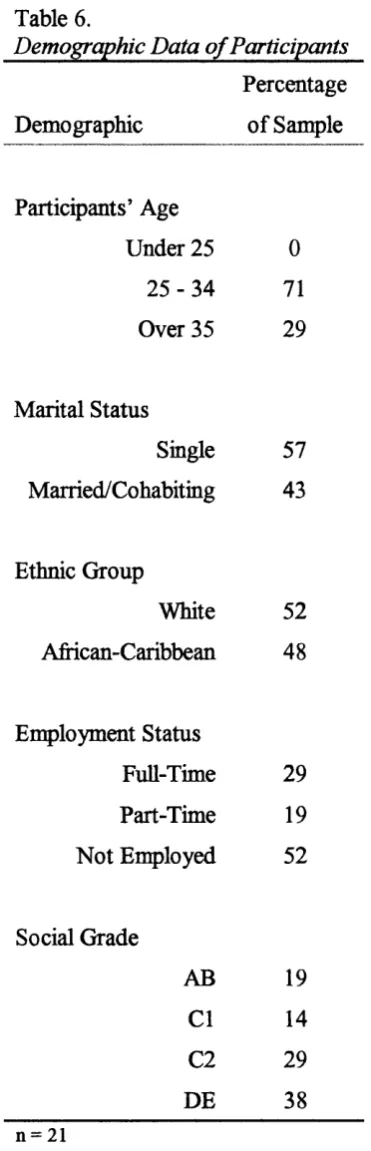
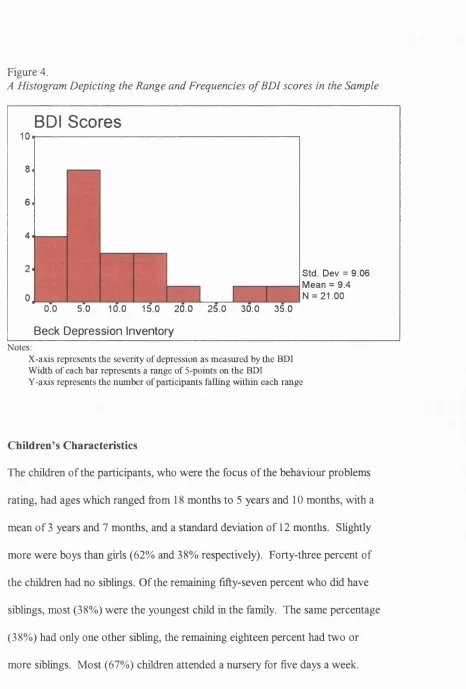
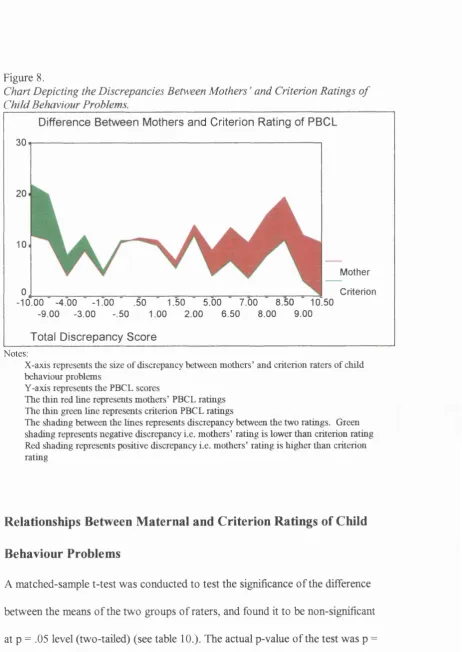
Maternal Representations and Perceptions of
Child Behaviour Problems
A Pilot Study
Duncan J. Law
Volume 1
Thesis submitted
in part fulfilment of the requirements for
D. Clin. Psy.
ProQuest Number: 10106752
All rights reserved
INFORMATION TO ALL USERS
The quality of this reproduction is dependent upon the quality of the copy submitted.
In the unlikely event that the author did not send a complete manuscript and there are missing pages, these will be noted. Also, if material had to be removed,
a note will indicate the deletion.
uest.
ProQuest 10106752
Published by ProQuest LLC(2016). Copyright of the Dissertation is held by the Author.
All rights reserved.
This work is protected against unauthorized copying under Title 17, United States Code. Microform Edition © ProQuest LLC.
ProQuest LLC
789 East Eisenhower Parkway P.O. Box 1346
C
o n t e n t sCo n t e n t s P a g e
Ac k n o w l e d g e m e n t s
Ab s t r a c t
In t r o d u c t io n 9
Overview 9
Previous Research, and the Current Model of Discrepancy in Ratings of
Child Behaviour Problems 10
Limitations of the Current Model, and Proposed New Model 16 Measures of Discrepancy in Ratings of Child Behaviour Problems 19
The Nature of Representations 22
The Theoretical Links Between Maternal Representations of Self and
Others, and Perception of Child Behaviour Problems 26
Accessing Representations 29
Inferring Representations Through Language: Free-Response
Descriptions 30
Inferring Representations Using Rating Scales: Repertory Grids 35
Me t h o d 42
Participants 42
Ethical Considerations 43
Design 44
Measures 45
Measures of Child Behaviour 45
Accessing Representations 47
Inferring Representations Through Language: Free-Response Descriptions 47 Inferring Representations Using Rating Scales: Repertory Grid Procedure 52
Measure of the Level of Maternal Depression 55
Demographic Data 56
Procedures 56
Analysis 59
Analysis of Free-Response Descriptions 59
Repertory Grid Analysis 61
Statistical Analysis 61
Re s u l t s 63
Section Outline 63
Sanq)le Characteristics 64
Sanq)le 64
Levels of Maternal Depression in the Sample 67
Children’s’ Characteristics 68
Maternal and Criterion Ratings of Child Behaviour and Discrepancy
Scores 70
Relationship Between Maternal and Criterion Ratings of Chüd
Behaviour Problems 74
Correlations Between Demographic Measures of the Sançle and
Ratings of Child Behaviour Problems 75
Association Between Level of Maternal Depression and Ratings of Child
Behaviour Problems 76
Repertory Grid Analysis 77
Content Features 77
Total Construct Ratings 77
Individual Construct Ratings 78
Factor Analysis 82
Structural Features 84
Analysis of Free-Response Descriptions 84
Inter-Rater Reliabihty 84
Content Features 86
Summary 86
Associations Between Content Dimensions of the Free-Response
Descriptions and Ratings of Child Behaviour Problems g7
Structural Features 90
Associations Between Structural Dimensions of the Free-Response
Descriptions and Ratings of Child Behaviour Problems 9 1
Global Rating and Discrepancy 93
Regression Analysis 93
Dis c u s s io n 97
Overview 97
Main Findings 98
Hypotheses Relating to Depression 98
Hypotheses Relating to Representations 99
Hypothesis Relating to the New Proposed Model 103 Maternal Depression and Discrepancy in Ratings of Child Behaviour
Problems 104
Maternal Representations and Discrepancy in Ratings of Child
Behaviour Problems 107
From the Repertory Grid 107
From the Free-Response Descriptions 110
Test of the Combined Influence of Representations and Depression 112 Limitations of the Study and Recommendations for Future Research 113
The Sample 113
The Design 114
The Measures 115
Relationship Between Mothers’ and Criterion Ratings of Child
Research Implications 117
Clinical Implications 119
Conclusion 121
Re f e r e n c e s 123
Ap p e n d ic e s 138
Appendix 1. Ethical Approval 139
Appendix 2. Information Sheet 140
Appendix 3. Consent Form 142
Appendix 4. The Pre-school Behaviour Checklist 143
Appendix 5. Demo graphic Sheet 144
Appendix 6. Free-Response Descriptions Discussion Guide 145
Appendix 7. Repertory Grid Rating Sheet 146
Appendix 8. Free-Response Rating Sheet 148
A
c k n o w l e d g e m e n t sI would like to thank the following people for their invaluable contributions
to this research. First, to all the mothers and nursery staff who took the time
and effort to participate in this project, and who more than tolerated my intrusions into their busy Uves.
I would like to thank Peter Fonagy and Peter Fuggle for their supervision of the project, for their helpful comments and suggestions, and help in keeping the research together. Also thanks to Stephen Frosh, Susan Wax, and Matthew Gloag, for their support, and help in keeping my head together.
I would like to thank Jackson who both inspired and encouraged me in the
A
b s t r a c tThere is known to be a great deal of variance between maternal ratings of child
behaviour problems when compared to those of some other ‘independent’ rater. Much of this variance may be explained by the different contexts in which the
child has been rated. However, there is a great deal of residual variance which appears to be informant-specific. This research sets out to explore the
characteristics of maternal informants of child behaviour problems which may account for some of this variance. Previous research in this area has focused on
depression and has found the level of maternal depression to be a reasonable predictor of discrepancies in child behaviour ratings. However, this finding offers only a limited account of informant-specific variance on the mother’s part. The central hypothesis of this research is that a consideration of a mother’s internal representations and level of depression will offer a much fuller model to
explain discrepancy in ratings of child behaviour problems. A new model which incorporates both levels of maternal depression and internal representations is
proposed and tested using a naturalistic correlational design.
Two measures for inferring representations are used: a repertory grid procedure,
and verbal firee-response description method. The findings suggest that maternal representations of self, as inferred fi’om the free-response method, might be
I
n t r o d u c t i o nOverview
There is known to be a great deal of variance between maternal ratings of child
behaviour problems when compared to those of some other ‘independent’ rater. Much of this variance may be explained by the different contexts in which the
child has been rated: the situational specificity of the rating. However, there is a great deal of residual variance which appears to be informant-specific, ie. related to some personal characteristics of the informer. This research sets out to
explore the characteristics of maternal informants of child behaviour problems which may account for some of this informant-specific variance.
Previous research in this area has focused on depression and has found the level of maternal depression to be a reasonable predictor of discrepancies in child
behaviour ratings. However, this finding offers only a limited account of informant-specific variance on the mother’s part. The central hypothesis of this research is that a consideration of a mother’s internal representations, of her
child, her self, and her own mother, as well as level of depression wiH offer a much fuller model to explain discrepancy in child behaviour problem rating. A
new model is proposed which incorporates both levels of maternal depression
The following sections of this introduction seek to expand this central idea and put forward a rationale for the model proposed in this research. The first section
offers a review of the key literature in the area of discrepancy m chüd behaviour
ratings, and sets out the current ‘depression-distortion’ model used to explain
maternal-specific variance. This is followed by a discussion of the limitations of this model, and proposes the new model to be tested. Issues of measuring
discrepancy in chüd behaviour problem ratings are discussed. Next, the nature of representations as conceptualised in this thesis, and the theoretical links between them and perceptions of chüd behaviour problems, are set out. The
methodological issues of accessing and measuring representations, are discussed. FinaUy, the specific aims of the research are outlined, as are the hypotheses to be
tested.
Previous Research, and the Current Model of Discrepancy in
Ratings of Child Behaviour Problems.
For many years, mothers have been viewed by researchers in psychology as a
convenient, reliable source of information about their chüdren. However,
recently a growing body of evidence has been produced which casts doubt on the assumption that mothers’ perceptions of their chüdren are no different fi*om other
‘independent’ informers when it comes to rating chüd behaviour problems, (Richters 1992). Researchers noticed that correlations between maternal ratings
about the ‘accuracy’ of maternal ratings of child behaviour problems. This
section reviews the research that has explored discrepancy between mothers’ and others’ ratings of child behaviour. It concludes that some of the difference can
be explained by the level of maternal depression, and sets out the current model to explain this association.
In a meta-analytic study examining over one hundred articles published between
1967 and 1985, con^aring ratings of child behavioural and emotional problems, Achenbach, McConaughy and Howell (1987), reviewed the evidence that there was indeed a difference in the rating of the same child between pairs of
informants. They found that although child behaviour ratings between
informants did correlate to some extent, these associations were often low. The analysis demonstrated weak, but statistically significant mean correlations between pairs of informants with different relationships to the child being rated
e.g. between teachers and mental health workers (mean-r = .28, p < .001). The lowest correlations were found between parents and mental health workers (mean-r = .24, significant at p < .001 level). Ratings between parents and
teachers (this category also included nursery workers) were only shghtly higher at mean-r = .27 (sig. at p < .001 level). However, there was a great deal of
variation between the studies in the strength of correlations between parent and teacher informants, ranging fi*om as low as r = .14 (Garrison and Earls, 1985), up
Correlations between informants with similar relationships to the child (e.g. sets
of parents or sets of teachers) were found to be much stronger (mean-r = .60). The general rule appears to be that: the lowest discrepancy in child behaviour
problem ratings is produced when informant pairs have a roughly similar
relationship to the child in question, and the ratings take place in a largely similar setting. This rule thus gives support to the situational specificity of ratings of
child behaviour, ie. that much of the variance in child behaviour rating can be explained by the difference m setting in which the ratings took place. However,
it must be noted that despite the strength of the correlations between hke pairs of raters, they are far fi*om perfect; indeed the correlation of r = .60, found between similar informant pairs, means that only 36% (r-squared = .36) of the variance between raters is explained by their similar relationship to the child. Therefore, although it seems that the context in which the rating takes place may indeed account for a large part of the variance between different informants on child behaviour, it by no means accounts fo r it all. This raises the question of what
accounts for the remaining 64% of the variance? The answer seems to be that each informant contributes a certain amount of unique variance which is highly
subjective.
The notion of a unique, informant-specific variance in ratings of child behaviour
has begun to be addressed more specifically by a further group of studies. Although clearly the characteristics of both informants in any rating pair will
characteristics of the mother, and perceptions of chÜd behaviour problems. In
this body of research a variety of maternal characteristics have been considered. However, the majority of studies have focused on the effects of maternal depression on perceptions of child behaviour (Richters, 1992).
In his review of the area Richters (1992), cites a number of studies that reach the
same general conclusion:
“a) that depressed mothers more often than non-depressed mothers tend to over-report problem behaviours in their children and b) that this over reporting is a product of their own depression.” (p. 486)
Richters labels this the ‘depression-distortion’ claim This idea follows from the
notion of a general, negative ‘response bias’ associated with depressed mood (Beck et al. 1979). The idea here is that depressed mothers tend to see everything more negatively, including the behaviour of their chüd, than others
who may be less depressed, and as a consequence tend to over-report problems. The depression-distortion model suggests that depression leads to a lowering of
the tolerance threshold to aversive chÜd behaviours (Lahey et al. 1984). Therefore, behaviours that may be viewed as ‘normal’, if undesirable, by a non
However, Richters, (1992), also offers evidence of a claim that counters the
depression-distortion model. These opposing studies give support to the contrary view of ‘depression-reahsm’ (Alloy and Abrahamson, 1988). The
depression-realism model does not challenge the view that depressed mothers
tend to rate their children as being more disturbed than less-depressed mothers when compared with some ‘independent’ rater, but rather challenges the
explanation for this discrepancy. The depression-reahsm model suggests that depressed mothers tend more accurately to report problem behaviours in their
children, and that this greater accuracy is a product of their depression (Conrad and Hammen, 1989). The idea here is that depressed mothers see their child ‘as- they-really-are’ whereas the less depressed mothers and criterion informants view the world through rose tinted spectacles, ie. it is less-depressed individuals who exhibit a perceptual bias albeit a positive one. There is empirical evidence from other areas that support this claim (Ackerman and DeRubeis, 1991). However, regardless of the different explanatory models, what both sets of studies do agree
on is that maternal perceptions of child behaviour problems are affected by the mother’s level of depression, and Richter (1992), concludes:
“The very fact that maternal depression has been so reliably linked across
studies to mothers’ reports of behaviour problems in their children is in itself
The positivist philosophical problem of whether discrepancy in child behaviour
rating associated with maternal level of depression reflects accuracy or distortion
is of less clinical relevance than the existence of the phenomenon. It is possible to ignore the direction of the bias in the two models and combine them into one
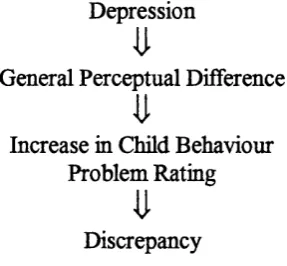
model which sets out the current explanation of the relationship between maternal depression and discrepancy in child behaviour problems. This model can be represented graphically as in Figure 1. below.
Figure 1.
The current model explaining maternal-specific variance in child behaviour problem rating.
Depression
General Perceptual Difference
I)
Increase in Child Behaviour Problem Rating
U
DiscrepancyThe current model, proposed to explain discrepancy in child behaviour problems
suggests that depression leads to some global perceptual difference. This perceptual difference affects more depressed raters to a greater extent. It
influences perceptions of child behaviour problems, leading to a more severe rating of child behaviour, and in turn, to a greater degree of discrepancy between
Limitations of the Current Model, and Proposed New Model.
The work into maternal depression clearly offers a step in the direction of
explaining the unique informant-specific variance in ratings of child behaviour. However, caution must be taken when judging the significance of this
association, as there is a suggestion fi'om further research that the current model is limited, offering only a partial explanation for discrepancy in child behaviour
ratings. This section looks at the research evidence that casts doubt on the current depression-specific model of discrepancy, and concludes with a suggestion of a new model that may explain the matemal-informant variance more fully.
The first indication of its limitation comes fi'om research that has considered maternal characteristics other than depression, which have found similar correlations between these characteristics and maternal perceptions of child behaviour. For exan^le Leftwich et al. (1994), found level of smoking in
mothers to be a better predictor of child behaviour problems than depression.
More striking is the study conducted by Jensen et al. (1988), which measures a whole battery of maternal characteristics including; anxiety, phobias, hostility,
The findings fi'om studies considering a wider range of maternal characteristics in
association with discrepancy in child behaviour ratings strongly suggest that depression is not the sole possible explanation for discrepancy in child behaviour
ratings. However, as Richters (1992), points out, none of these studies explores
the idea that these other maternal characteristics may offer “alternatives to or mediators of either the depression-perception association itself or depression-
related disagreements between mothers and criterion informants.” (Richters 1992, p. 495). In other words they challenge the assumption that depression is the only explanation of discrepancy, but do not propose new models. This raises
the question that if, as it seems, level of maternal depression offers only a limited explanation of discrepancy in child behaviour ratings, what other factors may mediate or offer alternatives to the depression-perception association, and thus
offer a more robust model to explain discrepancy?
The work of Blatt and colleagues (Blatt, Wein, Chevron and Quinlan, 1979,
Quinlan, Blatt, Chevron and Wein, 1992, and Bers, Blatt, Sayward, and Johnston, 1993) may offer some part of the answer. They have demonstrated in a series of
studies the close association between internal representations of ‘self and of significant ‘others’, and depression. Using a fi*ee-response description method,
they have found that more depressed adults tend to hold representations of their
own mothers as being more punitive and less benevolent, when compared with representations held by less-depressed adults (Blatt et al. 1979 and Quinlan et al.
there were found to be differences between more-, and less-depressed adults, in the structure of the representations (the way self and others were described), as
well as in the content (what was described). Blatt and colleagues concluded that there is a degree of association between internal representations and depression,
and that differences in internal representations may account to some extent for differences in levels of depression. This research suggests that a focus on the
representation may prove a valuable vein of information to expand the current model to explain matemal-informant variance in child behaviour problems rating. Further support for the value of exploration at the level of representations comes
from research that has considered how maternal representations have an effect on child behaviour and, more inq)ortantly perceptions of behaviour (Stem 1992, Fava Vizziello et al. 1993). From this it is proposed that a model which includes representations as well as depression will offer a more comprehensive
explanation of maternal variance in child behaviour rating; a model which accounts for more of the variance in child behaviour rating than can depression
alone.
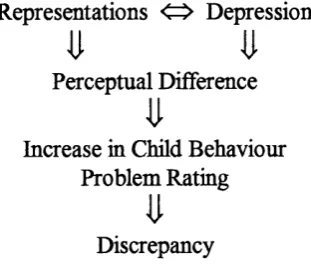
Therefore a new model is proposed to include representations and depression to
Figure 2.
Proposed New Model to Explain Discrepancy in Child Behaviour Problem Rating.
Representations Depression
U
Ü
Perceptual Difference
u
Increase in Child Behaviour Problem Rating
U
DiscrepancyThe model proposes that both depression and representations will contribute to the explanation of the variance in their own right but that a consideration of level of depression together with differences in representations will explain a greater degree of the variance than either variable on its own.
In the following sections the theoretical links between representations and perceptions of child behaviour are expanded, and the concept of representations used in this research is more clearly set out. However, before this, it is in^ortant
to expand a httle on how discrepancy in child behaviour problem ratings should
best be measured.
Measures of Discrepancy in Ratings of Child Behaviour problems
which aspects of the behavioural rating are a product of informant-specific
variables, which are a product of situational-specific variables, and which are a product of child-specific variables. By using a rating firom a second source
(Richters, 1992, has referred to this as the ‘Criterion Informant^ the child- specific variables are effectively controlled for. However, Achenbach et al.
(1987), are critical of those studies that use the criterion informant as a means of judging the accuracy of maternal ratings of child behaviour,
“We do not view direct observation or self-reports as a “gold standard” against which to vahdate other informants’ reports, however, because they are also apt to vary with situation and person variables'' (p. 214, Italics added).
Whilst in this study comparisons are made between maternal and criterion informant ratings of child behaviour, the above point is very much taken into
account. What is of concern here is not whether maternal ratings of child
behaviour are accurate, but rather what effect these informant-specific or ‘person
variables’ have on perceptions of child behaviour.
In order to judge the effect of informant-specific variables it is necessary to attempt to reduce the effects of situation-specific variables in child behaviour ratings. This would rather suggest that fathers might be the best choice as
agreements to be reasonably well correlated (mean r = .59). However, care
should be taken when interpreting this correlation as it is unclear as to the level of ‘independence’ of these two informants. Even if one could make the
assumption that the ratings were completed independently, ie. without any
knowledge of the other parent’s rating, it is likely that each parent’s perception of the child will have been coloured to some unknown extent by what they knew
of the other’s perceptions. In an attempt to compare mothers’ ratings with those of more independent criterion informers, a number of studies have used ratings
by teachers and/or nursery workers (Furgusson et al. 1985, Jensen et al. 1988, Richters and Pellegrini, 1989, and Shaughecy and Lehey, 1985). The idea here is to allow for ratings to take place over a range of activities and over an extended time period. Although the physical situation in which the child is rated is
different, the role that a nursery worker has to a pre-school age child is, in many respects, similar to that of the child’s mother. In many cases the roles of nursery worker and mother may have more similarities than the roles of the child’s father
and mother. For these reasons nursery workers who knew the child well were used as criterion informants in this study.
A second factor in reducing the situation-specific effects is to use identical
measures for both raters, and measures that include behaviours that can equally
well occur, and be observed to occur, in each setting by each informant. For this reason the Pre-school Behaviour Checklist (PBCL) (McGuire and Richman
removed home-specific behaviours that could not be observed in a nursery
setting, e.g. sleep disturbance at night, relationship with siblings, and eating habits, (Richman, 1977). The remaining behaviours that are rated are equally
well observed at nursery or at home, thus the PBCL can be used by both maternal and criterion raters, making the scores directly comparable.
A further strength of this measure is that the rules of scoring allow for rating of intensity as well as existence of a given behaviour, thus increasing both its rehabihty and validity (Achenbach et al., 1987).
Of course there is no pretence that situation-specific variables are perfectly controlled for in this research. This fact by no means diminishes the validity of the project, as what is of interest here is to pilot whether maternal characteristics,
in the form of representations, do predict some of the variance in child behaviour ratings, and this fact is taken into account when interpreting the results.
The Nature of Representations
Although the notion of internal representations is far fi'om a new one, there remains no precisely agreed definition of the concept (Stem 1992). Indeed, the
concept appears to be redefined depending on the context within which it is being
used. However, there is a degree of agreement with regard to some key elements of representations. The notion of representations that shall be used in this
representations can be thought of as conplex models of the world, containing affective as well as cognitive elements, that are constructed by an individual from
their interactions with their environment and the individuals within that environment. Once developed they remain relatively stable, and actively influence the individual’s
understanding of, and interaction with, their world. This section seeks to further explain and expand these central features of representations.
One of the central con^nents of Bowlby’s Attachment Theory (Bowlby 1969/1982,1973,1980) is the concept of Internal Working Models (1969/1982, 1973,1980). The models are thought to be constructed from an early age through interaction with the world, and develop in conçlexity to include models of the self as well as those of inçortant others (Bretherton, 1985). The structures are con^lex
containing emotional as well as cognitive conponents (Main, Kaplan and Cassidy, 1985). They should not be thouÿit of as sinqjle, symbolic representations of reality in the sense that maps are symbolic representations of geographical areas; rather, once developed. Internal Working Models are conceptualised as actively influencing the way in which events are appraised, and subsequently represented, at both a
conscious and unconscious level (Steele and Steele, 1994). The models operate to
predict the behaviour of others and the consequent emotional and cognitive responses of the self, and as a consequence seek to guide an individual’s behaviour in the context of a given situation.
behavioural enactment. Much of this support has been produced through the work of Ainsworth and her colleagues ençloying a standardised observational tool used to
infer an infant’s model of attachment via the categorical coding of a number of
mangulated child-carer interactions: the Strange Situation, (Ainsworth et al., 1978). These research based findings have also given support to the idea that once
developed these models remain largely stable after about the first year of life.
The work of Main and colleagues has since broadened the conceptualisation of Internal Working Models. They see Internal Working Models as:
“a set of conscious and/or unconscious rules for the organisation of information relevant to attachment and for obtaining or limiting access to that information, that is, to information regarding attachment-related experiences, feelings and ideations”. (Main, Kaplan and Cassidy, 1985, pp. 66 - 67).
With this reconceptualisation they proposed that internal Working Models of relationships direct not only behaviour but also “attention, memory, and cognition,”
(Main et al. 1985, p. 67), and consequently how an individual (attachment figure) is
thought about.
Epstein’s self-concept (1980), offers the possibility of more detailed elaboration of
the organisation of representational systems. It is inportant in as far as it
suggests that a person’s Internal Working Model of attachment could be thought of
as a major postulate, a tenç)late which is laid over all relationships, providing a ‘script’ as to how a person is in a relationship, however, it does not necessarily
dictate how a person is in all relationships. This idea of a hierarchy of representations has been developed by Stem (1995), representations of attachment being seen as
global construct, whilst lower down the hierarchy are representations of specific
individuals. Thus, it follows that representations measured using the Adult
Attachment Interview (AAI) (George, Kaplan and Main, 1985), are more global than tools that measure representations of a particular child (Zeanah and Barton, 1989).
The work of Blatt and colleagues (Blatt, Wein, Chevron and Quinlan, 1979, Quinlan, Blatt, Chevron and Wein, 1992, and Bers, Blatt, Sayward, and Johnston, 1993), conçlements these ideas, and has demonstrated the links between depression and representations of self, and parents.
Common to all the above is the proposal that early parent-child interactions are internalised in some way by the child. The internal representations of these
experiences combine to provide an individual with a ynodel' of the world through which an individual Yealitÿ is constructed. This construction of'reality' also includes
The Theoretical Links Between Maternal Representations of Self
and Others, and Perception of Child Behaviour Problems
It is hypothesised that representations of others are constructed out of dyadic
interactions and are initially models of relationships rather than models of individuals,
but later representations of self and others do become distinct. However, by means
of this process of development, “they represent obverse aspects of the same
relationship and cannot be understood without reference to each other”. (Bretherton, 1985, p. 12). For exanç>le a child whose mother is benevolent, warm and nurturant, will tend to come to represent itself, and its ability to cope, in a positive light.
However, those children whose parents are punitive and harshly critical of the child, will tend to see themselves in a negative light, as inconçetent and unworthy of love. Thus, in turn, such individuals come to see their own children as difficult, unloving, and rqecting.
As these representations begin to develop early in a baby’s life, the quality of the relationship with the primary care giver (usually the mother) is most influential on
their development. The quality of interaction with her child will depend on the
mother’s current mental representations, as these will influence her thoughts and
feelings about the child and consequently her actions towards it. As the mother’s representations are a result of early interaction with her mother before her, so there is
a powerful inter-generational conpDnent to the transmission of representations. This has been convincingly demonstrated by Fonagy, Steele and Steele (1991), who
Recent research has given support to the idea that the representation precedes the child. Ammanitti et al. (1992), demonstrated using a semi-structured
interview procedure: the Interview of Maternal Representations During
Pregnancy (Intervista per le Raperesentazioni Materne in Gravidanza - IRMAG),
eliciting representations through narrative, and questionnaires comprising ratings of various elements using paired adjectives lists, that by the last three months of pregnancy women had a clear representation of the child which was distinct from representations of self-as-mother.
Fava Vizziello et al. (1993), using a similar methodology to Ammanitti et al.
(1992), supported these findings. They demonstrated that not only is there a development of a representation of the child, but also changes in representations of self occur during pregnancy and the early postpartum period to include
representations o f ‘self-as-mother’ as well as ‘self-as-woman’. Furthermore, this
new representation is closely associated with the woman’s representations of her own mother. Further to this, a number of studies using a modified version of the
Infant Temperament Questionnaire (ITQ), have demonstrated that maternal perceptions of their child before birth remain substantially unchanged after the child is bom (Zeanah, Keener, Stewart, and Anders, 1985; Merbert and
Kahnowsky, 1986; and Zeanah, Keener, and Anders, 1986). Furthermore, it has been demonstrated that these pre-natal perceptions of the child are predictive of
These studies lend support to the idea that the mother’s subjective internal
representations of the child greatly influence her perceptions of the child’s behaviour.
Cramer (1987), offers a number of clinical examples to support this idea that the subjective aspects of the mother-child relationship are often as important, if not
more so, than the objectively observable behaviour of the child. He gives the example of a mother who brought her two month old child to see a consultant concerned by the fact that the child was vomiting. The consultant was puzzled by the level of concern in the mother about such ‘normal’ behaviour, untü the mother spontaneously revealed that her brother had died recently, and that soon before he died she had visited him in hospital. Her last memory of him before he died was of him vomiting. Prior to the clinician pointing it out, the mother seems to have not been consciously aware of the link between the brother’s vomiting
and his subsequent death, and the child’s vomiting and her fears for the child’s life.
Such an example clearly illustrates the importance of the subjective meaning a mother attributes to a child behaviour and how this meaning is “based on their
own personal beliefs, ideals and aversions. It is rooted in their personal history, their past, and their unconscious” (Cramer, 1987, p. 1055). A behaviour that may
To state this is not to deny the impact that the mother has on her chüd, nor to
deny the impact the child has on the mother. There is a body of research evidence that has clearly demonstrated that chüdren with depressed mothers are
‘objectively’ different when con^ared to children of a non-depressed group (Hammen et al 1987,; Murray, 1992). However, what is still being claimed here
is that behaviour which can be observed ‘objectively’ may not be the most important aspect of an interaction. In other words the child’s ‘actual’ behaviour may be less important than the meaning the mother attributes to it, or as Hinde
(1976) puts it: “What a person thinks about a relationship may be more important than the interaction that actually occurs.” (p. 4). He goes on to claim that,
“Mothers perpetually overestimate the element of intent in infant behaviour.” (Hinde, 1976, p. 14). What a person thinks about a behaviour, and the meaning that is attributed to it, will depend on the pre-existing representations the mother holds of her child, her self and her mother.
Accessing Representations
Before the specific aims of the study can be detailed it is important to outline some of the methodological issues raised by a study such as this. These relate to the difficulties in accessing representations.
“We do not know whether representations .... are to be viewed as the product (some kind of entity) of various processes or as a procedure, a
process itself to permit re-experiencing.” (Stem, 1995, p. 19)
Second, regardless of whether they are an entity or a process, by their nature they are internal, and as a consequence cannot be accessed directly. Therefore, representations can only be revealed through inference.
As a consequence of the lack of clarity of the stmcture of representations, in much of the recent research into the area, two methods have been adopted to infer representations: semi-structured interviews leading to some narrative account or verbal description of a person, and more stmctured rating-scales. In
the language based accounts the representations are qualified by an independent observer, whereas in the stmctured rating scales the representations are qualified by the participant. The employment of both methods in many studies reflects the lack of agreement as to which method is more accurate in accessing
representations. In keeping with current research this study adopts both methods, and these are discussed below.
Inferring Representations Through Language: Free-Response Descriptions
With the proposal of Main et aL (1985) that internal Working Models of relationshçs
through ‘"patterns of language and structures of mind”. That is, individual differences
in representations of self and others will have influence on that person’s memories and thoughts, and as such will affect the way that the individual constructs narrative
accounts of self, others, and relationsh%)s. \^^th the development of a semi structured interview: the Adult Attachment Interview (AAI) (George, Kaplan and
Main, 1985), which probes for accounts of childhood experiences with caregivers, inferences could be drawn about the individual’s current mental representations of attachment, through the qualitative differences in the verbal expression of these
experiences. The narrative accounts are transcribed verbatim, then rated on a number of dimensions using conçrehensively described operational definitions of the
dimensions. These dimensions measure not only wkat is said (the content of the narrative), but also the way in which accounts are given (the structural dimensions) e.g. the coherence of the descriptioa Research has demonstrated both aspects to be inç>ortant when inferring the nature of internal representations. However, as we have
already stated, the AAI leads to inferences about high order global representations, and does not yield explicit information regarding lower order representations of specific individuals, and particularly representations of a particular child (Zeanah and
Barton 1989).
Since the development of the AAI, Benoit et a l (1997), have noted that several groups of researchers have begun to redress this issue, developing instruments
designed specifically to explore mothers’ representations of their children and their relationship with them (Aber et a l 1989, Bretherton et a l 1989, and Cramer et a l
these tools. In response they developed the Working Model of the Child Interview (WMCI) (Zeanah, Benoit and Barton, 1986 and Benoit et al. 1997). The technique
is similar to that enç)loyed in the AAI, using a semi-structured interview exploring
aspects of the mother’s perception of the child and accounts of interactions with the child. Similarly the tra n s c r^ of the interview are rated along a series of constructs.
In addition transcripts are classified into one of three categories: balanced, disengaged or distorted, depending on the quality and structure of the inferred representation.
Despite the development of robust instruments for assessing representations such as the AAI and WMCI, due to their specific nature, none of them allows for inter-
generational conq)arisons of representations. Le. of child, self, and own mother. However, recently Blatt and colleagues (Blatt, Wein, Chevron and Quinlan, 1979, Quinlan, Blatt, Chevron and Wein, 1992, Bers, Blatt, Sayward, and Johnston, 1993, and Blatt, Bers and Schaffer, 1993), have devised a technique, with reasonable psychometric properties, which would allow for such conq)arisons. The method they devised conpiised a free-response procedure where particçants were singly asked
to give desertions of either themselves, (Bers, Blatt, Sayward, and Johnston, 1993) or their parents (Blatt, Wein, Chevron and Quinlan, 1979, and Quinlan, Blatt,
Chevron and Wein, 1992). In the original procedure the response was written down by the subject (Blatt et al. 1988), but in later studies the respondents gave verbal
accounts which were transcribed verbatim (Bers et al. 1993). Once transcribed the deselections were analysed using a series of rating scales which assess both the
rating system was re-designed to be sensitive to the inportant aspects of such descriptions.
Such free-response methods of eliciting internal representations have been shown to be effective elsewhere (e.g. Rosenberg, 1977). Althou^ the method of analysis was
different from that used by Blatt and colleagues^ Herzog et al. (1992), have shown free-response methods to be useful in eliciting representations across the generations, i.e. of Self, Child, and Own Mother. In a study of mothers identified as at risk of
abusing their own children, they found that these mothers produced highly elaborate representations of their child, but these descriptions showed distinct adultamorphic features. Representations of Self in this group were either highly disjunctive with representations of parents (hypothesised as a defence against identification with the abuser) or produced ‘equivalent’ representations (identification with the abuser). ‘Normal’ adults are expected to fall somewhere between the two (Rosenberg, 1988). Those who exhibit the disjunctive pattern were felt to have unrealistically high
expectations of their child; those who demonstrate the equivalence pattern tend to model their beliefs about the child as being inherently ‘bad’. However, those mothers
that were able to reflect on and integrate both acceptable and unacceptable past
experiences were able to be more accepting of their child’s behaviour and feel better able to cope^. Clearly, abuse is at the extreme end of negative experience, however, a
This study adopts such a free-response method for inferring representations from
verbal descriptions, as one of the measures of representations.
The analysis of the descriptions is based on that used by Blatt et al. (1993).
However, in order to conpare inter-generational representations, it has been
necessary to adapt the rating scales by omitting those scales which cannot be used to
rate descriptions of Own Mother, and Child, as well as Self. In addition to those scales developed by Blatt and colleagues to rate self descriptions, further scales were used to retain the sensitivity of the inportant relational characteristics of descriptions
of others that where included in the earlier versions of the Blatt measure (Blatt et al.
1988). However, it was felt that the operational definitions of the concepts in the original rating system ençployed by Blatt et al. (1988), were not sufficiently well developed. It was, therefore, decided to enploy the operational definitions from the AAI (Main and Goldwyn 1993). These operational definitions are much more
detailed than those described in Blatt et al. (1988), and capture, more explicitly, the individual’s perceptions of the relationshç) with the other.
Also, again due to the less well developed operational definition in the Blatt et al.
(1993), manual, the scale for rating ‘Self Reflectivity’ was replaced with the more
robust definition of the ‘Reflective-Self Scale’ produced by Fonagy et al. (1991), which has been demonstrated to be an extremely in c ita n t predictive variable in
structural features of the representation. In order to achieve this the categorisations developed from the WMCI were used, to categorise each of the three descriptions.
Inferring Representations Using Rating Scales: Repertory Grids
In addition to inferring representations from narrative or descriptive accounts, a number of studies have used some form of structured descriptive rating scale. In
most cases these have taken the form of lists of dichotomous pairs of adjectives (e.g. Good Vs. Bad etc.). Typically, participants are asked to rate either themselves, their child, or their own mother along a continuum depending on which adjective best describes that person. These scales are variously referred to as “bipolar Likert scales’
(Fava Vizziello et a l 1993), “Person x Features Matrix” (Herzog, Gara and
Rosenberg 1992), or “semantic differential scales” (Blatt et a l 1979, and
Ammanitti et a l 1992). These methods bear a great similarity to methods used in Personal Construct Psychology (PCP) (Kelly 1955), for eliciting an
individual’s construct system (or more accurately specific parts of it): Repertory
Grids.
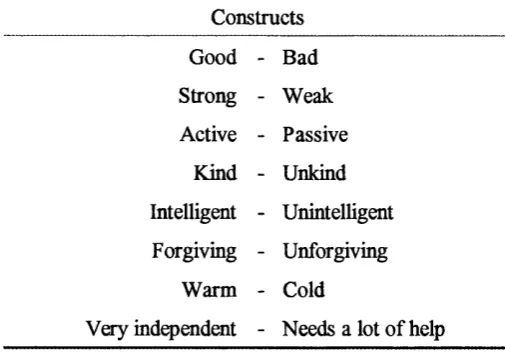
Using Repertory Grids, individuals typically are asked to rate a series of individuals or objects (referred to as elements in PCP) against a series of
dichotomous adjectives (referred to as constructs), similar to those methods mentioned above. These constructs and elements can be generated by the
participant comparisons (Fransella and Bannister, 1977). Once each element has been rated along each construct pole, it is possible to analyse the resulting
elements x constructs matrix or grid, to explore the relationships between
constructs, and between elements, and between constructs and elements. In so doing it is possible to inq)ly how a person represents the elements being assessed,
and how these representations are organised in relation to one another; basically how similar or different they are. In order to understand this, it is important to
consider what Hes behind the judgement an individual makes when rating an element along a construct pole. Fransella and Bannister (1977), explain it thus,
“Behind each single act of judgement that a person makes (consciously or unconsciously) lies his in^licit theory about the realm of events within which he is making judgements. The repertory grid technique i s a way of exploring the structure and content of such implicit theories.” (p. 2)
The strength of the Repertory Grid method is that it allows not only for
representations of individuals to be analysed, but also allows for the relationships
between them to be assessed. One possibility with the grid analysis is to examine distances between currently held representations and an ‘ideal’ the participant
may have by asking them to rate both ‘real’ and ‘imagined’ elements. In this way it is possible to obtain a more idiographic picture as to how a mother evaluates
analysis also allows for the intensity of the individuals construing to be examined: the extent to which elements are differentiated.
Aims of the Study
The broad aim of the study is to test the new proposed model to account for
matemal-informant-specific variance in ratings of child behaviour problems: that representations of child, self, and own parents (and particularly own mother) wiU
account for more of the variance in ratings of child behaviour than will depression.
Specifically it will test the idea that the content and structure of representations are more closely associated with discrepancy scores between mother and criterion raters of child behaviour problems, than levels of maternal depression. That both representations and depression will account for some unique aspects of
the variance in there own right, but that together they will account for more of the variance than either can alone.
These broad based aims can be further elaborated into a series of hypotheses
Hypotheses relating to depression;
L Higher levels o f maternal depression are associated with higher ratings o f
child behaviour problems from both mothers* and criterion informants.
This will rephcate previous research findings that suggest that levels of maternal depression are associated with ‘real’ increased levels of disturbance in children.
This will be tested by analysing the correlations between level of maternal depression and mothers, and criterion ratings of child behaviour problems.
2, Higher levels o f maternal depression are associated with greater
discrepancy between mothers* and criterion ratings o f child behaviour
problems.
This again will reflect previous research findings that led to the development of the current model used to explain discrepancy in child behaviour ratings.
Reflecting that although there may be ‘real’ differences in behaviour of children of depressed mothers, the level of maternal depression leads to perceptions of the
child as being still more disturbed than others’ perceptions of them. This will be tested by analysing the correlations between maternal levels of depression and
Hypothesis relating to representations:
3, The more positive the content ofparticipants* representations o f child, self
and parents, the less discrepant child behaviour problem ratings will tend to
be.
This hypothesis forms the first part of the initial testing of the new proposed
model. As has been hypothesised earlier in this section, the rating of child behaviour is associated with the closely linked representations a mother holds of
her child, herself and her own mother (and to a lesser extent her father). More negative representations are expected to lead to more negative perceptions of child behaviour, and thus to more discrepant ratings. This hypothesis will be tested in a number of ways. From the repertory grid, the ratings of the elements: child, self, own mother, and own father, on each of the constructs will be
correlated with discrepancy scores, both as individual constructs and as sum total construct ratings. It is expected that the more positive each of the elements are rated the less discrepancy there will be in ratings of child behaviour problems.
From the verbal free-response descriptions, the each of the rating scales used to assess the content of the descriptions will be correlated with discrepancy scores.
It is expected that the more positively the descriptions are rated on each of the
4. The structural features ofparticipants* representations o f child, self and
parents, will be associated with discrepancy in child behaviour problem
ratings.
This forms the second part of the initial testing of the new proposed model. As
representations are proposed to affect “attention, memory, and cognition” (Main
et al. 1985), it is expected that not only the content of the descriptions will differ
but that there will be a difference in the way the descriptions are given ie; they will be structurally different, and these structural differences will also be
associated with discrepancy in child behaviour ratings. For example the closely related dimensions of coherence, and substantiality, can be thought of as
measures of the degree to which an individual is able to think about the person
they are describing. Those individuals who demonstrate a less sophisticated capacity to think, or reflect, characterised for example by insubstantial or incoherent descriptions, will tend to view more behaviour as problematic.
Therefore, from the free-response descriptions, those whose descriptions are rated less highly on the structural dimension scales will tend to demonstrate more
discrepancy in child behaviour ratings.
From the repertory grid, mothers whose representations of self, child, and own parents are judged by them to be less than ideal, will tend to be more discrepant
pairings shall be considered: child - ideal child, self as a child - ideal child, self -
ideal self, self - ideal parent, own mother - ideal parent, and own father - ideal parent. Also, the greater the degree to which an individual makes distinctions
between elements and constructs in their ratings of them: the intensity of the
construing, the greater the discrepancy in child behaviour ratings. Intensity is opperationalised as the amount of variance explained by the first conq)onent in
the principle conq)onent analysis of the grid.
Hypothesis Related to the New Proposed Model:
5. Representations and depression together better explain
maternal-informant-specific variance in child behaviour ratings than each does
independently.
This will prove the culminate test of the new model and Avill be tested using multiple regression analysis. From the correlation analysis it will be possible to assess the amount of variance in discrepancy scores accounted for by measures of
M
e t h o dParticipants
Participants for the study were recruited from four agencies providing services
for pre-school children within one inner London borough. Three of the four agencies were nurseries run by the local education authority, providing both subsidised and non-subsidised places. The fourth was a voluntary sector play group, offering sessions five mornings a week, with a sliding scale fees structure. All agencies ran an equal opportunities admission pohcy.
Recruitment was restricted to any mother who had a child aged over 18 months
and under six years old. The recruitment process was a two part procedure. In the first instance all mothers with children of the appropriate age were given an
information sheet (see appendix 2.) by a staff member at the nursery. The sheet described how volunteers were being sought to take part in a research project
which aimed to look at how mothers see themselves and their child and what sense they make of their children’s behaviour. The sheet also gave a brief outline
of the research procedure, informing mothers that should they agree to take part, they would be asked simply to: “describe yourself and your child and some other
significant people m your life.” They were informed that this would be by way of a short interview and that they would also be asked to complete two
own feelings. At this stage potential subjects were informed that a member of staff at the nursery would also be asked to fill out a questionnaire to describe the
child’s behaviour “in order to get a view of your child from someone outside
your family”. It was made exphcit that the nursery would not be given access to any information received from the mother, and that the mother would not be given access to the questionnaire completed by the nursery.
The second phase of recruitment consisted of the researcher attending each of the nurseries, in person, for one morning - at the time when most parents dropped off their children. Mothers were approached in sequence as they left the nursery and
asked if they wished to participate. Interview dates were arranged by telephone following the initial agreement for those who agreed to take part.
Ethical Considerations
Ethical approval was sought from Camden and Islington Community NHS Trust, and the Joint University College London/University College London Hospitals Trust ethics committees. Copies of the letters of approval can be found in
Appendix 1. Approval was also sought and granted by Islington Education
Authority.
The two-phase recruitment process was designed to allow easy opt-out for
been given a full opportunity to ask questions regarding the research, and felt
they had received satisfactory answers to all their questions (see appendix 3. for a
copy of the form). The investigator was aware that in a sample the size of the
one used m this study, there was a likelihood of one or more of the participants having experienced some form of abuse or other severe negative experience as a
child, and that being asked to describe their parents may potentially cause some degree of distress. Furthermore, that one or more of the parents may have
abused or been involved in a severe negative experience with their own child, and so describing the child and particularly a recent conflict with the child may also lead to potential distress. However, it was felt that the details given in the information sheet would provide an opportunity for individuals to opt out if they were unwilling to describe their parents, self, or chÜd. Also, the nature of the interview meant that there was no probing of descriptions, allowing participants to reveal as httle or as much information as they felt comfortable with.
Design
A naturalistic (non-experimental), correlational design was adopted for this phot
study. All participants completed the full interview schedule which measured level of maternal depression, and used two methods, to infer representations of
self, child, and own mother: a structured rating scale (repertory grid), and verbal
of some aspect of representations being associated with discrepancy in child
behaviour rating. The participants were asked to rate their child’s behaviour, from which a criterion rating was subtracted to produce a discrepancy score.
The associations between the level of maternal depression, and the dimensions of
representations and ratings of chüd behaviour were assessed using correlation and regression analysis.
Measures
Measures of Child Behaviour
The Pre-school Behaviour Checklist (PBCL), (McGuire and Richman 1986), was
used as the primary measure of chüd behaviour (see Appendix 4.). It comprises 22 items, scored either 0, 1, or 2, assessing a range of potential emotional and behavioural problems in pre-school chüdren. For most items the rater is given a
choice of three descriptions of chÜd behaviour, in order of increasing frequency and/or severity of the problem, leading to a total possible score of 44. The
exceptions are the ‘activity’ item where four choices are given to include a description of extreme inactivity which, along with the description of extreme
activity, would also receive a score of 2. The ‘habits’ item is scored by summing the number of habits rated as occasional or frequent. In addition, cases where the first language is not English are taken into account when scoring the ‘speech’
McGuire and Richman (1986), have demonstrated good inter-rater agreement between nursery staff (r = .68, p > .001) using the PBCL, and found no
significant difference in ratings between teacher and nursery nurses/assistants
when both members of staff knew the child well. Internal consistency using the Spearman-Brown split half formula was high (r = .83). Test-retest reliability was
not examined. However, the Behaviour Checklist (BCL), (Richman, 1977), firom
which the PBCL was developed, has shown reasonable reliability on this concept (r = .81, over a 4 week interval, Richman, 1977), and (r = .54, over a 12 month interval, Spiker, 1992).
Further examination has demonstrated the PBCL to have comparable
discriminant validity when compared to clinical interview ratings of behaviour problems. It has also been shown to discriminate well between clinical and non- clinical groups of children. Concurrent validity as checked against the Pre-school Behaviour Questionnaire (PBQ), (Behar and Springfield 1974) was high (r =
.89), (McGuire and Richman, 1986),
There are a number of other specific reasons for en^loying the PBCL in this
research. First, it has been designed specifically for use with the subject group
examined in this study, and is one of only a few measures of child behaviour that can be rated adequately by mothers and nursery staff. Third, other widely used
an English population, but more specifically on an inner London population largely similar to the sample in this study.
Accessing Representations
In keeping with previous research this study adopts both a language based
measure of representations, and the more structured repertory grid procedure.
Inferring Representations Through Language: Free-Response Descriptions
This study adopts a free-response method for inferring representations from verbal descriptions, adapted from the method developed by Blatt and colleagues (Blatt, Wein, Chevron and Quinlan, 1979, Quinlan, Blatt, Chevron and Wein, 1992, Bers, Blatt, Sayward, and Johnston, 1993, and Blatt, Bers and Schaffer, 1993).
Participants were asked to give descriptions of; Self, Child, and Own Mother. As the study focuses primarily on the relationship between mother and child, it was important to elaborate on this relationshÿ, rather than rely solely on specific
descriptions. Therefore, in addition to the free-response descrçtions, partic^ants were asked to give a description of the last conflict they remembered between
themselves and their child.
The analysis of the descriptions is based on that used by Blatt et al. (1993) and adapted to compare inter-generational representations, by incorporating scales from
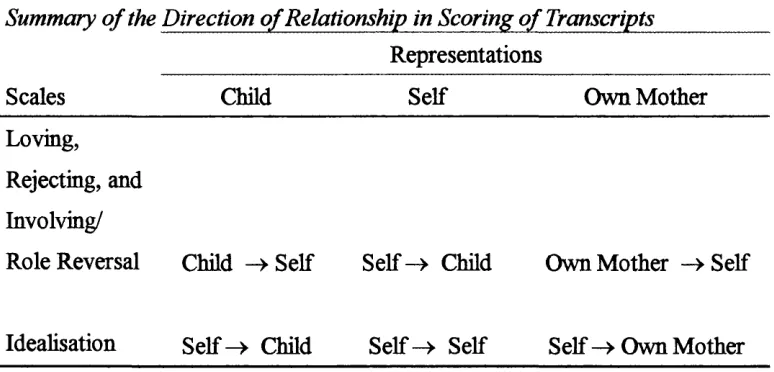
representation is included. The 14 scales used in this study rated the following dimensions of each of the three descriptions:
From Blatt and Colleagues
1. Predominant Mode of Representation - A four point scale which indicates which
mode of representation was given most enphasis in the description, 1 =
physical, 2 = behavioural, 3 = personality, 4 = internal qualities.
2. Substantiality - A four point scale which measures how substantial the description is. A low score indicates a flat unintegrated description using only one mode of representation, a high score represents a multidimensional
description, where many modes are used and integrated.
3. Conceptual Level - A nine point scale which assesses the highest cognitive developmental level of the description. The scale ranges from a score of one which is given to a description at a sensorimotor-preoperational level, through a score of three where the description reaches an external iconic level, up to a score of nine where the description is judged to have reached
a conceptual representation, where the individual is able to be understood on a variety of dimensions.
4. Tolerance of Contradictory Aspects - A five point scale measuring the eprtent to which contradictions are referred to and tolerated in the description. A low
score is given if no contradictions are mentioned, a high score is given to
5. Negative/ Positive Regard - A seven point scale measuring the extent to which the
individual is described in positive terms. A higher score represents a more positive description.
6. Critical - A five point scale which measures the extent to which the description is critical of the individual A high score represents a severely critical
description.
7. Striving/Ambitious - A five point scale measuring the extent to which the
individual is described as striving or ambitious. A low score indicates that the individual is described as non-striving, a high a score indicates a strongly striving individual
From the AAI
8. Loving/Unloving - A nine point scale measuring the extent to which the individual is described as loving. A low score represents a person very lacking in love, a high score represents a very loving individual.
9. Rejecting - A nine point scale measuring the extent to which the individual is
described as rejecting. A low score represents an individual described as
not at all rejecting, a high score is given to a description of a person who is extremely rejecting.
11. Coherence - A nine point scale measuring the extent to which the description of
the individual is a coherent one. A low score represents a highly incoherent description, a high score a highly coherent description.
12. Idealisation - A nine point scale which measures the extent to which the individual is idealised in the descriptiom A low score represents no idealisation, a high
score very strong idealisation.
FromFonagye^fl/.
13. Reflective-Self Scale - (used for rating descrÿtions of self only) A nine point scale
depicting the extent to which the participant is able to reflect on the
intentions and motivations of themselves and others. A low score is given if a person gives no evidence of this ability, a high score is given to a person who demonstrates a consistent understanding of the motivations of self and others.
From WMCI
14. Global Categorisation - This is a scale which integrates a number of dimensions of
the descrÿtions and places them into one of three categories: 1. Balanced which represents a rich and ençathic descrÿtion, 2. Disengaged, which represents a descr^o n suggesting detachment and
emotional distance, characterised by an extreme absence of interest in the
individual, 3. Distorted, characterised by internal inconsistency in the representation, the description may show over-concem for the individual, or
These scales are summarised below in table 1.
Table 1.
Scale Size of Scale
Scales from Blatt and Colleagues I. Modes of Description
Predominant Mode of Description 4-point
Substantiality 4-point
Conceptual Level 9-point
n.
Cognitive VariablesTolerance of Contradictory Aspects 5-point
in.
General ViewNegative/Positive Regard 7-point
Critical 5-point
Striving/Ambitious 5-point
Scales from AAI
Loving/Unloving 9-point
Rejecting 9-point
Involving/Role Reversal 9-point
Coherence 9-point
Idealisation 9-point
From WMCI
Global Categorisation 3-categories
FromFonagye^iz/.
The rating procedure for rating descriptions of others (Blatt et al. 1979), has been demonstrated to possess reasonable inter-rater reliability for each of the ratings
(ranging fromr = .69, to r = .95). Furthermore, the analysis of the descriptions was
shown to discriminate between types and levels of depression in individuals, using both the Depressive Experiences Questionnaire (Blatt et a l 1979), and the Zung
Depression Inventory (Zung, 1972). The rating scale developed for descriptions of self, showed similar psychometric properties. Inter-rater reliability for the scales was
acceptable ranging fromr = .74, to r = .99, (Blatt 1993). Furthermore, the scales were tested on both clinical and non-clinical populations and found to discriminate well between the two populations.
Inferring Representations Using Rating Scales: Repertory Grid Procedure
A repertory grid procedure was adopted as the method for inferring
representations through rating scales. Elements were chosen for participants to rate that would allow for construing of ‘real’ individuals to be examined, but also enable the relationship between ‘real’ and imagined ‘ideal’ elements to be
explored. Table 2. presents the elements rated by participants, elements are given in the order of presentation in the research procedure.
Table 2.
Elements Used in the Study, Presented in Order o f Presentation to Participants.
Elements My Child
My Child as I would ideally wish them to be Myself as I am now
Myself as I would ideally wish to be Myself as 1 imagine 1 was as a child My Mother
My Father