1 INTRODUCTION
EVERSIBLE information hiding in meaningful image is one of the latest research areas to achieve secret communication in digital images. It is a technique that embed secret message into meaningful media such as image in a reversible way which means that the original image will be perfectly recovered after taking out hidden message. This technique is mostly used in different areas such as forensics, military imagery medical imagery and, where single bit of distortion of the original cover image is not permitted to afford data loss and for the smooth message passing. Reversible data hiding was introduced in the beginning of 2000’s and gained the research interest and have emerged in recent years with some general frameworks.
Conventionally, data hiding is used for furtive communication but in some applications, for security point of view the embedded message is further encrypted to prevent the message from unauthorized access. In some other applications, content owner convert the content of carrier into encrypted form before sending carrier to the data hider for data embedding because the owner of the carrier not want the other person to gain knowledge about the content of the carrier before data hiding operation is actually performed. This application is very useful in confidential medical imagery or military imagery. The receiver side can extract the
embedded message and recover the original image.
In recent years, lots of methods on RDH have been proposed and analyzed. As we know that encryption is one of the popular and effective methods for privacy defense. In order to securely communicate a furtive message with other individual, a content proprietor encrypts the image before image transmission. In some scenarios, if data hider wants to add some additional data, for instance authentication data, within the encrypted image, he can do without knowledge of original image content. For example, in medical scenarios, a database administrator wants to embed the personal information into the corresponding encrypted images; he can encrypt the image for protecting the patient privacy [10]. Basically, a lot of research has been done in the field of reversible data hiding and still methods are developing. RDH methods can be classified into two types based on the embedding domain. Transform domain and Spatial domain. In the spatial domain , data embedding is applied directly on pixels, with relatively low capacity, whereas the transform domain utilizes the coefficients in the frequency province, for instance the integer DCT as well as the integer wavelet transform domains [2],[3],[4] to conceal the data. Apart from these, other methods based on vector quantization have also been proposed [11]. The existing works of RDH are focused on the developed techniques based on DE [2],[3],[4],[11] and HS [5],[6].
The primary impartial of proposed algorithm is to generate the hiding volume as high as feasible, second is to form the visible distortion as less as feasible. To accomplish high embedding capacity with less distortion proposed technique is divided into information hiding, image encryption, information extraction and image recovery stages. In the first stage, proprietor of the image hides the secrete data into cover image by Histogram of Pixel difference in inverse S-order of original image. Next stego image is encrypted using Skew tent map. At the receiver end, reverse operation is
R
————————————————
Anoop Kumar Chaturvedi, completed his Ph.D. in Computer Science & Engineering from RGPV, Bhopal, India, currently working as an Associate Professor in LNCT, Bhopal PH-9425026452, E-mail: anoop.chaturvedi77 @gmail.com.
Piyush Kumar Shukla, completed his Ph.D. in Computer Science & Engineering from RGPV, Bhopal, India, currently working as an Assistant Professor in UIT, RGPV, Bhopal. Email- [email protected].
Vijay Kumar Yadav, completed his M.Tech. in Software System, currently working as an Assistant Professor in LNCT, Bhopal, India, E-mail: [email protected].
Sachin Tiwari, completed his M.Tech. in Software System, currently working as an Assistant Professor in LNCTE, Bhopal, India, E-mail: [email protected].
Ravindra Tiwari, is currently pursuing Ph.D. in Computer Application from AISCET university , Bhopal ,India, E-mail: [email protected]
Skew Tent Map Based Secure Non-Separable
Reversible Data Hiding on Histogram
Modification in Inverse S-order
Anoop Kumar Chaturvedi, Piyush Kumar Shukla, Vijay Kumar Yadav, Sachin Tiwari, Ravindra Tiwari
Abstract— Nowadays, the reversible data hiding (RDH) techniques gain popularity in research area for improving the distortion in sensitive images. In addition to this, security level is also required. In this paper we proposed a Skew Tent Map based Secure Non-Separable Reversible Data Hiding on Histogram of Pixel dissimilarity in Inverse S-order of original image. Proposed system work as follows: owner of the image hides the secrete data into cover image by Histogram of Pixel difference in inverse S-order of original image. Next stego image is encrypted using Skew tent map. At the receiver end, reverse operation is performed. if the receiver doesn’t has encryption key, then he is unable to extract data and if receiver has encryption key then can generate an image similar as original image as well as it can read the concealed data. Performance of proposed system is evaluated based on PSNR. Proposed system has PSNR 53 dB approx, higher than existing RDH techniques in encrypted image.
Index Terms— Skew Tent Map , Histogram Shifting (HS), Histogram Modification (HM), Stego image, Reversible Data Hiding (RDH) , Cover Image, Difference Expansion (DE),PSNR.
2963 performed. if the receiver doesn’t have encryption key, then
he is unable to extract data and if receiver has encryption key then he can generate an image similar to original image as well as it can read the hidden data.
The rest of the part, in this paper is formulated as follows: part 2 defines the Literature review. Basic variance among separable and non-separable RDH is characterized in part 3. Schemes and steps of the considered system are illustrated in part 4. Part 5 shows the block diagram of proposed system. Factors used to check the effectiveness of proposed system is expressed in part 6. Part 7 shows the validity and efficacy of proposed system. Finally conclusions are picked in part 8.
2 LITERATURE REVIEW
Lots of research has been done in the area of RDH. In last few years different efficient techniques have been proposed for RDH. Some noticeable works in the area of RDH are given below.
―Wei-Liang Tai et.al. [5] present‖ HM based RDH method. They used the concept of binary tree structure to work out on the difficulty of communicating pairs of peak points. They embedded the data in multiple pairs of peak in histogram of pixel differences to get higher hiding capacity with minimum distortion. Overflow and underflow is controlled by histogram shifting technique.
―V. Suresh et.al [11] proposed‖ a RDH technique using RC4 technique. They used RC4 to generate the pseudo-random sequence using the 128-bit. For both encryption and decryption the XOR operation is performed with generated key sequence. For the purpose of data hiding they used the least significant bits (LSB) of the encrypted image and the hiding is based on data hiding key.
―Rintu Jose and C. Saraswathy [11] proposes‖ separable RDH scheme into encrypted grayscale image. During the encryption phase, the sender encrypts the image using the chaotic based permutation method. Hiding the additional information into the encrypted image is done by HM with a single MAX-MIN pair.
―G. Coatrieux, et.al.[5] proposed‖ a new scheme, reversible watermarking . One first contribution is a HS modulation which adaptively takes care of the local specificities of the image content. By applying it to the image prediction-errors and by considering their immediate neighborhood, the scheme they propose inserts data in textured areas where other methods fail to do so. In addition, their method makes use of a classification process for identifying parts of the image that can be watermarked with the most suited reversible modulation. This classification is based on a reference image derived from the image itself, a prediction of it, which has the property of being invariant to the watermark insertion. In that way, the watermark embedder and extractor remain synchronized for message extraction and image reconstruction.
―Bangxu Yin et.al.[3] proposed‖ a new RDH method based on classification permutation to enhance the security level as well as quality of decrypted image and recover image. Pixels in the images are divided into two categories, smooth and unsmooth set. They used binary matrix of same size as given image to classify image pixels belonging to smooth set or
unsmooth set. After the pixel classification, image is obtained by applying the exclusive-or operation between original image bits and pseudo-random bits which is obtained according to encryption key and then, extra data is embedded in MSB of encrypted pixels which is randomly selected from smooth set according to information hiding key. They improved the quality of recovered and decrypted image.
3 SEPARABLE V/S NON-SEPARABLE RDH
3.1 Separable RDH
The type of reversible information hiding away is the separable reversible information covering up. Here the distinguishable intends to isolate at the end of the day work can isolate something. The fundamental idea of separable reversible information hiding away is that work can separate the carrier image by utilizing the encryption key and the extraction of the payload by utilizing the information concealing key.
Both the parts are isolated from each other. It implies on the off chance that work have the information concealing key then work can extricate the hidden information however can't remake the carrier image and on the off chance that work have the encryption key then work can build the image similar as the carrier, can't read the hidden information. Work required both of the keys to peruse the entire got information.
3.2 Non-Separable RDH
Another method of reversible information hiding away is non-separable Reversible Data covering up. The strategy first encodes the content proprietor the image utilizing encryption key at that point passes it to the information hider. The information hider then inserted some extra information in the image utilizing the information concealing key. The principle highlight of RDH in Non-Separable manner varies from Separable RDH. At the receiver point work require both of the keys that is encryption key and the information concealing key to extricate the carrier information and the carrier image.
4 PROPOSED METHODOLOGY
This work proposes a proficient non-separable reversible information hiding away in encoded image. The strategy is partitioned into four stages:
Data Embedding Stage Image Encryption Stage Image Decryption Stage Data Recovering Stage
4.1 Data Embedding
This is the principal procedure of embedding. We Input a Color image I of size 512*512where each pixels contains 24 bits.
Traverse the entire image X in inverses-order and store it into one dimensional array X1D. After that calculate the pixel difference between the observed pixels value with its previous pixel values excepting start pixel (start pixel remain
unchanged).i.e. xi1 xi i 2 , 3, ...,M N . Store this pixel difference value into new variable D. Calculate the histogram H of pixel difference variable D. Scan the histogram H and determine the maximum point MAX (where H has highest value).
Data are embedded into pixels with pixel difference value is equal to MAX.
Those pixels xi that have the pixel difference value
di
>MAX are incremented by 1.i.e. xi =xi 1, if pixel xi is
greater than or equal to xi1otherwise decremented by 1. i.e.
x
i=xi 1, leaving histogram of MAX+1 empty. This process
is called histogram shifting.
Suppose that we have p pixels whose pixel difference value is equal to MAX .These p pixels are considered to be accessed to hide the data. The cover image must be converted into pixels before hiding the data. In the next stage, the pixels
are examined in a consecutive order. When a pixel xi with
pixel difference value di=MAX is encountered, check the bit to be embedded. If the corresponding bit to be embedded
into that pixel is ―1‖ and if the pixel value is xi is greater
than or equal to xi1then pixel xi is incremented by 1 and if
the pixel value is xi is less than to xi1 then pixel xi is decremented by 1. If the bit to be embedded is ―0‖, there will be no change in pixel value.
After modifying the pixel value of original image X we get the stego image Y and it is ready for encryption.
4.2 Image Encryption
Since pixel of image are much related to their neighboring pixels. So there is a need of a method that can shuffles the pixels to remove the relationship between's the neighbor pixels. Pixel Scrambling do this thing to conquer the issue. In
this way, subsequent stage is to applying pixel Permutation which is comprises of the accompanying steps:
Reshape the Stego image Y into 1-D signal Y 'and choose and P0 in (0, 1) and (3.58, 4) respectively.
Iterate the Logistic map given in equation below for T times to get rid of transient effect, where T is a constant;
1
/ [ 0 , ]
(1 ) / (1 ) , ( , 1]
i i
i
i i
P P
P
P P
Continue to iterate the Logistic map for M×N times, and take
out the state 0 1 1
{ , , ..., }
M N T
T T
S s s s
Sort S by descending order and get S’.
Generate the permutation keys K by finding positions of sorted chaotic values in the original chaotic sequence. i.e.
'
i
i k
s s
, i = 0, 1, …, MN-1.
scramble the image by shuffling the pixels of the whole 1-D
signal Ywith K using equation below and get Y.
i
i k
y y
Reshape the 1-D signal Y into the 2-D image Z and get
ciphered image.
4.3 Image Decryption
The reconstruction of Z cannot be made unless the distribution of K is determined. So at the receiver side same process is applied as applied at the time of encryption until we get same sequence K. The inverse transform for deciphering is given by:
i
k i
y y
This technique avoids the excess digitization of chaotic values.
4.4 Data Extraction
To extract the hidden data, the receiver may first apply same process of inverse S-order based difference D then scans the
pixels in the sequential order. If a pixel difference value di
for the pixel xi is equal to MAX + 1 is encountered, a bit ―1‖
is extracted and If pixel difference value di for the pixel xi = MAX is encountered, a bit ―0‖ is extracted.
The extracted bits are concatenated to get the concealed data. Thus, the overhead information as well as pure data is extracted exactly.
2965 difference valuedifor the pixel value xi is greater than
MAX, and if xi>xi1the pixel value xi is decremented by 1.
Similarly if difor the pixel value xi is greater than MAX,
and if xi <xi1the pixel value xi is incremented by 1.
5 PROPOSED BLOCK DIAGRAM
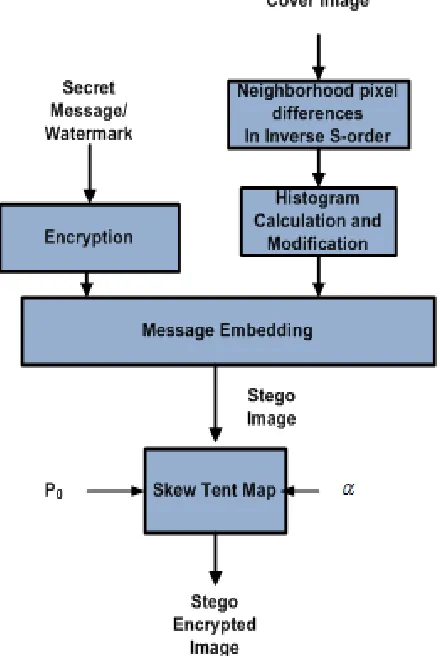
The Block graph of implanting process is separated into the individual squares, for example, Message encryption, Inverse S-order, Histogram Modification, Histogram Shifting Message Embedding and Skew Tent Map Transform as shown in Fig. 1(a) and Fig. 1(b).
Fig. 1(a). Structure of the Proposed Hiding Scheme Sender Side
Fig. 1(b). Structure of the Proposed Hiding Scheme
6 QUALITY MEASUREMENT
The nature of the encoded image is measured by computation of certain assessment estimation measurements. These measurements gives the research proportion between the carrier image and the adjusted image. The quality might be surveyed on the premise of these evaluations. The measurements utilized as a part of this paper are as per the following: Peak signal to-Noise Ratio(PSNR), Number Of Pixel Change Rate(NPCR),Correlation Coefficient (CC) and Embedding proportion in BPP.
6.1 Peak signal to noise ratio (PSNR)
The PSNR depicts the measure of quality of the encrypted image. A low value of PSNR shows that the quality of encrypted image good.
The metric used between original and encrypted image is formulated as:
2 2 5 5 1 0 lo g1 0
P S N R d B
M S E
And
1 2
( ( , ) '( , ) )
1 1
M N
M S E I x y I x y
x y
M N
6.2 Number of Pixel Change Rate (NPCR)
To test the influence of one pixel change on the whole encrypted image by the proposed algorithm, one common measure is used:
(, ) ,
100%
Di j
i j
NPCR
WH
I(x, y) and I'(x, y) are the pixel values of cover image and Stego-image.
D(x, y): determined by I(x, y) and I’(x. y), if I(x, y) = I’(x, y), then, D(i, j) = 1; otherwise, D(i, j) = 0.W and H: columns and rows of the image.
6.3 Bit rate/Embedding Ratio
Bit rate shows the number of bit hided per pixel in image and it is describe as below:
;
( )
EmbeddingCapacity Totalnumberofpixel
EmbeddingCapacity
Bitrate bitsperpixel
Totalnumberofpixels
7 E
XPERIMENT&
R
ESULTWe have used 4 standard test images to demonstrates and check the evaluation of proposed method. They are: (i) Leena (ii) Baboon (iii) Papper (iv) Bus, all the images are 24 bit color images and the size of each image 512×512 pixels. In our methodology we used histogram of neighborhood pixel difference image and based on the highest peak points of histogram data is hidden. Since our methodology is based on non separable, so whenever the receiver unknown to the encryption key, he is unable to decrypt the image as well as unable to extract the original data. The size and content of the recovered image is similar to the original image as in [1]. Fig. 2 shows the images used in testing the algorithm.
(a) (i) (ii) (iii) (iv)
(b) (i) (ii) (iii) (iv)
(c) (i) (ii) (iii) (iv)
(d) (i) (ii) (iii) (iv) Fig. 2. Test images used in evaluation the algorithm. (a)Original
images (b) Stego images (c) Encrypted image with hidden (d) Recovered images for (i) Lena (ii) Baboon (iii) Papper (iv) Bus
Evaluation of the proposed system on different evaluation metrics and on the different test images are tabulated in Table 1.
TABLE 1QUALITYPARAMETER CALCULATION OF PROPOSED
METHOD ON DIFFERENT IMAGES.
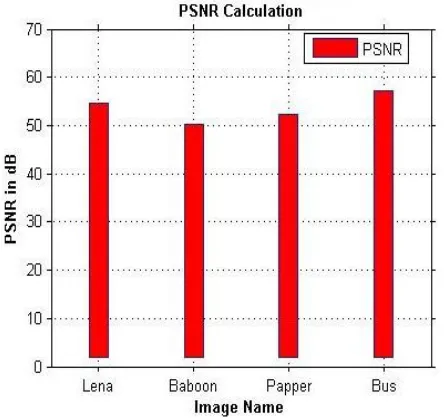
To check the factor of Stego image, we use the one quality factor i.e. PSNR. If the value of PSNR is high, then steganography method is robust and original image and Stego image are seem to be same. if PSNR is above 30 dBs we can say that Stego image has good quality. as we look at the table Proposed method has PSNR more than 30 dB (Avg. 53 aprox.) so it is clear that the proposed system gives better stego image quality. The PSNR chart of proposed strategy on various images is demonstrated in Fig. 3.
2967 Fig. 4. NPCR Calculation of proposed method on different
images.
There is problem with original histogram technique when it is used to hide data, is to it suffers from multiple peaks and due to this some additional information must be transmitted to the receiver side to make ensure successful restoration. However, efficient extension of the HM technique taking into consideration differences between adjacent pixels in place of simple pixel values. It give us, distribution of pixel difference has maximum peak at very close to zero and improve their embedding ability as shown in Fig. 5.
Fig. 5. Histogram of Original Image V/S Histogram of S-Order Difference Image.
7.1 Adjacent Pixel Correlation Analysis
Correlation coefficient is utilized to check the relationship among pixels within the image. It measures the relationship among pixels in the plain and the encrypted images at the same location [5]. This parameter can be calculated as follows:
c o v x y,
rx y
D x D y
Where x and y are the intensity values of two pixels in the plane and cipher images at the same location. In numerical computations, the following discrete formulas can be used:
1
1
2 1
1
1 c o v ,
1
T
E x X i
T i
T
D x xi E x
T i
T
x y xi E x yi E y
T i
where Xiand Yi, make the ith pair of adjacent pixels with
respect to horizontal, vertical or diagonal direction and T is the total number of pairs of adjacent pixels which are randomly selected. The correlation of neighboring pixels for plain-image Lena and their encrypted image with respect to horizontal, vertical, and diagonal direction are given in Table 1. Table 1 shows that the proposed technique considerably overcomes the correlation between the adjacent pixels of the plain image.
CORRELATION BETWEEN ADJACENT PIXELS OF PLAIN-IMAGE AND
CIPHER-IMAGE.
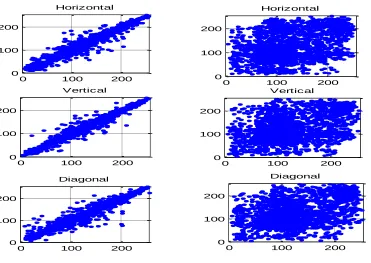
To show an algorithm’s potential for surviving statistic attacks [5], adjacent pixel correlation analysis can be used. In this section, we analyze the intensity distribution of two horizontally, vertically, and diagonally neighboring pixels in the original and its corresponding encrypted images by the presented new encryption algorithm.
0 100 200 0
100 200
Horizontal
0 100 200
0 100 200
Vertical
0 100 200
0 100 200
Diagonal
0 100 200
0 100 200
Horizontal
0 100 200
0 100 200
Vertical
0 100 200
0 100 200
Diagonal
Fig. 6 Correlation of adjacent pixels at different directions before and after image encryption.
7.2 Comparative Analysis
To demonstrates and check the evaluation of proposed method we select the standard test image Leena as an sample and perform more than 20 times of experimentation and each and every experimentation we generate the private key randomly as well as select various secrete data, after that we perform the operation and then evaluate the various quality factors such as PSNR and Embedding Ratio. The average value of PSNR, Embedding Ratio is tabulated in Table 2.
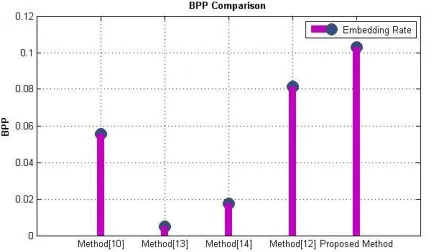
Looking at Table 2, we can show that PSNR are more appropriate than that obtained by using existing considered methods. It is clear from Tables II that the embedding rate is much better than other methods. Fig. 7 and Fig. 8 illustrate the comparison graph of proposed method with other considered method with respect to PSNR and Embedding Rate respectively.
TABLE 2 COMPARTIVE ANALYSIS OF PROPOSED DATA HIDING
TECHNIQUE
2969 Fig. 8. Shows average Correlation between pixel values and compare
different RDH Methods.
8 C
ONCLUSIONWe proposed a secure non-separable reversible data hiding technique in encrypted image. The method consists of various stages. In the first stage, owner of the image hides the secrete data into cover image by Histogram modification of Pixel difference in inverse S-order. in next stage, stego image is encrypted using Skew tent map. At the receiver end, reverse operation is performed. if the receiver doesn’t has encryption key, then he is unable to extract data and If receiver has encryption key then can generate an image same as original image as well as it can read the hidden data. Performance of proposed system is evaluated based on PSNR and embedding ration. Proposed system has PSNR 53 dB approx, higher than existing RDH techniques in encrypted image. Proposed method is tested on various hiding capacity. From the result we can conclude that proposed scheme performs excellent output quality.
REFERENCES
[1]. A. C. Lin, W. L. Tai, and C. C. Chang, ―Multilevel reversible data hiding based on histogram modification of difference images,‖ Pattern Recognition, vol. 41, no. 2008, pp. 3582–3591, 2008. [2]. A.M. Alattar, ―Reversible watermark using the
difference expansion of a generalized integer transform,‖ IEEE Trans. Image Process, vol. 13, no. 8, pp. 1147–1156, 2004.
[3]. Bangxu Yin, Fan Chen, Hongjie He, Shu Yan, ―Separable Reversible Data Hiding in Encrypted Image With Classification Permutation‖, IEEE Third International Conference on Multimedia Big Data, 2017.
[4]. D. Zou, Y. Q. Shi, Z. Ni, and W. Su, ―A semi-fragile lossless digital watermarking scheme based on integer wavelet transform,‖ IEEE Transactions on Circuits And Systems For Video Technology, vol. 16, no. 10, pp. 1294–1300, 2006.
[5]. Gouenou Coatrieux, Wei Pan, Nora Cuppens-Boulahia, ‖Reversible Watermarking Based on Invariant Image Classification and Dynamic Histogram Shifting,‖ IEEE Transactions on
Information Forensics and Security, Vol. 8, no. 1, pp. 1-10, 2013.
[6]. H. J. Kim, V. Sachnev, Y. Q. Shi, J. Nam, and H. G. Choo, ―A novel difference expansion transform for reversible data embedding,‖ IEEE Transactions on Information Forensics and Security, vol. 3, no. 3, pp. 456–465, 2008.
[7]. J. Fridrich, M. Goljan, and R. Du, ―Lossless data
embedding-new paradigm in digital
watermarking,‖ Eur. Assoc. Signal Process. J. Appl. Signal Process, vol. 2002, no. 2, pp. 185–196, 2002. [8]. J. Tian, ―Reversible data embedding using a
difference expansion,‖ IEEE Transaction Circuits Systems Video Technology, vol. 13, no. 8, pp. 890– 896, 2003.
[9]. M. Fallahpour and M. H. Sedaaghi, ―High capacity lossless data hiding based on histogram modification,‖ IEICE Electron Exp., vol. 4 no. 7, pp. 205–210, 2007.
[10].P. Tsai, Y. C. Hu, and H. L. Yeh, ―Reversible image hiding scheme using predictive coding and histogram shifting,‖ Signal Process, vol. 89, no. 6, pp. 1129–1143, 2009.
[11].Rintu Jose, Gincy Abraham,‖ Separable Reversible Data Hiding in Encrypted Image with Improved Performance,‖ IEEE International Conference on Microelectronics, Communication and Renewable Energy, 2013.
[12].S. Lee, C. D. Yoo, and T. Kalker, ―Reversible image watermarking based on integer-to-integer wavelet transform,‖ IEEE Transactions on Information Forensics and Security - Part 1, vol. 2, no. 3, pp. 321–330, 2007.
[13].V. Suresh, C. Saraswathy,‖ Separable Reversible Data Hiding Using Rc4 Algorithm,‖ IEEE International Conference on Pattern Recognition, Informatics and Mobile Engineering (PRIME), 2013.
[14].Wei-Liang Tai, Chia-Ming Yeh, and Chin-Chen Chang,‖ Reversible Data Hiding Based on Histogram Modification of Pixel Differences,‖ IEEE Transactions on Circuits And Systems For Video Technology, Vol. 19, no. 6, pp. 906-910, 2009. [15].Zaidoon Kh., AL-Ani, A.A.Zaidan, B.B.Zaidan and
Hamdan.O.Alanazi,‖ Overview: Main
Fundamentals for Steganography ,― Journal of computing, vol. 2, no. 3, pp. 158-165, 2010.