United Kingdom Vol. V, Issue 10, October 2017
Licensed under Creative Common Page 417
http://ijecm.co.uk/
ISSN 2348 0386
SOLUTIONS FOR PROMOTING INVESTMENT AND DEVELOPMENT
ACTIVITIES INTO ROAD TRAFFIC INFRASTRUCTURE
Cu Thanh Thuy
PhD candidate at National Economics University, Viet Nam Lecturer at Ha Noi Architectural University, Viet Nam
Tran Tho Dat
National Economics University, Viet Nam
Abstract
This study analyze the reality of investment and development activities into road traffic
infrastructure in VietNam, based on useing advanced econometric tools (Exploratory Factor
Analysis (EFA), statistic software SPSS 20.0) to identify and analyze factors affecting to
investment and development activities (Authors pointed out ten groups of factors). Based on the
empirical findings, the study proposed solutions to promoting investment and development
activities into road traffic infrastructure.
Keyword: Infrastructure, road traffic, investment and development activities, solutions for
promoting investment, Vietnam
INTRODUCTION
Licensed under Creative Common Page 418 To meet these requirements, the Transport sector has envisaged development policies and strategies by 2020 and vision by 2030. Continued efforts have been made in the implementation of development goals for transport infrastructure in terms of quantity and quality improvement of traffic projects across the nation. Specifically, the Ministry of Transport has focused on addressing issues such as restructuring, equalization of State-owned enterprises, reforming administrative procedures to improve business performance, create favorable mechanisms to appeal foreign investment flows into the traffic sector. The results obtained from these efforts are the appearance of numerous key transport projects, creating platforms and no few contributions to the development of other sectors. For instance, by the end of 2015, the total road length was about 309,969 km nationwide [Source: Vietnam Road Administration], around 114,146 kilometers of which is high-speed highway.
However, given that investment and development characteristics for road traffic in particular and other sectors in general, the capital demand is often very large, with long time for capital recovery, and a large proportion of public construction. In addition, these projects also face inevitable risks; therefore, the mobilization and use of capital remain a matter of concern not only for policy makers but also of the researchers in this field.
Beside that, how to excute the investment and development into road traffic is a question need to answer by not only the scientists but also the managers.
` This study analyze the reality of investment and development activities into road traffic infrastructure in VietNam, base on uses advanced econometric tools (Exploratory Factor Analysis (EFA), statistic software SPSS 20.0) to identify and analyze factors affecting to investment and development activities. Some solutions to promoting investment and development activities into road traffic infrastructure were proposed by author.
LITERATURE REVIEW
Investment and development have become a matter of concern for not only researchers but also policy-makers. The capital used in investment activities varies from state budget, official development assistance, business capital to foreign direct investment, and so forth. Investment for development is implemented in different sectors, each of which has its own characteristics but shares the most basic features of investment for development. The investment activities for development can be project-based, work item - based or in other methods (Tu Quang Phuong, Pham Van Hung, 2013)
Licensed under Creative Common Page 419 comprehensive theory to have a possibly best accurate and general insight of the state budget so that it can be managed as efficiently as possible. In fact, V.O. Key Jr. (1940) recognized the need for a theory of the state budget. In his research, he pointed out the problem when there is no theory for budget and analyzed its importance in macroeconomic management as well as in increasing allocative efficiency of the government budget. The author also pointed out that the most important regard in considering the state budget is the allocation of expenditure for the various purposes in a way that results obtained are the most optimal. In 1930s, Mabel L. W. was also aware of the importance of state budget expenditure. In his study, an analysis of the allocation of state budget and principle for budget spending were made. Malbel synthesized the theories related to public expenditure, and on this basis, developed and built a new theory to guide the spending allocation of the budget. Theories related to state budget have made great strides over time from work item-based budget management practices to task – based budget management practices; from program-based management to output-based budget management practices. Moreover, each budget management method has specific advantages and disadvantages, but it shares a point in common: all of these budget management practices are increasingly better over time through the process of different management practices in different countries. Martin et. al. (2010) compared and showed very clearly the development of budget-related theories. The researcher has confirmed the advantages of output-based budget management method, and this method answered the question often posed by budget managers: How to make decisions to allocate the funds for one activity instead of allocating it to another.
Licensed under Creative Common Page 420 investment theories and methods of collecting secondary data, quantitative models in the processing of the data, Edward Anderson et al (2006) considered the role of the investment that use the state budget as a means of poverty reduction. He demonstrated the social role of investment funds using the state budget through the indicators, which reflect the efficiency of public investment in growth, production and social balance. In addition, in the study the authors proposed a method to appraise projects using public investment and allocate optimally the budget between regions in order to achieve social objectives.
For the management of investment projects, studies of Peter E.D (2002) have pointed out that it is important to build a sample project for quality system of cost management to determine the quality of construction projects. In addition, the implementation of fundamental investment projects from construction budget sources, the activities of the project should be divided into the areas of work, done by the different sectors and carried out separately. In the management process, the classification of the project types and modes of operation have significant impacts on the cost of the whole project (P.E.D. Love et al (1999)). In view of PED Love (2002), the role of the parties in the management of capital for fundamental construction investment should be reviewed. Specifically, with a given construction investment projects, it is important to give suitable interpretations on the issue of management cost of investment activities.
By approaching towards State management experience in the infrastructure construction in different countries by state budget, Bernard Myers and Thomas Laursen (2008) summarized the experience of state management of investment and construction of infrastructure in the EU member states. Data for the study were collected from 2000 to the end of 2006, mainly focusing on an examination of management experience in the investment portfolio in the UK and some countries with developed economies. During the research, the EU countries have the large public debt across the world. This would be a lesson learned for performance management of basic investment and construction of the State budget in Vietnam, which could have been avoided partly a strong increase in public debt and inability to control.
Licensed under Creative Common Page 421 The same in approaching as using descriptive methodology and interpreting the results, with the data base were use from annual report’s ministry of transport, Vu Dinh Anh (2016) analyzed the
capital needs for investment and development road traffic infrastructure. This study showed that the resources of capital for doing investment and development road traffic infrastructure come from three chanel: (1) Investment from the state budget; (2) Domestic mobilized capital (via the banking system, enterprises, bonds issued…); (3) Foreign mobilized capital (borrowing from international countries, international bond issuance, foreign direct investment…)
Althougth having the same research suject with study of Vu Dinh Anh (2016), Nguyen Van Vinh (2016), Pham Thi Tuyet (2015), research of Tran Dinh Thien va Phi Vinh Tuong (2016) was concentrated on ability of development infrastructure to meet the needs of industrialization and modernization in the context of international economic intergration. The new context was impress in this research. They analyzed the successes and limitations in developing traffic infrastructure of Vietnam and developing of businessman in traffic infrastructure als. the authors pointed out the development in both quantity and quality of these firm in research period. Challenges in road transport also were mentioned, on which the authors proposed recommendations to open up capital for developing traffic infrastructure in Vietnam, one of the important area is the road traffic infrastructure.
The factors affected to investment and development activities were mentioned by before research on analysing how them affect, but these studies were not pointed out the evidences about quantitative impact to investment and development. Specifically:
+) The first: The group of objective factors: The authors were quite united in pointing out elements of objective group such as factors of natural condition, topography, climate, natural resources, these factors directly affect to investors’ investment decisions, for projects
infrastructure using state budget such as contractors, construction units... if favorable, these factors will have a positive impact on investment and development, but if unfavorable, this will increase costs of those and the result of investment and development activities will affect by the negative way.
+) The group of subject factors
Firstly, ability of parties participate in investment and development activities: Investors, construction units, monitoring units... if the capacity and qualifications as well as experience of these units and projects are good, it will have a positive impact on the operation and avoid risks by lack of experience in similar projects.
Licensed under Creative Common Page 422 monitoring units.. organization manage strictly and follow the process will avoid loss and waste with investment and development projects which using state budget.
Organizing and managing the investment and development from the state budget funds in the following contents: Writing project plan, evaluating plan, managing plan, investment planning, preparing for investment, inspecting, monitoring and evaluating project. If these contents were implemented properly and standardly, project will have more economic and fast progress performance result, further more for social effection.
Socio-economic development strategy and planning for investment and development projects: each stage has specific socio- economic objectives, priority is given to each category and each sector to meet the different socio-economic goals of country. Therefore, the long term strategies and plans of Vietnam have directly affect to the investment and development which using state budget funds.
Factor of qualification level of the staff who directly involve in investment and development activities: the professional qualifications of officials of the state management, the contractors, the investors, constructors... if they have good qualification, the implementation of project will minimize the unexpected occurrences when dealing work and could solve the problems arising when investing with both flexibility and technical accuracy in major of arising problems.
In summary, development investment has show that it is an important activities in the country’s socio-economic development. Investment and development in to road traffic
infrastructure will help create good infrastructure, thus create the advantage in attracting capital, the basis for circulating goods, contribute the development of country. So that, studying to analyze the factors affecting the investment and development into road traffic infrastructure in Vietnam is necessary.
RESEARCH METHODOLOGY
The data in the study was collected from the summary report of Ministry of Transport. Based on these data, the author in the current study used the method of descriptive statistics and interpretation results to analyze the actual situation of investment in infrastructure system of the road traffic in Vietnam in terms of strengths and drawbacks; thus, the author proposes some recommendations with the aim to enhance the achieved results of this activity.
Licensed under Creative Common Page 423
ANALYSIS AND RESULTS
Investment in developing road traffic infrastructure on the scale of capital investment
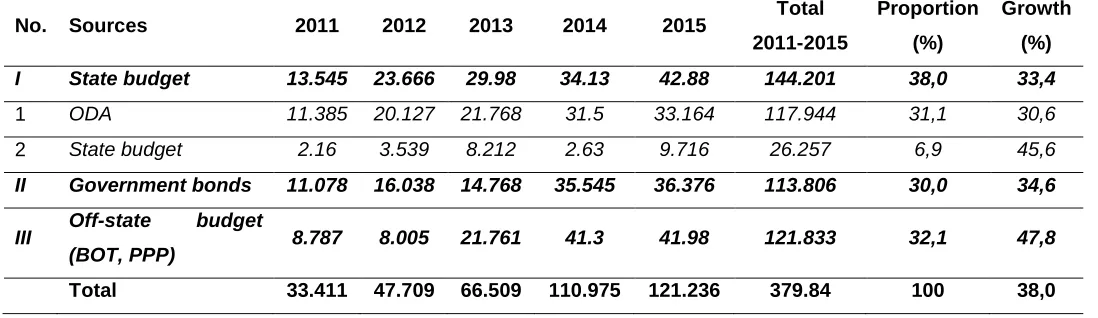
The total investment in road traffic infrastructure in period 2011-2015 reached at about 380,000 billion, increasing average 38% per year in which state budget accounted for 144,000 billion (38%); government bonds was 113,000 billion (30%); the remaining was mobilized from off-state budget sources.
Table 1: The total capital investment for developing road traffic infrastructure in period 2011-2015
Unit: Billion VND
No. Sources 2011 2012 2013 2014 2015 Total
2011-2015
Proportion
(%)
Growth
(%)
I State budget 13.545 23.666 29.98 34.13 42.88 144.201 38,0 33,4
1 ODA 11.385 20.127 21.768 31.5 33.164 117.944 31,1 30,6 2 State budget 2.16 3.539 8.212 2.63 9.716 26.257 6,9 45,6
II Government bonds 11.078 16.038 14.768 35.545 36.376 113.806 30,0 34,6
III Off-state budget
(BOT, PPP) 8.787 8.005 21.761 41.3 41.98 121.833 32,1 47,8
Total 33.411 47.709 66.509 110.975 121.236 379.84 100 38,0
(Source: Department of Planning and Investment, the Ministry of Transport)
In the period 2011-2015, the capital investment for development activities in road traffic infrastructure tended to gradually increase in the study period. The state budget accounted for a large share in the total capital investment for developing the road traffic infrastructure, namely in 2011, the capital from the state budget for this was about 13,545 billion. This figure increased by 33% in comparison with the study period with about 42,88 billion. The capital of the state budget comes from two basic sources, official development assistance (ODA) and the state budget funds in which the ODA have contributed considerably in the investment activities of developing road traffic infrastructure in Vietnam in 2011-2015 with about 31% of the total investment.
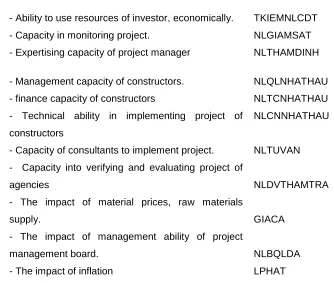
Licensed under Creative Common Page 424 Base on literature review of related research, the author has inherited and developed scale that reflect factors affecting to investment and development into road traffic infrastructure in Vietnam, the factors are as follows:
Independent variables Scale Acronym
Objective factor
1.1 Natural condition - Geographical location
- Terrain - Weather
VTDL DKDH DKKH
1.2 Economic - General economic policy
- Policy for development investment - The economic structure
- Economic development planning - Economic development plan
- Macroeconomic administration of the state
- The mechanism of allocating resources of the state
CSKTCHUNG CSDT CCKT QHPT KHPT KTVM PBNL
1.3 Politics, culture,
society
- Political stability, safety and security
- Supporting of resident for investment and development project in to infrastructure.
- Factors of culture, history and customs of the people.
CTRI
UNGHODAN
VHOA
Subjective factors
2.1. State management
agency
- Management capacity of state management officials
- Qualification level of state officials involved in investment and development into road traffic infrastructure.
- Disbursement plan of projects
NLQLNN
TDCM
KHGIAINGAN
2.2 Implementing
agencies
2.2.1. Investors - Management capacity of investors
- capability in examining and expertising project of project managers.
- Bidding capacity of project managers. - Technical level of investors.
- Experience in implementing project of investors.
NLQLCĐT NLTHAMTRA
Licensed under Creative Common Page 425 - Ability to use resources of investor, economically.
- Capacity in monitoring project.
- Expertising capacity of project manager
TKIEMNLCDT NLGIAMSAT NLTHAMDINH
2.2.2 Constructors - Management capacity of constructors. - finance capacity of constructors
- Technical ability in implementing project of constructors
NLQLNHATHAU NLTCNHATHAU NLCNNHATHAU
2.2.3 Another factors - Capacity of consultants to implement project. - Capacity into verifying and evaluating project of agencies
- The impact of material prices, raw materials supply.
- The impact of management ability of project management board.
- The impact of inflation
NLTUVAN
NLDVTHAMTRA
GIACA
NLBQLDA LPHAT
To analyze factors, author examined the suitability of data base with research model into using verification KMO and Barlett model, specific results:
Table 2: Result of verifying KMO and Bartlett’s
KMO and Bartlett's Test
Kaiser-Meyer-Olkin Measure of Sampling Adequacy. .527 Bartlett's Test of Sphericity Approx. Chi-Square 10364.769
Df 595
Sig. .000
(Sources: Results of processing data by using SPSS 20.2)
With KMO = 0,527 and sig = 0,000, the research model which author chose was suitable (To analyze factors, the verifying result need to respond following conditions: Kaiser-Meyer-Olkin index (KMO) > 0,5, the data base are proper for analysing factors and the significant of Verify Bartlett (Sig) < 0,05: consider variables that correlate with each other on the population).
Licensed under Creative Common Page 426 Table 3: Result in number of factors
Total Variance Explained
Component Initial Eigenvalues Extraction Sums of Squared Loadings
Total
% of
Variance Cumulative % Total
% of
Variance Cumulative %
1 8.470 24.200 24.200 8.470 24.200 24.200
2 3.696 10.561 34.761 3.696 10.561 34.761
3 3.191 9.117 43.878 3.191 9.117 43.878
4 2.594 7.412 51.290 2.594 7.412 51.290
5 2.445 6.985 58.275 2.445 6.985 58.275
6 1.740 4.970 63.245 1.740 4.970 63.245
7 1.566 4.474 67.720 1.566 4.474 67.720
8 1.275 3.642 71.362 1.275 3.642 71.362
9 1.242 3.550 74.912 1.242 3.550 74.912
10 1.156 3.304 78.216 1.156 3.304 78.216
11 .931 2.661 80.877
12 .879 2.512 83.389
13 .862 2.462 85.852
14 .797 2.276 88.127
15 .737 2.104 90.232
16 .552 1.577 91.809
17 .498 1.424 93.233
18 .419 1.198 94.431
19 .387 1.106 95.536
20 .319 .911 96.447
21 .249 .712 97.159
22 .202 .577 97.736
23 .183 .522 98.258
24 .126 .360 98.618
25 .118 .338 98.956
26 .097 .278 99.234
27 .072 .206 99.441
28 .068 .195 99.635
29 .040 .115 99.751
30 .026 .073 99.824
Licensed under Creative Common Page 427
32 .019 .055 99.948
33 .010 .029 99.978
34 .004 .012 99.990
35 .004 .010 100.000
(Sources: Results of processing data by using SPSS 20.2)
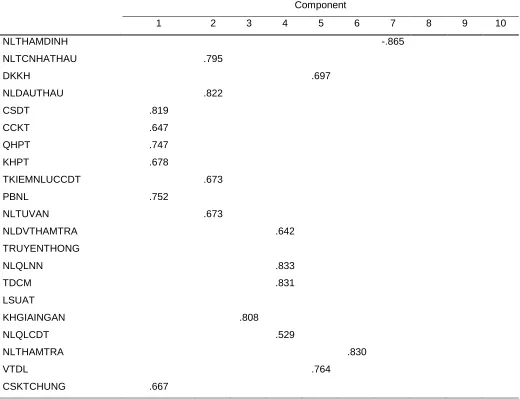
According to standard Kaiser, the factors which have Eigenvalue index lower than 1 will be rejected out of model, base on the results of processing data by using software spss 20.2, author pointed out ten groups of factors, which have Eigenvalues index >1. The level of explanation of ten factors is about rather than 78% (78,216%). In rotated component matrix, factors were indentified as follow:
Table 4: Rotated component matrix
Rotated Component Matrixa
Component
1 2 3 4 5 6 7 8 9 10
NLTHAMDINH -.865
NLTCNHATHAU .795
DKKH .697
NLDAUTHAU .822
CSDT .819
CCKT .647
QHPT .747
KHPT .678
TKIEMNLUCCDT .673
PBNL .752
NLTUVAN .673
NLDVTHAMTRA .642
TRUYENTHONG
NLQLNN .833
TDCM .831
LSUAT
KHGIAINGAN .808
NLQLCDT .529
NLTHAMTRA .830
VTDL .764
Licensed under Creative Common Page 428
NLGIAMSAT .575
KHKTCDT
KNCDT .609
KTVM .597
NLQLNHATHAU .549
KNNHATHAU .787
DKDH .823
NLCNNHATHAU .671
LPHAT .661
GIACA .655
CTRI .675
UNGHODAN .504 .620
NLBQLDA -.555
VHOA .647
(Sources: Results of processing data by using SPSS 20.2)
Ten group of Identified factors:
FAC1 = 0,819CSDT + 0,647CCKT + 0,747QHPT + 0,678KHPT + 0,752PBNL + 0,667CSKTCHUNG + 0,597KTVM
Factor 1, objective factors, including seven observed variables: policy for investment (CSDT), the economic structure (CCKT), distributed resources of state (PBNL), Macroeconomic administration of the state (KTVM) and general economic policy. In that, the grade show the most impactive is observed variables policy for investment (0.819) and the lowest impactive is Macroeconomic administration of the state with the grade is 0,597.
FAC2 = 0,795NLTCNHATHAU + 0,822NLDAUTHAU + 0,673TKIEMNLUCCDT + 0,673NLTUVAN + 0,549NLQLNHATHAU
Factor 2, finance capacity and ability to use the resources of implementation agencies, this factor include five observed variables: capacity of constructors (NLTCNHATHAU), Bidding capacity of investors (NLDAUTHAU), ability to using resources, economically (TKIEMNLUCCDT), consulting capacity for implementing project (NLTUVAN), management capacity of constructors (NLQLNHATHAU) and the most impactative observed variable is Bidding capacity of investors (0,822) and the lowest impactative observed variable is management capacity of constructors with impaction grade is 0,549.
FAC3 = 0,808KHGIAINGAN + 0,787KNNHATHAU + 0,671NLCNNHATHAU
Licensed under Creative Common Page 429 to implement project of constructor (NLCNNHATHAU). Author set the name for group is Disbursement plan of state and implementing capacity of constructor, these factors were impacted by observed variable Disbursement plan with highest grade (0,808), it is properly with investment and development activities because it directly affected to financial resources of implementation project agency.
FAC4 = 0,642NLDVTHAMTRA + 0,833NLQLNN + 0,831TDCM + 0,529NLQLCDT
Factor 4 including observed variables: Capacity into verifying and evaluating project of agencies (NLDVTHAMTRA), management capacity of state management officials (NLQLNN), level of qualification of state management officials involved to investment and development into road traffic infrastructure (TDCM) and ability in managing of investor (NLQLCDT). These factor has named is level off qualification and management capacity of agencies into investment and development of road traffic infrastructure implementation project, and they were influenced in highest level by variable management capacity of state management officials (0,833) and the lowest affected come from variable ability in managing of investor (0,529).
FAC5 = 0,697DKKH + 0,764VTDL + 0,823DKDH
Factor 5 includes three observed variables: Geographical location (VTDL), Terrain (DKDH), Weather (DKKH), the name of group factors is natural condition, in those, variables Terrain is highest impacted to this factor with grade of impaction is 0,823.
FAC6 = 0,83NLTHAMTRA + 0,575NLGIAMSAT
Factor 6, verification and monitoring capacity of investor, it includes two observed variables: ability to verify project manager (NLTHAMTRA) and monitoring capacity of project manager (NLGIAMSAT), it seem to be that the affect of variable ability to verify of project manager is more than variable of monitoring capacity of project manager with grade of the impaction is about 0,83.
FAC7 = 0,865NLTHAMDINH + 0,609KNCDT
Author set the name for factor 7 is capacity in managing and experience of investor, including two observed variables: Expertising ability of project manager (NLTHAMDINH) and Experience in implementing project of investor (KNCDT).
FAC8 = 0,655GIACA + 0,555NLBQLDA
Factor 8 has named: the level of influence of the inputs and capabilities of the project management board. It includes two observed variables : the impact of price and raw materials supply (GIACA) and the impact of capacity of project management board (NLBQLDA).
FAC9 = 0,661LPHAT
Licensed under Creative Common Page 430 FAC10 = 0,675CTRI + 0,62UNGHODAN + 0,647VHOA
Factor 10, factor politic, culture, society, including three variables: Political stability, security (CTRI), Resident’s support for investment and development into infrastructure project
(UNGHODAN), and cultural, historical, habitual factor (VHOA)
RECOMMENDATIONS
To further improve the economic results of the investment projects in infrastructure development of road traffic using state budget in Vietnam, based on study results, the author would like to give a number of recommendations as follows:
First, there is a need to take measures to improve the quality of training as well as uplifting voluntary action and qualification of state managerial staff working in the field of investment in infrastructure development of Vietnam.
Second, improve the quality of technical equipment as well as labor quality in machinery operation by the construction units who implement projects.
Third, it is important to improve the quality of the team bidding for the project, ensuring that procurement activities are carried out properly and ensure contractors selected are of high quality.
Fourth, given the allocation of investment resources of the State managerial agencies for investment activities in infrastructure development of road traffic using the state budget, there should be sound consultation with State’s management agencies when allocating resources to
projects, prioritizing the key projects and give proper distribution for the project.
In addition, it is necessary to carry out people’s mobilization well for those whose land
is repossessed when building investment projects in infrastructure development of road traffic because without land repossession, it will be impossible to carry out projects and highly likely that the project is behind schedule.
It is required to have care and close observation of the fluctuations of the economy so that right solutions can fulfil specific requirements of each stage.
REFERENCES
Benedict clements, Rina Bhattacharya, Toan Quoc Nguyen, (2003), External debt, public investment, and growth in low- income countries, IMF
Barnard Myers, Thomas Laursen, (2008), Public investment management in the EU
Edward Anderson, Paolo de Renzio, Stephanie levy, (2006), The role of public investment in poverty reduction: theories, evidence and methods, overseas development institute, 111 wesminster bridge road London SE1, 7JD, UK
Licensed under Creative Common Page 431 Mabel L. Walker, (1930), Municipal expenditures, National Municipal review, Volume 20, issue 9
Nguyễn Văn Vịnh, (2016), Huy động vốn cho phát triển cơ cấu hạ tầng, kỷ yếu hội thảo khoa học, Bộ giao thông vận tải
P.E.D Love (1999), A symptom of a dysfunctional supply chain’, European Journal of purchasing and supply management, 5
P.E.D. Love (2002), Auditing the indirect consequences of rework in construction: a case based approach, Managerial auditing journal, 17, pp. 138-146.
Peter E.D (2002), A project management quality cost information system for the construction industry’, Information and management, 40.
Pham Thi Tuyet, (2015), Thực trạng và nhu cầu vốn phát triển giao thông đường bộ Việt Nam, tạp chí giao thông
Tu Quang Phuong, Pham Van Hung, (2013), Giáo trình kinh tế đầu tư, Nhà xuất bản đại học Kinh tế quốc dân Hà Nội
Trần Đình Thiên, Phí Vĩnh Tường, (2016), Phát triển giao thông Việt Nam đáp ứng yêu cầu công nghiệp hóa, hiện đại hóa trong bối cảnh hội nhập kinh tế quốc tế, kỷ yếu hội thảo khoa học, Bộ giao thông vận tải V.O.Key Jr, (1940), The lack of budgetary theory, American political Science review, volume 34, issue 6 Vũ Đình Ánh, (2016), Nhu cầu vốn đầu tư phát triển hạ tầng giao thông, kỷ yếu hội thảo khoa học, Bộ