Research article Available online www.ijsrr.org
ISSN: 2279–0543
International Journal of Scientific Research and Reviews
Implementation of Project Database Integration System using Private
Cloud Services with an Efficient access through Web Application
Poornashankar
1*
and Choudhari Pragati
11
Computer Engineering Department, Indira College of Engineering & Management, Pune. India.
ABSTRACT
With evolution of Cloud computing, the IT infrastructure and data management has changed drastically and managed efficiently with the emphasis on server virtualization, standardization, automation and self service provisioning. The basic premise of the cloud computing is that users get access to any computing resource such as storage, processors, memory and software over the internet anytime ubiquitously and seamlessly. In academic institutions, every year real time projects developed by students increases and there is no systematic way of archiving the projects. Though the projects are stored in the department / centralized hardware, the accessibility of this projects are difficult for the successors. Hence an efficient, organized and secured storage system is required to maintain the data flood such as cloud storage. This research paper discusses on the implementation of private cloud for archiving such research projects in a hierarchical structure and proposes a swift search technique to access the cloud database through an interactive user interface. The efficient searching with B+ tree indexing and binary search method will be implemented for the fast retrieval from the cloud storage. The system keep track of all submitted project in search index. Then in matching stage keyword is searched from index file using binary search with page rank algorithm to retrieve the useful and relevant results in fraction of a second. The cloud deployment architecture and the Model View Controller (MVC) architecture of the user interface web application is discussed in this paper.
KEYWORDS:
MVC architecture, B+ tree indexing, keyword matching, virtualization, binary search.*
Corresponding Author
Dr. Poornashankar
Computer Engineering Department
Indira College of Engineering & Management
INTRODUCTION
With the proliferation of internet usage, every organization is taking advantage by private
cloud for various purposes like information reach to the large amount of audience as well as to make
functionality with easier and faster pace. Educational institutes are sharing information to the
students through the medium of private cloud data base which is numerous source of information for
the students.
In the present evolving technology revolution and globalization, it is the need of the hour to
nurture and develop the student’s approach towards technical and research applications. Academic
institutes take utmost care to abreast the curriculum to meet the Industry requirements and standards
and impart high quality education for the holistic development of students. The domain and practical
knowledge of the students are continuously monitored and evaluated through various assessment
procedures. Application development is one of the key area for all professional programmes where in
the students analytical, logical, reasoning and technical skills are demonstrated. Hence to encourage
these skills, real time projects are included as a part of curriculum.
Students carry out various mini projects in every semester and they take up a major
industry sponsored real-time projects in their final year. Pupils of all professional courses refer IEEE
papers and implement the latest research concepts in to applications. Students undergo internship at
Industry and develop the project according to Industry needs, where they get practical exposure and
get involved in all phases of project development life cycle. So there is a necessary for archiving
system of all such projects in a secured manner for easy and efficient access.
Customization and maintenance of the cloud data base the is done based on the need of
information sharing, but least concern is taken to organize the content with the effective
identification of the user interests and the encapsulation of those interests into the data base'
presentation and content, so that information can be availed to the users with less efforts. If the
private cloud implementation is successful for data archival in academic Institutes to store their
academic, research and student related information. Due to inherently long term nature of archive
storage of massive Institutional data, private cloud services can save the infrastructure cost, staff
turnover and maintenance risks. Data can be fully managed with high security in a dedicated
EXPERIMENTAL SECTION
Related Work
Cloud computing can be simply defined as Computing in a remote location or location
independent with shared and dynamic resource availability on demand. Cloud computing describes a
new supplement, consumption and delivery model for IT services based on the internet, and it
typically involves over the internet provision of dynamically scalable and often virtualized resources.
Cloud storage is a new business solution for remote backup outsourcing, as it offers an
abstraction of infinite storage space for clients to host data backups in a pay-asyou- go manner. It
helps enterprises and government agencies significantly reduce their financial overhead of data
management, since they can now archive their data backups remotely to third-party cloud storage
providers rather than maintain data centers on their own. For example, SmugMug, a photo sharing
website, chose to host terabytes of photos on Amazon S3 in 2006 and saved thousands of dollars on
maintaining storage devices. More case studies of using cloud storage for remote backup can be
found in. Apart from enterprises and government agencies, individuals can also archive their
personal data to the cloud using tools like Drop box. In particular, with the advent of smart phones,
we expect that more people will use Drop box-like tools to move audio/video files from their smart
phones to the cloud, given that smart phones typically have limited storage resources. There are
numerous research papers and case studies published in cloud computing related to cloud storage
implementation, security policies, file backup, scalability and other challenges.
W. Wang, Z. Li, R. Owens, and B. Bhargava 1 presented in their paper “Secure and efficient
access to Outsourced data” proposed a mechanism in owner-write-users-read applications. Analysis
shows that the key derivation procedure based on hash functions will introduce very limited
overhead. Use over-encryption and/or lazy revocation to prevent revoked users from getting access
to updated data blocks. Designed mechanisms to handle both updates to outsourced data and changes
in user access rights. However, this approach has less communication and storage overhead for data
retrieval when they have infrequent update operations handles user revocation without impacting
service provider over-encryption and lazy-revocation.
A cloud backed file system for the enterprise called BLUESKY are presented by Michael
Vrable, Stefan Savage, Geoffrey M.Voelker2 a network file system backed by cloud storage.
optimization. some of the optimizations are described which are necessary to achieve good
performance and low cost, including a log-structured design and a secure in-cloud log cleaner.
BlueSky supports multiple protocols—both NFS and CIFS—and is portable to different providers.
Yuchong Hu, Henry C. H. Chen, Patrick P. C. Lee, Yang Tang 3 in their paper “Applying
Network Coding for the Storage Repair in a Cloud-of-Clouds” discussed to provide fault tolerance
for cloud storage, recent studies propose to stripe data across multiple cloud vendors. However, if a
cloud suffers from a permanent failure and loses all its data, then we need to repair the lost data from
other surviving clouds to preserve data redundancy. They presented a proxy-based system for
multiple-cloud storage called NCCloud, which aims to achieve cost-effective repair for a permanent
single-cloud failure.
Jing He, Yue Wu, Yang Fu 4 in their research work “Snapshot-based data index in cloud
storage systems” explained the problem to create index on growing database and discussed the
limitations of traditional way of rebuilding the index on increasing size of data index. Paper proposed
a double-layer B+ tree based index structure that overcomes the throughput limitation triggered by
single index server. The index can improve the performance of cloud storage system dramatically
and also satisfy the users tend to prefer the inquiry which is more than one keyword within a scope
of specific period.
Mohammed Faez Al-Jaberi, Anazida Zainal6 in their research work “Data integrity and
privacy model in cloud computing” discussed the use of various algorithm and protocols like MD5,
AES to provide integrity and privacy preservation technique on cloud. Data integrity and privacy are
ensured against unauthorized parties using the prototype system. The model uses a third party to
check integrity of data stored in cloud storage. Also, it applies security mechanism that ensure
privacy and confidentiality of data stored in cloud computing.
Amjad Alsirhani; Peter Bodorik; Srinivas Sampalli7 in their research work “Improving
Database security in Cloud Computing by Fragmentation of Data” discussed the combined use of
encryption algorithm and distribution system to improve confidentiality of database. The results
showed that the scheme offers a highly secure approach that provides users with data confidentiality
and provides acceptable overhead performance.
Jyhjong Lin, Lendy Chaoyu Lin, Shiche Huang 8 in their research work “Migrating Web
Applications to Clouds with Cloud-Based MVC Framework” discussed how existing web
applications are migrated on cloud based environment using MVC framework. Also explained with
the advances of cloud technologies, how MVC framework acquired rich set of features of cloud
Proposed system
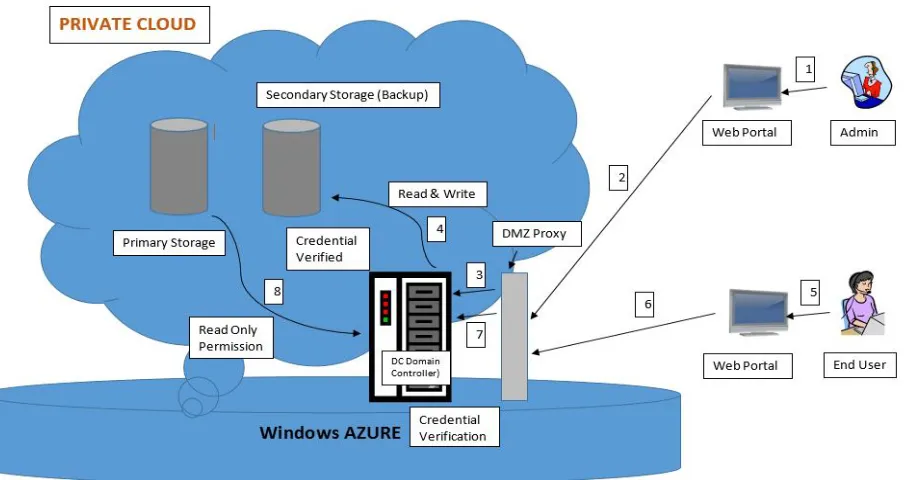
A private cloud implementation is proposed with the domain controller and identity access
management configuration and implementation through virtualization. Asset management and
Integration of project database will be executed through open source virtualization tools and
performance of server and services provided by all resources will be monitored.
The project data base will be organized in a hierarchical structure in the cloud and must be
easily searchable via metadata and protected from overwriting or tampering.
Location and device independent responsive web application using MVC architecture will be
developed for user interface to verify user’s authentication and provide access to the project database
through cloud archive services in a secured manner. It will provide catalogue of project database
with indexing services and provision for efficient keyword searches from the meta data with easy
navigation system. Two layer authentication will be provided with highly secured access policies for
the data access and retrieval from the cloud platform. The developed self-service user interface
application will be integrated with the cloud storage and all testing will be conducted to ensure the
functionality, accuracy and user acceptability. Necessary logs of searches, users’ detail and
download history will be generated to know the utility of the application.
Implementation
Initially an assessment of existing infrastructure will be carried out to understand the data
volume of the project database and its structure. The virtualization layer will be built through
Hypervisor or VMware. The asset management, automation and orchestration process will be
configured and integrated on the server. The existing project database will be integrated over the
Figure 1: Private Cloud Deployment System
A self-service web application for faster user access with project indexing and search service
using MVC architecture will be developed and integrated with the deployed cloud project database
management system. In this, first a user interface application will be developed to upload the
student’s project abstract and to accept other project related data like department, domain,
sub-domain and keywords.
In Project archival phase all accepted will be stored in database and accordingly index table
will be updated. Since it’s the requirement of system that any insert/delete/update does not affect the
performance and B + tree indexing fulfills this, we will use B+ tree method for indexing. Then in the
keyword matching stage user interface will be developed to accept project related data and controller
application with binary search and page rank algorithm will be developed for faster retrieval of data
from database. One of it’s challenges is an efficient keyword search from huge project database, in
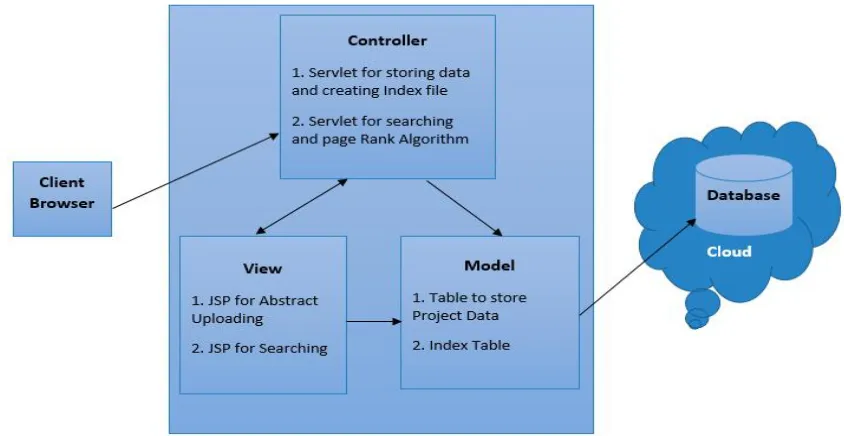
Figure 2: MVC Architecture for System
RESULTS AND DISCUSSION
In our paper, we will build B+ indexing on keyword, domain, subdomain and department
separately. As B+ tree required that all nodes should be sorted to improve the speed of searching a
record, we will store all the leaf records in sorted order of index attribute. If we take example of
keyword search, initially user has to enter multiple keywords in view part of MVC architecture as
shown in figure 2.Then view part pass this request to second servlet of controller part where it search
file using B+ indexing and create temporary table containing keyword in first column and files
matched in second column. Then page rank algorithm rank the file matched according to a number of
keywords found in a file and finally, displays files in descending order of rank given by page rank
algorithm. Our proposed method can give better performance for multiple keyword search.
In MVC architecture we will implement two user interface using JSP to accept project data
like domain, subdomain, department and keywords, and to accept search string to display matched
papers. Also, before it display search result, student has to login and after successful login OTP will
be sent on students mobile. After entering correct OTP result will be displayed to student.
In controller part of MVC we will write two program using servlet. First servlet to store data
After the completion of setup, configuration and installation the virtualization software will
host the centralized cloud project management system. Functional testing, integration testing and
User Acceptance Testing will be carried out on the implemented solutions. Performance of the server
and services provided by the application and other resources will be monitored. Regular logs and
reports will be generated to track the search statistics, download and utilization of the project
database.
Key Features
Configuring a private cloud for deploying project database through cloud archival system will be
a novel idea in academic institutions.
Cloud server will provide efficiency, scalability and backup at high speed. It supports
heterogonous IT environment through Virtualization, Data analytics, big data and other storage
centric applications.
Exponential growth and data volume are easily managed in a structured and efficient manner due
to its scalability.
Massive storage of all projects of all branches will be permanently available in a highly secured,
reliable and dedicated environment.
The project management solution through private cloud provides access to multi domain projects
on a single click to all authentic users.
This self-service project catalog solution will deliver easy access to students, faculty and
researchers to learn, understand and refer the existing projects.
Global visibility of this project will be enhanced by implementing search engine optimization
techniques to attract industry experts. This may fetch reward / recognition or employability to the
project developer.
CONCLUSION
This research will help in deploying the real time projects of the students in private cloud
environment and provide easy access to all aspiring learners. Previously created projects can be
explored further and research can be continued. Replication and redundancy of the existing projects
can be closely monitored and avoided. Dynamic Libraries and modules common to previously
executed projects can be refined and referred in the ongoing project and save lot of time. As the
project database is integrated and deployed in cloud server the scalability and security issues are
universities in the country by integrating their project database which will help students to develop
unique, original and quality projects to solve the real-world problems.
REFERENCES
1. Wang W., Li Z., Owens R., and Bhargava B., “Secure and efficient access to Outsourced data”,
ACM workshop on Cloud computing security. Chicago Illinois. USA; November, 2009;
13:55-56.
2. Vrable M., Savage S., Voelker G.M., “BlueSky: A Cloud-Backed File System for the
Enterprise”. 10th USENIX conference on File and Storage. February, 2012;19-19
3. Yuchong Hu , Henry C. H. Chen , Patrick P. C. Lee , Yang Tang, “Applying Network Coding
for the Storage Repair in a Cloud-of-Clouds”. IEEE Transactions on Computer. 2014;31-44.
4. Jing He, Yue Wu, Yang Fu “Snapshot-based data index in cloud storage systems” Information
Technology, Networking, Electronic and Automation Control Conference. IEEE;2016;784-788
5. Amazon Web Services. “Amazon Simple Storage Service” [online] March 2006 Available from
URL: http://aws.amazon.com/s3.
6. Mohammed Faez Al-Jaberi, Anazida Zainal,“Data integrity and privacy model in cloud
computing”. ISBAST. 2014; 280-284
7. Alsirhani A, Bodorik P, Sampalli S, “Improving Database security in Cloud Computing by
Fragmentation of Data”. ICCA. 2017;43-49
8. Jyhjong Lin, Lendy Chaoyu Lin, Shiche Huang “Migrating Web Applications to Clouds with