Covariant density functional theory and applications in nuclear physics
and
r
-process
P. W. Zhao1, L. L. Li2, Z. P. Li3, Z. M. Niu4, P. Ring1,5, J. M. Yao3, S. G. Zhou6,7, and J. Meng1,8,9,a
1 State Key Laboratory of Nuclear Physics and Technology, School of Physics, Peking University, Beijing 100871, China
2 Beijing Institute of Applied Physics and Computational Mathematics, Beijing 100094, China
3 School of Physical Science and Technology, Southwest University, Chongqing 400715, China
4 School of Physics and Material Science, Anhui University, Hefei 230039, China
5 Physikdepartment, Technische Universit¨at M¨unchen, 85748 Garching, Germany
6 State Key Laboratory of Theoretical Physics, Institute of Theoretical Physics, Chinese Academy of Sciences, Beijing
100190, China
7 Center of Theoretical Nuclear Physics, National Laboratory of Heavy Ion Accelerator, Lanzhou 730000, China
8 School of Physics and Nuclear Energy Engineering, Beihang University, Beijing 100191, China
9 Department of Physics, University of Stellenbosch, Stellenbosch, South Africa
Abstract. The covariant density functional theory (CDFT) with a few number of parameters allows a very successful description of the properties of nuclei all over the nuclear chart. The recent progress on the application of the CDFT as well as its extensions for a series of interesting and hot topics in nuclear structure and nuclear astrophysics are summarized. In particular, the newly proposed point-coupling parametrization PC-PK1 and the application of the CDFT to the single particle level of the radioactive neutron-rich doubly magic nucleus132Sn,
the deformed halo in nuclei, and theβdecay life-time of neutron rich nuclei are discussed in details.
1 Introduction
In the past decades, the radioactive ion beams (RIB) have extended our knowledge of nuclear physics from the stable nuclei to the unstable nuclei far away from the stability line — the so-called “exotic nuclei”. The investigation of exotic nuclei has attracted world-wide attention due to their large isospin values and intriguing properties, such as the halo phenomenon. Furthermore, the properties of exotic nuclei play essential roles in understanding the nucleosynthesis in the rapid neutron-capture process (r-process).
The density functional theory (DFT) is well known for its numerous applications to description of nuclear ground and excited states. In particular, the covariant version of DFT takes the Lorentz symmetry into account in a self-consistent way. During the past years, the covariant DFT has received wide attention due to its successful descrip-tion of lots of nuclear phenomena [1, 2]. In practical ap-plications, there are two widely used models in the covari-ant density functional theory (CDFT) framework: the rel-ativistic Hartree (RH) and relrel-ativistic Hartree-Fock (RHF) models. The former one is usually known as the relativistic mean field (RMF) model.
There exist a number of attractive features in the CDFT. The most obvious one is the natural inclusion of the spin degree of freedom and the resulting spin-orbit potential that emerges automatically with the empirical strength in a covariant way. The relativistic effects are responsible for the existence of approximate pseudospin symmetry [3–6] in the nuclear single-particle spectra and spin symmetry in the anti-nucleon spectra [7]. The representations with large
a e-mail:[email protected]
scalar and vector fields in nuclei, of the order of a few hun-dred MeV, provide more efficient descriptions than non-relativistic approaches that hide these scales. Moreover, it is of particular importance that the CDFT includes nuclear magnetism [8], i.e., a consistent description of currents and time-odd fields, which plays an important role in the nu-clear rotations [9–12].
In the conference, we presented the recent progress in the application of the CDFT as well as its extensions by the group in Beijing for a series of interesting and hot topics in nuclear structure and nuclear astrophysics including
– a newly developed point-coupling parametrization PC-PK1, which particularly improves the description for isospin dependence of the binding energy [13]; – a description for the radioactive neutron-rich doubly
magic nucleus132Sn, in particular, for the neutron single-particle spectrum [14];
– a deformed relativistic Hartree-Bogoliubov model in continuum in a Woods-Saxon basis, which aims at a proper description of exotic nuclei, in particular, de-formed halo nuclei [15];
– a study ofβdecay life-time of neutron rich nuclei based on self-consistent covariant quasiparticle random phase approximation [16].
In this contribution, these topics will be discussed in de-tails.
2 PC-PK1 parametrization
The parametrization of PC-PK1 is determined by a mul-tiparameter fitting to both the binding energies for 60
se-EPJ Web of Conferences DOI: 10.1051/
C
Owned by the authors, published by EDP Sciences, 2012 ,
epjconf 20123/
02001 (2012) 38
802001
This is an Open Access article distributed under the terms of the Creative Commons Attribution License 2 0 , which . permits unrestricted use, distributi and reproduction in any medium, provided the original work is properly cited.
lected spherical nuclei and charge radii for 17 ones with the Levenberg-Marquardt method. Meanwhile, the empirical pairing gaps for 6 nuclei obtained with the five-point for-mula are also employed to constrain the pairing strengths. With the experimental observables and the calculated val-ues, the ensemble of parameters can be obtained by min-imizing the square deviation. More details for the fitting procedure and coupling constants of the parametrization PC-PK1 can be found in Ref. [13].
As shown in Ref. [13], binding energies and quadrupole deformations of the ground states of Yb and U isotopes are investigated. In the upper panels of figure 1, the deviations of the calculated binding energies with PC-PK1 [13], DD-PC1 [17], and PC-F1 [18] from the data [19] are shown. When the rotational corrections are not taken into account, a systematic underestimation of the binding energies around 3 MeV for both Yb and U isotopes is found for PC-PK1. For PC-F1, however, the differences between the calcu-lated and the observed binding energies decrease mono-tonically with the neutron numbers. Since almost all the isotopes shown in figure 1 are employed to adjust the pa-rameters of DD-PC1, its predictions are in good agreement with the data (within 1 MeV).
After taking into account the rotational correction en-ergies with the cranking approximation [20], the calculated results with PC-PK1 reproduce the data quite well (within 1 MeV) for both Yb and U isotopes, while the differences between the corrected binding energies given by PC-F1 and data are still large. Since DD-PC1 is adjusted to the binding energies of well-deformed nuclei, the rotational correction energy is not considered in the corresponding calculations.
The calculated ground state deformations are shown in the lower panels of figure 1 in comparison with the data available [21]. It is found that PC-PK1 provides also good performance in the description of deformations as well as their corresponding evolutions with neutron number for both Yb and U isotopes.
For the nuclear matter, as in Ref. [13], the saturation properties and the equation of states (EOS) were investi-gated in the CDFT with PC-PK1 and the results were com-pared with the corresponding empirical values as well as the predictions with other effective interactions. Here, we mainly focus on the nuclear matter incompressibility K0
and the asymmetry term of nuclear incompressibilityKτ. The study of the nuclear matter incompressibility K0
continues to be a hot topic in both the theoretical and ex-perimental fields, since its value is one of the most funda-mental quantity in determining the EOS of nuclear matter. The nuclear matter incompressibilityK0cannot be directly
measured, while the energy of isoscalar giant monopole resonance (ISGMR) which is related to the finite nucleus incompressibility KA can be determined experimentally.
Moreover, the finite nucleus incompressibility KA can be
expressed in terms of [22]
KA=K0+KsurfA−1/3+Kτ[(N−Z)/A]2+KCoulZ2A−4/3, (1)
whereKτis the asymmetry term which is associated with the neutron excess and is very crucial in the study of neu-tron stars.
In figure 2, the values of nuclear matter incompress-ibilityK0and the asymmetry term of nuclear
incompress-ibilityKτfor the 25 parameter sets in both the relativistic
and non-relativistic density functional theories are shown. One could see that the predicted results with PC-PK1 are in very good agreement with the corresponding experiment constraints (see Ref. [23] and references therein).
3 Neutron single-particle spectrum in
132Sn
The magic numbers is one of the most fundamental in-gredients for understanding the nature of atomic nuclei. Recently, by using the 132Sn(d,p)133Sn reaction, the
ex-periment performed at Oak Ridge National Laboratory re-vealed for the first time that the spectroscopic factors of the neutron single-particle states 3p1/2,3p3/2,2f5/2, and 2f7/2
outside the N = 82 core are consistent withS ≈1 [25]. This is one of the critical pieces of evidence to conclude that 132Sn is a perfectly radioactive doubly magic nuclei, even better than the stable208Pb.
In Ref. [14], the CDFT is applied to investigate the properties of the radioactive neutron-rich doubly magic nu-cleus132Sn and the corresponding isotopes and isotones.
In figure 3, we show the neutron-effective single-particle energies (SPE) with respect to the orbital 2f7/2in132Sn
cal-culated by the RMF theory with PC-PK1 [13], NL3* [26], DD-ME2 [27], PK1 [28], and PKDD [28] in comparison with the data [25] and results calculated by the Skyrme-Hartree-Fock theory with the typical effective interactions SkP [29], SkM* [30], BSK17 [31], SLy4 [32], and SIII [33]. In the present mean-field level, it is clearly shown that the overall structure of the neutron-effective SPE for such a neutron-rich doubly magic nucleus can be well reproduced in the relativistic framework, where both the spin-orbit and orbit-orbit potentials are described in a self consistent way. In contrast, the nonrelativistic results overestimate nearly twice the single-particle energy spacing between the or-bitals 3p3/2and 2f7/2, where the reduction of the orbit-orbit
potential plays the most important role.
Furthermore, one can extract the Nilsson spin-orbit pa-rameter C and orbit-orbit parameter D by fitting to the single-particle energies. As discussed in Ref. [14], the RMF results agree quite well with the extracted Nilsson spin-orbit parameter C and orbit-orbit parameter D from ex-perimental SPE of 132Sn, but remarkably differ from the
traditional Nilsson parameters.
4 Deformed halo in nuclei
Halo is one of the most interesting exotic nuclear phe-nomena. There are many new features in the halo nuclei because of the extremely weakly binding properties. To give a proper theoretical description of the halo phenom-ena, it is crucial to treat properly the coupling between bound states and the continuum due to pairing correla-tions by either the finite range or the zero range pairing forces [34] and the very extended spatial density distribu-tions. This can be achieved by solving, in the coordinate (r) space or equivalent basis, the non-relativistic Hartree-Fock-Bogoliubov (HFB) [29, 35] or the relativistic Hartree Bogoliubov (RHB) [36–39] equations .
-4 -2 0 2 4 6 8
88 92 96 100 104 108 0.15
0.20 0.25 0.30 0.35
138 140 142 144 146 148 PC-PK1 DD-PC1 PC-F1 PC-PK1(cor.) PC-F1(cor.)
(b)
(c)
(d)
E
c
a
l
B
-E
e
x
p
B
(
M
e
V
)
(a)
Yb U
Neutron Number
Exp. PC-PK1 DD-PC1 PC-F1
Fig. 1.Deviations of the calculated binding energies from the data [19] for Yb and U isotopes obtained by PC-PK1 [13], DD-PC1 [17],
and PC-F1 [18] (upper panels) as well as the corresponding calculated ground state deformations in comparison with data [21] (lower panels). The filled circles and squares in the upper panels correspond to the rotational corrected values given by PC-PK1 and PC-F1, respectively. Taken from Ref. [13].
180 200 220 240 260 280 300 320 340 360 380 -800
-700 -600 -500 -400 -300 -200
PKDD TW99
K0 (MeV) TM 1
PC-PK1
DD-M E1 DD-M E2
NLSH TM 2
NL3
S6 S1
S3
S4 SkX M SkA
PK1 Sa Skl3
SG1
NLC
Skl4 SLy4
SkM SkM *
K
(
M
e
V
)
SG2
Fig. 2.Correlations between the nuclear matter incompressibilityK0 and the asymmetry term of nuclear incompressibilityKτfor the
25 parameter sets in both the relativistic and non-relativistic density functional theories. Constraints forK0 from the giant monopole resonance (GMR) data on208Pb and90Zr and forK
τ from the isotopic dependence of the GMR in the even-A Sn isotopes [23] are represented by the shadow area. The calculated results are taken from Ref. [24] except for that with PC-PK1.
quite well [36] and the giant halos in light and medium-heavy nuclei was predicted in Refs. [39, 41, 42]. Moreover, the RCHB theory has been generalized to treat the odd par-ticle system [43].
For deformed nuclei, on the other hand, the Woods-Saxon basis has been proposed in Ref. [44] to solve the de-formed RHB equation with proper treatment for the asymp-totic behavior of nuclear densities at larger. Over the past
-1 0 1 2 3 4 5
2f 7/2
1h 9/2
3p 3/2 3p
1/2
PK1 PKDD DD-ME2 NL3* PC-PK1
n
e
u
t
r
o
n
e
f
f
e
c
t
i
v
e
S
P
E
(
M
e
V
)
exp. SkP SkM* BSK17 SLy4 SIII
2f 5/2
SHF RMF
132
Sn
Fig. 3.Neutron-effective single-particle energies with respect to the orbital 2f7/2in132Sn calculated by the RMF theory with effective
interactions PC-PK1 [13], NL3* [26], DD-ME2 [27], PK1 [28], and PKDD [28]. The experimental data [25] and the results calculated by the Skyrme-Hartree-Fock theory with SkP [29], SkM* [30], BSK17 [31], SLy4 [32], and SIII [33] are also shown for comparison. The shaded areas indicate the area beyond the neutron threshold. Taken from Ref. [14].
Fig. 4.Density distributions for the neutron halo (a) and the neutron core (b) for the ground state of42Mg. Here, thezaxis is the symmetry
axis. Taken from Ref. [47].
The halo phenomenon in deformed nuclei has been in-vestigated with the DefRHBC theory in Refs. [15, 47]. In some deformed neutron-rich nuclei, e.g.,42,44Mg, a
decou-pling of the halo orbitals from the deformation of the core has been predicted. Here, we present and discuss in details the results from the DefRHBC theory for the deformed neutron-rich and weakly bound nucleus42Mg [15, 47].
Magnesium isotopes have been studied extensively in Refs. [15, 47] with the deformed relativistic Hartree Bo-goliubov theory in continuum and the parameter sets NL3 [50] and PK1 [28]. In the calculations with the PK1,42Mg
is predicted as the last bound nucleus in Mg isotopes [47]. As discussed in Ref. [47], the ground state of42Mg is
well deformed with a quadrupole deformationβ ≈ 0.41, and a very small two neutron separation energyS2n≈0.22
MeV. In the tail part, the neutron density extends more along the direction perpendicular to the symmetry axis. In figure 4, the density distribution is decomposed into the contributions from the oblate “halo” and the prolate “core”, respectively. The density distribution of this weakly bound nucleus has a very long tail in the direction perpendicular to the symmetry axis. As explained in Ref. [47], this indi-cates that the prolate nucleus42Mg has an oblate halo and
there is a decoupling between the deformations of the core and the halo.
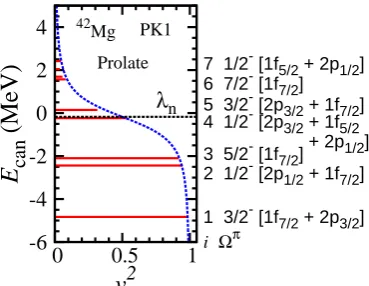
In figure 5, the single particle spectrum around the Fermi level for the ground state of 42Mg is presented together
with the good quantum numbers of each single particle state. Here, the occupation probabilitiesv2 in the
canoni-cal basis which are of the BCS-form [51] are given by the length of the horizontal lines. The levels near the thresh-old are labeled by the numberiaccording to their energies. Meanwhile, their good quantum numberΩπ and the main spherical components are given at the right hand side.
The neutron Fermi level locates in the p f shell and most of the single particle levels nearby have negative par-ities. Since the chemical potentialλn is close to the
con-tinuum, orbitals above the threshold have noticeable occu-pations due to the pairing correlations. The single neutron levels of 42Mg can be divided into two parts, the deeply
bound levels (εcan<−2 MeV) corresponding to the “core”,
and the remaining weakly bound levels close to the thresh-old (εcan >−0.3 MeV) and the continuum corresponding
to the “halo”.
As explained in Refs. [15, 47], the shape of the halo re-sults from the intrinsic structure of the weakly bound and continuum orbitals. By examining the neutron density dis-tribution, we could learn that the halo in42Mg is mainly formed by level 4 and level 5 composed of pand f com-ponents. Note that the angular distribution of|Y10(θ, ϕ)|2∝
cos2θwith a projection of the orbital angular momentum
on symmetry axisΛ=0 is prolate and that of|Y1±1(θ, ϕ)|2∝
sin2θwithΛ=1 is oblate. It turns out that theΛ=1 com-ponent dominates in level 4 (Ωπ = 1/2−) and is the sole component in level 5. Therefore, the shape of the halo in
42Mg is oblate and decouples from the corresponding
-6
-4
-2
0
2
4
0
0.5
1
E
can(MeV)
v
27 1/2- [1f5/2 + 2p1/2]
6 7/2- [1f7/2]
5 3/2- [2p3/2 + 1f7/2]
4 1/2- [2p3/2 + 1f5/2
+ 2p1/2]
3 5/2- [1f7/2]
2 1/2- [2p1/2 + 1f7/2]
1 3/2- [1f7/2 + 2p3/2]
i Ωπ
42
Mg PK1
Prolate
λ
nFig. 5.Single neutron levels of ground state of42Mg in the
canon-ical basis as a function of the occupation probabilityv2. The blue
dashed line corresponds to the BCS-formula with an average pair-ing gap. Taken from Ref. [47].
For odd particle system, the formation and the size of a halo depend strongly on the interplay among the odd-even effects, continuum and pairing effects, deformation effects, etc. The work on this topic is still in progress [52].
5 Beta decay of neutron rich nuclei
Nuclear βdecay plays an important role not only in nu-clear physics, but also in astrophysics and particle physics. With the development of radioactive ion beam facilities, the measurements of nuclearβdecay half-lives have achiev-ed great progress in recent years, especially for nuclei with neutron numbers near N = 50 and N = 82 shell clo-sures [19, 53, 54]. Recently,βdecay half-lives of very neutr-on-rich nuclei from Kr to Tc isotopes with neutron number betweenN=50 andN=82 have been measured [55].
Since majority of neutron-rich nuclei relevant to ther -process are still out of the reach of experimental capabili-ties, theoretical predictions are mandatory for ther-process calculations. In the framework of CDFT, the quasiparticle random phase approximation (QRPA) was combined with the RHB model [56] and was employed to calculate theβ decay half-lives of neutron-rich nuclei in theN =50 and
N=82 regions [57, 58].
Recently, a fully self-consistent proton-neutron QRPA based on the relativistic Hartree-Fock-Bogoliubov (RHFB) model is established [16]. With an isospin-dependent proton-neutron pairing interaction, the RHFB+QRPA approach is employed to calculate the decay half-lives of neutron rich nuclei with 20≤Z ≤50, covering the whole r-process path fromN=50 toN=82. It is found that the RHFB+QRPA model well reproduces the experimental decay half-lives for neutron-rich nuclei, especially for the nuclei with cal-culated half-lives less than one second. The work on this topic is still in progress [16].
6 Summary
In summary, the recent progress in the application of the CDFT as well as its extensions by the group in Beijing for a series of interesting and hot topics in nuclear struc-ture and nuclear astrophysics are summarized. In partic-ular, the newly proposed point-coupling parametrization
PC-PK1 and the application of the CDFT to the single par-ticle levels of the radioactive neutron-rich doubly magic nucleus132Sn, the deformed halo in nuclei, and theβdecay life-time of neutron rich nuclei are discussed in details. It is found that PC-PK1 can provide very good descriptions for not only the finite nuclei but also the nuclear matter. Investigations have also been applied to the single-particle spectrum of the neutron-rich doubly magic nucleus132Sn. It is found that the RMF results agree quite well with the experimental single-particle spectrum in132Sn as well as
the Nilsson spin-orbit parameterCand orbit-orbit param-eter Dthus extracted, but remarkably differ from the tra-ditional Nilsson parameters. Moreover, the development of a deformed relativistic Hartree-Bogoliubov theory in continuum and the study of neutron halo in deformed nu-clei42Mg is presented. Pronounced deformed neutron ha-los and a decoupling between the shapes of the core and the halo were predicted. Finally, a fully self-consistent proton-neutron QRPA based on the RHFB model and its appli-cations to theβdecay life-time of neutron rich nuclei are briefly reported.
Acknowledgments
This work was supported in part by the Major State 973 Program of China (Grant No 2013CB834400), the Natural Science Foundation of China (Grants No. 10875157, No. 10979066, No. 10975007, No. 10975100, No. 10975008, No. 11005069, No.11175002, No.11175252, No.11105005, No. 11105111, No. 11105110, No. 11121403, and No. 11120101005), the Research Fund for the Doctoral Pro-gram of Higher Education No.20110001110087, Funda-mental Research Funds for the Central Universities (Grant No. XDJK2010B007 and No. XDJK2011B002), and South-west University Initial Research Foundation Grants to Doc-tors (No. SWU109011 and No. SWU110039), and Knowl-edge Innovation Project of CAS (KJCX2-EW-N01 and KJCX2-YW-N32). Part of the results described in this con-tribution were obtained on the ScGrid of Supercomputing Center, Computer Network Information Center of Chinese Academy of Sciences.
References
1. J. Meng, H. Toki, S. Zhou, S. Zhang, W. Long, and L. Geng, Prog. Part. Nucl. Phys.57, 470 (2006) 2. P. Ring, Prog. Part. Nucl. Phys.37, 193 (1996) 3. J. N. Ginocchio, Phys. Rep.414, 165 (2005)
4. J. Meng, K. Sugawara-Tanabe, S. Yamaji, and A. Arima, Phys. Rev. C59, 154 (1999)
5. J. Meng, K. Sugawara-Tanabe, S. Yamaji, P. Ring, and A. Arima, Phys. Rev. C58, R628 (1998)
6. H. Liang, P. Zhao, Y. Zhang, J. Meng, and N. V. Giai, Phys. Rev. C83, 041301 (2011)
7. S. G. Zhou, J. Meng, and P. Ring, Phys. Rev. Lett.91, 262501 (2003)
8. W. Koepf and P. Ring, Nucl. Phys. A493, 61 (1989) 9. A. V. Afanasjev, P. Ring, and J. K¨onig, Nucl. Phys. A
676, 196 (2000)
11. P. W. Zhao, J. Peng, H. Z. Liang, P. Ring, and J. Meng, Phys. Rev. Lett.107, 122501 (2011)
12. P. W. Zhao, S. Q. Zhang, J. Peng, H. Z. Liang, P. Ring, and J. Meng, Phys. Lett. B699, 181 (2011)
13. P. W. Zhao, Z. P. Li, J. M. Yao, and J. Meng, Phys. Rev. C82, 054319 (2010)
14. H. Liang, P. Zhao, L. Li, and J. Meng, Phys. Rev. C 83, 011302 (2011)
15. S. G. Zhou, J. Meng, P. Ring, and E. G. Zhao, Phys. Rev. C82, 011301(R) (2010)
16. Z. M. Niuet al., in preparation
17. T. Nikˇsi´c, D. Vretenar, and P. Ring, Phys. Rev. C78, 034318 (2008)
18. T. B¨urvenich, D. G. Madland, J. A. Maruhn, and P. G. Reinhard, Phys. Rev. C65, 044308 (2002)
19. G. Audi, A. H. Wapstra, and C. Thibault, Nucl. Phys.
A729, 337 (2003)
20. M. Girod and B. Grammaticos, Nucl. Phys. A330, 40 (1979)
21. S. Raman, C. Nestor, and P. Tikkanen, At. Data Nucl. Data Tables78, 1 (2001)
22. J. P. Blaizot, Phys. Rep.64, 171 (1980) 23. T. Liet al., Phys. Rev. Lett.99, 162503 (2007) 24. H. Sagawa, S. Yoshida, G. M. Zeng, J. Z. Gu, and X.
Z. Zhang, Phys. Rev. C76, 034327 (2007) 25. K. L. Joneset al., Nature465, 454 (2010)
26. G. Lalazissis, S. Karatzikos, R. Fossion, D. P. Arteaga, A. Afanasjev, and P. Ring, Phys. Lett. B671, 36 (2009) 27. G. A. Lalazissis, T. Nikˇsi´c, D. Vretenar, and P. Ring,
Phys. Rev. C71, 024312 (2005)
28. W. Long, J. Meng, N. Van Giai, and S. G. Zhou, Phys. Rev. C69, 034319 (2004)
29. J. Dobaczewski, H. Flocard, and J. Treiner, Nucl. Phys. A422, 103 (1984)
30. J. Bartel, P. Quentin, M. Brack, C. Guet, and H. B. Hakansson, Nucl. Phys. A386, 79 (1982)
31. S. Goriely, N. Chamel, and J. M. Pearson, Phys. Rev. Lett.102, 152503 (2009)
32. E. Chabanat, P. Bonche, P. Haensel, J. Meyer, and R. Schaeffer, Nucl. Phys. A635, 231 (1998)
33. M. Beiner, H. Flocard, N. Van Giai, and P. Quentin, Nucl. Phys. A238, 29 (1975)
34. J. Meng, Phys. Rev. C57, 1229 (1998)
35. J. Dobaczewski, W. Nazarewicz, T. Werner, J. Berger, C. Chinn, and J. Decharg´e, Phys. Rev. C 53, 2809 (1996)
36. J. Meng and P. Ring, Phys. Rev. Lett.77, 3963 (1996) 37. W. P¨oschl, D. Vretenar, G. Lalazissis, and P. Ring,
Phys. Rev. Lett.79, 3841 (1997)
38. G. Lalazissis, D. Vretenar, W. Poschl, and P. Ring, Phys. Lett. B418, 7 (1998)
39. J. Meng and P. Ring, Phys. Rev. Lett.80, 460 (1998) 40. J. Meng, Nucl. Phys. A635, 3 (1998)
41. J. Meng, H. Toki, J. Y. Zeng, S. Q. Zhang, and S. G. Zhou, Phys. Rev. C65, 041302 (2002)
42. S. Q. Zhang, J. Meng, and S. G. Zhou, Sci. China G 46, 632 (2003)
43. J. Meng, I. Tanihata, and S. Yamaji, Phys. Lett. B419, 1 (1998)
44. S. G. Zhou, J. Meng, and P. Ring, Phys. Rev. C68, 034323 (2003)
45. S. G. Zhou, J. Meng, and P. Ring, AIP Conf. Proc.865, 90 (2006)
46. S. G. Zhou, J. Meng, P. Ring, in Physics of Unsta-ble Nuclei, edited by D. T. Khoa, P. Egelhof, S. Gales, N. Van Giai, T. Motobayashi (World Scientific, 2008), pp. 402–408 (proceedings of the International Sym-posium on Physics of Unstable Nuclei, July 3-7, 2007, Hoi An, Vietnam)
47. L. Li, J. Meng, P. Ring, E. Zhao, and S. Zhou, Phys. Rev. C85, 024312 (2012)
48. L. L. Li, J. Meng, P. Ring, E. G. Zhao, and S. G. Zhou, Chin. Phys. Lett.29, 042101 (2012)
49. Y. Chen, L. Li, H. Liang, and J. Meng, Phys. Rev. C 85, 067301 (2012)
50. G. A. Lalazissis, J. K¨onig, and P. Ring, Phys. Rev. C 55, 540 (1997)
51. P. Ring and P. Schuck,The nuclear many-body prob-lem(Springer-Verlag, New York, 1980)
52. L. L. Liet al., in preparation
53. P. T. Hosmeret al., Phys. Rev. Lett.94, 112501 (2005) 54. J. Pereiraet al., Phys. Rev. C79, 035806 (2009) 55. S. Nishimura et al., Phys. Rev. Lett. 106, 052502
(2011)
56. N. Paar, T. Nikˇsi´c, D. Vretenar, and P. Ring, Phys. Rev.
C69, 054303 (2004)
57. T. Nikˇsi´c, T. Marketin, D. Vretenar, N. Paar, and P. Ring, Phys. Rev. C71, 014308 (2005)
![Fig. 1. Deviations of the calculated binding energies from the data [19] for Yb and U isotopes obtained by PC-PK1 [13], DD-PC1 [17],and PC-F1 [18] (upper panels) as well as the corresponding calculated ground state deformations in comparison with data [21]](https://thumb-us.123doks.com/thumbv2/123dok_us/9023336.1439196/3.595.166.434.353.614/deviations-calculated-energies-isotopes-corresponding-calculated-deformations-comparison.webp)
![Fig. 3. Neutron-effective single-particle energies with respect to the orbital 2 f7/2 in 132Sn calculated by the RMF theory with effectiveinteractions PC-PK1 [13], NL3* [26], DD-ME2 [27], PK1 [28], and PKDD [28]](https://thumb-us.123doks.com/thumbv2/123dok_us/9023336.1439196/4.595.115.484.252.403/neutron-eective-particle-energies-respect-orbital-calculated-eectiveinteractions.webp)