Licensed under Creative Common Page 476
http://ijecm.co.uk/
THE AVAILABILITY AND UTILIZATION OF ELECTRONIC
RESOURCES AMONG STUDENTS IN TERTIARY INSTITUTIONS
IN NIGERIA: A STUDY OF NNAMDI AZIKIWE UNIVERSITY, AWKA
Agbasi O. E.
Department of Cooperative Economics and Management, Nnamdi Azikiwe University, Awka, Anambra State, Nigeria
[email protected] [email protected]
Onugu U. C.
Department of Agricultural Extension, Nnamdi Azikiwe University Awka, Anmbra State, Nigeria
Abstract
The study was carried out to examine the extent of the availability and utilization of electronic
resources among students in tertiary institutions in Nigeria with special reference to Nnamdi
Azikiwe University, Awka. With the aid of a structured and validated instrument, data were
collected from a sample size of 358 respondents randomly selected from four academic
programs carried out in the school using a multistage sampling procedure. The data were
analyzed using Statistical tools such as weighted mean and one way analysis of variance
(ANOVA). Results indicate that majority of the respondents agree that E-books (3.12), E-thesis
(3.32) and research (3.25) reports are available to a high extent while Journals (2.80),
E-audio or video resources (2.30), CD-ROMs (2.72), E-database (2.63) and E-Magazine (2.82)
are available to a low extent. The extent of utilization of electronic resources shows that majority
of the respondents agree that E-Journals (3.29), E-books(3.11), E-thesis (3.30) and E-research
reports (3.24) are to a high extent utilized while E-audio or video resources (2.47), CD-ROMs
(2.71), E-database (2.62) and E-Magazine (3.30) are to a low extent utilized. The obstacles to
the availability and use of electronic resources included political will(3.25), lack of funds(3.12),
low ICT skill among library users(3.20), unstable power supply(3.32), lack of ICT facilities(3.25),
Licensed under Creative Common Page 477
impediments to the use of electronic resources in academic libraries Nnamdi Azikiwe University,
Awka. There was a significant differences among respondents on the availability of electronic
information to students considering their academic program (p<0.05) in the area. It was
recommended that Universities should establish adequate computer laboratories facilities and
cybercafés to provide access to electronic information sources at subsidized prices.
Keywords: Availability, Utilization, Electronic Resources, Tertiary Institutions, ANOVA
INTRODUCTION
Developing countries today depend increasingly on knowledge, ideas, skills that are produced in universities. In Nigeria, Universities been recognised as engine of growth and have a broader role in the social, economic, technological and manpower development (Osagie, 2009). In fact, Universities serve as the main source of supply of highly skilled manpower needed in the various sectors of the nation. The National Policy on Education (2015) acknowledged that university education make optimum contribution to national development by intensifying and diversifying its programme for the development of high level manpower within the context of the needs of the nation.
Considering the increasingly role of university education in capacity building and knowledge acquisition, universities in developing countries need to advance beyond the provision of printed library resources for student academic advancement to the provision of robust electronic resources that is easily accessible and affordable (Oduwole and Akpati, 2003). Alison, Cooper, Armstrong, Roger, Ray and Sian (2012) showed that use of electronic resources will to a large extent determine how effectively universities achieve their goal of teaching, learning, and research. This is because electronic resources make it easy for provision of online courses and modules, and art-training programmes electronically which are easily accessible, affordable and interactive (Reid, 2000). Simply defined Electronic resources are information resources that user’s access electronically via a computing network from inside
E-Licensed under Creative Common Page 478 books, Internet resources etc. Croom (2002) explain that multiple accesses speed, richer in content, reuse, timeliness, anywhere access is some of the features of e-resources. Universities community have benefit to derive from the use of electronic resources over traditional print based sources. Electronic resources are often faster to consult than print indexes especially when searching retrospectively, and they are straight forward when wishing to use combination of keywords (Montogemery and King, 2002). They open up the possibility of searching multiple files at a time. They can be printed, searched and saved to be repeated or consulted at a later date. They are updated more often than printed resources. They have the potential for enhancing student’s learning, as the resources provide teachers and students with vast
quantities of information in an easily accessible non-sequential format. They help holding huge volumes of information which allow students to retrieve as quality information to meet their needs (Bashorun, Isah and Adisa, 2011).No doubt, the use of electronic resources is now giving rise to new modes of organizing the educational environment in tertiary institutions. It is beginning to introduce a new concept of the teaching and learning process at real time. In universities, it will reduced pressure on academic libraries for physical space for storage of books and journals, gives librarian the assurance that electronic books or journals are complete, analyzed and in the right place and provides unlimited access to users (Dadzie, 2005). It will even add value to the academic libraries to offer better services to users.
It is important to note here that electronic resources are not only accessed in the university library but also in other places such as cyber cafes. However, University libraries may provide the best form of electronic resources as they have links to suitable database and have well organized information according to disciplines/topics which reduces their searching time (Heterick (2002). The provision of electronic resources by university libraries will not only entail users visiting university libraries to access electronic resources but more so, the provision of internet services that enable library users to access the library resources anywhere and at any time (Dadzie, 2005).Nnamdi Azikiwe University is one of the renowned and fast growing universities in Southeast Nigeria. Recently, there has been increasing effort and investment by the university’s management to improve quality of learning and general academic performance
Licensed under Creative Common Page 479
Statement of the Problem
In developing countries there is increasing need to enhance the quality of education and academic performance at the university level through the provision of some form of robust informative resources. Electronic resource is one of such robust informative resources whichare today a welcome innovation all over the world as they are easily available over the internet and electronic applications (Okello-Obura and Ikoja- Odongo, 2010). In Nigeria University libraries however, there is increasing practice of provision of just printed resources while the provision and utilization of electronic resources are undermined (Okiki, and Asiru, 2011). There are problem with provision of printed resources, it makes it difficult to provide real time studies, and even access to the resources by users is limited by time and space which limit opportunities for research advancement, poor reading culture and by extension poor academic performance (Barret, 2005)To promote the use of electronic resources in university libraries and enhance reading culture among student in the university community means that there is need to find out the extent of availability and use of electronic resources in university as well as the obstacle to their provision and utilization. In recent studies however, information on availability and extent of use of electronic resources in university library Nigeria is limited. This form the basis for undertaking this study
Objective of the Study
The main purpose of this study is to examine extent of the availability and utilization of electronic resources among students in tertiary institutions in Nigeria: A study of Nnamdi Azikiwe University, Awka. The specific objectives of the study include:
i To find out the extent of availability of electronic resources to students in Nnamdi Azikiwe University;
ii To determine the extent of use of electronic resources among students in Nnamdi Azikiwe University;
iii To find out the obstacles to the availability and use of electronic resources among students in Nnamdi Azikiwe University;
iv To find solutions to the problems of availability and use of electronic resources in Nnamdi Azikiwe University.
Research Hypotheses
H01: There is no significant difference in the availability of electronic resources to students
considering their academic programs
H02: There is no significant difference in the utilization of electronic resources among
Licensed under Creative Common Page 480
METHODOLOGY
Research Design
Licensed under Creative Common Page 481
RESULTS AND DISCUSSION
Research Question 1: What is the extent of availability of electronic resources to
students in Nnamdi Azikiwe University, Awka?
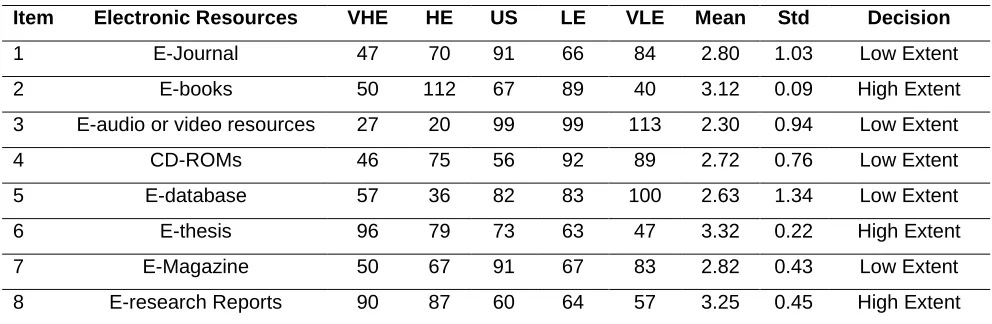
Table 1 shows the mean scores on the extent of availability of electronic resources to students in Nnamdi Azikiwe University, Awka. The table indicates that items 2, 6 and 8 have a mean score above the cut-off mean of 3.0 while the mean score on items 1, 3, 4, 5 and 7 are below the cut-off mean of 3.0. This shows that majority of the respondents agree that books, E-thesis and E-research reports are available to a high extent while E-Journals, E-audio or video resources, CD-ROMs, E-database and E-Magazine are available to a low extent. The findings of this study is consisted with the study of Adenkule et al (2007) who observed that the extent of availability of E-book, E-thesis and E-research reports in federal university libraries in South western Nigeria were high because students actively demanded them for information to do assignments, write up term papers and dissertations when compared to E-audio or video resources, CD-ROMs, E-database and E-Magazine. The study of Ezeji (2008) also found that the availability of E-audio or video resources, CD-ROMs, E-database and E-Magazine were low in state universities in South-southern Nigeria because the university management deem it less necessary for academic relevance
Table 1: Mean score on the extent of availability of electronic resources to students in Nnamdi Azikiwe University, Awka
Item Electronic Resources VHE HE US LE VLE Mean Std Decision
1 E-Journal 47 70 91 66 84 2.80 1.03 Low Extent
2 E-books 50 112 67 89 40 3.12 0.09 High Extent
3 E-audio or video resources 27 20 99 99 113 2.30 0.94 Low Extent
4 CD-ROMs 46 75 56 92 89 2.72 0.76 Low Extent
5 E-database 57 36 82 83 100 2.63 1.34 Low Extent
6 E-thesis 96 79 73 63 47 3.32 0.22 High Extent
7 E-Magazine 50 67 91 67 83 2.82 0.43 Low Extent
8 E-research Reports 90 87 60 64 57 3.25 0.45 High Extent
Research Question 2: What is the extent of utilization of electronic resources to students
in Nnamdi Azikiwe University, Awka?
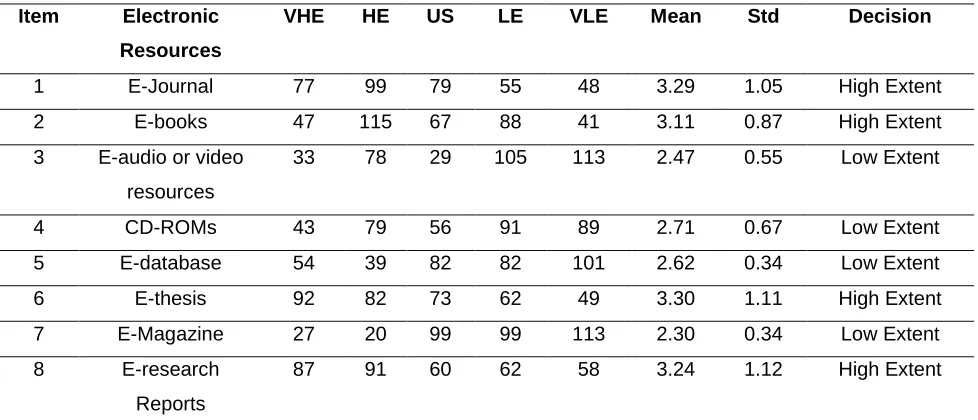
Licensed under Creative Common Page 482 below the cut-off mean of 3.0. This shows that majority of the respondents agree that E-Journals, E-books, E-thesis and E-research reports are to a high extent utilized while E-audio or video resources, CD-ROMs, E-database and E-Magazine are to a low extent utilized. This finding agree with those of Croom (2002) and Ogbonna (2003) who observed that most library users found it more convenient accessing E-audio or video resources, CD-ROMs, E-database and E-Magazine resources through their phones and laptops than visiting the library but preferred the university library for E-journals E-book, E-thesis and E-research reports because most university libraries have organized database that makes E-journals E-book, E-thesis and E-research reports very accessible. The study of Heterick (2002) also reported high utilization of E -journals E-book, E-thesis and E-research reports because most library users relied on them for information to do assignments, write up term papers and dissertations
Table 2: Mean score on the extent of utilization of electronic resources to students in Nnamdi Azikiwe University, Awka
Item Electronic
Resources
VHE HE US LE VLE Mean Std Decision
1 E-Journal 77 99 79 55 48 3.29 1.05 High Extent
2 E-books 47 115 67 88 41 3.11 0.87 High Extent
3 E-audio or video resources
33 78 29 105 113 2.47 0.55 Low Extent
4 CD-ROMs 43 79 56 91 89 2.71 0.67 Low Extent
5 E-database 54 39 82 82 101 2.62 0.34 Low Extent
6 E-thesis 92 82 73 62 49 3.30 1.11 High Extent
7 E-Magazine 27 20 99 99 113 2.30 0.34 Low Extent 8 E-research
Reports
87 91 60 62 58 3.24 1.12 High Extent
Research Question 3: What are the obstacles to the availability and use of electronic resources in Nnamdi Azikiwe University, Awka?
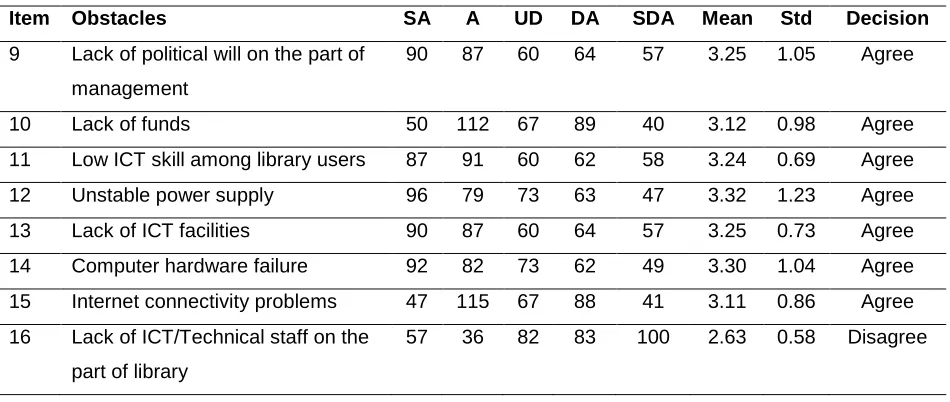
Licensed under Creative Common Page 483 Oduwole, and Akpati, (2003) who reported slow internet connectivity problems among most university libraries due to usual low signal strength, and excessive multiple demands by the subscribers above the capacity of the server. Ezeji (2008) study also showed that the major problem that affects students’ use of electronic resources was erratic power supply. Ojo and
Akande (2005) study equally agree with the findings of the study of Ezeji (2008) who observed that lack of ICT facilities, computer hardware failures were major impediments to the use of electronic resources in academic libraries.
Table 3: Obstacles to the availability and use of electronic resources in Nnamdi Azikiwe University, Awka
Item Obstacles SA A UD DA SDA Mean Std Decision
9 Lack of political will on the part of management
90 87 60 64 57 3.25 1.05 Agree
10 Lack of funds 50 112 67 89 40 3.12 0.98 Agree
11 Low ICT skill among library users 87 91 60 62 58 3.24 0.69 Agree 12 Unstable power supply 96 79 73 63 47 3.32 1.23 Agree 13 Lack of ICT facilities 90 87 60 64 57 3.25 0.73 Agree 14 Computer hardware failure 92 82 73 62 49 3.30 1.04 Agree 15 Internet connectivity problems 47 115 67 88 41 3.11 0.86 Agree 16 Lack of ICT/Technical staff on the
part of library
57 36 82 83 100 2.63 0.58 Disagree
Hypothesis 1: There is no significant difference in the availability of electronic resources
to students considering their academic programs
Table 4 shows the analysis of variance on availability of electronic resources to students in Nnamdi Azikiwe University, Awka with respect to their academic program. The table indicates that the mean score on availability of electronic resources is highest for postgraduate students (29.48) and lowest for CEP students (20.72).
There was a significant difference in the availability of electronic information to students considering their academic program (p<0.05). This finding totally agreed with the study of Ezeji (2008) who observed differences in the availability electronic resources between students’
Licensed under Creative Common Page 484 Table 4: Analysis of Variance on Extent of Availability of Electronic resources to students in
Nnamdi Azikiwe University, Awka with respect to academic programs
Programs N Mean Std. Deviation F-Stat
PG 98 29.48 7.23 138.389**
Regular 174 22.44 4.07
CEP 48 20.72 3.05
Sandwich 38 25.28 6.30
Total 358 24.81 6.32
p<0.01
Hypotheses 2: There is no significant difference in the use of electronic resources among students considering their academic programs
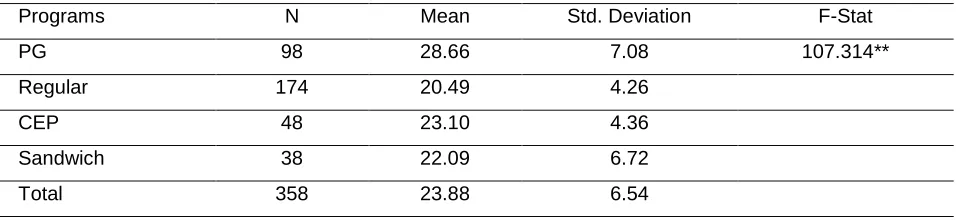
Table 5 shows the analysis of variance on the utilization of electronic resources among students in Nnamdi Azikiwe University with respect to their academic program. The table indicates that the mean score on the utilization of electronic information system is highest for PG students (28.66) and lowest for regular undergraduate students (20.48). There was a significant difference in the use of electronic resources among students in Nnamdi Azikiwe University with respect to their academic program (p<0.05). This finding totally agreed with the study of Heterick (2002) observed differences in the use electronic resources between students due to the fact that some academic programs make it mandatory through course work and research for student to consult the university library when compared with other programs.
Table 5: Analysis of Variance onExtent of Utilization of Electronic resources by students in Nnamdi Azikiwe University, Awka with respect to academic programs
Programs N Mean Std. Deviation F-Stat
PG 98 28.66 7.08 107.314**
Regular 174 20.49 4.26
CEP 48 23.10 4.36
Sandwich 38 22.09 6.72
Total 358 23.88 6.54
Licensed under Creative Common Page 485
CONCLUSION
The following conclusion is reached based on the findings of this study-
1. The study showed that the availability of E-book, E-thesis and E-research reports were high in Nnamdi Azikiwe University, Awka while the availability of E-Journals, E-audio or video resources, CD-ROMs, E-database and E-Magazine were low.
2. The study also showed that the use of E-Journals, E-book, E-thesis and E-research reports were high in Nnamdi Azikiwe University, Awka while the use of E-audio or video resources, CD-ROMs, E-database and E-Magazine were low.
3. The study showed that lack of political will on the part of university management, lack of funds, low ICT skill among library users, unstable power supply, lack of ICT facilities, computer hardware failures and internet connectivity problem are the obstacles to the availability and use of electronic resources in the university library.
4. The study showed a significant difference in the availability and use of electronic resources considering students academic programs.
IMPLICATIONS OF THE STUDY
The findings of this have implications for university management. Since, lack of ICT facilities was found to limit the use of electronic resources; the findings of this study will engender university management to establish university cybercafés and computer laboratory facilities to improve the access to EIR. Similarly, the finding of the study showed that although E -journals were highly utilized they were rarely available. The implication of this finding is that university libraries should restructure library centered services to user centered services. This means the libraries should not focus on the library holdings but on the needs of the users. Libraries may also need to intensify their awareness campaigns concerning the available electronic resources in the libraries and motivate the users to use them for their academic work.
The findings equally has implications for students because improvement in the provision of electronic resources by universities libraries will go a long way in improving the students’ use and access to electronic resources for their academic work and help them
Licensed under Creative Common Page 486
RECOMMENDATIONS
Base on the findings of this study, the following recommendations are proffered
1. Universities should establish adequate computer laboratories facilities and cybercafés to provide access to electronic information sources at subsidized prices.
2. Information and communication training programme should be given to students as a course of study as this will help to educate the students in the use of electronic resources for academic purposes.
3. More networked computers and laptops with easy internet connectivity should be provided by the universities libraries.
4. Alternative sources of power should be provided for web-based equipment/ facilities to checkmate erratic power supply to facilities
5. Libraries should intensify their awareness campaigns concerning available electronic resources in the libraries and motivate the library users to greater use of EIR for their academic work.
6. Improved funding of university libraries is necessary for web-based information resources and services to be effective. Libraries should be provided with enough accurate and adequate current hard and software for web-based information services. 7. Government needs to improve funding in the universities to enable the library users have
access to latest information on electronic resources.
8. There is a need for the universities to subscribe to internet service provider with a very high bandwidth to checkmate problem with slow connectivity.
LIMITATIONS OF THE CURRENT STUDY
The present research effort was not without some constraints. Some of the problems encountered include sample size limitation. This is because not all the students in the South-East Universities were sampled in the study. The study was also limited to Nnamdi Azikiwe University because of the re-engineering and expansion of the library facility from the conventional to digital library. Other challenges include difficulty in accessing and eliciting the needed information from the students that were sampled in the study. In spite of the identified limitations, the researcher finally obtained the information that aided the completion of the study.
REFERENCES
Licensed under Creative Common Page 487 Barrett, A.(2005).The information seeking habits of graduate student researchers in the humanities. Journal of Academic Librarianship, 31(4): 324 331)
Bashorun, M.T., Isah A., and Adisa M.Y. (2011). User Perception of Electronic Resources in the University of Ilorin, Nigeria (UNILORIN).Journal of Emerging Trends in Computing and Information Sciences. 2(11) 554 -562
Croom, S.R. (2002). The Impact of Web-Based procurement on the management of operating resources supply. Journal of Supply Chain management 2:23-45.
Dadzie, P.S.(2005). Electronic resources: access and usage at Ashesi university college. Campus Wide Information Systems, 22 (5):1065-1074
Ezeji, E.C. (2008) Academic use of computer services by undergraduates in two Nigerian universities. Unpublished thesis, university of Nigeria, Nsukka.
Harper, P.V. (2006). The 1st electronic resources and libraries conference: A report. Library Hi Tech News, Vol.23 (5):12-22.
Heterick, B. (2002). Usability Evaluation of Digital Libraries. In Digital Libraries: Philosophies, Technical Design Considerations, and Example Scenarios, Stern, D. (Ed). New York: Haworth Press.
Montgomery, C. H. and D. W. King. (2002). Comparing Library and User Related Costs of Print and Electronic Journal Collections. A First Step Towards a Comprehensive Analysis. D-Lib Magazine 8(10)34-54
Nworgu, B.G. (2006). Educational research basic issues & methodology. Obatra: Wisdom Publishers Ltd. Odunlade M L. (2008). E-learning strategies for delivering knowledge in the digital age. McGraw hill, New York. Ogbonna, I.M .(2003).Academic libraries in Nigeria: challenges of ICT in the 21st century. The Nigerian Library Link- A Journal of library and information science, 1(1):116-128.
Ojo, R. A. and Akande, S. O. (2005). Students Access, Usage and awareness of Electronic resources at the University College Hospital, University of Ibadan, Nigeria. LagosJournal of Library and Information Science 3(1): 16 – 24.
Okello-Obura C. and Ikoja- Odongo, J.R. (2010). Electronic Information Seeking among LIS Postgraduate students at Mekerere University, Uganda. Retrieved from: http://www.webpages. uidaho.edu/~mbolin/ Okello-obura-ikojo-odongo.htm. (accessed 11th March, 2018).
Okiki, O.C. and Asiru, S.M. (2011). Use of Electronic information sources by postgraduate students in Nigeria: Influencing factors. Library philosophy and practice 2011. Accessed from http://www.Uidaho.Edu/~mbolin/ tella3.htm on 22/6/2016
Osagie, A.U.(2009). Change and choice-The development of private universities in Nigeria. Benin City; Rawel fortune resources
Reid, G. (2000). The digitization of heritage material: arguing for an interpretative approach based on the experience of the Powys Digital History Project. Program: Electronic library and information systems, 34(2)143-158.