Open Access
S T U D Y P R O T O C O L
© 2010 van der Putten et al; licensee BioMed Central Ltd. This is an Open Access article distributed under the terms of the Creative Com-mons Attribution License (http://creativecomCom-mons.org/licenses/by/2.0), which permits unrestricted use, distribution, and reproduc-tion in any medium, provided the original work is properly cited.
Study protocol
Supervised versus non-supervised implementation
of an oral health care guideline in (residential) care
homes: a cluster randomized controlled clinical
trial
Gert-Jan van der Putten*
1, Luc De Visschere
2, Jos Schols
3, Cees de Baat
4and Jacques Vanobbergen
2Abstract
Background: The increase of the proportion of elderly people has implications for health care services. Advances in oral health care and treatment have resulted in a reduced number of edentulous individuals. An increasing number of dentate elderly people have tooth wear, periodontal disease, oral implants, and sophisticated restorations and prostheses. Hence, they are in need of both preventive and curative oral health care continuously. Weakened oral health due to neglect of self care and professional care and due to reduced oral health care utilization is already present when elderly people are still community-dwelling. At the moment of (residential) care home admittance, many elderly people are in need of oral health care urgently. The key factor in realizing and maintaining good oral health is daily oral hygiene care. For proper daily oral hygiene care, many residents are dependent on nurses and nurse aides. In 2007, the Dutch guideline "Oral health care in (residential) care homes for elderly people" was developed. Previous implementation research studies have revealed that implementation of a guideline is very complicated. The overall aim of this study is to compare a supervised versus a non-supervised implementation of the guideline in The Netherlands and Flanders (Belgium).
Methods/Design: The study is a cluster randomized intervention trial with an institution as unit of randomization. A random sample of 12 (residential) care homes accommodating somatic as well as psycho-geriatric residents in The Netherlands as well as in Flanders (Belgium) are randomly allocated to an intervention or control group. Representative samples of 30 residents in each of the 24 (residential) care homes are monitored during a 6-months period. The intervention consists of supervised implementation of the guideline and a daily oral health care protocol. Primary outcome variable is the oral hygiene level of the participating residents. To determine the stimulating or inhibiting factors of the implementation project and the nurses' and nurse aides' compliance and perceived barriers, a process evaluation is carried out.
Discussion: The method of cluster randomization may result in a random effect and cluster selection bias, which has to be taken into account when analyzing and interpreting the results.
Trial registration: Current Controlled Trials ISRCTN86156614
Background
The international literature shows that the proportion of elderly people has increased considerably during the last decades and is expected to further increase during the next decades. This demographic shift will have important
implications for health care services. More (frail) elderly people will present more morbidity and care dependency and, consequently, will need an increasing proportion of health care services [1]. Those elderly people, who are not able to function independently, are often supported by domiciliary care service or admitted to (residential) care homes [2,3].
* Correspondence: [email protected]
1 Birkhoven Care-estate, P.O. Box 363, 3800 AJ Amersfoort, The Netherlands
Advances in oral health care and treatment during the last decades have resulted in a reduced number of eden-tulous individuals. A still increasing number of dentate elderly people have tooth wear, periodontal disease, oral implants, and sophisticated tooth- and implant-sup-ported restorations and prostheses. Hence, they are in need of both preventive and curative oral health care con-tinuously. Complexity of the oral conditions, oral mucosal lesions, systemic diseases, and medication use make (frail) elderly people more vulnerable to oral prob-lems than younger age groups, especially when they are cognitively impaired [4,5]. Weakened oral health due to neglect of self care and professional care and due to reduced oral health care utilization is already present when (cognitively impaired) elderly people are still com-munity-dwelling [5-8]. At the moment of (residential) care home admittance, many elderly people in countries all over the world are in need of oral health care urgently. If their needs are not met, their oral health will be persis-tently poor and will utmost probably further deteriorate during their residency because of increasing care depen-dency and subsequent lack of adequate oral health care [9-14].
Systemic diseases affect oral health and vice versa [15,16]. Several medications have also a negative effect on oral health by inducing xerostomia, hyposalivation, mucosal lesions, and abnormal bleeding [17]. Hyposaliva-tion is a specific problem because saliva plays a major role in protecting both hard and soft oral tissues [18]. Further-more, several aspects of oral health are affecting quality of life and well-being [19-21]. Oral health influences mas-tication, food selection, weight, speech, taste, hydration, appearance, and psycho-social behaviour and is thereby a concern not only for the elderly individuals themselves, but also for their relatives and care providers [22-25].
The key factor in realizing and maintaining good oral health is daily oral hygiene care by removing the oral bac-terial plaque, mainly composed of pathogenic gram-nega-tive germs [26,27]. However, many residents of residential care homes and long-term care facilities are not able to clean their mouths and eventually removable dentures themselves. For proper daily oral hygiene care, they are dependent on nurses and nurse aides [28,29]. However, the importance of oral health of residents is often misun-derstood and neglected by nurses and nurse aides [30]. A lack of oral health knowledge and oral health care skills of even qualified nurses is an important inhibiting factor in achieving an acceptable level of residents' oral hygiene [31]. No prioritisation to oral health care of the residents themselves and their family is another barrier of proper oral health and daily oral hygiene care [32,33]. Further-more, in many cases a resident's repeated resistiveness is disincentive for nurses and nurse aides, leading to inade-quate daily oral hygiene care [34]. Teaching and
qualify-ing nurses and nurse aides in providqualify-ing individual oral health care for residents had until recently a low priority in managers and physicians of residential care homes and long-term care facilities [35,36]. Convincing the manag-ers and physicians of the benefits of oral health and ade-quate oral health care as well as improving the oral health knowledge and oral health care attitude and skills of nurses and nurse aides may contribute to an improve-ment of oral health and quality of life of residents. Although during the last several years increasing atten-tion has been paid to improving oral health care, there is still a need for guidelines and effective protocols, for oral health and oral hygiene assessment tools for nurses and nurse aides, and for teaching nurses and nurse aides prac-tical skills of daily oral hygiene care [37-39]. In 2007, the Dutch guideline "Oral health care in (residential) care homes for elderly people" was developed and presented to all (residential) care homes for elderly people in The Netherlands and a part of Flanders, Belgium. The Dutch guideline is satisfying the Appraisal of Guidelines Research & Evaluation Instrument (AGREE) [40]. It describes all aspects of good oral health and oral health care, presents the methods and skills needed for provid-ing oral health care to residents, and presents effective oral health and oral hygiene assessment tools. The ulti-mate objective of the guideline is to improve the oral health of the residents.
Any care guideline needs careful implementation as well as research for assessing its residents' and care pro-viders' compliance. Guideline implementation involves the concrete activities and interventions undertaken to turn policies into desired results. Previous implementa-tion research studies have revealed that implementaimplementa-tion of a guideline is very complicated. Although numerous attempts have been made, an effective implementation method has not yet been discovered. Key factors are 'buy-ing in' the care providers, determin'buy-ing dur'buy-ing the imple-mentation project which factors are stimulating or inhibiting the project, and determining the care provid-ers' perceived barriers and compliance [41-48].
Scientific hypothesis
The scientific hypothesis of the present study is that supervised implementation of the guideline "Oral health care in (residential) care homes for elderly people" is more effective in improving oral health and oral health care of the residents when compared to non-supervised imple-mentation.
Aim and objectives
1. Is there any statistically significant difference between oral hygiene levels of elderly residents in (resi-dential) care homes with supervised implementation of the guideline when compared to those in (residential) care homes without supervised implementation of the guideline?
2. Is there at care home level any statistically significant difference between attitude and knowledge level of nurses and nurse aides of (residential) care homes with supervised implementation of the guideline when com-pared to those in (residential) care homes without super-vised implementation of the guideline?
3. Is there any statistically significant difference in impact on the outcome variables of research questions 1 and 2 between the (residential) care homes in The Neth-erlands when compared to Flanders (Belgium) and which factors are causing the country differences?
4. Which factors are stimulating or inhibiting the implementation of the guideline in the (residential) care homes in The Netherlands and Flanders (Belgium)?
5. What is the compliance of and which barriers are perceived by the nurses and nurse aides in (residential) care homes in The Netherlands and Flanders (Belgium) while implementing the guideline?
Methods/Design
Design of the study
The study is a cluster randomized intervention trial with an institution as the unit of randomization. A random sample of 12 (residential) care homes accommodating a total of 120-180 somatic as well as psycho-geriatric resi-dents in The Netherlands as well as in Flanders (Belgium) are randomly allocated to an intervention or control group. Representative samples of 30 residents in each of the 24 (residential) care homes are monitored during a 6-months period. Research data are gathered at baseline and at 6 months after the start of the study. The study is supervised and monitored by 2 investigators, the first and second author of this article. In each institution, an insti-tution study supervisor, appointed by the managing director, is responsible for executing all study activities. The intervention consists of supervised implementation of the guideline "Oral health care (residential) care homes for elderly people" and a daily oral health care protocol. This protocol is derived from the guideline and formu-lated by the authors. Primary outcome variable is the oral hygiene level of the participating residents. To determine the stimulating or inhibiting factors of the implementa-tion project and the nurses' and nurse aides' compliance and perceived barriers, a process evaluation is carried out [49]. The study is conducted according to the principles of the Declaration of Helsinki (version 17c, 2004) and in accordance with the Medical Research Involving Human Subjects Act (WMO). The study protocol is approved by
the Ethics Committees of the Ghent University, Belgium (OG017 - approval 2008/440) and the Radboud Univer-sity Nijmegen, The Netherlands (NL24666.091.08 approval 2008/273).
Participants and setting
In each country, a sample of (residential) care homes for elderly people is obtained using stratified (geographical distribution) cluster sampling with replacement. A (resi-dential) care home is considered eligible for inclusion unless any of the following exclusion criteria are applica-ble:
• The management of the institution does not agree with the random allocation to the intervention or control group;
• The institution has mainly wards accommodating less than 20 residents;
• The institution has only somatic or psycho-geriatric wards;
• An oral health care guideline or protocol has already been introduced and implemented;
• Nurses and nurse aides have received special training on oral health care during the last 24 months;
• More than 5 other major care innovation projects have been implemented during the last 24 months.
Once the managing director of an institution agrees to participate by written informed consent, the institution is randomly allocated to either the intervention group or the control group of the country. Based on the power cal-culation (see following indentation) a representative cohort of 30 residents of the institution needs to be included.
Crucial factors for calculating the sample size (n) are the presumed distribution of the outcome measure (oral hygiene level) in the population of residents (σ), the pre-sumed effect of the intervention (μ1 - μ2), the power required (1-β), the a priori determined level of signifi-cance (α), and the value of the intraclass correlation (design effect). An a priori power of 80% and a level of significance of 0.05 are predetermined. The design effect (Deff ) represents the ratio of the number of residents required using cluster randomization to the number of residents required using individual randomization.
The primary formula for calculating the sample size is:
.
Deff = 1 + [(m - 1) ρ]; m = the number of residents in each institution, ρ = the intraclass correlation coefficient.
The adjusted sample size (nadj) equals: n × Deff. The number of residents in each institution (m) = nadj : k; k = the number of institutions in the sample.
Based on previous studies, an intraclass correlation coefficient of 0.95 and a standard deviation (sd) for dental
n= ×f
−
2
1 2
s
m m a b
²
plaque and denture plaque of 0.75 and 0.88 respectively is used. A 25% improvement of oral hygiene level is the pre-sumed effect of the intervention. With regard to the design effect and drop-outs, loss to follow up, and uncer-tainty in power calculation, a sample size of 360 residents and 12 clusters per country seems an achievable number for the 6-months period. This means 30 residents per (residential) care home.
To participate in the study, a resident should:
• Supply a written informed consent, undersigned by himself or his legal representative
• Have teeth and/or partial or complete dentures • Have the cognitive and physical condition required for undergoing an oral examination
• Be residing in the institution during the entire 6-months period presumably.
Residents are excluded when in day-care, in short-term residency, in coma, in palliative care or terminally ill, using a denture adhesive, expressing verbal or physical resistiveness before or during an oral examination.
Intervention
The intervention consists of supervised implementation of the guideline "Oral health care in (residential) care homes for elderly people" and the daily oral health care protocol derived from the guideline. In each institution of the intervention group, every ward head appoints a nurse who will act as ward oral health care organizer (WOO). The managing director, physician(s), ward heads, WOO's, nurses, nurse aides, and a sample of 30 residents are involved in the study. The implementation of the guideline is supervised by a dental hygienist and includes: • A 1.5-hour informative oral presentation on the guideline, the daily oral health care protocol, and the supervised implementation project before the start of the study, introduced by the dental hygienist and one of the investigators and addressing the managing director, the institution study supervisor, the ward heads, and the WOO's. Important objective of the informative oral pre-sentation is to lay a strong institutional foundation of the implementation project and the study.
• A 2-hour lecture and in total 3 hours of practical edu-cation for the WOO's. The eduedu-cation, presented by the dental hygienist, regards the theoretical and practical essentials of the guideline. The WOO's are practically educated in skills facilitating them to practically educate and encourage the nurses and nurse aides of theirs wards. • A 1.5-hour theoretical and executive education ses-sion at each ward, presented by the WOO, for all ward nurses and nurse aides. This education session is sched-uled after the baseline data collection. A summary of the guideline is presented and all executive actions, such as tooth brushing, are taught and demonstrated with ward residents on site. As from the education session, the
WOO will encourage and assist the nurses and nurse aides regularly in the daily delivery of oral health care.
• Providing oral health care materials and products for each resident by the dental hygienist.
• Monitoring visits of the dental hygienist and an inves-tigator every 6 weeks, meeting the institution study supervisor and WOO's for listing and resolving imple-mentation and study problems.
Data collection
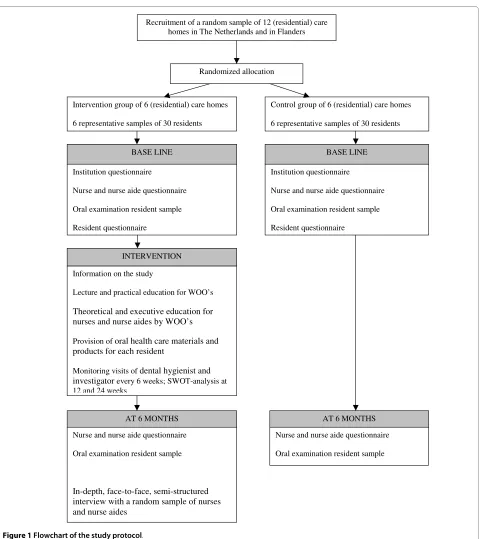
Research data are gathered in the institutions of the inter-vention and the control group. At baseline, a question-naire on the resident capacity of the institution, the mean length of stay of the entire group of residents, mean age of the entire group of residents, and the presence of oral health care providers is completed by the managing director of each institution. At baseline and at 6 months, an oral examination of the random sample of 30 residents is carried out by a team of trained external examiners (dentists, master dental students, and master dental hygiene students). They will carry out the data collection after exercising and calibrating the examination criteria and after determining their intra- and inter-examiners' reliability in a pilot study. The examiners do not know whether an institution is allocated to the intervention or the control group. At baseline, a questionnaire on per-sonal and medical details of every resident of the random sample is completed. Furthermore, at baseline and at 6 months a questionnaire addressing the nurses and nurse aides is completed. Finally, at the end of the study, a pro-cess evaluation is conducted in the institutions of the intervention group to acquire insight in the stimulating and inhibiting factors of the implementation process. Fig-ure 1 presents a flowchart of the study protocol and Table 1 presents an overview of the data collection.
Oral examination
The oral hygiene level of natural teeth is assessed using the validated plaque index described by Silness and Löe (score range 0-3) at a subset of the so-called 'Ramfjörd teeth' [50]. In absence of one of these teeth, the corre-sponding distal neighbour tooth will be assessed. The oral hygiene level of dentures is assessed using a Methyl-ene Blue® denture plaque disclosing solution according to the method of Augsburger and Elahi (score range 0-4) [51].
Resident questionnaire
The resident questionnaire is completed by a physician of the institution and records personal details, primary diagnosis, secondary diagnoses, Care Dependency Scale (CDS) score [52], Mini Mental State Examination (MMSE) score [53], and prescribed drugs.
Nurse and nurse aide questionnaire
of experience, oral health knowledge, and attitude to per-sonal oral health care.
Process evaluation
During monitoring visits of the dental hygienist and an investigator every 6 weeks during the intervention, meet-ing the institution study supervisor and WOO's, prob-lems of the implementation project and the study are listed and resolved. At 12 and 24 weeks, a SWOT analysis is performed. SWOT is a strategic planning method for evaluating the Strengths, Weaknesses, Opportunities and Threats, identifying the favourable and unfavourable fac-tors while achieving the implementation project objec-tives. A 10 items questionnaire is used concerning the progress, the involvement of the residents, and the orga-nizational aspects of the implementation project. At the end of the study, the implementation project is evaluated by an in-depth, face-to-face, semi-structured interview with a random sample of nurses and nurse aides of each institution. Main questions of the semi-structured inter-view are on observed alterations of the oral health care provided in the institution, causality of these alterations and difficulties experienced during the implementation process. Subsequently, an adaptation of 'reflective listen-ing' is used, a counselling technique eliciting a thorough disclosure of thoughts and feelings [54]. The technique
involves reflecting what the interviewer believes was said in order to verify or clarify the nurses' and nurse aides' statements. Using this technique, the nurses and nurse aides are also actively confronted with eventual inconsis-tencies in their answers and statements. The interviews take 20-30 minutes and are conducted individually by the two investigators. All interviews are taped and tran-scribed.
Statistical analysis
Both categorical and continuous variables are initially analyzed using exploratory data analysis, employing a variety of mostly graphical techniques and techniques for testing the necessary assumptions. The institution is the unit of randomization and the residents are the units of analysis. Cluster effects are addressed in the analysis. Intraclass correlation will be calculated for each outcome variable as a measure of correlation among residents within the institutions as well as among institutions within each country. The effect of the implementation project at individual, institution and country level is sum-marized and analyzed in a multilevel comparative analy-sis. Three comparative dimensions are handled simultaneously: the resident effect, the institution effect, and the country effect. Therefore, a three-level structure Table 1: Overview of data collection
Data Collection time Purpose
Institution questionnaire
resident capacity
mean length of stay of residents mean age of residents
presence of oral health care providers
baseline baseline baseline baseline
comparison institutions comparison institutions comparison institutions comparison institutions
Nurses and nurse aides questionnaire
gender age
years of experience oral health knowledge
attitude to personal oral health care
baseline/6 months baseline/6 months baseline/6 months baseline/6 months baseline/6 months
comparison nurses and nurse aides comparison nurses and nurse aides comparison nurses and nurse aides intervention effect
intervention effect
Resident questionnaire
Age baseline comparison residents
Gender baseline comparison residents
Primary diagnoses baseline comparison residents
secondary diagnoses baseline comparison residents
prescribed drugs baseline comparison residents
Care Dependency Scale baseline comparison residents
Mini Mental State Examination baseline comparison residents
Oral examination
Plaque index (natural teeth, denture)
Figure 1 Flowchart of the study protocol.
Recruitment of a random sample of 12 (residential) care homes in The Netherlands and in Flanders
Randomized allocation
Intervention group of 6 (residential) care homes
6 representative samples of 30 residents
Control group of 6 (residential) care homes
6 representative samples of 30 residents
Institution questionnaire
Nurse and nurse aide questionnaire
Oral examination resident sample
Resident questionnaire
Information on the study
Lecture and practical education for WOO’s
Theoretical and executive education for nurses and nurse aides by WOO’s
Provision of oral health care materials and products for each resident
Monitoring visits of dental hygienist and investigator every 6 weeks; SWOT-analysis at 12 and 24 weeks
Institution questionnaire
Nurse and nurse aide questionnaire
Oral examination resident sample
Resident questionnaire
INTERVENTION
BASE LINE BASE LINE
Nurse and nurse aide questionnaire
Oral examination resident sample
In-depth, face-to-face, semi-structured interview with a random sample of nurses and nurse aides
AT 6 MONTHS AT 6 MONTHS
Nurse and nurse aide questionnaire
Oral examination resident sample
is used with resident (level 1) and institution (level 2), nested in broader organization units on country level (level 3). Differences in primary outcomes at baseline and differences between the intervention and the control group as well as between countries at baseline and at 6 month are calculated. Covariates at individual level are the subjects of the resident questionnaire and the nurse and nurse aide questionnaire.
Responses to the semi-structured interview of the pro-cess evaluation are analyzed using coding techniques commonly utilized for qualitative research methods [55]. Recurrent themes in the responses are used to set up a framework.
most important predicting factors with respect to oral hygiene level.
Discussion
A cluster randomized controlled trial allows for statistical analysis of the feasibility and effectiveness of an interven-tion on care provision. This trial provides both practical and methodological advantages for implementation stud-ies, especially when the intervention requires policy or behavioural alterations and intends an effect at institution level [56]. Cluster randomization using institutions as the unit of randomization reduces contamination between groups of persons. It is easier to deliver an intervention at institution level (unit) than at individual level within an institution. Also, when focussing on all nurses, nurse aides, and residents, group dynamics and peer pressure may facilitate the adoption of the intervention. On the other hand, cluster randomization may result in a ran-dom effect, which has to be taken into account when ana-lyzing and interpreting the results. Another problem of cluster randomization is the hazard of selection bias at cluster level. An institution which, for one or another rea-son, decides to abandon the study may cause an impor-tant attrition bias. This is even of greater concern in case of drop outs of differential institutions in the intervention as well as in the control group. To prevent drop-out, all participating institutions are requested to provide a writ-ten informed consent for the entire study and study period.
The level of oral hygiene as primary outcome measure, a set of explanatory variables at different levels (resident, institution, and country), and the process evaluation data will allow revealing the supervised implementation effect and the stimulating and inhibiting factors.
An essential objective of the implementation project is to improve the oral health knowledge and the oral health care attitude and skills of the nurses and nurse aides. Many guidelines are, because of their lengthy and detailed character, rather difficult to access for nurses and nurse aides. The guideline used in this study provides also an easy to use daily oral health care protocol derived from the guideline, enabling the nurses and nurse aides to adhere the instructions and recommendations more eas-ily.
Competing interests
The authors declare that they have no competing interests.
Authors' contributions
All authors participated in the conception and design of the study protocol. G-JvdP and LDV drafted the manuscript. JS, CdB and JV reviewed the draft manu-script. All authors read and approved the final manumanu-script.
Acknowledgements
This research project is funded by the Open Ankh, Soest and Stichting De Opbouw, Utrecht, The Netherlands.
Author Details
1Birkhoven Care-estate, P.O. Box 363, 3800 AJ Amersfoort, The Netherlands, 2Department of Community Dentistry and Oral Public Health, Ghent University,
Belgium, 3Department of General Practice, Section Nursing Home Medicine,
CAPHRI, Maastricht University, The Netherlands and 4Department of Oral
Function and Prosthetic Dentistry, Radboud University Nijmegen Medical Centre, Nijmegen, The Netherlands
References
1. Branca S, Bennati E, Ferlito L, Spallina G, Cardillo E, Malaguarnera M, Motta M: The health-care in the extreme longevity. Arch Gerontol Geriatr 2009, 49:32-34.
2. Rothera I, Jones R, Harwood R, Avery A, Waite J: Health status and assessed need for a cohort of older people admitted to nursing and residential homes. Age Ageing 2003, 32:303-309.
3. Schols JMGA, Crebolder HFJM, van Weel C: Nursing home and nursing home physician: The Dutch experience. J Am Med Dir Assoc 2004, 5:207-212.
4. Ettinger RL: Oral health and the aging population. J Am Dent Assoc 2007, 138:5S-6S.
5. Wu B, Plassman BL, Crout RJ, Liang J: Cognitive function and oral health among community-dwelling older adults. J Gerontol A Biol Sci Med Sci
2008, 63:495-500.
6. Holm-Pedersen P, Vigild M, Nitschke I, Berkey DB: Dental care for aging populations in Denmark, Sweden, Norway, United Kingdom, and Germany. J Dent Educ 2005, 69:987-997.
7. Holm-Pedersen P, Russell SL, Avlund K, Viitanen M, Winblad B, Katz RV: Periodontal disease in the oldest-old living in Kungsholmen, Sweden: findings from the KEOHS project. J Clin Periodontol 2006, 33:376-384. 8. Wu B, Plassman BL, Liang J, Wei L: Cognitive function and dental care
utilization among community-dwelling older adults. Am J Public Health
2007, 97:2216-2221.
9. Jokstad A, Ambjørnsen E, Eide KE: Oral health in institutionalized elderly people in 1993 compared with in 1980. Acta Odontol Scand 1996, 54:303-108.
10. Stubbs C, Riordan PJ: Dental screening of older adults living in residential care facilities in Perth. Aust Dent J 2002, 47:321-326. 11. Simunković SK, Boras VV, Pandurić J, Zilić IA: Oral health among institutionalised elderly in Zagreb, Croatia. Gerodontology 2005, 22:238-241.
12. Unlüer S, Gökalp S, Doğan BG: Oral health of the elderly in a residential home in Turkey. Gerodontology 2007, 24:22-29.
13. Arpin S, Brodeur JM, Corbeil P: Dental caries, problems perceived and use of services among institutionalized elderly in 3 regions of Quebec, Canada. J Can Dent Assoc 2008, 74:807.
14. Samson H, Strand GV, Haugejorden O: Change in oral health status among the institutionalized Norwegian elderly over a period of 16 years. Acta Odontol Scand 2008, 66:368-373.
15. Seymour GJ, Ford PJ, Cullinan MP, Leishman S, Yamazaki K: Relationship between periodontal infections and systemic disease. Clin Microbiol Infect 2007, 14(Suppl 4):3-10.
16. Rautemaa R, Lauhio A, Cullinan MP, Seymour GJ: Oral infections and systemic disease - an emerging problem in medicine. Clin Microbiol Infect 2007, 13:1041-1047.
17. Ciancio SG: Medications' impact on oral health. J Am Dent Assoc 2004, 135:1440-1448.
18. Moore PA, Guggenheimer J: Medication-induced hyposalivation: etiology, diagnosis, and treatment. Compend Contin Educ Dent 2008, 29:50-55.
19. Tsakos G, Steele JG, Marcenes W, Walls AW, Sheiham A: Clinical correlates of oral health-related quality of life: evidence from a national sample of British older people. Eur J Oral Sci 2006, 114:391-395.
20. Kandelman D, Petersen PE, Ueda H: Oral health, general health, and quality of life in older people. Spec Care Dentist 2008, 28:224-236. 21. Mariño R, Schofield M, Wright C, Calache H, Minichiello V: Self-reported
and clinically determined oral health status predictors for quality of life in dentate older migrant adults. Community Dent Oral Epidemiol 2008, 36:85-94.
Received: 15 March 2010 Accepted: 2 July 2010 Published: 2 July 2010
This article is available from: http://www.biomedcentral.com/1472-6831/10/17 © 2010 van der Putten et al; licensee BioMed Central Ltd.
22. Nordenram G, Rönnberg L, Winblad B: The perceived importance of appearance and oral function, comfort and health for severely demented persons rated by relatives, nursing staff and hospital dentists. Gerodontology 1994, 11:18-24.
23. Nitschke I, Müller F: The impact of oral health on the quality of life in the elderly. Oral Health Prev Dent 2004, 2(Suppl 1):271-275.
24. Ikebe K, Matsuda K, Morii K, Nokubi T, Ettinger RL: The relationship between oral function and body mass index among independently living older Japenese people. Int J Prosthodont 2006, 19:539-546. 25. Ikebe K, Morii K, Matsuda K, Nokubi T: Discrepancy between satisfaction
with mastication, food acceptability, and masticatory performance in older adults. Int J Prosthodont 2007, 20:161-167.
26. Hancock EB, Newell DH: Preventive strategies and supportive treatment. Periodontology 2000 2001, 25:59-76.
27. Attin T, Hornecker E: Tooth brushing and oral health: how frequently and when should tooth brushing be performed? Oral Health Prev Dent
2005, 3:135-140.
28. Gil-Montoya JA, de Mello AL, Cardenas CB, Lopez IG: Oral health protocol for the dependent institutionalized elderly. Geriatr Nurs 2006, 27:95-101.
29. Stein PS, Henry RG: Poor oral hygiene in long-term care. Am J Nurs 2009, 109(6):44-50.
30. Murray PE, Ede-Nichols D, Garcia-Godoy F: Oral health in Florida nursing homes. Int J Dent Hyg 2006, 4:198-203.
31. Costello T, Coyne I: Nurses' knowledge of mouth care practices. Br J Nurs
2008, 17:264-268.
32. Young BC, Murray CA, Thomson J: Care home staff knowledge of oral care compared to best practice: a West of Scotland pilot study. Br Dent J 2008, 205:E15.
33. de Mello ALSF, Padilha DMP: Oral health care in private and small long-term care facilities: a qualitative study. Gerodontology 2009, 26:53-57. 34. Coleman P, Watson NM: Oral care provided by certified nursing
assistants in nursing homes. J Am Geriatr Soc 2006, 54:138-143. 35. Chung JP, Mojon P, Budtz-Jørgensen E: Dental care of elderly in nursing
homes: perceptions of managers, nurses, and physicians. Spec Care Dent 2000, 20:12-17.
36. Sweeney MP, Williams C, Kennedy C, Macpherson LM, Turner S, Bagg J: Oral health care and status of elderly care home residents in Glasgow.
Community Dent Health 2007, 24:37-42.
37. O'Reilly : Oral care for the critically ill: a review of the literature and guidelines for practice. Aust Crit Care 2003, 16:101-110.
38. Vanobbergen JNO, De Visschere LM: Factors contributing to the variation in oral hygiene practices and facilities in long-term care institutions for the elderly. Community Dent Health 2005, 22:260-265. 39. McGrath C, Zhang W, Lo EC: A review of the effectiveness of oral health
promotion activities among elderly people. Gerodontology 2009, 26:85-96.
40. AGREE Collaboration: Development and validation of an international appraisal instrument for assessing the quality of clinical practice guidelines: the AGREE project. Qual Saf Health Care 2003, 12:18-23. 41. Burgers JS, Grol RP, Zaat JO, Spies TH, van der Bij AK, Mokkink HG:
Characteristics of effective clinical guidelines for general practice. Br J Gen Pract 2003, 53:15-19.
42. Grol R, Grimshaw J: From best evidence to best practice: effective implementation of change in patients' care. Lancet 2003, 362:1225-1230.
43. Maue SK, Segal R, Kimberlin CL, Lipowski EE: Predicting physician guideline compliance: An assessment of motivators and perceived barriers. Am J Manag Care 2004, 10:383-391.
44. Eccles M, Grimshaw J, Walker A, Johnston M, Pitts N: Changing the behavior of healthcare professionals: the use of theory in promoting the uptake of research findings. J Clin Epidemiol 2005, 58:107-112. 45. Fretheim A, Schunemann HJ, Oxman AD: Improving the use of research
evidence in guideline development: 15. Disseminating and implementing guidelines. Health Res Policy Syst 2006, 4:27. 46. Davies B, Edwards N, Ploeg J, Virani T: Insights about the process and
impact of implementing nursing guidelines on delivery of care in hospitals and community settings. BMC Health Serv Res 2008, 8:29. 47. Planas LG: Intervention design, implementation, and evaluation. Am J
Health Syst Pharm 2008, 65:1854-1863.
48. Rosenbrand K, Van Croonenborg J, Wittenberg J: Guideline development. Stud Health Technol Inform 2008, 139:3-21.
49. Oakley A, Strnage V, Bonell C, Allen E, Stephenson J: Process evaluation in randomised controlled trials of complex interventions. BMJ 2006, 332:414-416.
50. Silness J, Löe H: Periodontal disease in pregnancy. II. Correlation between oral hygiene and periodontal condition. Acta Odontol Scand
1964, 22:121-135.
51. Augsburger RH, Elahi JM: Evaluation of seven proprietary denture cleansers. J Prosthet Dent 1982, 47:356-359.
52. Dijkstra A, Tiesinga LJ, Plantinga L, Veltman G, Dassen TW: Diagnostic accuracy of the care dependency scale. J Adv Nurs 2005, 50:410-416. 53. Tombaugh TN, McIntyre NJ: The mini-mental state examination: a
comprehensive review. J Am Geriatr Soc 1992, 40:922-935.
54. Rautalinko E, Lisper HO, Ekehammar B: Reflective listening in counseling: effects of training time and evaluator social skills. Am J Psychother 2007, 61:191-209.
55. Gelo O, Braakmann D, Benetka G: Quantitative and qualitative research: beyond the debate. Integr Psychol Behav Sci 2008, 42:266-290. 56. Eccles M, Grimshaw J, Campbell M, Ramsay C: Research designs for
studies evaluating the effectiveness of change and improvement strategies. Qual Saf Health Care 2003, 12:47-52.
Pre-publication history
The pre-publication history for this paper can be accessed here: http://www.biomedcentral.com/1472-6831/10/17/prepub
doi: 10.1186/1472-6831-10-17