138 | P a g e
A NOVEL APPROACH FOR THE DETECTION
OF BLUR USING SVM AND KNN CLASSIFICATION
TECHNIQUES IN IMAGE PROCESSING
Anupama Sharma
1, Devarishi Shukla
2 1,.2ECE Department, L.R.I.E.T Solan, (India)
ABSTRACT
This dissertation work provides the knowledge about the support vector machine and K nearest neighbor techniques
to detect the blur from various types of images. In last few years there is a lot of development and attentions in area
of blur detection techniques. Blur detection techniques are generally used to detect or to remove the blur from the
blurred images. The blur detection techniques are very useful in real life application and are used in image
restoration, image enhancement, and image segmentation. Previously various blur detection technique are used to
remove the blur like low directional high frequency energy, DDWT (double discrete wavelet transform), no
reference blur metric etc. but all these techniques are not able to remove the blur up to greater extent. Formerly,
support vector machine (SVM) classifier kernel based used for the segmentation of images to determine the blur
area of picture but this SVM classifier does not able to segment the images perfectly, because SVM has fundamental
complications of kernels and therefore there are huge scope of development so in our system we will use the KNN
(K-nearest neighbor) classifier to improve the blur detection method and to determine the blur area more precisely.
Keywords: Blur detection, k nearest neighbor (KNN), Support vector machine (SVM), Digital image
processing, Motion blur, Out of focus blur.
I. INTRODUCTION
1.1 Digital image processing
Image processing is a type of signal processing. Image processing is mainly be defined as evolution of images
employing numerical equations, over applying whatever type of signal processing. The input of image processing is
a chain of images, an image, or a video, just as a picture or video frame. The image processing output is either an
image or either the guideline interrelated to an image.
1.2 Blur detection
Images are used to store or display information, which are very useful. But in many scenarios the quality of an
image is spoiled due to blur. To remove the blur and to increase the quality of an image is an important task for blur
139 | P a g e
Blur occurred due to defocus of an optical device or a same time motion between camera and scene. For remotesensing when we generate an elevated picture, blur are produced by metrological disturbance, optical aberrations,
and same time motion between camera and the scene. There are various type of blur that is mainly be formed in an
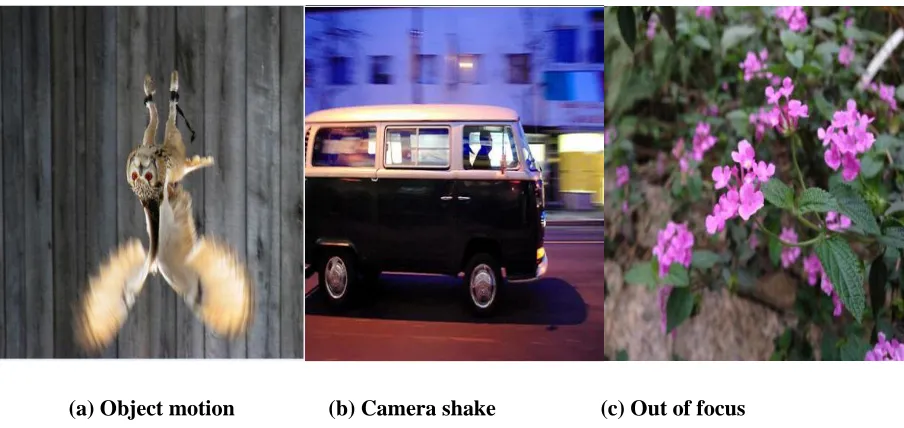
image such as Gaussian blur, motion blur and out of focus blur. Motion blur generated due to camera motion which
can mainly degrade the quality of an image. Deblurring of motion blurred images is a very hard problem, because
the path of the camera motion random [9]. At the time of image capturing, motion blur is the relative motion
between the camera and scene. Simply we can say during the image capturing, the motion due to camera or objects
causes motion blurred images.
(a) Object motion (b) Camera shake (c) Out of focus
Fig 1.1 various types of blur
In this paper, we simply propose a different technique to detect, to process and to analyze the blur kernels, and
images suffering from blur.
1.3 Blur detection techniques
To boost the quality of a digital image, investigation on blur detection is more effective. Thus there are various
techniques that are used to boost the quality of digital image, video, and also used for crime solving.
1.3.1 Blur detection method for digital images by using wavelet transform:
Blur detection technique for digital images by using harr wavelet transform is a direct technique, which is used for
the estimation of blur. Wavelet transform technique used to check whether the given image is blurred or not, and if
the given image is blurred then up to which extent it is, depends upon the edge type analysis [23]. The method takes
advantage of the facility of harr wavelet transform in both distinctive various types of edges and to improve the
140 | P a g e
the blur arises due to the movement of object and camera. Its performance may not be affected by the reliablebackground in pictures or images.
1.3.2 Blur detection scheme by using discrete cosine transform
blur detection scheme for discrete cosine transform (DCT) uses a recent clarification to desire at manipulate the
accessible discrete cosine transform data in MPEG or JPEG compressed video or pictures although containing a
lowest computational load, the technique calculated from MPEG or JPEG images and commanly depends upon the
histograms of non-zero occurrences. This method is relevant for all type of pictures such as I-frames, P- frames and
B-frames , for MPEG compressed video. In this operation the main aim of blur detection is to given the percentage
the quality of global image in the form of blur: 0 % percentage contains that the frame is fully blurred and 100 %
percenrage contains that no blur formed in an image. This blur detector represents the global image blur generated
due to the motion of camera, motion of objects and due to defocusing since we focused to analyse the MPEG
compressed video information, it is desirable that the blur detector caculated from the dicrete cosine transform layer
directly of the bit stream of an MPEG video.
II LITERATURE REVIEW
Yi Zhang and Keigo Hirakawa [6] proposed a technique receipts the application of sparse delegation of double
discrete wavelet transform (DDWT) to clarify the wavelet analyzation of blurred images. The main aim of this paper
to overcome the drawbacks that is computational efficiency and proneness to noise of the previous paper, by using
three steps of blur estimation, such as spatial smoothing, direction estimation, length estimation. C. Paramanad and
A.N Rajagopalan [7] proposed a method to evaluate the transformation spread function (TSF) of both depth layers.
Berhold K.P. Horn [13] in their paper calculates the radon transform of the kernel by analysing the edges of the
image occurred due to motion of the camera. Two algorithms are used for calculating the spatially invariant blur
kernel. Stanely H. Chan et al. [5] proposed a spatially variant blind deconvolution algorithm for the removal of blur
problem in a scene where foreground objects are clearer then or in focus then the background objects of the scene.
Chew Lim Tan et al. [1] proposed a simple and effective technique that is automatic blur detection and classification
proposed to detect the regions that are blurred. Nasser kehtarnavaz et al. [12] proposed adaptive tonal correction
algorithm for the reduction of image blur for cell phone cameras. When we capture an image using cell phone
camera, image quality is reduced or blurred due to handshakes or motion. Rob Fergus and Aaron Hertzmann et al.
[11] propose new methods that are suitable for removing the issue of unknown camera shake from a photograph.
Hanghang Tong et al. [2] proposed a harr wavelet transform technique to determine whether an image is blurred or
not. The determination of whether an image is blurred or not depends upon the edge type analysis and the
determination of up to what extent an image is blurred depend upon the edge sharpness analysis. This proposed
scheme generally takes the advantage of harr wavelet transform to differentiate the different type of edges and
141 | P a g e
the estimation of blur from an image by using the information that the image containing itself. Our method estimatesthe sharpness of the sharpest edges that generally contains the information about blurred images.
III METHODOLOGY
3.1 Implementation steps
Because of the changing nature of universal (uniform) pictures in this dissertation, users implement a learning
framework to detect the images having partially blurred with a training process.
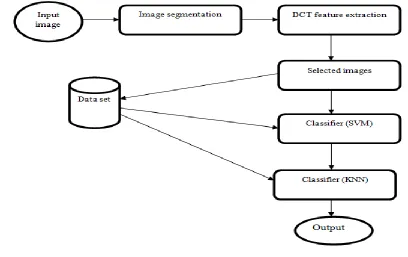
Fig. 3.1 Flow chart of the user system
Step 1) Input image
Firstly an image is to load, and the loading image should be blurred.
Step 2) Image segmentation
Image segmentation is a technique to partition an image into various components. Image segmentation is generally
be used for the identification of objects and the information containing by objects in digital images.
Step 3) Feature extraction
Our technique mainly uses a region based feature extraction to determine the images that are suffering from blur.
Individually, the input image is divided in to blocks and then determines features of each image. In the present
chapters we show that this regional delegation gives well methods for the measurement of blur. Note that the blur
142 | P a g e
besides proposed spectral and viewable suggestions, we also combine analysis attributes of the two blur types,which mainly give the useful suggestions for designing complementary features. Discrete cosine transform (DCT) is
mainly be used to detect the feature extraction of normalized iris image. The representation of discrete cosine
transform matrix is given as:
Step 4) Data set
The dataset contains up to 1000 images, these images are carried from internet. For all image ground truth regions
are applied. It is formed that mostly the blur occurs in an image either due to motion or defocusing. We partition the
motion blur images in to dataset 1 and defocus blur imaged in to dataset 2.
Step 5) Classification
Suppose every sample in our data set has m attributes, these m attributes are combined to produce m - dimensional
vectors = (y1, y2... yn). These m attributes are examined to be the self-determining variables. Every sample also
contained other attributes, these attributes are denoted by ‘x’ and these attributes are contained dependent variables. We assume that ‘x’ is a category variable, and there is a scalar function and this scalar function is denoted by ‘f’,
which authorize a class, x = f(y) to each such vectors. I have no experience about scalar function except that we
consider that it is continuous (invariable) in some sense. We consider that a set of H such vectors are disposed
together with their analogous classes:
y(j), x(j) for j = 1,2, ..., H
.
This set is known as training set. The complication we wish to determine is the following.
Assumed we are disposed a different sample where y = v. If we want to know the knowledge about the scalar
function ‘f’, we would simply calculate u = f (v) to recognize how to determine this new sample, but of course we have no knowledge about the scalar function ‘f’ except that it is adequately smooth.
3.2 Support Vector Machine (SVM)
SVM (support vector machine) firstly invented by vapnik (1995). Support vector machine (SVMs) are a group of
supervised learning techniques, and these techniques are generally be used for regression and analysis [31]. The
most important property of support vector machine (SVM) is that it reduces the theoretical classification error and
143 | P a g e
machine depends upon SRM (structural risk minimization). Support vector machine design input vector, this inputvector designs, to a larger dimensional space where a largest separating hyperplane is established. Two hyperplanes
that are parallel are designed on every side of the hyperplane that generally differentiate the information. The
differentiated hyperplane is that type of hyperplane which enlarges the distance between two hyperplanes and these
hyperplanes are parallel. The basic assumption of this classifier is that the generalization error of this classifier is
much good when the distance and margin between these two parallel hyperplanes is greater [31].
The data points are taken in the form of such as:
{(
,
), (
,
), (
,
), (
,
)... (
,
)}
3.3. Proposed nearest neighbor classifier (KNN)
K-nearest neighbor (KNN) is one of the most important learning algorithm i.e. non parametric or slothful. This
algorithm is called slothful because the points of training data does not use for any generalization. In other words,
we can say that there is no accurate phase and this is more minimal. It means that the training phase is fast. The
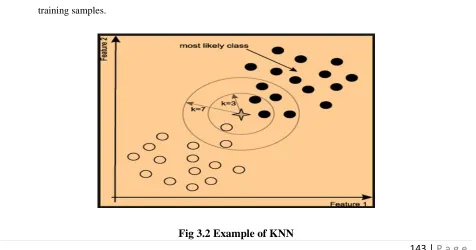
classification rules are developed itself by the training samples. The k-nearest neighbor classifier (KNN) determines
the test sample’s category, this h-sample category selected according to the k training samples that are closest
neighbour to the test sample. Thus the process of k nearest neighbour algorithm (K-NN) is used to determine the
sample Y. [30]
Imagine that there are I training categories which are denoted by and the total amount of
training samples is H after feature contraction, they become dimension vector which is denoted by n.
Compose sample Y that is in the form of ( ) and is similar to feature vector, like whole
training samples.
144 | P a g e
Finally determine all the approximation (similarity) that lies between training samples and Y, the
approximation (similarity) for the sample ( ) as an example, the approximation is
defined by APP(Y, )
APP(Y,
) =
Select K samples that is higher from M approximations of APP(Y, ), (j = 1, 2, ...M) and face them like a
K-nearest neighbor (KNN) collection of Y. Then calculate the probability of Y related to every category by
the formula i.e.
R(Y,
) =
Where represents a category attribute function
Select sample Y to be the category having the value of probability is R(Y, ) higher.
3.4 Experimental results for SVM and KNN
145 | P a g e
Fig. 3.4 Actual image (SVM) Fig. 3.5 Actual image (KNN)
3.5 Experimental results for SVM and KNN
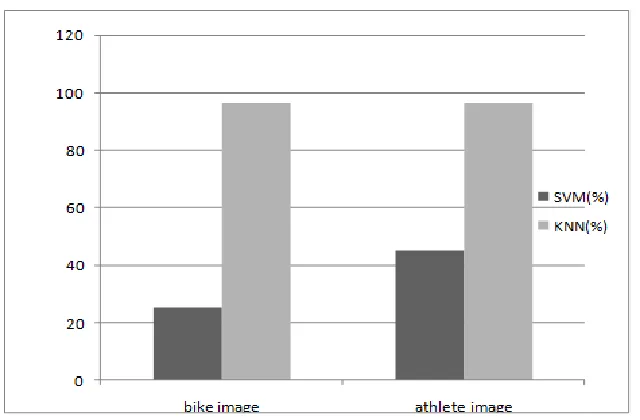
Cover image SVM (%) KNN (%)
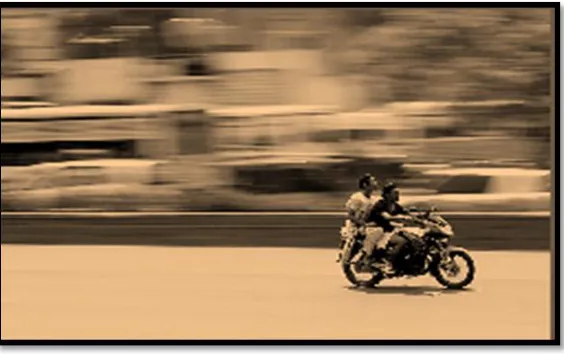
Blurred bike image (due to motion
blur)
25.334 96.501
Blurred athlete image (due to
motion blur)
45.391 96.340
Table 3.1 Results of SVM and KNN classifier
5.5 Experimental results for SVM and KNN
146 | P a g e
VI. CONCLUSION AND FUTURE SCOPE
4.1 Conclusion
The use of image processing is to improve the quality of an image which is degraded by the blurred regions. The
blur can be occurred by defocus of camera or motion of the object. To detect the blur from blurred images is an
important task. Previous years ago various techniques are developed for blur detection such as low directional high
frequency, DDWT etc. But all these techniques are not able to remove the blur and to detect the blurred regions
perfectly because there are various limitations in these techniques. In this paper we propose the SVM and KNN
classifiers to remove the blur and to detect the blur from the blurred regions of an image. SVM classifier i.e. kernel
based is used to segment the images and to determine the blur area of an image. But this SVM classifier does not
segment the images properly because there are various fundamental complications of kernels and therefore there is
huge scope of development so in our system we will use the KNN classifier to improve the quality of an image by
removing blur area more efficiently.
4.2 Future Scope
All SVM become more and more adaptive so that to improve all detection algorithms, and apply these algorithms on
real time data.
More algorithms are combined to get good results.
Larger data set can be taken by KNN and it gives very good run time performance
REFERENCES
[1]Su, S.Lu, and C.L. Tan, Blurred image region detection and classification, In: ACM Multimedia 2011, MM
11, pp. 1397- 1400, 2011.
[2]Tong, H., Li, M., Zhang, H., and Zhang, C. Blur detection for digital images using wavelet transform, in
Proc. IEEE Int. Conf. on Multimedia and Expo, June 2004, vol.1, pp. 27-30, doi:
10.1109/ICME.2004.1394114.
[3]F. Rooms, and A. Pizurica, Estimating image blur in the wavelet domain, ProRISC 2001, pp. 568-572.
[4]K. Sheppard, D.G. Marcellin, M.W. Marcellin, and B.R. Hunt, “Blur identification from vector quantizer
encoder distortion, IEEE Trans. On Image Processing, March 2001, pp. 465-470.
[5]S. Chan and T. Nguyen, Single image spatially-variant out of- focus blur removal, ICIP, 2011.
[6]Yi Zhang and Keigo Hirakawa, Fast spatially varying object motion blur estimation, in Computer Vision
and Pattern Recognition (CVPR), 2015 IEEE Conference on. IEEE, 2015, pp. 646-650.
[7]C. Paramanand and A. N. Rajagopalan, Non uniform Motion Deblurring for Bilayer Scenes, in Computer
147 | P a g e
[8]Bovik and J. Gibson, Handbook of Image and Video Processing, Academic Press, Inc. Orlando, FL, USA,
2000.
[9]M. Ben-Ezra and S.K. Nayar, Motion deblurring using hybrid imaging, in Computer Vision and Pattern
Recognition, 2003. Proceedings. 2003 IEEE Computer Society Conference on. IEEE, 2003, vol. 1, pp. I–
657.
[10] V. Vapnik. The Nature of Statistical Learning Theory. NY: Springer-Verlag. 1995.
[11] R. Fergus, B. Singh, A. Hertzmann, S. Roweis, and W. Freeman, Removing camera shake from a single
photograph, ACM SIGGRAPH, 2006.
[12] Q. R. Razligh, and N.Kehtarnavaz, Image blur reduction for cellphone cameras via adaptive tonal
correction, In International Conference on Image Processing ,ICIP, pp. 113-116, 2007.
[13] T.S. Cho, S. Paris, B.K.P. Horn, and W.T. Freeman, Blur kernel estimation using the radon transform, in