INTERNATIONAL RESEARCH JOURNAL OF PHARMACY
www.irjponline.com
ISSN 2230
–
8407
Research Article
PHYTOCHEMICAL SCREENING AND SPECTROSCOPY ANALYSIS OF JACKFRUIT
(Artocarpus integer Thumb.) PEEL
Antony Allwyn Sundarraj and Thottiam Vasudevan Ranganathan *
Department of Food Processing and Engineering, Karunya University, Coimbatore, TamilNadu, India
*Corresponding Author Email: [email protected]
Article Received on: 28/08/17 Approved for publication: 29/09/17
DOI: 10.7897/2230-8407.089171
ABSTRACT
Ethanolic and methanolic extracts of Jackfruit peels (Artocarpus integer) were investigated. The phytochemical screening revealed that the presence of alkaloids, flavonoids, carbohydrates, proteins and triterpenoids the active compounds. The Gas Chromatography-Mass Spectroscopic analysis of various extracts like ethanol and methanol identified the presence of various phytochemical compounds and secondary metabolit es like Hexadecanoic acid, Squalene, Calophyllolide, Thialisopyine and so on. Nuclear Mass Resonance Spectroscopy showed the presence of Alkyl group and carbon bearing OH group compounds. Atomic Absorption Spectroscopy of peel indicated the presence of major minerals like calcium, potassium and other minor minerals. All these findings implied the availability of various active and phytochemical compounds and also some minerals from the peel. It might be the potential resources for the development of the antioxidant function of dietary foods.
Keywords: Phyto-chemical, Jackfruit, Artocarpus, Spectroscopy, Compounds.
INTRODUCTION
Plants are always a rich source of compounds that don't appear essential for primary metabolism, together with thousands of secondary metabolites and several macromolecules, such as peptides, proteins, enzymes, lignin and cellulose (1). Phytochemicals are compounds that act as the free radical scavengers to assist eliminate the highly charges oxygen molecules that are byproducts of metabolized oxygen (2), and are believed to supply various health advantages (3). The consumption of a plant-based or phytochemical-rich diet has been associated with a reduced risk of chronic human health problem such as certain types of cancers, inflammation, cardiovascular and neurodegenerative diseases (4).
“The Jackfruit are such large and interesting fruits and trees thus well behaved that it's difficult to explain the general lack of knowledge concerning them’’(5). Jackfruit is a dicotyledonous compound fruit of the jack tree (Artocarpus heterophyllus) which belongs to the family Moraceae grow in several of the tropical countries of Southeast Asia but is particularly abundant in Republic of India and Bangladesh (6). In South India, Jackfruit fruit production is higher than any other fruit. Hence significant the amount of peel is expected to be discarded as agricultural waste (7). The outer peel, that is usually fibrous and fairly rich in calcium and pectin, constitutes about 59% of the ripe fruit (8). Jackfruit was originally from India and spread out into tropic regions, including Indonesia (9). The marketplace for natural additives and ingredients is rapidly growing with some natural products obtaining high costs (10). The purpose of this work is to research the phytochemical screening, Gas Chromatography Mass Spectroscopic analysis of peel and other properties like Nuclear Mass Resonance Spectroscopy and Atomic Absorption Spectroscopy.
MATERIALS AND METHODS Raw material collection
Mature Jackfruit was collected from the local market of Pudukkottai (district), TamilNadu, India. It was identified as Artocarpus integer ((Thumb.). Merr. - Moraceae). Plant species authentication was done at Botanical Survey of India (BSI), Coimbatore, South India (Ref no. BSI/SRC/5/23/2013-14/Tech/1714).
Preparation of Jackfruit peel powder
Jackfruit was peeled manually to discard the edible part including the seeds. The peels were cut into smaller pieces and treated according to the method reported by (11). The treated jackfruit peels were then washed with boiling water and pressed to remove excess amount of water. Subsequently, the Jackfruit peels were dried in a Cross Flow Dryer at 65ºC for 8 hours. The dried peels were grounded and packed in polyethylene bags and stored at room temperature.
Preliminary Phytochemical Screening
The methods used for detection of various phytochemical were followed by a qualitative chemical test to give the general idea regarding the nature of constituents present in the peel.
Preparation of Plant extracts (Ethanolic and Methanolic extract) from Jackfruit Peel
solvent in the extract was removed by distillation and the concentrated extract so obtained was further dried under reduced pressure at a temperature not exceeding 40°C in a rotary evaporator. The extract was then collected (extractive value 10gm), kept in Petri dish and stored in the refrigerator. The condensed extracts were used for preliminary screening of various phytochemicals like in the presence of Steroids, Glycosides, Flavonoids, Tannins, Carbohydrates and so on.
Test for Steroids and Triterpenoids
Liebermann's Burchard test - Crude extract was mixed with few drops of acetic anhydride, boiled and cooled. Concentrated sulphuric acid was then added from the edges of the tube and observed for the formation of a brown ring at the junction of two layers. Green coloration of the upper layer and the formation of red colorize the lower layer would indicate a positive test for steroids and triterpenoids respectively (13).
Salkowski Test - 2ml of crude extracts, 2ml of chloroform and 2ml of concentrated sulphuric acid was added. The solution was shaken well. As a result chloroform layer turned red and acid layer showed greenish yellow (14).
Test for Glycosides
Borntrager's Test - 3ml of crude extracts, dilute sulphuric acid was added. The solution was then boiled and filtered. The filtrate was cooled and added an equal volume of benzene. The solution was shaken well and also the organic layer was separated. An equal volume of dilute ammonia solution was added to the organic layer. The ammoniacal layer turned pink showing the presence of glycosides (14).
Keller - Killiani Test - Test solution was treated with few drops of glacial acetic acid and ferric chloride solution and mixed. Concentrated sulphuric acid was added and observed for the formation of two layers. Lower reddish brown layer and the upper acetic acid layer which turns bluish green would indicate a positive test for glycosides (14).
Test for Saponins
Foam Test - Test solution was mixed with water and shaken and observed for the formation of froth, which is stable for ten minutes for a positive result (15)
Test for Alkaloids
Hager's Test - Test solution was treated with few drops of Hager's reagent. Formation of yellow precipitate would show a positive result for the presence of alkaloids (16).
Mayer's Test - To the 3ml of filtrate Mayer's reagent was added. Formation of yellow precipitate showed the presence of alkaloids (15).
Test for Flavonoids
Ferric Chloride Test - When the solution was treated with few drops of Ferric chloride solution would result in the formation of blackish red color indicating the presence of flavonoids (17). Alkaline reagent Test - Test solution when treated with sodium hydroxide solution, shows an increase in the intensity of yellow color which might become colorless with the addition of few drops of dilute hydrochloric acid, indicates the presence of flavonoids (18).
Lead acetate solution Test - Test solution when treated with few drops of lead acetate (10%) solution would result in the formation of a yellow precipitate (18).
Test for Tannins and Phenolic compounds
Gelatin Test - When the solution was treated with gelatin solution would give white precipitate indicating the presence of tannins (18).
Ferric Chloride Test - On addition of five percent Ferric Chloride solution to the crude extract, the deep blue color appeared (19).
Lead acetate Test - On addition of lead acetate solution to the crude extract white precipitate appeared (14).
Dilute Nitric acid Test - On addition of the dilute nitric acid solution to the crude extract, the reddish color appeared (14).
Test for Proteins
Biuret Test - Test solution was treated with 10% sodium hydroxide solution and two drops of 0.1% copper sulphate solution and observed for the formation of violet/pink color (18).
Xanthoproteic Test - To the little amount of crude extract, 1ml of concentrated sulphuric acid was added. This resulted in the formation of a white precipitate which on boiling turned yellow. On addition of ammonium hydroxide, yellow precipitate turned orange (14).
Test for Carbohydrates
Fehling’s Test: 1 ml. Fehling’s A solution and 1 ml. of Fehling’s B solution were mixed and boiled for one minute. Now the equal volume of test solution (crude extract) was added to the above mixture. The solution was heated in boiling water bath for 5-10 minutes. First a yellow, the brick red precipitate was observed (20).
Gas Chromatography Mass Spectroscopy Analysis
The volatile components of various extracts from jackfruit peel were analyzed using Thermo MS DSQ II (DB 5 - MS Capillary Standard Non - Polar Column for Methanol extract and ZB 5 - MS Capillary Standard Non - Polar Column for Ethanol extract), injector and oven temperature was 70°C raised to 260°C. The heating rate was programmed at 6°C/minutes. The injection was performed in the split ratio of 260 and the volume was 1µL. The flow of carrier gasses was maintained 1.0ml/minutes throughout the run.
The identification of the compounds was performed by similarity searches and mass spectra data in the NIST (National Institute of Standard and Technology) MS Search 2.0 Library (20). The quantification of components was done by relative peak areas calculation. Relative peak areas were divided the peak area for the compound by the total peak areas for the entire compounds detected and expressing this value as the percent.
Characterization of Jackfruit peel Powder Nuclear Mass Resonance Spectroscopy (NMR)
13C-NMR plays a vital role in deciding the structure of unknown
organic molecules, reactions, and processes. 13C-NMR to help
you solve structures of unknown organic compounds. Samples of 15 mg were dissolved in 0.5 mL Dimethyl sulfoxide (NMR
13C: 1mg in a 1mL solvent) and NMR spectra were recorded on
a Bruker Avance 500 MHZ spectrometer equipped with a quadruple nucleus probe at room temperature for 13C (21).
Atomic Absorption Spectroscopy (AAS)
The major and minor minerals present in the jackfruit peel was carried out in an Atomic Absorption Spectrophotometer (Agilent Technologies 200 series AA), equipped with a graphite furnace (22).
RESULTS AND DISCUSSIONS Phytochemical Screening
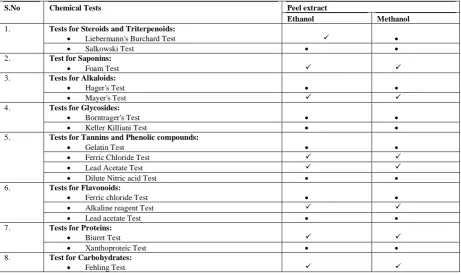
The various extracts of peel have revealed the presence of saponins, tannins, proteins and carbohydrates. Glycosides were
found to be absent in all the extracts. From this analysis, ethanolic extract of peel was found to have more constituents compared to methanolic extract. The results of preliminary phytochemical screening tests of each extract of peel presented in Table 1. The preliminary phytochemical screening tests might be useful in the detection of bioactive principles and revealed the presence of flavonoids, tannins, carbohydrate, saponins, alkaloids, tannins, triterpenoids, proteins in the peel extract. Further, the presence of different phytoconstituents in the two different extracts might be responsible for the therapeutic properties (23).
Table 1: Phytochemical screening for various extracts of Jackfruit peel
S.No Chemical Tests Peel extract
Ethanol Methanol
1. Tests for Steroids and Triterpenoids:
• Liebermann's Burchard Test ✓ •
• Salkowski Test • •
2. Test for Saponins:
• Foam Test ✓ ✓
3. Tests for Alkaloids:
• Hager's Test • •
• Mayer's Test ✓ ✓
4. Tests for Glycosides:
• Borntrager's Test • •
• Keller Killiani Test • •
5. Tests for Tannins and Phenolic compounds:
• Gelatin Test • •
• Ferric Chloride Test ✓ ✓
• Lead Acetate Test ✓ ✓
• Dilute Nitric acid Test • •
6. Tests for Flavonoids:
• Ferric chloride Test • •
• Alkaline reagent Test ✓ ✓
• Lead acetate Test • •
7. Tests for Proteins:
• Biuret Test ✓ ✓
• Xanthoproteic Test • •
8. Test for Carbohydrates:
• Fehling Test ✓ ✓
Alkaloids are commonly found to have antimicrobial properties (24). Flavonoids and tannins are phenolic compounds and plant phenolics are a major group of compounds acts as primary antioxidants (18). Tannins are reported to prevent the growth of the many molds, yeasts, bacteria, and viruses are inhibited by tannins (25). Since these compounds were found to be present in the extracts, it might be responsible for the antioxidant capacity of Jackfruit peel. The secondary metabolites and other chemical constituents were presented in Jackfruit peel. Since the whole peel extracts contain the various constituents and had the number of bioactive compounds. The preliminary phytochemical tests are helpful in finding chemical constituents in the plant material that may lead to their quantitative estimation (18). Indeed, a suitable extracting procedure should be developed and improved to recover as many antioxidants as possible before an extract rich in natural antioxidants could be further explored for possible application in health - promoting supplements for the food industry (26).
Gas Chromatography Mass Spectroscopy Analysis (GC - MS)
The results of the GC - MS analysis of various extracts (ethanol and methanol)identified the various compounds present in the peel.
Ethanol Extract
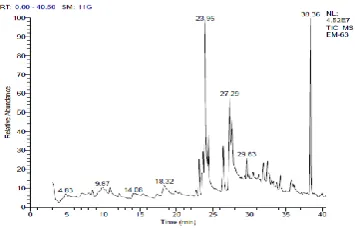
The major compounds present in the ethanolic extract of peel as identified by GC - MS was Hexadecanoic acid (CAS) with 23.95 (retention time) and 21.90 % relative peak area was the highest followed by Squalene with 38.36 RT (retention time), and 16.34 % relative peak area is shown in fig. 1and other various compounds present in the Jackfruit peel powder (Table 2).
Figure 1: Relative peak areas of ethanolic extract from Jackfruit peel
Some of the other compounds are also identified from the ethanolic extract of peel; Cyclopropaneotanic acid, 2-[(2-(2-ethycyclopropyl)methyl)]-methylester (CAS) (RT - 27.29 and 12.54 % peak area), Ethyl linoleate (RT - 27.65 and 6.40 % peak area), Methyl, 8,11,14 - heptadecatrienoate (RT - 26.11 and 5.40 % peak area), Acetonitrile, isothiocyanate-(RT - 35.72 and 98 % peak area) and so on. The activities of some phytochemicals with compound nature of flavonoids, palmitic acid (hexadecanoic acid) as antimicrobial, antioxidant hypochlolesteremia, cancer preventive, hepatoprotective and anti-coronary (31).
Table 2: List of Volatile compound in Jackfruit peel ethanol extract
RT
(Retention time)
Compound Name Molecular Formula Molecular
Weight
Area (%)
4.85 2-n-Butylmercapto-2-imidazoline C7H14N2S 58 0.57
7.02 1,-(3-Nitrophenylsufonyl)-2-phenylethylene C14H11NO4S 289 1.00
8.03 2-[(z)-But-z-en-1-yl]benzyl alcohol C11H14O 162 0.51
8.50 Naphthalene (CAS) C10H8 128 0.82
9.85
(E)-2-[N-hydroxy-N-phenylo-amino]-3-[N-(phenylamino)]-indole
C22H19N30 341 3.22
14.08 O-Dithiane-3-carboxylic acid C5H8O2S2 162 1.89
17.36 1,4-Diphenyl-2-Butene C16H16 208 0.63
18.32 Eicosane,2-methyl- C21H44 296 3.44
19.87 L-Mannitol,1-deoxy-,cyclic3,4-(ethyl
boronate)2,5,6-triacetate
C14H23BO8 330 0.53
22.70 Methylhexadec-9-enoate C17H32O2 268 0.67
23.11 Hexadecanoic acid methyl ester C17H34O2 270 3.17
23.95 Hexadecanoic acid (CAS) C16H32O2 256 21.90
24.39 Hexadecanoic acid, ethyl ester (CAS) C18H36O2 284 2.90
26.41 Methyl,8,11,14-heptadecatrienoate C18H30O2 278 5.40
27.65 Ethyl linoleate C20H36O2 308 6.40
30.51 Eicosane,7-hexyl- C26H54 366 1.08
31.28 Tetradeanal (CAS) C14H28O 212 0.83
31.91 Octadec-9-Enoic acid C18H34O2 282 2.43
32.48 Hexadecanoic acid,2-hydroxy-1-(hydroxy methyl)ethyl
ester
C19H38O4 330 3.31
34.23 Betulin C30H50O2 442 1.44
35.72 Acetonitrile, isothiocyanato- C3H2N2S 98 3.47
32.41 14-Oxonodec-10-enoic acid, methyl ester C20H36O3 324 0.48
38.36 Squalene C30H50 410 16.34
39.95 Phosphonothio acid, methyl-s-butyl-ethyl ester (CAS) C7H17O2PS 196 0.64
Methanol Extract
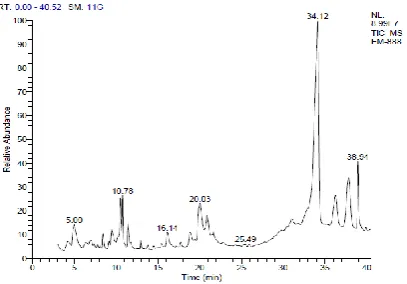
The major compounds present in the methanolic extract of peel as identified by Gas Chromatography - Mass Spectroscopy was Calophyllolide with 34.14 RT (retention time), and 38.64 % relative peak area is shown in fig. 2 and other various compounds present in the Jackfruit peel powder (Table 3). Calophyllolide has been reported to exhibits some biological activity, including lower capillary vascular permeability (32), anti -cancer (33) and anti - coagulant (34) properties.
Figure 2: Relative peak areas of Methanolic extract from Jackfruit peel Table 3: List of Volatile compounds in Jackfruit peel ethanol extract
RT
(Retention time)
Compound Name Molecular Formula Molecular
Weight
Area (%)
4.24 6-(2,2,5-trimethyl-(1,3)dioxan-4-yl)-hepta-2,4-dienoic acid, methyl ester
C15H24O4 268 1.58
5.00 1,2-Cyclopentanedione C5H6O2 98 3.93
6.38 1,2-Octanediol C8H18O2 146 0.80
7.04 2,2,dimesityl-2Silatetracyclo)7.6.0.0.(3,8).0(10,15) hexadecadodeane
C3H32Si 444 0.77
8.42 4H-pyran-4-one,2,3-dihydro-3,5-dihydroxy-6-methyl C6H8O4 144 1.05
9.18 Cycloheptasiloxane, tetradeca-methyl C14H42O7Si7 518 0.53
9.48 Hydrozine,(1-methylethyl) C3H10N2 74 1.86
23.11 Hexadecanoic acid methyl ester C17H34O2 270 3.17
11.42 N,2,3-trimethyl-1,4-thiazone-s-dioxide C7H15NOS 161 1.67
12.94 Cyclohexanol, 2-(dimethylamino)-cis C8H18O2 143 0.61
13.84 3,4-dihydro-2H-1,5-(3"-t-butyl)benzodioxepene C13H18O2 206 0.44
14.45 Cyclononasiloxane, octa Deca methyl C18H54O9Si9 666 0.30
16.14 2-vinyl-5-methoxy-2,3-dihydrobenzofuran C11H12O2 176 1.83
17.71 Piperdine, 1-methyl-(CAS) C6H13N 99 0.40
18.81 1,2-hexanediol,1,2-diphenyl C18H22O2 270 1.48
19.99 AD-glycopyranose,4-O-a-D-galactopyranosyl C12H22O11 342 6.82
20.91 Pregan-5-ene-12,20-dione,3,4,15-trihydroxyl-(3a,14a,15a) C21H30O5 362 2.88
21.68 Hexadecanoic acid, methyl ester C17H34O2 270 0.89
25.49 Heptadecanoic acid, 9-methyl-methylester (CAS) C19H38O2 298 0.42
31.00 Benehexaethanol, hexaacetate C30H42O12 594 1.29
34.14 Calophyllolide C26H24O5 416 38.64
36.30 (+ -) lnophylum D C25H24O5 404 6.40
37.86 Thialisopyine C21H25NO5 371 10.28
38.94 9-octadecanaamide (CAS) C18H35NO 281 5.04
Fruits and vegetables are most popular due to their nutritional value worldwide and rich sources of beneficial anti-oxidants, minerals, vitamins and fibers (35). By-products of Jackfruits aren't the only good source of bioactive compounds but also could be used as several value-added products (36). Phenolic compounds are secondary metabolites ubiquitous in plants and plant derived foods and beverages (37). It acts as a vital part of the human diet, a dare of considerable interest due to their inhibitor properties.
Many phenolic compounds have antioxidant properties. Phenolic compounds can be used as ingredients in pharmaceuticals, nutraceuticals and food (38). Flavonoids are
polyphenolic compounds present in plants as secondary metabolites and also have antioxidant activity.
Nuclear Mass Resonance Spectroscopy (NMR)
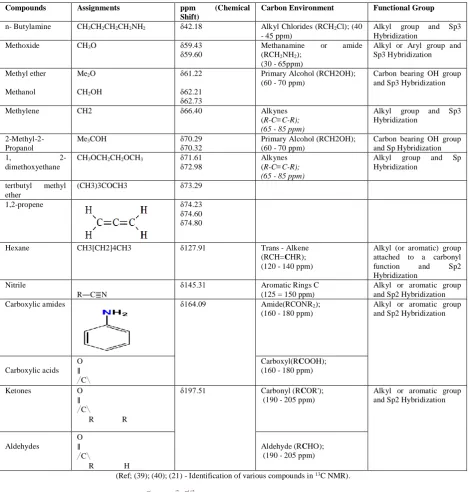
The Nuclear Mass Resonance data displayed the six carbon atoms of the aromatic ring, methylene group side chain, carbon bearing OH group and the methylamino group, were all diagnostic for phenyl ethyl amine moiety, containing a hydroxyl group at the para position of the aromatic ring present in Table 4. The 13C Nuclear Mass Resonance spectrum of Jackfruit peel
Table 4: List of various chemical compounds and assignments present in Jackfruit peel
Compounds Assignments ppm (Chemical Shift)
Carbon Environment Functional Group
n- Butylamine CH3CH2CH2CH2NH2 δ42.18 Alkyl Chlorides (RCH2Cl); (40
- 45 ppm)
Alkyl group and Sp3 Hybridization
Methoxide CH3O δ59.43
δ59.60
Methanamine or amide
(RCH2NH2);
(30 - 65ppm)
Alkyl or Aryl group and Sp3 Hybridization
Methyl ether
Methanol
Me2O
CH2OH
δ61.22
δ62.21 δ62.73
Primary Alcohol (RCH2OH); (60 - 70 ppm)
Carbon bearing OH group and Sp3 Hybridization
Methylene CH2 δ66.40 Alkynes
(R-C≡C-R); (65 - 85 ppm)
Alkyl group and Sp3 Hybridization
2-Methyl-2-Propanol
Me3COH δ70.29
δ70.32 Primary Alcohol (RCH2OH); (60 - 70 ppm)
Carbon bearing OH group and Sp Hybridization
1,
2-dimethoxyethane
CH3OCH2CH2OCH3 δ71.61
δ72.98 Alkynes (R-C≡C-R);
(65 - 85 ppm)
Alkyl group and Sp
Hybridization
tertbutyl methyl ether
(CH3)3COCH3 δ73.29
1,2-propene δ74.23
δ74.60 δ74.80
Hexane CH3[CH2]4CH3 δ127.91 Trans - Alkene
(RCH=CHR); (120 - 140 ppm)
Alkyl (or aromatic) group attached to a carbonyl
function and Sp2
Hybridization Nitrile
R―C≣N
δ145.31 Aromatic Rings C
(125 = 150 ppm)
Alkyl or aromatic group and Sp2 Hybridization
Carboxylic amides δ164.09 Amide(RCONR2);
(160 - 180 ppm)
Alkyl or aromatic group and Sp2 Hybridization
Carboxylic acids O
∥
╱C╲
Carboxyl(RCOOH); (160 - 180 ppm)
Ketones O
∥
╱C╲
R R
δ197.51 Carbonyl (RCOR');
(190 - 205 ppm)
Alkyl or aromatic group and Sp2 Hybridization
Aldehydes
O
∥
╱C╲
R H
Aldehyde (RCHO); (190 - 205 ppm)
(Ref; (39); (40); (21) - Identification of various compounds in 13C NMR).
Atomic Absorption Spectroscopy
The elemental content of peel is given in Table 5. The mineral content showed that the higher concentration of calcium (Ca) was present as 30.45 ppm.
According to (41), the proportion of calcium immersed depends on the total quantity of elemental calcium devoted at one time; as the quantity increase, the proportion absorption decrease. Incorporation is highest doses ≦ 500 mg. The concentration of aluminum (Al) present in the peel was found to be 2.16 ppm. According to (42) established a PTWI (Provisional Tolerable Monthly Intake) for Al of 1 mg/kg BW (body weight) for all aluminum compounds in food, including additives; previously established ADIs and PTWI for aluminum compounds were withdrawn. The JECFA (Joint FAO/WHO Expert Committee on Food Additives) concluded that aluminum compounds have the potential to affect the reproductive system and developing the nervous system at doses lower than those used in establishing the previous PTWI. The JFAO also noted that dietary exposure to Al is expected to be very high for infants fed on soya-based formula. The concentration of iron (Fe) in the peel was found to be 4.2 ppm. The permissible limit set by FAO/WHO in edible plants or fruits 20 ppm (43). Fe is necessary for the formation of haemoglobin and also plays an important role in other metabolic functions. The Provisional Tolerable Monthly Intake (PTWI) of 0.8mg/kg body weight (BW) body weight applies to iron from all sources except iron oxides used as the colouring agent, supplemental iron taken during pregnancy and lactation, and supplemental iron for specific clinical requirements. Important dietary sources include water, beverages and iron medication. The average daily intake of iron has been estimated to be 17mg / day for males and 9 - 12 mg/day for females. Iron fortification of food, but also contamination of food during its preparation (iron - rich soil) could increase intake of iron (42).
According to (44); the permissible limit of Cu in edible plants is up to 3.0 ppm. In this study, the concentration of copper Cu was found to be 0.735 ppm. According to (42), the dietary copper intake will vary with the types of food consumed, the condition of the solids the foods are produced on (e.g. copper content) and drinking - water characteristics. Copper is ubiquitously distributed in foods, but the richest sources of copper in food are liver, seafood (especially shellfish and crustaceans), grains, cereal products, and potatoes, which contribute to about 65% of total dietary intake. Also, drinking -water may contribute for a considerable part to the total daily intake of copper. The average daily intake of copper has been estimated to range from 0.5 to 0.7 mg for infants for 6 months of age or less up to 2-3 mg for adults, however, this level is likely to be exceeded in arid areas where there may be a high intake of containing high levels of copper. The concentration of lead (Pb) present in the peel was found to be 0.28 ppm. According to (42), the mean dietary exposure estimates for children aged about 1-4 years ranged from 0.03 to 9 µg/kg BW (body weight) per day and adults from 0.02 to 3 µg/kg BW (body weight) per day. The higher end of the exposure range for children was deemed by the FAO to be a concern, as it was higher than the level 1.9 µg/kg BW (body weight) per day calculated by the FAO to be associated with a population decrease of 3 IQ points. For adults, the higher end of the exposure range, a population increase of approximately 2 mmHg (0.3 kPa) in systolic blood pressure would be expected to occur.
Table 5: Elemental/mineral Contents of Jackfruit peel
Chemical Elements / minerals mg / L (or) ppm
Silica (Si) 0.24
Aluminum (Al) 2.16
Cadmium (Cd) 0.001
Calcium (Ca) 30.445
Chromium (Cr) 0.027
Cobalt (Co) 0.008
Copper (Cu) 0.735
Iron (Fe) 4.184
Lead (Pb) 0.28
Manganese (Mn) 1.873
Nickel (Ni) 0.118
Silver (Ag) 1.071
Zinc (Zn) 0.9982
The positive impact of zinc present in the Jackfruit peel powder is (Zn - 1ppm) supplementation on the growth of some stunted children, and on the prevalence of selected childhood diseases such as diarrhoea, suggests that zinc deficiency is likely to be a significant public health problem, especially in developing countries (43). According to FAO's food balance data, it has been calculated that about 20% of the world's population could be at risk of zinc deficiency (44). Zinc is an essential trace element; the requirement of zinc changes throughout life and health effects associated with zinc deficiency are numerous. According to (42), level ranges from high for oysters with lesser amounts in other seafood, muscle meats, nuts, whole cereals. Sugar, citrus, and non-leafy vegetables are poor sources of zinc. The interaction with other dietary factors affects the absorption of zinc. The average daily intake of zinc has been estimated to be maximally 20mg / day for adults. Zinc, Calcium and a few traces of chromium, etc., play important roles in the maintenance of normal glucose - tolerance and in the release of insulin from beta cells of islets of Langerhans (45).
CONCLUSION
As the current trend in the world, today is to utilize and convert waste into useful products and to recycle waste product as means of achieving sustainable development. The presence of various phytoconstituents makes the peel useful for treating different ailments and have a potential of providing useful drugs of human use. In the present study, Gas Chromatography - Mass Spectroscopy analysis of ethanolic extract showed the presence of important bioactive compounds especially Hexadecanoic acid (CAS) and Squalene which has to increases the risk of developing cardiovascular diseases and Chemopreventive substance that protects from cancer. Since the ethanolic extract of peel contains more constituents it can be considered beneficial for further investigation. In conclusion, the result of this investigation demonstration the potentials of peel extracts as a source of useful structures for the development of new chemotherapeutic agents that could be hardnessed for use in the health care delivery. Furthermore, byproducts represent a very important source of sugars, minerals, dietary fiber and phenolics which have a wide range of action which includes antitumoral, antiviral, antibacterial, cardio preventive and antimutagenic activities and it could provide health benefits to humans and may be used in food preservation and pharmaceutical purposes.
ACKNOWLEDGEMENT
(Gas Chromatography Mass Spectroscopy) analysis and to CSIR - CECRI, Karaikudi, for NMR (Nuclear Mass Resonance Spectroscopy) analysis.
REFERENCES
1. Elfalleh W, Hannachi H, Tlili N, Yahia Y, Nasri N, Ferchich A. Total phenolic contents and antioxidant activities of Pomegranate peel, seed, leaf, and flower. J of Medic Plants Res 2012, 6XX: 4724 - 4730.
2. Khalid R. Studies of free radicals, antioxidants and co-factors. Clinical Interv. Aging 2007, 2: 219 - 236.
3. Nixwell MF, Johanna M, Ngezimana W. Effects of Sulphur preservative on the phytochemical and antioxidant capacity of peels of mango cultivars (Mangifera indiaca L.) produced in South Africa. African J of Biotech 2013, 12 suppl 41: 6007 - 6012.
4. Berretta G, Rossoni G, Santagati AN, Facino MR. Anti-ischemic activity and endothelium - dependent vasorelaxant effect of hydrolysable tannins from the leaves of Rhus Coriaria (Sumae) in isolated rabbit heart and thoracic aorta. Plantation Medic 2009, 75 suppl 14: 1482 - 1488.
5. Barrett OW. The tropical crops. Macmillan Co., New York, 1928, 445.
6. Remme RN, Mondal C, Mamun AA, Sultana S, Ali MH, Mannan MA. Product development from Jackfruit (Artocarpus heterophyllus) and analysis of Nutritional quality of the processed products. IOSR J of Agri and Veter Sci 2013, 4 suppl 1: 76 - 84.
7. Sulochana N, Inbaraj BS. Carbonized Jackfruit peel as an adsorbent for the removal of Cd (II) from aqueous solution. Biores Tech 2004, 94: 49 - 52.
8. Chandha YR. The Wealth of India - Raw Materials. Publications and Information Directorate, CSIR, New Delhi, India, 1985, 450.
9. Ismadji S, Prahas D, Kartika Y, Indraswati N. Activated carbon from Jackfruit peel waste by H3PO4 chemical activation: Pore structure and surface chemistry characterization. Cheml Engg J 2008, 140: 32 - 42.
10.Goldsmith CD, Vuong QV, Stathopoulos CE, Roach PD, Scarlett CJ. Optimization of aqueous extraction of phenolic compounds from Olive leaves. Antioxidant 2014, 3: 700 - 712.
11.Mohamed S, Hasan, Z. Extraction and characterization of pectin from tropical agro wastes. ASEAN Food J 1995, 10 suppl 2, 43 - 50.
12.Amit P, Shweta. Antibacterial properties of Psidium Guajava leaves, fruits and stems against various pathogens. Intern J of Pharma Res and Developm 2012, 3 suppl 1: 15 - 24.
13.Nayak BS, Isitor G, Davir EM, Pillai GK. The evidence-based wound Healing activity of Lawsonia inermis Linn. Phytotherapy Res 2007, 29: 829.
14.Vinod SK, Raghuveer I, Alok S, Himanshu G. Phytochemical investigation and Chromatographic evaluation of the ethanolic extract of whole plant extract of Dendrophthoe Faleata (L.F.) Ettingsh. Intern J of Pharma Sci and Res 2010, 1 suppl 1: 39 - 45.
15.Devanaboyina N, Ramalakshmi N, Sudepthi BSP, Hemachakradhar H, Pavankumar RN. Preliminary phytochemical screening, Quantitative estimation and evaluation of antimicrobial activity of Alstoniamacrophylla stem bark. Intern J of Sci Innova Today 2013, 2 suppl 1: 31- 39.
16.Trease GE, Evans WC. A textbook of Pharmacognosy 13th edition Bacilliere Tindall Ltd., London 1989.
17.Evans WC. Trease and Evans Pharmacognosy, 14th edition, Bailiere Tindall W.B. Sauders company Ltd; London, 1996, 224- 228; 293-309; 542 - 575.
18.Bhandary SK, Kumar SN, Vadisha SB, Sharmila KP, Mahesh PB. Preliminary Phytochemical Screening of various extracts of Punica granatum peel, whole fruit, and seeds. Nittle University J of Health Sci 2012, 2 suppl 4: 34 - 38.
19.Okechukwu RI, Onyedineke NE, Mgbemena IC, Opara FN, Ukaoma MA. Inhibition of Pathogenic Microorganisms by Ethnobacterial extracts of fruit peels of Musa paradisiaca. J of Appl Pharm Sci 2012, 2 suppl 4: 1 - 3.
20.Singh R, Kumar A, Bhuvaneshwar DDK, Pandey KD. Gas Chromatography-Mass Spectrometry analysis and phytochemical screening of methanolic fruit extract of Momordica charantia. J of Recent Adv Agri Res 2012, 1 suppl 4: 122 - 127.
21.Cheng HN, Thomas GN. Solution NMR Spectroscopy of Food Polysaccharides. Polym Rev 2012, 52: 81 - 114. 22.Verma V, Mahabir V. Application of atomic absorption
spectroscopy in food sciences: A study on (Cucurbita maxima). APCBEE Procee 2012, 2: 135 - 140.
23.Varadharajan P, Rathinaswamy G, Asirvatahm D. Antimicrobial properties and phytochemical constituents of Rheo disorder. Ethanobotanical leaflet 2008, 12: 841 - 845. 24.Omulokoli E, Khan B, Chhabra S. Antiplasmodial activity
of four Kenyan medicinal plants. J of Ethnopharm 1997, 56 suppl 2: 133 - 137.
25.Arjit D, Chaitra HR, Madhuri M, Nishitha ST, Sourav B, Rohit KC. Evaluation of antimicrobial properties, phytochemical contents and antioxidant capacities of leaf extracts of Punica granatum L. ISCA J of Bio Sci 2012, 1 suppl 2: 32 - 37.
26.Li Y, Guo C, Yang J, Wei J, Xu J, Cheng S. Evaluation of antioxidant properties of Pomegranate peel extract in comparison with Pomegranate pulp extract. Food Chem 2006, 96 suppl 2: 254 - 260.
27.Gunstone FD, John LH, Dijkstra AJ. The lipid Handbook with Cd-ROM, 3rd ed., Boca Raton, CRC Press 2007. 28.WHO. World Health Organization Technical Report Series
916, Report of a joint WHO/FAO Expert consultation, WHO, Geneva, 2003, 88.
29.Owen RW, Haubner R, Wurtete G, Hull WE, Spiegelhalder B, Bartsch H. "Olives and olive oil in Cancer Prevention" European J of Cancer Prev 2004, 13 suppl 4: 319 - 326. 30.Smith, Theresa J. "Squalene : Potential Chemopreventive
agent" Expert opinion on Investigational Drugs 2000, 9 suppl 8: 1841 -1848.
31.Kumar PP, Kumaravel S, Lalitha C. Screening of antioxidant activity, total phenolics and GC - MS study of Vitex negundo. African J of Biochem Res 2010, 4 suppl 7: 191 - 195.
32.Saxena RC, Nath R, Palit G, Nigam SK, Bhargava KP. Effect of Calophyllolide, a nonsteroidal anti-inflammatory agent, on capillary permeability. Plantation Medicine 1982, 44: 246 - 248.
33.Ito C, Murata T, Itoigawa M, Nakaro K, Kaneda N, Furukawa H. Apoptosis inducing the activity of 4- substituted coumarins from Calophyllum brasiliense in human leukemia Hl- 60 cells. J of Pharm Pharmac 2006, 58: 975 - 980.
34.Arora RB, Mathur CN, Seth SDS. Calophyllum inophyllum Linn. J of Pharm Pharmac 1962, 14: 534 - 535.
36.Noor F, Rahman MJ, Mahomad MS, Akter MS, Talukder MD AI, MAI, Ahmed M. Physiochemical properties of flour and extraction of starch from Jackfruit Seed. Intern J of Nutr and Food Sci 2014, 3 suppl 4: 347 - 354.
37.Sharmin T, Ahmed N, Hossain A, Hossain MD M, Mandal SC, Haque MD R, Almas M, Siddik MD AB. Extraction of Bioactive compounds from some fruits and vegetables (Pomegranate peel carrot and Tomato). American J of Food and Nutri 2012, 4 suppl 1: 8 - 19.
38.Andrich G, Stevanin F, Zinnai A, Venturi F, Fiorentini R. Extraction kinetics of natural antioxidants from Potato industry by- products France, 2003, 159 - 163.
39.Wehrli FW, Wirthlin T. Carbon chemical Shifts. Interpretation of carbon - 13 NMR Spectra, Heyden, Newyork 1976.
40.Silverstein RM, Webster FX, Kiemle DJ. Hydrogen Chemical Shifts and Carbon Chemical Shifts. Identification of Organic compounds, 7th edition, John Wiley and Sons, Newyork 2005.
41.CRDRI (Committee to Review Dietary Reference Intakes) for vitamin D and calcium, Food and Nutrition Board, Institute of Medicine. Dietary Reference Intakes for Calcium
and vitamin D. Washington, DC: National Academy Press, 2010.
42.FAO / WHO. Contaminants. In: Codex Alimentarius (38th session) FAO / WHO, Codex Alimentarius Commission: Hague, Netherlands 2011.
43.Mohammed AMA, Ibrahim AM, Omran AA, Mohamed ME, Elsheikh SEM. Minerals content, essential oils, composition and physicochemical properties of Citrus jambhiri Lush. (Rough Lemon) from the Sudan. Intern Letter of Chem Phy and Astro 2013, 9 suppl 1: 25 - 30. 44.FAO / WHO. Contaminants. In: Codex Alimentarius (1st ed.,
XVII) FAO/WHO, Codex Alimentarius Commission: Rome, Italy 1984.
45.Oloyede OI. Chemical profile of unripe pulp of Carica papaya. Pakistan J of Nutri 2005, 4 suppl 6: 379 - 381. Cite this article as:
Antony Allwyn Sundarraj and Thottiam Vasudevan Ranganathan. Phytochemical screening and spectroscopy analysis of Jackfruit (ArtocarpusInteger Thumb.) peel. Int. Res. J. Pharm. 2017;8(9):151-159 http://dx.doi.org/10.7897/2230-8407.089171
Source of support: Nil, Conflict of interest: None Declared