“Binkie Flutter,” an Apparently Voluntary Behavior of Infants, Possibly
Related to Vibratory Jaw Movements in Dogs: Report of 4 Cases
□vJohn Gall, MD
ABSTRACT. Four cases of apparently voluntary rapid vibratory pacifier movements occurring in normal, un-stressed infants up to 1 year of age and captured on video are presented. I speculate on the possible relationship of the movements to similar vibratory jaw movements in dogs, in which species they may represent a neuromus-cular mechanism for rapid feedback control. Pediatrics 2005;115:e367–e369. URL: www.pediatrics.org/cgi/doi/ 10.1542/peds.2004-1727;binkie flutter, dummy flutter, pac-ifier flutter, neonatal jaw clonus, infant jaw clonus, infant jaw movements, infant sucking movements, jaw wags, mandibular oscillation, mandibular trembling, and chin trembling.
T
he phenomenon of “binkie flutter” (rapid vi-bratory movements of the pacifier in an in-fant’s mouth) is widely known to pediatricians and no doubt to mothers worldwide, but a search of the scientific literature failed to retrieve any formal reports or studies of it.* Four examples of “binkie flutter” in infants are here presented.CASE REPORTS Case 1
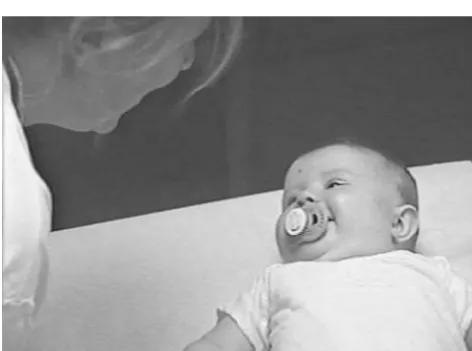
During a routine examination in the doctor’s office, a 3-week-old male infant’s pacifier was noted to be vibrating rapidly while in the infant’s mouth. Three or 4 episodes of rapid pacifier move-ment, each lasting several seconds, occurred, interspersed with normal sucking activity, over a period of several minutes. The periodicity of the vibration was noticeably higher than that of the usual movements associated with ordinary tongue and mouth sucking movements. The event was captured on videotape (Fig 1), but its significance was not appreciated until the second case (Fig 2) was observed.
Case 2
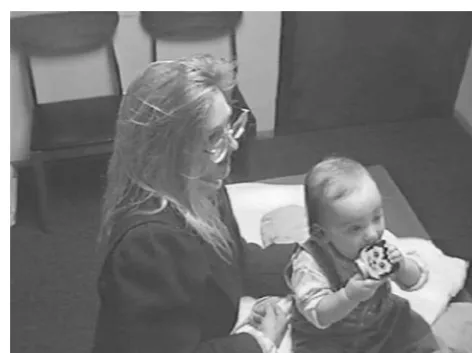
In the second case (Fig 2), the behavior occurred spontaneously during routine physical examination of a 1-year-old female child
and was captured on videotape. The child was mouthing a plastic toy when the behavior was observed.
When the behavior occurred and was commented on by the observer (J.G.), the mother reported that she had noted the behav-ior on many previous occasions and had been concerned that it might be abnormal. She had been reassured, however, by her own mother (a skilled infant development specialist) that it did not signal any known disorder.
The infant spontaneously repeated the behavior several times during⬃9 minutes of videotaping while she contentedly mouthed a plastic toy. Each episode seemed voluntary and seemed to be associated with pleasurable sensations.
Case 3
A third case was subsequently identified in a 5-month-old female infant. The infant continued intermittently to induce the From Walker, Minnesota.
□vVideo material for Figs 1– 4 is available online.
Accepted for publication Oct 29, 2004. doi:10.1542/peds.2004-1727
No conflict of interest declared.
Reprint requests to (J.G.) 7027 S Walker Bay Rd NW, Walker, MN 56484. E-mail: [email protected]
PEDIATRICS (ISSN 0031 4005). Copyright © 2005 by the American Acad-emy of Pediatrics.
* Three online databases were searched: PubMed, the Nature group search engine, and the Questia online library. Terms of search were: binkie flutter, dummy flutter, pacifier flutter, neonatal jaw clonus, infant jaw clonus, infant jaw movements, infant sucking movements, jaw wags, mandibular oscillation, mandibular trembling, and chin trembling. No relevant reports were obtained. The term “chin trembling” yielded reports of a rare auto-somal dominant disorder characterized by involuntary trembling of the chin, probably myoclonic in nature and clearly unrelated to the voluntary behavioral phenomenon here described.1,2
Fig 1. Case 1: Three-week-old male.
Fig 2. Case 2: One-year-old female.
vibrating or fluttering movements while giving indications of pleasure, including smiling, over a period of⬎9 minutes.
On subsequent examination at 6 months of age, the infant again exhibited the behavior 5 to 6 times over a period of 16 minutes. On 3 of those occasions the infant’s mother actively elicited the be-havior by performing a rapid, smiling face approach to the infant combined with an explosive “pooh” or “booh” sound. The infant immediately responded by grinning with pacifier in mouth and then exhibiting the rapid pacifier movements (Fig 3).
Case 4
Review of videotapes made earlier revealed an additional case in a 3-month-old female infant (Fig 4). On subsequent well-infant examination at 43⁄4months, the infant sucked her pacifier for⬎7 minutes without exhibiting the behavior. No attempt was made to elicit the behavior.
DISCUSSION
The videotapes demonstrate pacifier rhythms at 3 distinguishable frequencies: (1) the standard, low-frequency sucking rhythm of 1 to 2/second; (2) a higher-frequency 3 to 4/second rhythm, performed with greater vigor; and (3) a still-higher-frequency rhythm, clearly distinct from 1 and 2 that appears to qualify as a vibratory or tremor-like phenomenon. The frequency of the vibratory motion was not mea-sured precisely, but slow-motion review of the vid-eotapes suggests a basal frequency in the neighbor-hood of 6 Hz with a suggestion of a second-order frequency of⬃18 Hz. It is interesting to note that 6 Hz is the reported frequency of “trembling” of the adult human mandible in the resting position.3The
vibratory phenomenon has been recorded in 1 boy and 3 girls at ages ranging from 3 weeks to 1 year.
It could not be determined with certainty from the videotapes whether the source of the vibratory movements in each case was tremor-like movements of the jaw or fluttering movements of the tongue. In case 2, the vibratory motion was transmitted to a plastic toy too bulky to fit into the mouth and thus was unlikely to have been actuated by tongue move-ments; in fact, the motion seemed to originate in vibratory movement of the entire head (Fig 2). In cases 1, 3, and 4, the pacifier could have been actu-ated either by fluttering movements of the tongue or by vibratory movements of the mandible. It thus
seems possible thatⱖ2 distinct phenomena could be involved.
Many normal infants are seen to exhibit spontane-ous jittery, tremor-like movements of the chin, espe-cially under stress or when crying. The relationship of such movements to the phenomenon discussed here is unclear. The infants reported here were not under stress, nor were they crying. All 4 gave unmis-takable signals of comfort, even of high spirits, to the point of smiling, grinning, and vocalizing happily. The behavior reported here seems rather clearly to be under voluntary control, because in at least 1 case (case 3) the infant could produce it repeatedly on mother’s signal; this and the fact that it occurs at least as late as 1 year of age suggest that it is not a residual sign of nervous system immaturity.
The behavior is clearly distinct from rhythmic sucking of the pacifier in time with music or other rhythmic external auditory stimuli, which is often seen in association with rhythmic movements of the arms, legs, and trunk (a report on that behavioral pattern is currently in preparation).
The behavior did not seem to represent a manifes-tation or even a partial manifesmanifes-tation of any recog-nized neurologic or motor disorder such as infant shuddering, staring spells, or other nonepileptic par-oxysmal disorders presenting in infancy. The clinical picture was incompatible with that of familial chin trembling. In particular, the ability to produce and stop the behavior on demand seemed to militate against a pathologic diagnosis.
No family history of neurologic disorder was re-corded in the 4 families. However, no specific gene-alogical search was performed, because the behavior was considered to be normal.
In the cases reported here, no attempt was made to induce or modify the phenomenon by pulling on the pacifier or otherwise interfering; however, the mother in case 3 was able to elicit the behavior from her infant by means of an established routine of playful head approach coupled with an explosive mouth sound.
I have noted a possibly related phenomenon oc-curring in my pet dog, Molly, a mixed breed (pre-dominantly Sheltie). Molly loves to clasp an object in
Fig 3. Case 3: Six-month-old female.
Fig 4. Case 4: Three-month-old female.
her teeth and pull on it while I try to pull it away. At such times, a vibratory movement of the jaw can be noted. When I experimentally inserted my hand in Molly’s mouth, I could clearly feel the vibratory mo-tion transmitted through the teeth to my hand. I speculate that the vibratory motion, in addition to being intrinsically pleasurable, serves about the same purpose as electronic antilock brakes in trucks and cars, namely, that it provides better control through extremely rapid microadjustments of the set of the jaws in response to high-frequency feedback signals. A similar vibratory motion is appreciated when Mol-ly’s head is scratched in the region of the eyelids and may serve the same general purpose, namely, instan-taneous control through high-frequency feedback.
The behavior reported here in human infants may involve the same basic neurologic circuitry.
ACKNOWLEDGMENTS
Special thanks are due to Martha Ellen, BSN, MSN, RN(C), and her daughter Ru Knoedler of Ann Arbor, Michigan (grandmother and mother, respectively, of case 2) for help in verifying that the observed behavior was an established part of the ongoing behav-ioral repertoire of case 2.
REFERENCES
1. Wadlington WB. Familial trembling of the chin.J Pediatr.1958;53:316 –321 2. Grossman BJ. Trembling of the chin; an inheritable dominant character.
Pediatrics.1957;19:453– 455
3. Jaberzadeh S, Brodin P, Flavel SC, O’Dwyer NJ, Nordstrom MA, Miles TS. Pulsatile control of the human masticatory muscles.J Physiol.2003; 547:613– 620
www.pediatrics.org/cgi/doi/10.1542/peds.2004-1727 at Viet Nam:AAP Sponsored on August 29, 2020 e369
www.aappublications.org/news
DOI: 10.1542/peds.2004-1727
2005;115;e367
Pediatrics
John Gall
to Vibratory Jaw Movements in Dogs: Report of 4 Cases
''Binkie Flutter,'' an Apparently Voluntary Behavior of Infants, Possibly Related
Services
Updated Information &
http://pediatrics.aappublications.org/content/115/3/e367 including high resolution figures, can be found at:
References
http://pediatrics.aappublications.org/content/115/3/e367#BIBL This article cites 3 articles, 1 of which you can access for free at:
Subspecialty Collections
sub
http://www.aappublications.org/cgi/collection/fetus:newborn_infant_
Fetus/Newborn Infant
following collection(s):
This article, along with others on similar topics, appears in the
Permissions & Licensing
http://www.aappublications.org/site/misc/Permissions.xhtml in its entirety can be found online at:
Information about reproducing this article in parts (figures, tables) or
Reprints
http://www.aappublications.org/site/misc/reprints.xhtml Information about ordering reprints can be found online:
at Viet Nam:AAP Sponsored on August 29, 2020
www.aappublications.org/news
DOI: 10.1542/peds.2004-1727
2005;115;e367
Pediatrics
John Gall
to Vibratory Jaw Movements in Dogs: Report of 4 Cases
''Binkie Flutter,'' an Apparently Voluntary Behavior of Infants, Possibly Related
http://pediatrics.aappublications.org/content/115/3/e367
located on the World Wide Web at:
The online version of this article, along with updated information and services, is
by the American Academy of Pediatrics. All rights reserved. Print ISSN: 1073-0397.
the American Academy of Pediatrics, 345 Park Avenue, Itasca, Illinois, 60143. Copyright © 2005 has been published continuously since 1948. Pediatrics is owned, published, and trademarked by Pediatrics is the official journal of the American Academy of Pediatrics. A monthly publication, it
at Viet Nam:AAP Sponsored on August 29, 2020
www.aappublications.org/news