R E S E A R C H A R T I C L E
Open Access
Preparation by mandatory E-modules
improves learning of practical skills: a
quasi-experimental comparison of skill
examination results
Kelly J. Kwant
1*, Eugene J. F. M. Custers
2, Femke J. Jongen-Hermus
1and Manon Kluijtmans
1Abstract
Background:Until recently, students at UMC Utrecht Faculty of Medicine prepared for practical skills training sessions by studying recommended literature and making written assignments, which was considered unsatisfactory. Therefore, mandatory e-modules were gradually introduced as substitute for the text based preparation. This study aimed to investigate whether this innovation improved students’performance on the practical skills (OSCE) examination.
Method:In both the 2012 and 2013 OSCEs, e-modules were available for some skill stations whereas others still had text based preparation. We compared students’performance, both within and between cohorts, for skill stations which had e-module preparation versus skill stations with text based preparation.
Results:We found that performance on skill stations for which students had prepared by e-modules was significantly higher than on stations with text based preparation, both within and between cohorts. This improvement cannot be explained by overall differences between the two cohorts.
Conclusion:Our results show that results of skills training can be improved, by the introduction of e-modules without increasing teacher time. Further research is needed to answer the question whether the improved performance is due to the content of the e-modules of to their obligatory character.
Keywords:E-learning, Blended learning, Skills education, Undergraduate education
Background
Before medical students start their first clerkships, they have to be thoroughly trained in physical examination skills. Most medical programmes have introduced tical skills training sessions. Skills training requires prac-tice materials, rooms, and a high teacher-student ratio, which makes skill training very resource intensive. It is important to use time and recourses available for skills training as efficiently as possible, to optimize learning outcomes.
The medical curriculum of UMC Utrecht Faculty of Medicine is a six year programme characterized by early
patient-contact: the medical students in Utrecht start with their first full-fledged clerkship in the third year. To prepare the students for these early clerkships, in the first two years of the programme students learn how to perform the basics of physical examination (e.g., examin-ation of lungs, elbow or neurological examinexamin-ation) and other basic medical skills (e.g., intramuscular injections or resuscitation). In addition to these supervised training sessions students have the possibility to practice and fur-ther improve their skills by unsupervised practice in a skills lab, as well as the possibility to consult the skills teachers with any questions they have by using the elec-tronic learning environment and by appointment. Even with these additional training possibilities, in all likeli-hood the regular training sessions are the most
* Correspondence:[email protected] 1
Department Clinical Skills Training, University Medical Center Utrecht, HB Building 3.06, P.O. Box 85500, 3508 Utrecht, GA, The Netherlands Full list of author information is available at the end of the article
important element in mastering the skills, because it is the only preparation that involves modeling of a skill by a trainer.
Students are required to prepare for the training ses-sions, in order to keep time for instructions to a mini-mum, leaving as much time as possible to actually practice the skills under supervision. Until recently, stu-dents had to prepare by studying recommended literature and make assignments about the theoretical, practical and clinical background of the skill. In the rest of the paper we will refer to this type of preparation as‘text based prepar-ation’. Due to time limitations these written assignments were not discussed in detail in the training sessions and students did not receive any feedback on their prepar-ation. Thus, many students lacked motivation to thor-oughly prepare (confirmed by course evaluations in which students indicate they did not prepare well). As a conse-quence, teachers noticed that most students arrived at the training sessions unprepared and valuable practice time was lost introducing the clinical background, the neces-sary anatomical knowledge and performance of the skill to the students.
In addition to the lack of student motivation, the text based preparation might not have been the best means to prepare students for a practical skills training session due to its inherently passive nature (it is impossible to exercise the skill). Therefore, in 2010 the faculty decided to grad-ually substitute e-modules for text based preparation. These e-modules cover the same content as the text based preparation: information about the theoretical background of the skill and its clinical application, as well as instruc-tions on how the skill is performed in practice. However, in the e-modules this content is delivered in a richer for-mat, including video, sound, animations and exercises with direct feedback. An e-module finishes with a forma-tive self-test and takes students approximately 1–1.5 h to complete. The e-modules were developed specifically for our practical skills training programme. Because the dvelopment of modules is time and labor intensive, e-modules were developed successively over a prolonged period of time for all 16 physical examination sessions from 2011 to 2014. Thus, from academic years 2011–2012 until 2013–2014 for some skills training sessions e-modules were available, whereas for other skills training sessions, students still used text based preparation.
Besides being more appealing to students, the digital na-ture of e-modules allows teachers to check whether the students have completed the e-module. At our faculty, completion of the modules is mandatory before students are allowed to participate in the training session. In con-trast, for the text based preparation it was practically not possible to check whether students had prepared for their skill training session. Although completing the e-modules is obligatory, and completion is checked in the electronic
learning environment before each training session, no control is exerted as to how thoroughly the students study the issues addressed. Students have to proceed through the e-module linearly and can’t skip topics or interactive elements the first time. After completion of the e-module (which is registered in the electronic learning environ-ment), the e-module remains available to the student.
The addition of e-modules to a practical training session is a form of blended learning. Blended learning has con-sistently been shown to have a high learning satisfaction and either an equal or more positive effect on theoretical knowledge acquisition and clinical reasoning [1–5]. For practical skills training preparation, however, few studies have been published. Bloomfield and Jones [6] com-pared student satisfaction in learning clinical skills with a blended learning approach versus a traditional ap-proach. In this research, students did think e-modules could be valuable for developing clinical skills, but they did not want to relinquish practical training sessions. Two other studies, by Arroyo-Morales et al. [7] and Orientale et al. [8], showed that the availability of media material, like videos, in addition to the face-to-face les-sons, could improve the performance on skills, like pal-pation of the knee or other physical examination skills. However, their e-learning did not include interactive elements.
based preparation, this would be evidence that use of e-modules could result in better performance of the skills tested by the OSCE. In other words, we predict that the OSCE exam has a higher overall score in 2012–2013 due to the introduction of more e-modules in that year.
Method
Our study covered the academic years 2011–2012 and 2012–2013. In both years for part of the skill training ses-sions e-modules were available whereas for other sesses-sions students still used text based preparation. In years 1 and 2, a total of 27 training sessions were scheduled: 16 physical examination training sessions, and 11 other basic medical skills training sessions (see Appendix). Each training session focused on a specific skill or set of skills and started with a an instruction and a demonstration by a teacher to groups of eight students. Subsequently, the students practiced the skill in pairs, either on each other or using training mate-rials (medical phantoms and low fidelity simulations e.g. intravenous practice arms). The duration of each training session was 1 h and 45 min. All e-modules dealt with phys-ical examination skills. As a result, our study was limited to these skills.
Participants were all first and second year medical stu-dents at the UMC Utrecht who participated in the end of year 2-station OSCE. In this OSCE two different skills were tested in a 12 min time frame. The intervention was part of the regular quality improvement cycle, and the collected data were part of the routine educational assessment. Therefore, approval from the ethical com-mittee of the Dutch Society of Medical Education was not necessary.
Data (OSCE scores, see Table 1) were collected from 15 stations in year 1, and 15 stations in year 2, so 30 stations
in total. Our main unit of analysis was the individual stu-dent score. The individual stustu-dent score of each station consisted of an average of 3 to 6 sub-items - depending on the station-, each sub-item being scored on a 5-point scale. Theoretically the individual student scores could range from 1.00 to 5.00. The total number of students in the dataset was 780, each participating in 2 to 4 stations. In total we were able to collect data from 2010 individual stu-dent scores from which we calculated the average scores per station (see Tables 2 and 3).
In 2011–2012, 4 of the 30 OSCE stations had e-module preparation, whereas in 2012–2013 this had increased to 16 of the 30 OSCE stations. For a first global impression, the average score for all stations of the 2011–2012 OSCE, and for all stations of 2012–2013 OSCE were calculated and compared for difference.
For a more detailed analysis of the effect of e-module preparation, scores for stations which had e-module prep-aration were compared with the scores for stations which had text based preparation. Three main comparisons were made:
1. A within cohort comparison of scores for all skill stations with e-module preparation versus all stations with text based preparation (different set of stations). We expected higher average performance at stations with e-module preparation for the training session. 2. A between cohort comparison of scores before and
after introduction of mandatory e-module preparation (same set of stations). To check whether a possible difference could have been caused by a cohort difference in students’performance, we also compared average scores of stations with text based preparation for the training sessions in both years. Because in 2011–2012 only four stations had e-module preparation, we had few data to compare the results of stations that had e-module preparation in both 2011–2012 and 2012– 2013. We predicted higher scores for stations which changed from text based preparation to e-module preparation, but no difference on scores for stations for which students had text based preparation for both years.
3. A within participants comparison (different stations). Because at our OSCE, students were non-systematically assigned to the stations, it could occur that a student was examined on: two stations which both had text based preparation, two stations which both had e-module preparation, or one station with text based preparation and one station with e-module preparation. For the last group of students (332 students) we compared the individual station scores between e-module versus text based preparation. We predicted that these students would have a higher score for the station with an e-module preparation.
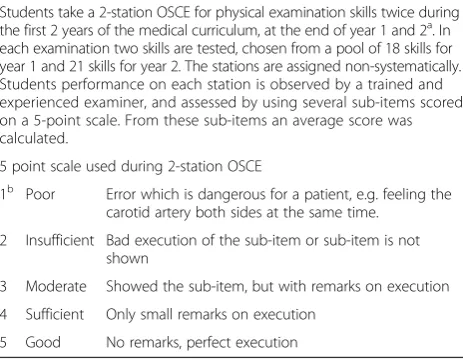
Table 1Details of the 2-station OSCE in year 1 and 2
Students take a 2-station OSCE for physical examination skills twice during the first 2 years of the medical curriculum, at the end of year 1 and 2a. In each examination two skills are tested, chosen from a pool of 18 skills for year 1 and 21 skills for year 2. The stations are assigned non-systematically. Students performance on each station is observed by a trained and experienced examiner, and assessed by using several sub-items scored on a 5-point scale. From these sub-items an average score was calculated.
5 point scale used during 2-station OSCE
1b Poor Error which is dangerous for a patient, e.g. feeling the carotid artery both sides at the same time.
2 Insufficient Bad execution of the sub-item or sub-item is not shown
3 Moderate Showed the sub-item, but with remarks on execution
4 Sufficient Only small remarks on execution
5 Good No remarks, perfect execution
a
At the end of year 2 the basic medical skills are tested in a 1- station OSCE
b
Data-analysis
The distribution of station scores was tested for normality. As this distribution did depart significantly from normality, for the text based preparation group (W = 0.988, df = 554, p < 0.0001), as well as for the e-module preparation group (W = 0.980, df = 502, p < 0.0001); the appropriate test would be a non-parametric test. However, as the data covered a wide range of deci-mal values on the 5-point scale and the distribution was unimodal, we decided nonetheless to perform independ-ent T-tests [11]. A p-value of <0.05 is considered signifi-cant. The within participants comparison is analysed with a pairedT-test.
Results
The total average score of all the separate stations on the OSCE in 2011–2012 and 2012–2013 for year 1 and 2 combined was 3.58 ± 0.67 (n = 2010 individual student scores on station performance). The scores ranged from 2.00 to 5.00. The average score for all stations in 2011– 2012 is 3.51 ± 0.65 (n= 954) and in 2012–2013 3.62 ± 0.69 (n= 1056) (t =−3.68, p < 0,01; Cohen’s d = 0.16). The average was significantly higher in the academic year in which more e-modules were available to prepare for training sessions. In our subsequent analyses we tried to unravel whether this difference could be attributed to the introduction of blended learning.
Comparison of scores for skill stations with e-module preparation and stations with text based preparation (within cohort, different stations)
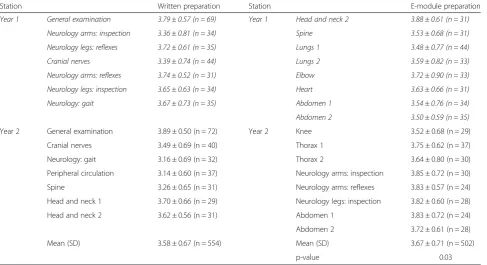
Students from the 2012–2013 cohort obtained an average score of 3.58 ± 0.67 (n= 554) on stations with text based preparation versus 3.67 ± 0.71 (n= 502) on stations with e-module preparation. The average scores of stations with an e-module preparation were significantly higher than the average scores of stations with text based preparation (t = 2.14 p = 0.03; Cohen’s d = 0.13) (see Table 2).
Comparison of scores before and after introduction of mandatory e-module preparation (between cohorts, same station)
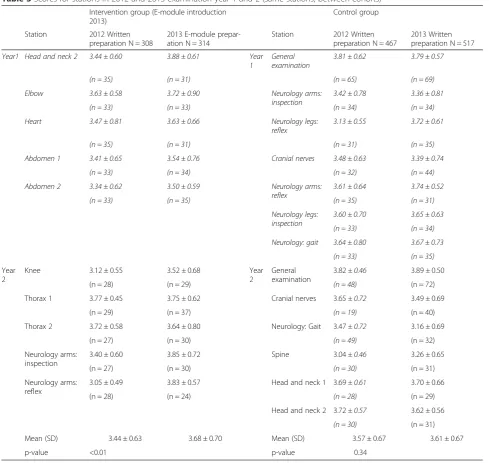
The average score on stations at the 2012 (cohort 2011– 2012) and 2013 (cohort 2012–2013) examination showed that at the 2013 examination, students obtained a higher score on the stations which had moved from text based preparation in 2012 to e-module preparation in 2013; 3.44 ± 0.63 (n= 308) and 3.68 ± 0.70 (n= 314) (t = 4.97 p < 0.01; Cohen’s d = 0.36) respectively. This difference was significant (see Table 3).
The results showed no significant difference between the two cohorts on stations for which students had pre-pared by text based preparation in both academic years, 3.57 ± 0.67 (cohort 2011–2012, n = 467) and 3.61 ± 0.67 (cohort 2012–2013, n = 517), (t = 1.47 p = 0.34) . Thus, the higher score on the stations with e-module preparation
Table 2Scores for stations at 2013 examination year 1 and 2 (different stations, within cohort)
Station Written preparation Station E-module preparation
Year 1 General examination 3.79±0.57 (n = 69) Year 1 Head and neck 2 3.88±0.61 (n = 31)
Neurology arms: inspection 3.36±0.81 (n = 34) Spine 3.53±0.68 (n = 31)
Neurology legs: reflexes 3.72±0.61 (n = 35) Lungs 1 3.48±0.77 (n = 44)
Cranial nerves 3.39±0.74 (n = 44) Lungs 2 3.59±0.82 (n = 33)
Neurology arms: reflexes 3.74±0.52 (n = 31) Elbow 3.72±0.90 (n = 33)
Neurology legs: inspection 3.65±0.63 (n = 34) Heart 3.63±0.66 (n = 31)
Neurology: gait 3.67±0.73 (n = 35) Abdomen 1 3.54±0.76 (n = 34)
Abdomen 2 3.50±0.59 (n = 35)
Year 2 General examination 3.89 ± 0.50 (n = 72) Year 2 Knee 3.52 ± 0.68 (n = 29)
Cranial nerves 3.49 ± 0.69 (n = 40) Thorax 1 3.75 ± 0.62 (n = 37)
Neurology: gait 3.16 ± 0.69 (n = 32) Thorax 2 3.64 ± 0.80 (n = 30)
Peripheral circulation 3.14 ± 0.60 (n = 37) Neurology arms: inspection 3.85 ± 0.72 (n = 30)
Spine 3.26 ± 0.65 (n = 31) Neurology arms: reflexes 3.83 ± 0.57 (n = 24)
Head and neck 1 3.70 ± 0.66 (n = 29) Neurology legs: inspection 3.82 ± 0.60 (n = 28)
Head and neck 2 3.62 ± 0.56 (n = 31) Abdomen 1 3.83 ± 0.72 (n = 24)
Abdomen 2 3.72 ± 0.61 (n = 28)
Mean (SD) 3.58 ± 0.67 (n = 554) Mean (SD) 3.67 ± 0.71 (n = 502)
p-value 0.03
Italics: Year 1
was not a result of the cohort as a whole performing bet-ter on all stations.
Within participants comparison (within student, different stations)
For 332 students we had two station scores with differ-ent preparation: one station with text based preparation and one with e-module preparation. The within-subject comparison showed a station average of 3.50 ± 0.68 for the stations with a text based preparation and an average of 3.60 ± 0.66 for stations with an e-module preparation.
This difference was significant, (t = 2.48 p = 0.01; Cohen’s d = 0.15).
Discussion
Our results showed that students obtained on average a higher score for stations with an e-module preparation be-fore the training session than on stations with text based preparation before the training session. We have confidence in our results, because we performed several comparisons that support this conclusion. To begin with, we demon-strated that students at the 2013 OSCE, when more e-modules were available to prepare for the skills training
Table 3Scores for stations in 2012 and 2013 examination year 1 and 2 (same stations, between cohorts)
Intervention group (E-module introduction 2013)
Control group
Station 2012 Written
preparation N = 308
2013 E-module prepar-ation N = 314
Station 2012 Written
preparation N = 467
2013 Written preparation N = 517
Year1 Head and neck 2 3.44 ± 0.60 3.88 ± 0.61 Year 1
General examination
3.81 ± 0.62 3.79 ± 0.57
(n = 35) (n = 31) (n = 65) (n = 69)
Elbow 3.63 ± 0.58 3.72 ± 0.90 Neurology arms: inspection
3.42 ± 0.78 3.36 ± 0.81
(n = 33) (n = 33) (n = 34) (n = 34)
Heart 3.47 ± 0.81 3.63 ± 0.66 Neurology legs: reflex
3.13 ± 0.55 3.72 ± 0.61
(n = 35) (n = 31) (n = 31) (n = 35)
Abdomen 1 3.41 ± 0.65 3.54 ± 0.76 Cranial nerves 3.48 ± 0.63 3.39 ± 0.74
(n = 33) (n = 34) (n = 32) (n = 44)
Abdomen 2 3.34 ± 0.62 3.50 ± 0.59 Neurology arms: reflex
3.61 ± 0.64 3.74 ± 0.52
(n = 33) (n = 35) (n = 35) (n = 31)
Neurology legs: inspection
3.60 ± 0.70 3.65 ± 0.63
(n = 33) (n = 34)
Neurology: gait 3.64 ± 0.80 3.67 ± 0.73
(n = 33) (n = 35)
Year 2
Knee 3.12 ± 0.55 3.52±0.68 Year
2
General examination
3.82± 0.46 3.89±0.50
(n = 28) (n = 29) (n = 48) (n = 72)
Thorax 1 3.77 ± 0.45 3.75±0.62 Cranial nerves 3.65± 0.72 3.49±0.69
(n = 29) (n = 37) (n = 19) (n = 40)
Thorax 2 3.72 ± 0.58 3.64±0.80 Neurology: Gait 3.47± 0.72 3.16±0.69
(n = 27) (n = 30) (n = 49) (n = 32)
Neurology arms: inspection
3.40 ± 0.60 3.85±0.72 Spine 3.04± 0.46 3.26±0.65
(n = 27) (n = 30) (n = 30) (n = 31)
Neurology arms: reflex
3.05 ± 0.49 3.83±0.57 Head and neck 1 3.69± 0.61 3.70±0.66
(n = 28) (n = 24) (n = 28) (n = 29)
Head and neck 2 3.72± 0.57 3.62±0.56
(n = 30) (n = 31)
Mean (SD) 3.44 ± 0.63 3.68 ± 0.70 Mean (SD) 3.57 ± 0.67 3.61 ± 0.67
p-value <0.01 p-value 0.34
Italics: Year 1
sessions, scored on average higher than at the previous year’s OSCE, when fewer e-modules were available. Though this could theoretically be caused by the 2012–2013 cohort being better in general than its predecessor, within-cohort comparisons also revealed better scores on OSCE stations with e-module preparation than those without. As this comparison included different OSCE stations (different skills), we needed to corroborate these results by investigat-ing OSCE scores of the same skills that moved from text based preparation to e-module preparation between 2012 and 2013 (between cohorts comparison). Again, we found better scores for skills with e-modules than for skills with written assignments. Finally, we compared within partici-pant differences for those students who were tested on one skill with text based preparation versus a second skill with e-modules. Though this comparison involved different skills, the results were in line with the other findings: stu-dents showed better performance on skills for which they had prepared by e-modules. Our findings add to an earlier evaluation of mandatory e-modules as preparation for training sessions, which reports high satisfaction in both students and teachers [12]. In addition to this higher satis-faction, the current study found more objective evidence of e-module preparation actually being more effective in im-proving learning outcomes from skill training sessions.
The 2-station OSCE is a high-stakes examination for which students will prepare extensively. Students must pass this examination before they are allowed to start with
their clinical rotations. In this context, it would not be very realistic to expect large effects of the substitution of text based preparation by mandatory e-modules, which is a relatively small intervention given that students have many more options to practice the skills. Yet, we were still able to demonstrate a significant effect. And although the average improvement may be quantitatively small, ranging from 0.09 (comparison 1) to 0.24 (comparison 2) on a 5-point scale, a difference of this size for the whole cohort may have a relevant impact on numbers of students failing the exam. It might be expected that in a large number of students many students score around the pass/fail cutoff. Therefore, a small improvement can result in an increase in the number of students passing the exam.
It might be argued that our results were an artifact of e-modules being developed for relatively easy skills, on which students already showed better performance across the board. However, our results suggested the opposite, i.e. e-modules were developed for the more difficult sta-tions. In 2011–2012 students obtained lower scores on the OSCE stations for which e-module preparation was devel-oped in 2012–2013 than on the stations for which no e-modules were yet developed in 2012–2013 (Table 3). This was an accidental finding, because there was no fac-ulty policy to prepare e-modules for more difficult skills first, but it substantiated our results. This suggests that our study may underestimate the actual improvement caused by the introduction of e-module preparation.
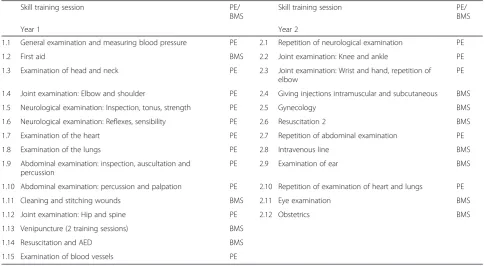
Table 4Skill training sessions year 1 and year 2
Skill training session PE/
BMS
Skill training session PE/
BMS
Year 1 Year 2
1.1 General examination and measuring blood pressure PE 2.1 Repetition of neurological examination PE
1.2 First aid BMS 2.2 Joint examination: Knee and ankle PE
1.3 Examination of head and neck PE 2.3 Joint examination: Wrist and hand, repetition of elbow
PE
1.4 Joint examination: Elbow and shoulder PE 2.4 Giving injections intramuscular and subcutaneous BMS
1.5 Neurological examination: Inspection, tonus, strength PE 2.5 Gynecology BMS
1.6 Neurological examination: Reflexes, sensibility PE 2.6 Resuscitation 2 BMS
1.7 Examination of the heart PE 2.7 Repetition of abdominal examination PE
1.8 Examination of the lungs PE 2.8 Intravenous line BMS
1.9 Abdominal examination: inspection, auscultation and percussion
PE 2.9 Examination of ear BMS
1.10 Abdominal examination: percussion and palpation PE 2.10 Repetition of examination of heart and lungs PE
1.11 Cleaning and stitching wounds BMS 2.11 Eye examination BMS
1.12 Joint examination: Hip and spine PE 2.12 Obstetrics BMS
1.13 Venipuncture (2 training sessions) BMS
1.14 Resuscitation and AED BMS
1.15 Examination of blood vessels PE
PEphysical examination
Our study has a few limitations, though. First, the ideal study design to test an effect of this form of blended learn-ing would be a controlled trial. However, for practical rea-sons such a design would not be possible as it would imply randomly assigning half of the students to an e-module preparation condition, and the other half to a text based condition. Such randomization should be made per training group to optimize expected gain in training time, but in practice students frequently change groups. Besides, students exchange information and it would be impossible to prevent students from using e-modules any-way. In an effort to overcome this limitation, we performed the abovementioned checks on the results. Because the study was not a controlled trial, the OSCE examiners were not blinded with respect to the availability of e-modules for the skills they assessed. Theoretically, whether or not stu-dents had e-module preparation could have influenced the scores the examiners assigned. Four of the seven examiners were also the developers of the e-modules. However, this would be far-fetched, if only because at the time of the examination the examiners were unaware that the results would be used to assess the effectiveness of the preparation for skill training sessions. We have no reason to expect any relationship between e-module preparation and students’ assignment to OSCE stations.
Second, the within student comparison showed better performance on stations which had e-module preparation versus text based preparation. However, it should be noted that the 2 OSCE stations were included in one OSCE time slot. Hence, one skill was always tested first, followed by the second skill. This implied that if a student took much time to perform the first skill, less time would be available to perform the second skill. We found after further analysis of our data that in this comparison, skills with e-module preparation were more often tested first than skills with text based preparation and hence, these latter skills had a somewhat higher probability of not being completed by a student because of lack of time, which might result in poorer performance. In this within participant comparison, our results indeed showed lower performance on skills tested as second station, which can, at least partly, be at-tributed to lack of time to complete the second station. This effect only occurred in the within students compari-son; the other comparisons were not affected by this po-tential bias, because first and second tested skills had equally often e-module and text based preparation.
Third, our intervention can be conceived as the introduc-tion of a form of blended learning, and we cannot distin-guish between the effects of three different aspects of the intervention: the fact that the E-module preparation has been made “obligatory” (i.e. unlike the text based prepar-ation, we checked whether students went through the mod-ule), the richer format and the organization of the e-module (which was quite different from the text based
preparation), and the fact that trainers changed their ap-proach during the actual training sessions when the stu-dents had prepared by e-modules. For example, trainers had a strong impression they had to spend less time explaining the skill to the students and as a result, students had more time available to practice the skills. It is very likely that all these elements, mentioned above, reinforced each other and together contributed positively to the re-sults. That is, we saw a spectacular increase in the number of students who indicated in the student evaluations that they prepared well (from 72 % not preparing to 2 % not pre-paring), and also the time they spent for the preparation in-creased substantially (from an average of 40 min per student in case of text based preparation to 69 min when they used e-modules). In addition, students pointed out receiving im-mediate feedback on their answers as very positive aspect of the e-modules. They missed this in the written assignments of the text based preparation. This could have improved their motivation to prepare more thoroughly. Teacher evalu-ations indicate that the training sessions became more ef-fective, since the students were better prepared and more motivated, because they were already familiar with the phys-ical examination skills, at least at a theoretphys-ical level. Thus, it remains an open question what caused the improvement, whether it was the content of the e-modules or some collat-eral factor, such as motivation or time on task.
Skills education has an important place in medical edu-cation. With the growing attention to the importance of patient safety and qualified personnel in healthcare, its role is expected to increase even further. Extensive practical skills training is often limited due to resources; this type of education has a high teacher-student ratio and is resource intensive. Increasing the effectiveness of skills training without prolonging costly training time, can therefore be very valuable for medical education. Our results show obligatory e-modules before practical skills training ses-sions improves learning of physical examination skills in first and second year medical students, and hence contribute to better preparation of students for their first clerkships. Based on these results it is certainly worthwhile for medical faculties to consider introdu-cing a blended learning approach for practical skills training to enhance efficient use of this time and labour intensive type of education.
Further research is needed to answer the question whether the improved performance is due to the content of the e-modules or to their obligatory character and to find the most effective and efficient way to teach prac-tical medical skills.
Conclusion
Appendix
Overview of skill training sessions in the medical cur-riculum UMC Utrecht Faculty of Medicine in year 1 and 2: 16 physical examination training sessions and 11 other basic medical skills training sessions (see Table 4).
Competing interests
The authors declare that they have no competing interests.
Authors’contributions
All authors contributed substantially to the conception and design of the study. KK acquired all data. KK, EC and MK were involved with the analysis and interpretation of the data. KK, EC and MK wrote the first draft of the manuscript. All authors contributed to the revision of the paper and approved the final manuscript for submission.
Authors’information
KK, MD, is teacher at the Department Clinical Skills Training and teaches physical examination skills and other basic medical skills to medical students at the Utrecht Faculty of Medicine.
EC, PhD, is medical education researcher, Center for Research and Development of Education, University Medical Center, Utrecht, The Netherlands.
FJ, MD, is team-coordinator and teacher at the Department Clinical Skills Training and teaches physical examination skills and other basic medical skills to medical students at the Utrecht Faculty of Medicine.
MK, PhD, is Head of the Department Clinical Skills Training and Educational Director Clinical Health Sciences. She has a background in epidemiology & medical education, and is involved in many innovation projects a.o. E-module development. She is active in teacher training and member of the board for teaching qualifications UMCU.
Acknowledgements
The authors thank Sjoukje van den Broek, Inge de Klerk-van der Wiel and Abel van de Ven for their thoughtful comments on the article.
Author details
1
Department Clinical Skills Training, University Medical Center Utrecht, HB Building 3.06, P.O. Box 85500, 3508 Utrecht, GA, The Netherlands.2Center for Research and Development of Education, University Medical Center Utrecht, HB Building 4.05, P.O. Box 85500, 3508 Utrecht, GA, The Netherlands.
Received: 27 November 2014 Accepted: 12 May 2015
References
1. Bains M, Reynolds PA, Mcdonald F, Sherriff M. Effectiveness and acceptability of face-to-face, blended and e-learning: A randomised trial of orthodontic undergraduates. Eur J Dent Educ. 2011;15(2):110–7.
2. Chumley-Jones HS, Dobbie A, Alford CL. Web-based learning: Sound educational method or hype? A review of the evaluation literature. Acad Med.
2002;77(10):S86–93.
3. Lahti M, Hatonen H, Valimaki M. Impact of e-learning on nurses’and student nurses knowledge, skills, and satisfaction: A systematic review and meta-analysis. Int J Nurs Stud. 2014;51(1):136–49.
4. Ruiz JG, Mintzer MJ, Leipzig RM. The impact of e-learning in medical education. Acad Med. 2006;81(3):207–12.
5. Cook DA, Levinson AJ, Garside S, Dupras DM, Erwin PJ, Montori VM. Internet-based learning in health professions: a meta-analysis. JAMA. 2008;300(10):1181–96.
6. Bloomfield JG, Jones A. Using e-learning to support clinical skills acquisition: exploring the experiences and perceptions of graduate first-year pre-registration nursing students - a mixed method study. Nurse Educ Today. 2013;33(12):1605–11.
7. Arroyo-Morales M, Cantarero-Villanueva I, Fernandez-Lao C, Guirao-Pineyro M, Castro-Martin E, AZ-Rodriguez L. A blended learning approach to palpation and ultrasound imaging skills through supplementation of traditional classroom teaching with an e-learning package. Man Ther. 2012;17(5):474–8.
8. Orientale J, Kosowicz L, Alerte A, Pfeiffer C, Harrington K, Palley J, et al. Using web-based video to enhance physical examination skills in medical students. Fam Med. 2008;40(7):471–6.
9. Duvivier RJ, van Geel K, van Dalen J, Scherpbier AJ, van der Vleuten CP. Learning physical examination skills outside timetabled training sessions: what happens and why? Adv Health Sci Educ Theory Pract. 2012;17(3):339–55. 10. Rudland J, Wilkinson T, Smith-Han K, Thompson-Fawcett M. You can do it
late at night or in the morning. You can do it at home, I did it with my flatmate. The educational impact of an OSCE. Med Teach. 2008;30(2):206–11. 11. Norman G. Likert scales, levels of measurement and the“laws”of statistics.
Adv Health Sci Educ. 2010;15:625–32.
12. van de Ven A, Jongen-Hermus F, Slond F, van der Plank LO, Kluijtmans M: E-learning binnen het praktisch Lijnonderwijs (PLO) UMC Utrecht. Resultaten van het evaluatieonderzoek (E-learning in practical skills training sessions at UMC Utrecht. Results of an evaluation study). Paper presented at the annual meeting of the Dutch Society of Medical Education (NVMO). Abstract retrieved from http://www.nvmo.nl/resources/js/tinymce/plugins/imagema nager/files/PDF_versie_abstractboek_28-09-2012.pdf.
Submit your next manuscript to BioMed Central and take full advantage of:
• Convenient online submission • Thorough peer review
• No space constraints or color figure charges • Immediate publication on acceptance
• Inclusion in PubMed, CAS, Scopus and Google Scholar
• Research which is freely available for redistribution