Volume -2, Issue-2,March – April- 2016, Page No. 01-08
Pag
e1
Study of Various Filters for Removal Noise from RSI Using Matlab Simulation
1Nadeem Ahmad, 2Rakesh Jain 1
M.Tech. Scholar, 2 Assistant Professor
Department of Electronics & communication Engineering Suresh Gyan Vihar University, Jaipur (Rajasthan), India
E-Mail: [email protected], [email protected] Abstract
This paper attempts to undertake the study of some nonlinear and adaptive digital image filtering algorithms have been developed additive white Gaussian Noise(AWGS), Salt and Pepper Noise(SPN), Shot Noise (Poisson noise), Speckle Noise. In this paper a comparative study among four types of noise removal filters is carried out. THE investigated filters are Average Filter, Weiner Filter, and Median Filter. The comparative study is conducted with the help of Mean Square Errors (MSE) and Peak-Signal to Noise Ratio (PSNR). To send visual digital images are a major issue in the modern data communication network. The images sent from sender end may not be the same at the receiving end. The image obtained after transmission is often corrupted with noise. A noise is introduced in the transmission medium due to a noisy channel, errors during the measurement process and during quantization of the data for digital storage. The image received at the receiving end needs processing before it can be used for further applications. To restore the original image at the receiver end is the challenging task for the researchers. Noise can degrade the images at the time of capturing or transmission of the image. Before applying image processing tools to an image, noise removal from images is done at highest priority. Key Words: Filter, RSI, MATLAB, PSNR, AWGS, SPN, MSE, Signal.
1. Introduction
Is the study of digital image processing, electronics and communications engineering, consumer and entertainment electronics, control and instrumentation promising, biomedical instrumentation, remote sensing one, robotics and computer vision and computer-aided manufacturing (CAM) field area. For a meaningful and useful process, such as image segmentation and object recognition, and there are like TV, camera phones and other applications very good visual display, an image signal obtained must go fuzzy, and made no noise. To blur and noise suppression (filtering) to the next general class called image restoration image processing tasks.
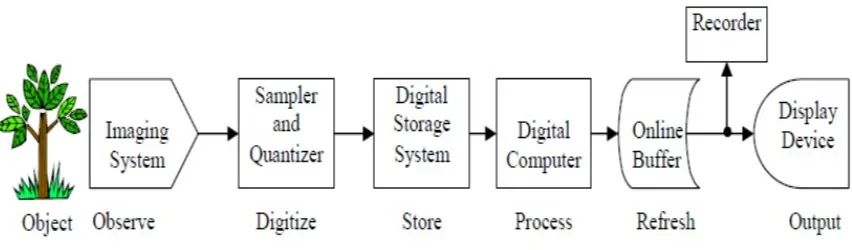
Figure 1: A typical digital image processing system
In this paper, various noise environments research and design a number of effective, linear, to adapt to the digital image filter to suppress the increase of white Gaussian noise (AWGN), bipolar electrostatic noise impact worth , also known as
impulse noise (SPN), random noise value of the pulse (RVIN), Shot Noise (Poisson noise), Speckle Noise mixing and
noise (MN) is very effective. The purpose of the development of Internet filters in real-time applications, such as television, telephone and pictures.
e2 e2 e2 e2 e2 e2 e2 e2 e2
e2
e2
e2
e2 e2 e2 e2 e2 e2 e2 e2
e2
geographical mapping, prediction of agricultural crops, urban growth, weather, flood and fire control etc. Space image application includes recognition and analysis of objects in the images, obtained from deep space-probe missions.
3. Image Noise: Noise is any undesired information that contaminates an image. Noise appears in image from various sources. The digital image acquisition process, which converts an optical image into a continuous electrical signal that is then sampled, is primary process by which noise appears in digital image. There are several ways through which noise can be introduced into an image, depending on how the image is created. Satellite image, containing the noise signals and lead to a distorted image and not being able to understand and study it properly, requires the use of appropriate filters to limit or reduce much of the noise. It helps the possibility of better interpretation of the content of the image.
3.1 Gaussian Noise:- This type of noise is also called the Gaussian noise or normal noise is randomly occurs as white intensity values.
The PDF of a Gaussian random variable, z is given by:
P (z) = 1/ √(2πσ)e-(z-µ)²/2σ²….. (i)
Where z represents gray level, μ is the mean of average value of z, and σ is its standard deviation. The standard deviation
squared, σ² is called the variance of z. Because of its mathematical tractability in both the spatial and frequency domains,
Gaussian (also called normal) noise models are frequently used in practice. In fact, this tractability is so convenient that it often results in Gaussian models being used in situations in which they are marginally applicable at best.
3.2 Impulse (Salt-and-Pepper) Noise:- This type contains random occurrences of both black and white intensity values, and often caused by threshold of noise image.
The PDF of impulse noise is given by:
If b > a, gray-level b will appear as a light dot in the image.
Conversely lava will appear like a dark dot. If either Pa or Pb is zero, the impulse noise is called unipolar. If neither probability is zero and especially if they are approximately equal impulse noise values will resemble salt-and-pepper granules randomly distributed over the image. For this reason bipolar impulse noise is also called salt-and-peppernoise. Shot and spike noise terms are also used to refer this type of noise. Noise impulses can be negative or positive. Scaling usually is part of the image digitizing process. Because impulse corruption usually is large compared with the strength of the image signal, impulse noise generally is digitized as extreme (pure white or black) values in an image. Thus the assumption usually is that a and b are “saturated” values in the sense that they are equal to the minimum and maximum allowed values in the digitized image. As a result, negative impulses appear as black (pepper) points in an image. For the same reason, positive impulses appear white (salt) noise. For an 8-bit image this means that a = 0 (black) and b = 255 (white).
Pag e3 Pag e3 Pag e3 Pag e3 Pag e3 Pag e3 Pag e3 Pag e3 Pag e3 Pag e3 Pag e3 Pag e3 Pag e3 Pag e3 Pag e3 Pag e3 Pag e3 Pag e3 Pag e3 Pag e3 Pag e3
occurrence of independent random events, are of significance. Magnitude of this noise increase with the average magnitude of the current or intensity of the light.
3.4 Speckle Noise:- Speckle noise is multiplicative noise unlike the Gaussian and salt pepper noise. This noise can be modeled by random vale multiplications with pixel values of the image and can be expressed as
P = I + n × I (iii)
Where P is the speckle noise distribution image, I is the input image and n is the uniform noise image by mean o and variance v. Speckle noise is commonly observed in radar sensing system, although it may appear in any type of remotely sensed image utilizing coherent radiation. Like the light from a laser, the waves emitted by active sensors travel in phase and interact minimally on their way to the target area. Reducing the effect of speckle noise permits both better discrimination of scene targets and easier automatic image segmentation.
4. Noise Removal Techniques: Image de-noising is very important task in image processing for the analysis of images. One goal in image restoration is to remove the noise from the image in such a way that the original image is discernible. In modern digital image processing data de-noising is a well- known problem and it is the concern of diverse application areas. Image de-noising is often used in the field of photography or publishing where image was somehow degraded but needs to be improved before it can be printed. When we have a model for the degradation process, the inverse process can be applied to the image to restore it back to the original form.
There are two types of noise removal approaches (i) linear filtering (ii) nonlinear filtering.
Linear Filtering:- Linear filters are used to remove certain types of noise. These filters remove noise by convolving the original image with a mask that represents a low-pass filter or smoothing operation. The output of a linear operation due to the sum of two inputs is the same as performing the operation on the inputs individually and then summing the results. These filters also tend to blur the sharp edges, destroy the lines and other fine details of the image. Linear methods are fast but they do not preserve the details of the image.
Non-Linear Filtering:- Non- linear filter is a filter whose output is not a linear function of its inputs. Non-linear filters preserve the details of the image. Non-linear filters have many applications, especially removal of certain types of noise that are not additive. Non-linear filters are considerably harder to use and design than linear ones.
4.1 Average Filter:- Mean filter is an averaging linear filter. Here the filter computes the average value of the corrupted image in a pre-decided area. Then the center pixel intensity value is replaced by that average value. This process is repeated for all pixel values in the image. Show the effect of using mean filter of size 5X5 on different types of noise.
4.2 Weiner Filter: Wiener Filter (WF) changes its behavior based on the statistical characteristics of the image inside the filter window. Adaptive filter performance is usually superior to non-adaptive counterparts. But the improved performance is at the cost of added filter complexity. Mean and variance are two important statistical measures using which adaptive filters can be designed.
e4 e4 e4 e4 e4 e4 e4 e4 e4
e4
e4
e4
e4 e4 e4 e4 e4 e4 e4 e4
e4
pixel is variable. This variation depends on the median of the pixels in the present window. If the median value is an impulse, then the size of the window is expanded.
5. Experiments Verifications
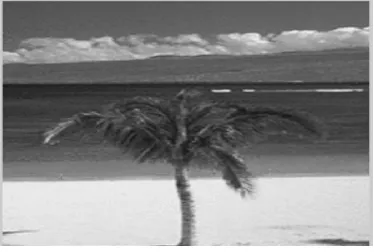
5.1. Testing Procedure:- The filters were implemented using (MATLAB R2013a) and tested Four types of noise: Additive White Gaussian Noise(AWGS), Salt and Pepper Noise(SPN), Shot Noise (Poisson noise), Speckle Noise Corrupted on the Tree image illustrated in the Fig. 1.
Figure 2: Tree Image
For this image, its performance for (AWGN), (SPN), (SN) and (SPKN), noise with probabilities from 1% to 50%. Three types of filters are implemented. Average Filter, Weiner Filter, Median Filter.
5.2 Simulation Results: Intensive simulations were carried out using one monochrome satellite images are chosen for demonstration. The performance evaluation of the filtering operation is quantified by the PSNR (Peak Signal to Noise Ratio) and MSE (Mean Square Error) calculated using formula:
Where,
Where, M and N are the total number of pixels in the horizontal and the vertical dimensions of image. g denotes the Noise image and f denotes the filtered image.
TABLE: 1 Comparison of PSNR and MSE in Gaussian Noise by filter in 10%
FILTER PSNR VALUE MSE VALUE
Average 31.422 47.2330
Winner 32.286 37.8279
Pag
e5
Pag
e5
Pag
e5
Pag
e5
Pag
e5
Pag
e5
Pag
e5
Pag
e5
Pag
e5
Pag
e5
Pag
e5
Pag
e5
Pag
e5
Pag
e5
Pag
e5
Pag
e5
Pag
e5
Pag
e5
Pag
e5
Pag
e5
Pag
e5
Figure 3: Noise mixed in 10%
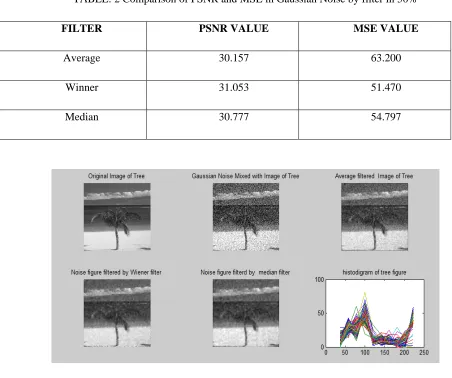
TABLE: 2 Comparison of PSNR and MSE in Gaussian Noise by filter in 50%
FILTER PSNR VALUE MSE VALUE
Average 30.157 63.200
Winner 31.053 51.470
Median 30.777 54.797
e6 e6 e6 e6 e6 e6 e6 e6 e6
e6
e6
e6
e6 e6 e6 e6 e6 e6 e6 e6
e6
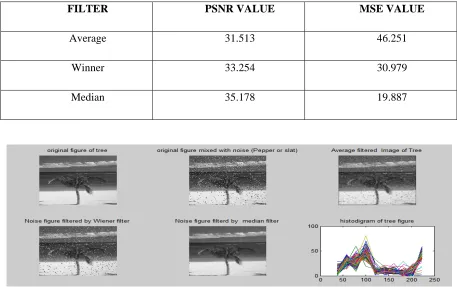
TABLE: 3 Comparison of PSNR and MSE in Salt and Pepper Noise by filter in 50%
FILTER PSNR VALUE MSE VALUE
Average 31.513 46.251
Winner 33.254 30.979
Median 35.178 19.887
Figure 5: Noise mixed in 50%
TABLE: 4 Comparison of PSNR and MSE in spackle Noise by filter in 5%
FILTER PSNR VALUE MSE VALUE
Average 28.279 97.394
Winner 28.646 89.505
Pag
e7
Pag
e7
Pag
e7
Pag
e7
Pag
e7
Pag
e7
Pag
e7
Pag
e7
Pag
e7
Pag
e7
Pag
e7
Pag
e7
Pag
e7
Pag
e7
Pag
e7
Pag
e7
Pag
e7
Pag
e7
Pag
e7
Pag
e7
Pag
e7
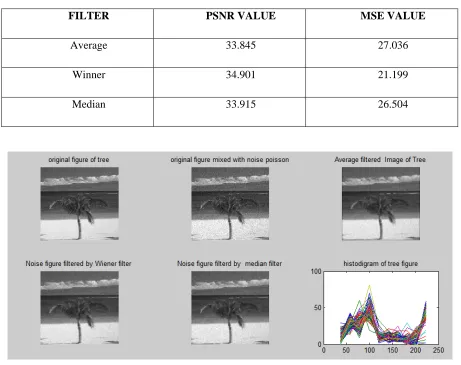
TABLE: 5 Comparison of PSNR and MSE in Poisson Noise by filter
FILTER PSNR VALUE MSE VALUE
Average 33.845 27.036
Winner 34.901 21.199
Median 33.915 26.504
Figure 7: Noise mixed in poison
6. Conclusion: In this pepper, various types of the noise in a digital image and their sources, the practical noise levels, and the
range of the noise power in a practical picture are studied. Then, the types of noise and the noise levels are studied for the
communication applications like television and the photo-phones. For the real-time applications, effort has been made to
develop the efficient nonlinear filters to suppress the AWGN, SPN, Poisson, Spackle RVIN and the MN. Image signal is
transmitted in the analog form; the noise should be a mixed version of AWGN and the SPN. On the other hand, if the image
signal is transmitted in the digital form, then the received signal is corrupted with the RVIN. So, many efficient filters are
proposed to suppress MN and the RVIN quite effectively without blurring the edges and without distorting the fine-details of
the picture. The proposed filtering schemes are meant for the real-time applications.
Various approaches adopted to achieve these goals are:
(a)The Median filters also provide better results for Gaussian noise and the Poisson noise. In this thesis PSNR and the
RMSE has been used as the comparison parameters.
(b) We have implemented the above mentioned filter in Matlab to recover the picture degraded by Gaussian noise and the
Poisson noise.
e8 e8 e8 e8 e8 e8 e8 e8 e8
e8
e8
e8
e8 e8 e8 e8 e8 e8 e8 e8
e8
7. References
[1]. Nichol, J.E. and Vohra, V., Noise over water surfaces In Landsat TM images, International Journal of Remote
Sensing, Vol.25, No.11, 2004, PP.2087 - 2093.
[2]. Mr. F. N. Hasoon, Weight Median Filter Using Neural Network for Reducing Impulse Noise,M.S.thesis,Department
Computer Sciences, University of Putra,Putra, Malaysia,2008.
[3]. D.Dhanasekaran, K. Bagan, High Speed Pipeline Architecture for Adaptive Median Filter, European Journal of
Scientific Research, Vol.29, No.4, 2009, PP.454-460.
[4]. R.C.Gonzalez and R.E. Wood, Digital Image Processing, Prentice-Hall, India, Second Edition, 2007.
[5]. Mr. Salem Saleh Al-amr, Dr. N.V. Kalyankarand Dr. Khamitkar S.D A Comparative Study of Removal Noise from
Remote Sensing Image IJCSI International Journal of Computer Science Issues, Vol. 7, Issue. 1, No. 1, January 2010.
[6]. F. Russo and G. Ramponi, "A Fuzzy Operator for the Enhancement of Blurred and Noisy Images", IEEE Trans.on
Image Processing, vol.4, no.8, August, 1995.
[7]. T. Chen, H. R. Wu, “Space variant Median Filters for restoration of Impulse Noise Corrupted images”, IEEETrans.
on Circuits and Systems – II,AnalogandDigital Signal Processing, August, 2001, vol. 48, no. 8, pp. 784-789.
[8]. Eng. Mohamed Ahmed Ali ,Dr. Fawzy Eltohamy ,Dr.Mahmoud Safwat ,Dr. GoudaI.Salama A comparative study of
noise removal from High Resolution Remote Sensing Images IJITE Vol.03 Issue-06, (June, 2015) ISSN: 2321-1776.
[9]. Mrs. C. Mythili, Dr. V. Kavitha, “Efficient Technique for Color Image Noise Reduction”, IJJ The Research Bulletin