Abstract :
The randomness of the communication channel leads to random fluctuation in the received signal. This fluctuation known as fading. Fading is a major problem in wireless communication because of this fading we cannot get exact signal at the receiver side. The wireless channel is non stationary and noisy due to fading and interference. The transmitting signal in wireless channel suffers from two main categories, propagation effects which are large scale fading and small scale fading effects. To improve the signal performance diversity technique is being used. Diversity conveying information through multiple independent random fades. Diversity technique uses multiple-input and multiple output (MIMO) concepts to overcome the problem of fading and interference in a wireless channel. Space time coding arises from a technique known as diversity. MIMO system enables increased spectral efficiency. This paper presents the progress made towards determining the capacity and diversity benefits of multiple antennas under different assumptions about the underlying channel. Simulations suggest that the resulting codes allow for effective high-rate data transmissions in multiple antenna communication systems. Rayleigh channel model and evaluate its performance in term of BER. Finally, the simulation results will be used to analyze and compare their performance. Through work, it is investigated and demonstrated that significant gains can be achieved by increasing the number of transmit antennas. We provided a space time codes for transmission using multiple transmit antennas. The encoding and decoding of these codes have low complexity. It is essential to observe that the two, three, and four transmit antennas schemes shows no error at any value of SNR.The research will be conducted in MATLAB environment.
Keywords: Diversity, space-time code, fading channels, wireless communications.
1. Introduction
The Largest obstacle facing designers of wireless communication systems are the random nature of the wireless propagation Channel. The transmitting signal in wireless channel suffers from two main categories, propagation effects which are large scale fading and small scale fading effects [1].
Large-scale fading effects
The loss of transmitting signal power due to distance between transmitting node and receiving node, also called path loss and measured in decibel (dB) ratio between transmitting and receiving power. The path loss is proportional to the distance; it means attenuation increases as the signal propagates from the transmitter to receiver [2]. This degradation occurs slowly in time and phase over the distance classified as large scale propagation effects. These variations occur over distances of hundreds of meters and involve variation up to around 20dB.
Small-scale fading effects
Fig. 1. Signal Propagation over a wireless channel
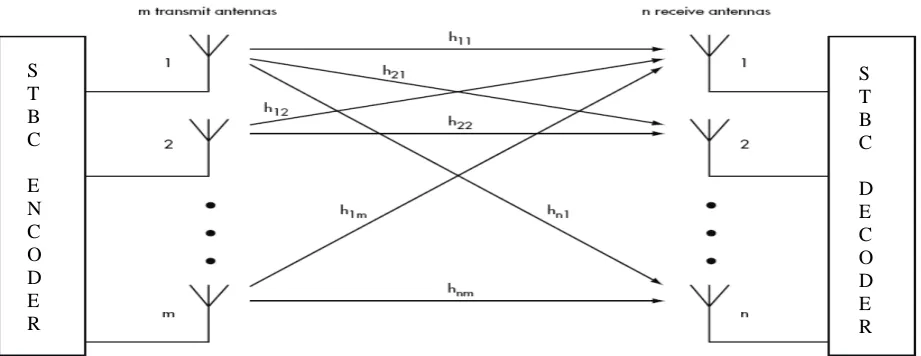
Recent multiple-input-multiple-output (MIMO) wireless systems can significantly improve the system performance [3]. MIMO technology has thus potential to provide improvements towards wireless communications. However, MIMO systems have increased complexity and cost compared to traditional single input single-output (SISO) systems. While additional antenna elements (dipole antennas) are inexpensive and give us better performance. MIMO systems with Nt transmit and Nr receive antennas gives a complete RF chains at the transmitter and the receiver.
As we know, STC system also referred to as multiple-input multiple-output (MIMO) system uses at both the transmitter and receiver ends of a wireless communication system to improve communication performance [4]. MIMO wireless technology exploits multipath propagation to improve the quality of service measures such as the bit error rate (BER) or the data rate (bits/sec). In other words, MIMO effectively takes advantage of random fading and multipath delay spread to increase the data transfer rate. The ST code design, a major challenge in MIMO systems, involves finding an optimal way of encoding and transmitting multiple copies of a data stream across multiple antennas to improve the rate and reliability of data transfer.
Different smart antenna architectures provide different benefits which can be broadly classified as Array gain, Diversity gain, Multiplexing gain and Interference reduction [5]. The signaling strategy at the transmitter and the corresponding processing at the receiver are designed based on link requirements (data rate, range, reliability etc.). For example, in order to increase the point- to- point spectral efficiency (in bits/sec/Hz) between a transmitter and receiver, multiplexing gain is required which is provided by the MIMO architecture. The signaling strategy also depends on the availability of channel information at the transmitter.
2. MIMO System Model
[8]. In the simulation, QPSK modulation was used, and there is perfect channel state information at receiver.
3.1. BER performance of STBC for uncoded
Fig.3. The BER performance curve of STBC for uncoded.
EbNo =
0 2 4 6 8 10 12 14 16 18 20
BER_uncoded =
Columns 1 through 9
0.1832 0.1472 0.1132 0.0826 0.0579 0.0392 0.0264 0.0171 0.0112
Columns 10 through 11
3.2. Two Transmit Antennas and One Receive Antenna
Fig.4. The BER performance curve of STBC for nTX = 2 and nRX = 1.
EbNo =
0 2 4 6 8 10 12 14 16 18 20
BER =
Columns 1 through 9
0.1862 0.1395 0.0945 0.0578 0.0329 0.0171 0.0084 0.0035 0.0016
Columns 10 through 11
0.0007 0.0003
3.3. Three Transmit Antennas and Two Receive Antenna
Fig.5. The BER performance curve of STBC for nTX = 2 and nRX = 1.
Fig.6. The BER performance curve of STBC for nTX = 4 and nRX = 2
EbNo =
0 2 4 6 8 10 12 14 16 18 20
BER =
Columns 1 through 9
0.0626 0.0225 0.0059 0.0011 0.0001 0 0 0 0
Columns 10 through 11
0 0
3.5 Comparison of the STBC Designs with different numbers of transmitting and receiving antennas
Space-time code design, which minimizes the error that arises due to fading. The new orthogonal design has many advantages over the conventional code that has been used so far. Clearly, the new orthogonal design has a greater rate than the conventional code. Consequently, the new high rate orthogonal design can achieve bigger diversity gain by transmitting additional two more information symbols.
Fig.7. The BER performance curve of STBC for uncoded, nTX = 2, 3, and 4, nRX= 1, 2 and 2.
4. Simulation Results for same numbers of transmitting and receiving antennas
Simulation results for the performance of STBC on a Rayleigh fading channel will be presented here. In the simulation, QPSK modulation was used, and there is perfect channel state information at receiver. The bit error rate (BER) for STBC when there is 2, 3, and 4 transmitting antennas and receiving antennas are shown in Figure 12. Also, the performance of an un-coded QPSK is plotted in the figures for comparison. These figures show that there is improvement between coded and un-coded, and also when number of transmitting antennas and receiving antennas increases.
4.1. BER performance of STBC for uncoded
Fig.8. The BER performance curve of STBC for uncoded.
EbNo =
0 2 4 6 8 10 12 14 16 18 20
Fig.9. The BER performance curve of STBC for nTX = 2 and nRX = 2.
EbNo =
0 2 4 6 8 10 12 14 16 18 20
BER =
Columns 1 through 9
0.1874 0.1376 0.0950 0.0580 0.0317 0.0166 0.0085 0.0038 0.0018
Columns 10 through 11
0.0007 0.0003
4.3. Three Transmit Antennas and Three Receive Antenna
EbNo =
0 2 4 6 8 10 12 14 16 18 20
BER =
Columns 1 through 9
0.0245 0.0066 0.0010 0.0001 0 0 0 0 0
Columns 10 through 11
0 0
4.4. Four Transmit Antennas and Four Receive Antenna
Fig.11. The BER performance curve of STBC for nTX = 4 and nRX = 4.
EbNo =
0 2 4 6 8 10 12 14 16 18 20
BER =
Columns 1 through 8
0.0078 0.0011 0.0001 0 0 0 0 0
Columns 9 through 11
. Fig.12. The BER performance curve of STBC for uncoded, nTX = 2, 3, and 4, nRX= 2, 3 and 4.
In this paper it is investigated and demonstrated that significant gains can be achieved by increasing the number of transmit antennas as shown in Figure 3.4.e. We provided a space-time codes for transmission using multiple transmit antennas. The encoding and decoding of these codes have low complexity. It’s essential to observe that the two, three, and four transmit antennas schemes shows that error reduced at any value of SNR. We also observe that the bit error rate reduced by using same numbers of transmitting and receiving antennas as shown in Fig.12. By comparing these two figures that is Fig.7. and Fig.12., we observe that we get better performance when we used same number of transmitting and receiving antennas.
5. Conclusion and Future Considerations
In this paper, we consider the effect of spatial and temporal correlation in channel on space-time codes. We give analysis for the special case of coded space-time block transmission. We compare the analytical bounds with simulation results. One of the direct extensions of this work can be design of space-time codes for spatially correlated channels. One of the interesting observations is the destruction of uniform error probability property of space-time trellis codes in presence of antenna correlation. It is possible to design space-time trellis codes that preserve uniform error probability property even under spatial correlation.
6. References
[1] “The application of orthogonal designs to wireless communication,” in Proc. IEEE Information Theory Workshop, Killarney, Ireland, June 1998, pp. 46–47.
[2] J. G. Proakis, “Digital Communications through Fading Multipath Channels,” in Digital Communications, 4th ed.: McGraw-Hill, 2001, ch. 14, pp. 800-896.
[3] V. Tarokh, N. Seshadri and A. R. Calderbank, Space-Time Codes for High Data Rate Wireless Communication: Performance Criterion and Code Construction", IEEE Trans. Inform. Theory, Vol. 44(2), pp. 744-765, March 1998
[4] J. Paulraj, D. A. Gore, and R. U. Nabar, Introduction to space-time wireless communications. Cambridge: Cambridge University Press, 2003.
[5] S. M. Alamouti, “A simple transmitter diversity scheme for wireless communications,” IEEE J. Select. Areas Commun., vol. 16, pp. 1451-1458, Oct. 1998.
[6] L.-Y Song, and A. Burr, “Successive interference cancellation for space-time block codes over time selective channels,” IEEE Comm. Letters, vol 10, no. 12, pp 837-839.
[7] Vahid Tarokh, Hamid Jafarkhani, and A. Robert Calderbank, “Space–time block coding for wireless communications: performance results,” IEEE J. on Selected Areas in Commun., vol. 17, pp. 451–460, Mar. 1999.