Resource Evaluation for Usable Speech Interfaces:
Utilizing Human – Human Dialogues
Pepi Stavropoulou
1,3, Dimitris Spiliotopoulos
2, Georgios Kouroupetroglou
11
Department of Informatics and Telecommunications National and Kapodistrian University of Athens Panepistimiopolis, Ilisia, GR-15784, Athens, Greece
E-mail: {pepis, koupe}@di.uoa.gr
2
Athens Technology Centre
Rizariou 10, Chalandri, GR-15233, Athens, Greece E-mail: [email protected]
3
Omilia Ltd
Konitsis 3-5, Marousi GR-15125, Greece
Abstract
Human-human spoken dialogues are considered an important tool for effective speech interface design and are often used for stochastic model training in speech based applications. However, the less restricted nature of human-human interaction compared to human-system interaction may undermine the usefulness of such corpora for creating effective and usable interfaces. In this respect, this work examines the differences between corpora collected from human-human interaction and corpora collected from actual system use, in order to formally assess the appropriateness of the former for both the design and implementation of spoken dialogue systems. Comparison results show that there are significant differences with respect to vocabulary, sentence structure and speech recognition success rate among others. Nevertheless, compared to other available tools and techniques, human-human dialogues may still be used as a temporary at least solution for building more effective working systems. Accordingly, ways to better utilize such resources are presented.
Keywords: Spoken Dialog Interfaces, Resources for Language Modeling, Human-Human Dialogue.
1.
Introduction
Commercial Spoken Dialogue Systems may range from simple directed dialogue applications involving a primarily menu driven interface, where the user navigates through a menu of options, to open-ended natural language conversational systems. The latter are commonly used for large scale applications, and are targeted for user satisfaction and naturalness, as they allow the user to respond in a more natural, “in his own words” way. Whether it is a directed dialogue or a more elaborate open-ended conversational system, there are three generally acknowledged major steps in the process of building such a system (Cohen et al., 2004):
Design: Requirements Analysis and High-Level Design, Detailed Design
Implementation, iterative testing and deployment: Testing and development of system components (Automated Speech Recognition (ASR) Module, Natural Language Understanding (NLU) Module, Dialogue Manager (DM), Language Generation Module, Text to Speech Synthesizer)
Evaluation
Empirical approaches involving the collection and analysis of “in domain” spoken corpora are commonly employed throughout these steps especially in the case of
open ended natural language systems, where such corpora are necessary for design issues as well as the development of statistical language models for ASR, input classifiers for NLU, other machine learning modules for dialogue management, user simulation and so on.
More specifically, during the early design cycle, analysis of such corpora may provide insights in the vocabulary used, the nature of the interaction, user’s attitude and mental model of the task in general. They are, therefore, very important for the development of grammars later on – providing the list of slots and meaningful key-words – as well as the design of the dialogue flow and the prompt specification. The latter is particularly important taking into account that the success of a speech based application greatly depends on the correspondence between the “natural” mental model that first time users bring to the interaction and the proposed model afforded by the design of the interface (Norman, 1988; Galitz, 2007; Weinschenk, 2000). Even by simply adjusting the wording of the prompts to conform with user discourse patterns, the ease of use and clarity of the interface may be significantly improved. In short, corpus analysis comprises a significant aspect of user-centred design, and is, thus, of great significance when it comes to creating a usable, user-friendly application.
WSystem corpus are safely comparable, as they consist of the same number of tokens.
Tokens/Turn
Mean
Tokens
/Turn
SD
Type/Token
Ratio
Number
of Types
(Vocab.
Size)
Agent
Corpus
15.77 9.22 7.8% 2587
TSystem
Corpus
5.00 4.58 9.8% 1032
WSystem
Corpus
4.85 4.45 5.4% 1781
Table 1. Lexical analysis results
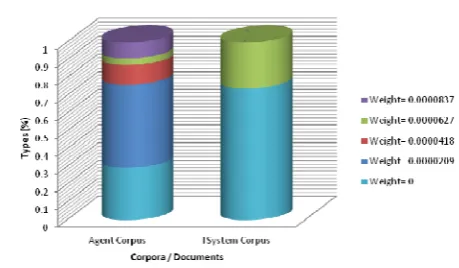
In addition, the --IDF measure (Figures 1 and 2) revealed a significant percentage of highly weighted terms differentiating the Agent corpus from the rest (~70% and 59% when compared to the TSystem and WSystem corpus respectively). Several of these terms – e.g. “obviously”, “firstly”, “therefore”, “last year” – are not identified as key-words and are not important for succesful call routing. On the other hand, most terms in the System corpora are included in the Agent corpus; 74% and 60% of the total number of types in the TSystem and WSystem respectively are assigned a zero value.
This percentage is expected to increase for non-inflectional languages or similarly for inflectional languages if lemmas instead of word forms are taken into account (stem based approach). Overall, results suggest that the Agent corpus may achieve adequate coverage of real use key-words - especially when the size of the corpus increases - but at the same it displays an unnecessary increase in the size of the model’s vocabulary. And a larger vocabulary size typically results in a decrease in ASR success rate.
Fig. 1 TF-IDF measure - Agent and TSystem corpus compared: Distribution of weights among word types in each corpus
Fig. 2 TF-IDF measure - Agent and WSystem corpus compared: Distribution of weights among word types in each corpus
Table 2 shows the Part of Speech distribution for the most important tag subsets. The most striking difference is the high percentage of nouns of the System corpora compared to the Agent corpus. In contrast, the percentage of verbs is higher for the Agent corpus. Note that noun phrases, as opposed to verb phrases, are commonly used for brevity, conciseness and compactness of expression, as proven by the wide use of noun phrases and nominalizations in captions and titles. Given that nouns are prototypically linked to reference as opposed to predication, and that the discourse topic is commonly a nominal (Lyons, 1977), system users seem to point out what they want to talk about rather than what they want to say or do about it. Also, the percentage of conjunctions is higher for the Agent corpus, indicating subordination and hence more complex sentence structure.
Nouns Verbs Conjunctions Adjectives Other
Agent
Corpus 28.41% 13.18% 14.22% 6.52% 37.68%
TSystem
Corpus 36.68% 8.16% 9.97% 7.07% 38.12%
WSystem
Corpus 39.69% 7.83% 9.50% 6.82% 36.16%
Table 2. Part of Speech Distribution per Corpus
Finally, Figure 3 summarizes the results of the evaluation of the language models. The language models trained on the System corpus perform better having an over 100% lower perplexity. Accordingly, they result in a 9-14 and 11-14 percentage point decrease in WER and CER respectively. Furthermore, recognition confidence is slightly higher for these models. Also, note that they result in faster processing times, ranging from 0.19 – 0.20 sec per turn for the System models as opposed to 0.25 sec for the Agent models. As all other recognition parameters that may influence speed, such as pruning, were kept the same, the increased time cost in the case of the Agent model is most likely due to the size and complexity of the model.
8.
References
Ai, H., Raux, A., Bohus, D., Eskenazi, M., & Litman, D. (2007). Comparing spoken dialog corpora collected with recruited subjects versus real users. In Proc. of the 8th SIGdial workshop on Discourse and Dialogue, pp. 124–131.
Cohen, M., Giancola, J.P. and Balogh, J. (2004). Voice User Interface Design, Addison-Wesley.
Dybkjær, L., & Bernsen, N. O. (2000). Usability Issues in Spoken Language Dialogue Systems. Natural Language Engineering, 6(3-4), 243-272.
Fraser, J., and Gilbret, G. (1991). Simulating speech systems. Computer, Speech and Language 5, 81-99. Galitz, W.O. (2007). The Essential Guide to User
Interface Design, Wiley Publishing, Inc.
Gross, D., Allen, J. and Traum, D. (1993) The Trains dialogues. Trains Technical Note. Department of Computer Science. University of Rochester
Heeman, P.A, and Allen, J.F. (1994). Dialogue
Transcription Tools. TRAINS Technical Note 94-1.
August 1994. University of Rochester.
Huang, X., Acero, A. and Hon, H.W. (2001). Spoken Language Processing: A Guide to Theory, Algorithm and System Development. Prentice Hall PTR.
Kamm, C.A. and Walker, M.A. (1997). Design and Evaluation of Spoken Dialogue Systems. In Proc. of the IEEE Workshop on Automatic Speech Recognition and Understanding, Santa Barbara (CA), 14–17.
Lyons, John. 1977. Semantics, vol. 2. Cambridge: Cambridge University Press.
McTear, M. F. (2004). Towards the Conversational User Interface. Springer Verlag.
Nakajima, S. & Allen, J.F. (1993) A study on prosody and discourse structure in cooperative dialogues. Phonetica 50:197-210.
Norman, D. (1988). The Design of Everyday Things. New York: Doubleday/Currency.
Petasis, G., Karkaletsis, V., Paliouras, G., Androutsopoulos I. and Spyropoulos, C. (2002). Ellogon: A New Text Engineering Platform. In Proceedings of the 3rd International Conference on Language Resources and Evaluation (LREC 2002), Las Palmas, Canary Islands, Spain, vol. I, pp. 72 – 78, May 2002.
Stavropoulou, P., Spiliotopoulos, D., Kouroupetroglou, G. (2011): Design and Development of an Automated Voice Agent: Theory and Practice Brought Together. In D. Perez-Marin and I. Pascual-Nieto (Eds), Conversational Agents and Natural Language Interaction: Techniques and Effective Practices, 2011, Information Science Reference Press (IGI Global), Pennsylvania, USA.
TR01 (2011): DiaManT Platform technical report, http://www.omilia.com/index.php?option=com_conten t&view=article&id=170&Itemid=294&lang=en Turunen, M., Hakulinen, J., and Kainulainen, A. (2006).
Evaluation of a Spoken Dialogue System with Usability Tests and Long-term Pilot Studies: Similarities and Differences, Interspeech 2006.
Walker, M. A., Litman, D. J., Kamm, C. A., & Abella, A. (1998). Evaluating spoken dialogue agents with PARADISE: Two case studies. Computer Speech and Language, 12(3), 317-347.