2019
7-1-2019
Age at the Start of Birth Control Use and How it
Affects Safe Sex Decision Making
Lea Iuliano
University of New Hampshire, Durham
Follow this and additional works at:https://scholars.unh.edu/perspectives
This Article is brought to you for free and open access by the Student Journals and Publications at University of New Hampshire Scholars' Repository. It has been accepted for inclusion in Perspectives by an authorized editor of University of New Hampshire Scholars' Repository. For more information, please [email protected].
Recommended Citation
Iuliano, Lea (2019) "Age at the Start of Birth Control Use and How it Affects Safe Sex Decision Making,"Perspectives: Vol. 11 : Iss. 1 , Article 4.
Age at the Start of Birth Control Use and How it Affects Safe Sex Decision
Making
Lea Iuliano
ABSTRACT
In this research, I wanted to explore age at the start of birth control use and whether
that has an effect on safe sex decision making in a sexual situation. To gather findings, a
survey was administered to UNH students. There was a total of 393 respondents. 322 people
answered the independent variable question and 321 people answered the dependent variable
question. The independent variable question in the survey asked; “Before entering college, did
you ever use birth control (such as condom, pill, IUD, etc.)” and the dependent variable
question asked; ‘‘Have you ever had sex without birth control because your partner persuaded
you not to?’’ Of the 97 people who responded “no” to the independent variable question, 13
answered “yes” to the dependent variable question (13.4%). Of the 224 that responded “yes”
to the independent variable question, 53 responded “yes” to the dependent variable question
(23.66%). From this research, we found that beginning birth control use before college does
not relate to letting a partner sway your decision to use birth control in a sexual situation.
INTRODUCTION
Females begin the use of different types of birth control at all different ages and for a
variety of reasons. Many females use a hormonal birth control to prevent pregnancy, manage
menstruation symptoms, clear acne, and more. There is also physical birth control, the most
commonly known form of this is the condom. It is common that females may use a hormonal
and physical method for extra protection against getting pregnant, but also because using a
my research, I will focusing on if beginning the practice of birth control methods before
college has an effect on safe sex decision making, more specifically if a sex partner has ever
persuaded you not use birth control. This is a fairly new topic to explore and not a lot of
previous research has been done around this subject.
In an article titled “Sexual and Reproductive Health Indicators and Intimate Partner
Violence Victimization Among Female Family Planning Clinic Patients Who Have Sex with
Women and Men,” the article focuses on whether women who are victims of intimate partner
violence (IPV) have an association/knowledge of reproductive health options. Data was
collected through a survey given to women ages 16-29 at 24 family planning clinics in western
PA. Women who are victims of IPV were reported to have “higher sexual risk behavior”
(Mccauly et al. 2015).
Kabagenyi et al studied this topic from the perspective of those in a poorer economic
society. The article is titled “Barriers to male involvement in contraceptive uptake and
reproductive health services: a qualitative study of men and women’s perceptions in two rural
districts in Uganda.” This article used in-depth interview questions to get men and women’s
perspectives on family planning health. The researchers found 5 common themes, one being
“perceived side effects of female contraceptive methods which disrupt sexual activity”
(Kabagenyi et al. 2014).
Slightly different from the previous research, this study focuses on condom use rather
than hormonal birth control. The researcher used literature reviews to find male opinions on
condom use (East et al. 2007). One of the more prominent responses was “male resistance to
condom use.” Within this article, they mentioned a study from 1999 which found that males
intimacy (Grady et al. 1999).
In an article by Ariely and Loewenstein titled “The Heat of the Moment: The Effect of
Sexual Arousal on Sexual Decision Making,” they focused on male arousal in a sexual
situation and explores three areas. The area I am focusing on that has the most to do with this
research is “their willingness to engage in unsafe sex when sexually aroused.” The study
compared answers to questions between a group of aroused males and a group on non aroused
males. They found significant differences in answers to whether they would use a condom if
the female was not on hormonal birth control. More males who were aroused stated a lower
likelihood to use condoms compared to males who were not aroused (Ariely, Loewenstein
2006).
A common theme throughout the previously done research is male pleasure during
sexual activity with a female, if sexual pleasure for the male is compromised by safe sex
practices such as using a condom, males seem to shy away from using them. Although some of
this research does not specifically discuss female decision making based on a sexual partner’s
input, it is important to be able to back up this research with studies based on safe sexual
decision making because that can translate into sexual situations between partners.
METHODS
Survey questions were administered to students within the UNH community. No
compensation was given to those who completed the survey. Before taking the survey, a
document stating the survey procedures/asking permission for consent should have been read
over and agreed to by the participant. The data was analyzed through quantitative
methodologies through survey answers. The main survey question for my research stated;
to?’’The other survey question that asked to see when participants began practicing birth
control use stated “before entering college, did you ever use birth control (such as condom,
pill, IUD, etc.)”. Participants of the study remained completely anonymous, as names of
participants were not required for findings in this research. The independent variable in this
study; Whether birth control practice began prior to entering college. The dependent variable
in this study; whether a sexual partner has persuaded you to not use a form of birth control.
The null hypothesis; Those who started practicing birth control use after entering college will
not have let a partner sway their decision. The alternative hypothesis; Those who started
practicing birth control after entering college will have let a partner sway their decision.
RESULTS
393 UNH students consented to taking the survey. Of those students, 355 answered
the gender identity question. 103 identified as male (29%), 246 identified as female (69.3%),
1 identified as transman (>1%), 2 identified as non-binary (>1%), and 3 identified as a
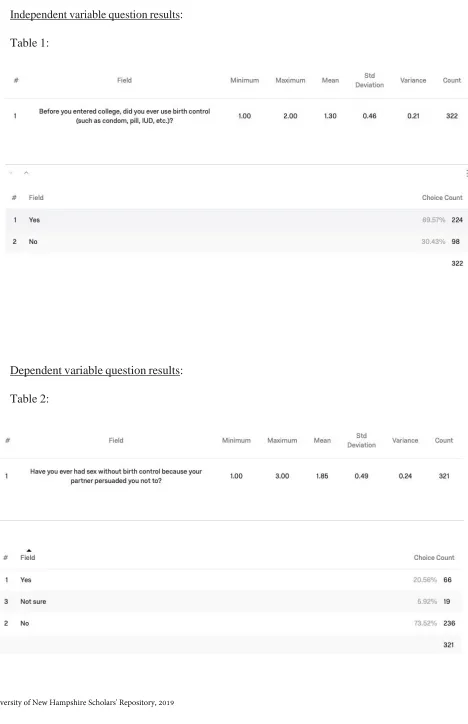
different identity (>1%). 322 people answered the independent variable question “Before you
entered college, did you ever use birth control (such as condom, pill, IUD, etc.)” and 321
people answered the dependent variable question “Have you ever had sex without birth
Independent variable question results:
Table 1:
Dependent variable question results:
Well over half of the respondents (224) answered “yes” to the independent variable
question (69.57%) and 98 respondents (30.43%) answered “no.” Due to this being more of a
qualitative research questions (the only answers being “yes” or “no”) the measure of central
tendencies is not completely relevant to discuss besides the mode being “yes” with 224
responses and the variance within these results is 0.24. The majority of respondents (236) for
the independent variable responded “no” (73.52%) while only 66 said “yes” (20.56%). Only a
small number answered “not sure,”19 ( 5.92%).
Cross tabulation of independent and dependent variable research question:
Table 3:
From the cross tabulation above, of those who answered “yes” to the independent
who answered “no” to the independent variable question, only 13 (13.4%) answered yes to the
dependent variable question. A majority of respondents who began birth control before
entering college answered “no” to letting their partner sway them on safe sex decisions
(68.75%). The largest majority of respondents answered “no” to using birth control before
college and also answered “no” to letting a partner sway their decision on not to use birth
control (84.54%). With a chi square test value of 9.25 and a p-value of 0.01, the survey results
can be considered statistically significant. There is only a 1% likelihood that the null
hypothesis is correct. Therefore, I can fail to reject the null hypothesis.
CONCLUSION
Through a survey taken by 393 students, of the 321/322 students we can conclude
based on this study that a larger proportion of students who began using birth control before
college have let a partner interfere with their decision to use birth control in a sexual situation
(23.66%). About 30% of the respondents answered “no” to using birth control before
entering college and 4% of them answered “yes” to letting a partner interfere with their safe
sex decision making. From this study, we can conclude that beginning to practice birth
control before entering college will not have an effect on letting a partner sway your decision
REFERENCES
Ariely, Dan, and George Loewenstein. “The Heat of the Moment: the Effect of Sexual
Arousal on Sexual Decision Making.” Journal of Behavioral Decision Making, vol.
19, no. 2, 2006, pp. 87–98., doi:10.1002/bdm.501.
East, Leah, Debra Jackson, Louise Obrien, and Kathleen Peters. 2007. “Use of the Male
Condom by Heterosexual Adolescents and Young People: Literature Review.” Journal
of Advanced Nursing59(2):103–10.
Grady, William R., Daniel H. Klepinger, and Anjanette Nelson-Wally. 1999. “Contraceptive
Characteristics: The Perceptions and Priorities of Men and Women.” Family Planning
Perspectives31(4):168.
Kabagenyi, Allen et al. 2014. “Barriers to Male Involvement in Contraceptive Uptake and
Reproductive Health Services: a Qualitative Study of Men and Women’s Perceptions
in Two Rural Districts in Uganda.” Reproductive Health11(1).
Mccauley, Heather L. et al. 2015. “Sexual and Reproductive Health Indicators and Intimate
Partner Violence Victimization Among Female Family Planning Clinic Patients Who