Proceedings of the
Third International Workshop on Graph Based Tools
(GraBaTs 2006)
ENFORCe: A System for Ensuring Formal Correctness of High-level
Programs
Karl Azab, Annegret Habel, Karl-Heinz Pennemann and Christian Zuckschwerdt
12 pages
Guest Editors: Albert Z ¨undorf, Daniel Varr ´o
Managing Editors: Tiziana Margaria, Julia Padberg, Gabriele Taentzer
ENFORCe: A System for Ensuring Formal Correctness of
High-level Programs
Karl Azab, Annegret Habel, Karl-Heinz Pennemann and Christian Zuckschwerdt
Carl v. Ossietzky Universit¨at Oldenburg, Germany
{azab,habel,pennemann,zuckschwerdt}@informatik.uni-oldenburg.de
Abstract: Graph programs allow a visual description of programs on graphs and graph-like structures. The correctness of a graph program with respect to a pre- and a postcondition can be shown in a classical way by constructing a weakest precondi-tion of the program relative to the postcondiprecondi-tion and checking whether the precon-dition implies the weakest preconprecon-dition. ENFORCe is a currently developed system for ensuring formal correctness of graph programs and, more general, high-level programs by computing weakest preconditions of these programs. In this paper, we outline the features of the system and present its software framework.
Keywords: high-level programs, correctness, formal verification, weakest precon-ditions, weak adhesive HLR categories.
1
Introduction
Graph transformation has many application areas in computer science, such as software engi-neering or the design of concurrent and distributed systems. It is a visual modeling technique and plays a decisive role in the development of growingly larger and complex systems. How-ever, the use of visual modeling techniques alone does not guarantee the correctness of a design. In context of rising standards for trustworthy systems, there is a growing need for the verifica-tion of graph transformaverifica-tion systems. Therefore, tools supporting formal verificaverifica-tion of graph transformations will increase the attractiveness of this modeling technique and are in this sense important for its practical application.
There exist several tools specifically concerned with graph transformation: Engines for plain transformation, e.g., [Bus04, GBG+06, MP06], general purpose tools with visual editors and debuggers for transformation systems like [Tae04,SWZ99,BGN+04], and tools concerned with model checking or analysis of transformation systems properties, e.g., [Tae04, KK06, SV03,
KR06,BBG+06].
In this paper, we will present the main ideas of ENFORCe, a suite of tools for ensuring the correctness of high-level programs. It is designed for weak adhesive HLR categories, exploiting the fact that necessary high-level algorithms can be based on a small set of structure-specific methods. Structurally, ENFORCe consists of Applications (e.g., user interface), Correctness
Tools and Transformations (e.g., for proving the correctness of a program), Engines (i.e., specific
data structures and methods) and a Core containing general high-level notions and methods, connecting these components. We plan to reuse existing engines, like GRAJ. Our efforts aim for a tool supplementary to existing tools such as [Tae04,KK06,KR06,BBG+06], i.e., in terms of structures or functionality (see related systems).
The paper is organized as follows. In Section2, we introduce programs for high-level struc-tures like graphs and algebraic specifications and present a method for showing correctness for high-level programs. In Sections 3and 4, we present the system requirements and the system design. In Section 5, we give an overview on related systems. A conclusion including further work is given in Section6.
2
Correctness of Programs
In this section, we give an informal introduction to the main concepts of the paper, in particular into correctness of high-level programs based on all kinds of high-level structures such as graphs, place-transition nets, and algebraic specifications. The concepts are illustrated by a running example in the category of graphs. For more details refer to [EEPT06,HPR06].
Assumption. We assume thathC,Miis a weak adhesive HLR category with a decidable setM,
binary coproducts, epi-M-factorization, anM-initial object, i.e., there is an object I such that,
for every object G inC, there exists a unique morphism from I to G inM, and a finite number
of matches for each object, i.e., for every morphism l : K→L inM and every object G, there
exist only a finite number of morphisms m : L→G such thathl,mihas a pushout complement.
Example 1 (access control graphs). For illustration, we consider the weak adhesive HLR
cate-gory of all directed labeled graphs. We consider a simple access control for computer systems, which abstracts authentication and models user and session management in a simple way. The basic items are users , sessions , and computer systems with directed edges between them. An edge between a user and a system represents that the user has the right to access the system, i.e., establish a session with the system. Every session is connected to a user and a sys-tem. The direction of the latter edge differentiates between proposed and established sessions, i.e., an edge from a session node to a system in the first case and a reversed edge in the latter. Self-loops may occur in graphs during the execution of programs to select certain elements, but not beyond. An example of an access control graph is given in Figure1. The complete example is published in [HPR06].
We use a graphical notion of conditions to specify valid system and program states, as well as morphism.
Definition 1 (conditions). A condition over an object P is of the form ∃a or ∃(a,c), where
a : P→C is a morphism and c is a condition over C. Moreover, Boolean formulas over
condi-tions [over P] are condicondi-tions [over P]. Additionally,∀(a,c)abbreviates¬∃(a,¬c). A morphism
p : P→G satisfies a condition ∃a [∃(a,c)] over P if there exists a morphism q : C→G inM
with q◦a= p [satisfying c]. An object G satisfies a condition ∃a [∃(a,c)] if all morphisms
p : P→G inM satisfy the condition. The satisfaction of conditions [over P] is extended onto
Boolean conditions [over P] in the usual way.
In the context of objects, conditions are also called constraints, in the context of rules, they are called application conditions.
Example 2 (access control conditions). The condition nosession=∄(/0→ )over the empty graph expresses that a selected user shall not have an established session, and the condition nouser=∄(/0→ )means that no user is selected.
Transformation rules form the elementary steps of our computing model.
Definition 2 (rules). A rule consists of a plain rule p=hL←K→Ri, shortly denoted by
hL⇒Ri, and a pairhacL,acRiof conditions over L and R, respectively. L is called the left-hand
side, R the right-hand side, and K the interface. The conditions acL,acR are called the left and right application condition of p.
L K R
G D H
m (1) (2) m∗
A direct derivation through a plain rule p consists of two pushouts (1) and (2). We write
G⇒p,m,m∗ H, G⇒pH, or short G⇒H and say that m is the match and m
∗ is the comatch
of p in H. A direct derivation G⇒pˆ,m,m∗ H through a rule is a direct derivation G⇒p,m,m∗ H
through the underlying plain rule such that the match m satisfies the left application condition acLand the comatch m∗satisfies the right application condition acR.
Example 3 (access control rules). The ruleSelectUselects a user and the ruleLogoutU1 cancels an established session of a selected user.
SelectU: h ⇒ i
LogoutU1 : h ⇒ i
Sequential composition and iteration give rise to rule-based programs.
Definition 3 (programs). Programs are inductively defined: Skipand every rule p are pro-grams. Every finite setS of programs is a program. Given programs P and Q, then the sequential
composition (P; Q), the reflexive, transitive closure P∗ and the as long as possible iteration P↓
Example 4 (access control program). The programLogout=SelectU;LogoutU1↓ selects a user and closes all of his established sessions.
Definition 4 (correctness). A program P with respect to a pre- and a postcondition is correct if, for all objects G satisfying the precondition holds: H satisfies the postcondition for every pair
hG,Hiin the semantics of P, there is some pairhG,Hiin the semantics of P, and the program P
terminates for G.
Concerning correctness, we are considering the following strategies:
Correctness by proof. A well-known method for showing the total correctness of a program with respect to a pre- and a postcondition is to construct a weakest precondition (Wp) of the program relative to the postcondition and to prove that the precondition implies the weakest precondition.
program
postcondition
precondition
Wp
Decide yes/no weakest
precondition
In [HPR06], we consider weakest preconditions for high-level programs similar to the ones for Dijkstra’s guarded commands and show how to construct weakest preconditions for programs on weak adhesive HLR categories with a finite number of matches. In case of rules, the construction of a weakest precondition makes use of two known transformations [HW95, EEHP06, HP05] from constraints to right application conditions, and from right to left application conditions, and additionally, a new transformation from application conditions to constraints [HPR06].
However, this method requires an algorithm for the implication problem for conditions, which may be able to decide the problem for a suitable class of conditions, and approximate the de-cision in the general case. Moreover, the construction of weakest preconditions for programs with iteration relies on invariants, which in the general case requires an approximation or user intervention.
Example 5 (correctness by proof). Consider the program LogoutUserof Example 4 and the conditions in Example2. One might verify the partial correctness ofLogoutUserwith respect to the precondition nouser and the postcondition nosession. According to [HPR06], we construct the weakest liberal precondition Wlp(LogoutUser,nosession) =Wlp((SelectU;LogoutU1↓),
nosession) =Wlp(SelectU,Wlp(LogoutU1↓,nosession)). One has to show that Wlp(LogoutU1↓,
nosession) =Wlp(LogoutU1∗,Wlp(LogoutU1,false)⇒nosession) =Wlp(LogoutU1
∗
,∀(/0→ ,¬Appl(LogoutU1))⇒nosession)if Wlp(LogoutU1
∗
,∄(/0→ )⇒
nosession) equivalent to true, hence Wlp(LogoutU,nosession) equivalent to true. Obviously
nouser implies true, henceLogoutUseris correct with respect to the given conditions. For more examples, we refer to the long version of [HPR06].
to insert assertions in form of applications conditions into rules within iterations of the program to enforce the invariance of postconditions. The construction is based on the integration of constraints into application conditions of rules. It makes use of the two known transformations from constraints to right application conditions (A), and from right to left application conditions (L) [HW95,HP05].
program postcondition
precondition Transformation
correct program
Example 6 (Correctness by transformation). Consider the postcondition nosession. The pro-gram LogoutUser=SelectU;LogoutU1↓ is transformed into a partial correct program P= Assert(c);SelectU;hLogoutU1,hac,trueii
∗, with constraint c=Wlp(SelectU
,(Wlp(P,false)
⇒nosession)), and application condition ac=L(LogoutU1,A(LogoutU1,(Wlp(P, false)⇒
nosession))), andAssert(c) =hhI⇒Ii,hc,trueiifor any condition c over theM-initial object
I. As observed in Example5,((Wlp(P,false)⇒nosession)is equivalent to true. A subsequent
optimization step may be able to eliminate some superfluous application conditions.
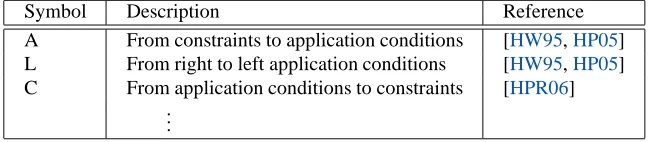
The strategies for ensuring correctness base on certain high-level transformations (see Table1) such as the transformations from constraints to right application conditions and from right to left application conditions. In a concrete weak adhesive HLR category, high-level transformations
Symbol Description Reference
A From constraints to application conditions [HW95,HP05] L From right to left application conditions [HW95,HP05] C From application conditions to constraints [HPR06]
.. .
Table 1: High-level transformations
may be applied by using a small set of elementary, structure-specific operations (see Table 2) such as the constructions of pushouts and pushout complements, the set of all epimorphisms with a given domain G, the composition of two morphisms, and theM-test for morphisms.
3
System Requirements
Symbol Description
PO Construct a pushout alongM-morphisms
POC Construct a pushout complement of two morphisms, if possible = Check commutativity of two morphisms
◦ Construct the composition of two morphisms
initial Construct morphism from initial object to input object matches Find allM-matchings of one object in another epiM Construct an epi-M-factorization of a morphism
epimorphisms Construct all epimorphisms with a given domain (up to iso.) isM? [isEpi?] Is the given morphism anM-morphism [epimorphism]?
.. .
Table 2: Structure-specific operations
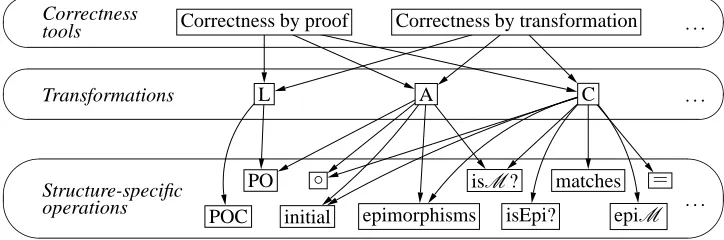
correctness strategies (correctness tools) depending on high-level transformations of conditions that in turn depend on elementary structure-specific operations. For one transformation system working on graphs and for another on Petri-nets, the structure-specific operations differ but the algorithms for transformation of conditions and the correctness tools remain the same. From a software engineering point of view, the components modeling correctness algorithms and weak adhesive HLR categories should therefore be loosely coupled and have as few dependencies on each other as possible. This ensures that the system can be easily extended with new weak adhesive HLR categories and high-level algorithms.
Correctness
tools
Transformations
#
" ! Structure-specific
operations
Correctness by proof Correctness by transformation · · ·
A
L C · · ·
POC
PO matches
epimorphisms initial
isM?
isEpi? epiM
◦ =
· · ·
Figure 2: Levels in ENFORCe
4
System Design
cate-gories, the Core evaluates conditions and connects Engines with the third component,
Trans-formations, that contain algorithms transforming conditions, and the Application uses the four
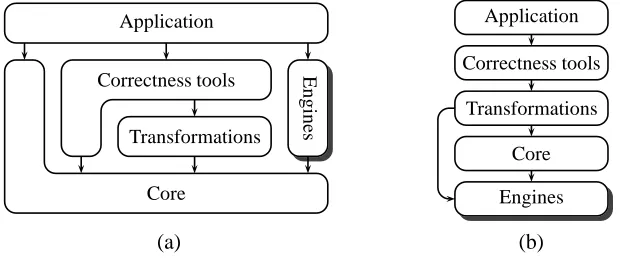
previous components to calculate the correctness results its user has requested. The components and their static dependencies are illustrated in Figure3(a).
Core Correctness tools
Transformations
E
n
g
in
es
Application
Engines Core Transformations Correctness tools
Application
(a) (b)
Figure 3: (a) Static dependencies and (b) runtime data flow
Engines. An Engine is the combination of the structural implementation of a weak adhe-sive HLR category with a category specific implementation of the operations listed in Table2.
E.g. GraphEngine, contains the data structures for directed labeled graphs and graph
mor-phisms as well as the algorithms working exclusively on these structures. As ENFORCe may have several Engines the Engine component is shown with a shadow. The Core and Transforma-tions can use different (and new) Engines without having to be modified or updated.
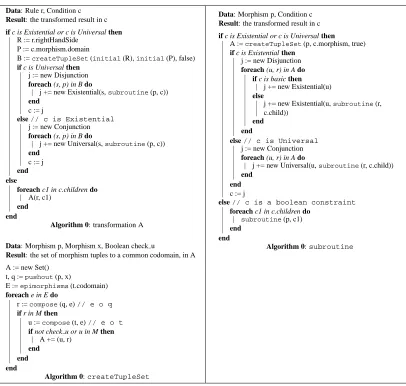
Correctness tools and Transformations. These two components contain algorithms operating exclusively on weak adhesive HLR categories and can therefore be abstracted from the actual category in question. An example of algorithms working at this level is the chain of transforma-tions from constraints to right- to left application conditransforma-tions to weakest preconditransforma-tions. Pseudo code for the transformation from constraints to application conditions is shown in Figure4. Cor-rectness tools and Transformations works on conditions, explaining their static dependency on the Core.
Core. The Core consists of two important parts: One contains data structures for programs and conditions. It also evaluates conditions with the help of operations in Engines. The other part channels and controls the communication between Transformations and individual Engines at runtime. To facilitate communication, the Core provides an interface for Engine plug-ins and works as a dependency injector, explaining the runtime connection between Transformations and Engines.
Although of secondary concern, the Core can execute high-level programs. Most necessary parts are already implemented for other functionality: Data structures modeling programs and conditions, evaluation of conditions, and the matching and pushout operation in the Engines.
to connect the system with an Engine and then uses one of the Correctness tools. The Application provides the graphical user interface (GUI) and manages input/output for creation, saving and loading of data structures, e.g., rules, structures and morphisms. To create structures usable by an Engine, the Application must know the specifics of the data structures of the Engine. This static dependency is illustrated in Figure3(a).
Data: Rule r, Condition c Result: the transformed result in c
if c is Existential or c is Universal then
R := r.rightHandSide P := c.morphism.domain
B :=createTupleSet(initial(R),initial(P), false)
if c is Universal then
j := new Disjunction
foreach (s, p) in B do
j += new Existential(s,subroutine(p, c))
end
c := j
else// c is Existential
j := new Conjunction
foreach (s, p) in B do
j += new Universal(s,subroutine(p, c))
end
c := j
end else
foreach c1 in c.children do
A(r, c1)
end end
Algorithm 0: transformation A
Data: Morphism p, Morphism x, Boolean check u
Result: the set of morphism tuples to a common codomain, in A
A := new Set() t, q :=pushout(p, x)
E :=epimorphisms(t.codomain)
foreach e in E do
r :=compose(q, e)// e o q if r in M then
u :=compose(t, e)// e o t if not check u or u in M then
A += (u, r)
end end end
Algorithm 0:createTupleSet
Data: Morphism p, Condition c Result: the transformed result in c
if c is Existential or c is Universal then
A :=createTupleSet(p, c.morphism, true)
if c is Existential then
j := new Disjunction
foreach (u, r) in A do if c is basic then
j += new Existential(u)
else
j += new Existential(u,subroutine(r, c.child))
end end
else// c is Universal
j := new Conjunction
foreach (u, r) in A do
j += new Universal(u,subroutine(r, c.child))
end end
c := j
else// c is a boolean constraint foreach c1 in c.children do
subroutine(p, c1)
end end
Algorithm 0:subroutine
Figure 4: Pseudo code for the transformation A from constraint to right application condition
Our Current Status
imple-mentations of the Transformations from constraints to right- to left application conditions. Our plans include an Application with a GUI allowing users to experiment with the functionality promised by ENFORCe.
5
Related Systems
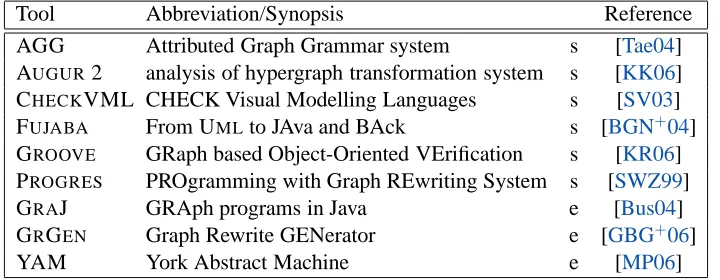
There are several related systems that may be distinguished functionally and methodically: E.g., one may distinguish between (e) transformation engines and (s) tools supporting model checking, verification or analysis (termination, confluence).
Tool Abbreviation/Synopsis Reference
AGG Attributed Graph Grammar system s [Tae04] AUGUR2 analysis of hypergraph transformation system s [KK06] CHECKVML CHECK Visual Modelling Languages s [SV03] FUJABA From UMLto JAva and BAck s [BGN+04] GROOVE GRaph based Object-Oriented VErification s [KR06] PROGRES PROgramming with Graph REwriting System s [SWZ99]
GRAJ GRAph programs in Java e [Bus04]
GRGEN Graph Rewrite GENerator e [GBG+06]
YAM York Abstract Machine e [MP06]
Table 3: A selection of related systems
AGG [Tae04] is a general development environment for attributed graph transformation sys-tems written in Java. It consists of a SPO-based transformation engine, graphical editors, a visual interpreter/debugger and a set of validation tools. AGG supports graph parsing, a transforma-tion of (basic) constraints into equivalent left applicatransforma-tion conditransforma-tions [HW95] and critical pair analysis, i.e., a test for confluency.
AUGUR2 [KK06] is a tool for analyzing node-preserving hyperedge transformation systems by abstraction to so-called Petri graphs: A node in a Petri graph represents multiple hypergraph nodes, while token represent hyperedges. The system consists of approximating algorithms for the abstraction of hypergraph transformation system, a coverability as well as a planned reacha-bility algorithm for deciding Petri graph properties, and abstraction refinement algorithms in the case of a counterexample.
CHECKVML [SV03] is a tool for model checking dynamic consistency properties of arbitrary visual modeling languages (e.g., UML, Petri nets) by generating a model-level specification. Such high-level specifications are translated into a tool independent abstract representation of transition systems defined by a corresponding meta-model. This intermediate representation is automatically translated to the input language of the back-end model checker tool SPIN.
condition and priorities (SPO with gluing condition). Apart from the priorities, the method corresponds to the construction of a weakest precondition and the decision of the implication problem while ignoring the application conditions and the implicit gluing conditions of the rules (both correct approximations).
GRAJ [Bus04] is a tool for executing graph programs. The system consists of a virtual ma-chine, a compiler translating rules into GRAJ machine code and a recently developed graphical user interface. The virtual machine provides primitives for manipulating graphs and storing the execution history of a program needed for implementing the non-deterministic behavior of pro-grams. TheGraphEngineof ENFORCe will make use of GRAJ.
GRGEN [GBG+06] is a generative programming system for graph rewriting. It consists of a compiler for SPO rules specified in a declarative language, a transformation engine called libGr written in C and a shell-like frontend for the transformation engine called GrShell. GRGEN is aimed at attributed typed directed multigraphs, supporting various matching conditions and featuring attribute computation, relabeling and regular graph rewrite sequences comparable to graph programs.
GROOVE [KR06] is a set of (planned) tools for software model checking of object-oriented systems. It aims at directed edge-labeled graphs without parallel edges, a structure suitable for representing binary predicate logic. The GROOVESimulator, consisting of a user interface and a SPO-based transformation engine, may be used for state space generation of (finite) trans-formation systems. The state space is translated to a Kripke structure for standard CTL model checking.
PROGRES[SWZ99] is a set of tools as well as a hybrid visual language for attributed graph transformation. The environment consists of graphical and textual editors supporting syntax-directed editing of graphical specifications and incremental parsing of textual language elements, an interpreter/debugger with built-in constraint checking facilities for transformation specifica-tions, and a compiler backend that translates graph transformations into C-code and generates a tcl/tk-based user interface for calling graph transformations and displaying manipulated graphs.
YAM [MP06] defines a stack-based abstract machine language for graph transformation, com-parable to postscript for graphics. This includes low-level instructions as get node, get node/edge label, get source/target, add/delete/relabel node edge, to which graph transformations rules get translated to. The YAM interpreter is written in C, while a compiler for translating graph rules and programs to YAM code is still under development.
6
Conclusion
ENFORCe is a suite of tools for ensuring the correctness of high-level programs. It is designed for weak adhesive HLR categories, exploiting the fact that necessary high-level algorithms can be based on a small set of structure-specific methods. Structurally, ENFORCe consists of Ap-plications (e.g., user interface), Correctness tools (e.g., for correctness by construction), Engines (i.e., specific data structures and methods for a weak adhesive HLR category) and a Core con-taining general high-level notions and methods, connecting Engines with the rest of the system. This separation allows us to include new categories with a minimum of effort and to develop new Correctness tools and Transformation which instantly work with any Engine. While developing more efficient algorithms for a category, the ability to quickly exchange Engines could be useful for comparing the performance. Further topics could be the following:
(1) Engines for other weak adhesive HLR categories, like the categories of place-transition nets, hypergraphs, or typed attributed graphs.
(2) Adapters for other existing transformation engines like YAM or GRGEN. Adapters pro-vide an interface and complete functionality, if necessary.
(3) Further Correctness tools and Transformations like semantic converters of conditions and rules, for switching the satisfiability and matching notions from arbitrary morphisms to
M-morphisms and vice versa [HP06], or a tool for proving the conflictfreeness of
specifi-cations.
(4) The construction of a correct program from a specification in form of a pre- and postcon-dition, e.g., see [LEHS06]).
Acknowledgements: This work is supported by the German Research Foundation (DFG), grants GRK 1076/1 (Graduate School on Trustworthy Software Systems) and HA 2936/2 (De-velopment of Correct Graph Transformation Systems).
Bibliography
[BBG+06] B. Becker, D. Beyer, H. Giese, F. Klein, D. Schilling. Symbolic invariant verification for systems with dynamic structural adaptation. In Proc. of the 28th int. conference
on Software engineering (ICSE’06). Pp. 72–81. ACM Press, 2006.
[BCKK04] P. Baldan, A. Corradini, B. K ¨onig, B. K ¨onig. Verifying a Behavioural Logic for Graph Transformation Systems. In Proc. of COMETA ’03. ENTCS 104, pp. 5–24. Elsevier, 2004.
[BGN+04] S. Burmester, H. Giese, J. Niere, M. Tichy, J. P. Wadsack, R. Wagner, L. Wendehals, A. Z ¨undorf. Tool integration at the meta-model level: the Fujaba approach. Journal
on Software Tools for Technology Transfer (STTT) 6(3):203–218, 2004.
[EEHP06] H. Ehrig, K. Ehrig, A. Habel, K.-H. Pennemann. Theory of Constraints and Applica-tion CondiApplica-tions: From Graphs to High-Level Structures. Fundamenta Informaticae 74:135–166, 2006.
[EEPT06] H. Ehrig, K. Ehrig, U. Prange, G. Taentzer. Fundamentals of Algebraic Graph
Trans-formation. EATCS Monographs of Theoretical Computer Science. Springer-Verlag,
Berlin, 2006.
[GBG+06] R. Geiß, V. Batz, D. Grund, S. Hack, A. M. Szalkowski. GrGen: A fast SPO-based graph rewriting tool. In Graph Transformations (ICGT’06). LNCS 4178, pp. 383– 397. Springer, 2006.
[HP05] A. Habel, K.-H. Pennemann. Nested Constraints and Application Conditions for High-Level Structures. In Formal Methods in Software and System Modeling. LNCS 3393, pp. 293–308. Springer, 2005.
[HP06] A. Habel, K.-H. Pennemann. Satisfiability of High-Level Conditions. In Graph
Transformations (ICGT’06). LNCS 4178, pp. 430–444. Springer, 2006.
[HPR06] A. Habel, K.-H. Pennemann, A. Rensink. Weakest Preconditions for High-Level Programs. In Graph Transformations (ICGT’06). LNCS 4178, pp. 445–460. Springer, 2006. A long version is available as technical report at [Uni].
[HW95] R. Heckel, A. Wagner. Ensuring Consistency of Conditional Graph Grammars — A Constructive Approach. In SEGRAGRA’95. ENTCS 2, pp. 95–104. 1995.
[KK06] B. K ¨onig, V. Kozioura. Augur 2 — A New Version of a Tool for the Analysis of Graph Transformation Systems. In Proc. Workshop on Graph Transformation and
Visual Modeling Techniques (GT-VMT’06). ENTCS. Elsevier, 2006. To appear.
[KR06] H. Kastenberg, A. Rensink. Model Checking Dynamic States in GROOVE. In Model
Checking Software (SPIN). LNCS 3925, pp. 299–305. Springer, 2006.
[LEHS06] M. Lohmann, G. Engels, R. Heckel, S. Sauer. Model-Driven Monitoring: An Appli-cation of Graph Transformation for Design by Contract. In Graph Transformations
(ICGT’06). LNCS 4178. Springer, 2006.
[MP06] G. Manning, D. Plump. The York Abstract Machine. In Proc. Graph Transformation
and Visual Modelling Techniques (GT-VMT’06). ENTCS. Elsevier, 2006. To appear.
[SV03] A. Schmidt, D. Varr´o. CheckVML: A Tool for Model Checking Visual Modeling´ Languages. In Proc. UML 2003: 6th International Conference on Unified Modeling
Language. LNCS 2863, pp. 92–95. Springer, 2003.
[SWZ99] A. Sch¨urr, A. J. Winter, A. Z ¨undorf. The PROGRES Approach: Language and En-vironment. In Handbook of Graph Grammars and Computing by Graph Trans. Vol-ume 2, pp. 487–550. World Scientific, 1999.
[Tae04] G. Taentzer. AGG: AGraph Transformation Environment for Modeling and Vali-dation of Software. In Proc. Application of Graph Transformations with Industrial
Relevance (AGTIVE’03). LNCS 3062, pp. 446–453. Springer, 2004.