Increasing Immunization: A Medicaid Managed Care Model
Kevin Browngoehl, MD*; Kathleen Kennedy, PhD*; Karol Krotki, PhD‡; and Hugh Mainzer, MS, DVM§
ABSTRACT. Objective. To evaluate the impact of an immunization outreach program on immunization rates.
Setting. A Pennsylvania independent practice associ-ation model managed care organizassoci-ation (100% Medicaid).
Design. Retrospective cohort study (N52511) of chil-dren 30 to 35 months of age from two age cohorts that compared immunization rates for Advisory Committee on Immunization Practices schedules for diphtheria-tetanus-pertussis, oral polio vaccine, measles-mumps-rubella, and
Haemophilus influenza type b. An evaluation of the
out-reach component of the program compared treatment and nontreatment subgroups of one age cohort (N51002).
Intervention. The immunization program targeted approximately 19 000 members from birth to 6 years of age. The program components included computerized tracking and reminders, member and provider education, provider incentives, member incentives, and home visit-ing outreach.
Results. Data indicate that the treatment group has higher completed immunization rates at 35 months of age than does the control group. Furthermore, data show that members with home visits have significantly higher completed immunization rates than do other members. The corresponding comparisons for age-appropriate im-munizations by 24 months indicate a nonsignificant trend of increased rates.
Conclusion. The data provide evidence supporting a correlation between comprehensive strategies (computer-ized tracking, member and provider education and in-centives, and home visiting) and increased immunization rates. Those individuals who received home visits were more likely to complete an immunization series by 35 months of age than those who did not. However, within the Mercy Health Plan program, age-appropriate immunizations are not significantly affected by home-visiting outreach. Pediatrics 1997;99(1). URL: http: //www.pediatrics.org/cgi/content/full/99/1/e4;
immuniza-tion, managed care, Medicaid, medical assistance, incen-tives, home visiting, barriers.
ABBREVIATIONS. MCO, managed care organization; MHP, Mercy Health Plan; DTP, diphtheria-tetanus-pertussis; OPV, oral polio vaccine; MCV, measles-containing vaccine; HIB, Haemophilus
influenza type b.
Underimmunization is not uniformly distributed across population groups in the United States. Rather, it is concentrated among the poor, those with uneven or limited access to comprehensive primary care.1Studies that evaluate the immunization status of children from all socioeconomic backgrounds in-dicate that nearly 90% are fully “caught up” by school age. However the most recent surveys indi-cate that only 75% are fully immunized before their third birthday.2Although increases in immunization rates occurred in response to the recent measles ep-idemic, these increases were less evident in poor inner-city populations.3–5The contributing factors to this condition are many and include lack of knowl-edge about immunizations, language and cultural barriers, competing priorities of poverty, homeless-ness, mobility, and an inability to navigate the health care system. Clinic requirements and physician prac-tices often contribute to missed opportunities to immunize.6 – 8
Recommendations and standards have been made by national public health and medical institutions for practices to increase the demand for and delivery of immunization services.9,10 These recommendations address both recipient-specific barriers as well as institutional and physician-associated barriers. Sev-eral studies have evaluated the performance of man-aged care in the delivery of immunization and pre-ventive services to poor populations and have made recommendations about financial incentives to par-ticipating providers.6,11
Increasingly, managed care organizations (MCOs) are assuming greater responsibility, both in the private and public sectors, for the care of children.12,13 Public health experts indicate that MCOs are ideally organized to assist health care institutions to meet the goals set forth by the Childhood Immunization Initiative.14 MCOs have participated in the national renewed interest in immunization provision as essential preventive health care and as an indicator of the organiza-tion’s quality of care.15The industry has responded by targeting children not fully immunized with interventions designed to raise their immunization rates.16These interventions have had some success with the commercial population, but there has been little success to date among those MCOs that serve the Medicaid population. This article reports an evaluation of a multifaceted immunization pro-gram delivered to pediatric members by a Medic-aid MCO.
From *Mercy Health Plan, Philadelphia, Pennsylvania; ‡Institute for Survey Research, Temple University, Philadelphia, Pennsylvania; and §Centers For Disease Control and Prevention, National Immunization Program, Atlanta, Georgia.
The involvement and affiliation of US Public Health Service personnel in this study and the presentation of results generated by a specific managed care organization (Mercy Health Plan) does not indicate endorsement, real or implied, by the US Centers for Disease Control and Prevention or the US Public Health Service.
Received for publication Apr 26, 1996; accepted Sep 3, 1996.
Reprint requests to (K.B.) Drexel Hill Pediatrics, 3030 Garrett Road, Drexel Hill, PA 19026.
METHODS Setting and Children
The setting was Mercy Health Plan (MHP), an independent practice association MCO that at the time of this study was the largest Pennsylvania Medicaid MCO. Seventy percent of the 130 000 members reside in Philadelphia, and 30% percent live in the six surrounding counties.
The children who constituted the convenience sample for the evaluation of the comprehensive program were members of two age cohorts: those 30 to 35 months of age as of October 1992, the month in which the program was initiated, and those 18 to 24 months of age as of October 1992. The first cohort was the control group, because these members were not participants in the pro-gram before 30 months of age, and the second is the treatment group, the children of which were participants in the immuniza-tion program. The evaluaimmuniza-tion of the home-visiting component was limited to members of the treatment group who were identified as underimmunized by the MHP tracking system and referred for home visits. All children were enrolled continuously in MHP for the first full year of the program.
Intervention
The immunization program is multifaceted and designed to address all identified barriers. A comprehensive description of the program has been published previously.17
Computerized Tracking and Reporting
An automated tracking and reporting system was developed by the MHP Information Management Service, which continu-ously tracks member immunization status. The system uses both claims data and “out-of-plan” immunization data, capturing cur-rent procedural terminology codes of mnemonic description, date of service, and source of data. Data management, tracking, and member notification and reminder are functions of the system.
Provider Education and Incentives
MHP provides fee-for-service payment to providers for each immunization in addition to monthly capitation payments. To reduce missed opportunities for immunization, providers receive audiotape educational material when they join MHP and printed materials semiannually thereafter.
Parent Education and Incentives
To encourage age-appropriate immunization, MHP sends re-minder cards at birth, again 1 month before an immunization is due, and when children have missed a scheduled immunization. The postcard offers a $10 gift certificate for diapers or shoes when the necessary immunization is obtained. MHP provides transpor-tation assistance as needed and ongoing education through its newsletter and in prenatal classes.
Home-visiting Outreach
The MHP tracking system identifies bimonthly those members who do not have immunization data indicating an up-to-date status. These members are referred to a home-visiting agency for additional data collection from previous providers and from the members’ parents or guardians. If these activities indicate that a member is truly not up to date, a home visit is made. Registered nurses are sent to households with children 2 years old or younger. At the time of the home visit, nurses review home records, educate parents and care givers about the importance of immunizing, assist with scheduling provider appointments, and follow up to determine whether the provider appointment was attended. During the first 8 months of the program, staffs of eight home health agencies with which MHP contracts made 8500 home visits.
Design
This was a retrospective cohort study of the year 1 impact of a comprehensive program on immunization rates and, second, the impact of home visiting on immunization rates. Immunization data were collected from provider claims, provider records, and member home records and entered into the registry. A detailed
description of this data collection procedure has been previously described.17
Data collected on each individual from the MHP system in-cluded address, date of birth, number of children in the house-hold, types and dates of immunization, and dates of home visit if received. Information on gender, race, and income is not collected by MHP. Therefore, the address of the member was matched to census tract data for comparisons by ethnic group and socioeco-nomic factors, including age, education, number in the household, income, in-home telephone, and car ownership.
Measures
Immunization status was determined for several combination series and for individual vaccines. The combination and the indi-vidual vaccines were compared with ACIP dose count require-ments. The combination series included: (1) three diphtheria-tet-anus-pertussis (DTP) vaccines, three oral polio vaccines (OPVs), and one measles-containing vaccine (MCV) (3-3-1); (2) four DTP vaccines, three OPVs, and one MCV (4-3-1); and (3) four DTP vaccines, three OPVs, one MCV, and one Haemophilus influenza type b (HIB) vaccine between the first and second year of life (4-3-1-1). Immunization status for individual vaccines included four DTP vaccines (4DTP), three DTP vaccines (3DTP), three OPVs (3OPV), one MCV (1MCV), and one HIB vaccine between the first and second year of life (HIB1–2).
Up-to-date immunization status was determined for two points in time. “Completeness” considers the status of the member for each combination and each individual vaccine by 35 months of age. “Age appropriateness” was determined only among those members in the control and treatment groups who met the criteria for completeness. Age appropriateness measures the status of the member for each combination and each individual vaccine by the first day of 24 months of age and indicates immunizations re-ceived “on time.” Those members with a complete vaccine status by 35 months who were not age appropriate by 24 months repre-sent a “catch-up group.”
Statistical Analysis
Statistical comparisons between groups (control versus treat-ment) and home visit groups (with and without) were made using Student’s t test. It is assumed that both groups in each comparison represent random samples from the corresponding populations. Regression analysis was used to examine relationships between the independent variables of census tract, household and, group membership and immunization rates as the dependent variable.
RESULTS Sample Demographics
Two age groups were identified from the enroll-ment database as enrolled as of October 1992 and who remained continuously enrolled through Octo-ber 1993. These include 1257 memOcto-bers 30 to 35 months of age as of October 1992 and 1254 members 18 to 24 months of age as of October 1992. The addresses of the sample members were matched with census tract and MHP household data. The two groups were compared on all relevant census vari-ables based on the percentage of specific factors in the census tract in which the member resided. All were found to have no significant relationship. Al-though the tracts within the groups were not the same, the two age groups were very similar with respect to the variables analyzed.
Impact of Comprehensive Program on Immunization Rates
Comparison of Immunization Rates by Group
combina-tion series. The treatment group had higher com-pleteness rates for all combined series and individual vaccines. All differences are significant, with the ex-ception of HIB and the combined series of which HIB is a part. HIB is the newest vaccine of all those measured and may reflect delayed acceptance.
Outcomes for age-appropriate rates of control and treatment groups differed between groups for all seven individual vaccines and combination series. Improvement in the treatment group is statistically significant for the combination series (4DTP, 3OPV, and 1MCV; and 4DTP, 3OPV, 1MCV, and HIB1–2) and for 4DTP. The age-appropriate rate for the com-bined series including HIB shows a significant im-provement between control and treatment groups, whereas this was not true for the completeness rate.
Comparison of Immunization Rates by Census Tract and Household Variables
The combination series of 4DTP and 3OPV and 1MCV and HIB1–2 was selected as the measure of the dependent variable for the comparison of census tract and household variables. None of the variables had significant relationships with the dichotomous dependent variable.
Impact of Home Visiting on Immunization Rates The results reported in Tables 3 and 4 were
gen-erated by limiting the universe to members of the treatment group who were identified by the MHP tracking system in October 1992 as not up to date with immunizations and referred for home visits. Some members who were referred for home visits did not receive them. This as because either: (1) additional data collection efforts by the agency work-ers indicated that the membwork-ers were up to date; or (2) attempts by the home visitor to contact the members were unsuccessful. Additional data for members who were referred but who did not have home visits were collected via telephone contact or late claims or through a review of previous and current provider records.
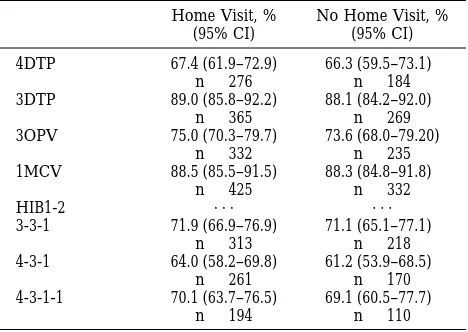
For each of the five individual vaccines and three combination series, completeness rates were calcu-lated separately for those members with and without home visits. The results show that members with home visits had significantly higher immunization rates for all vaccines and combination series than those without home visits. Age-appropriate rates were calculated for all single and combination vac-cines. Members receiving home visits have margin-ally higher age-appropriate rates than members without home visits, but these differences are not statistically significant.
Program Costs
The year 1 operating costs for the program based on the 1992 pediatric enrollment totals $424 080,
TABLE 2. Age-appropriate Rates Among Those Who Met Completeness Criteria by Control and Treatment Groups for Various Immunization Profiles*
Vaccine Control Group (n51257), % (95% CI)†
Treatment Group (n51254), % (95% CI) 4DTP 72.1 (69.6–74.6)† 77.5 (75.2–79.8)† 3DTP 89.8 (88.1–91.5) 91.7 (90.2–93.2) 3OPV 77.9 (75.6–80.2) 81.6 (79.5–83.7) 1MCV 90.5 (88.9–92.1) 91.1 (89.5–92.7)
HIB1-2 . . . .
3-3-1 76.1 (73.7–78.5) 80.0 (77.8–82.2) 4-3-1 68.5 (65.9–71.1)† 75.1 (72.7–77.5)† 4-3-1-1 73.5 (71.1–75.9)† 80.1 (77.9–82.3)† * Abbreviations are defined in Table 1.
† Test for significant difference between control and treatment significant at P#.05.
TABLE 4. Age-appropriate Rates for Treatment Group by Home Visit for Various Immunization Profiles*
Home Visit, % (95% CI)
No Home Visit, % (95% CI) 4DTP 67.4 (61.9–72.9) 66.3 (59.5–73.1)
n5276 n5184 3DTP 89.0 (85.8–92.2) 88.1 (84.2–92.0)
n5365 n5269 3OPV 75.0 (70.3–79.7) 73.6 (68.0–79.20)
n5332 n5235 1MCV 88.5 (85.5–91.5) 88.3 (84.8–91.8)
n5425 n5332
HIB1-2 . . . .
3-3-1 71.9 (66.9–76.9) 71.1 (65.1–77.1) n5313 n5218 4-3-1 64.0 (58.2–69.8) 61.2 (53.9–68.5)
n5261 n5170 4-3-1-1 70.1 (63.7–76.5) 69.1 (60.5–77.7)
n5194 n5110 * Abbreviations are defined in Table 1.
TABLE 1. Completeness Rates by Control and Treatment Groups for Various Immunization Profiles
Vaccine* Control Group (n51257), % (95% CI)†
Treatment Group (n51254), % (95% CI) 4DTP 48.2 (45.4–51.0)‡ 55.3 (52.5–58.1)‡ 3DTP 61.7 (59.0–64.4)‡ 70.3 (67.8–72.8)‡ 3OPV 55.7 (53.0–58.4)‡ 64.2 (61.5–66.9)‡ 1MCV 71.0 (68.5–73.5)‡ 80.1 (77.9–82.3)‡ HIB1-2 51.6 (48.8–54.4) 52.9 (50.1–55.7) 3-3-1 53.9 (51.1–56.7)‡ 61.3 (58.6–64.0)‡ 4-3-1 45.7 (42.9–48.5)‡ 52.9 (50.1–55.7)‡ 4-3-1-1 36.9 (34.2–39.6) 38.5 (35.8–41.2) * DTP indicates diphtheria-tetanus-pertussis; OPV, oral polio vac-cine; MCV, measles-containing vacvac-cine; HIB1–2 Haemophilus
influ-enza type b between 1 and 2 years of life; 3-3-1, 3DTP, 3OPV, and
1MCV; 4-3-1, 4DTP, 3OPV, and 1MCV; and 4-3-1-1, 4DTP, 3OPV, 1MCV, and HIB1-2.
† CI indicates confidence interval.
‡ Test for significant difference between control and treatment significant at P#.05.
TABLE 3. Completeness Rates for Treatment Group by Home Visit for Various Immunization Profiles*
Vaccine Home Visit (n5504), % (95% CI)
No Home Visit (n5498), % (95% CI) 4DTP 54.8 (50.5–59.1)† 36.9 (32.7–41.1)† 3DTP 72.4 (68.5–76.3)† 54.0 (49.6–58.4)† 3OPV 65.9 (61.8–70.0)† 47.2 (42.8–51.6)† 1MCV 84.3 (81.1–87.5)† 66.7 (62.6–70.8)† HIB1-2 57.5 (53.2–61.8)† 40.4 (36.1–44.7)† 3-3-1 62.1 (57.9–66.3)† 43.8 (39.4–48.2)† 4-3-1 51.8 (47.4–56.2)† 34.1 (29.9–38.3)† 4-3-1-1 38.5 (34.3–42.7)† 22.1 (18.5–25.7)† * Abbreviations are defined in Table 1.
which is funded solely by MHP. The highest budget costs are $292 235 for home visiting services and $48 000 for member incentives. Exclusive of vaccine costs, the program per age-eligible member is esti-mated at $26.26; per estiesti-mated underimmunized member, $48.74; and per member who is contacted and successfully immunized based on the stated pro-gram goal, $131.61.
DISCUSSION Limitations
The program targeted all children 3 months to 6 years of age. The evaluation focused on a subgroup of this population 18 to 24 months of age at the time of program implementation. This age group repre-sents a population that is most consistent with other populations measured by the Centers for Disease Control and Prevention.
Members in the treatment group had between 1 and 6 months to obtain required age-appropriate immunizations by 24 months, whereas completeness permitted 11 to 17 months to obtain immunizations by 35 months. As a result of a more limited time period available for receiving immunization, age-appropriate analyses are weaker than are those for completeness.
This was a multifaceted, comprehensive immuni-zation program; however, only the principle compo-nent, home visiting, was individually measured. The contribution of the other components to improving immunizations, particularly provider fee-for-service incentives for immunizations and member incen-tives, are unknown.
Data collection efforts searched all possible and available sources of immunization records. Data may be incomplete for some members. These would be members of the no– home visit group, who did not have up-to-date records with the primary physician, were not available for contact by phone or home visit, and did not have claims for immunizations indicating an up-to-date status. It is highly likely that the data available for this group represent the true underimmunized status, because these members are likely to be the most mobile, least compliant, and most at-risk group.
The data do not permit us to draw definitive con-clusions concerning causal relationships between the program and the immunization rate increases. These data simply show that immunization rates increased after the program was introduced. Other tion activities and campaigns to promote immuniza-tions were occurring within the community at large and independent of MHP. Although these activities may have been a confounding factor with the total group comparison, these activities would not have confounded the comparison between those who had home visits and those who did not.
Conclusions
This study evaluated the impact of a comprehen-sive immunization program on immunization rates in an independent practice association MCO. Chil-dren who had been exposed to the program had
higher rates of complete immunizations by 35 months of age than those who were not exposed to the program. Members who were exposed to the program also had higher rates for age-appropriate immunization for some vaccines and combination series by 24 months.
Children who were not initially up to date and received home visits had higher rates of complete immunization by 35 months of age than those chil-dren who did not receive home visits. However, there was no difference between these two groups in the age appropriateness of immunizations by 24 months of age. Census tract data, albeit limited, sug-gest that the control and treatment groups do not differ significantly with respect to several fundamen-tal demographic criteria.
The comparison of complete immunization rates by 35 months of age between two separate age co-horts indicated significant increases in all individual and combined series vaccines with the exception of one HIB vaccine between the first and second year and the HIB-containing series (4-3-1-1). The greatest increases in age-appropriate immunizations across groups occurred in the combined series of 4-3-1 and 3-3-1 and for 4DTP and 3OPV. This probably reflects successful program efforts in improving immuniza-tions required at 18 months, particularly the receipt of the fourth DTP vaccine and third OPV.
This study provides evidence supporting a posi-tive association between strategies implemented by MHP and improved immunization rates. The most obvious alternative explanation for the increase in rates between these two groups is the universal in-creases that occurred in this period as a result of the measles epidemic. However, minimal change is ob-served between the two age groups in the age-appropriate rates for MCV, which are very high for both groups. The stability in these rates seems to mitigate the lingering effect of the measles epidemic as the primary factor in continued increases in im-munization rates across these two cohort groups. (Exploration of the data revealed temporal increases in immunizations between the previous birth cohort [42 to 48 months of age as of October 1992]; however, these increases seemed directly related to the mea-sles epidemic, because the increases in age-appropri-ate rage-appropri-ates for MCV between the 42- to 48-month co-hort and the 30- to 35-month coco-hort equaled 9.5% compared with the increase of 0.6% for the control and treatment groups of this evaluation).
In addition, although this universal increase in immunization rates was witnessed in the general population during this period, studies indicate that this improvement did not occur until very recently for inner-city children.2–5
ob-tain on-time immunizations and permits the greatest gains to be realized in catch-up rates.
Implications
This study has several implications—for services provided by Medicaid MCOs, program planning, and the development of public-private partnerships between managed care and public health institu-tions. The outcomes of this program evaluation pro-vide epro-vidence that MCOs can design and implement successful comprehensive outreach programs that target members who are underimmunized. Consis-tent with the recommendations of other studies and the most recent Centers for Disease Control and Pre-vention recommendations, these programs need to be comprehensive and include assessment, feedback, incentives, and data exchange. Specifically, this eval-uation indicates that home visits that offer face-to-face instruction, assistance with appointment sched-uling, and transportation are successful strategies for the transmission of this information and for im-proved access to care.
As MCOs assume a larger role in the care of Med-icaid recipients, there is a need to develop working relationships with other MCOs and public institu-tions that serve this population. In Pennsylvania and in many other states, Medicaid recipients who select an MCO can, on a monthly basis, change MCOs or return to the fee-for-service system. This is a serious obstacle to the continuous tracking of a child’s im-munization status. Where several MCOs operate in the same region, immunization information can be shared via regular exchange of claims information and existing immunization-tracking systems.
Future expansion of MHP efforts to improve im-munizations and the delivery of well child care are illustrative of our recommendations for the forma-tion of public-private partnerships between MCOs and public health institutions. MHP has expanded the existing immunization program through a grant to the local department of public health. The public services supported by the MHP grant are: the com-pletion of a city-wide computerized tracking system, which will continuously track the status of all chil-dren who reside in the city; bimonthly exchange of immunization data between the MHP and the de-partment of public health tracking systems; the pro-vision of “express lane” immunizations in four of the district health centers; and one full-time nurse who immunizes MHP members in the home who have not responded to MHP traditional outreach efforts.
The Medicaid population, as a result of poverty-inflicted barriers, requires aggressive, comprehen-sive programs to improve the delivery of immuniza-tions. These programs are expensive; however, the cost-benefit considerations should not be limited to immunizations. When children receive immuniza-tions at a health care facility, they also have a wide range of preventive services made available to them. Immunizations are only one measure of the overall delivery of all preventive health services to children.
REFERENCES
1. Newacheck PW, Halfon N., Preventive care use by school-aged children: differences by socioeconomic status. Pediatrics. 1988;82: 462– 468
2. Centers for Disease Control and Prevention. State and national vacci-nation coverage levels among children age 19 –35 months—United States, April 1994. MMWR. 1995;44:613– 622
3. Centers for Disease Control and Prevention. Vaccination coverage of 2-year-old children—United States, third quarter, 1993. JAMA. 1994;272: 584 –585
4. Centers for Disease Control and Prevention. Retrospective assessment of vaccination coverage among school-aged children—selected cities, 1991. MMWR. 1992;41:103–107
5. Los Angeles County Immunization Program. Vaccine-preventable Disease
Report. Los Angeles, CA: Los Angeles County Immunization Program;
1992
6. Wood D, Halfon N, Sherbournne C, Grabowsky M. Access to infant immunizations for poor, inner city families: what is the impact of managed care? J Health Care Poor Underserved. 1994;5:112–123 7. Orenstein WA, Atkinson W, Mason D, Bernier RH. Barriers to
vacci-nating preschool children. J Health Care Poor Underserved. 1990;1:315–330 8. Cutts FT, Orenstein WA, Bernier RH. Causes of low preschool
immu-nization coverage. Annu Rev Public Health. 1991;13:385–398
9. Public Health Services. The Public Health Service action plan to im-prove access to immunization services. Public Health Rep. 1992;107: 243–251
10. Ad Hoc Working Group for the Development of Standards for Pediatric Immunization Practices. Standards for pediatric immunization prac-tices. JAMA. 1993;269:1817–1822
11. Arnold PJ, Schlenker TL. The impact of health care financing on child-hood immunization practices. Am J Dis Child. 1992;146:728 –732 12. Sullivan CB, Miller M, Feldman R, et al. Employer-sponsored health
insurance in 1991. Health Aff (Millwood). 1992;11:172–185
13. Wilensky GR, Rossiter LF. Coordinated care and public programs.
Health Aff (Millwood). 1991;10:62–77
14. Orenstein WA. A partnership to protect our children. HMO Magazine. 1994;35:13–14
15. Rodewald LE, Szilagyi PG, Shiuh T, Humiston SG, LeBaron C, Hall CB. Is under-immunization a marker for insufficient utilization of preven-tive and primary care? Arch Pediatr Adoles Med. 1995;149:393–397 16. Zablocki E. Taking aim at childhood illnesses. HMO Magazine. 1995;36:
29 –35
17. Kennedy KM, Browngoehl K. A “high-tech,” “soft-touch” immuniza-tion program for members of a Medicaid managed care organizaimmuniza-tion.
DOI: 10.1542/peds.99.1.e4
1997;99;e4
Pediatrics
Kevin Browngoehl, Kathleen Kennedy, Karol Krotki and Hugh Mainzer
Increasing Immunization: A Medicaid Managed Care Model
Services
Updated Information &
http://pediatrics.aappublications.org/content/99/1/e4 including high resolution figures, can be found at:
References
http://pediatrics.aappublications.org/content/99/1/e4#BIBL This article cites 16 articles, 3 of which you can access for free at:
Permissions & Licensing
http://www.aappublications.org/site/misc/Permissions.xhtml in its entirety can be found online at:
Information about reproducing this article in parts (figures, tables) or
Reprints
DOI: 10.1542/peds.99.1.e4
1997;99;e4
Pediatrics
Kevin Browngoehl, Kathleen Kennedy, Karol Krotki and Hugh Mainzer
Increasing Immunization: A Medicaid Managed Care Model
http://pediatrics.aappublications.org/content/99/1/e4
located on the World Wide Web at:
The online version of this article, along with updated information and services, is
by the American Academy of Pediatrics. All rights reserved. Print ISSN: 1073-0397.