Pathogenicity and rDNA-ITS sequence analysis of the
Corynespora cassiicola isolates from rubber plantations
in Indonesia
Fetrina Oktavia1*, Kuswanhadi1, Widodo2, Diny Dinarti3, Sudarsono3
1Sembawa Research Centre, Indonesian Rubber Research Institute, Palembang, Indonesia, 2Department of Plant Pathology, Bogor Agricultural University, Dramaga, Bogor, Indonesia, 3Plant Molecular Biology Laboratory, Department of Agriculture, Bogor Agricultural University, Dramaga, Bogor, Indonesia
*Corresponding author:
Fetrina Oktavia, Sembawa Research Centre, Indonesian Rubber Research Institute, Palembang, Indonesia. E-mail: [email protected]
Received: 05 May 2017; Revised: 15 November 2017; Accepted: 19 November 2017; Published Online: 25 November 2017
INTRODUCTION
Corynespora cassiicola is one of the most important plant pathogenic fungi that attacks a lot of plant species. The pathogen has wide range of host plants whrere it is found in more than 388 species (Farr and Rossman, 2015) including fruit, flower, vegetable, ornamental and perennial plants (Smith and Schlub, 2005; Furukawa et al., 2008; Shimomoto et al., 2008; Hieu et al., 2014). The fungus can attack all parts of plants such as leaves, roots, stems, fruits and flowers (Dixon et al., 2009).
In the rubber plant, C. cassiicola causes leaf fall disease, which has become one of the most important diseases of rubber in all of the natural rubber producing countries in Asia and Africa (Fernando et al., 2010; Ogbebor, 2010). In the country of origin of the rubber plant, Brazil, C. cassiicola is still found as an endophyte fungus and a potentially dangerous pathogen (Déon et al., 2012a). CLF
disease can attack rubber plants at all stages of growth and development in both the nursery and in field plantation (Othman, 2013). It can cause severe damage and reduce the production of latex by about 60% and it can cause death of rubber plants (Situmoranget al., 2007).
Evolution process of the C. cassiicola was showed by the variation and changes of the isolates virulence level. The previous studies had reported influence of the origin of host species to pathogenicity pattern of the C. cassiicola isolates (Cutrim and Silva, 2003), where the different pathogenicity could be found on the isolates from the same host (Furukawa et al., 2008), or a isolates had a different pathogenic pattern to some species, pathogenic to one species but saprophytic to others depended on their host (Dixonet al., 2009; Shimomoto et al., 2011). Host specificity is not only found on the level of host species, but also at the lower genetic level that are rubber clones (Smith and Schlub, 2005; Fernandoet al., 2009).
Corynespora cassiicola is an important pathogen causing Corynespora leaf fall disease on the rubber tree. Analysis of virulence and rDNA-ITS sequence were undertaken to investigate the effect of agro-climatic conditions and host rubber clones to virulence of 23 C. cassiicola
isolates on six clones (RRIC 100, BPM 24, BPM 1, PB 260, GT 1 and RRIM 600) and to observed the evolution pattern of C. cassiicola
isolates. Virulence analysis showed that there is an interaction between isolates and clones, indicating the differences of each isolates
virulence to six clones. Agro-climatic conditions and host clones influenced the virulence of isolates and rDNA-ITS sequence variation.
Analysis of rDNA-ITS showed that there were three of Single Nucleotide Polymorphism (SNP) that separated of isolates into 5 haplotypes. Most of the isolates belonging to the haplotype 1. Phylogenetic analysis indicated that C. cassiicola have a high diversity, however the clustering did not indicate country and host species of isolates. This information will be very useful on developing strategies of disease management and rubber plant breeding towards resistance to CLF disease.
Keywords: Cassiicolin; CLF disease; Genetic diversity; Hevea brasiliensis; rDNA-ITS
A B S T R A C T
http://www.ejfa.me/Effect of geographical condition of the isolates origin to the virulence level is related to climate, temperature, humidity and radiation conditions. It could be indicated by the different attack of CLF disease at some areas, which the severe attacks of CLF were often found in the lowland areas with moderate rainfall. Futherore there were a different of resistant level of clone in many locations showing that there were a geographic effect on the virulence of C. cassiicola isolates attacking of these clones (Saha et al., 2002; Atan and Hamid, 2003; Silvaet al., 2003). The genetic diversity among isolates had been reported by using various methods such as RAPD (Romruensukharom et al., 2005; Oktaviaet al., 2011) and ISSR (Nghiaet al., 2008; Qiet al., 2009; Muniret al., 2011). Although those methods had been able to show the genetic diversity in the isolate genome and grouping of the isolates based on genetic similarity, however the information obtained was still not able to explain which part that had been changed and their effect on isolates virulence. This was due to both methods were only able to detect the diversity randomly, and also the repeatability and the homology assessment of used techniques were still low (Isabelet al., 1999).
ITS-rDNA (Interspecific Transcript Spacer- ribosomal DNA) is the sequence with a repeat unit of the ribosomal genes that is frequently used for genome clustering of the fungi (Nilssonet al., 2009). ITS-rDNA sequence showed the variation of species (Ganley and Kobayashi, 2007) shown by the difference of length of sequences due to insertions or deletions (one or several bases) or as a result of nucleotide substitutions without altering the number of bases (Katochet al., 2015). Moreover, the ITS-rDNA can be used as a marker in the process of evolution (Glass and Donaldson, 1995). Diversity analysis using the ITS-rDNA sequences to construct of phylogenetic tree of the C. cassiicola isolates had been reported (Sahaet al., 2002; Atan and Hamid, 2003; Romruensukharomet al., 2005; Nghiaet al., 2008; 2010; Qiet al., 2011; Déonet al., 2012b; Déonet al. 2014; Hieuet al. 2014; Shuib et al. 2015), and these results showed that the ITS was very useful in phylogenetic study and DNA barcoding.
As a country having largest rubber plantation area with different geographic conditions, Indonesia has a huge of genetic diversity of C. cassiicola isolates. However, the extent to which the nucleotide diversity and their influence to virulence changes of C. cassiicola that attack rubber plantations in Indonesia has not been reported. These information are very important to develop the disease management strategies such as identification of source of the resistance gene, prediction of the genetic breakdown and distribution of the resistant varieties (Rampersadet al., 2013). This study aimed to evaluate the virulence diversity of the C. cassiicola isolates to six tested clones, to evaluate
the virulence diversity of the C. cassiicola isolates that come from different geographical area and host rubber clones, to evaluate the nucleotide diversity of the ITS-rDNA sequences of 23 C. cassiicola isolates and comparison made with the sequences in Genebank.
MATERIALS AND METHODS
Isolates of C. cassiicola
A total of 23 C. cassiicola isolates analyzed in this research consisted of two groups. The first group was of 6 isolates from GT1 clone grown in rubber plantation in Indonesia i.e. North Sumatera, Bengkulu, Jambi, Lampung, East Java, Central Java and East Kalimantan, and the second group was of 17 isolates collected from different rubber clones grown in Sembawa Research Centre, South Sumatera. The clones and origins of each isolates and also resistance level of host clone to CLF disease is showed on Table 1, whereas Fig. 1 shows the location of isolates collection.
All Isolates were from rubber leaves showing symptoms of CLF disease. Isolations were made using PDA medium that contained chloramphenicol (0.05%). Isolation of single spore from 10 days old culture was done by drip the sterile distilled water into the culture and then the liquid of culture obtained was retrieved using a sterile pipette and spread evenly in the water agar medium. Identification of the presence of single spores in the media was done under a microscope by identifying spore of C. cassiicola isolates and marked positions of the spores in the media. Furthermore, the single spores was cultured on new PDA for futher analysis. Preparation of cultures derived from single spore were performed to ensure genetic uniformity.
Production and application of toxin
Production of toxin was conducted in 100 ml Czapeck liquid medium. The media were inoculated with three mycelia plugs (5 mm in diameter) taken from 7-days old culture of the isolates. The cultures were incubated for 16 days at room temperature, filtered through Whatman No 1 filter paper, and then continued filtered through Millipore filters membrane (pore size was 0.22 µm). The culture filtrate was used as the source of toxin.
Pathogenicity analysis
Pathogenicity assay was performed according to the method described by Breton et al., (2000) with modifications. Three young leaves of each clone were collected from field and immersed in water for one night. Then, 125 ml of toxin filtrate were placed in the chamber and covered by Styrofoam with holes having a diameter of 3 cm. The petioles of excised leaves were placed into holes immersed in the toxin filtrate. Petioles of control leaves were immersed in the sterilized water. The leaves were incubated
at room temperature under 100% RH. Observations were recorded for 48 hours after the incubation.
Pathogenicity or virulence of isolates was quantified based on the leaf water loss caused by toxin activity where observation was made after 48 hour immersion in toxin filtrate. The isolates virulence were grouped into weak, medium, high and extremely virulent based on the Standard Deviation (SD) value i.e. those which have a value under -1 Table 1: Host rubber clones, resistance level of hosts to C. cassiicola, geographic origins and genebank accession numbers of 23 C.cassiicola isolates that isolated from rubber plantation in Indonesia
CC Isolate Host clone Resistance level of Host to CCa Geographic originb GeneBank accession numberc
CC-01 GT 1 Very susceptible North Sumatera KP759967
CC-02 GT 1 Susceptible Bengkulu KP759968
CC-03 GT 1 Very susceptible Jambi KP759969
CC-04 GT 1 Susceptible Central Java KP759970
CC-05 GT 1 Very susceptible West Kalimantan KP759971
CC-06 GT 1 Susceptible South Sumatera KP759972
CC-07 IRR 32 Very susceptible South Sumatera KP759973
CC-08 IRR 72 Susceptible South Sumatera KP759974
CC-09 IRR 104 Resistance South Sumatera KP759975
CC-10 IRR 105 Very resistance South Sumatera KP759976
CC-11 IRR 107 Susceptible South Sumatera KP759977
CC-12 IRR 112 Resistance South Sumatera KP759978
CC-13 IRR 118 Susceptible South Sumatera KP759979
CC-14 LCB 1320 Susceptible South Sumatera KP759980
CC-15 PB 217 Resistance South Sumatera KP759981
CC-16 PB 260 Resistance South Sumatera KP759982
CC-17 PB 330 Susceptible South Sumatera KP759983
CC-18 PR 261 Resistance South Sumatera KP759984
CC-19 PR 300 Resistance South Sumatera KP759985
CC-20 PR 303 Resistance South Sumatera KP759986
CC-21 RRIC 100 Very resistance South Sumatera KP759987
CC-22 RRIM 600 Very susceptible South Sumatera KP759988
CC-23 TJIR 1 Very susceptible South Sumatera KP759989
aBased on previous report (Situmorang, 2002; Fairuzah et al., 2009; Munir et al, 2009; 1996), bGeographic origin showed by Province of this area, cIdentity of
rDNA-ITS sequence of 23 C. cassiicola isolates from GeneBank
Fig 1. Map of Indonesia showing the locations of rubber plantations where the C. cassiicola isolates were collected. This locations indicated by
SD were grouped as weak virulence between -1 SD to mean as medium virulence, mean to +1 SD as high virulence, and more than +1 SD as a extremely virulent isolate.
The clustering of isolates based on the leaf wilting intensity on the each tester rubber clones had been done using the Euclidean Hierarchical clustering method by using the Darwin6 software (Perrier and Jacquemoud-Collet, 2010). Interaction of C. cassiicola isolates and clones test were analyzed using two factors ANOVA (isolate*clone) by SAS (Statistical Analysis System) program and differences between means were tested using DMRT (Duncan’s Multiple Range Test) test (P < 0.05).
DNA extraction
Fungal isolates were grown by placing 3 mycelia plugs into Erlenmeyer flaks containing 100 ml Potato Dextrose Broth, isolates were shaken at 60 rpm using an orbital shaker at room temperature for 10 days. The mycelia were collected and washed with distilled water and they were used for DNA extraction (Nghia et al., 2008). The concentration and purity of DNA was measured using spectrophotometer. The DNA was stored in the refrigerator at 4oC and it was
used as stock for DNA template (50 ng/µl).
Phylogenetic analysis based on ITS-rDNA sequence Identification of the 23 isolates of C. cassiicola from different rubber clones and different geographical regions were done using the ribosomal DNA Internal Transcribes Spacer (rDNA-ITS) region sequence. A region of the rDNA-ITS included the spacer between the 18S and 5.8S rDNA subunits (ITS 1), the 5.8S rDNA subunit and spacer between the 5.8S and 28S rDNA subunits (ITS 2). The PCR was done using universal primers ITS1F (5’CTTGGTCATTTAGAGGAAGTAA3’) and ITS4 (5’ TCCTCCGCTTATTGATATGC3’) (White et al., 1990). The primers were synthesized at Integrated DNA Technologies (IDT)® Singapore.
PCR reactions were carried out in a volume of 25 µl containing 1x PCR buffer, 0.2 mM of dNTP mix, 2 mM of MgCl2, 0.5 U of Taq polymerase (Kapa BiosystemsTM Inc.
USA), 0.2 µM of primers, 50 ng of DNA template and the final volume was adjusted to 25 µl with nuclease free water. Amplifications were performed in a T-100 Thermal Cycler Bio-RadTM that was programmed for initial denaturation
at 95oC for 3 min, followed by 35 cycles at denaturing
temperature 95oC for 15 s, annealing temperature 54oC
for 15 s, extention temperature 72oC for 30 s and final
extention at 72oC for 3 min. All PCR reactions were done
in three technical replications. Amplified DNA fragment was confirmed using agarose gel electrophoresis containing of GelRedTM by running of 2 µl PCR product on 1%
agarose gel using 1xTAE buffer (40 mM Tris, 20 mM acetic
acid and 1 mM EDTA) at 60 V for 60 min. The gel was visualized under Bio-Rad Gel DocTM UV-Transluminator.
The amplified DNA fragment size was estimated using 1 kb DNA ladder marker (Vivantis). The PCR products were sequenced by a commercial sequencing service (First BASE Laboratories Sdn. Bhd. Malaysia) by using the ITS1F and ITS4 primers. Sequencing were based on Sanger’s dideoxy sequencing technology with Big Dye Terminator v3.1 cycle sequencing kit chemistry (Applied Bio systems).
The sequence data of isolates were refined using Geneious Pro Trial software (version 5.6.6) (Drummond et al., 2012) in which the sequence from reverse primer of ITS4 was transformed to reverse complement and they were aligned with the sequence from forward primer of ITS1F for correcting of the ambiguous nucleotides on analyzed chromatogram. The species identity of the 23 isolates were confirmed by analyzing these sequences using the BLAST alignment. The sequence data obtained were submitted to GenBank with accession number listed in Table 1. Analysis of isolates clustering based on ITS-rDNA sequences was performed by the Neighbour-Joining method with number of bootstrap of 1000 using Mega6 program (Tamura et al., 2013), whereas to detect the similarity among C. cassiicola isolates and with other isolates that deposit in Gene Bank database, all sequences were allignmented and done the phyllogenetic tree analysis using Neighbour-Joining (NJ) methods with 1000 bootstrap by Geneious Pro Trial software (version 5.6.6). List of accessesion number, the host clones and region of origin of C. cassiicola isolates can be seen in Table 2. Identification of haplotypes based on mutation of the nucleotide bases was done by using algorithms Reduced Median of Network v 4.6.1.1 software (Bandelt et al., 1999).
RESULTS
Pathogenicity analysis
Pathogenicity analysis was based on the leaf water loss estimation caused by toxin activity from 23 C. cassiicola isolates on the six tested rubber clones (BPM 1, BPM 24, GT 1, PB 260, RRIC 100 and RRIM 600). Result of two factor of ANOVA (isolate*clone) and DMRT test (P < 0.05) showed that there were a significant effect of the isolate and clone factors to pathogenicity of C. cassiicola. DNMRT test (P < 0.05%) showed that each of the C. cassiicola isolates had different virulence level on each tested rubber clones (Data not shown).
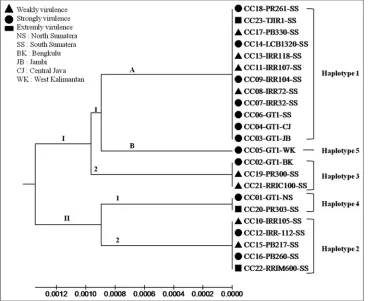
had a similar pattern. The influence of geographical areas and host clones were analyzed by clustering analysis of isolates using Hierarchy Euclidean method based on the leaf wilting intensity on the each of clone tester (Fig. 2). Isolates from different regions and host clones were distributed in different groups. There were three clusters of isolates.The first cluster was dominated by isolates from the same clone, furthermore the second and third cluster consisted of isolates from different clones. This result led to conclusion that isolates from different clones were more widespread than isolates from the same clone, or virulence diversity caused by the influence of the host clones were greater than the influence of the geographical areas.
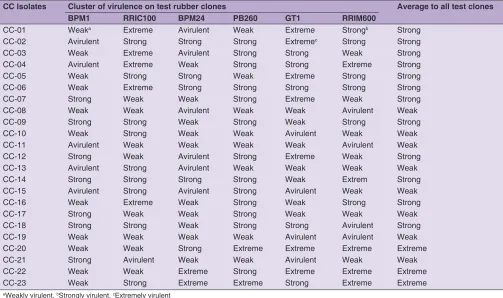
Acording to the average of virulence on the six clones tested, CC-20, CC-22 and CC-23 isolates were the highest virulence isolates (Table 3), and then the clustering analyzes showed that all the three isolates grouped into the third group separate from the others (Fig. 2).
Clustering of virulence level based on Standard Deviation (SD) of leaf wilting intensity which under of -1 SD was
classified as avirulent isolates, between -1 SD to average was weakly virulent, betwen average to +1 SD was strongly virulent and more than +1 SD was classified as a extremely virulent isolates.
CC-01 to CC-06 isolates were collected from GT 1 clones from different area, CC-07 to CC-23 isolates were collected from different clones from the same area.
BPM 1 and RRIC 100 were very resistant, BPM 24 and PB 260 moderately resistant and GT 1 and RRIM 600 susceptible to CLF disease
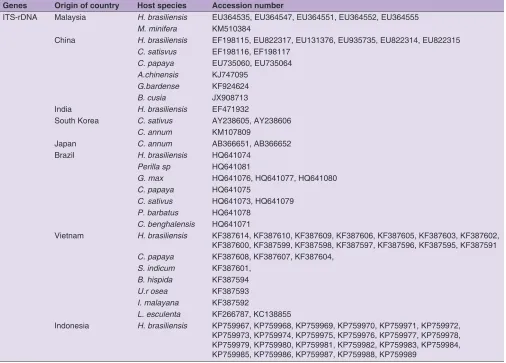
Phylogenetic analysis based on rDNA- ITS sequence PCR amplification of total genomic DNA of 23 C. cassiicola isolates using the ITS 1F and ITS 4 primers obtained a single DNA fragment in equal size (559 bp). According to BLAST with other sequence of C. cassiicola isolates in GeneBank of National Centre for Biotechnology Information (NCBI) showed that the sequences similarity among these isolates was 99-100% and between these isolates with C. cassiicola sequences in NCBI was 97-100%. Moreover, BLAST Table 2: Accession numbers, hosts species and origin of countries of C. cassiicola isolates using in phylogenetic analysis of the ITS‑rDNA sequences
Genes Origin of country Host species Accession number
ITS-rDNA Malaysia H. brasiliensis EU364535, EU364547, EU364551, EU364552, EU364555
M. minifera KM510384
China H. brasiliensis EF198115, EU822317, EU131376, EU935735, EU822314, EU822315
C. satisvus EF198116, EF198117
C. papaya EU735060, EU735064
A.chinensis KJ747095
G.bardense KF924624
B. cusia JX908713
India H. brasiliensis EF471932
South Korea C. sativus AY238605, AY238606
C. annum KM107809
Japan C. annum AB366651, AB366652
Brazil H. brasiliensis HQ641074
Perilla sp HQ641081
G. max HQ641076, HQ641077, HQ641080
C. papaya HQ641075
C. sativus HQ641073, HQ641079
P. barbatus HQ641078
C. benghalensis HQ641071
Vietnam H. brasiliensis KF387614, KF387610, KF387609, KF387606, KF387605, KF387603, KF387602,
KF387600, KF387599, KF387598, KF387597, KF387596, KF387595, KF387591
C. papaya KF387608, KF387607, KF387604,
S. indicum KF387601,
B. hispida KF387594
U.r osea KF387593
I. malayana KF387592
L. esculenta KF266787, KC138855
Indonesia H. brasiliensis KP759967, KP759968, KP759969, KP759970, KP759971, KP759972,
analysis also showed that this fragment was part of ITS (Interspecific Transcript Spacer) 1 sequence, complete sequence of 5.8S rDNA and part of ITS 2 sequence.
Phylogenetic analysis using the Neighbour Joining method showed that there was a broad of genetic diversity of the
isolates from Indonesia. Isolates could be classified into two large groups. The largest groups could be divided into a smaller subgroups. Most of the isolates were classified into the first large group, which one of this group was divided into two small groups. Likewise, the second major group were split in to two small groups (Fig. 3). The grouping Table 3: Clustering of virulence level of 23 C. cassiicola isolates based on leaf wilting intensity on each and average to six test rubber clones which have a different resistance to CLF disease
CC Isolates Cluster of virulence on test rubber clones Average to all test clones
BPM1 RRIC100 BPM24 PB260 GT1 RRIM600
CC-01 Weaka Extreme Avirulent Weak Extreme Strongb Strong
CC-02 Avirulent Strong Strong Strong Extremec Strong Strong
CC-03 Weak Extreme Avirulent Strong Strong Weak Strong
CC-04 Avirulent Extreme Weak Strong Strong Extreme Strong
CC-05 Weak Strong Strong Weak Extreme Strong Strong
CC-06 Weak Extreme Strong Strong Strong Strong Strong
CC-07 Strong Weak Weak Strong Extreme Weak Strong
CC-08 Weak Weak Avirulent Weak Weak Avirulent Weak
CC-09 Strong Strong Weak Strong Weak Strong Strong
CC-10 Weak Strong Weak Weak Avirulent Weak Weak
CC-11 Avirulent Weak Weak Weak Weak Avirulent Weak
CC-12 Strong Weak Avirulent Strong Extreme Weak Strong
CC-13 Avirulent Strong Avirulent Weak Weak Weak Weak
CC-14 Strong Strong Strong Strong Weak Extrem Strong
CC-15 Avirulent Strong Avirulent Strong Avirulent Weak Weak
CC-16 Weak Extreme Weak Strong Weak Strong Strong
CC-17 Strong Weak Weak Strong Weak Weak Weak
CC-18 Strong Strong Weak Strong Strong Avirulent Strong
CC-19 Weak Weak Weak Weak Avirulent Avirulent Weak
CC-20 Weak Weak Strong Extreme Extreme Extreme Extreme
CC-21 Strong Avirulent Weak Weak Avirulent Weak Weak
CC-22 Weak Weak Extreme Strong Extreme Extreme Extreme
CC-23 Weak Strong Extreme Extreme Strong Extreme Extreme
aWeakly virulent, bStrongly virulent, cExtremely virulent
Fig 2. Euclidean Hierarchical clustering method of 23 C. cassiicola isolates based on leaf wilting intensity on the six rubber clones (BPM 1,
did not show the position closely of the geographical and the virulence level of isolates. Based on the geographical area, the isolates from the GT1 clones grouped separately on the some small groups and then almost of all isolates belonging to the first major group except the isolate from North Sumatera.
Despite having an average similar capability of virulence to six test clones, but the genetically that showed by grouping on the phylogenetic tree were not determined by the closeness of geographically origin of isolates. Geographically, North Sumatera, Jambi, Bengkulu and South Sumatera are located in one of island, while Central Java and West Kalimantan are on the different islands, but in the phylogenetic tree showed that isolate from Bengkulu was in the separate group, while Jambi, Central Java and South Sumatera isolates merged in the same group, as well as North Sumatera and West Kalimantan isolates merged in the other group (Fig. 1 and 3).
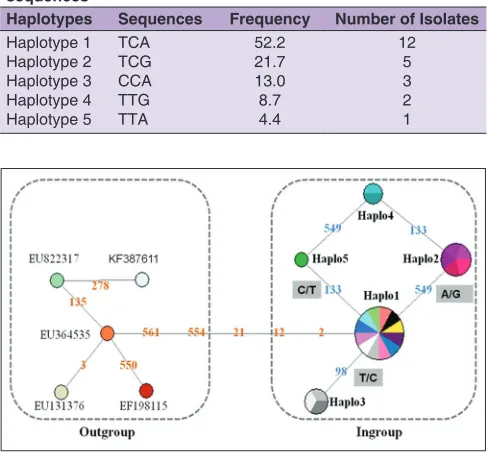
The alignment analysis of 23 rDNA-ITS sequences of C. cassiicola showed that almost all of the sequences were identical, except three points of SNPs (Single Nucleotide Polymorphism) in different positions, namely at nucleotide 98th (C/T), 133th (T/C) and 549th (A/G). All of SNPs were
used as a basis on the network analysis using Reduced Median method that indicated a distance and a pattern of
the positions change of mutated nucleotides, either directly into haplotypes or through several of mutations stages.
Based on the mutation patterns of nucleotide bases there were five haplotypes of the C. Cassiicola isolates. The isolates changed from progenitor of haplotype 1 to haplotype 2 through mutation of 549th nucleotide base
which altered A to G. Likewise with haplotype 3 that changes of the 98th base from T to C and on the haplotype 5
there was a mutation at the base 133rd that converts C to T.
in the other hand, haplotype 4 have two of base mutation namely the 133rd that convert of C to T and 549th base that
convert A to G. Each hapotype had a different frequency that determined by population size. From all haplotypes, haplotype 1 was the highest frequency, 52.2% (Fig. 4 and Table 4). The fig. 4 also showed that the Indonesian’s isolates have a 5-7 differences of nucleotide mutation point with other countries isolates (outgroup).
Isolates were classified in different haplotypes using the differences of mutation point (Table 4). There was a close relationship between virulence level of isolates with geographically origin of isolates that showed by isolates virulence to the host clone (GT 1) (Table 3). Isolates from Jambi, South Sumatera and Central Java which have a haplotypes sequence TCA and in the same phylogenetic group, have the same virulence level (high virulence) to
Fig 3. Phyllogenetic analysis of 23 C. cassiicola isolates of different host rubber clones and geographic origins. The tree was generated from the
the host plant. But when there was a mutation in one of these bases, level of virulence would turn out to be very virulent. These were showed by isolate from Bengkulu that had haplotype sequence of CCA and isolate from West Kalimantan that had a haplotype sequence of CTA. While in isolate from North Sumatera, there were two bases mutation, namely C replaced by T and A by G thus haplotype bases of TTG. It was indicated that there was genetic variation in isolates that come from a different geographic that would affect the virulence level of isolates.
Effect of mutations on the virulence level of isolates was also shown by the changes over time as reflected also from changes of the resistance level of the host plant. A previous study reported that GT1 had the resistance level of a medium-susceptible to C. cassiicola isolates meaning that the isolates had a high level of virulence. Nevertheless the isolates from North Sumatera, Bengkulu and West Kalimantan that had different mutation point with Jambi, South Sumatera and Central Java, the level of virulence change were from high become very virulent (Table 3).
In the other hand, type of host rubber clones showed the genetic diversity of isolates that indicated by isolates grouped into different groups and haplotypes. Haplotype sequence analysis of each isolate indicated that there was a change of the nucleotide base to 98 from T to C and
base to 549 from A to G in some of isolates. Although mutations in these bases were slightly shifting the level of the isolates virulence, but it have not been able to show a close relationship between changes in the ITS-rDNA sequences with altered levels of isolates virulence.
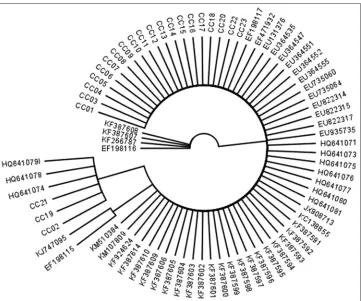
The phylogenetic analysis depicts the genetic diversity of the C. cassiicola isolates from different plant species and from various countries based on ITS-rDNA gene sequences (Fig. 5). The phylogenetic tree showed that the isolates from Indonesia are in the same group along with many of the sequences from the database. There were two groups of Indonesian isolates, of which 20 isolates were joined by the large group of sequences databases, and only three isolates joined with other. Nevertheless, the grouping was at random based on similarity of ITS-rDNA sequences not on host species and regions of origin.
DISCUSSION
Diversity of C. cassiicola races could be determined by the pathogenicity level. This information is useful to identify species and races of C. cassiicola isolates, and for the selection of management strategies to protect and control disease spreading in rubber plantations. The pathogenicity test was performed using a toxin assay method by considering that cassiicolin toxin produced by C. cassiicola was a main effector in the pathogenicity process of C. cassiicola isolate (Breton et al., 2000; de Lamotteet al., 2007; Déonet al., 2012b; Déon et al., 2014). In addition, Tran et al. (2016) reported that there were six QTL (Quantitative Trait Loci) linked to sensitivity to toxin filtrate of C. cassiicola detected on five chromosomes of rubber plant, suggesting that cassiicolin is the main effector in pathogenicity. Using of the toxin filtrate of phytoptahogenic as a selection tool has also been reported on several pathogen such as Sclerotium
rolfsii (Yusnita et al., 2009), Phytophthora parasitica (Savita et al., 2011) and Fusarium oxysporum (Oubraim et al., 2016). It caused that the detection of virulence may be more emphased on the genetic factors and minimizing the influence of environmental factors.
Each C. cassiicola isolates has a different of virulence level. This indicated that there is a specific interaction between pathogen with the host clones and there is the environmental impact to the virulence ability of isolate. This effect is related to temperature, humidity, rainfall and sun light that will affect the production and development of C. Cassiicola isolates (Fernandoet al., 2012).
All of isolates were virulent, although some isolates were avirulent to a few of tested clones. But this is a reasonable because the tested clones are not a host clones origin of Table 4: Haplotype sequences and frequencies of
23 C. cassiicola isolates from Indonesia based on ITS‑rDNA sequences
Haplotypes Sequences Frequency Number of Isolates Haplotype 1
Haplotype 2 Haplotype 3 Haplotype 4 Haplotype 5
TCA TCG CCA TTG TTA
52.2 21.7 13.0 8.7 4.4
12 5 3 2 1
Fig 4. Haplotypes network based on Reduced Median from ITS-rDNA
the isolates. Basically the isolates is virulent because it was isolated from the leaf tissue have CLF symptoms. This is consistent with previous research which reported that C. cassiicola isolate is able to attack all rubber clones with different levels of severity (Akpaja et al., 2015). There were 3 of C. cassiicola isolates namely CC-20, CC-22 and CC-23 that isolated from PR 303, RRIM 600 and Tjir 1 rubber clone which very virulent, so all the isolates must be wary because it could be very dangerous to the rubber plantation.
The study of correlation between virulence of C. Cassiicola isolates with different host species showed that there were a differences of isolates virulence to the plants which most of isolates isolated from different host species had a huge broad host range and most others had a specific host (Pereira et al. 2003; Nilssonet al., 2009; Shimomotoet al., 2011; Schochet al., 2012; Glasset al., 2013). The same case was also found in this study, where the isolates from different rubber clones showed a different of virulence level to six of tested clones. Their specificity of virulence capability is expected to link to the main effectors of pathogenicity on the C. Cassiicola that is namely cassiicollin. It is a Host Specific Toxin (HST), so that there is a relationship of gene for gene between Avr gene of isolates with R gene of host plant (Gururaniet al., 2011). Furthermore the virulence level of an isolate is also influenced by the resistance level
of plants infected, either through the mechanism of toxin degradation or other defense mechanisms that caused plant cell walls become less sensitive to the toxins was released by isolates (Déon et al., 2012b; Déonet al., 2014).
A variety of other genes classified as house-keeping genes such as Act, GA4, gpd, tef1, CAA and ITS-rDNA may be used in the identification and clustering of C. cassiicola isolates (Dixon et al., 2009; Gaziset al., 2011; Shimomoto et al., 2011; Déonet al., 2014). Among of these genes, ITS-rDNA genes were considered capable of well classifying the C. cassiicola isolates based on genetic relatedness (Dixonet al., 2009; Shimomotoet al., 2011). It has been chosen in the diversity analysis of fungi with consider that these primers are universal (Nilsson et al., 2008) and the sequence information is already in the database. Furthermore these sequences can also be used as an early selection of isolates by the grouping that may be used on the resistance test of the new clones in the rubber breeding program.
There were 3 SNPs on the ITS-rDNA sequences of C. cassiicola isolates indicated that there have been a transition mutation in the isolates genome, that is replacement of the one base in the same class, purine is replaced by the purine and pyrimidine replaced by pyrimidine (Primmer et al., 2002). Commonly, the frequency of transition mutations
Fig 5. Phylogenetic tree of 23 C. cassiicola isolates from Indonesia (CC-01 to CC-23) and other countries from database based on ITS-rDNA
in the genome is higher than transversion mutations (replacement of bases from different classes) (Yanget al., 2004; Zeng et al., 2009), because these bases have the balance structure of the backbone of the constituent DNA bases (Guo and Jamison 2005).
Qiet al. (2011) reported that the fragment size of the rDNA of C. cassiicola isolates that successfully amplified using the ITS primer was 180 bp, 158 bp and 221 bp for ITS-1, 5.8S and ITS-2 respectively, so the first (base to-98) and the second (base to-133) of SNP position were expected on the ITS 1 sequence, the third SNP (base to-549) on the ITS 2 sequence, while the 5.8S subunit conserve to all of isolates. These results are consistent with a previous study which state that 5.8S subunit on the rDNA gene are a region conserve in all organisms and ITS regions are a high diversity so it can be used on the identification of a species, genetic diversity analysis, DNA barcoding and analysis of fungi phylogenetic (Hinrikson et al., 2005; Murali et al., 2006; Nilsson et al., 2009; U‘renet al., 2009; Schochet al., 2012; Glasset al., 2013; Harringtonet al., 2014), as well as a locus supports the clustering of C. cassiicola isolates based on genetic similarity (Dixonet al., 2009). The differences of the SNPs positions of two ITS sequences in this study showed that the ITS 1 has a higher genetic variation than the ITS 2. It was estimated randomly mutation on genome of isolates. This is similar with previous study that stated ITS 1 sequence more variable than ITS 2 (Nilsson et al., 2009), whereas the other studies reported that the ITS 2 was better in detecting of the genetic variation in the closely related (Schochet al., 2012).
All of SNP positions were an informative character in the analysis of genetic variation, where the SNP position can be used as a tool in determining of haplotypes (Dixon et al., 2009) or race group of C. cassiicola isolates(Nghia et al., 2010). Except of the third SNP position, the same SNP position were also found on the some of C. cassiicola isolates from other countries (Dixonet al., 2009; Nghia et al., 2010; Hieuet al., 2014). Network analysis based on Reduced Median method that showed the distance and the change pattern of the nucleotide positions mutated, either directly into the haplotypes or through several stages of mutations demonstrated that the isolates from Indonesia had a different genetic variations with other countries. Based on third of the SNPs, the Indonesian isolates were divided into five haplotypes separated by 1-2 point mutations and different frequency, where the highest frequency was found in the haplotype 1. These results indicated that there were at least five of different races in C. Cassiicola isolates from the rubber plant in Indonesia and most of the isolates were belonged to the race 1.
CONCLUSION
Virulence analysis showed that there are a different of virulence levels of C. cassiicola isolates to six of tested rubber clones. The diversity analysis of ITS-rDNA sequence was known that there was a diversity of ITS-rDNA sequences of the 23 isolates of C. cassiicola analyzed and phylogenetic analysis of 23 isolates with ITS-rDNA sequence database shows that there was a high genetic diversity in isolates of C. cassiicola, but the grouping was not indicate the country of origin and the host species of isolates. Geographic and host rubber clones origin of the isolates isolated affect the ability of the virulence and diversity of ITS-rDNA sequences of C. cassiicola isolates were analyzed. Compared to geographic, the influence of the host rubber clones were more clearly to the virulence level of isolates. Analysis of the diversity of ITS-rDNA sequences showed that there were three points Single Nucletide Polymorphism (SNPs) on the 23 of C. Cassiicola isolates analyzed that separated isolates into 5 different haplotypes, and most of the isolates belonged to the haplotype 1. There was a relationship between the ITS-rDNA sequences with the ability of virulence, which changes of the base at the SNPs point caused change of the isolates virulence level.
ACKNOWLEDGMENTS
The authors would like to acknowledge Dr. Thomas Wijaya for his revision of the English and thankfull for the financial support of the Indonesian Rubber Research Institute for this research.
Author’s contributions
This manuscript is part of the PhD Dissertation (Plant Breeding and Biotechnology) of first author advised by all co-author. Fetrina Oktavia was responsible for isolation of isolates from field, extraction of DNA, PCR analysis, data analysis and wrote of the manuscript. Kuswanhadi, Widodo, Diny Dinarti and Sudarsono were responsible for supervise data analysis and processing of the manuscript.
REFERENCES
Akpaja, E., D. Omorogbe and N. Nwogu. 2015. Field and in-vitro studies on Corynespora leaf fall disease of Hevea brasiliensis in Nigeria. Br. Microb. Res. J. 7: 322-328.
Atan, S. and N. Hamid. 2003. Differentiating races of Corynespora cassiicola using RAPD and internal transcribed spacer markers. J. Rubber Res. 6: 58-64.
Bandelt, H. J., P. Forster and A. Rohl. 1999. Median joining networks for inferring intraspecific phylogenies. Mol. Biol. Evol. 6: 37-47. Breton, F., C. Sanier and J. D’Auzac. 2000. Role of Cassiicolline. A
115-128.
Cutrim, F. and G. Silva. 2003. Pathogenicity of Corynespora cassiicola to different plant species. Phytopathology. 28: 103-193. de Lamotte, F., M. P. Duviau, C. Sanier, R. Thai, J. Poncet, D.
Bieysse, F. Breton and V. Pujade-Renaud. 2007. Purification and characterization of Cassiicollin toxin produced by Corynespora cassiicola causal agent of the leaf fall disease of rubber tree. J. Chrom. 849: 357-362.
Déon, M., A. Scomparin, A. Tixier, C. R. Mattos, T. Leroy, M. Seguin, P. Roeckel-Drevet and V. Pujade-Renaud. 2012a. First characterization of endophytic Corynespora cassiicola isolates with variant Cassiicolline genes recovered from rubber trees in Brazil. Fungal Divers. 54: 87-99.
Déon, M., Y. Bourré, S. Gimenez, A. Berger, D. Bieysse, F. de Lamotte, J. Poncet, V. Roussel, F. Bonnot, G. Oliver, J. Franchel, M. Seguin, T. Leroy, P. Roeckel-Drevet and V. Pujade-Renaud. 2012b. Characterization of a Cassiicolline-encoding gene from Corynespora cassiicola pathogen of rubber tree (Hevea brasiliensis). Plant Sci. 185-186: 227-237.
Déon, M., B. Fumanal, S. Gimenez, D. Bieysse, R. R. Oliveira, S. S. Shuib, F. Breton, S. Elumalai, J. B. Vida, M. Seguin, T. Leroy, P. Roeckel-Drevet and V. Pujade-Renaud. 2014. Diversity of the Cassiicolline gene in Corynespora cassiicola and relation with the pathogenicity in Hevea brasiliensis. Fungal Biol. 118: 32-47. Dixon, L. J., R. L. Schlub, K. Pernezny, and L. E. Datnoff. 2009.
Host specialization and phylogenetic diversity of Corynespora cassiicola. Phytopathology. 99: 1015-1027.
Fairuzah, Z., B. Setyawan and T. R. Febbyanti. 2009. Resistance and susceptibility of recomendation and promising rubber clones to Corynespora cassiicola isolates. In: Proceedings of the National Breeding Seminar. Publisher Indonesian Rubber Institute, Indonesia. p269-275.
Farr, D. and A. Rossman. 2015. Fungal Databases, Systematic Mycology and Microbiology Laboratory, ARS, USDA. Available from: https://www.nt.ars-grin.gov/fungaldatabases. [Last accessed on 2015 Dec 07].
Fernando, T., C. Jayasinghe, R. Wijesundera and D. Siriwardana. 2009. Variability of hevea isolates of Corynespora cassiicola from Sri Lanka. J. Plant Dis. Prot. 116: 115-117.
Fernando T. H. P. S., C. K. Jayasinghe, R. L. C. Wijesundera, W. P. K. Silva and E. A. D. N. Nishantha. 2010. Evaluation of screening methods against Corynespora leaf fall disease of rubber (Hevea brasiliensis). J. Plant Dis. Prot. 117: 24-29. Fernando, T., C. Jayasinghe, R. Wijesundera and D. Siriwardane.
2012. Some factors affecting in vitro production, germination and viability of conidia of Corynespora cassiicola from Hevea brasiliensis. J. Nat. Sci. Sri Lanka. 40: 241-249.
Furukawa, T., K. Ushiyama and K. Kishi. 2008. Corynespora leaf spot of scarlet sage caused by Corynespora cassiicola. J. Genet. Plant Pathol. 4: 117-119.
Ganley, A. and T. Kobayashi. 2007. Highly efficient concerted evolution in the ribosomal DNA repeats: Total rDNA repeat variation evealed by whole-genome shotgun sequence data. Genet. Res. 17: 184-191.
Gazis, R., S. Rehner and P. Chaverri. 2011. Species delimitation in fungal endophyte diversity studies and its implications in ecological and biogeographic inferences. Mol. Ecol. 20: 3001-3013. Glass, D., N. Takebayashi, L. Olson and D. Taylor. 2013. Evaluation
of the authenticity of a highly novel environmental sequence from boreal forest soil using ribosomal RNA secondary structure modeling. Mol. Physiol. Evol. 67: 234-245.
Glass, N. and G. Donaldson. 1995. Development of primer sets
designed for use with the PCR to amplify conserved genes from filamentous ascomycetes. Appl. Environ. Microbiol. 61: 1323-1330.
Harrington, T., M. Kazmi, A. Al-Sadi and S. Ismail. 2014. Intraspecific and intragenomic variability of ITS rDNA sequences reveals taxonomic problems in Ceratocytsis fimbriata sensu stricto. Mycologia. 106: 224-242.
Hieu, N., N. Nghia, V. Chi and P. Dung. 2014. Genetic diversity and pathogenicity of Corynespora cassiicola isolates from rubber trees and other hosts in Vietnam. J. Rubber Res. 17: 187-202. Hinrikson, H., S. Hurst, T. Lott, D. Warnock and C. Morrisson.
2005. Assessment of ribosomal large-subunit D1-D2. Internal transcribed spacer 1. And internal transcribed spacer 2 regions as targets for molecular identification of medically important Aspergillus species. J. Clin. Microb. 43: 2092-2103.
Isabel, N., J. Beaulieu, P. Theriault and J. Bousquet. 1999. Direct evidence for biased gene diversity estimates from dominant random amplified polymorphic DNA (RAPD) fingerprints. Mol. Ecol. 8: 477-482.
Katoch, A., C. S. Prabhakar and P. N. Sharma. 2015. Metageographic population analysis of Colletotrichum truncatum associated with chili fruit rot and other hosts using ITS region nucleotide sequences. J. Plant Biochem. Biotechnol. 25: 64-72.
Munir, M., H. Suryaningtyas, A. Situmorang and T. R. Febbyanti. 2009. Resistance of rubber clones IRR series 100 to Corynespora and Colletotrichum leaf fall disease. In: Proceedings of the National Breeding Seminar. Publisher Indonesian Rubber Institute, Indonesia. pp262-268.
Munir, M., H. Suryaningtyas and Kuswanhadi. 2011. Genetic variability analysis of Corynespora cassiicola (Berk and Curt) Wei. Isolates in Indonesia using ISSR. Indones. J. Nat. Rubber Res. 30: 86-99.
Murali, T., T. Suryanarayanan and R. Geeta. 2006. Endophytic Phomopsis species: Host range and implications for diversity estimates. Can. J. Microb. 57: 673-680.
Nghia, N., J. Kadir, E. Sunderasan, M. Abdullah, A. Malik and S. Napis. 2008. Morphological and inter simple sequence repeat (ISSR) markers analyses of Corynespora cassiicola isolates from rubber plantations in Malaysia. Mycopathologia. 166: 189-201.
Nghia, N., J. Kadir, E. Sunderasan, M. Abdullah, A. Malik and S. Napis. 2010. Intraspecific variability of Corynespora cassiicola inferred from single nucletide polymorphisms in ITS region of ribosomal DNA. J. Rubber Res. 13: 257-264.
Nilsson, H., E. Kristiansson, M. Ryberg, N. Hallenbergand and K. Larsson. 2008. Intraspecific ITS variability in the kingdom fungi as expressed in the international sequence databases and it’s implications for molecular species identification. Evol. Bioinformatics. 4: 193-201.
Nilsson, R., M. Ryberg, K. Abarenkov, E. Sjokvist and E. Kristiansson. 2009. The ITS region as a target for characterization of fungal communities using emerging sequencing technologies. FEMS Microbiol. Lett. 296: 97-101.
Ogbebor, O.N. 2010. The status of three common leaf disease of Para rubber in Nigeria. J. Plant Sci. 6: 567-570.
Oktavia, F., M. Munir, H. Suryaningtyas and K. Kuswanhadi. 2011. Characterization of DNA finger printing of Corynespora cassiicola isolates from varians regions of rubber plantation. Indones. J. Nat. Rubber Res. 29: 118-128.
Othman, R. 2013. Development of High Yielding Disease Resistance Clones. IRRDB Agronomy Workshop, Indonesia.
between bayoud disease severity and toxin susceptibility of date palm cultivars. Emir. J. Food Agric. 28: 45-51.
Qi, Y. X., X. Zhang, J. J. Pu, X. M. Liu, Y. Lu, H. Zhang, H. Q. Zhang, Y. C. Lv and Y. X. Xie. 2011. Morphological and molecular analysis of genetic variability within isolates of Corynespora cassiicola from different hosts. Eur. J. Plant Pathol. 130: 83-95. Rampersad, S. N., D. Perez-Brito, C. Torres-Calzada, R.
Tapia-Tussell and C. V. Carrington. 2013. Genetic structure and demographic history of Colletotrichum gloeosporioides sensu lato and C. truncatum isolates from Trinidad and Mexico. BMC Evol. Biol. 13: 1-17.
Romruensukharom, P., S. Tragoonrung, A. Vanavichit and T. Toojinda. 2005. Genetic variability of Corynespora cassiicola populations in Thailand. J. Rubber Res. 8: 38-49.
Saha, T., A. Kumar, B. Roy, M. Ravindran, A. Joseph, C. K. Jacob, M. A. Nazeer, K. Sreedharan, K. Vinod and B. Chulaki. 2002. Molecular characterisation of fungal pathogens causing leaf diseases in rubber (Hevea brasiliensis). In: Proceeding of the 15th Plantation Crops Symposium Placrosym XV. India. p195-203.
Savita-Virk, G. S. and A. Nagpal. 2011. In vitro selection of calli of Citrus jambhiri Lush. For tolerance to culture filtrate of Phytophthora parasitica and their regeneration. Physiol. Mol. Biol. Plants. 17: 41-47.
Schoch, C., K. Seifert, S. Huhndorf, V. Robert, J. Spouge, C. Levesque, W. Chen and F. B. Consortium. 2012. Nuclear ribosomal internal transcribed spacer (ITS) region as a universal DNA barcode marker for fungi. PNAS. 109: 6241-6246.
Shimomoto, Y., R. Adachi, Y. Morita, K. Yano, A. Kiba, Y. Hikichi and S. Takeuchi. 2008. Corynespora blight of sweet pepper (Capsicum annuum) caused by Corynespora cassiicola (Berk. and Curt.) Wei. J. Gen. Plant Pathol. 74: 335-337.
Shimomoto, Y., T. Sato, H. Hojo, Y. Morita, S. Takeuchi, H. Mizumoto, A. Kiba and Y. Hikichi. 2011. Pathogenic and genetic variation among isolates of Corynespora cassiicola in Japan. Plant Pathol. 60: 253-260.
Shuib, S., M. Deon, M. M. Mahyuddin, A. Izhar, B. Fumanal, E. Sunderasan and V. Pujade-Renaud. 2015. Cassiicolline genes
among Corynespora cassiicola isolates from rubber plantations in Malaysia. J. Rubber Res. 18: 6241-6246.
Silva, W. P. K., E. H. Karunanayake, R. L. C. Wijesundera and U. M. S. Priyanka. 2003. Genetic variation in Corynespora cassiicola: A possible relationship between host origin and virulence. Mycol. Res. 107: 567-571.
Situmorang, A. 2002. Spreading of the Corynespora Leaf Fall Disease, Virulence and Genetic of Corynespora cassiicola were Collected from Rubber Plantation in Indonesia, Ph.D. Dissertation. Bogor Agricultural University, Indonesia.
Situmorang, A., M. Sinaga, R. Suseno, S. H. Siswanto and A. Darussamin. 2007. Spreading of Corynespora leaf fall disease in the Indonesian rubber plantation. Indon. J. Nat. Rubber Res. 25: 76-82.
Smith, L. and R. Schlub. 2005. Foliar fungi on weeds of Guam and the potential for Corynespora cassiicola as a bioherbicide for Stachytarpheta jamaicensis. (Abstract). Phytopathology. 95: S93.
Tran, D. M., A. Clement-Demange, M. Deon, D. Garcia, V. Le Guen, A. Clement-Vidal, M. Souahoro, A. Masson, P. Label, M. T. Le and V. Pujade-Renaud. 2016. Genetic determinism of sensitivity to Corynespora cassiicola exudates in rubber tree (Hevea brasiliensis). PLoS One. 11: e0162807.
U’ren, J., J. Dalling, R. Gallery, D. Maddison, E. Davis, C. Gibson and A. Arnold. 2009. Diversity and evolutionary origins of fungi associated with seeds of a Neotropical pioneer tree: A case study for analyzing fungal environmental samples. Mycol. Res. 113: 432-449.
White, T. J., T. Bruns, S. Lee and J. Taylor. 1990. Amplification and direct sequencing of fungal ribosomal RNA genes for phylogenetics. In: Innis, M. A., D. Gelland, J. J. Sninsky and T. J. White (Eds.), PCR Protocols: A Guide to Methods and Applications. Academic Press, New York. pp315-322.