Stability Analysis of Hydrodynamic
Journal Bearing using Stiffness
Coefficients
Ravindra R. Navthar 1* ,Dr. N.V. Halegowda 2
1. Asst. Prof., Dept. of Mechanical Engineering, P.D.V.V.P. College of Engineering, Vilad Ghat, P.O MIDC,Ahmednagar-414111, Maharashtra India.
Phone: +912412777296 Fax: +912412777533
2. Prof and Head, Dept. of Mechanical Engineering, S.S.B.T’s . College of Engineering, Jalgaon -425001, Maharashtra India.
ABSTRACT
Journal bearings are widely applied in different rotating machineries. These bearings allow for transmission of large loads at mean speed of rotation. These bearings are susceptible to large amplitude lateral vibration due to self exited instability which is known as oil whirl or Synchronous whirl. This paper presents a method to determine the Synchronous whirl i.e. Stability of hydrodynamic Journal bearings by using dynamic characteristics such as stiffness coefficients. Analysis shows that Bearing operating at a speed of 800 rpm and 150N load remains stable up to a speed of 1666rpm. This is verified experimentally on journal bearing test rig by operating the bearing up to 1666 rpm and observing the pressure distribution plot .Different journal speeds and loads are considered for the analysis.
Keywords: Journal bearing, stability, oil film thickness stiffness coefficients synchronous whirl.
1.0 INTRODUCTION.
Hydrodynamic journal bearings are considered to be a vital component of all the rotating machinery. It is used to support radial loads under high speed operating conditions. In a hydrodynamic journal bearing pressure of hydrodynamic lift is generated in thin lubricant oil film that separates the shaft and bearing thus preventing metal-to-metal contact. Some journal bearing configurations are susceptible to large amplitude, lateral vibrations due to ‘self exited instability’ known as oil whirl. Oil whirl is independent of shaft unbalance or misalignment. Forces generated in lubricating oil film due to hydrodynamic action cause a self-exited instability. During oil whirl the shaft orbits in its bearing at a frequency approximately half the angular speed of shaft
If
not controlled this non synchronous, self excited orbiting motion will grow and may lead to catastrophic failure. The stiffness of the shaft itself combined with the stiffness of bearing that support the journal determines several forms of natural frequencies of vibration called critical speed or threshold of whirl instability or stability of journal bearings. When a bearing is operating at high speeds there is possibility of whirl instability. This limits the operating speed of journal. Therefore it is important to know the speed above which the bearing system will become unstable. Viscosity of Lubricant plays a major role in whirl instability . Stability also depends on other important parameters such as surface roughness, fluid inertia, and rehology of lubricant, oil film thickness, and load carrying capacity.2.0 LITRATURE REVIEW
transient method for an externally pressurized porous gas journal bearing. This analysis gives the journal centre locus and from this the system stability can be determined. A study of the whirl instability of externally pressurized gas-lubricated porous journal bearings was made by B. C. Majumdar. The theoretical analysis was obtained using a quasi-static assumption. Effect of fluid inertia on stability of oil journal bearings was studied by S.K.Kakoty and B.C Majumdar [3]. An attempt was made to evaluate the mass parameter (measure of stability) besides finding out steady state characteristics of finite journal bearings considering the effect of fluid inertia. A extensive survey of Experimental research on static and dynamic characteristics for fixed geometry hydrodynamic journal bearing s was done by E.E. Swanson and R.G.Kirk. [4]
Experimental Analysis of journal bearings was done by A.H.Elkholy and A.Elshakweer [5] presenting a comprehensive technique which could be applied to almost any rotating equipment to identify and diagnose journal bearing problems that relate to metal to metal bearing surface contact. Anjani Kumar and S. S. Mishra [6] considered the effects of geometric change due to wear on stability of hydrodynamic
turbulent journal bearings have been investigated numerically, following Constantinescus turbulent lubrication theory.
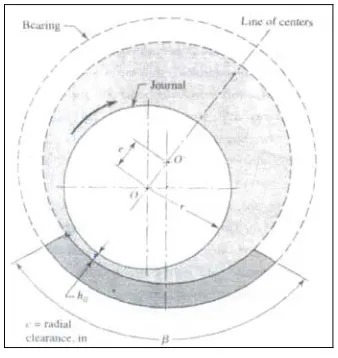
3.0 GEOMETRY: The Geometry and nomenclature of journal bearing considered in this
analysis is shown in figure 1. [7]
Fig. 1 : Journal bearing with usual notations.
4.0 DETERMINATION OF STABILITY OF HYDRODYNAMIC JOURNAL BEARING:
If the shaft is considered to be rigid mass in connections with the fluid film will be natural frequency of vibration. There is also disturbing force coming from residual unbalance in the system. Therefore the resonant vibration will be at shaft rotation speed and has been observed as a precession or orbiting of the center of shaft about the center of the bearing
The influence of fluid film bearing on the dynamic behavior of the journal is studied theoretically. The stiffness of the shaft itself combined with the stiffness of bearing that support the journal determines several forms of natural frequencies of vibration called critical speed or threshold of whirl instability or stability of journal bearings. With gas bearings the phase shift is very rapid, because of low damping. With liquid lubricated bearings the phase shift is more gradual but still very real.
The stiffness of the bearing film is non linear, but for small displacements of shaft about t the equilibrium film thickness, the film stiffness may be taken as a constant.
Synchronous speed (Stability speed) is determined theoretically for different operating conditions and verified experimentally on Journal bearing test rig .
4.1Governing Equations:
Clearance ( C ) :0.185 mm
C / Rj :0.005
Speed ( N ) :800 rpm
Load ( W ) :150 N
Lubricant : SAE 20W40 , µ = 0.0981 Pa-sec.
1) Bearing Pressure p = 0.09 N / mm2
2) Summerfeld Number : S = 0.16951
From raimondi and boyd chart ε = 0.52 3) Pressure Distribution : P = 25.156 Kpa.
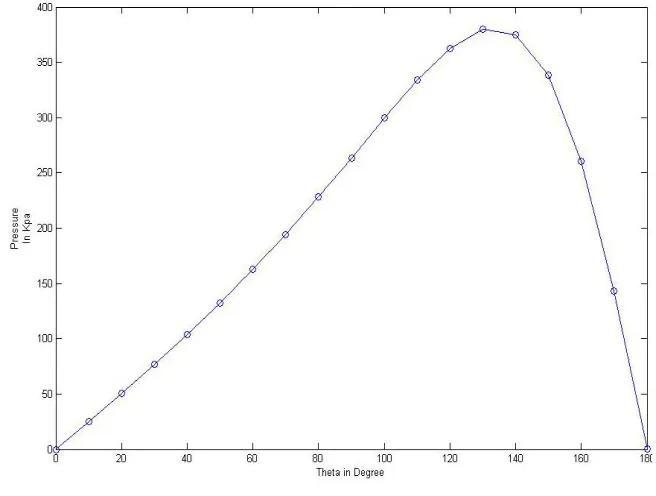
4.2 Pressure Distribution plot ( Theoretical) :
Fig 2. Pressure Distribution plot for 800 rpm and 150 N (Theoretical)
4.3 Determination of synchronous whirl.
Considering partial arc bearing 60º to 150 º (β = 90º ) [7] Let m = Diametrical clearance / Dia. of journal = 9.25 * 10-3
Table 1: Values of η and ε with L /D as 1 [7]
ε η
0.2 0.42 0.4 0.47 0.6 0.52 0.8 0.60 Using following equations [7]
Pavg = A η Z N / [ 132 ( 1000 m)2]
W = Pavg * L *Dj
=16.374 A η --- ( b) ho = mr(1- ε)
= 1.848 *10-4 (1- ε) ---( c )
Taking values of A and η From table 1, applied load ( W = 150 N ) will produce an eccentricity of 0.52 with a minimum film thickness ho = 9.24 * 10-5 m.
Performance of bearing is predicted by varying the eccentricity ratio ( ε) from 0.1 to 0.9, taking corresponding values of A and η From table1 and determining values of Pavg, W and ho by using equations a ,b and c [7]
4.4 Performance of Bearing under consideration at 800 rpm
Fig 3. Bearing Performance factors at 800 rpm and 150 N load.
4.5 Stiffness:
Although the stiffness of the film in the journal bearing is non-linear , it may be assumed as linear for small displacement about equilibrium position.
To obtain the stability of hydrodynamic journal bearing a graph of Load v/s Eccentricity and oil film thickness is plotted as shown in fig. 3 .Tangent is drawn to the curve at the operating eccentricity ratio of 0.5 and its slope is determined. Slope of the tangent to the curve is the stiffness.
From graph in fig. 3 Stiffness =∆W / ∆ ho
= (345-0) / (9.24*10-5- 1.848*10-5 ) = 466090 N / M
= 27.78 cycles/sec =1666.8 cycles/min
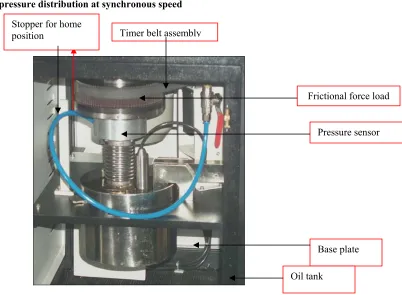
4.6 Experimental pressure distribution at synchronous speed
Fig. 4 Experimental Set Up .
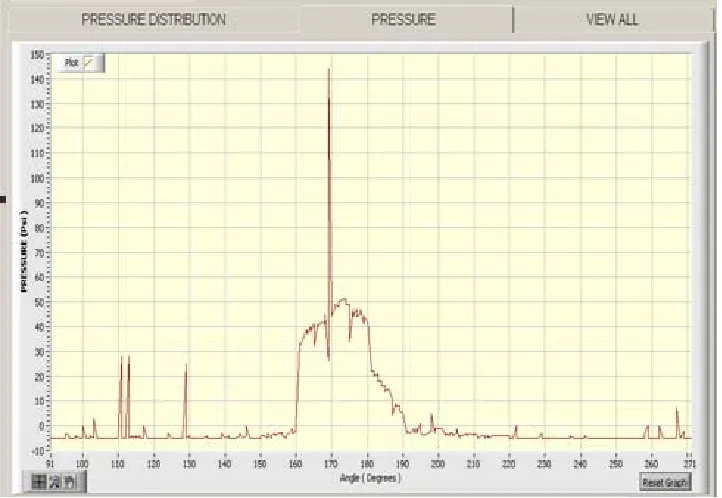
From theoretical calculations of synchronous whirl for operating speed of 800 rpm and 150 N load the stability speed is found to be 1666 rpm. At this speed the experimental analysis is carried out on journal bearing test rig. The pressure distribution is plotted as shown is fig. 5.
Stopper for home
position Timer belt assembly
Frictional force load
Pressure sensor
Fig . 5 Pressure Distribution for 1666 rpm and 150 N load.
5.0 RESULT AND DISCUSSION:
Stability speed of journal bearing based on stiffness coefficients while operating at 800 rpm and 150 N load is found as 1666 rpm, which states that the bearing is stable up to 1666 rpm. Same is verified experimentally on journal bearing test rig by operating the bearing at 1666 rpm and 150 N load. From the plot it can be seen that the pressure distribution is normal and regular up to this speed of 1666 rpm. Beyond that the pressure distribution varies considerably.
Experimental pressure distribution on Journal bearing test rig for bearing under consideration shows that maximum pressure is 52 Psi at 82.5 degrees. This is in good agreement with the theoretical value of maximum pressure. So it can be concluded that the bearing is stable up to the speed of 1666 rpm.
6.0 CONCLUSION:
Theoretical synchronous whirl occurs at 1666 cycles/min when the bearing is operating at 800 rpm and 150 N load. i.e. the bearing is stable up to 1666 rpm.
From experimental pressure distribution on journal bearing test rig it is observed that maximum pressure is 52 Psi at 82.5 degrees .which is in good agreement with the theoretical results. Also the pressure distribution is regular. i.e. the bearing is stable up to 1666 rpm.
Nomenclature:
A =Load carrying factor for journal bearing. Pavg =Average Pressure ,Kpa c =Radial clearance, mm Rj =Radius of Journal, mm
C =Diametrical clearance, mm S = (Rj / C)2 (µ Nj / P), Summerfeld
D =Diameter of bearing, mm Number
Dj =Diameter of journal, mm ωj =Angular velocity , rad/sae
e =Eccentricity, mm W =Load, N
ε =Eccentricity ratio µ =Dynamic viscosity, N-s/sq. m ƒ = Frequency , Cycles/Sec η =Side leakage load coefficient g =Acceleration due to gravity, m/sq.sec Z =Kinematic viscosity , stokes ho =Film thickness, mm
M =Mass, kg
Nj =Rotational speed of journal, rpm p = W / 2 Rj L ,Bearing pressure, kpa
P = 6 ωj µ (r / C)2 ε sin θ ( 2 + ε sin θ ) / [( 2 + ε2) ( 1 + ε cos θ ) 2 ], Pressure on fluid film, kpa
References:
[1] R. Pai and B. C. Majumdar (1991): Stability of submerged oil journal bearings under dynamic load, Wear, Volume 146, Issue 1, 30 May 1991, Pages 125-135
[2] M. C. Majumder and B. C. Majumdar(1989):Non-linear transient analysis for an externally pressurized porous gas journal bearing. Wear, Volume 132, Issue 1, July 1989, Pages 139-150
[3] S.K.Kakoty and B.C Majumdar (2000) : Effect of fluid inertia on stability of journal bearings, Journal of Trobology Volume 122,Issue October 2000,pages 741-745
[4] E.E. Swanson and R.G.Kirk.(1997): Survey of Experimental data for fixed geometry hydrodynamic journal bearings. Journal of Trobology Volume 119,Issue October 1997,pages 704-710
[5] A.H.Elkholy and A.Elshakweer(1995) : Experimental Analysis of Journal bearings, Journal of Trobology Volume
117,Issue July 1995 ,pages 589-592.
[6] Anjani Kumar and S. S. Mishra (1996): Stability of a rigid rotor in turbulent hydrodynamic worn journal bearings Wear, Volume 193, Issue 1, April 1996, Pages 25-30
[7] Dudley D.Fuller(1984): Theory and practice of lubrication for engineers, A Wiley –inter science publication,1984(second edition) ,pages 271-282.