Correspondence:Hiroshi Ishimoto ([email protected]) Received: 25 July 2018 – Discussion started: 20 August 2018
Revised: 12 November 2018 – Accepted: 11 December 2018 – Published: 7 January 2019
Abstract.To retrieve the physical properties of aerosols from multi-channel ground-based and satellite measurements, we developed a shape model of coated soot particles and created a dataset of their optical properties. Bare soot particles were assumed to have an aggregate shape, and two types of aggre-gates with different size–shape dependences were modeled using a polyhedral Voronoi structure. To simulate the detailed shape properties of mixtures of soot aggregates and adhered water-soluble substances, we propose a simple model of surface tension derived from the artificial surface potential. The light-scattering properties of the modeled particles with different volume fractions of water-soluble material were calculated using the finite-difference time-domain method and discrete-dipole approximation. The results of the single-scattering albedo and asymmetry factors were compared to those of conventional internally mixed spheres (i.e., effec-tive medium spheres based on the Maxwell-Garnett approx-imation and simple core-shell spheres). In addition, the lidar backscattering properties (i.e., lidar ratios and linear depo-larization ratios) of the modeled soot particles were investi-gated. For internally mixed soot particles, the lidar backscat-tering properties were sensitive to the shape of the soot par-ticles and the volume mixing ratio of the assumed water-soluble components. However, the average optical properties of biomass smoke, which have been reported from in situ field and laboratory measurements, were difficult to explain based on the individually modeled particle. Nonetheless, our shape model and its calculated optical properties are ex-pected to be useful as an alternative model for biomass smoke particles in advanced remote sensing via multi-channel ra-diometer and lidar measurements.
1 Introduction
or morphology and light-scattering properties is not well de-fined.
As an alternative model for soot particles in a mixing state, we developed a new shape model of internally mixed particles. We assumed that bare soot particles with fractal-like shapes were mixed with water-soluble (WS) compo-nents. Moreover, we considered hydrophilic soot particles with high wettability due to atmospheric aging. The shapes of the mixed particles were determined by applying artificial potential calculations of the surface tension of the WS com-ponents. The numerical results of the light-scattering prop-erties of the modeled particles at visible and near-infrared wavelengths are discussed.
2 Shape model of internally mixed aerosols 2.1 Soot model
Bare soot particles are commonly described as fractal aggre-gates formed from primary particles (or monomers) with a degree of overlapping and necking between neighboring pri-mary particles (Yon et al., 2015; Okyay et al., 2016). Pripri-mary particles have a diameter of 20–50 nm (Bond and Bergstrom, 2006), and the fractal dimension of the aggregates depends on emissions’ conditions and atmospheric aging. For exam-ple, newly generated soot aggregates often form lace-like structures with relatively small fractal dimensions, whereas aged soot aggregates tend to be compact and to be charac-terized by large fractal dimensions (Mikhailov et al., 2001, 2006; Zhang et al., 2016). In this study, we modeled soot ag-gregates using spatial Poisson–Voronoi tessellation. The ba-sic methods to make the aggregate model are the same as those of dust particles and ice aggregates described in our previous works (Ishimoto et al., 2010, 2012a, b; Baran et al., 2018). A spatial Poisson–Voronoi tessellation was produced from randomly distributed nucleation points in the numeri-cal field, and polyhedral cells overlapping with the assumed fractal frame were selected from the tessellation (Ishimoto et al., 2012a). We regarded the cells (i.e., Voronoi cells) as the primary soot aggregate particles to mimic overlapping and necking between neighboring primary particles. To en-sure that the size of the Voronoi cells was relatively uniform, we applied a Matérn hard-core point field (Ohser and Mück-lich, 2000) to the spatial distribution of the nucleation points (Ishimoto et al., 2012b). Aggregate particles of different sizes were produced in the same manner but by changing the rel-ative size of the fractal frame within the same tessellation. Figure 1 shows two sets of aggregate particles (Types A and B) created from fractal frames of different shapes. To cal-culate the light-scattering properties, Type A aggregates of 10 sizes and Type B aggregates of 13 sizes (where nos. 1, 2 and 3 were used for both sets) were prepared. The mean radius of the primary particlea=20 nm was used as a typ-ical value (Wu et al., 2015, 2017; Mishchenko et al., 2016;
Luo et al., 2018), and the total size of each aggregate was corrected by adjusting the average cell volume of the aggre-gate asVc,agg=4/3π a3. Although the aggregates shown in Fig. 1 were created using a box-counting approach to main-tain a fractal relationship between size and shape, this fractal relationship differed from that of the commonly used frac-tal dimensionDfused to describe individual soot particles. The fractal dimension Df is defined from the number of monomersN, fractal prefactork0and gyration radiusRgas follows (Adachi et al., 2007):
N=k0
R
g
a
Df
. (1)
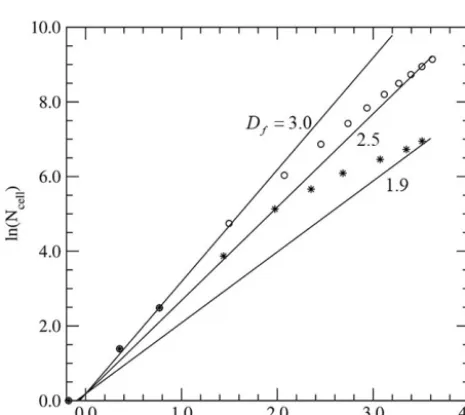
For numerical simulation of the light-scattering properties of aged soot particles, various Df values for a typical prefac-tor ofk0=1.2 have been proposed in the literature, such as Df=2.0–2.5 (Nyeki and Colbeck, 1995), 1.9–2.6 (Adachi et al., 2007), 2.5 (He et al., 2015), 2.6 (Mishchenko et al., 2016) and 2.5–3.0 (Zhang et al., 2017). The corresponding Df values for our modeled soot particles derived from the calculation ofRgare plotted in Fig. 2. Applying the fractal prefactork0=1.2 resulted in aggregate particles in the range ofDf=1.9–2.5 (Type A) and 2.5–3.0 (Type B) given a nor-malized gyration radius of ln Rg/a≤3.6.
2.2 Artificial surface tension of mixed soot and water-soluble components
Figure 1.Model of bare soot particles created using three-dimensional Voronoi tessellation (Types A and B).
Figure 2.Relationship between the number of cellsNcellassuming Ncell=N, from Eq. (1), and normalized gyration radiusRg/afor the modeled soot aggregates. Asterisks and open circles correspond to Type A and Type B aggregates, respectively. Solid lines represent the relationship described by Eq. (1) for fractal dimensions ofDf= 1.9,2.5,3.0 whenk0=1.2.
surface potential.
Uj≡ −
X
i fi,
fi=1 rij≤d fi=0 rij> d
, (2)
whereUj is the artificial potential at surface pointj, andUj is defined as the negative value of the total number of grid points of material with distancer≤d. We used this simple model for the surface potential calculations to focus on the
shape of the mixture in discrete grid space. An equilibrium mixing state was simulated assuming that the applied WS components preferentially accumulate at grid points of lower potential. The shape of internally mixed particles under an arbitrary volume mixing ratio was determined based on iter-ative calculations of the surface potential and by adding WS elements. In the artificial potential calculations in Eq. (2), the setting of the lengthdis important. We applied two steps for the potential calculations and adhesion of WS components for each iterative calculation.
d1=3l, Nadd=0.016Ns
d2=Max(d1dcor), Nadd=0.004Ns, (3)
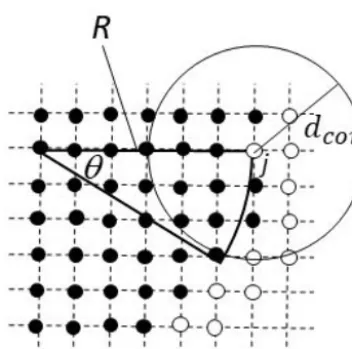
relation-Figure 3.Schematic diagram of the distancedcorbased on the arti-ficial potential calculation for a two-dimensional case. Open circles represent surface points for the potential field calculation, and solid circles indicate points occupied by material. To discriminate the cur-vature of the radiusRfrom the calculated potential at surface point j, the lengthdin Eq. (2) should be larger thandcor. A spherical mixed particle is automatically generated from the potential calcu-lations and adding water-soluble material when the soot particle is completely encapsulated.
ships. 4 3π R
3=N
Vl3,4π R2γ=Nsl3, Rsinθ=dcor,
Rcosθ=R−l (4)
dcor=l
s
6NVγ Nsl
−1, (5)
whereNV is the total number of grid points occupied by the material, andγ is the effective skin depth (γ=1.51l). Fig-ure 3 presents a schematic diagram describingdcorin a two-dimensional case.
The artificial potential was calculated for each iterative step, andNaddof WS elements was added, starting with the grid points of lowest potential. The internally mixed soot model (i.e., the particle shape modeled based on artificial surface tension, AST hereafter) was created for different val-ues of the volume ratioVr=Vws/Vsoot, whereVwsandVsoot are the volumes of the WS and soot materials, respectively. Figure 4 shows the results of several mixed soot models for Vr∼0,2,5,10,20. The total number of iterations was ap-proximately 1000 (2000) to createVr∼10 (Vr∼20) parti-cles. For simplicity, we neglected the difference in materi-als (i.e., soot or WS) in the potential calculations of Eq. (2), which implicitly assumes that soot material is sufficiently hy-drophilic, with high WS wettability. Although we made as-sumptions in the modeling of these particles, their shapes are similar to those observed by electron microscopy (Adachi et al., 2010; Fig. 5). The shape model of the particle was
ul-timately defined using a three-dimensional rendering tech-nique.
3 Single-scattering properties
We calculated the light-scattering properties using the finite-difference time-domain (FDTD) method (Cole, 2005; Taflove and Hagness, 2005; Ishimoto et al., 2012a) and DDA (DDSCAT version 7.3; https://code.google.com/archive/p/ ddscat/ (last access: 25 December 2018); Draine and Flatau, 1994). Particles defined by discrete points as the input for the light-scattering calculations were reconstructed from the shape model described in Sect. 2, and the grid length was set within the range 2≤2a/ l≤10 for correct reproduction of the defined aggregates within the numerical convergence cri-terion. Although soot particles are generally small aerosols, large computational resources for FDTD and DDA calcula-tions are necessary to estimate the exact scattering properties of the mixed particles due to the fine structure of soot and ad-ditional volume contributed by WS material. Using the same discretized particle under an appropriate convergence con-dition, the scattering properties calculated by FDTD would have approximately the same accuracy as those derived from DDA (Yurkin et al., 2007). However, the numerical cost of the two methods differs depending on the particle shape and the refractive index of the particle material (Yurkin et al., 2007). The memory and CPU time of the DDA calcula-tions mainly depend on the number of discretized points (i.e., dipoles) and depend on particle volume. Meanwhile, the nu-merical costs of the FDTD calculations are determined by the size of the discretized numerical field that encloses the particle. For fractal-shaped particles of relatively small frac-tal dimensions, DDA calculations are faster than FDTD ones because of the small relative volume with respect to size. By contrast, the numerical cost of DDA calculations drastically increases as the volume of attached WS elements increases, whereas the FDTD method can output results within similar CPU times given similar total sizes. Therefore, we used both numerical methods for the light-scattering calculations in ac-cordance with the size and shape of the particles. In the nu-merical environment of our nonparallel computation, light-scattering calculations performed using FDTD were faster than those using DDA for AST-B particles (nos. 10–13).
Figure 4.Mixed soot particle model developed using artificial surface tension (AST) for the attached water-soluble material. Several Type A (Type B) aggregates of different sizes were used on the left (right) side. The marching cubes method was applied for surface rendering.
Figure 5. An example transmission electron microscopy (TEM) image of an internally mixed soot particle. The sample was col-lected from biomass burned during the Biomass Burning Observa-tion Project (BBOP) (Adachi et al., 2018). The soot particle has an aggregate structure of spherical monomers and is embedded within organic material. This particle looks similar to the AST-A particles (e.g., no. 6 particle withVr=5 in Fig. 4).
(340, 355, 380, 400, 500, 532, 675, 870, 1020 and 1064 nm) were selected. We used a spectral refractive index dataset by Chang and Charalampopoulos (1990) for the bare soot mate-rial. For the WS components, the dependence of the refrac-tive index on relarefrac-tive humidity was considered, and relarefrac-tive humidity values of 0 %, 50 %, 90 % and 98 % in the software package Optical Properties of Aerosols and Clouds (OPAC) were applied (Hess et al., 1998). The outputs included the results of the light-scattering properties with those averaged over 88 orientations for the FDTD method and 100 orienta-tions for the DDA method.
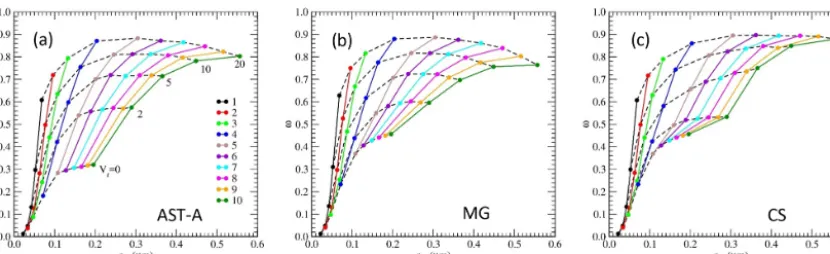
As examples of the numerical results, Figs. 6 and 7 present the size (req) dependence of single-scattering albedo (ω) and
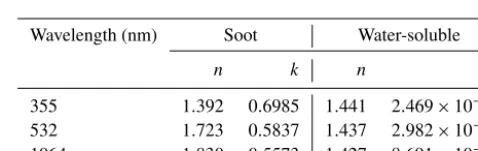
Table 1.Complex refractive index (n+i k) of soot and water-soluble (WS) components used for light-scattering calculations (Figs. 6– 10). A relative humidity of 50 % was assumed for the WS compo-nent.
Wavelength (nm) Soot Water-soluble
n k n k
355 1.392 0.6985 1.441 2.469×10⁻³ 532 1.723 0.5837 1.437 2.982×10⁻³ 1064 1.830 0.5573 1.427 8.691×10⁻³
the asymmetry factor (g) at a wavelength ofλ=532 nm for AST-A. The complex refractive indices for soot and WS are listed in Table 1, for which the refractive index at a relative humidity of 50 % was applied for WS. For comparison, the results ofωandgwith the sameVrbut derived via Mie calcu-lations for spheres of the effective refractive index calculated using the Maxwell-Garnett mixing rule (MG) (Bohren and Huffman, 1983) and for spheres with a soot-core/WS-shell structure (CS) were also plotted.
Figure 6. Single-scattering albedoωversus particle size (volume-equivalent sphere radius: req) at a wavelength of λ=532 nm for the (a)AST model of Type A aggregates (AST-A),(b)Maxwell-Garnett approximation (MG) and(c)core-shell approximation (CS). Results for the same bare soot aggregate at different volume ratios ofVr∼0251020 are plotted in the same color. Aggregate numbers are the same as those in Fig. 1.
Figure 7.As Fig. 6, but for the results of the asymmetry factorg.
were fractal shapes with relatively smallDf(Figs. 1 and 2), the effective medium theory based on the MG mixing rule of-fered a better approximation than the CS approximation did for the AST-A model.
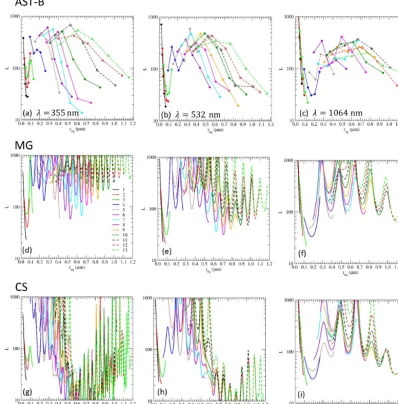
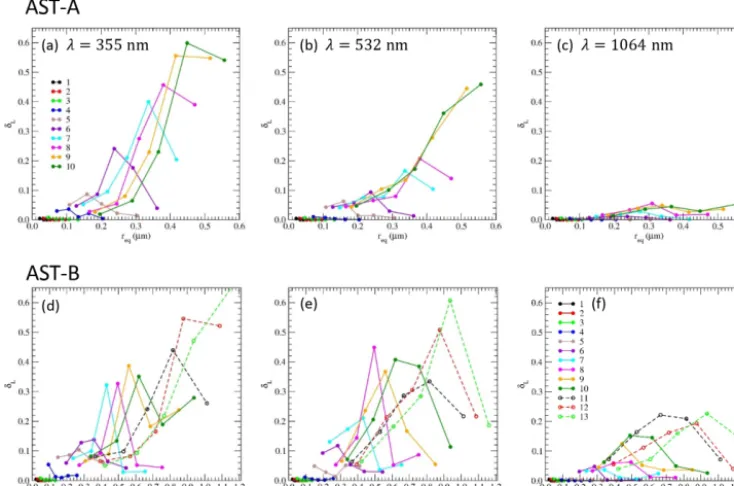
Compared toωandg, the backscattering properties of par-ticles are sensitive to particle shape and mixing state. There-fore, lidar measurements could potentially offer information on the validity of the particle model. The calculated lidar ra-tio Land linear depolarization ratio δL for the AST-A and AST-B particles at wavelengths of 355, 532 and 1064 nm are plotted in Figs. 8–10. For a single particle,L is calcu-lated from ωand the normalized phase functionP11 in the backscattering direction, andδLis derived from theP11and P22 components of the scattering matrix. Here, we omitted the backscattering of P12 for δL due to the assumption of random particle orientation.
L= 4π
ωP11 , δL=
P11−P22 P11+P22
(6) For lidar ratios, the MG and CS sphere results for the same volume of bare soot aggregates and the same req range of Vr≤20 as that for AST-A and AST-B are also plotted in Figs. 8 and 9. Because backscatteringP11 is sensitive to the size of spherical particles, calculations were performed at a
step size of 0.01 µm. The lidar ratios of CS particles tended to be smaller than those of MG particles, and the difference be-tween MG and CS was significant at wavelengths of 355 and 532 nm. Furthermore, the lidar ratios of AST-A and AST-B particles were approximately between the MG and CS results for particles of the samereqand mixing ratios, particularly for entirely encapsulatedVr≥1 particles. As denoted in the asymmetry factor results, MG and CS corresponded to two extreme cases of mixture soot materials within the WS shell; our lidar ratio results for fractal-like soot shapes among AST-A and AST-AST-B are reasonable.
Figure 8.Results of the lidar ratioLfor particles derived from the AST-A model at wavelengths of(a)355,(b)532 and(c)1064 nm. Panels (d)–(f)are the same as(a)–(c), but for spheres with an average refractive index calculated using the Maxwell-Garnett mixing rule (MG). Panels(g)–(i)are the same as(a)–(c), but for core-shell (CS) spheres. Colors and volume ratiosVrfor each point are the same as those in Fig. 6a for the AST-A model (Vr∼0251020 from left to right for circles of the same color). For(d)–(i), calculations were performed for Vr≤20 with a step size of 0.01 µm.
size parameterxeq(=2π req/λ) is an important factor for the evaluation ofδLas well as shape nonsphericity.
According to the biomass smoke measurement results, the size of dry particles was 0.10–0.16 µm at count me-dian diameter (0.25–0.30 µm at volume meme-dian diameter) (Reid et al., 2005a). Laboratory and in situ measurements for aged biomass smoke yielded estimates of ω≥0.75 and g∼0.6 at λ=532 nm (Reid et al., 2005b; Pokhrel et al., 2016). For lidar measurements, typical values of L∼70 sr and δL∼7 % at λ=532 nm have been reported (Groß et al., 2015a, b). Among our optical property results for AST-A, particle no. 4 (Vr=20) had values of (ω, g, L, δL)= (0.87,0.67,69 sr,0 %), and particle no. 5 (Vr=2) had
Figure 9.As Fig. 8, but for internally mixed Type B particles (AST-B)(a–c), MG(d–f)and CS(g–i). The horizontal scale differs from that shown in Fig. 8.
al., 2015; Mishchenko et al., 2016) can be explained, for ex-ample, by the AST-A particle no. 6 (Vr=5−10; Fig. 10a–c). However, such nonspherical mixed particles tended to have relatively large lidar ratios ofL≥100 sr atλ=355,532 nm in the AST-A model. In the comparison between AST-A and AST-B particles, variation inLandδLfor AST-B was greater than for AST-A. Atλ=355 nm, the measurement-derived li-dar ratio wasL355 nm=76±12 sr (Groß et al., 2015b). The value was difficult to explain for MG particles, but was rel-atively consistent with the largeVrobserved for AST-A and AST-B particles and some CS particles. By contrast, the cal-culated depolarization ratios of AST-A and AST-B particles at both λ=355 and 532 nm exceeded 30 % for larger ag-gregates with a high amount of coating. These ratios were higher than those measured for biomass burning (7 %–16 %; Groß et al., 2015b), suggesting that the depolarization ratios
of nonspherical soot particles were easily enhanced when coated with weakly absorbing WS material. A similar effect was previously reported (Kahnert, 2017). According to Kan-ngießer and Kahnert (2018), the speed of transition from film coating to spherical growth (Pei et al., 2018) is a morpholog-ical parameter that strongly affects the depolarization ratio. A rapid transition to spherical growth may cause a smaller depolarization ratio of internally mixed soot particles.
Figure 10.Results of the linear depolarization ratioδLfor particles derived from the AST-A model at wavelengths of(a)355,(b)532 and (c)1064 nm. Panels(d)–(f)are the same as(a)–(c), but for AST-B particle results.
Among the field measurements, the observed optical prop-erties were the average of the particle size distribution. Our results indicate that the presence of large mixed soot particles may enhance the bulkδLof smoke.
Typical values of Vr for mixed biomass smoke particles likely depend on the relative humidity, concentrations of WS components and the size and shape of soot aggregates. The mixing of different aerosol types, such as dust in biomass burning (Groß et al., 2011, 2013), may be important for the interpretation of measured optical properties. Improved re-trieval calculations based on realistic aerosol simulations that consider particle size and shape distribution and other types of aerosol contamination are expected using our AST model for internally mixed soot particles.
4 Summary
For satellite- and ground-based remote-sensing analysis ap-plications, we developed a shape model of internally mixed soot particles and calculated the optical properties of par-ticles at visible and near-infrared wavelengths. Fractal-like structures extracted using spatial Voronoi tessellation were considered to mimic necking and overlapping between neighboring primary particles. We created two types of poly-hedral aggregates with different particle shape–size depen-dences (Type A and Type B) to account for the effects of compaction on soot aggregate shape during the atmospheric aging process. Then the artificial surface potential for the particle in a Cartesian grid space was defined, and the
sur-face tension of the WS components on the soot aggregate was simulated, assuming that the soot was hydrophilic with high wettability. Based on a simple assumption of the be-havior of WS elements, the shapes of internally mixed soot particles dependent on the amount of attached dissolved ma-terial were determined from iterative calculations. Overall, an aggregate coated with a thin film was simulated given a relatively small volume of added WS components, whereas the soot aggregate was covered with a spherical shell given a large number of WS components. The optical properties of the developed internally mixed particles were calculated using the FDTD and DDA methods while considering the spectral dependence on the refractive indices.
be simulated by a single particle in our internally mixed soot model. In particular, AST particles tended to have larger lidar ratios and depolarization ratios than those obtained by field measurements. The inconsistencies in lidar backscattering properties between the model results and measurements may remain unresolved even after size-averaging the optical prop-erties. One possible explanation for this phenomenon is that soot aggregates change their shapes to become more com-pact (i.e., become spherical) during the WS adhesion process in the atmosphere. The contribution of the core-shell type of internally mixed soot particles and the use of the nonspheri-cal model may be necessary to simulate observed results for burned biomass aerosols.
In addition to its use in direct analyses for the field mea-surement results, the dataset of the AST particle optical prop-erties can be used for the parameterization of conventional spherical particle models, such as the MG model, CS model, and their combined model. Furthermore, the dataset will be useful for determining the shape property conditions of smoke particles observed from multi-sensor measurements, including lidar backscattering.
Data availability. The data in the figures are available upon request
from the corresponding author (Hiroshi Ishimoto).
Supplement. The supplement related to this article is available
online at: https://doi.org/10.5194/amt-12-107-2019-supplement.
Author contributions. HI, RK and KA created particle shape model
and finalized the paper. Light scattering properties were calculated by HI. The optical database was designed by RK.
Competing interests. The authors declare that they have no conflict
of interest.
Special issue statement. This article is part of the special issue
“SKYNET – the international network for aerosol, clouds, and so-lar radiation studies and their applications (AMT/ACP inter-journal SI)”. It is not associated with a conference.
Acknowledgements. This research was supported by the Global
Change Observation Mission-Climate (GCOM-C) research project of the Japan Aerospace Exploration Agency (JAXA), and by a grant for the Global Environmental Research Coordination System from the Ministry of the Environment, Japan.
Edited by: Teruyuki Nakajima
Reviewed by: three anonymous referees
References
Adachi, K. and Buseck, P. R.: Internally mixed soot, sulfates, and organic matter in aerosol particles from Mexico City, Atmos. Chem. Phys., 8, 6469–6481, https://doi.org/10.5194/acp-8-6469-2008, 2008.
Adachi, K., Chung, S. H., Friedrich, H., and Buseck, P. R.: Frac-tal parameters of individual soot particles determined using elec-tron tomography: Implications for optical properties, J. Geophys. Res.-Atmos., 112, 1–10, https://doi.org/10.1029/2006JD008296, 2007.
Adachi, K., Chung, S. H., and Buseck, P. R.: Shapes of soot aerosol particles and implications for their effects on climate, J. Geophys. Res.-Atmos., 115, 1–9, https://doi.org/10.1029/2009JD012868, 2010.
Adachi, K., Sedlacek, A. J., Kleinman, L., Chand, D., Hubbe, J. M., and Buseck, P. R.: Volume changes upon heating of aerosol particles from biomass burning using transmis-sion electron microscopy, Aerosol Sci. Technol., 52, 46–56, https://doi.org/10.1080/02786826.2017.1373181, 2018. Akinci, N., Akinci, G., and Teschner, M.: Versatile surface
ten-sion and adheten-sion for SPH fluids, ACM Trans. Graph., 32, 182, https://doi.org/10.1145/2508363.2508395, 2013.
Baran, A. J., Ishimoto, H., Sourdeval, O., Hesse, E., and Har-low, C.: The applicability of physical optics in the millime-tre and sub-millimemillime-tre spectral region, Part II: Application to a three-component model of ice cloud and its evalua-tion against the bulk single-scattering properties of various other aggregate models, J. Quant. Spectrosc. Ra., 206, 83–100, https://doi.org/10.1016/j.jqsrt.2017.10.027, 2018.
Becker, S., Urbassek, H. M., Horsch, M., and Hasse, H.: Contact Angle of Sessile Drops in Lennard-Jones Systems, Langmuir, 30, 13606–13614, https://doi.org/10.1021/la503974z, 2014. Bohren, C. F. and Huffman, D. R.: Absorption and scattering of
light by small particles, John Wiley & Sons, New York, 1983. Bond, T. C. and Bergstrom, R. W.: Light absorption by
carbona-ceous particles: An investigative review, Aerosol Sci. Technol., 40, 27–67, https://doi.org/10.1080/02786820500421521, 2006. Burton, S. P., Hair, J. W., Kahnert, M., Ferrare, R. A., Hostetler,
C. A., Cook, A. L., Harper, D. B., Berkoff, T. A., Seaman, S. T., Collins, J. E., Fenn, M. A., and Rogers, R. R.: Observa-tions of the spectral dependence of linear particle depolariza-tion ratio of aerosols using NASA Langley airborne High Spec-tral Resolution Lidar, Atmos. Chem. Phys., 15, 13453–13473, https://doi.org/10.5194/acp-15-13453-2015, 2015.
Chang, H. and Charalampopoulos, T. T.: Determination of the Wavelength Dependence of Refractive Indices of Flame Soot, Proc. R. Soc. A Math. Phys. Eng. Sci., 430, 577–591, https://doi.org/10.1098/rspa.1990.0107, 1990.
Cheng, T., Gu, X., Wu, Y., and Chen, H.: Effects of atmospheric water on the optical properties of soot aerosols with differ-ent mixing states, J. Quant. Spectrosc. Ra., 147, 196–206, https://doi.org/10.1016/j.jqsrt.2014.06.002, 2014.
Cole, J. B.: High accuracy nonstandard finite-difference time-domain algorithms for computational electromagnetics: Appli-cations to optics and photonics, in: Advances in the AppliAppli-cations of Nonstandard Finite Difference Schemes, edited by: Mickens, R. E., 89–189, World Scientific, Singapore, 2005.
Groß, S., Freudenthaler, V., Schepanski, K., Toledano, C., Schäfler, A., Ansmann, A., and Weinzierl, B.: Optical prop-erties of long-range transported Saharan dust over Barba-dos as measured by dual-wavelength depolarization Raman li-dar measurements, Atmos. Chem. Phys., 15, 11067–11080, https://doi.org/10.5194/acp-15-11067-2015, 2015a.
Groß, S., Freudenthaler, V., Wirth, M., and Weinzierl, B.: Towards an aerosol classification scheme for future EarthCARE lidar ob-servations and implications for research needs, Atmos. Sci. Lett., 16, 77–82, https://doi.org/10.1002/asl2.524, 2015b.
Hara, Y., Nishizawa, T., Sugimoto, N., Osada, K., Yumimoto, K., Uno, I., Kudo, R., and Ishimoto, H.: Retrieval of Aerosol ponents Using Multi-Wavelength Mie-Raman Lidar and Com-parison with Ground Aerosol Sampling, Remote Sens., 10, 937, https://doi.org/10.3390/rs10060937, 2018.
He, C., Liou, K.-N., Takano, Y., Zhang, R., Levy Zamora, M., Yang, P., Li, Q., and Leung, L. R.: Variation of the radiative properties during black carbon aging: theoretical and experi-mental intercomparison, Atmos. Chem. Phys., 15, 11967–11980, https://doi.org/10.5194/acp-15-11967-2015, 2015.
Hess, M., Koepke, P., and Schult, I.: Optical Properties of Aerosols and Clouds: The Software Package OPAC, B. Am. Meteor. Soc., 79, 831–844, https://doi.org/10.1175/1520-0477(1998)079<0831:OPOAAC>2.0.CO;2, 1998.
Ishimoto, H., Zaizen, Y., Uchiyama, A., Masuda, K., and Mano, Y.: Shape modeling of mineral dust particles for light-scattering calculations using the spatial Poisson-Voronoi tessellation, J. Quant. Spectrosc. Ra., 111, 2434–2443, https://doi.org/10.1016/j.jqsrt.2010.06.018, 2010.
Ishimoto, H., Masuda, K., Mano, Y., Orikasa, N., and Uchiyama, A.: Irregularly shaped ice aggregates in optical modeling of con-vectively generated ice clouds, J. Quant. Spectrosc. Ra., 113, 632–643, https://doi.org/10.1016/j.jqsrt.2012.01.017, 2012a. Ishimoto, H., Zaizen, Y., Masuda, K., Mano, Y., and Uchiyama,
A.: Shape modeling of dust and soot particles for remote sens-ing applications considersens-ing the geometrical features of sam-pled aerosols, in: Technical Reports of the Meteorological Re-search Institute, 40–43, available at: http://www.mri-jma.go. jp/Publish/Technical/index_en.html (last access: 26 December 2018), 2012b.
Jacobson, M. Z.: Strong radiative heating due to the mixing state of black carbon in atmospheric aerosols, Nature, 409, 695–697, https://doi.org/10.1038/35055518, 2001.
https://doi.org/10.1002/2017JD027909, 2018.
Liu, F., Yon, J., and Bescond, A.: On the radiative properties of soot aggregates – Part 2: Effects of coating, J. Quant. Spectrosc. Ra., 172, 134–145, https://doi.org/10.1016/j.jqsrt.2015.08.005, 2016. Luo, J., Zhang, Y., and Zhang, Q.: A model study of aggre-gates composed of spherical soot monomers with an acen-tric carbon shell, J. Quant. Spectrosc. Ra., 205, 184–195, https://doi.org/10.1016/j.jqsrt.2017.10.024, 2018.
Mikhailov, E. F., Vlasenko, S. S., Krämer, L., and Niessner, R.: Interaction of soot aerosol particles with water droplets: Influ-ence of surface hydrophilicity, J. Aerosol Sci., 32, 697–711, https://doi.org/10.1016/S0021-8502(00)00101-4, 2001. Mikhailov, E. F., Vlasenko, S. S., Podgorny, I. A., Ramanathan,
V., and Corrigan, C. E.: Optical properties of soot-water drop agglomerates: An experimental study, J. Geophys. Res.-Atmos., 111, D07209, https://doi.org/10.1029/2005JD006389, 2006. Mishchenko, M. I., Dlugach, J. M., and Liu, L.: Linear
depolar-ization of lidar returns by aged smoke particles, Appl. Opt., 55, 9968–9973, https://doi.org/10.1364/AO.55.009968, 2016. Moteki, N.: Discrete dipole approximation for black
carbon-containing aerosols in arbitrary mixing state: A hybrid dis-cretization scheme, J. Quant. Spectrosc. Ra., 178, 306–314, https://doi.org/10.1016/j.jqsrt.2016.01.025, 2016.
Moteki, N. and Kondo, Y.: Effects of mixing state on black carbon measurements by laser-induced in-candescence, Aerosol Sci. Technol., 41, 398–417, https://doi.org/10.1080/02786820701199728, 2007.
Nyeki, S. and Colbeck, I.: Fractal Dimension Analysis of Single, In-Situ, Restructured Carbonaceous Aggregates, Aerosol Sci. Tech-nol., 23, 109–120, https://doi.org/10.1080/02786829508965298, 1995.
Ohser, J. and Mücklich, F.: Statistical Analysis of Microstructures in Materials Science, John Wiley & Sons, Chichester, 2000. Okyay, G., Héripré, E., Reiss, T., Haghi-Ashtiani, P., Auger, T.,
and Enguehard, F.: Soot aggregate complex morphology: 3D geometry reconstruction by SEM tomography applied on soot issued from propane combustion, J. Aerosol Sci., 93, 63–79, https://doi.org/10.1016/j.jaerosci.2015.11.009, 2016.
ozonolysis product vapors, Atmos. Chem. Phys., 18, 9845–9860, https://doi.org/10.5194/acp-18-9845-2018, 2018.
Pokhrel, R. P., Wagner, N. L., Langridge, J. M., Lack, D. A., Jayarathne, T., Stone, E. A., Stockwell, C. E., Yokelson, R. J., and Murphy, S. M.: Parameterization of single-scattering albedo (SSA) and absorption Ångström exponent (AAE) with EC/OC for aerosol emissions from biomass burning, Atmos. Chem. Phys., 16, 9549–9561, https://doi.org/10.5194/acp-16-9549-2016, 2016.
Ramanathan, V. and Carmichael, G.: Global and regional cli-mate changes due to black carbon, Nat. Geosci., 1, 221–227, https://doi.org/10.1038/ngeo156, 2008.
Reid, J. S., Koppmann, R., Eck, T. F., and Eleuterio, D. P.: A review of biomass burning emissions part II: intensive physical proper-ties of biomass burning particles, Atmos. Chem. Phys., 5, 799– 825, https://doi.org/10.5194/acp-5-799-2005, 2005a.
Reid, J. S., Eck, T. F., Christopher, S. A., Koppmann, R., Dubovik, O., Eleuterio, D. P., Holben, B. N., Reid, E. A., and Zhang, J.: A review of biomass burning emissions part III: intensive optical properties of biomass burning particles, Atmos. Chem. Phys., 5, 827–849, https://doi.org/10.5194/acp-5-827-2005, 2005b. Reid, S. and Hobbs, P. V: Physical and optical properties of young
smoke from individual biomass fires in Brazil, J. Geophys. Res., 103, 32013–32030, 1998.
Scarnato, B. V., Vahidinia, S., Richard, D. T., and Kirchstetter, T. W.: Effects of internal mixing and aggregate morphology on optical properties of black carbon using a discrete dipole approximation model, Atmos. Chem. Phys., 13, 5089–5101, https://doi.org/10.5194/acp-13-5089-2013, 2013.
Shiraiwa, M., Kondo, Y., Moteki, N., Takegawa, N., Miyazaki, Y., and Blake, D. R.: Evolution of mixing state of black car-bon in polluted air from Tokyo, Geophys. Res. Lett., 34, 2–6, https://doi.org/10.1029/2007GL029819, 2007.
Shiraiwa, M., Kondo, Y., Iwamoto, T., and Kita, K.: Amplification of light absorption of black carbon by organic coating, Aerosol Sci. Technol., 44, 46–54, https://doi.org/10.1080/02786820903357686, 2010.
Taflove, A. and Hagness, S. C.: Computational electrodynamics The finite-difference time-domain method, 3rd edn., Artech House, Boston, 2005.
Tartakovsky, A. and Meakin, P.: Modeling of sur-face tension and contact angles with smoothed par-ticle hydrodynamics, Phys. Rev. E, 72, 026301, https://doi.org/10.1103/PhysRevE.72.026301, 2005.
Wu, Y., Cheng, T., Zheng, L., Chen, H., and Xu, H.: Single scat-tering properties of semi-embedded soot morphologies with in-tersecting and non-inin-tersecting surfaces of absorbing spheres and non-absorbing host, J. Quant. Spectrosc. Ra., 157, 1–13, https://doi.org/10.1016/j.jqsrt.2015.02.006, 2015.
Wu, Y., Cheng, T., Zheng, L., and Chen, H.: Optical properties of the semi-external mixture composed of sulfate particle and different quantities of soot aggregates, J. Quant. Spectrosc. Ra., 179, 139–148, https://doi.org/10.1016/j.jqsrt.2016.03.012, 2016. Wu, Y., Cheng, T., Zheng, L., and Chen, H.: Sensitivity of mixing states on optical properties of fresh secondary or-ganic carbon aerosols, J. Quant. Spectrosc. Ra., 195, 147–155, https://doi.org/10.1016/j.jqsrt.2017.01.013, 2017.
Yon, J., Bescond, A., and Liu, F.: On the radiative properties of soot aggregates part 1: Necking and overlapping, J. Quant. Spectrosc. Ra., 162, 197–206, https://doi.org/10.1016/j.jqsrt.2015.03.027, 2015.
Yurkin, M. A., Hoekstra, A. G., Brock, R. S., and Lu, J. Q.: Sys-tematic comparison of the discrete dipole approximation and the finite difference time domain method for large dielectric scatter-ers, Opt. Express, 15, 17902–17911, 2007.
Zhang, X., Mao, M., Yin, Y., and Wang, B.: Absorption enhance-ment of aged black carbon aerosols affected by their micro-physics: A numerical investigation, J. Quant. Spectrosc. Ra., 202, 90–97, https://doi.org/10.1016/j.jqsrt.2017.07.025, 2017. Zhang, Y., Zhang, Q., Cheng, Y., Su, H., Kecorius, S., Wang, Z.,