The training technologies by specialty «Automation and
control» within the program «Synergy»
Iosif V. Breido
1,*, Boris N. Feshin
2, Galina I. Parshina
2, Lyubov G. Lyubchenko
2, Roman V. Маrkvardt
2and Andrey V.Sichkarenko
21Karaganda State Technical University, No.56, Mira B., Karaganda, 100027, Kazakhstan 2Karaganda State Technical University, No.56, Mira B., Karaganda, 100027, Kazakhstan
Abstract
This program describes the experience over the ages and it was improved as the main goals of technology training used by specialty "Automation and Control" at the Department of Automation of Production Processes at the Karaganda State Technical University, within the program as the international distance educational project "SYNERGY" by the fallowing research direction such as: in process control and management for computer development and microprocessor systems; the government program of industrial-innovative development; the profile magistracy as a new educational system; the complexes of virtual practical-laboratory; on the basis of industrial equipment also on the basis of various control were created the stands; the new stands are designed and manufactured; the existing training stands are modernized; the contemporaneity educational standards are taken and created.
Keywords: education, electrical engineering, automation, information technology, microprocessor, computer, industry, telecommunication, network, project, synergy.
Received on 30 November 2017, accepted on 08 February 2018, published on 10 July 2018
Copyright © 2018Iosif V. Breidoet al., licensed to EAI. This is an open access article distributed under the terms of the Creative Commons Attribution licence (http://creativecommons.org/licenses/by/3.0/), which permits unlimited use, distribution and reproduction in any medium so long as the original work is properly cited.
doi: 10.4108/eai.10-7-2018.155044
*Email:[email protected]
1. Introduction
High-quality specialization training of electrical discipline is connected with modern Universities availability ( at the time of analyzes) to have element tool base and automation system. There are two main reasons which largely determine the final training result. The first reason is connected with supply lag of equipment by the organizational and financial considerations of university. The second reason is determined by the training methodology for new automation technologies according to the change regularity of the microprocessing element base which was noticed by Moore [1, 2] and constantly change with a periodicity of at least 5 years.
2. Computer and microprocessor systems
development as technological control and
management
2
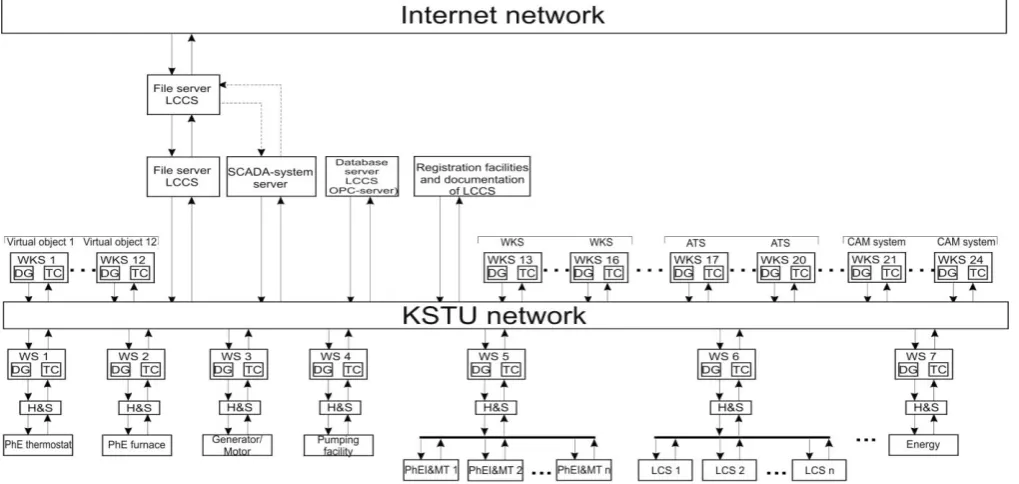
related to the acquisition of controllers and other equipment by the company Advantech, including: PCA-6135, PCL-735, PCL-836, PCL-818, PS-150, IPC-6010, and also freely distributed training and demonstration versions SCADA-system TraceMode, Genesis 32, WinCС,Genie and etc. On the base of "LCCS" were created physical monitoring and control systems (see figure 1: "р.stan.1,……, р.stan.4"), including the adaptive computer system for monitoring and controlling a laboratory electric furnace – CS CM LE (figure 1 is "р. stan.1"). The LCCS creation (and its fragments like CS CM LE) significantly influenced to the quality of engineers training (there was a system of training engineers in the framework of a 5-year education in the Republic of Kazakhstan (RK) in those years) for specialties "Automation of technological complexes" and "Electric drive and automation of technological complexes ". The laboratory work was accomplished in a base of CS CM LE. Laboratory work (LW) 1. The studying principals computer systems for technological control and control based on company devices were constructed by Advantech818LS, 735, PCL-836 (on the basis of the laboratory electric oven-thermostat stand ); LW2. The analyzing principles of structuring and tudying the operative modes of OPC servers in the structure of integrated computer monitoring systems and operation: LW3. The development and design of mnemonic scheme for operating modes of a laboratory electric furnace in a computing environment of SCADA-system: Genesis32; LW4. The identification of standing elements "The laboratory furnaces" as the object of automation control and operation by instrumentation of SCADA-system. The works made possible to study the technology of designing control systems for industrial facilities (software) which based on
microprocessor facilities and software such as SCADA-systems and get the customization skills, setting up, operating, researching software, control systems and regulation software.
The firmware and systems allowed the following tasks to be set and solved at the lower level of LCCS the technical study characteristic of the firmware of computer process control systems; the principal studying of structural computer systems for technological control and operating; the analysis of the principles of construction and operation modes of OPC servers in the structure of integrated computer monitoring and control systems; development and design of mnemonic scheme of technological processes in the environment of SCADA-systems; the analysis of information exchange protocols as integrated control and operating systems; the principal studying of constructing software and hardware "electronic oscilloscope"; analysis and development of computer systems for automated control, operating control and electric drives; analysis of operating modes and characteristics of computer measuring systems, analysis of the interaction principles ASP Matlab, MathCad, Excel, Access with SCADA-systems; the operating modes analysis of industrial measurement and control systems with parametric and generator sensors; the operating modes analysis of industrial systems for measuring, controlling and stabilizing temperature in a laboratory furnace; the operating modes engineering analysis WKS in LCCS; the operating modes analysis of administrative and organizational opereting systems in the hierarchical system (ie LCCS).
Figure 1. Functional-structural scheme of LCCS
The prospective nature problems were taken into account the LCCS hierarchical links, the expansion possibilities of the functional complex capabilities were allowed to assume in the direction of creating optimization-heuristic subsystems, including: the development and analysis of operators-dispatchers simulators connected with technological processes and productions; the development and analysis (real or virtual) energy accounting and control systems; development and analysis of (real and virtual) systems of identification of technological processes, machines and mechanisms, as objects of management and control development and analysis of supervisory systems of optimal (real and virtual) control of technological processes according to specified quality criteria; the operators-dispatchers skills are got as a process control systems and (or) production (real and virtual) as LCCS tools; the development and analysis of (real or virtual) systems for diagnosing the state of machines and mechanisms, AMS, IGS and ACS.
The computer technologies of automation and training were successfully passed. They were led to a creative surge in the initiative of students also undergraduates and graduate students. The creation is expressed as the software and hardware so as virtual complexes for the students training. At the same time, it became obvious that further work development to the LCCS improvement. It is necessary to fundamentally change the organizational approaches to the working process for the group of people which take a part of LCCS development and the solution of this problem is found in the case of LCCS fully deploy. It requires the development of its own specialized in real-time instrumental software (RT Software), with the labour contribution in tens of thousands man-hours or carry out the alternative and acquisition of licensed versions of software RV. The main creation of “perfect” LCCS had the awared difficulties and it was accompanied by a moderate approach to building a laboratory and training base for specialties in the electrotechnical direction. It could be used in financial, material and technical terms. [6-7].The training robot manipulator was purchased and it has 5 degree of freedom. The robot's working body is the "gripper". There are used five stepper motor –in all axes except "gripper", and in the drive "gripper" is installed a direct current motor. The robot manipulator of is executed on one printed circuit board control system. The microcontroller is the central part of the control system PIC 16F877 "Microchip" enterprise, and it performs bringing the parts of the manipulator to the starting position after the manipulator switching on. The order reception from the control PCN through the RS232 interface: the response packet formation about the actual position of the manipulator axes; the main control of all manipulator engines. As amplifiers of motor control are used the microcircuit chip КТ1128КН4, the required voltage levels are formed as a communication unit for the operational interface RS232, The microcircuit MAX232 is used. The logical microcircuit 12V from the power pack is stabilized by a linear stabilizer КР142ЕН5. During the study
of the basic software and hardware, than this work were revealed following disadvantages the introduction of the program code is carried out by downloading of txt-files. As the result, is not only the creating time spent on a management program, applications "note pad", but also on its loading. There is no possibility to set the speed for each stepper motor, which does not allow speeding up the technological process; the system does not monitor the limit values of the axes position. Therefore the program fails, and further movement of the axes is not controlled and the robot cannot move multiple axes simultaneously and also there is no feedback. When the limit values are reached the system fails; it is impossible to implement a delay in the executing code of the control program; the control program does not include some conditional and unconditional transitions. It is impossible to create an executing cycle of the control program, the robot stops after the executing the program. For activation it on the same counter, it was necessary to perform the second press of the button "the program activation"; for the computer monitor there is no possibility to visualize the process; there is no possibility to execute the program code in virtual mode.
The initial opening software and hardware robot manipulator allowed us to deliver and solve the task of modernizing the control system, first of all with the aim of eliminating the shortcomings, and then to create an optimal positioning control system "gripper" based on the theory of fuzzy-regulation [8-11]. The fact that it was possible to create new software and hardware without significantly changing the source its program was an extremely important educational value.
4
presence in KarSTU of the equipment of the firm "Festo" MPS, consisting of 5 stands, a bench for adjusting the fluid parameters "Process station" and mobile robotic systems Robotino, significantly affected the training quality of students and undergraduates of electrical engineering specialties and directions.
Student and master's projects with the Robotino mobile robotic system as an object of research, they were delivered, solved, and subsequently transformed into the laboratory works and methodological manuals, tasks [12-15]: the development of a traffic control system along a given trajectory of a mobile robot in a basic software environment also as the mathematical model development of a mobile robot in the environment ASP "MatLab-Simulink"; the movement of mobile robot control via wireless communication channels Wi-Fi; the simulation movement of robot in the environment "MatLab-Simulink"; an experimental study of the synchronization movement of the of Robotino's mobile robot and the simulation model of the Robotino’s robot.
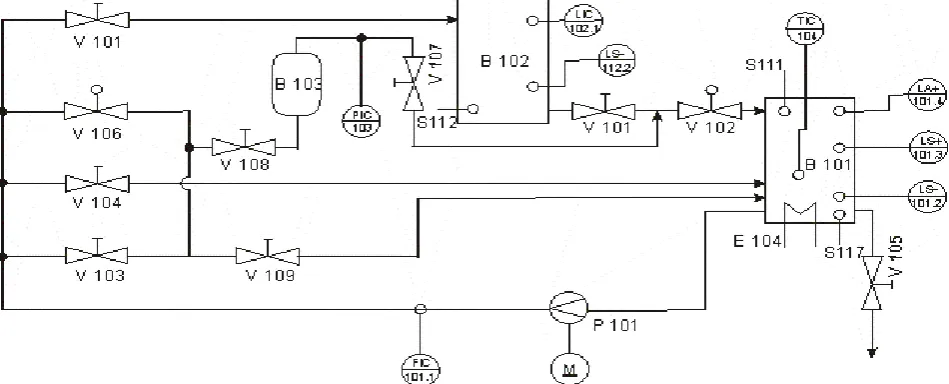
In 2008 as the suggestion of Professor Eliseev A.S. KSTU was included into the international educational project "Synergy". It was based on two main factors. Firstly: the above-described experience in creating software and hardware intended for remote e-learning in the field of automation and electrical engineering. Secondly: the presence in KarSTU of the equipment of the firm "Festo". A unique object for the educational process was the "Festo Process Station" stand, the functional diagram of which is shown in the figure 2. At this stand were performed at least 10 master's graduation works [14-16]. The station has 4 closed loop regulation of the physical variables with digital analogue sensors and actuators. The company controller "Siemens" SIMATIC S7-300 functions as a control device. The control system interface contains a control panel, an analogue terminal also as SysLink terminal. The upper level of the computer control system is equipped with the system of operational dispatch control implemented in the environment of the SCADA system WinCC.
Figure 2. The functional scheme of the stand "Festo"
The process station required the investing of a large amount of temporary resources to prepare technical documentation, study the operating modes, and determine the operability of the work algorithms and the software of the computer control system, like many other Festo stations. The most significant problem was the impossibility with the basic software (both local and top), operate the station as a multiply connected control object. All mentioned control loops of the physical liquid parameters of the initial system (respectively in the software) were presented as unrelated [14]. This reason did not prevent to develop, debug and introduce into the curriculum of undergraduates the specialty 6М070200 – "Automation and control" educational and methodical work: adjustment and setup of the stand (equipped with computer control system and SCADA system at the upper level), based on the evaluation
ATS stand at the time characteristics; identification of ATS level, pressure, temperature and fluid flow by time characteristics; distance learning of students, undergraduates and engineers for the methods of adjustment and as ATS equipped with computer control systems and SCADA-systems; parametric optimization of ATS (level, temperature, pressure and flow rate) (including in remote mode); study of the integrated system "FESTO + SCADA-system + MATLAB" for solving identification problems, parametric optimization and operation of ATS (level, temperature, pressure and liquid flow) in real and divided time, including for distance learning; parametric optimization of multiply connected ATS (level, temperature, pressure and flow rate) of the FESTO processor station. The "Synergy" project is implemented and an inter-university Internet network was created, to which the
stations were connected of the MPS line. In test mode, together with the MEI and OmSTU in Internet technology have been worked out on laboratory work sorting station, part of the MPS line KarSTU. In total, the project involved 5 stations in KSTU: buffer station, assembly station with robot, distribution station, sorting station and transfer station.
Technologies for performing laboratory works in the network are realized as with the use of software visual simulators "Cosimir" so as on standard MPS stands and on unique stands developed by MEI on the basis of Festo components.
The main example of non-standard solutions complementing the functionality of the Festo stands was the master's work partially presented in the [17-22]. These solutions have been tested at the stands "FESTO servo drive" and "Step electric actuator FESTO".
Laboratory stand "Tracking electric drive FESTO" (picture 3) consisting of MTR-AC-55-3S-AA synchronous motor, DGE-ZR belt drive converter, carriage, power supply and SEC-AC controller with Testbox control panel. Also, the stand includes such sensors as optical proximity sensors FESTO 150 391 PNP NC and resolver. The control signals are received from the PC by the serial data connection RS-232C or from the analogue control panel Testbox to the controller, and then it gets the appropriate processing and adjustment and is received for the synchronous motor.
Rotational movement of the shaft converts into translational horizontal movement of the carriage by means of a belt drive. Optical proximity sensors are used to limit the motion of the linear actuator carriage. The "Wmemoc" program supplied with the laboratory stand manages the servo drive according to the moment (current), speed and position of the output shaft by means of a specially created interface or by sending commands via a serial connection RS-232C. At the projects [17-20], some studies were carried out concerning the connection of the stands "Tracking electric drive FESTO" and "Step electric drive FESTO" from the PC through the PPVI LabVIEW. This problem was solved by creating a program for data transfer via a serial connectionRS-232C.
Figure 3.The structural diagram of the laboratory stand "Tracking electric drive FESTO"
Figure 4 shows a block diagram of a virtual instrument (VI), which writes commands to the COM port and reads the response from the controller SEC-AC-305.
Figure 4.Block diagram of the slave motor monitoring system in the environment LabVIEW
For the inclusion of the stands "Follower electric drive FESTO" and "Step electric drive FESTO" in the project "SYNERGY", the tasks of creating virtual devices were set in the LabVIEW environment, including: to create a block for calculating the pulses applied to the shaft of the electric drive, to set the position of the carriage in millimetres; to create the ability to save a database to a file without using a flash card in the controller; to create the opportunity of remote access to the stand with the help of special library elements LabVIEW; to turn on the smart
projector EPSON EB-465i in the learning process; to create methodical support in case of the updated monitoring systems for the parameters of the servomotor and stepper motor drive.
6
BSTU-VoenMech (St. Petersburg)), Omsk State Technical University and SevNTU), dial-up and connection. During the video session, it is possible to switch images from the webcam to the computer display, and also change the layout of the received pictures, slides or video on the viewed screen. However, compared to the Epson EB-465i projector, there are fewer channels for sending images in SONY Video equipment, and there is also no slide show function from an external carrier. The framework creation [19-20] also the hardware and software add-on on the basis of the Epson EB-465i projector allows to overcome this lack. The information presented in this section reflects the work carried out by faculty, staff, undergraduates and scientists of the APP department at the initial stage of the project "Synergy". At the same time, other approaches to the organization and technology of the learning process have been developed, some of which are described in the following sections of the article.
3. The State program of
industrial-innovative development
In the process of implementation of the State Programs of Industrial and Innovative Development (SPIID) of the Kazakhstan Republic (RK) aimed at diversifying the industry and its reorientation to produce products with high added value and reducing the share of primary industries, modern production facilities equipped with automation and robotics systems are being put into operation, new industries are being created, new directions are developing, including electrical engineering, electric machine building, engine building, the production of medical equipment agricultural machinery, etc., there is also a modernization of production [21].
All production needs qualified engineers. In this regard, the Government of the RK has decided to develop and implement fundamentally new practice-oriented educational programs for the State Program of Industrial and Innovative Development "(GPIIIR) in the profile magistracy using the example of the world's leading practices aimed at training a specialist in competencies required by specific enterprises [22, 23]. Their sponsorship is provided from the resources of the National Fund of the Kazakhstan Republic.
4. The new educational program of
profile magistracy
KSTU has developed several new educational programs for the profile magistracy, including "Robotics. Control systems". Robotics in Kazakhstan is one of the priority areas of industrial and innovative development. KSTU is preparing bachelors on the educational trajectory
"Mechatronics and Robotics" in the specialty "Automation and Control". The magistracy, in accordance with the concepts of the development of remote engineering e-learning under the auspices of the company" Festo "(Austria, Germany), an international educational project" Synergy "is developing, in which NIU MPEI (Moscow), NE SPbPU (St.-Petersburg) BSTU (Voenmeh, St. Petersburg), OmGTU (Omsk), SevGU (Sevastopol) and KSTU (Karaganda) [24]. The project implements the principles of the international integration as the educational process on the basis of Internet technologies and a unified laboratory base, new teaching and methodological support and the best teachers of leading technical universities in the specialties and directions "Automation and mechatronics", "Automation and Control", "Robotics. Control systems", "Management in technical systems", "Power engineering": with the use of equipment of leading companies. Regular distance education of undergraduates is organized by specially prepared modules [25-27].
5. The virtual laboratory and practical
complexes
The main discussion about the effectiveness and feasibility of replacing real laboratory equipment with imitation modelling has recently lost its edge. Obviously, the most optimal ratio is the equality of both in the learning process, and also in the place where it does not exist, compensation by exchange programs, for example, as it is possible in the project "Synergy".
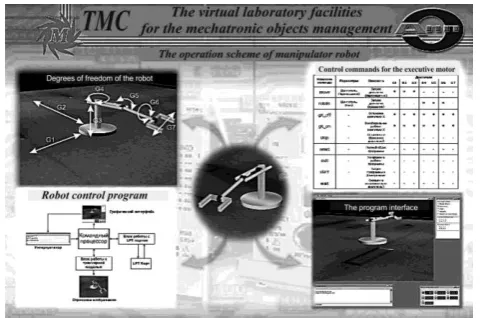
A number of software and hardware (PAK) and virtual laboratory and practical complexes (VLPK) on various basic and profile disciplines were developed at the Department of Apparatuses and Automation of KSTU. There are 15 software and hardware (PAK) and virtual laboratory-practical complexes (VLPK). Each complex contains software, hardware or software parts and methodological support, including theoretical sections and guidelines for the implementation of 5-15 laboratory works in electronic form, and completely covers many disciplines of working curricula [28]. The complexes formed the basis of the virtual laboratory of the department base PAK and VLPK used in the study of basic and profile disciplines on software modelling tools; application software; electronics; on automatic control systems; converter technology, etc. The complexes showed high efficiency in studying basic disciplines. Also, the virtual complexes are developed for a variety of relevant disciplines. In particular, a virtual laboratory complex for the management of mechatronic objects based on the software simulator of the robot manipulator is presented in the figure 5.
EAI Endorsed Transactions on Energy Web and Information Technologies
Figure 5. The virtual laboratory complex for mechatronics
6. The stands creation on the basis of
industrial equipment
In connection with the fact that the cost of modern teaching and laboratory stands is many times higher than the cost of industrial equipment on the basis of these stands are manufactured, training stands have been created on the basis of elements and components of manufacturers of automation and electrical equipment. In recent years, the technology is created by Training stands on the base of software and hardware manufacturers such as "Siemens", "Schneider-Electric", "Mitsubishi-Electric", "Trei", "ADAM" and others. As the example, the software and hardware complex (PAK) "Ball in the pipe", which is based on the stand" Ball in the pipe" and a frequency converter ALTIVAR 71 made by SchneiderElectric. A management system for this stand has been developed. At the base of the pipe there is a device in the form of a diaphragm, which limits the airflow, increasing the pressure in the tube and changing the position of the ball. The control unit consists of a microcontroller Arduino UNOR-3, a digital-to-analog converter (DAC) КР572ПА1, ultrasonic distance sensor HC-SR501. The structural diagram of the stand is shown in the figure 6. The principle of the device is to measure the ball position in the tube and transmit this data to the microcontroller to generate a feedback signal by position in the PID controller of the frequency converter. A laboratory-methodical complex was developed for the discipline "Automated electric drive" for students in the specialties "Power engineering" and "Automation and Control".
7. The creation of stands on the basis of
various control objects
Educational equipment for automation and mechatronics, with a fairly wide range of modern automation tools as usual the control facilities are not enough and the limited
areas of laboratories are obstacles to their placement. For possible solutions to these problems include the use of control objects to virtual models. However, as practice shows, specialists in the operation face various situations, including mechanical problems, improper wiring or devices, interference effects, variability of parameters that are not reproduced in computer models. Therefore, a set of the PIKO children's railway is used with additional railway trains.
1 – PC, 2 – ArduinoUno microcontroller board, 3 – HC-SR04 ultrasonic transducer, 4 – digital-to-analog converter КР572ПА1 , 5 – ALTIVAR71 circuit board, 6 –
Balloon in the pipe (Ball in the column stand)
Figure 6. The Structural diagram of the stand "Control system" Ball in the pipe"
8
cover under them was chosen white, which made it possible to clearly identify the fact of having a sleeper optically. It’s possible to determine the number of sleepers passed by the train. The most important feature of this complex is the wireless communication between trains and the head control unit. A wireless module was chosen as the communication unit nRF24L01+ company Nordic semiconductor. The module operates at a frequency of 2.4 GHz, the range in the room is up to 30 m, the speed is up to 2 Mb, and it is controlled by the SPI interface.
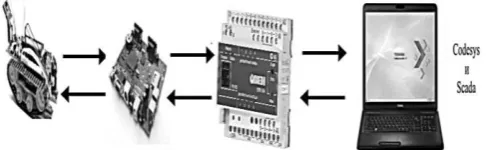
A similar approach was used in the PAC Robo-PICA, which was created on the training robot Robo-PICA basis the firm MikroElektronika. Robo-PICA is built on the universal chassis base that represents a platform for installing collector motors with reducers and a processor board on the PIC16F877 microcontroller. During the stand creating, the task was set for transferring the robot control system made on the PIC16F877 microcontroller to industrial logic controllers (PLCs) widely used in the industry. The choice of industrial controller was carried out according to the following criteria: reliability of its operation, speed of operation, support for working with standard protocols, availability of serial ports (RS-485, RS-232), availability of accessible programming environment and other software. The prevalence of controllers in the industry of the republic, as well as their cost indicators, was taken into account. As a result, there was chosen the industrial controller OWEN PLC154. During this problem solving was raised a number of difficulties. Technical possibilities and dimensions of ROBOPICA do not allow placing even the smallest PLC. It is also impossible to directly connect the PLC to the microcontroller, due to inconsistencies in device signal levels and electrical characteristics. As a device for coordinating the electrical parameters of PLC and ROBOPICA, a motherboard has been developed and it was based on the PIC16F877a microprocessor. The proposed functional scheme is shown in the figure 7. Two analog signals (speeds of the left and right tracks) and 5 discrete signals are used to control the ROBOPICA. The distance and line sensors are transmitted from the mobile robot. The robot is connected to the central controller based on the nRF24L01 wireless module via the SPI interface.
Figure 7. Functional diagram of mobile robot control
8. The new stands designing and
manufacturing
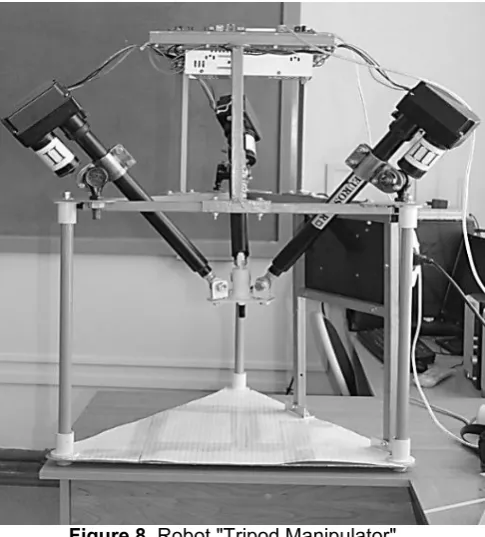
A robot manipulator with parallel kinematics was created to control the actuator; it was executed according to the Tripod scheme [29]. The mechanical part of the robot manipulator during its developing is used as a model and selection the most rational design of the robot and the software package Autodesk 3dsMax, GeoGebra. The design of the stand is a metal frame made in a straight triangular prism form. The apex of the prism is also made in an equilateral triangle form. The driving slave gives 3 Eurostar actuators for work. Each actuator contains a DC motor with an operating voltage of up to 36V with a power of 10 W; with an allowable workload of 250 kg and a stroke length of 690 mm.
As a mechanical protection out off the manipulator arm output from the working area in actuators are installed as adjustable limit switches for forward and reverse travel. In the robot manipulator control system, a personal computer (PC) is used that sets the program for moving the actuator rods, their positioning, and also serves as a travel calculator for each actuator rod. The demand signal from the PC is feeding to the plateau with the EasyPICv7 microcontroller, which is responsible for working out the movement of each rod of the set value and provides feedback on the impulse displacement sensor located in the actuator housing. From the microcontroller board, the signals are fend to the interface module (MI). The MI performs the switching-in motion actuators in the desired direction of rotation, in accordance with the control signal, the signals amplification from the PIC, bringing the pulse signal from the actuators to the level of the TTL signal, and transmitting to the PIC.
The main task of the manipulator is the exact positioning of the executive body (IO) from the initial position to the desired point of the working space. If the length of one, two or all links is changed simultaneously, the IO moves to the given point. For the purpose of debugging and researching software algorithms in the IO, a marker is installed that allows you to visually monitor the software operation and the hardware of the tripod.
During the manipulator operation, uncontrolled backlashes and angular movements of the actuators in space were detected, which leads to errors in the positioning of the EUT.
The revealed defects became the basis for continuation of works by authors in profile magistracy on improvement of the manipulator. The appearance of the acting tripod is shown in the figure 8.
As part of the PAC Robot Manipulator-Tripod the further development, is integrated with a laboratory-practical complex (LPK), previously developed in the LabVIEW environment, for monitoring the physical coordinates of objects (machines, mechanisms, installations, robotic devices), and then analyzing them, evaluation, identification of properties and characteristics.
EAI Endorsed Transactions on Energy Web and Information Technologies
The upgraded control and monitoring system provides control over the movement dynamics of robot rods in real time. The stand is used in the study of disciplines: "Automation of robotic complexes", "Programming languages of industrial controllers", "Software and modeling technologies", "Means of Mechatronic Systems".
Students receive skills in programming microcontrollers and assessing the performance of mechatronic objects.
Figure 8. Robot "Tripod Manipulator"
9. Modernization of existing training
stands
The FESTO technological line was modernized, which initially contained 5 autonomously working modules. As a result of the modernization, an MPI network was created, which allowed managing the entire line at the time using the operator station. It became possible to remotely monitor the work of the entire production line with also developed SCADA system. Figure 8 shows the structure of the modernized technological line management system. The stand of Festo process equipment was also upgraded, in which the level, flow rate, pressure and temperature of the liquid are monitored with the help of Siemens S7-313C industrial controller.
The booth's capabilities are expanded, a control unit based on the Mitsubishi Melsec L industrial controller. Also for this control unit, a program was developed in the GX Works2 programming environment and the SCADA system project in Wonderware InTouch. In addition, to
familiarize with the new capabilities of the stand, a laboratory workshop was developed consisting of four laboratory works in which the principles of multiply-connected regulation are implemented, which was fundamentally impossible in the basic software of the Festo Process Station stand.
As the fact that a number of enterprises in operation still use obsolete means of automation (for example, AUC-10ТМ), which, in particular, is typical for mining, the department upgraded the stands for mining automation. When the existing elements and the control panel are saved, the relay-contact automatics are replaced by digital equipment or a PLC of the "Logo" type. All algorithms of operating control systems are preserved, and the reliability of bench equipment is increased many times. Therefore, students gain practical skills in operating automation systems.
Figure 9. The structure of the modernized control system of the technological line "Festo"
10 Acquisition and production of
modern training stands
10
laboratory electronics and microprocessor technology (main hardware and software: industrial controller "ALPHA XL"; "Distributed data collection system based on the ADAM controller"; Industrial controller LOGO! 24RC; Industrial controller SIMATIC S7-200; Industrial automation company "Siemens"; Training stand "LEGO mind storms EV3").
11. Conclusion
The training stands under the guidance of teachers who have practical experience in engineering design and creation of automation tools are developed by students in the course of course design for 3-4 courses. The manufacture and adjustment of stands is carried out within the framework of course and diploma design.
Participation in the development of the laboratory base makes for the PPP high requirements in terms of professional competence and is an effective method of increasing the engineering qualifications of young teachers. It is important, in the conditions of limited financial resources; design training technologies are used to create a training and laboratory base.
At the same time, the cost of training stands is lower in many times, than the cost of finished laboratory equipment, which is purchased as only constitutive elements and components. The technologies presented above provide a constant update of the laboratory base. Each stand is software and hardware complex is required for the professional engineering training creation. The main sources of the laboratory equipment base formation are sponsorship assistance organized by graduates; funds received from the implementation of economic contracts, as well as earmarked funds allocated by the University for the Purchase of educational equipment. The described technologies simultaneously and in a complex solve following problems: constant modernization and development of a modern laboratory base on automation and robotics; realization of technologies of project elite training for the best students; acquisition of engineering competencies in the process of training by the most trained students; obtaining practical skills necessary for the operation of modern software and hardware automation tools, middle-level students; the professional development of young teachers and the acquisition of engineering knowledge and skills in the process of creating laboratory equipment.
References
[1] Dangers of Moore's Law. Michael Malow "Like Robert Neuss, Gordon Moore and Endy Grow have created the most influential company in the world": Per. from English / Vayser M. et. al.– M.: Mir, 1992. – 522 p.
[2] Anna Kartashova, Tatiana Shirko, Igor Khomenko, Ludmila Naumova (2015). Educational Activity of
National Research Universities as a Basis for Integration of Science, Education and Industry in Regional Research and Educational Complexes/ Procedia - Social and Behavioural Sciences, Volume 214, 5 December 2015. – P. 619-627
[3] Breido I.V., Feshin B.N. (2005) Laboratory complex of computer systems of technological control and management of Karaganda State Technical University. III International Forum "Informatization of Education in Kazakhstan and CIS Countries" (Almaty, 2005).
[4] Feshin B.N., Breido I.V. (2005) Integrated scientific and laboratory complex "Modern automation technologies". International scientific and practical conference "Problems of the development of energy and telecommunications in the light of the strategy of industrial and innovative development of Kazakhstan" (Almaty, 2005).
[5] Elena Ospennikova, Michael Ershov, Ivan Iljin (2015). Educational Robotics as an Innovative Educational Technology / Procedia - Social and Behavioural Sciences, Volume 214, 5 December 2015. – P. 18-26
[6] Li, P., Toderick, L.W., Lunsford, P.J. (2009) Experiencing virtual computing lab in information technology education, SIGITE'09 - Proceedings of the 2009 ACM Special Interest Group for Information Technology Education Conference: Proceedings of the 10th Conference on Information Technology Education, SIGITE 2009, Fairfax, Virginia, USA, October 22-24, 2009, pp. 55–59.
[7] B.N. Feshin, I.V. Breido, G.I.Parshina, R.V. Markvardt, L.G. Shpakova. (2011) Distance learning technologies in the framework of the "Synergy" project. The journal "Automatics. Informatics", №1-2 (28-29), 2011, KarSTU, Karaganda, 4p.
[8] Lyubchenko L.G. (2009) Development of a robot manipulator control system using the FUZZY-logic methods. Journal of Automation, Computer Science, No. 1-2 (24-25), 2009, KarSTU, Karaganda, 4p.
[9] Rybina, G.V., Rybin, V.M., Blokhin, Y.M., Sergienko, E.S. (2017) Intelligent support of educational process basing on ontological approach with use of tutoring integrated expert systems, Advances in Intelligent Systems and Computing book series (AISC, volume 680), Proceedings of the Second International Scientific Conference “Intelligent Information Technologies for Industry” (IITI’17) pp 11-20.
[10] B.N. Feshin, I.V. Breido, G.I.Parshina, R.V. Markvardt, L.G.Shpakova. (2012). Distance learning technologies in the direction "Automation and Control" in the framework of the "Synergy" project. International Conference "Informatization of Engineering Education (Inforino 2012)" Moscow.
[11] Nikolay Kachalov, Anna Velsh, Zoya Antonova, Angelina Konysheva, Natalia Proschaeva (2015). Application of Modern Educational Technologies at the Research University / Procedia - Social and Behavioural Sciences, Volume 206, 17 October 2015. – P. 225-231
[12] B.N. Feshin, I.V. Breido, G.I.Parshina, R.V. Marquardt, L.G. Shpakova. (2005). Distance Learning Technologies in the Synergy Project. The journal "Automatics. Informatics", №1-2 (28-29), 2011, KSTU, Karaganda. – p.28-32.
[13] B.N. Feshin and R.V. Markvardt (2009). Mechatronic complex Robotino in the program "Synergia-SYNERGY". Journal "Automation. Informatics" № 1-2 (24-25), 2009, KarSTU, Karaganda. – P.45-50.
[14] B.N. Feshin, G.E. Ogurtsov, S.A. Parfenov. (2009) Investigation of a multiply connected system of automatic regulation of pressure, flow, level and temperature of the FESTO processor station. Journal "Proceedings of the University", № 2, 2009, 4p.
[15] Shoaleh Bigdeli (2012). New Educational Research Technologies in the Global World / Procedia - Social and Behavioural Sciences, Volume 47, 2012. – P. 1469-1472 [16] Feshin B.N., Murdalova Ye.O. (2010). Investigation of
multiply connected ATS – FESTO processor station. Journal "Automation and Informatics", No. (1-2), 2010. KSTU, Karaganda. – 4p.
[17] Kalashnikova E.V., Kochekayeva Yu.R. (2012). Software development in the LabVIEW environment for the FESTO training stand // Journal "Automation and Informatics", No. 2 (31). 2012, KSTU, Karaganda. – P. 25-28. [18] LabVIEW. Getting Started with LabVIEW, National
Instruments Corporate Headquarters, June 2013, p. 89. [19] Feshin B.N., Kalashnikova E.V. (2013). Monitoring
system for servo and stepper electric drives FESTO// Journal "Automation and Informatics", No. 2 (33), 2013. KarSTU, Karaganda.– p. 71-75.
[20] Feshin B.N., Kalashnikova E.V. (2014) Investigation of the response of the FESTO stepper motor control system to disturbing effects // Proceedings of the IV International Scientific and Technical Internet Conference of Young Scientists "Automation, mechatronics, information technologies". Omsk: OmGTU publishing house, 2014. – p. 194-197.
[21] State program of industrial-innovative development of the Republic of Kazakhstan for 2015-2019. Approved by the Decree of the President of the Republic of Kazakhstan dated August 1, 2014 No. 874.
[22] Vögtle, E.M., Martens, K.(2014) The Bologna Process as a template for transnational policy coordination, Policy Studies Volume 35, 2014 pp 246-263
[23] Breido I.V., Egorov V.V., Kochkin A.M. (2016) Program of profile magistracy for the industry of Kazakhstan // Journal "Higher Education in Russia". – 2016, No. 12. – p. 151-157.
[24] Breido I.V., Eliseev A.S., Catalinich B., Kramar V.A., Pashkov E.V., Stazhkov S.M., Feshin B.N., Khomchenko V.G., Shtol V. (2015). International university network project "Synergy": modern possibilities of uniting and using the educational resources of engineering universities in cooperation with the leading European concern FESTO // Journal of Automation, Informatics. – KarSTU Karaganda: 2015. – No. 1. – p. 16-20.
[25] Andrew Topper Ph. D., Sean Lancaster Ph. D. (2016). Studies in Educational Evaluation, Volume 51, December 2016. – P. 108-115
[26] Breido I.V., Kochkin A.M., Feshin B.N., Smagulova K.K. (2015). New educational program "Robotics. Management Systems" within the specialty 6M070200 – Automation and Control // Journal "Automation, Informatics". KSTU, Karaganda. – 2015. – No. 1. – p. 35-48.
[27] Dobbins, M., Knill, C., Vögtle, E.M., (2011) An analytical framework for the cross-country comparison of higher education governance, Higher Education, November 2011, Volume 62, Issue 5, pp 665–683.
[28] Breido I.V., Feshin B.N. (2006). New technologies for creating a training and laboratory base for training specialists in the field of automation and control // Proc. II Intern. Symposium "Quality, Innovation, Education and
CALS-technologies". – Egypt, Hurghada: 8-15 April 2006. – p.114-117.