(PLATES 40-42)
S UPPLEMENTARY investigations were carried out at Lerna during the first
J) fortnight in June 1958, in connection with a brief campaign of conservation and study.'
EXCAVATION
The excavation of the preceding year had uncovered sections of massive walls near the northeast corner of the House of the Tiles, belonging obviously to a monu- mental edifice of earlier date (Building BG, Hesperia, XXVII, 1958, p. 130). Although little room was now left for further digging (P1. 40, a, b), it seemed desirable to examine whatever parts of this structure could still be reached. An L-shaped space was therefore opened, outside the House of the Tiles, and small pits were dug through the floor inside.
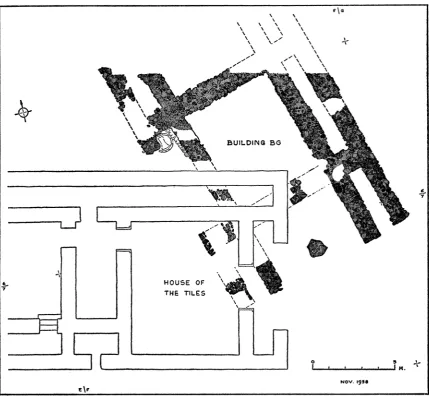
Building BG (Fig. 1) was rectangular in plan, its main axis running roughly north and south. A series of large rooms occupies the central part. On the east is a pair of parallel walls with a corridor or a succession of narrow chambers between them; on the west there are also two lines of walls, probably balancing those on the other side, but with some irregularities that could not be completely investigated in the space available. These four main walls end abruptly at the south. There was no evidence of an end wall. The building runs on into unexcavated ground at the north. A large irregular slab of stone, which on its discovery in 1955 was taken to be associated with the House of the Tiles (Hesperia, XXV, 1956, p. 164), is now seen to lie precisely in the axis of Building BG. Almost certainly it was the base for a single wooden column in the center of the south porch.
Only the foundations and socles of the walls are preserved. They are of rough stone masonry and very heavy, measuring 1.00 m. to 1.20 m. or even more in thickness. The superstructure was undoubtedly of crude brick; it has disappeared altogether. Exact measurements cannot now be made, but general resemblances to the House of the Tiles are striking. The total width is 11.75 m. to 12.00 m. (40 E. H. feet ?);
I Mrs. Caskey supervised the excavation of the larger area, assisted by Mrs. McLeod. Wallace McLeod had charge of digging the smaller trenches and shared the duties of surveyor with J. L. Caskey, who served as field director. The staff lived at the Hotel Neon in Nauplia. Evangelos Lekkas was foreman, directing the work of ten men. Nikos Didaskalou, junior technician from Corinth, repaired and strengthened the weak points in the House of the Tiles. Petros Abatielos, carpenter of the American School, constructed and installed representations of the ancient wooden doorjambs in the building.
American School of Classical Studies at Athens is collaborating with JSTOR to digitize, preserve, and extend access to
Hesperia
big rooms in the central row are bordered on either side by narrow passages and compartments. One can scarcely doubt that this was a prototype and precursor of the later palace.
F 16~~~~~~4
\ \ \ \
. ~~~~~~~~~~~~~~~\ \ \ \
\ \ \ \
NOV. igsS
FIG. 1. Plan of Early Helladic Building BG as Exposed in 1958.
Remains of flagstone pavements were found just above the walls of Building BG at several places, and sections of much smaller house walls also gave evidence of at least one architectural period intermediate between the demolition of BG and the erection of the House of the Tiles. The pottery recovered from these layers was all fragmentary; it belonged to the general classes of Early Helladic glazed and plain wares but gave no more exact indications of date. From the relative position of the various systems of walls we may presume that Building BG was in use during two or three of the successive phases when the circuit of fortifications was being developed along the southern border of the citadel (Hesperia, XXVII 1958, pp. 132-136).
Walls of still earlier structures, probably houses of modest size, were observed below the foundations of Building BG. A closed deposit of pottery on the floor of one of these houses yielded several whole vessels, including an askos in plain rough ware with incised decoration 2 (P1. 41, e) and a squat pyxis in brown slipped ware, well
burnished' (P1. 41, f).
There being no practical means of draining the area excavated this season, the walls of Building BG and of its immediate predecessors and successors were covered over again with earth after they had been examined and recorded.
An attempt was made to explore the course of the road which presumably ran southeastward toward the shore from the foot of the Early Helladic flagged stairway, W (Hesperia, XXVII, 1958, p. 128, fig. 1). A long trench was excavated, some 10 m. out from the towers, but even at the bottom, where hardpan was reached at water level (0.68 m. A.T.), the earth was unstratified and contained sherds and tiles of the
Classical period. The accumulations were obviously too deep to allow more extensive search, and the trench was refilled.
As a further test of the topmost Neolithic deposits a trench, called JC, was dug in- the western side of Square F7 from the border of the tumulus southward across Room C of the circuit wall (see plan iln Hesperics, XXVII, 1958, p. 128). In it were found some remains of Early Helladic strata antedating the House of the Tiles, but pure Neolithic ground was discovered at a high level, around 4.55 m. A.T. Most
of the pottery was of types already recorded as characteristic of this stage, the second major period at Lerna, comprising fragments of bowls and jars in red-brown glazed ware. A typical example of the bowls is illustrated on Plate 41, c.4 In the uppermost levels, however, there were also a few scattered bits of pottery bearing patterns in dull paint on a light ground, exemplifying or related to a later class of Neolithic wares..
2 Inv. L. 1604; H. 0.107, D. 0.171.
3 Inv. L. 1603; H. 0.076, D. 0.166.
4 Inv. L. 1612; H. 0.075, D. 0.132.
No whole deposits of this sort have been found at Lerna, but it is not improbable that they once existed and were cut away by the Early Helladic settlers.
Two graves came to light in the Neolithic deposits in Trench JC. One, a simple inhumation, was that of a small child. The other, encircled by stones, contained the skeleton of an adult lying on its left side with head to the southwest (P1. 41, a). Near the knees was a jug of unusual form, its mouth rounded-triangular in shape with a small projection making a rudimentary spout in front, and its handle broad and high- swinging, with an upright projection at the top and two struts set crosswise within the openings (P1. 41, b). Like the grave found a year earlier in Trench HTN
(Hesperia, XXVII, 1958, pp. 136-137), the adult burial in Trench JC was so near the top of the Neolithic layer that it must be assigned to a stage of the settlement the remains of which were largely obliterated by the levelling and grading operations of the Early Helladic builders. It is not to be associated with the Early Helladic settlers themselves. Intramural burial, we may now say with some certainty, was not practiced in their time at Lerna; and the pottery from the two graves in question, though strange and not readily datable, looks more at home in a Neolithic context than in the repertory of the well-known Early Helladic types.
The jug from Trench JC has a moderately coarse red-brown biscuit and retains considerable traces of a powdery orange-red coating. In all respects except shape it very closely resembles one of the bowls from Grave HTN. 1 (Hesperia, XXVII,
1958, pl. 37, a). Similar red color appears also on the surface of a few sherds of white-crusted ware found near the grave in Trench JC, a fabric identical with that of another vessel from HTN. 1 7 (P1. 41, d). It thus appears reasonably certain that
the two graves belong to the same late Neolithic phase.
CONSERVATION
During the brief campaign of 1958 the work of conservation undertaken a year before was supplemented and consolidated. Retaining walls were strengthened where necessary, provision for drainage was improved, and additions were made to the shelter over the House of the Tiles. Heavy wire grilles were installed in the lower series of openings between the pillars, and pairs of wooden shutters were set in the three central bays on the north and south sides (P1. 40, e). The leaves of the shutters are hinged at the top and bottom respectively, protecting the crude brick walls from driven rain when they are fastened, and leaving an unobstructed view from outside the shelter when they are open in good weather. Further repairs were also made to strengthen the walls of the ancient building, and wooden sheathings were
6 Inv. L. 1610; H. to rim 0.115, D. 0.128.
7 Inv. L. 465; H. 0.221, D. 0.228. Formerly reported as Inv. L. 545, before the foot had been
set in place to represent jambs in the three doorways where cavities in the floor had shown conclusively that casings of this sort once existed (e. g. P1. 40, c, d). Outside, in the rest of the excavated area, a moderate amount of planting was completed during the winter season. A few olive trees, some hardy oleanders, vines, flowering shrubs, and many smaller plants have now taken root. The whole area has been enclosed with a wire fence.
STUDIES
Throughout the year members of the staff have continued to study various groups and classes of objects in the workrooms of the museum at Corinth. The inventory of pottery, growing as pieces of interest come to light in the course of this study, now lists 1694 items, and a total of 4471 items is comprised in the inventory of miscellaneous objects of metal, stone, glass, ivory, bone, and terracotta. Mending and restoring have been carried on meanwhile by the senior technician George Kachros and his assistant Nikos Didaskalou; among their achievements of note is the complete reconstitution of the fragmentary hearth from the Early Helladic building BG
(P1. 42, a).
Material from the successive settlements, and particularly that which may be assigned to the principal closed deposits, has been reviewed and many of the final catalogues have been drafted by Mrs. Martha Heath Wiencke (Period 38), Mrs. Caskey (Period 4), Wallace McLeod (Period 5), J. L. Caskey (Periods 5 and 6), and Mrs. Elizabeth McLeod (Periods 5 and 7).
Mrs. Wiencke also drew up a catalogue of the decorated bands on hearth rims and pithoi of the Early Helladic period, and Piet de Jong rendered many of the motives in water colors. Some of these pieces are illustrated on Plate 42, b-f. In the course of the study a number of interesting observations were made. The patterns in relief, comprising a variety of rectilinear and curvilinear designs, were applied to the bands with fairly rough cylindrical seals, presumably of carved wood. Filling ornament often appears between the principal elements of the spiral compositions. In one of these there is a representation of a hound and of a smaller quadruped, perhaps the hound's quarry (Inv. L. 1564, P1. 42, c-e). The same roller was used to decorate a pithos found at Tiryns.9 Evidently, therefore, there was
a
central market for these great storage jars or, more probably, skilled pithos-makers travelled about the Argolid producing them to order.In addition to his study of the Middle Helladic deposits in general, Mr. McLeod is completing an analysis of the graffiti and other marks on pots of the period (a total
8 See preliminary outline of periods in Hesperia, XXVII, 1958, pp. 143-144.
of 255 pieces has been recorded up to now), and will present them for publication. He has also made a preliminary survey of the medieval fort on Mt. Pontinos.
During the autumn of 1958 Mrs. Grace Freed Muscarella drew profiles of many pots and fragments in the collection and made reconstructed drawings of others in water color.
Perry Bialor has spent parts of the year at Corinth examining and classifying the stone tools from Lerna, with special attention to the chipped implements of flint and obsi.dian.
A thorough investigation of the fauna of the district, as represented by animal bones found in the debris of the successive settlements, is being conducted by Nils- Gustaf Gejvall of the Royal Academy of History and Antiquities, Stockholm. He and his assistant Mrs. Carin Green gave six weeks in May and June 1958 to recording all the osteological material, held in some 2300 containers, at Corinth, and also identi- fied the bones from which many hundreds of minor objects had been fashioned. Dr. Maria Hopf of the R6misch-Germanisches Zentralmuseum in Mainz has begun the examination of vegetable remains recovered, identifying the species of various plants and trees preserved in a carbonized state and recording particularly the seeds and grains that leave impressions in the biscuit of pottery and burnt bricks. She is spending some days at Corinth in May 1959. Inorganic materials are being analysed by Mr. George Koumoulos of Athens, and samples of burnt wood have been submitted to the laboratories of the University Museum, Philadelphia, for radio-carbon testing.
DISPOSITION OF THE COLLECTION
It has been decided by the Archaeological Service of the Ministry of Education that the Lerna collection should be kept and exhibited in the Kallergeion at Argos, a fine old house newly rehabilitated as a public museum. Two large rooms have been designated for this purpose, the one to hold a representative selection of objects on display, the other to house the remainder as a study collection and permanent record of the stratified deposits. At the present writing (May 1959) the Greek services are in process of furnishing display cases for the former room and the American School is providing the shelves, cases, and other furniture required for the latter.
In closing this report I take pleasure once again in expressing the gratitude of the excavation staff to our Greek colleagues for collaboration, assistance, facilities, and many courtesies extended to us since the inception of the excavations in 1952.
JOHN L. CASKEY AMERICAN SCHOOL OF CLASSICAL
~~~~~~~~~ d __~~~~~~~~~~~~~~~~~~~~~~~~~~~~~~~~~~~~
a. Walls of Building BG from Northwest. b. East Walls of Building BG from North. c. House of the Tiles. jamb of Door Pfo otes
... .... ....
d. House of the Tiles. jambs of Door A from within. e. House of the Tiles. North Side of Shelter fromr iti
Alk
a. Trench JC. Late Neolithic Grave. b. Jug from Grave in Trench JC.
c. Neolithic Bowl.
d. Late Neolithic Bowl with Foot.
e. Early Helladic Askos. f. Early Helladic Pyxis.
a. Early Helladic Ceremonial Hearth Restored.
I
x~~~~~~~~~~~~~~~~~~~~~~~~~~~~~~~~~~~~~~~~~~~~~~~~~~~~~~~~~~~~~~~~~~~~~~~~~~c. Early Helladic Pithos Band, No. 1564a. b. Rim of Hearth. (Piet de Jong)
d. Pithos Band, No. 1564. (Piet de Jong) e. PithosBand,No. 1564b.
f. Pithos Band, No. 1 570a.