A GROUP OF DISTINCTIVE PATTERN-DECORATED
EARLY HELLADIC III POTTERY FROM LERNA
AND ITS IMPLICATIONS
(PLATES
98-100)
O
NE of the hallmarks of Early Helladic (EH) III ceramics, and one which serves to
distinguish it sharply from the pottery both of the preceding EH II phase and the
subsequent Middle Helladic (MH) period, is its pattern-painted pottery.1 Such pottery
falls into two classes: one decorated in a dark-on-light style achieved by the application of
geometric ornament in dark-firing paint directly on a paler-firing clay ground, and the
second characterized
by a light-on-dark style effected by the superposition of similarly ab-
stract patterns in a pale-firing paint on top of a vessel surface already completely coated
with dark-firing paint. These two classes were first attributed to the Early Bronze Age
(EBA) some sixty years ago, when it was recognized that such pattern-painted pottery be-
came more common at the end of the period.2 The excavations at Lerna in the 1950's by the
'I should like to thank the following for their indispensable contributions to this article, for their invaluable assistance in the research associated with it, or for both: Julie Baker, Kathi Donahue, and Sally Rutter for executing the drawings; Craig Mauzy for taking the photographs of the Lerna pottery; Dr. Nancy Bookidis of the Corinth Excavations for supplying photographs of the pottery from Korakou and Zygouries; Dr. Aik. Demakopoulou, Ephor of Antiquities for the Argolid and Corinthia, and Dr. K. Tsakos, Ephor of Antiquities for Elis and Messenia, for their cooperation in connection with my research in Argos and Olympia; Dr. C. K. Williams, II, Director of the Corinth Excavations, for giving me permis- sion to study and either publish or republish some of the Early Helladic III material from Korakou and Zygouries stored in the Corinth Museum; Professor F. Felten and Dr. M. Koumouzelis for allowing me to examine the EH III pottery from the German excavations at the Kolonna site on Aigina and from the Greek excavations under the New Museum at Olympia, respectively; Mr. Elmar Christmann for permit- ting me to study the Early Bronze Age pottery from the German excavations at Pefkakia, and Dr. G. Chourmouziades, Ephor of Antiquities in Volos, where this material is stored, for his cooperation in this research. Special thanks are due to Miss G. Chatzi, Epimeletria of Antiquities in Olympia, for her help in locating the EH III pottery from both the Greek and German excavations at Olympia not actually on display in the New Museum but kept in the basement storerooms. The research on which this article is based was supported by a Research Grant from the National Endowment for the Humanities during the years 1980 and 1981. A preliminary version of this article was presented orally at the annual meetings of the Archaeological Institute of America on 30 December 1981 in San Francisco under the title "Lerna IV and Prehistoric Olympia: A Neglected Group of Early Helladic III Pattern-decorated Pottery."
Works frequently cited below are abbreviated as follows:
Caskey, 1966 = J. L. Caskey, "Houses of the Fourth Settlement at Lerna," XapLo-771pLov Ets 'Ava-
0Trao-LoP K. 'OpAa?vbov, III, Athens 1966, pp. 144-152
Dorpfeld, 1935 = W. D6rpfeld, Alt-Olympia. Untersuchungen und Ausgrabungen zur Geschichte des dltesten Heiligtums von Olympia und der dlteren griechischen Kunst, Berlin 1935
Koumouzelis, 1980 = M. Koumouzelis, The Early and Middle Helladic Periods in Elis, diss. Brandeis University 1980, University Microfilms International 8024537
Weege, 1911 = F. Weege, "Einzelfunde von Olympia 1907-1909," AthMitt 36, 1911, pp. 163-192
2 A. J. B. Wace and C. W. Blegen, "The Pre-Mycenaean Pottery of the Greek Mainland," BSA 22,
1916-18,pp. 177-179.
American School of Classical Studies at Athens is collaborating with JSTOR to digitize, preserve, and extend access to Hesperia
460 JEREMY B. RUTTER
American School of Classical Studies at Athens under the direction of Dr. J. L. Caskey
clearly demonstrated that the vast majority of EH pattern-painted pottery dates from the
EH III phase. The findings of Caskey and his staff also strongly supported a thesis pro-
posed long before to the effect that the Dark-on-Light class was at home in the northern Pe-
loponnese while the Light-on-Dark class was more typical of Boiotia and other areas in
central Greece, a thesis which has been further sustained by French's survey of the prehis-
toric ceramic sequence in central Greece.3
No doubt partially as a result of the fact that the pattern-painted pottery of the EH III
phase is so distinctive, as well as being fairly common, most surveys of EH III ceramics tend
to overlook other modes of decoration which, although perhaps not quite so copious, are in
some cases equally peculiar to this relatively short-lived interlude in southern Greek prehis-
tory. For example, a particularly dense version of plastic and impressed decoration, usually
in the form of horizontal banding but occasionally consisting of abstract geometric motifs as
well, is not well paralleled in either EH II or MH pottery.4 Another mode of patterned dec-
oration employed to form geometric motifs relies on finely incised lines and small impres-
sions having a variety of different outlines; quite often, both the incisions and the impres-
sions are filled with white paste, which contrasts sharply with the generally dark surface
color of the pottery to produce a light-on-dark effect comparable to that of the more common
Light-on-Dark pattern-painted class. It is the primary purpose of this article to publish a
corpus of the EH III pottery from the sites of Lerna, Korakou, and Zygouries decorated
exclusively with such finely incised or impressed ornament or both.5 Comparanda securely
3J. L. Caskey, "The Early Helladic Period in the Argolid," Hesperia 29, 1960, pp. 292, 295-296; W. Donovan, A Study of Early Helladic Pottery with Painted Decoration, diss. University of Cincinnati 1961, University Microfilms International 61-5219; H. Goldman, Excavations at Eutresis in Boeotia, Cam- bridge, Mass. 1931, p. 116 and note 2; D. H. French, Prehistoric Pottery Groups from Central Greece, Athens 1972, pp. 20-22.
4Published examples from Lerna: J. L. Caskey, "Excavations at Lerna, 1955," Hesperia 25, 1956, pls. 43:f, 44:c; Caskey, 1966, pl. 51:7. Small fragments decorated in this fashion are commonly found at a number of other sites in the Peloponnese: K. Muller, Tiryns, IV, Die Urfirniskeramik, Munich 1938, p. 40, pl. XIV:4, 5 (Tiryns); H. Dohl, "Die prahistorische Besiedlung von Synoro," Tiryns VI, Mainz 1973, p. 217, pl. 86:4 (Kandia); A. J. B. Wace, "Excavations at Mycenae. VII.7: The Grave Circle," BSA 25, 1921-23, p. 114, fig. 26:f (Mykenai); C. W. Blegen, Prosymna, The Helladic Settlement Preceding the Argive Heraeum, Cambridge, Mass. 1937, p. 377, fig. 638:9 (Prosymna); G. Saflund, Excavations at Berbati 1936-1937, Uppsala 1965, fig. 107:a (Berbati); E. J. Holmberg, The Swedish Excavations at Asea in Arcadia, Goteborg 1944, fig. 74:b, e, h (Asea); Koumouzelis, 1980, p. 151, fig. 38:1, 2, pls. 92:b, 108:c (Olympia, New Museum). An unpublished fragment from Corinth (inv. no. C-40-523; to be published in a forthcoming article by Dr. G. Merker, to whom I am grateful for permission to mention it here) extends the geographical range of this class of material a bit further to the north.
Specifically omitted from consideration here are the following: 1) Coarsely incised pottery of the class termed "Adriatic ware" (M. N. Valmin, The Swedish Messenia Expedition, Lund 1938, pp. 256- 269, fig. 60, pls. I:1, XVI:1, 103, XXI) which is characteristic at Lerna of later EH III and MH contexts and which is easily differentiated from the material treated here not only by the coarseness of its incised decoration but also by the fact that almost without exception (but see G. S. Korres, "'EpEvvaL Kxa 'Ava- o-Kaxaa &ava T7Jv flv t'av," IlpaKxlKta, 1978, pl. 212:b, of MH date) it occurs in the form of a wide-
EARLY HELLADIC III POTTERY FROM LERNA 461
dated to the EH III phase either by form or by context from other sites in southern Greece
indicate that pottery decorated in this fashion was widespread south of the Isthmus of Cor-
inth, although perhaps common only in certain areas and at a particularly early stage with-
in the EH III phase. The evidence available suggests that the most elaborate versions of this
mode of decoration may prove to be typical of the earliest pattern-decorated
EH III pottery
of any kind in the Peloponnese. Such material may therefore become a particularly valuable
tool in future attempts to determine the immediate antecedents of this highly distinctive
archaeological
assemblage whose pronounced differences from that which defines the EH II
cultural phase have led many Aegean prehistorians to posit a migration or invasion of new
peoples into the Peloponnese.
at this time.
CATALOGUE
The following catalogue is divided into two parts. The first consists of fragments of finely incised or impressed pottery from Lerna, while the second includes similarly decorated pieces from Blegen's excavations at Korakou and Zygouries. Within the longer first part, the material is listed according to shape, first the open vessels and then the closed. Each piece in this section is dated by its provenience in terms of the three ceramic phases identified within the various levels of occupation which together constitute the EH III settlement represented by Lerna stratum IV (Table 2).6 Colors are described verbally in the catalogue and semiquantita- tively in Table 1, in both instances using the terminology of the Munsell Soil Color Charts. Clays are charac- terized as coarse if they contain inclusions with a maximum dimension exceeding 4 mm., as medium coarse if the same dimension exceeds 2 mm., and otherwise as fine; only three pieces (2, 26, 39) contain inclusions all smaller than 0.5 mm.7 All the items are handmade. Most pieces are dark surfaced, and the few exceptions (8, 25, 29, 37-39) are light brown, yellowish red, or red rather than very pale brown, yellow, or white. Only one piece (29) lacks a burnished surface, although tankards (1, 2, 39), some pedestal-footed cups (6, 9, 11, 41, 42) and almost all closed shapes (29-31, 33, 35-38) are roughly smoothed on the interior below the level of the base of the neck rather than being burnished all over; the undersides of all handles and exterior body surfaces immediately behind handles are likewise smoothed due to the difficulty of applying a burnish to such areas; the undersides of feet may be either burnished (11, 41) or smoothed (9).
Dimensions are given in meters.
A. LERNA
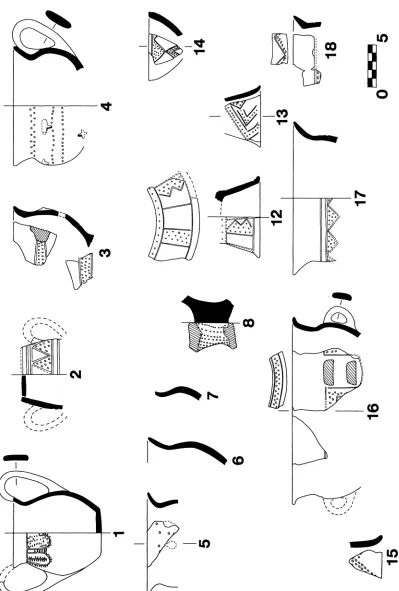
1 (L.525) Rim-handled tankard Fig. 1, P1. 98
Complete profile. H. 0.098-0.104, diam. rim 0.081, max. diam. of body 0.099, diam. base 0.051-0.055.
Mended from 7 sherds. Coarse clay; reddish
brown fracture; surface mottled from black to yel- lowish red. Incised decoration, partially obliterated by subsequent burnishing, consists of five loops on each side pendent from an incised line.
Phase 2. (Lot G 73)
Published: Caskey, 1966, pl. 54:16.
shallow horizontal incisions or grooves, a group which is common at Lerna in the last ceramic phase of the EH III settlement and which is limited, with three exceptions, to shoulder-handled bowls and kantharoi (for a published example, see P. and W. Gercke and G. Hiesel, "Tiryns-Stadt 1971: Graben H," Tiryns VIII, Mainz 1975, p. 35, no. 97, fig. 11:2, pl. 38:2). The holes pierced completely through the vessel wall of most of the EH III pedestal-footed cups from Lerna and other sites are not considered to constitute "impressed decoration" but presumably were perforations designed to serve a particular functional rather than decorative purpose.
6 Phase 1 is equivalent to the architectural phase IVA, phase 2 to IVB, and phase 3 to IVC-D, as
these architectural subphases have been defined (Caskey, 1966).
462 JEREMY B. RUTTER
Table 1: Colors of Incised and Impressed Pottery from Lerna IV, Korakou, and Zygouries
FRACTURE SURFACE
CAT. [ NEAR
NO. CORE SURFACE INTERIOR EXTERIOR
1 2.5YR 4.5/4 Black to 3.75YR 4/8
2 7.5YR 5/4 2.5YR 6/6 5YR 6/6 Black to 2.5YR 3/6*
3 1OYR 4.5/2
[
3.75YR 5/4 Black to 1OYR 5/3-44 2.5YR 5/7 to 1OYR 4.5/1 Black; 10YR 4/2; 7.5YR 5/3, 5.5/6
5 Black, 5YR 3.5/3, 2.5YR 4/4
6 10 R 5.5/4 |1OYR 5/1 to 7.5YR 5/4
|
5YR 5/6 to 2.5YR 4/67 10YR 5/1, 7.5YR 5/4-6, 2.5YR 5/4
8 10YR 5.5/1 6.25YR 6/6 5YR 6/6
9 10YR 5/1; 2.5YR 4/0, 5/4, 5/6 Black to 8.75YR 5/4 10YR 4/2 to 5YR 5/4
10 10YR 4/2, 8.75YR 5/6, 2.5YR 5/4
11 Black, 10YR 4/3, 5YR 5/4, 3.75YR 5/8
12 7.5YR 3-4/0 Black to 5YR 4.5/4
13 10YR 5/1 2.5YR 5/5 7.5YR 3.5/2 to 2.5YR 5/5
14 7.5YR 5.5/4
15 10YR 4/1 Black to 1OYR 3/2
16 1OYR 5/1.5 2.5YR 3.5/4 1OYR 3/1 to 6/4
17 10YR 4/2 2.5YR 4/6 1OYR 4-6/2 to 5YR 5/8
18 Black 2.5YR 3/4 Black, 5YR 4.5/3
19 10YR 3.5/1 Black, 7.5YR 4/2, 2.5YR 4/6
20
10YR
6/3
II5YR
5.5/4
1OYR4/2
to6/4
21 7.5YR 5/2 to 10YR 4.5/2 Black to 10YR 3.5/1
22 7.5YR 5/2 1 5YR 5O4 10YR 4/1 to 6/3
23 10YR 4.5/1 10YR 4.5/1 to 7.5YR 5.5/4
24 10YR 3/1
25 10YR 5/1 1 7.5YR 6/4
26 10YR 4/1 10YR 4/1 to 5/2
27 1OYR 6/3
j
jIBlack28 10YR 5/1 IOYR 5/2 1OYR 5/2
29 2.5Y 5/2 2.5YR 5/6 _ 3.75YR 5.5/6
30 10YR 5/1 10YR 4/1.5 7.5-10YR 6/4
31
2.5Y
3.5/0I
5YR
5/4
10YR
4.5/1
to7.5YR
5/6
32 5YR 4/6 to 2.5YR 4/8 10YR 4/2 to 5YR 4.5/4
33 1OYR 5/1.5 Black; 10YR 5/1; 7.5YR 5/0, 5.5/4-6
34 10YR 3/1 to 6/4
35 10YR 3/1 _ Black
36 10YR 3/1 _ - Black
37 10YR 6/2.5 to 2.5YR 6/6 - 10YR 6.5/4 to 7.5YR 7/6
38 10YR 4/1 to 5YR 5.5/4 - 10YR 5/3 to 7.5YR 6.5/6
39 7.5YR 4/0 5YR 4.5/4 5YR 4-5/8 to 2.5YR 3.5/2
40 Black to 7.5YR 6.5/6
41 5YR 4/1-2 2.5YR 5/4 - 10YR 4/2 to 7.5YR 6.5/6
42 2.5YR 4/2 5YR 3/1
EARLY HELLADIC III POTTERY FROM LERNA 463
Table 2: Contexts and Decorative Treatment of Incised and Impressed Pottery from Lerna IV, Korakou, and Zygouries
v~~
~~
,;t &hm
CNo. Shape
|xE=| |@^ '
1 Rim-handled tankard (L.525) 2 x . . .
2 Shoulder-handled tankard 2 x x
3 Pedestal-footed cup 2 ? x
4 Pedestal-footed cup 3 x
5 Pedestal-footed cup 3 x
6 Pedestal-footed cup 1-3 x x
7 Pedestal-footed cup 3 x
8 Pedestal-footed cup (L.44) 3? x
9 Pedestal-footed cup 3 x
10 Pedestal-footed cup 3 ? x
1 1 Pedestal-footed cup 3? x
12 Pedestal-footed cup (L.415) 2 ? x x
13 Pedestal-footed cup 1 x
14 Pedestal-footed cup 1 x
15 Pedestal-footed cup 1 x x
16 Shoulder-handled bowl 1 x
17 Shoulder-handled bowl 1 x x
18 Shoulder-handled bowl 1 x
19 Shoulder-handled bowl 1 -3 x
20 Shoulder-handled bowl 1 x x
21 Shoulder-handled bowl 1 x
22 Shoulder-handled bowl 1 x
23 Shoulder-handled bowl 1-2 x
24 Bowl with horizontal handles 1-2 x x
25 Unidentifiable open shape 1 x x
26 Unidentifiable open shape 1 x
27 Unidentifiable open shape 3 x x
28 Unidentifiable open shape 1-3 x
29 Narrow-necked jar (L.373 + 1653) 3 x
30 Narrow-necked jar 3 x
31 Flask 3 x
32 Flask 3 x
33 Askos (L.718) 1 x
34 Askos 1 ? x
35 Unidentifiable closed shape 1 x
36 Unidentifiable closed shape 1 x
37 Unidentifiable closed shape 1-3 x 38 Unidentifiable closed shape 2? x
SITE AND CONTEXTn
39 Neck-handled tankard (CP 132) Korakou, P IX x 40 Pedestal-footed cup (Z 250) Zygouries, R East VI x 41 Pedestal-footed cup (CP 292) Korakou x x
464 JEREMY B. RUTTER
2 Shoulder-handled tankard Fig. 1, P1. 98 Handle-and-body fragment. Max. diam. of body 0.082.
Mended from 3 sherds. Very fine clay; fracture brown at core, light red near surfaces; reddish yel- low, unpainted interior surface; mottled black to dark red paint, applied after execution of shallow impressed decoration, covers all exterior (except for underside of handle and shoulder behind it) and top of preserved profile on interior. It is uncertain whether the complete shape had one or two handles.
Phase 2. (Lot G 206)
3 Pedestal-footed cup Fig. 1, P1. 98 Rim-and-handle fragment plus non-joining frag- ment of lower body with pedestal foot. Diam. rim not measurable.
Two non-joining sherds. Coarse clay; dark red- dish brown fracture, sometimes with a dark grayish brown core; surface mostly black but with some mot- tled brown patches. Upper stump of handle attached by means of small cylindrical plug.
Phase 2(?). (Lot B 749)
4 Pedestal-footed cup Fig. 1, P1. 98 Rim-and-handle fragment. Diam. rim 0.14. Mended from 5 sherds. Coarse clay; red to dark gray fracture, surface mottled from black through brown to reddish yellow. All or parts of four T- shaped perforations preserved on shoulder; parts of two cruciform perforations preserved on lower body.
Phase 3. (Lot A346)
5 Pedestal-footed cup Fig. 1, P1. 98 Rim sherd. Diam. rim 0.12.
Single sherd. Medium-coarse clay; fracture and surface mottled from black to reddish brown.
Phase 3. (Bothros B-F I)
6 Pedestal-footed cup Fig. 1, P1. 98 Rim fragment. Diam. rim 0. 13.
Mended from 3 sherds. Medium-coarse clay; weak red fracture; mottled surface, mostly brown on interior and red to yellowish red on exterior. At point of maximum diameter and below, two rows of widely spaced cruciform perforations; some of the
roughly triangular impressions on the shoulder above actually break through to the interior as perfo- rations; all impressions were originally filled with white paste.
Context mixed, with contents ranging in date from phases 1-2 to the Transitional IV-V phase.8 (Bothros B-M)
7 Pedestal-footed cup Fig. 1, P1. 98 Body sherd. Max. diam. of body 0.12.
Single sherd. Coarse clay; mottled gray to reddish brown fracture and surface. Single row of circular perforations partially preserved on lower body; at point of maximum diameter, a row of impressed quatrefoils of which three of the four wholly or par- tially preserved examples have circular perforations at their centers.
Phase 3. (Lot B 325)
8 (L.44) Pedestal-footed cup Fig. 1, P1. 98 Fragment of stem connecting bowl and pedestal foot. Max. pres. H. 0.058, min. diam. of stem 0.050.
Single sherd. Medium-coarse clay; fracture gray at core, reddish yellow near and at surfaces. Im- pressed decoration, partially obliterated by subse- quent burnishing, consists of 32 vertical or slightly curving rows of small dots, of which the maximum number preserved in any given row is 14.
Phase 3(?). (Trench A, cleaning scarp)
9 Pedestal-footed cup P1. 98 Fragment of stem connecting bowl and pedestal foot. Max. pres. H. 0.043, min. diam. of stem 0.038.
Single sherd. Coarse clay; variable fracture, dark gray through red; mottled surfaces, dark grayish brown to reddish brown on exterior, black to yellow- ish brown on interior. Impressed decoration, partial- ly obliterated by subsequent burnishing, consists of six roughly horizontal rows of dots.
Phase 3. (Lot G 199)
10 Pedestal-footed cup P1. 98 Fragment of stem connecting bowl and pedestal foot. Max. pres. H. 0.061, min. diam. of stem 0.044.
8 For the definition of this transitional EH III/MH I ceramic subphase at Lerna, see C. W. Zerner,
EARLY HELLADIC III POTTERY FROM LERNA 465
Single sherd. Coarse clay; mottled fracture and surface, dark grayish brown through reddish brown. Impressed decoration consists of at least seven roughly horizontal rows of dots.
Phase 3(?). (Lot J 527)
11 Pedestal-footed cup P1. 98 Fragment of stem connecting bowl and pedestal foot. Max. pres. H. 0.077, min. diam. of stem 0.039.
Single sherd. Coarse clay; mottled fracture and surface, black through yellowish red. Impressed dec- oration, partially obliterated by subsequent burnish- ing, consists of three horizontal rows of dots.
Phase 3(?). (Lot J 527)
12 (L.415) Pedestal-footed cup Fig. 1, P1. 98 Foot fragments. Max. pres. H. 0.052, diam. foot 0.095.
Mended from 3 sherds into 2 non-joining frag- ments. Coarse clay; dark gray fracture; surface mot- tled from black to reddish brown. All incised and im- pressed decoration originally filled with white paste.
Phase 2(?). (Lots B 747 and B 748)
13 Pedestal-footed cup Fig. 1, P1. 98 Foot fragment. Diam. foot 0.072.
Single sherd-. Fine clay; fracture mostly gray but reddish brown to red near surface; mottled dark brown to red surface.
Phase 1. (Lot G 65)
14 Pedestal-footed cup (?) Fig. 1, P1. 99 Rim fragment. Diam. rim 0.08.
Single sherd. Fine clay; brown fracture and sur- face.
Phase 1. (Lot BD 618)
15 Pedestal-footed cup (?). Fig. 1, P1. 99 Foot fragment(?). Diam. foot not measurable. Single sherd. Fine clay; dark gray fracture; sur- face mottled from black to very dark grayish brown. This sherd is more likely to be a foot fragment than a flaring rim. Impressed decoration all originally filled with white paste.
Phase 1. (Lot BD 438)
16 Shoulder-handled bowl Fig. 1, P1. 99 Rim-and-handle fragment plus non-joining rim. Diam. rim 0.22.
Two non-joining rim fragments. Fine clay; frac- ture mostly gray to grayish brown, occasionally mottled to reddish brown near exterior surface; surface mottled from very dark gray to light yellowish brown.
Phase 1. (Lot G 209)
17 Shoulder-handled bowl Fig. 1, P1. 99 Rim fragment. Diam. rim ca. 0.18.
Mended from 2 sherds. Fine clay; fracture mostly dark grayish brown, mottled occasionally to red near exterior surface; surface mostly dark grayish brown to light brownish gray but mottled to yellowish red at rim. Incised and impressed decoration all origi- nally filled with white paste.
Phase 1. (Lots G 62 and GL 39)
18 Shoulder-handled bowl Fig. 1, P1. 99 Rim and body sherds. Diam. rim not measurable. Two non-joining rim fragments and a non-joining body sherd. Fine clay; fracture and surface mostly black, with slight mottling of the exterior surface and some of the fracture to reddish brown and dark reddish brown, respectively.
Phase 1. (Lots B 1512, G 78, and G 162)
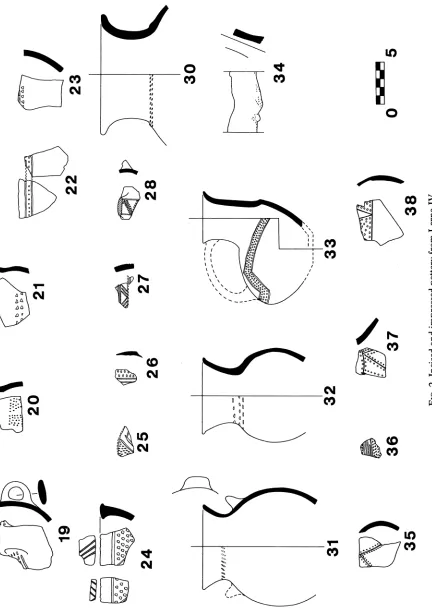
19 Shoulder-handled bowl Fig. 2, P1. 99 Handle-and-body fragment. Max. diam. not measurable.
Single sherd. Fine clay; dark gray fracture; sur- face mostly black, but there is scattered mottling of the exterior to brown (body) and red (back of handle).
Context mixed, with contents ranging in date from Phase 1 to Phase 3. (Lot J 465)
20 Shoulder-handled bowl Fig. 2, P1. 99 Body sherd. Diam. not measurable.
Single sherd. Medium-coarse clay; fracture pale brown at core, reddish brown near surface; surface mottled from dark grayish brown to light yellowish brown. Swelling of wall thickness at left end of sherd indicates proximity of upper handle attachment. Im- pressed decoration, all originally filled with paste, probably consisted of a horizontal series of pendent triangles framed at each end by a rough rectangle flanking the handle(s).
Phase 1. (Lot G 164)
ON ON
a -~~~~~~~~~~~~~~~~~~~~~~~~~~~~~~~~~~~~~~~~~~~~~~~~~~~~~~~~~~~~~~~~~4
'(>1 ~~~00 a~~~~~~~~~~~~~~~~~~~~~~~~~~~~ O0 O"0 0.
/J
t~~~~~~~~~~~~~~~~~~~~~~~5
~ ~
/00 00*0~
~
~
~
~
~
aa~
~ ~~~~~~~~~~
00 ~0< a0<
~~~~~~~~~~~~~~~~~~~~~
Il/a
314
?~~~
~~~~
AL *0 -14
6
8
A/'4.'
12
13
0
~~~18
0
~~~~~~~~16
17R%5
15
\~~~ /_
20
.~~~21
19
22
23
S)
~~
fLf)
J2
1
w
V-6103 ill,' /0
24525
278
30
2
3 4
31
3 2
3 3
36
37
0
5
35
38
468 JEREMY B. RUTTER
Single sherd. Fine clay; fracture mostly brown, occasionally mottled to grayish brown; surface mot- tled from black to dark gray.
Phase 1. (Lot BD 617)
22 Shoulder-handled bowl (?) Fig. 2, P1. 99 Body sherds. Diam. not measurable.
Two non-joining sherds. Fine clay; fracture most- ly brown, mottled to reddish brown near exterior surface; surface mottled from dark gray to pale brown.
Phase 1. (Bothros J-R)
23 Shoulder-handled bowl (?) Fig. 2, P1. 99 Body sherd. Diam. not measurable.
Single sherd. Coarse clay; dark gray fracture; sur- face mottled from dark gray to light brown.
Phases 1-2. (Bothros B-W)
24 Bowl with horizontal handles Fig. 2, P1. 99 or lugs.
Rim sherds. Diam. rim not measurable.
Two non-joining rim fragments. Fine clay; very dark gray fracture and surface. This shape would have been furnished either with two horizontal han- dles, trianguloid in section, or with two broad hori- zontal ledge lugs, in either case attached below the rim at approximately the level of the exterior decora- tive zone. Incised, impressed, and cord-impressed decoration all originally filled with white paste.
Phases 1-2. (Lots BE 452 and BE 455)
25 Open shape; precise form un- Fig. 2, P1. 99 determinable
Body sherd. Diam. not measurable.
Single sherd. Fine clay; gray fracture; light brown surface. Incised and impressed decoration all origi- nally filled with white paste.
Phase 1. (Lot J 149)
26 Open shape, precise form un- Fig. 2, P1. 99 determinable
Body sherd. Diam. not measurable.
Single sherd. Fine clay; dark gray fracture; sur- face mottled from dark gray to grayish brown.
Phase 1. (Lot J 514)
27 Open shape, precise form un- Fig. 2, P1. 99 determinable
Body sherd. Diam. not measurable.
Single sherd. Fine clay; pale brown fracture; black exterior surface. Incised decoration all originally filled with white paste.
Phase 3. (Lot GP 17)
28 Open shape, precise form un- Fig. 2, P1. 99 determinable
Handle-and-body fragment. Diam. not measur- able.
Single sherd. Fine clay; fracture mostly gray, be- coming grayish brown near and at surface. This sherd probably belonged to a rim- or neck-handled tankard.
Context mixed, with contents ranging in date from Phases 1-2 to the Transitional IV-V phase.9 (Bothros B-M)
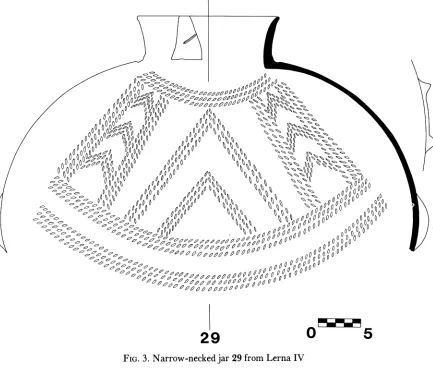
29 (L.373 + 1653) Narrow-necked Fig. 3, P1. 99 jar
Rim, neck, lug and body fragments. Max. pres. H. (composite) 0.275, diam. rim 0.166, max. diam. 0.493.
Mended from 60 sherds into 24 non-joining frag- ments, four of which reveal traces of having been burnt after the vase was broken. Fine clay; fracture mostly grayish brown, red near surface; light red to reddish yellow exterior surface, possibly coated with a thin wash. The shape had at least two, and proba- bly four, unperforated spool lugs. The diagonal groove incised before firing on the neck fragment (L.373) is probably to be identified as a potter's mark.
Phase 3. (Lots B 748,1476, and 1506; G 101,118, 250, 253, 273, 276,,279, 282, 284, 287, and 289)
30 Narrow-necked jar Fig. 2, P1. 100 Rim-, neck-and-shoulder fragment. Diam. rim 0.142.
Mended from 2 sherds. Fine clay; gray fracture; surface dark gray to dark grayish brown on interior, light brown to light yellowish brown on exterior.
Phase 3. (Bothros J-B)
31 Flask Fig. 2, P1. 100
Rim-, lug-and-body fragment. Max. pres. H. 0.135, diam. rim 0.100, max. diam. 0.140.
EARLY HELLADIC III POTTERY FROM LERNA 469
00 aOOOO Q~~~~~~~~~~~~~~~~12~~0 0 0lJz 0 I & ,,266~6P
o 06 0 oO 0
0 0~%
0 ~~~~~~~0 0
00o% Q0 0 0
o0oo 0 o 00 0000
O~ 0000
~
~
~
00 0 0 00
~
~
0C7,
ao 0
' 00 0v 000
0 0 o 0000 0 o 00
aov
0O 00 0~0 00
C7,
~
~~~00%0p00~
00 0000 0~~~~~~~~ aAV0
0~~~~~~~~a 066o aa0000 o00 loo0 o o o~oo
0 0 0000
e 0 00000
e5 oOo o
a~66aaa 70~0 ~~o 0 0 0%oo0
29
~~
~~~~~~0
5
FIG.3. arrw-ncke jar29 romLera I
Mended from 10 sherds. Medium-coarse clay; fracture mostly dark gray, reddish brown near sur- face; surface mottled from dark gray to strong brown.
Phase 3. (Bothros B-Ff)
32 Flask Fig. 2, P1. 100
Rim plus non-joining shoulder fragment. Max. pres. H. (composite) 0.12, diam. rim 0.09, max. diam. 0.1 1.
Two non-joining sherds. Medium-coarse clay; yellowish red to red fracture; surface mottled from dark grayish brown to reddish brown.
Phase 3. (Bothros B-At + BD-X + BF3)
33 (L.718) Askos Fig. 2, P1. 100 Rim-, neck-and-body fragment. Max. pres. H. 0.120, diam. rim 0.061, max. diam. 0.122. Mended from 7 sherds. Fine clay; gray to grayish brown fracture; surface mostly black to gray but mottled in patches to strong brown. Thickening of wall on upper neck suggests that upper handle at- tachment was near or at rim.
Phase 1. (Lot G 181)
34 Askos Fig. 2, P1. 100
470 JEREMY B. RUTTER
Single sherd. Medium-coarse clay; fracture and surface mottled from very dark gray to light yellow- ish brown. Impressed decoration at base of neck probably to be identified as horizontal double-zigzag pattern. Near the top of the neck is a single partially preserved triangular impression, considerably larger than the tiny circular impressions below (omitted from drawing, Fig. 2:34).
Phase 1(?). (Lot BD 353)
35 Closed shape, precise form Fig. 2, P1. 100 undeterminable
Body fragment. Diam. not measurable;
Mended from 2 sherds. Fine clay; very dark gray fracture; black exterior surface. Possibly from the same vase as 36.
Phase 1. (Lot J 475)
36 Closed shape, precise form Fig. 2, P1. 100 undeterminable
Body sherd. Diam. not measurable.
Single sherd. Fine clay; very dark gray fracture; black exterior surface. Possibly from the same vase as 35.
Phase 1. (Lot J 470)
37 Closed shape, precise form Fig. 2, P1. 100 undeterminable
Body sherd. Diam. not measurable.
Single sherd. Fine clay; fracture mottled from light brownish gray to light red; exterior surface mottled from light yellowish brown to reddish yellow.
Context mixed, with contents ranging in date from phase 1 to early Lerna V. (Lot A 361)
38 Closed shape, precise form Fig. 2, P1. 100 undeterminable
Body sherd. Diam. not measurable.
Single sherd. Fine clay; fracture mottled from dark gray to light reddish brown; exterior surface mottled from brown to reddish yellow. Interior sur- face blackened from secondary burning.
Phase 2(?). (Lot B 1508)
B. KORAKOU AND ZYGOURIES
39 (Korakou CP 132) Neck-handled P1. 100 tankard
Almost complete profile, lacking base. Max. pres. H. 0.098, diam. rim 0.075-0.078, max. diam. of body 0.072.
Mended from ca. 25 sherds. Fine clay; fracture gray at core, reddish brown near surface; exterior surface mostly yellowish red but mottled in spots to weak red. Base completely restored in plaster; pre- served stumps of both handles show them to have been narrow vertical straps. Incised and impressed decoration, partially smeared over by subsequent burnishing, is identical on both sides; the band of or- nament on the upper shoulder steps down around the base of both handles and is thus continuous around the entire vase.
Trench P, level IX.'0
Published: C. W. Blegen, Korakou, A Prehistoric Settlement Near Corinth, Boston and New York 1921, pp. 13-14, fig. 17.
40 (Zygouries Z 250) Pedestal-footed P1. 100 cup
Complete profile. H. 0.090-0.093, diam. rim 0.082-0.086, max. diam. body 0.086, diam. foot 0.052.
Intact and complete except for almost half of foot. Medium-coarse clay; fracture and surface mottled from black to reddish yellow, the black probably the result of secondary burning. Foot pierced at 1200 in- tervals by three circular fenestrations; single vertical strap handle attached at top to exterior face of rim. Incised and impressed ornament on foot consists of a series of panels whose decoration alternates between those containing a circular fenestration ringed by an irregular row of tiny circular impressions and those consisting of three to four incised vertical lines be- tween each pair of which are one or two vertical rows of similar impressions.
10 The preserved sherd material from this level stored in the Corinth Museum suggests that this stra-
EARLY HELLADIC III POTTERY FROM LERNA 471
Trench R East, level VI.1I
Published: C. W. Blegen, Zygouries, A Prehis- toric Settlement in the Valley of Cleonae, Cambridge 1928, p. 124, fig. 116.
41 (Korakou CP 292) Pedestal-footed P1. 100 cup
Stem-and-lower-body fragment. Max. pres. H. 0.117.
Mended from 2 sherds. Medium-coarse clay; fracture dark gray at core, reddish brown near sur- face; exterior surface mottled from dark grayish brown to reddish yellow. Uppermost portion of hol- lowed foot preserved at base of stem. Within the over-all decorative scheme of multiple dot-filled hor- izontal zigzags, the largest circles are true perfora- tions, while two of the smallest circles preserve traces of a filling of white paste.
Context at Korakou unknown.
42 Pedestal-footed cup P1. 100 Body sherd. Korakou, uninventoried fragment. Max. pres. L. 0.061, max. pres. W. 0.044, diam. not measurable.
Single sherd. Medium-coarse clay; weak red frac- ture; very dark gray surface. Thickening of vessel wall at lower end as illustrated probably occurs in the vicinity of what was the vessel's everted rim; all but two of the impressed circles are true perforations whose interior diameters are considerably smaller than they are on the exterior surface; within the acute angle defined by the impressed decoration is part of a considerably larger perforation which was evidently triangular in outline. The obtuse angle formed by the incised ornament is probably indica- tive of the fact that the decorative band stepped down around a handle base (cf. 16, 22, 33, and 39).
Trench P, level VIII.12
COMPARANDA
The remaining pieces of pattern-decorated
pottery, incised or impressed or both, that
are well dated to the EH III phase from other sites are few enough to be listed in their
totality prior to an analysis of the material from Lerna.
1311 The discovery of Zygouries Z 250 is reported in Harland's 1921 Zygouries field notebook, kept in
the Corinth Museum, on pages 108-109; it was apparently found when the excavations tunneled under a cross wall. A dating for the piece to the EH III phase may be considered certain on the grounds of exter- nal parallels, but its circumstances of discovery and the lack of associated sherd material make any more precise dating in terms of the ceramic sequence within Lerna IV difficult.
12The preserved sherd material from this level stored in the Corinth Museum is mixed: most of it belongs to MH II ("Classical Minyan") types, but between a quarter and a third of it dates from a stage of EH III seemingly somewhat later than that represented in the underlying level P IX (for which see footnote 10 above). The incised and impressed fragment 42 belongs with the EH III material in this level. In both his field notes and later pottery notes (Corinth Notebook 81 [1915], pp. 226-228, 361-363), Bleg- en records a deep layer of ash and burnt debris at the bottom of level P VIII. It is unfortunately unclear whether this burnt stratum is to be dated to the end of the early stage of EH III represented by the con- tents of P IX or to some later stage of EH III represented by the EH III material from P VIII. There is, of course, no way to tell whether the burnt destruction was restricted in scope or affected the site as a whole.
13 Pieces are listed only if their shape is a characteristic EH III type or if the context from which they
472 JEREMY B. RUTTER
Argolid-Corinthia 1 4
Korakou: (see above, 39, 41, and 42).
Mykenai: Pyxis: Wace, op. cit. (footnote 4 above), p. 117, fig. 26:h.
Prosymna: 1) Neck-handled jug: Blegen, op. cit. (footnote 4 above), p. 378, fig. 638:7. 2) Narrow-necked jar (?): ibid., fig. 638:1-2.
Tiryns: Unidentifiable shape: Gercke, Gercke, and Hiesel, op. cit. (footnote 5 above), p. 35, no. 89, pl. 35:3c.
Zygouries: (see 40 above).
Arcadia
Asea: Flask: Holmberg, op. cit. (footnote 4 above), p. 83, fig. 89:a.
Elis
Olympia: Dark Burnished
1) Rim-handled tankards, two-handled: Weege, 1911, p. 167, nos. 11, 12, pl. V:1, 2; Dorp- feld, 1935, pl. 22:1, 2.
2) Neck-handled tankard, one-handled: Weege, 1911, p. 165, no. 1, pl. V:7, 8; Dorpfeld, 1935, pl. 22:3, Beil. 25:c, d.
3) Neck-handled tankards, two-handled: Weege, 1911, pp. 166-167, nos. 9, 10, pl. V:5, 6; Dorpfeld, 1935, pl. 22:4, 5, Beil. 25:b; Koumouzelis, 1980, p. 165, fig. 38:4, pl. 108:g. 4) Shoulder-handled bowls, one-handled: Weege, 1911, pp. 170-171, nos. 29-31, 173, no.
38, figs. 12-16, pl. V:3, 4; Dorpfeld, 1935, pl. 22:7, 8; Koumouzelis, 1980, pp. 165- 166, figs. 33:10, 35:3, 38:5, 6, 8; pls. 108:f, 1, o, 109 passim.
5) Bowl with horizontal handles or lugs: Koumouzelis, 1980, pp. 156, 166-167, fig. 33:9, pl. 108:n.
6) Unidentifiable shapes: Koumouzelis, 1980, p. 174, fig. 39:4, 5. Fine, gray-burnished ( = Gray Minyan)
1) Shoulder-handled bowl: Weege, 1911, fig. 18, upper left.
2) Kantharoi: Weege, 1911, pp. 167-168, figs. 5-7, 18, lower left; Dorpfeld, 1935, fig. 12:1, 3, pl. 22:14; Koumouzelis, 1980, fig. 38:7.
Ionian Islands
Pelikata (Ithaka): Fine, gray-burnished ( Gray Minyan)
Kantharoi: W. A. Heurtley, "Excavations in Ithaca, II," BSA 35, 1934-35, p. 31, nos. 106-109, figs. 24, 26.
tsa in Macedonia, and Troy, all of which are cited as parallels by Koumouzelis (Koumouzelis, 1980, p. 168 and notes 37-41). A cord-impressed sherd from Eutresis said to come from an EH III context at this site is not listed since it is uncertain which of the illustrated cord-impressed sherds this piece in fact is (Goldman, op. cit. [footnote 3 above], p. 123, fig. 169). Similar cord-impressed fragments from Aghia Marina in Phokis come from uncertain contexts (ibid., p. 123, note 6; V. Milojcic, "Zur Frage der Schnurkeramik in Griechenland," Germania 33, 1955, fig. 1:1-5).
EARLY HELLADIC III POTTERY FROM LERNA 473
Saronic Gulf and Attica' 5
Aigina 1) Pedestal-footed cup: Walter and Felten, op. cit. (footnote 15 above), pp. 110, 161, no. 228, pl. 97.
2) Rim-handled tankard (?): ibid., pp. 106, 158, no. 171, fig. 102, pl. 89
ANALYSIS (Table 2)
GENERAL CHARACTERISTICS OF THE LERNA MATERIAL
The vast majority of the 38 samples of pottery from Lerna IV bearing finely incised or
impressed decoration are unpainted and burnished, with mottled, generally dark surfaces
(i.e., brown, grayish brown, gray, or black). In terms of their fabric, they range from fine to
coarse, the coarse pieces tending to date from phases 2 or 3 and to be pedestal-footed cups,
while most of the remaining shapes, as well as the bulk of the phase 1 material, are made of
fine or medium-coarse clay. There are no examples from Lerna of fine, gray-burnished
pottery, the EH III ancestor of MH Gray Minyan, decorated with finely incised or im-
pressed motifs, in marked contrast to the situation at Olympia and Pelikata.
The single example of painted pottery, 2, belongs to a common class of Lerna IV pot-
tery which is typified by a fine, reddish yellow and micaceous fabric coated solidly with
paint and subsequently burnished.16 Although the decoration of shoulder-handled tank-
ards, shoulder-handled
bowls, and kantharoi of this class with groups of shallow horizontal
incisions or grooves begins on tankards in phase 2 and becomes common on bowls and kan-
tharoi during phase 3 of Lerna IV,17 2 is unique in having patterned rather than purely
linear ornament and in featuring impressed decoration. This piece, however, is almost
15 Incised and impressed pottery of Phylakopi I types from sites in and around the Saronic Gulf is all,
to judge from the well-dated excavation proveniences of much of this material at the Kolonna site on Aigina, no earlier than the beginning of the MH period (H. Walter and F. Felten, Alt-Agina, III, i, Die vorgeschichtlichen Stadt. Befestigungen, Hauser, Befunde, Mainz 1981, pp. 117, 124-126, nos. 393-395), and it is therefore omitted here. For a selection of such pottery in the characteristic shapes of duck askoi, conical pyxides, and lids, see R. Wiinsche, Studien zur dginetischen Keramik der friuhen und mittleren Bronzezeit, Munich and Berlin 1977, pp. 51-59 (Aigina), G. Mylonas, H1poCo-ropLKq 'EA(vdrt, Athens
1932, fig. 84 (Eleusis), and 0. Broneer, "Excavations on the North Slope of the Acropolis in Athens 1931-1932," Hesperia 2, 1933, p. 357, fig. 27 (Athens). The incised and impressed pottery from Aghios Kosmas, some of it white filled, appears to be uniformly of EH II date, like the few pieces of pattern- painted Dark-on-Light pottery from the site (G. Mylonas, Aghios Kosmas. An Early Bronze Age Settle- ment and Cemetery in Attica, Princeton 1959, p. 12.7 and note 43, figs. 122:1-4, 160, nos. 311, 312, the last two certainly of types current in the EB 2 Cyclades). The most popular incised and impressed shapes are frying pans and pyxides with close Cycladic affinities. One of the pyxides closely resembles in the style of its decoration some of the EH III pieces from Lerna, but its context, albeit somewhat disturbed, sug- gests a date no later than EH II for the piece (ibid., fig. 161, nos. 305-310). A pedestal-footed cup from Eleusis having three incised horizontal lines alternating with two rows of circular perforations on the shoulder is reminiscent of the pedestal-footed cups of EH III phase 3 from Lerna but is dated to the MH
period (Mylonas, IHpoCo-roplK' 'EA(vo-rsv, p. 86, no. 133, fig. 57, left).
16 Caskey, op. cit. (footnote 3 above), p. 296 where this class is described as slipped and burnished.
The substance used to coat these vases, Caskey's "slip", appears to be identical to the paint utilized for the execution of geometric motifs in the pattern-painted Dark-on-Light class, hence the use of the term "paint" rather than "slip" here.
474 JEREMY B. RUTTER
certainly to be identified as a local imitation of a mode of decoration normally restricted to
unpainted burnished pottery on shapes other than shoulder-handled
tankards at the site.
29 is unique in having an unburnished surface and in bearing what is best identified as
a potter's mark on the neck. Its unusual fabric and elaborate decoration, at a time (phase 3)
when most of the finely incised or impressed pottery from Lerna is decorated with horizon-
tal bands of such ornament, strongly suggests that it is an import to the site. 30, the only
other certain example from Lerna of a narrow-necked jar belonging to this decorative
group, is also atypical in its fabric and may likewise be an import.
SHAPES
By far the commonest shapes from Lerna decorated with finely incised or impressed
ornament are the pedestal-footed cup and the shoulder-handled bowl. Together these
account for slightly more than half of the preserved corpus of material. It is nevertheless
striking how many different shapes, both open and closed, were in fact decorated in this
fashion. The comparanda from other sites extend this shape range even further, so that it
eventually includes all the major EH III vessel forms produced in fine fabrics with the
exception of the ouzo cup and the rim-handled, flat-based cup. Each shape represented at
Lerna is worth considering in some detail.
Rim-handled tankard. 1 is unique among the finely incised or impressed pottery of Lerna
IV, not only in terms of its shape but also because it is the only vase in the collection deco-
rated with curvilinear motifs; it is also one of the few, along with 27 and 31, to bear only
finely incised ornament and no impressed decoration. Its shape is not well paralleled else-
where, but the style of its decoration, if not the actual motifs, is close to that on the flask from
Asea, and it may be that 1 is actually an Arcadian import.
Shoulder-handled tankard. 2 has already been discussed (p. 473 above). Here it is only
worth noting how surprising it is that the shoulder-handled
tankard, common at other EH
III sites in the northeastern Peloponnese, is so rarely decorated with fine incisions or im-
pressions, particularly when rim- and neck-handled versions of the same basic form are
quite commonly so decorated (cf. 1, 28, 39, and the comparanda from Olympia).18
Pedestal-footed
cup. At least two varieties of the basic form appear to be attested, the more
common having an everted rim and a deep bowl (3-7), while a rare variant with a vertical
rim and a shallow bowl is probably represented by 14. The comparanda from elsewhere
(40-42 from Korakou and Zygouries and the example from Aigina) are probably all of the
18 This peculiar circumstance is potentially of considerable significance with regard to the evolution
EARLY HELLADIC III POTTERY FROM LERNA 475
commoner Lernaean variety. The fenestrated feet of the examples from Aigina and Zygou-
ries (40) are not attested at Lerna, although the paneled system of decoration on the foot of
40 is paralleled at Lerna on 12. From the point of view of decoration, the pedestal-footed
cups from Lerna divide neatly into two groups, an earlier (3, 12-15 of phases 1-2) and a
later (4-11 of phase 3). The earlier group normally bears both incised and impressed orna-
ment (3, 12-14), and in two cases the relief decoration is filled with white paste (12, 15). In
contrast, the later group regularly bears only impressed decoration in the form of horizontal
rows of circular impressions which is in only one case filled with white paste (6). If these
decorative criteria can be validly applied at other sites, then all the comparanda from Ai-
gina, Korakou, and Zygouries should predate phase 3 of Lerna IV.
Shoulder-handled
bowl. Unfortunately, not one of the fragments of this shape from Lerna is
fully enough preserved to indicate whether bowls of this form decorated with incised or
impressed ornament had two handles or only one. There is no certain example of the one-
handled variant of this shape among any of the ceramic classes of Lerna IV, although there
are well over 50 examples of such bowls which definitely had two handles. At Olympia,
however, the incised and impressed shoulder-handled bowls, when fully enough preserved
for the shape to be entirely reconstructed,
are exclusively one-handled. The fragments from
Lerna which have fully preserved handles (16, 19) both exhibit a ringlike form of strap
handle which is not at all uptilted or high swung, a characteristic
feature of shoulder-han-
dled bowls during phase 1 of Lerna IV. Six of the total of eight incised or impressed exam-
ples of this shape from Lerna (16-18, 20-22) come from contexts of phase 1, while the other
two come from mixed (19) or imprecisely datable (23) contexts which include material of
the same early phase. It thus seems likely that this shape, when decorated with finely incised
or impressed ornament, is restricted to the earliest EH III subphase of Lerna IV.
Bowl with horizontal handles. 24 is of particular interest in that it is the only preserved
fragment of pottery from Lerna IV to be decorated with cord impressions and is the only
example of such ceramic decoration from any EBA context in the entire Peloponnese, in-
deed from any EH site south of Eutresis in Boiotia.19 But before this piece is hailed as the
southernmost
occurrence
of central European "corded
ware", several observations should be
made. First, the cord impressions on the upper surface of the rim were originally filled with
white paste, with the result that the corded decoration itself would not have been visible.20
Second, neither shape nor fabric nor the remaining decoration of the piece suggests that it
was an import. Bowls with similarly thickened, T-shaped rims occur in the Dark-on-Light
pattern-painted class in phase 1 contexts of Lerna IV: the pattern of opposed diagonals
executed by means of corded impressions is common enough on the interior rim of pattern-
painted bowls with horizontal handles, although bowls with such decoration only become
common in late phase 2 and in phase 3; the dot-filled triangles on the exterior are a motif
19 E. Hanschmann and V. Milojcic, Die deutschen Ausgrabungen auf der Argissa-Magula in Thessa-
lien, III, i, Die friihe und beginnende mittlere Bronzezeit, Bonn 1976, pp. 231-235 for the most recent discussion of cord-impressed pottery from EBA contexts throughout Greece. See also Milojcic, op. cit. (footnote 13 above), pp. 151-154.
20 In her publication of the four cord-impressed sherds found in EH levels in Eutresis, Goldman makes
476 JEREMY B. RUTTER
commonly represented among the small number of incised or impressed fragments which
form the subject of this article. On the other hand, all the above notwithstanding, it remains
true that the closest over-all parallel for 24 is a cord-impressed
rim sherd from the distant
site of Pefkakia in Thessaly.2I
Fragments from unidentifiable open shapes. 27 and 28, both from phase 3 contexts, are
probably earlier than these contexts suggest. 28, likely to be from a rim- or neck-handled
tankard (cf. 39 and the comparanda from Olympia), should be early since neck-handled
tankards are apparently restricted to phase 1 at Lerna while -rim-handled
tankards are very
rare after phase 2. 27 is probably early because of the white paste which fills its incised
decoration (see below under "Decoration").
Narrow-necked
jar. 29 and 30 have been discussed above, where it was suggested that both
are likely to be imports. It is further worth noting that both come from late (phase 3) con-
texts. Neither seems closely related to the only potential parallel from another site, a frag-
mentary vase from Prosymna which is in any case not certainly an example of this shape.
The source from which such jars might have been imported to Lerna must remain problem-
atic in the present state of our knowledge.
Flask. Like the jars just discussed, both flasks, 31 and 32, come from late contexts. Both are
simply decorated and belong to a variant of the flask form having a flaring neck and lugs on
the shoulder, the latter either solid or pierced vertically by circular perforations. This shape
appears in phase 3 of Lerna IV to replace an earlier type having a cylindrical neck and
vertically pierced, tubular lugs attached on the neck. The earlier type occurs rarely in
phases 1 and 2 decorated with Dark-on-Light pattern-painted ornament and is paralleled
elsewhere by the incised flask from Asea, as well as by examples from Tiryns, Nemea,
Olympia, and Troy.22 The later type is occasionally decorated with Dark-on-Light painted
patterns at Lerna but is usually unpainted; comparanda come from a late EH III context at
Tiryns and from early MH contexts both at Asine and at Lerna itself.23
Askos. Both examples of the askos form, 33 and 34, belong to a version of the shape which
seems to be restricted to phase 1 at Lerna. This variant is small, has a cylindrical neck offset
sharply from the body, and at Lerna occurs only as an unpainted shape.24
21 V. Milojcic, "Bericht tiber die deutschen Ausgrabungen in Thessalien," AEAr 28, 1973, B' 2 [1977],
pl. 305:c, lower right; Hanschmann and Milojcic, op. cit. (footnote 19 above), p. 232 (d) and note 999. Note that the bowl with a thickened rim also occurs in the EH III repertoire of finely incised and im- pressed shapes at Olympia, although here without corded decoration: Koumouzelis, 1980, pp. 166-167, fig. 33:9, pl. 108:n.
22 H. Schliemann, Tiryns. The Prehistoric Palace of the Kings of Tiryns. The Results of the Latest
Excavations, New York 1885, p. 59, pl. XXIII:d (Tiryns); C. W. Blegen et al., Troy, II, The Third, Fourth, and Fifth Settlements, Princeton 1951, pp. 109, 138, 214, figs. 170:10, 185 (Troy); Koumouzelis, 1980, p. 150, H-175, fig. 37:2, pl. 93 (Olympia). Several examples from Nemea are unpublished; I am grateful to Professor G. Mylonas for permission to mention them here.
23 Gercke, Gercke, and Hiesel, op. cit. (footnote 5 above), p. 33, no. 85, fig. 11:6, pl. 36:2a (Tiryns); 0.
Frodin and A. W. Persson, Asine. Results of the Swedish Excavations 1922-1930, Stockholm 1938, p. 264, fig. 184:8 (Asine); Zerner, op. cit. (footnote 8 above), p. 104, BD155/4, fig. 12, pl. XV (Lerna). A coarse EH flask from Asea may also be cited (Holmberg, op. cit. [footnote 4 above], fig. 81:b).
24 For an undecorated version of this phase 1 variant at Lerna, see Caskey, 1966, pl. 55:18. This
EARLY HELLADIC III POTTERY FROM LERNA 477
Fragments from unidentifiable closed shapes. Of the four pieces in question, 35 and 36 are
certainly datable to phase 1, while 37 comes from a mixed deposit containing some material
assignable to phase 1 and is also likely to be early. 38, from a context whose date is some-
what uncertain, closely resembles 37 in its style of decoration and is probably contemporary
with it. All four pieces have been attributed to closed shapes because of their roughly fin-
ished interior surfaces. They all, however, belong to rather small, thin-walled vases with
strongly convex body profiles. It is likely that some of them, perhaps even all, come from
tankards with high, relatively narrow necks such as 39 from Korakou and the tankards cited
as comparanda from Olympia, although they could equally well belong to pyxides such as
the example from Mykenai. In the complexity and fineness of their decoration, their only
parallels among the closed shapes from Lerna itself are the askoi 33 and 34.
DECORATION (Table
2)
The evidence of the 38 vases and fragments from Lerna with finely incised or
impressed decoration strongly suggests that, if complex, it is characteristic of the earlier
phase of EH III (Lerna IV phases 1-2), whereas very simple decoration is typical of later
EH III (Lerna IV phase 3). On the assumption that 27 and 28 are early pieces in late
contexts, the decoration on vessels dated by context to phase 3 consists exclusively, with the
single exception of the chevron-filled panels and multiple triangles on the jar 29, of several
horizontal rows of circular (4-11) or elliptical (30, 32) impressions or a single row of incised
diagonal bars
(31).25With the exception of the two jars 29 and 30, both likely to have been
imported, decoration in this subphase is either purely incised or purely impressed but not a
combination of both; even the jars are purely impressed except for a single horizontal groove
at the base of their necks. There is only one example of the use of white paste as a filling
material in phase 3 (6). Finally, ornament is restricted to the body of the vase in phase 3 and
to the shoulder on all shapes except for the pedestal-footed cup, where decoration may cover
the body and also the stem. Like the shape range at this time, which has been reduced to the
pedestal-footed cup, the narrow-necked jar, and the flask, the repertoire of motifs, if one
should dignify simple rows of dots and dashes with that term, is impoverished.26
By contrast, the material from phases 1 and 2, which boasts six or more distinct shapes
in comparison to the three of phase 3, also exhibits a far broader range of motifs and a
greater variety in the placement of them on the vase. Furthermore, of the total, from all
phases, of eight pieces with traces of white paste used as filling, five (15, 17, 20, 24,25) come
Die kretisch-mykenische Kultur, Leipzig and Berlin 1921, fig. 128, left, from Aghia Marina). The later and more common variety of EH III askos, normally solidly painted, is exemplified by published speci- mens from Tiryns and Gonia (Muller, op. cit. [footnote 4 above], pl. IX:1; C. W. Blegen, "Gonia," MMS 3, 1930-31, fig. 20).
25 Possibly to be added to 29 as an exception is the pedestal-footed cup fragment 7 which has, inserted
between its rows of impressed circles at its point of maximum diameter, a zone of impressed quatrefoils ringing circular perforations.
26 A phenomenon parallel to this narrow range of impressed ornament in terms of its simplicity and
478 JEREMY B. RUTTER
from securely dated early contexts and serve as a -strong argument for confirming the sug-
gested phase 2 date for 12 and a generally early date for 27. Of the 26 pieces (including 19,
27, 28, and 37) certainly or probably to be dated to phases 1 or 2, fully 20 combine incised
and impressed ornament rather than using either one or the other in isolation, and three of
the remaining six make use of white paste as filling matter. In view of the fact that many of
the pieces are only small sherds from vases which no doubt originally bore fairly extensive
zones of decoration, it is likely that the number of vases datable to phases 1 and 2 which bore
only impressed or only incised decoration was in reality even smaller.
During phases 1 and 2, incised or impressed ornament or both may appear on the
interior (16, 18) or on top (24) of the rim, on the neck of closed shapes (34), on the shoulder
(passim),