A Partial-differential Approximation for
Spatial Stochastic Process Algebra
Max Tschaikowski
Electronics and Computer Science
University of Southampton, UK
[email protected]
Mirco Tribastone
Electronics and Computer Science
University of Southampton, UK
[email protected]
ABSTRACT
We study a spatial framework for process algebra with or-dinary differential equation (ODE) semantics. We consider an explicit mobility model over a 2D lattice where processes may walk to neighbouring regions independently, and inter-act with each other when they are in same region. The ODE system size will grow linearly with the number of regions, hindering the analysis in practice. Assuming an unbiased random walk, we introduce an approximation in terms of a system of reaction-diffusion partial differential equations, of size independent of the lattice granularity. Numerical tests on a spatial version of the generalised Lotka-Volterra model show high accuracy and very competitive runtimes against ODE solutions for fine-grained lattices.
Keywords
Process Algebra, Fluid Approximation, Partial Differential Equations
1. INTRODUCTION
Modelling space explicitly is a relevant concern in a va-riety of disciplines such as biochemistry, ecology, and epi-demiology. At the same time, process algebra [13, 7, 8, 12, 2] have been successfully applied in the modelling of com-plex systems. Here we focus on spatial models expressed by process algebras with ordinary differential equation (ODE) semantics. We consider a spatial domain modelled as a regu-lar two-dimensional lattice, where agents may interact with each other if they are in the same region. In additions, agents may move independently from each other to neigh-bouring regions with an unbiased random walk, i.e., equally likely in any direction. The rate of movement, however, may be dependent on the agent type considered (and may be zero). Under these assumptions, the ODE state-space size grows linearly with the number of regions, making the analysis difficult in practice for dense lattices.
Our main contribution is a technique that, given a process algebra model, infers a system of partial-differential
equa-tions (PDEs) of reaction-diffusion type whose size is inde-pendent from the lattice size. This is an approximate view of the model which replaces discrete movements across regions in a continuous fashion. We work with the process algebra FEPA (Fluid Extended Process Algebra) presented in [19, 20]. However, with appropriate changes our ideas are appli-cable to languages such as Bio-PEPA [7], Cardelli’s Chemi-cal Ground Form [4], and the continuousπ-calculus [14].
In the literature concerned with models thatare not de-rived from a process algebra, such PDE approximations are typically presented by first considering astaticversion of the system in terms of an ODE model, where locality is not ex-plicitly taken into account. Such a static description defines the model of local interactions. Then, a spatial domain and a mobility model are added, leading to amobile model in terms of a PDE where a diffusive term captures movement, and a reactive term captures the interacting behaviour of the static model (cf., e.g., [16]). We proceed in an analo-gous fashion. The generic behaviour within any region is captured by some static FEPA modelM, where space is not modelled explicitly. Then, we consider a spatial lifting of the model, S(M), a syntactic transformation which yields an FEPA model that makes the static version parametric with respect to the set of regions, and adds the random-walk behaviour. We justify our PDE approximation by observ-ing that the ODE system of the spatial modelS(M) can be written in terms of a discrete Laplacian operator. The PDE is taken as the continuous approximation of such Laplacian. At first sight, this approximation might appear of little use in practice. This is because, except for special cases, analyt-ical PDE solutions are not available, and PDE systems are solved numerically using algorithms that discretise the con-tinuous space [18]. However, when solving the spatial ODE system directly the number of discrete regions is determined by the FEPA model, while the coarseness of the discrete mesh made by the PDE solver depends on the algorithm’s parameters. Thus, the PDE solver may in effect perform a coarsening of the original spatial domain. Numerical anal-ysis of spatial extensions of the generalised Lotka-Volterra model [15] confirm high accuracy for fine meshes.
Related work.
[3] studies mobile ad-hoc networks by means of a probabilistic process algebra. Potential fluid limits, however, are not investigated. PALOMA, instead, is a re-cently proposed stochastic process algebra with an explicit notion of space [9]. It assumes arbitrary spatial domain and mobility model, which can be captured by an ODE sys-tem but not as a PDE, as done here. MASSPA has an3HUPLVVLRQWRPDNHGLJLWDORUKDUGFRSLHVRIDOORUSDUWRIWKLVZRUNIRU SHUVRQDORUFODVVURRPXVHLVJUDQWHGZLWKRXWIHHSURYLGHGWKDWFRSLHV DUHQRWPDGHRUGLVWULEXWHGIRUSURILWRUFRPPHUFLDODGYDQWDJHDQGWKDW FRSLHVEHDUWKLVQRWLFHDQGWKHIXOOFLWDWLRQRQWKHILUVWSDJH7RFRS\ RWKHUZLVHWRUHSXEOLVKWRSRVWRQVHUYHUVRUWRUHGLVWULEXWHWROLVWV UHTXLUHVSULRUVSHFLILFSHUPLVVLRQDQGRUDIHH
9$/8(722/6'HFHPEHU%UDWLVODYD6ORYDNLD &RS\ULJKWk,&67
'2,LFVWYDOXHWRROV
ODE semantics (also supporting higher-order moment clo-sures) with an explicit spatial domain, but with no move-ment [11]. Both PALOMA and MASSPA provide a process-algebra framework on top of the Markovian Agents Model [6]. Amobileextension of [6] is presented in [5], yielding a PDE. Space is directly continuous, instead of being interpreted as an approximation to a fine-grained lattice as done in this pa-per. The communication semantics is also different, being based on asynchronous exchange of messages, as opposed to a stricter notion synchronisation in FEPA. PALPS is a pro-cess algebra for spatial ecological modelling, proposed with a discrete-state semantics [17], allowing for individual-based reasoning which however does not scale to population mod-els. A review of other process algebras with explicit spatial support, but without PDE approximations, is given in [1]. Beyond process algebra, but closely related, is the spatial modelling technique for coloured Petri Nets in [10]. Tech-nically, we both assume a uniform lattice; conceptually, we both superimpose a spatial domain onto a static model. In-terestingly, their motivation is dual to ours: in [10] a contin-uous domain is discretised (allowing, e.g., to re-use Petri-net machinery), as opposed to our making discrete lattices con-tinuous.
Paper outline.
Section 2 overviews FEPA. Section 3 presents the spatial extension. Section 4 discusses the numerical eval-uation. Finally, Section 5 concludes.2. FLUID EXTENDED PROCESS ALGEBRA
Next we present the fluid process algebra FEPA [20], here extended to allow birth and death of processes, needed in many models of biological and ecological systems. This is achieved made by considering a single-level grammar mixing sequential behaviour and parallel composition.
The notion offluid atomessentially defines the behaviour of an agent.
Definition 1. The syntax of a FEPA fluid atom is given by
S::=0|P | i∈I
(αi, ri).S|SS
where P def= S denotes a constant, α is an action in the
action setAandr∈R>0.
As usual,0stands for the inert process. Choice between activities is encoded byi∈I(αi, ri).Si. The valueriin ac-tivity (αi, ri) denotes a coefficient that contributes to
deter-mining the rate of the exponential distribution at which the activity occurs. The parallel compositionSS is without synchronisation. Thus, an activity (α, r).(SS) encodes a process that spawns two independent copies ofS. The se-mantics for a fluid atom is given by the following standard rules:
i∈I(αi, ri).Si
(αj,rj)
−−−−−→Sj
, j∈I S (α,r)
−−−→S P −−−→(α,r) S, P
def
=S
S1−−−−→(α,r1) S1 S1S2−−−−→(α,r1) S1 S2
S2−−−−→(α,r2) S2 S1S2−−−−→(α,r2) S1S2 For a fluid atomP, we denote the set of constants reachable fromPasB(P). More formally,B(P) is the smallest set such
that a)P ∈ B(P) and b) for any P0 −−−→(α,r) P1 . . . Pn
withP0∈ B(P), it holds thatP1, . . . , Pn ∈ B(P), provided
thatPi=0for all 1≤i≤n. Here, the equality is intended
to be syntactical.
We can now state the FEPA grammar for composing species.
Definition 2 (FEPA Model). A FEPA modelM is given by the grammar
M::=MLM|P
whereL⊆ AandP is a constant. For any two distinct con-stantsP andPinM, we require (without loss of generality) thatB(P)∩ B(P) =∅.
As usual,Lis the parallel operator; here synchronisation
takes place over shared action types belonging to the action set L. For a FEPA model M, we define G(M) as the set of all constants in M andB(M) ={B(P)|P ∈ G(M)}. Each fluid atomP appearing inM represents an indepen-dent population of agents of typeP. Thus, the model is com-pleted by aninitial concentration function v(0) :X→N0, with B(M) ⊆ X assigning initial conditions. A function v:X→R≥0is calledconcentration function.
Example 1. The well known SEIR (susceptible-exposed-infectious-recovered) model (e.g., [21]) can be described by the FEPA modelS{α}Iwith
Sdef= (α, r).0
Idef= (α,1).(IE) + (γ, z).R Edef= (β, s).I
whereα,β andγrefer to infection, exposure and recovery, respectively. We have thatG(S{α} I) ={S, I}, B(S{α} I) =B(S)∪ B(I) ={S, E, I, R}.
For conciseness, we present the semantics of interaction using only mass action. To encode PEPA [13], the version in [20] also allows minimum-based synchronisation which is however not used in the examples of interest here.
For an action α, the apparent rate of a fluid atom S is given by the sum of all rates labelled withα that may be performed by S. This allows to account for multiple α -labelled choices such asP def= (α, r).P+ (α, r).P.
Definition 3(Apparent Rate). The apparent rate of action
αof a fluid atomS, denoted byrα(S), is defined as follows:
rα(0) = 0,
rα(P) =rα(S) ifPdef=S
rα i∈I
(αi, ri).Si=
i∈I:αi=α
ri,
rα(S0S1) =rα(S0) +rα(S1).
Definition 4 (Parameterised Apparent Rate). LetM be a FEPA model,α ∈ Aandv a concentration function. The apparent rate ofMwith respect tov is defined as
rα(M0LM1, v) =
rα(M0, v)·rα(M1, v) , α∈L,
rα(M0, v) +rα(M1, v) , α /∈L,
rα(P, v) =
Pi∈B(P)
vPirα(Pi)
whererα(Pi)is the apparent rate of a FEPA fluid atomPi, by Definition 3.
In Example 1 it holds thatrα(S, v) =rvS, which gives the
apparent rate at which a concentration ofvSS-components
exhibits actionα. When applied to a parallel composition, it gives the rate of interaction, e.g.,rα(S{α}I, v) =rvSvI, which models the mass-action kinetics.
Parameterised component rates define the “fluxes” related to a species. These will be the constituents of the vector field of the ODE system to be analysed (shown below Definition 6). In the ODE for species P, these will yield a negative contribution toα-actions performed byP, and positive for all contributions of other speciesP.
Definition 5(Parameterised Component Rate). LetMbe a FEPA model,α∈ Aandva concentration function. The component rate of P ∈ B(M) is parameterised byv in the following manner.
• M=M0LM1: ifP ∈ B(Mi), i= 0,1, andα∈L
then
Rα(M0LM1, v, P) := Rα
(Mi, v, P) rα(Mi, v) rα
(M0LM1, v).
• M=M0L M1: ifP ∈ B(Mi), i= 0,1, andα /∈L
then
Rα(M0LM1, v, P) :=Rα(Mi, v, P).
• M=Q: thenRα(Q, v, P) :=vPrα(P).
Notation.
We use Newton’s dot notation ˙vP for the derivative ofvP. To enhance readability, timetwill be suppressed, e.g., ˙vP denotes ˙vP(t).
Definition 6. LetM be a FEPA model. The fluid seman-tics of M is given byv˙ =α∈AFα(M, v)≡F(M, v) with
initial conditionv(0)andF(M, v)P being defined as
α∈A P∈B(M)
pα(P, P)Rα(M, v, P)
− Rα(M, v, P),
whereP∈ B(M)and
pα(P, P) :=
1 rα(P)
P−−−→(α,r) P1...Pn
r· |{i|Pi=P}|
For instance,S{α}Igives the well-known ODE system for the SEIR model:
˙
vS=−rvSvI v˙E=−svE+rvSvI (1)
˙
vI=−zvI+svE v˙R=zvI
Example 1 is non-spatial. More in general, as discussed, we take a FEPA model as a static description of the dynam-ics of interaction within any region of some spatial domain. In the remainder of this section we show how two further ex-amples from epidemiology and ecology of non-spatial models can be captured in FEPA. In the next section, instead, we consider the extension that can lift these models to a spatial domain. In passing, we note that none of the models pre-sented here can be encoded with the predecessors of FEPA [19, 20], because of the presence of birth/death behaviour.
Example 2(Predator/Prey Model). Let us define
Sidef=
1≤j≤d
(αi,j, qi,jri,j).(SiSi) + (αi,j,(1−qi,j)ri,j).Si
+ (βi, si).0
Rjdef=
1≤i≤d
(αi,j,1).0+ (γj, zj).(RjRj),
where0< qi,j<1and1≤i, j≤d. Then, the model
M:= (S1∅. . .∅Sd){αi,j|i,j}(R1∅. . .∅Rd) (2)
induces the ODE system
˙ vSi=vSi
d
j=1
qi,jri,jvRj−sivSi (3)
˙
vRj =zjvRj−vRj
d
i=1 ri,jvSi
This is known as the generalised Lotka-Volterra model [15, Section 3.2], where the predatorsS1, . . . , Sd prey on all the prey species R1, . . . , Rd, but with different severities ri,j.
With this agent-based view, qi,j can be interpreted as the
probability that a predator Si replicates after eating a prey
Rj.
Example 3(Competing Species). Let us define
S1def= (α, r1).(S1S1S1)
S2def= (α, r2).(S2S2)
Rdef= (α,1).0
Then the FEPA process(S1∅S2){α}Rinduces the ODE system
˙
vS1= 2r1vS1vR
˙
vS2=r2vS2vR
˙
vR=−(r1vS1+r2vS2)vR
Fluid atomRmodels a resource, which can be consumed with anα interaction; S1 is a species that gives rise to two de-scendants after consuming a resource, whileS2induces only one offspring. These ODEs are an instance of competitive Lotka-Volterra ODEs in the case of two species [15, Section 3.5].
3. SPATIAL FLUID EXTENDED PROCESS
ALGEBRA
In ecology, spatial models are explained as arising from their static counterparts by adding the Laplace operator
= ∂xx+∂yy [16, Chapter 10]. That is, if ˙v = f(v) is
a static ODE model its spatial version is given by apartial
differential equation∂tω=f(ω) +μω, withμbeing the
diffusion coefficient. The usage of the Laplace operator is motivated by the fact that the spatial probability distribu-tionπ(t, x, y) of a particle which is subject to a random walk satisfies the PDE∂tπ=π[15, Section 11.1].
In an analogous way, we take a FEPA process as the static model of the local interactions occurring within an arbitrary region, and define its spatial version in such a way that all fluid atoms are augmented with the capability of moving across neighbouring regions independently from each other,
in addition to enabling all the activities that are available in the static version. The transformation depends on the choice of the spatial domain, which we assume to be a discretisation of a square Ω ⊆ R2, denoted byRK.1 The parameterK determines the size of the region, i.e., we have thatRK :=
Ω∩(K1Z)×(K1Z), whereK≥1. Thus, the total number of regions isO(K2).
The transformation from a static to a spatial model is carried out so as to have that processes never change region as a result of performing an activity originally present in the static version. For any static FEPA processM, such a transformation is denoted bySK(M). In the present section
we show that the ODE system ofSK(M) is an
approxima-tion to the PDE system∂tωP =F(M, ω) +μPωP, with P ∈ B(M).
We illustrate our intent behind the definition ofSK by
considering the predator-prey FEPA model (2) in the case of a single class of predators and preys (i.e.,d= 1). To improve readability, we drop the superfluous index, i.e. S ≡ S1, α ≡ α1,1 and so on. Let us write N(x, y) for the set of (Neumann) neighbours of the region (x, y), that isN(x, y) is given by
RK∩ {(x−1/K, y),(x+ 1/K, y),(x, y−1/K),(x, y+ 1/K)}
Our transformation will yieldSK(M) defined as
SK(M) =S(0,0)LR(0,0), L={αl|l∈ RK},
with
Sldef= (αl, qr).(SlSl) + (αl,(1−q)r).Sl
+ (βl, s).0+
l∈N(l)
(δ, μl,Sl(K)).Sl
Rldef= (αl,1).0 + (γl, z).(RlRl) +
l∈N(l)
(δ, μl,Rl(K)).Rl,
for alll∈ RK. Intuitively,SK(M) models a situation where fluid atoms of typeB(M) ={S, R}move acrossRKvia the diffusion actionδ(which we assume in the remainder that it does not belong toA).
Such a transformation induces in effect a family of spatial
models depending on the choice of the ratesμl,Pl(K), which have not yet been defined. These may depend, in general, on the fluid atomP that is moving, on the origin and target region, i.e.,landl, respectively, and onK. The actions orig-inally available inM, i.e.,α,βandγ, are instead performed locally, with the same rates as in the static model version
M. Enforcing synchronisation only between processes in the same region is achieved by appendinglto each action type, modifying the synchronisation sets accordingly in the model equation.
Hence, our idea of spatial extension is formally captured by the following.
Definition 7 (Spatial FEPA). For a given FEPA model
M, the spatial version ofM overRK, denoted bySK(M),
is inductively given by
SK(P) :=P(0,0)
SK(M0LM1) :=SK(M0)SK(L)SK(M1),
1This assumption simplifies presentation and implementa-tion, but it can be in principle relaxed to arbitrary domains with a piecewise differentiable boundary.
whereSK(L) ={αl|α∈L∧l∈ RK}and, for alll∈ RK,
Pldef=
l∈N(l)
(δ, μl,Pl(K)).Pl+ (α,r,i)∈X
(αl, r).(Pi,l1. . .Pi,nl i)
whenever P def= (α,r,i)∈X(α, r).(Pi,1 . . . Pi,ni), where the caseμl,Pl(K) = 0corresponds to removing of the respec-tive summand in the definition of Pl. (In the special case
(Pi,1 . . . Pi,ni) =0, we set(Pl
i,1 . . . Pi,nl i) := 0.)
Moreover, letA+:={αl|α∈ A ∧l∈ R
K} ∪ {δ}.
For any FEPA modelM,SK(M) is a FEPA model, with
actions from A+. For any choice of the rates μl,Pl(K), an underlying ODE system can be defined. For example, the ODE ofvSl inSK(M) is given by
˙
vSl=qrvSlvRl−svSl+
l∈N(l)
μl,lS(K)vSl−μ l,l S(K)vSl
,
wherel∈ RKandμl,lS(K)≥0. SinceRinduces|RK|ODEs
as well, the overall size of the system is 2|RK|. In general, such a derivation is formally obtained through the following.
Theorem 1. Let us fix a FEPA modelM, a concentration function v of SK(M) and some l ∈ RK. Then, the
con-centration functionv|l ofM, given by(v|l)P :=vPl for all
P ∈ B(M), satisfies the ODEv˙Pl =F(SK(M), v)Pl with
F(SK(M), v)Pl=F(M, v|l)P
+
l∈N(l)
μl,lP(K)vPl−μ l,l P(K)vPl
, P ∈ B(M).
Proof. See Appendix A.
Informally, this theorem says that each ODE inSK(M)
has two contributions. The first contribution is thereactive
partF(M, v|l)P, which corresponds to the behaviour of the static modelM, accounting for local interactions within a region. Thediffusivepart, instead, is due to the migration across regions. A direct consequence of the above theorem is that the ODE system of a FEPA modelM overRK has
|B(M)| · |RK|coupled ODEs.
Now, we wish to study the conditions under which the analysis ofSK(M) is independent fromK. Intuitively, we would like to make spacecontinuousby sendingKto infin-ity, hence by making theRKincreasingly finer. This entails
turning per-region ODEs into a system of PDEs. For this, specific assumptions must be made on the choice of the rates
μl,Pl(K). In particular, a suitable scaling needs to be found
also with respect toK. Further, we need to make assump-tions on the initial concentration function forSK(M) and how it scales withK.
Overall, we make three assumptions, which we discuss in detail next.
Assumption 1: Unbiased Random Walk
.
We assume that each fluid atom is subjected to an unbi-ased random walk, i.e., it may migrate equally likely to any of its neighbours. More formally, we require that
(A1) μl,Pl(K) =μP(K)
for all P ∈ B(M), l ∈ RK and l ∈ N(l). Notice,
how-ever, that our assumption still allows distinct fluid atoms to perform migrations with different rates.
Assumption 2: Scaling ofμP(K)
.
Since a migration activity covers the distance 1/KinRK,
eachμP(K) should scale withK in a reasonable way. To
motivate our forthcoming spatial scaling, let us consider an unbiased random walk in the two-dimensional unbounded grid K1Z×K1Z, where each migration covers the distance 1/Kand the sojourn time at each state is exponentially dis-tributed with mean 1/rK. Then, the corresponding CTMC, denoted by (WK(t))t≥0, enjoys the following property. Proposition 1. Let us assume thatWK(0) = (0,0)and de-note bydK(t) :=WK(t)the Euclidean distance ofWK(t)
from the origin after timet. Then, it holds that
E(dK(t)2) =rK K2
t, for all K≥1 and t≥0,
whereE(·)denotes the expectation value.
Proof. See Appendix A.
Notice that ifrK = K2r1 for allK ≥ 1, Proposition 1 yields
E(dK(t)2) =E(d1(t)2), for all K≥1 and t≥0.
The above relation states that if each migration of the pro-cess covers a distance of 1/K, then the migration rate should beK2r1, in order for the random walk to always coverthe same distanceon average independently ofK.
Thus, we define the scaling of the migration rates as
(A2) μP(K) =μPK2, for all P ∈ B(M),
whereμP denotes some given nonnegative constant. When it is equal to zero, thenP-processes never move.
Assumption 3: Initial and Boundary Conditions
.
Whilst in the ODE interpretation (5) of spatial FEPA no particular restriction on the initial concentration function is needed, the PDE approximation can only make sense if v(0) converges, as a family of functions dependent on K, to adifferentiable function on Ω asK→ ∞. Thus, we fix partially continuously differentiable functionsω0P : Ω→R, whereP ∈ B(M), and define the initial concentration as
(A3) v(0)P(x,y):=ωP0(x, y)
forP∈ B(M) and (x, y)∈ RK. This assumption establishes
the link between the PDE and the ODE interpretation. The initial conditionωP0 evaluated at (x, y) provides the initial concentration function for the ODE of the fluid atomP(x,y). Finally, PDEs also require boundary conditions. In our model, the spatial domain isreflective, i.e., processes are not allowed to migrate outside the boundary. Formally, this cor-responds to setting Neumann boundary conditions (NBCs):
0 =∂xωP, ∂yωP(x, y)·ν(x, y), (4)
for all (x, y)∈∂Ω andt≥0, whereP ∈ B(M) andν(x, y) is the exterior normal vector at (x, y) to the boundary∂Ω of the square Ω.
Here, we wish to point out that by applying a minor change to the definition ofSK(M),absorbingboundary con-ditions could be encoded as well. While NBCs can be used
to model geographical barriers (e.g., an island), absorbing boundaries may be used to capture hostile environments (e.g., [16, Section 10.1]).
Definition 8 (Partial-differential Approximation). Let us fix a FEPA modelM and suppose that assumptions(A1)– (A3) are satisfied forSK(M). Then, the underlying PDE system ofSK(M)is given by
∂tωP =F(M, ω)P+μPωP, P ∈ B(M).
The initial conditions are given by the functionsωP0 : Ω→ R≥0, whereas the boundary conditions satisfy the NBCs (4). This is well-known in the literature as areaction-diffusion
PDE system (e.g., [15]), to highlight the role of the two summands in the time-derivative of ωP, i.e., the reactive
part due to the local interactions and the diffusive part due to process migrations. Importantly, this PDE system has a size which is equal to|B(M)|, the number of local states in the model’s static versionM.
We intend this PDE system as an approximation. Roughly speaking, the relation v(0)P(x,y) = ω0P(x, y) in(A3)
sug-gests that the ODE and PDE solutions satisfyvP(x,y)(t)≈
ωP(x, y, t).
The nature of this approximation can be understood by considering the continuous Laplace operator appearing in the PDE system as the limit of thediscreteLaplace operator in the unit square. This is obtained by using Theorem 1 and assumptions(A1)and(A2). The spatial ODE system can be rewritten as:
˙
vPl =F(M, v|l)P+μP
(K) K2
l∈N(l)
vPl−vPl
(1/K)2
=F(M, v|l)P+μPdvPl, (5) whereP ∈ B(M),l∈ RKanddv
Pl:=
l∈N(l)
v
Pl−vP l (1/K)2
denotes the discrete Laplace operator for all inner regions l∈ RK. For instance, applied to Example 2, Equation (5)
reads
˙
vSl =qrvSlvIl−svSl+μSdvSl,
˙
vRl =zvRl−rvSlvIl+μRdvRl,
for alll ∈ RK. Then, assuming that for sufficiently large
Kthe discrete Laplace operator can be approximated by its continuous analogue, we get the PDE
∂tωS=qrωSωI−sωS+μSωS,
∂tωR=zωR−rωSωI+μRωR,
whereωP : Ω×[0;∞)→R≥0. This is consistent with the PDE model that is already available in the literature (cf. [16, Chapter 10]).
As discussed, the PDE is used to provide an approximate estimate of the ODE solution of a modelSK(M), in a way that is however independent fromK(in the above example, using two PDEs only). In the following section we perform a numerical evaluation to assess the quality of this approxi-mation.
4. NUMERICAL EXAMPLES
For our tests we considered the predator-prey model of Ex-ample 2. We parameterised it for different number of species,
d= 1 d= 3 d= 5
K μ1 Time μ2 Time μ1 Time μ2 Time μ1 Time μ2 Time
4 0.082 0 s 0.057 0 s 0.086 0 s 0.060 0 s 0.090 0 s 0.064 1 s 8 0.026 0 s 0.017 0 s 0.030 3 s 0.019 3 s 0.034 11 s 0.023 12 s 16 0.014 5 s 0.008 6 s 0.018 68 s 0.015 71 s 0.021 241 s 0.015 264 s 20 0.013 13 s 0.007 14 s 0.017 195 s 0.011 211 s 0.020 764 s 0.014 837 s
PDE Time 0 s 0 s 1 s 1 s 2 s 2 s
Table 1: Maximum absolute error between the ODE and PDE estimates of speciesS1 at time0.2 across the discrete mesh, for diffusion coefficientsμ1= 0.10andμ2= 0.15.
−1 −0.5 0 0.5 1 0 0.1 0.2 0.3 0.4 0.5
(a) ODE Solution
−1 −0.5 0 0.5 1
0 0.1 0.2 0.3 0.4 0.5
(b) PDE Solution
Figure 1: S1surfaces projected on the x-axis;K= 20, d= 5, μ= 0.15.
d= 1,3,5, in order to study the impact on the PDE system size (equal to 2d) of the static version of the model. We set the unit square Ω = [−1; 1]2as the spatial domain. We (arbi-trarily) fixed the parametersri,·=i/20,si=zi= (i+1)/20,
qi,j= 1. Instead, we experimented with two different
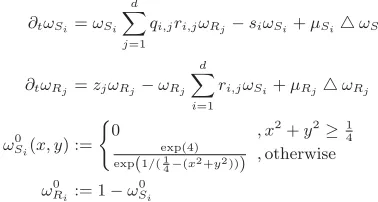
diffu-sion coefficients by settingμSi=μRi=μ∈ {0.10,0.15}for all 1≤i≤dto show the impact of mobility on the model’s dynamics. For each parameterisation of the model, we con-sidered spatial transformations withK = 4,8,16, and 20, corresponding to increasingly finer discrete meshes with 92, 172, 332, and 412 regions, respectively. Thus each spatial transformation had migration rates equal toμK2. In this way, all ODE systems with different values ofK(and other-wise same parameters) have the same PDE approximation.
The corresponding PDE system is, for all 1≤i, j≤d:
∂tωSi=ωSi
d
j=1
qi,jri,jωRj−siωSi+μSiωSi
∂tωRj =zjωRj−ωRj
d
i=1
ri,jωSi+μRjωRj
ωS0i(x, y) :=
0 , x2+y2≥14 exp(4)
exp(1/(1
4−(x2+y2))) ,
otherwise
ωR0i:= 1−ω0Si
The initial conditions,ωS0iandω0Ri(bells centered at (0,0) with peak 1.0), are consistent with the NBCs.
As a measure of the accuracy, we considered solutions for speciesS1 at timet= 0.20. These were chosen arbitrarily, the latter ensuring that the solution was sufficiently away from the initial condition. For each K, the error is de-fined as the maximum absolute difference across the whole spatial domain between the ODE solution at each point in the discrete mesh and the corresponding PDE solution
(us-ing linear interpolation to sample at the same coordinate). Matlab R2013b was used for the numerical solutions. The ODEs were solved using the built-inode15sfunction, while the PDEs were solved using the functionparabolic in the Partial Differential Equation Toolbox. All parameters were set as the default ones. Runtimes were taken on a machine with 16 GB RAM.
Table 1 presents the results, showing high quality of the approximation in general. Figure 1, instead, visualises the numerical solutions ofS1. The range of values attained by the ODE/PDE solutions were within [0.00; 0.40], thus the absolute differences correspond to at most around 20% (for K= 4) relative to the peak values. The table shows higher accuracy with increasingKacross all tests (cf. Figure 1 for a visual appreciation). However, PDEs are cheaper to solve than ODEs for fine meshes. In fact, the ODEs could not be solved for significantly larger values ofKdue to out-of-memory errors.
5. CONCLUSION
In this paper we considered a spatial extension of stochas-tic process algebra with ODE semanstochas-tics. Under the assump-tion of processes evolving over a two-dimensional regular lat-tice with an unbiased random walk, we have provided an ap-proximating reaction-diffusion PDE system. In our numer-ical tests, the quality of this approximation has been found to be highly accurate in the case of fine-grained lattices, at a much smaller computational cost. Pragmatically, tool im-plementation is ongoing. Theoretically, although here we focussed on ODE semantics only, future work will aim at in-vestigating convergence of the stochastic process underlying the process algebra to a PDE limit.
Acknowledgement.
This work was supported by the EU project QUANTICOL, 600708.6. REFERENCES
[1] Bittig, A., Uhrmacher, A.: Spatial modeling in cell biology at multiple levels. In: Winter Simulation Conference. pp. 608–619 (2010)
[2] Buchholz, P.: Markovian Process Algebra: Composition and Equivalence. In: Proc. 2nd Workshop on Process Algebra and Performance Modelling. Erlangen, Germany (1994)
[3] Bugliesi, M., Gallina, L., Hamadou, S., Marin, A., Rossi, S.: Behavioural equivalences and interference metrics for mobile ad-hoc networks. Perform. Eval. 73, 41–72 (2014)
[4] Cardelli, L.: On process rate semantics. Theor. Comput. Sci. 391, 190–215 (2008)
[5] Cerotti, D., Gribaudo, M., Bobbio, A.: Presenting Dynamic Markovian Agents with a road tunnel application. In: MASCOTS. pp. 1–4 (2009)
[6] Cerotti, D., Gribaudo, M., Bobbio, A., Calafate, C.T., Manzoni, P.: A Markovian Agent Model for fire propagation in outdoor environments. In: EPEW, LNCS, vol. 6342, pp. 131–146. Springer (2010) [7] Ciocchetta, F., Hillston, J.: Bio-PEPA: A framework
for the modelling and analysis of biological systems. Theor. Comput. Sci. 410(33–34), 3065–3084 (2009) [8] De Nicola, R., Ferrari, G., Pugliese, R.: KLAIM: a kernel language for agents interaction and mobility. IEEE Trans. Software Eng. 24(5), 315–330 (1998) [9] Feng, C., Hillston, J.: PALOMA: A Process Algebra
for Located Markovian Agents. In: QEST (2014), to appear
[10] Gilbert, D., Heiner, M., Liu, F., Saunders, N.: Colouring Space — A Coloured Framework for Spatial Modelling in Systems Biology. In: Petri Nets, LNCS, vol. 7927, pp. 230–249. Springer (2013)
[11] Guenther, M.C., Bradley, J.T.: Higher moment analysis of a spatial stochastic process algebra. In: EPEW, LNCS, vol. 6977, pp. 87–101. Springer (2011) [12] Hermanns, H., Rettelbach, M.: Syntax, semantics,
equivalences, and axioms for MTIPP. In: Proceedings of Process Algebra and Probabilistic Methods. pp. 71–87. Erlangen (1994)
[13] Hillston, J.: A compositional approach to performance modelling. Cambridge University Press, New York, NY, USA (1996)
[14] Kwiatkowski, M., Stark, I.: The continuous pi-calculus: A process algebra for biochemical modelling. In: CMSB. pp. 103–122. No. 5307 in LNCS (2008)
[15] Murray, J.D.: Mathematical Biology I: An Introduction. Springer, 3rd edn. (2002)
[16] Okubo, A., Levin, S.A.: Diffusion and Ecological Problems : Modern Perspectives. Interdisciplinary Applied Mathematics, Springer (2001)
[17] Philippou, A., Toro, M., Antonaki, M.: Simulation and verification in a process calculus for
spatially-explicit ecological models. Scientific Annals of Computer Science 23(1), 119–167 (2013)
[18] Thomas, J.W.: Numerical Partial Differential Equations: Finite Difference Methods. Springer-Verlag (1995)
[19] Tschaikowski, M., Tribastone, M.: Exact fluid lumpability for Markovian process algebra. In: CONCUR. LNCS, vol. 7545, pp. 380–394 (2012) [20] Tschaikowski, M., Tribastone, M.: Extended extended
differential aggregations in process algebra for performance and biology. In: QAPL (2014), to appear. [21] Watson, R.K.: On an epidemic in a stratified
population. Journal of Applied Probability 9(3), pp. 659–666 (1972)
APPENDIX
A. PROOFS
A.1 Proof of Proposition 1
Although the the continuous-time random walk is well studied, we could not find a reference that shows Proposition 1.
Proposition 1. We give a proof which relies on the uniformi-sation method for CTMCs with countable state spaces2. Let (WK(n))n≥0 denote the unbiased random walk in discrete
time onK1Z×K1ZwithWK(0) = (0,0) and let (N(t))t≥0be the homogenous Poisson process with intensityrK. Further, letP denote the transition matrix of (WK(n))n≥0. Then it holds thatWK(t) =WK(N(t)) and
E(d2K(t)) = (x,y)∈Z2
PWK(t) =
x
K, y K
x
K
2 +
y
K
2
=
(x,y)∈Z2
∞
n=0 e(T0
K,K0)P
n(rKt)n
n! e
−rKt
e(x K,Ky)
x2+y2 K2
=e−rKt
∞
n=0 (rKt)n
n!
(x,y)∈Z2
e(T0
K,K0)P
n
e(x K,Ky)
x2+y2 K2
= 1 K2e
−rKt
∞
n=0 (rKt)n
n! E
WK(n)2
= 1 K2e−rKt
∞
n=0 (rKt)n
n! n
= 1 K2e
−rKt
rKt
∞
n=1
(rKt)n−1
(n−1)!
=
r
K
K2
t
A.2 Proof of Theorem 1
Lemma 1. Let us fix a FEPA modelM. Then it holds that
rαl(SK(M), v) =rα(M, v|l)
Rαl(SK(M), v, Pl) =Rα(M, v|l, P)
for allP ∈ B(M), α∈ A,l∈ RK and concentration func-tionsv ofSK(M).
Proof. We prove this by induction onM.
• M=P0: The claim follows with
rαl
SK(P0), v
=
Pi∈B(P0)
rα(Pi)vPil=rα(P0, v|l),
Rαl
SK(P0), v, Pl
=rα(P)vPl =Rα(P0, v|l, P).
• M=M0LM1: We assume without loss of generality
thatP ∈ B(M0), which yields alsoPl ∈ B(S K(M0)).
Let us first consider the caseα ∈L. Then, together withαl∈ S
K(L), we infer
rαl(SK(M0LM1), v) =rαl(SK(M0), v)·rαl(SK(M1), v)
I.H.=
rα(M0, v|l)·rα(M1, v|l)
=rα(M0LM1, v|l)
2See Section 2.1 of Chapter 8 in Br´emaud, P.: Markov chains, Gibbs fields, Monte Carlo simulation, and queues. Springer-Verlag (1999)
and
Rαl
SK(M0LM1), v, Pl
=Rαl
SK(M0), v, Pl
rαl(SK(M0), v) rα
lSK(M0LM1), v
I.H.= Rα(M0, v|l, P)
rα(M0, v|l) r
α(M0LM1, v|l)
=Rα(M0LM1, v|l, P).
Ifα /∈L, it holds thatαl∈ S/
K(L), yielding
rαl(SK(M0LM1), v)
=rαl(SK(M0), v) +rαl(SK(M1), v)
I.H.=
rα(M0, v|l) +rα(M1, v|l)
=rα(M0LM1, v|l)
and
Rαl
SK(M0LM1), v, Pl
=RαlSK(M0), v, Pl
I.H.= R
α(M0, v|l, P)
=Rα(M0LM1, v|l, P)
Theorem 1. Let us fix the unique √P ∈ G(M) such that P ∈ B(√P). The claim follows then
F(SK(M), v)Pl =
=
α∈A+
P∈B(SK(M))
pα(P, Pl)Rα(SK(M), v, P)
− Rα(SK(M), v, Pl)
=
α∈A P˜∈B(√P)
pαl( ˜Pl, Pl)Rαl(SK(M), v,P˜l)
− Rαl(SK(M), v, Pl)
− Rδ(SK(M), v, Pl)
+
l∈N(l) pδ(P
l
, Pl)Rδ(SK(M), v, Pl)
L1=
α∈A P˜∈B(√P)
pα( ˜P , P)Rα(M, v|l,P˜)− Rα(M, v|l, P)
+
l∈N(l)
μl,lP(K)vPl−μ l,l P(K)vPl
=F(M, v|l)P+
l∈N(l)
μl,lP(K)vPl−μ l,l P(K)vPl
.