Virtual Small Cell Selection Schemes Based on Sum Rate
Analysis in Ultra-Dense Network
Qi Zhang1, Jie Zeng2,*, Xin Su2, Liping Rong2 and Xibin Xu2
1Chongqing University of Posts and Telecommunications, [email protected] 2Tsinghua University,[email protected],
2Tsinghua University, [email protected], 2Tsinghua University, [email protected], 2Tsinghua University, [email protected].
Abstract
Ultra-Dense Network (UDN) is regarded as a major development trend in the evolution of future networks, due to its ability to provide larger sum rate to the whole system and meet higher users' Quality of Service (QoS). Different from the existing heterogeneous network, UDN has a smaller cell radius and a new network structure. The core concept of UDN is to deploy the low power Base Stations (BSs), i.e. Virtual Small Cells (VSCs). First, we derive an ergodic sum rate expression. To acquire the maximum ergodic sum rate of all the users, then we adopt the selection mode based on minimum distance. Due to the consideration of the computation complexity of the above VSC selection scheme, we finally propose a novel VSC selection scheme based on pattern search. The simulation results demonstrate the correctness of the ergodic sum rate expression and show the lower computation complexity of the proposed VSC selection scheme comparing with the above reference scheme.
Keywords: Ultra-dense network, virtual small cell, sum rate, pattern search.
Received on 17 November 2017, accepted on 16 December 2017,published on 21 December 2017
Copyright © 2017 Qi Zhanget al., licensed to EAI. This is an open access article distributed under the terms of the Creative
Commons Attribution licence (http://creativecommons.org/licenses/by/3.0/), which permits unlimited use, distribution and
reproduction in any medium so long as the original work is properly cited.
doi: 10.4108/_______________
*Corresponding author. Email:[email protected],
1. Introduction
Current heterogeneous network is consisted of macro-cells and small cells. This network structure could not be able to meet the traffic demand which is increasing rapidly in the future 5th Generation (5G). In [1], it is predicted that the traffic demand would increase at least a 1000x network capacity in 2020. To meet the more traffic demand, enhanced technologies are essential. So far, there are some potential candidates in [2], such as UDN, massive Multiple-Input Multiple-Output (MIMO), and Non-Orthogonal Multiple Access (NOMA). This paper focuses on UDN which is seen as a major development trend in the evolution of future networks, due to its ability to provide larger sum rate to the whole system and meet higher users' QoS. In recent years, UDN attracts many researchers in colleges and
workers in industries. Both the industry and academia are working together, e.g.Mobile and wireless communications Enablers for the 2020 Information Society (METIS) and 5th Generation Non-Orthogonal Waveforms (5GNOW), to meet the capacity demand of the 5G mobile communication systems [3], [4].
Different from the existing heterogeneous network, UDN has a smaller cell radius and a new network structure. In urban areas, there exist many potential hot spots, such as conference halls, hospitals, and schools. In these areas, users are more easily to aggregate in a small place. At the same time, many users require high data transmission rate to support kinds of multimedia business. To meet the demand, VSC is presented in [5]. The core concept of UDN is to deploy the low power Base Stations (BSs) in the network, and the number of BSs is even larger than the number of Mobile Stations (MSs) [6]. We regard each low-power BS as a VSC.
EAI Endorsed Transactions on
Recently, [7] analyzes radius of VSC based large-scale distributed antenna system, and proves that the number of BSs and MSs has an impact on the downlink rate. [8] proposes a novel Resource Allocation (RA) scheme which is based on the sectoring of VSC. Its main idea is to reuse the Physical Resource Blocks (PRBs) of sectoring and improve the system capacity. [9] draws attention to the sum-rate maximization, and they develop a new formulation of the beamforming problem for sum-rate maximization in VSC and analyze the structure of its optimal solutions. Different from the existing single cell serving mode, [10] and [11] present the concept of VSC clustering in UDN. [10] utilizes VSC clustering technique to maximize energy saving gain. [11] studies orthogonal training resource allocation problem for VSC cooperative network through a graph-theoretic approach aiming at minimizing the overall training overhead and then demonstrates that the proposed low complexity algorithm performs closely to the optimal solution.
This paper aims to maximize ergodic sum rate of all the users in UDN with low computation complexity. In this paper, the following tasks are completed: we first derive an ergodic sum rate expression. Second, due to the consideration of the computation complexity of the VSC selection scheme based on minimum distance, we propose a novel VSC selection scheme based on pattern search. Also, the two schemes can acquire almost the same maximum ergodic sum rate of all the users. The simulation results demonstrate the correctness of the ergodic sum rate expression and show the lower computation complexity of the proposed VSC selection scheme comparing with the reference scheme.
The remainder of this paper is organized as follows: In section 2, we present the system model of VSC with multi-user environment. Section 3 derives an ergodic sum rate expression. In section 4, we propose VSCs selection schemes based on maximum sum rate analysis. We provide simulation results in section 5. Finally, conclusions are provided in section 6.
2. System Model
We consider the downlink transmission in UDN with K
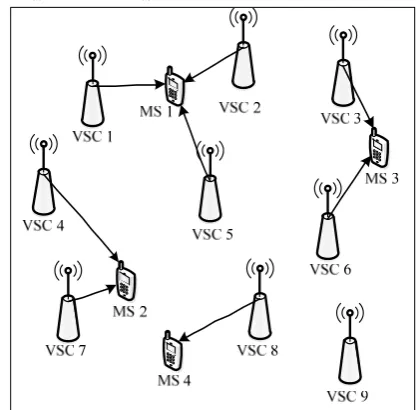
MSs and NVSCs. Both of them are equipped with a single antenna. As shown in Fig. 1, nine VSCs and four MSs uniformly and randomly are distributed in the area, and the number of VSCs is larger than the number of MSs
KN
. In our analysis, the total available power of VSCs is P. We assume each VSC has the same power constraint, i.e. the jthVSCtransmitted power isPj P N/ ,(j1, 2,3... )N . The transmitted signal to noise power ratio for all VSCs is
0 2
n
P N
. If the jth VSC is turned off, Pj 0. A principal
goal of this paper is to determine the pairings of NVSCs and their supporting MSs which maximize the ergodic sum rate. Let us denote the transmission mode
as the MS index of N VSCs where un{0,1,..., }K , (n1, 2,... )N represents the MS index supported by the nth
VSC. If nthVSC turns off, we defineun 0. From (1), let us
define Gi S, ( ) { |x n un i n, {1, 2,..., }}N as the set of VSC
indices supporting the ith MS, and
, ( ) { | , 0, {1, 2,..., }}
i I n n
G x n u i u n N as the set of VSC indices supporting other MSs except ith MS. For MS i, the
signal from VSCs in Gi S, is regarded as the useful signal, while the signal transmitted from VSCs in Gi I, is treated as interference. In Fig. 1, the transmission mode
[1,1,3, 2,1,3, 2, 4, 0]
X . For 1th MS, the useful signal is fromG1,S , i.e. 1th VSC, 2th VSC and 5th VSC, and the
interference information is from 3th VSC, 4th VSC, 6th
VSC, 7th VSC and 8th VSC.
Figure. 1. Structure of UDN with four MSs and nine VSCs
K4, 9N
.The received signal of ithMS is
, 1
,( 1, 2,..., )
N
i j i j j i
j
y P g x n i K
(2)where (x jj 1, 2,..., )N is the transmitted symbol from the VSC j with the average power E[| | ] 12
j
x , Pj is the
power allocated to VSC j, gi j, denotes the channel gain from ith MS to jth VSC, and ni represents the additive whiteGaussiannoise with variance 2
n
for the ith MS. The channel gain isgi j, Cd s hi j, i j i j, , , where Cis a constant,
,
i j
d is the distance from ithMS to jth VSC, is the path
EAI Endorsed Transactions on
loss factor, si j, denotes shadow fading, and hi j, is the independent and identically distributed complex Gaussian random variable. Let 10lgsi j, represent zero mean Gaussian random variable, and its standard deviation equals 1. Also the mean value of hi j, is 0, and standard deviation of hi j, is 1.
3.Ergodic Sum Rate Analysis
In this paper, inter-MS interference is regarded as the Gaussian noise since it can be interpreted as the worst effect that the measurement noise can have [12]. We use i j, to represent Cd si j, i j, , i.e.
, , ,
i j Cd si j i j
. Then we can do the following theoretical derivations. And the Signal to Interference plus Noise power Ratio (SINR) of the ith MS is
generally represented as
, , , , , , 2 , , 2 2 , , 2 , , , 2 ,
, , 2
, , , , ( ) ( ) ( ) ( ) /
i S i I i S i I i S i Ii l i l
l G i
i k i k n
k G
i l
i l i l
l G
i k
i k i k
k G n
i l
l G i S
i k i I
k G P h N P h N d s h R
d s h NR
R CP
(3)
where , 2
, ( ) , ,
i l
i l i l i l
d
s h R
is the logarithmic normal
distributed random variable, represents 2 / n NR CP
, and R
is the normalized distance.
In the following, we consider the Probability Density Function (PDF) of i to derive a closed form of the ergodic sum rate. The corresponding PDF of i can be expressed as
[13] , 2 , 2 0 , , ( ) (10lg ) 1
exp( ) exp[ ]
2 2
i l i l i l i l f x x d (4)where i l, 10 lg[(di l, / ) ]R ,
,
i l
is the standard deviation of 10 lgsi l, , and 10 / ln10 is a constant. The moment-generating function of i l, can be expressed as follows [13]
. . ,
0.1( 2 ) 1
1
1
( ) [1 10 i l p i l ]
i l
M
Z p
p
s W s
(5)where Zp and Wp are the pth root of M order Hermite
polynomial and the corresponding integral weighted coefficient respectively.
Let us regard i S,
i l, as the sum of several independent random variable. Its moment-generating function is, ,
,
( ) ( ).
i S i l
i S
l G
s s
(6),
i S
can approximatively be expressed by a logarithmic normal distributed random variable, so the PDF of i S, is denoted as [14]
, 2 , 2 , ,
(10 lg )
( ) exp[ ]( 0).
2 2 i S i S i s i S x
f x x
x
(7)
The corresponding moment-generating function of i S, is [13]
, , ,
0.1( 2 )
1
1
( ) exp[10 i S p i S ].
i S
M
Z p
p
s W s
(8)Here, the equation (6) is equal to the equation (8), i.e.
, , ,
,
0.1( 2 )
1 1
( ) exp[10 i S p i S ]. i l i S M Z p p l G
s W s
(9)When there are two different values for variables, we can get binary equation groups of i S, andi S, . The equation groups can be solved by numerical method. So i S, can be approximatively expressed as a logarithmic normal distributed random variable through the parameter
, , ( i S, i S).
In the same way, i I, can be approximatively expressed as a logarithmic normal distributed random variable, and its PDF is
, , 2 , 2 , ( )
2 ( )
(10 lg( ) )
exp[ ] 2 ( ). i I i I i I i I f y y y y (10)
EAI Endorsed Transactions on
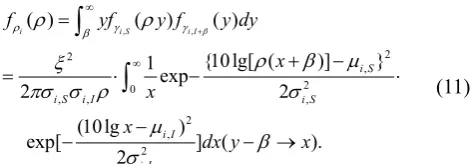
andi I, , so the PDF of i is denoted as , , 2 2 , 2 0 , , , 2 , 2 , ( ) ( ) ( )
{10 lg[ ( )] }
1exp
2 2
(10lg )
exp[ ] ( ).
2
i i S i I
i S
i S i I i S
i I
i I
f yf y f y dy
x x
x
dx y x
(11)
From the above, we can denote ergodic rate of ith MS as
2 0 2 2 , 2 0 , , , 2 , 2 2 0 , E[ ] log (1 ) ( )
(10lg )
1exp( )
2 2
{10lg[ ( )] }
log (1 )
exp( ) .
2
i i i Ii S i I i I
i S
i S
R f d
x x
x
d dx
(12)
We can get the following equation through the Gauss-Hermite integration
, ,
, , 0.1( 2 )
2 0.1( 2 )
1 1
1 10
E[ ] [ log (1 )]
10
i S p i S
i I p i I
Z
M M
i q p Z
q p
R W W
(13)whereZp and Wp are the pth root of M order Hermite
polynomial and the corresponding integral weighted coefficient respectively.So the ergodic sum rate of K MSs is 1 E[ ]. K sum i i R R
(14)4. Analysis on VSC Selection Schemes
In this section, we study the VSC selection scheme based on minimum distance and propose a novel VSC selection scheme for the ergodic sum rate maximization using the derived expression in the previous section.
4.1. VSC Selection Scheme based on
Minimum Distance
We introduce a VSC selection scheme based on the minimum distance where the number of mode candidates increases dramatically for largeN. For N VSCs and K MSs, we can define all mode candidates as. The size of the set of mode candidates is given as 2NN [15].
mode where each VSC serves its nearest MS with turning on all the VSCs. Then, we turn off VSCs in this transmission mode one by one with 2N 1 distinct combinations, and generate a mode candidate by replacing the corresponding user indices to 0. Then, all these 2N1 candidates are added to the mode candidate set. Finally, after evaluating the ergodic sum rate for each candidate mode in using the expressions derived in Section 3, we select the best mode which exhibits the maximum rate.
4.2. VSC Selection Scheme based on Pattern
Search
In this subsection, we propose a novel transmission mode selection scheme which reduces the computation complexity comparing with VSC selection scheme based on minimum distance. This scheme is based on pattern search. The objective function is
(X) .
obj sum
f R (15)
Our objection is searching the opt arg max sum
X X R . The
mode selection procedure is described in Table 1, where
( ,*)
N
I i means the i row of the N order identity matrix.
Table 1. VSC selection scheme based on pattern search.
Step 1. Initialization
SetX0 [ , ,...,u u1 2 uN]as the mode where each VSC serves its
nearest MS
initial step size T1
( ,*),1
( ,*), 1 2
N i
N
I i i N
X
I i N N i N
Step 2. While T 0.5
i opt i
X X T X for i1, 2,..., 2N
if max fobj(Xi) fobj(Xopt)
{ arg max ( ), 2 }
i
opt X obj i
X f X T T
else T0.5T
end If
end while
Step 3. For i1:K
[ , ,..., ]
i
X i i i
if max fobj(Xi) fobj(Xopt)
{ arg max ( )}
i
opt X obj i
X f X
end if end for
EAI Endorsed Transactions on
5. Simulation Results and Analysis
In this section, we demonstrate the correctness of the ergodic sum rate expression. And we also evaluate computation complexity of the proposed VSC selection scheme comparing with the selection mode based on minimum distance by a system level simulator. The results of simulation with the method of Monte Carlo are given. In this simulation, we use wrap-around to have reliable interference calculation. The numberof generated channel realizations is equivalent to 5000. More specific parameter is shown in Table 2 in detail.
Table 2. Basic parameters of simulation scenario.
Parameter Value
Carrier frequency 2GHz
(Inter Site Distance) ISD 35m
,
i j
6dB
4
The order of Hermite polynomial
M
20
In Fig. 2, each VSC chooses the nearest MS to serve with all VSCs turned on, and the two pairing lines are almost overlap with different K .So it can demonstrate the correctness of the ergodic sum rate expression. With the increasing of K or the transmitted signal to noise power ratio0, the ergodic sum rate is increasing.
Figure 2.Ergodic sum rate with different K.
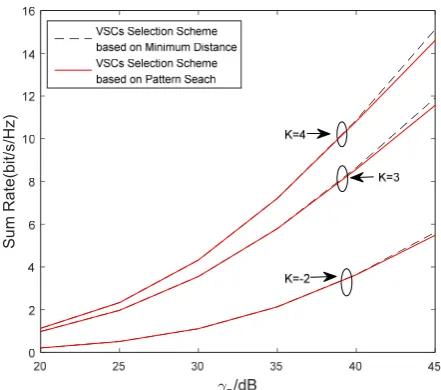
In Fig. 3, the ergodic sum rate by VSC selection scheme based on pattern search is similar to the result of VSC selection scheme based on minimum distance. However, the proposed scheme has lower computation complexity than VSC selection scheme based on minimum distance. From Fig. 4, the computation complexity of VSC selection
scheme based on minimum distance is a constant value with different number of MSs K . Because the computation complexity of VSC selection scheme based on minimum distance is only related to the number of VSCsN. However, the computation complexity of VSC selection scheme based on pattern search is much lower than the computation complexity of VSC selection scheme based on minimum distance with differentK (KN). When N is given, the computation complexity of VSC selection scheme based on pattern search increases withKand then start to change little. This is because whenKis closed toN, there are almost the same number of times the objective function is called.
Figure 3.The ergodic sum rate comparison between VSC
selection scheme based on minimum distance and VSC selection scheme based on pattern search.
Figure 4.The comparison of compute times about two VSC
selection scheme with different K (KN N, 9).
Sum Rate(bit/s/Hz)
3 4 5 6 7 8
Number of MSs (K)
0 100 200 300 400 500 600 700 800
C
om
put
e ti
m
es
VSCs Selection Scheme based on Pattern Search VSCs Selection Scheme based on Minimum Distance
EAI Endorsed Transactions on
6. Conclusions
In this paper, we have studied the multi-MSs downlink VSC and have derived an ergodic sum rate expression using the PDF of MSs' SINR. The simulation result demonstrates the correctness of the ergodic sum rate expression. Through the derived expressions, we have proposed the VSC selection scheme based on pattern search to maximize the ergodic sum rate of whole MSs. In the proposed scheme, the ergodic sum rate is similar to the result of VSC selection scheme based on minimum distance. However, simulation results show that the VSC selection scheme based on pattern search has lower computation complexity than VSC selection scheme based onminimum distance. So the proposed scheme can get desired ergodic sum rate with lower computation complexity.
Acknowledgements.
This work was supported by the China's 863 Project (No. 2014AA01A706), the National S&T Major Project (No.2014ZX03004003), Science and Technology Program of Beijing (No.D161100001016002), and by State Key Laboratory of Wireless Mobile Communications, China Academy of Telecommunications Technology (CATT).
Reference
[1] Lopez-Perez, D., Ding, M., Claussen, H., Jafari, A.H. (2015)
Towards 1 Gbps/UE in Cellular Systems: Understanding
Ultra-Dense Small Cell Deployments. IEEE Commun. Surv.
Tutor, vol. 17, pp. 2078–2101.
[2] Boccardi,F., Heath, R. W., Lozano,A., Marzetta, T. L.,
Popovski,P. (2014) Five disruptive technology directions for 5G. IEEE Communications Magazine, vol. 52, no. 2, pp. 74-80.
[3] A`spar, S., Wunder, G.: 5G Cellular communications
scenarios and system requirements, https://www.5gnow.eu
[4] Popov ski,P., Braun,Y.,Mayer,H.-P'., Fertl, P. (2014)
Requirements and KPIs for 5G mobile and wireless system, Tech. Rep. https://www.metis2020.com
[5] Ana, G., Sofia, M. L., Alberto, D. R., Azeddine, G. (2015)
Virtual Small Cells Using Large Antenna Arrays as an
Alternative to Classical HetNets. 2015 IEEE 81st Vehicular
Technology Conference (VTC Spring), pp. 1-6
[6] Gelabert, X., Legg, P., Qvarfordt. (2013) Small Cell
densification requirements in high capacity future cellular
networks. IEEE International Conference on
Communications Workshops, pp.1112-1116
[7] WANG, J. and Dai, L. (2016) Downlink Rate Analysis for
Virtual-Cell based Large-Scale Distributed Antenna Systems.
J. IEEE Trans. Wireless Commun., pp. 1998-2011
[8] Sattiraju R., Klein A., Ji L. (2015) Virtual Cell Sectoring for
Enhancing Resource Allocation and Reuse in Network
Controlled D2D Communication. 81st IEEE Vehicular
Technology Conference (VTC Spring), Glasgow, pp. 1-6.
[9] Kim J, Lee H.W, Song C. (2014) Virtual Cell Beamforming
in Cooperative Networks. IEEE Journal on Selected Areas in
Communications, pp. 1126-1138
[10] Feng C, XiaoQ. (2012) Cooperative Virtual Cell Clustering
for Green Cellular Networks. IEEE 75th Vehicular
Technology Conference (VTC Spring), pp. 1-5
Allocation for User-centric Base-station Cooperation
Networks. J. IEEE Transactions on Vehicular Technology .
[12] Thomas M. Cover, Joy A. Thomas. (2006) Elements of
Information Theory.
[13] Simon, M.K, Alouini, M.S. (2005) Digital communication
over fading channels. M. 2nd edition, pp. 32-34.
[14] Metha, N.B., Wu Jingxian, Molisch, A.F. (2007)
Approximating a sum of random variables with a lognormal.
J.IEEE Trans. Wireless Commun, pp. 2690-2699.
[15] Kim, H., Lee, S.R., Lee, K.J. (2012) Transmission Schemes
Based on Sum Rate Analysis in Distributed Antenna Systems.
J. IEEE Trans. Wireless Commun, pp. 1201 – 1209.
EAI Endorsed Transactions on