2
Original
The long-wavelength-limit of structure factor and chemical
ordering in binary Ag-In melts
Raghvendu Pathak
Department of Chemistry, Pachhunga University College, Aizawl 796001, India
Received 7 September 2014 | Revised 25 January 2015 | Accepted 29 January 2015
A
BSTRACTThe long-wavelength-limit partial structure factors, Sxy(0), have been determined for liquid silver-indium (Ag-In) alloys using square well potential as perturbation over Percus-Yevick (PY) hard sphere reference system. Obtained Sxy(0) at various compositions of In have been employed to calculate isothermal compressibility and chemical ordering in the alloys. Further, homo-coordination and hetero-homo-coordination in Ag-In alloys have been studied at microscopic level in terms of mutual and intrinsic diffusion coefficients
Key words: Liquid alloys; structure factor; square well potential; diffusion coefficient.
Corresponding author: Pathak Phone: +91-9436370190 E-mail: [email protected]
I
NTRODUCTIONThe microscopic structural, thermodynamic and dynamic properties of binary liquid alloys have been studied and of longstanding interest. These studies are also important from metallur-gical point of view.1 In recent years, many
inves-tigations regarding compound forming behavior and various thermodynamic properties as a func-tion of concentrafunc-tion in binary liquid alloys from their long-wavelength-limit of structure factors have been reported, which are of importance from scientific and technological points of view.2 -10
A good number of experimental, theoretical and simulation results on structure, dynamic and thermodynamic properties of Ag-In melts 11-15 are available in literature but knowledge about
the chemical ordering in this alloy is desired. The complete structural characteristics in binary melts in momentum space can be described by three partial pair correlation functions (partial structure factors, PSFs) namely Sx-x(k), Sy-y(k)
and Sx-y(k). From these PSFs partial gxy(r) and
total g(r) radial distribution functions can be ob-tained. Partial Yxy and total Y coordination
number can by integrating gxy(r) and g(r)
func-tions in between first two minimum values of these functions.16
In present paper, the direct correlation func-tions (DCFs) of liquid Ag-In alloys were deter-mined using Lebowitz solution17 of
Percus-Science Vision 15(1), 2-7
2015 January-March ISSN (print) 0975-6175 ISSN (online) 2229-6026
Research
3
Yevick (PY) equation for hard sphere model with square well attractive tail in limit of zero wave vector. From the DCFs long-wavelength- limit of PSFs SAg-Ag(0), SIn-In(0) and SAg-In(0) are
evaluated. The total structure factor in long-wavelength limit S(0), isothermal compressibil-ity KT, Bhatia-Thornton (BT) concentration –
concentration correlation function, in long-wavelength-limit SCC(0) were compute from long
- wavelength-limit of PSFs. The ratio of mutual diffusion coefficients (DM) and inter-diffusion
coefficients (Did) of components and chemical
short range order parameter (CSRO), α are also presented in the later part of this paper.
T
HEORETICAL FORMALISMWithin the mean spherical model approximation (MSMA) the direct correlation functions (DCFs) in repulsive and attractive region of potential function can be given as 16
Cxy r = Cxy0 (r) − εxy
KBT (1)
where 𝐶𝑥𝑦0 (𝑟) is the DCF in the hard sphere region,
0
r
σ
xy, obtained by Lebowitz 17 for Percus-Yevick equation, −𝐾𝜀𝑥𝑦𝐵𝑇 is the direct correlation function (DCF) in the square well attractive region,
σ
xy
r
λ
xyσ
xy. The DCF beyond square well region is considered as 0 it means that there is no correlation between liquid atoms in the regionr
λ
xyσ
xy.Further r is the separation between pair of atoms whereas xx, xx, and xx (xx-1) are the
diameter, the potential energy depth and breadth respectively of the square well potential of the xth species. The mixed parameters are
determined through the use of Lorentz Berthelot rules 16. Thus, the mixed parameters are given
by
12 2 22 1 11 12 1/2 22 11 12 2 1 12σ
2
σ
λ
σ
λ
λ
)
ε
(ε
ε
2
/
)
σ
(σ
σ
(2)The Fourier transform of direct correlation functions (DCFs) have been well explained already 16 and will not be repeated here.
However, in thermodynamic limit when k 0, DCFs can be given as
3
1 1 1 1
1 11 1
3 1 11 11
B
a
b σ
dσ
ρ C (0) 24 η
3
4
6
8 η ε (λ - 1)
k T
(3) 32 2 2 2
2 22 2
3 2 22 22
B
a
b σ
dσ
ρ C (0)
24 η
3
4
6
8 η ε (λ - 1)
k T
(4) 3 312 12 12 12
B 3 1 12
3 1 2
1
1 1 2
4π ε σ (λ - 1)
C (0)
3 k T
4 π a σ
-
3
b (σ
2 σ )
4π σ {
12
λ d σ (3σ 5 σ )
+
10
21 1 2
d σ (2σ
3 σ )
+
}
30
(5) Here 1 stands for Ag (silver) and 2 for In (indium), rest of the symbols used in equations 3 to 5 have been already explained elsewhere 19.
Kirkwood and Buff 19 related the isothermal
compressibility, KT of the mixture to x Cxx(0)
and 12 C12(0) as follows
B T 1 1 11 2 2 22
1 2 12 12
ρ k T χ
[1 - c ρ C (0) - c ρ C (0)
- 2 c c ρ C (0)]
(6)
Here ρx is the number density of pure component and 12 = (12)1/2.
Three partial structure factors (PSFs) in the long-wavelength-limits can be written in terms of direct correlation functions C11(0), C22(0) and
C12(0)
Ag-Ag Ag Ag-Ag
2
Ag In Ag-In 1
S
(0)
[ 1
ρ C
(0)
ρ ρ C
(0)
]
4
R
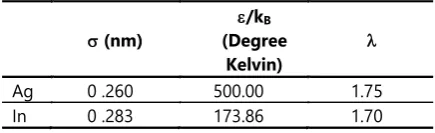
ESULTSThe square well potential parameters of the pure components are used for the study of Ag-In melts at different compositions. The parameters taken from literature 16 and are given in Table 1.
A necessary condition in the application of Le-bowitz equations is s22>s11. Here s11 corresponds
to the diameter of Ag and s22 refers to the
diame-ter of In. The PSFs in long-wavelength-limit are obtained through eqns. (7) to (9) and are pre-Three partial structure factors (PSFs) in the
long-wavelength-limits can be written in terms of direct correlation functions C11(0), C22(0) and
C12(0)
Ag-Ag Ag Ag-Ag
2
Ag In Ag-In 1
In In-In
S
(0)
[ 1
ρ C
(0)
ρ ρ C
(0)
]
1
ρ C
(0)
(7)(0)
C
ρ
1
(0)
S
(0))]
C
ρ
[1
(0)
S
In -In In Ag -Ag Ag -Ag 1 In -In
(8)(0)
C
ρ
1
(0)
S
(0)
C
)
ρ
ρ
(
(0)
S
In -In In Ag -Ag In -Ag 2 1 In Ag In-Ag
(9) Thus for the binary alloy the total structure
factor can be written as
2 1 / 2
Ag Ag Ag-Ag Ag In 2 Ag In Ag-In In In In-In
2 2 1
Ag Ag In In
S(0)
[c f S
(0)
2 (c c )
f f S
(0) c f S
(0)]
X [c f
c f ]
(10) Here fAg and fIn are atomic scattering factors
and cAg and cIn are the atomic fractions of Ag
and In respectively.
Important relations also exist between Bhatia-Thornton (BT) correlation functions in the long wave length limit and Sxy(0) and also be 19
CC Ag In In Ag-Ag
Ag In-In 1 2 Ag In Ag-In
S (0)
c c [c S
(0)
c S
(0)
2 (c c ) S
(0)]
(11)
The CSRO can be obtained from SCC(0) as 8
CC CC
CC 1
1
CC 1
S (0)
S (0),id
α
S (0)
S
S
S (0)
S
(12) Here 2 1 CC(0),
id
c
c
S
(13)and S1 is the deviation of the concentration –
concentration correlation function in the long wavelength limit from its ideal value,
is the coordination number can be computed from the total radial distribution function obtained from the Fourier transformation of the total structure factor S(k)
min 0 2dr
r
g(r)
ρ
π
4
r (14)
Further, DM and Did can be given by Darken
thermodynamic relation as 10
(0)
S
C
C
D
D
CC 2 1 idM
(15)with 1 1 M 1 id
C
a
1
D
a
D
(16)DM = C2D1 + C1D2 (17)
where D1 and D2 are the self-diffusion
coefficients of pure components and a1 is the
activity of first component, Ag in binary melts.
(nm)
/kB
(Degree Kelvin)
Ag 0 .260 500.00 1.75
In 0 .283 173.86 1.70
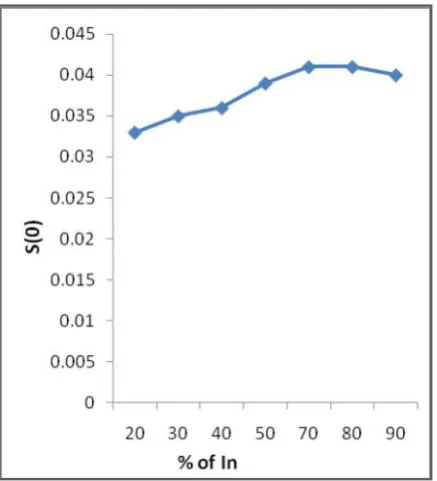
sented in Table 2. The total structure factor in long-wavelength limit, S(0) was evaluated from equation (10) and are given in Table 2 and also presented as a function of concentration in Fig-ure 1. The DM values at different compositions
are calculated by Venkatesh et al. 16 and
there-fore not repeated here but employed in the com-putation of Did at the same compositions.
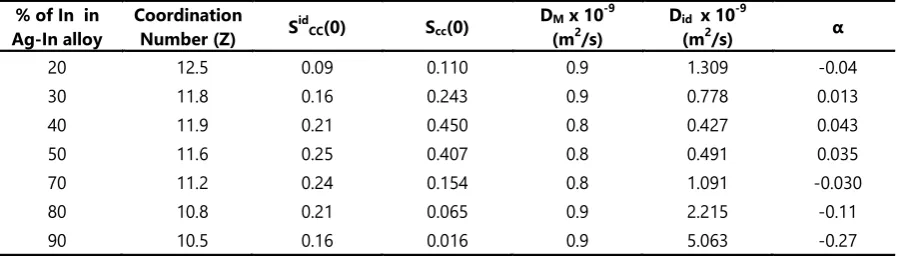
Computed values of ψ, SCC(0), DM, Did and α
are listed in Table 3. Further, to understand the chemical ordering in the alloy, the ratio DM/Did
and α are plotted as function of concentration in Figure 2.
D
ISCUSSIONUnfortunately, there are no experimental values forpartial structure factors (PSFs) in the
long-wavelength limit and isothermal compressi-bility are available for comparison. Thus, it can be seen from Table 2 in the high composition region of Ag up to 50% Ag-Ag correlation in long-wavelength-limit is favourable whereas as In-In correlation is favourable at lower % of In. In high % of In cross correlation is favourable and this opinion can be supported by the ob-served SCC(0) values beyond 70% of In as
pre-sented in Table 2. Decrease in SCC(0) is an
indi-cation of compound formation between compo-nents of the alloy 8. S(0) against % of In is
plot-ted in Figure 1 it can be observed that this value also decreases between 35 to 40% of In and also beyond 70% of In.
Computed values of SCC(0) with their ideal
values, i.e SCCideal(0), total coordination number,
ψ and the CSRO, a at different atomic fraction
% of In in Ag-In alloy
Temperature
(K) SAg-Ag(0) SIn-In(0) SAg-In(0) S(0)
20 1123 0.515 1.153 -0.743 0.033
30 1023 0.908 1.197 -1.015 0.035
40 873 1.569 1.314 -1.409 0.036
50 873 1.679 0.948 -1.231 0.039
70 873 1.425 0.367 -0.682 0.041
80 873 1.260 0.206 -0.459 0.041
90 873 1.118 0.103 -0.271 0.040
% of In in Ag-In alloy
Coordination
Number (Z) SidCC(0) Scc(0)
DM x 10-9
(m2/s) Did x 10 -9
(m2/s) α
20 12.5 0.09 0.110 0.9 1.309 -0.04
30 11.8 0.16 0.243 0.9 0.778 0.013
40 11.9 0.21 0.450 0.8 0.427 0.043
50 11.6 0.25 0.407 0.8 0.491 0.035
70 11.2 0.24 0.154 0.8 1.091 -0.030
80 10.8 0.21 0.065 0.9 2.215 -0.11
90 10.5 0.16 0.016 0.9 5.063 -0.27
Table 2. Computed values of PSFs and total structure factor S(0) in long-wavelength-limit at different atomic % of In in Ag-In liquid alloys.
6 of In in liquid Ag – In liquid binary alloys are
shown in Table 3. A liquid binary alloys can be classified on the basis of their concentration de-pendent SCC(0) data. If SCC(0) < SCCideal(0) for
those concentrations liquid metals components in binary melts show compound forming nature and exhibit some short range order while, SCC(0)
> SCCideal(0) at these concentrations components
show demixing tendency.
D12/Did approaches 1 for an ideal mixing and
less than 1 of this ratio shows phase separation and more than 1 indicates the compound forma-tion tendency in binary mixtures. From Table 2 we confirm that the computed results of SCC(0)
for 0.30 to 0.70 atomic fraction of In in Ag-In melts have higher values than their correspond-ing ideal values and this shows the segregation tendency of Ag and In atoms. This outcome is also supported by positive values of a and less than 1 values of D12/Did between this
concentra-tion range 10 as can be seen from Figure 2. The
negative difference of SCC(0) from their
corre-sponding ideal values and the condition D12/Did
> 1 inform that there is complex formation
be-low 0.30 and above 0.70 atomic fractions of In. The CSRO parameter varies between –1 to 1, with negative values indicating the short range atomic ordering in the melt and positive values indicating segregation of atomic constituents.
C
ONCLUSIONSConsidered alloys show compound forming nature between 0.7 to 0.3 atomic fractions of In, hence, there must be some ordering potential between components of binary alloys. The per-turbation of hard sphere with square well inter-action is suitable model for such calculations. Microscopic functions of the alloy were deter-mined using potential parameters of pure com-ponents. There is no evidence for experimental results of SCC(0) from scattering properties of the
alloys, however, experimentalist determine this function by analyzing experimental thermody-namic activity data so the purposed model cal-culation is very useful for understanding the chemical ordering in binary melts.
Figure 1. % of In in Ag-In alloy vs S(0)
R
EFERENCES1. Gopala Rao RV & Satpathy A (1990). Statistical-mechanical model in the evaluation of partial and total structure factors, atomic distribution functions, and diffu-sion coefficients of silver-tin liquids at various concentra-tions. Phys Rev B, 41, 11938.
2. Anusionwu BC, & IIo-Okeke EO (2005). Segregation and surface properties of In-Zn liquid alloys. Phys Chem Liq, 43, 25–36 .
3. Awe OE & Olawole O (2012). Correlation between bulk and surface properties in Cd-X (X=Hg,Mg) liquid alloys. J
Non-Cryst Sol,358, 1491–1496.
4. Singh NKP, Singh RN & Choudhary RB (1991). Thermo-dynamic investigation of atomic order in AlMg liquid alloys. J Phys Condens Matter, 3, 3635.
5. Gonz’alez DJ, Gonz´alez LE, Opez JML & Stott MJ (2005). Collective modes in liquid binary alloys. An ab initio molecular dynamics study of the LiMg and LiBa alloys. J Phys Condens Matter, 17, 1429.
6. Mishra PP, Milanarunb M, Jha N & Mishra, AK (2002). Thermodynamic properties of liquid glass-forming Ca– Mg alloys.J Alloys Compd,340, 108.
7. Odusote YA (2008). Investigation of ordering phenome-non in Me-Pt (Me=Fe,Ni) liquid alloys. Sci Technol Adv Mater,9, 1–7.
8. Singh RN & Sommer F (1997). Segregation and immisci-bility in liquid binary alloys. Rep Prog Phys, 60, 57. 9. Khaeque MA, Bhuiyan GM, Sharmin S, Rashid RIMA &
Rahman SMM (2002). Calculation of partial structure factors of a less-simple binary alloy. European Phys J B,
26, 319.
10. Singh BP, Adhikari D & Jha IS (2012). Short range order in molten Al–Si alloys. Phys Chem Liq,50, 697.
11. Mendelev MI (1998). An iterative procedure for the crea-tion of computer models of non-crystalline materials from diffraction data. J Non-Cryst Solids,223, 230.
12. Mendelev MI (1998). Computer simulation of Ag–In liquid alloys structure and self-diffusion coefficient calcu-lations.J Non-Cryst Solids, 232, 560.
13. Arai Y, Shirakawa Y, Tamaki S, Saito M & Waseda Y (1998). Structural properties of liquid Ag-In system. Phys
Chem Liq,35, 253.
14. Kes H, Dalgic SS & Dalgic S (2005). Structure of less simple liquid alloys: AgX-In1-X, J Optoelectron Adv Materials,
7, 2047–2057.
15. Bhuiyan GM, Ali I & Mujibur Rahman SM (2003). Atomic transport properties of AgIn liquid binary alloys. Phys B: Condens Matter, 334, 147.
16. Venkatesh R, Mishra RK & Gopala Rao RV (2003). Structural, thermodynamics and other associated proper-ties of partially ordered Ag-In alloy. PhysStat Sol B, 240, 549–560.
17. Lebowitz JL (1964). Exact solution of generalized Percus-Yevick equation for a mixture of hard spheres. Phys Rev,
133A, 895.
18. Gopala Rao RV & Venkatesh R (1989). Computation of
total and partial structure factors, coordination number, and compressibility with self- and mutual-diffusion coeffi-cients of Hg-In alloy. Phys RevB, 39, 3563.