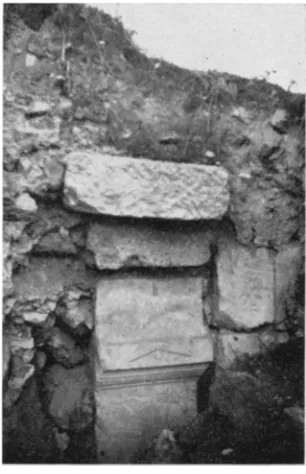
It was my good fortune to visit Beroea with Mr, C. F. Edson in the autumn of 1936 at a time when a group of ancient marbles had recently come to light in the course of excavations made during tree-planting. These remains, consisting of marble grave monuments,' architectural blocks, and pieces of tufa columns, still bearing traces of Roman plaster, were collected in an open space, the property of 'AVTrOvtoW lappij-
KWO0TY), in the 0680 llep4oeptaKok (Fig. 1), whither they had been brought from their
Fig. 1. Inscriptions at V'erria
Fig. 2. Circuit Wall of Beroea
original site, opposite the place where the Naoussa road branches from the road leading to the railway station of Verria, lying on the right, i. e. S. E. as one goes to the station. When we visited the site,2 it became clear that the workmen had by a fortunate accident uncovered part of the circuit wall of Beroea (Fig. 2), built, in all probability, in the third century after Christ, like the Valerian Wall in Athens, to
'The Ephor, Mr. Kotzias, kiindly gav-e us permission to publish these finds; it may be that some of them have subsequently appeared in a Greek or German journal, to which I have had no access. I am indebted to Mr. M. N. Tod for sonme helpful suggestions in preparing this paper.
2 It is hoped that further investigation nmay be possible in happier times. If Beroea, second only to Thessalonica in wealth of surface remains, were to be excavated, the epigraphic harvest would be rich.
American School of Classical Studies at Athens is collaborating with JSTOR to digitize, preserve, and extend access to Hesperia
ward off the attacks of the barbarians; this date is supported by the lettering of the inscriptions. The unfinished state of the stones is ample proof of the urgency with which the wall was built. All are of snow-white marble, preserved in all its pristine freshness, straight from the cutter's yard. One (Fig. 3) has its relief, showing a boy with a goose (?), just blocked out; another (Fig. 4) figures a charmiing Cupid with a little dog holding out its paw; neither of these has any inscription. Even the inscribed stones were probably never used for the purpose for which they were originally intended, as they show no signs of weathering.
The following inscribed monuments were found.
Fig. 3. Stone froni Wall of Beroea, Boy with Goose ( ?)
*~ (i
Fig. 4. Stone fronm Wall of Beroea. Cuipid withl Dog
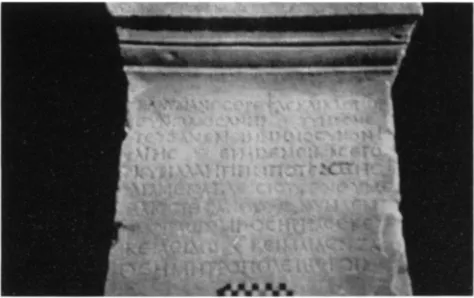
1. " Macedonian " grave monument, of white marble, slightly damaged on right and left edges bv workmen's tools; nmoulding at top, sturnmounted by incised gable with acroteria, and at bottom. Height, 1.17 m.; width, 0.535 n1. (at top); 0.56 m. (at
bottom); maximum thickness, 0.495 m. Letters: 0.014-0.017 m.; 4, q, 0.04 in.; inter-
spaces, 0.012 m. (Fig. 5).
KXav8tav?s Ope'~a Kat Ka6orTwp cvowya/a a&vip p rvupov E Teveav E'/oL, /jVJJrnO4TVVOV 4L-
5
KvptXXa, 77 lrpivTE ore 0f3 0'dpa,pEva 1TXEL'OOV ev Ovpu'-
Xatq o-TEOd'VOVs 0 Nivv 8E 1LLE Motpa6ov LTog r)pTraoE, K<O>V-
KET aEL&) 0' KEq.kat 8' 'v Ca-
10 Ofl .7)rTpO'oXet BEpoita.
Line 1. epEAag. The relationship of Opcrroi to their foster-parents is the subject of a detailed study by A. Cameron in A natolianl Studies Presented to W. H. Buckler (Manchester, 1939), pp. 27-62.
X_
Fig. 5. Grave Monument (No. 1) fromi Beroea
Line 4. MEqd'6g. This elegiac epigram, a welcome addition to our all too scanty
knowledge of the theatrical profession in Imperial times,' is the first epigraphi-c evi- dence, so far as I know, for the presentation of mimes in Macedonia. It is fitting that it should come from Beroea, the seat of the Imperial Kotw'w MaLKEU6VV, the aLywovoOE&at
of which presided at the Games of the Koinon and bore the expenses of staging them. The kind of games at which Cyrilla may have won her " many glorious crowns " is
well described in the well-known inscription in honour of Q. Popillius Python,'
lines 12-17:
For this subject see, among others, E. Wiist (who does not, however. make full use of the epigraphic evidence), Pauly-Wissowa, R.E., s. v., Mimos, 1727-1764, especially 1755-7; L. Robert, APXAIOAOrO4 in R.E.G., XLIX, 1936, pp. 235-54, where he remarks (pp. 238-9) on the com- paratively limited information which we may expect from inscriptions: Les inscriptions . . . peuvent
nous faire connaitre des acteurs de mimies, les villes ofu ils donnaient leurs representations, les honneurs dont ils etaient gratifies. Ident, " Pantomimen im griechischen Orient," Hermes, LXV,
1930, pp. 106-122. We must, as Robert reminds us, R.E.G., loc. cit., p. 238, note 2, " distinguer soigneusement les mimes, comediens ou chanteuirs ou bouffons. des pantomimes, danseurs." From lines 8-9 it appears that Cyrilla was a singer.
Kat KaTavyEtAavra Kat ayay6vTa
EtaaKTtoVs aywvag TaLXavtatovg
0V/.EXtKOVS KaL YV1JJVtKOV9, GOV-
Ta 6%qpto/XLaga 8ta 7ravroiawv 4wv
EV7OTftl-V Kat EV/,KOV Kat povopaXt-
aS KTA.
Our inscription recalls the charming epigram from the theatre of Aquileia,5 in which a colleague pays graceful tribute to the pup.tas Bassilla:
Trqv 7roxxoIs 84,POtr-t 7rapos, 7roXXaZg & 70roAEcct 8 o'av xowvaEo-o-av Evt O-KT)vataTt Xa,/3ovoav
7ravTot7)s apET7)l EV /EL1tLOL, Era xopoLOTa
7rOXXaKtl EPv Ov/EXac, aAXX' ovX ov'T(o & Oavo1'o-q,
5 a?? MOKal- Moo-rcr, ro XaXEYt' rooso" 'HpaKXEi'7
8Eqa Bao-a4XXA or'rXqv 6k'ro /toXoyog k. ,UELca
q a - ,q ET
,,
0
7)&7 Kat VEKVS ovo-a 'toiv /3tov EXaXE TEL/.LT)V.
P,OVtLKOv Etl &a7ErEOv O-OJt acva7ra.vo-a/EVrq. TavTa.
10 Ot' 0t cVOK-qVOi O-OV XEyOVO-tv
Ev'fJvXEL, evvxe Ba6o-o-tXXa OvC A OVE&IS o8ts a nih?ar avazrog.
Line 8. Motpadwv 1ut-rog. This is a common cliche in funerary epigrams, appearing, in one form or another, at least a dozen times in Kaibel. The penultimate letter in this line appears to show the cross-bar of an epsilon, and it is unlikely that this is due to a chip by a workman's tool.
Line 10. MvhpTpo7rAEt. On the basis of a false restoration in a Beroean inscription in honour of Nerva,6 scholars have assumed that it was Nerva who bestowed the title of Metropolis on Beroea. The corrected reading, given in J.R.S., XXX, 1940, pp. 50-52, proves that Nerva merely confirmed an honour already granted.
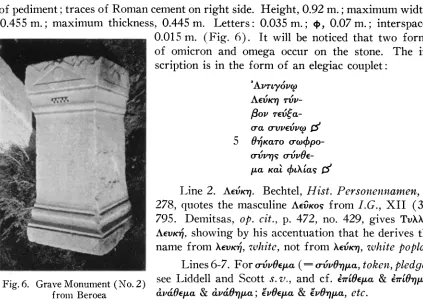
2. " Macedonian " grave monument, rather smaller than the usual type; mould- ing at top, surmounted by incised gable writh acroteria, and at bottom; circle in centre
5 C.I.G., 6750; Kaibel, Ep. Gr., 609; I.G., XIV. 2342 and Add., p. 704; 0. Crusius, Herondas Mimiambi5, p. 149.
6Delacoulonche, Archives des missions scientifiques et litt'raires, viii (1859), pp. 221-4 and p. 252, no. 44; Demitsas, ' MaKCoSOKa (At'hens, 1896), p. 66, no. 55. The title of Metropolis occurs
in the following inscriptions from Beroea: the Popillius Python inscription cited in footnote 4; Rostovtzeff, Bull. de l'Inst. russe a Constantintople (in Russian), IV, 3, 1899, pp. 175-6, no. 3
of pediment; traces of Roman cement on right side. Height, 0.92 m.; maximum width, 0.455 m.; maximum thickness, 0.445 m. Letters: 0.035 m.; 4, 0.07 m.; interspaces
~~~~~~~~~~~~~~~~~~~~. .. ...
Fig. 6. Grave Monument (No. 2) frolmi Beroea
0.015 m. (Fig. 6). Tt will be noticed that two forms of omicron and omega occur on the stone. The in- scription is in the form of an elegiac couplet:
'Avr7yo'vc AEVKrq 7vv- f,ov rEvea-
cra c-vvEvv 0' 5 O9rKaro crco4po-
O,V77Slg 4TVVOE-
,aKat rtXLas 0
Line 2. AEV'K7. Bechtel, Hist. Personennamen, p. 278, quotes the masculine AE1KOS from I.G., XII (3), 795. Demitsas, op. cit., p. 472, no. 429, gives TvXXta
AEVK77. showing by his accentuation that he derives the name from XeVKT', w hite, not from XEVK7Y, wzhite poplar. Lines 6-7. For cnVvOEq.a (= iv'VO/ja, tokent, pledge)
see Liddell and Scott s. v., and cf. b1rW.epa & E'rMi0O)a; avaOELca & aWvacLO1)a; E'vOEpa & E'vJO7/a, etc.
3. Upper portion of a " Macedonian " grave monument; moulding, surmounted by incised gable, with acroteria: circle in centre of pediment; design repeated on right and left sides of stone; traces of Roman cement. Maximum extant height, 1.25 m.;
muaximum width, 0.66 mn.; maximum thickness. 0.465 m. Letters (Imperial, of poor quality, e, o, c, w): line 1, 0.035-0.04 m.; rest of inscription, 0.03 m.; 4p, 0.07 m.; interspaces, lines 1-5, 0.015 in.; lines 5-6, 0.02-0.095 m.
'IoV'Xtov IEpELKX'a 'HpaKXEVrqv llopiro- vta MapKa Trov 'yXvKv- rarov avSpaKat oc - 5 XoO'nporarov Kat iTav-
V , , \
Ta aptT-rov Eug avTTrv
IEVOuLEVOV 'Y,pwoa.
Line 2. Julius Pericles is perhaps a native of Heracleia Lyncestis, rather than of Heracleia Sintice.
4. Grave monument; moulding at top, surmounted by incised gable with acro- teria, and at bottorn; in centre of pediment, a wheel with four spokes; same decoration on right and left sides, but these have a simple triangle. Though the lettering is good, the workmanship of the stone in general is inferior; it seems to have experienced more weathering than the rest before being built into the wall, if indeed it ever was; there are no traces of cement. Height, 1.20 m.; width, 0.505 m. (at top), 0.49 ni. (at bottom); maximum thickness, 0.425 m. Letters, 0.035 m.; interspaces, 0.015-0.02 m. There are no ligatures; letter-formns: E, 0, i, Q.
KXEayo6pa Bor-
pVL TXW VLp E(K
ToM V &OV 11VEi-
a4 at, Xa as xapbv xaZ- 5 pE 'rapo&Zra.
Lines 1-2. Borpvg occurs in another MViacedonian inscription published by A. Struck, Ath. Mitt., XXVII, 1902, p. 308, no. 8. 'Bechtel lists it in Hist. Personen- namen, p. 592, under names derived from plants and trees.
5. "Macedonian " grave monument; moulding at top, surmounted by incised gable with acroteria, and at bottom. Height. 1.28 m.; maximum width, 0.53 m.; maximum thickness, 0.455 m. Letters, line 1, 0.04 m.; lines 2-4, 0.035 m.; ?, 0.088 m.;
interspaces, 0.025 m. Letter-forms: E, 0, :,
n
; ligatures: T4NE, NPE, N-.D?XoVP,EvT 'A-
XLXXE' T4t)
av8pL 11VEtag
xaptv.
Line 1. (CXOVLE-r4. This namie occtirs in an inscription published by A. Orlandos, 'ApX. AEXr., II, 1916, pp. 152-3, no. 6.
6. Large grave monument; mnoulding at top, stirmounted bv incised gable with acroteria, and at bottom; circle in pedinient; same design on right and left sides; many traces of Roman cement. Height, 1.645 m.; width, 0.685 m. (at top), 0.67 m. (at bottom); maximum thickness, 0.48 m. Letters, 0.04 m.; interspaces, 0.012 m. Letter-forms: i, O, I,
.
'Jtavo'4 A&q(fqrpcog Ho-
OTL&OVECtW) Top OYVvyE-
vZ /VEtac xap*v.
7. Fragment of Roman grave stele, broken away at top. left, and bottom; the lower right extremity of the relief area is just visible; surface covered with hard Roman cement. Maximum height, 0.45i m.; maximum width, 0.35 m.; thickness, 0.06 m. Letters, 0.03-0.035 m.; interspaces, 0.01-0.015 m.
----]La 0
kEvco ET O
[Et ] vCtWv lfvtca 5 ax6ptv 0'
rEXEvTr)o-avnt.
Line 1. One woould expect this to be part of a namie, such as (DtX]-pa'[rtov, but the position of the leaf is against a restoration on these lines.
Lines 6-7. This phrase occurs in an inscription published by Orlandos. 'ApX. AEXr., II, 1916, p. 159, no. 29.
8. Fragment of grave stone, broken left and bottom; damaged on right side of face; incised gable at top with acroteria on right and circle in pediment; traces of Roman cement. Maximum height, 0.445 m.; maximum width, 0.27 m.; thickness, 0.09 m. Letters, lines 1-4, 0.04 m.; lines 5-6. 0.045-0.05 m.; ?, 0.075 m.; interspaces, lines 1-3, 0.01 m.; lines 3-6, 0.003-0.005 ni.
- )AA -
-yXVK] vrar<o)>
(?) v LC'O] 4PAofeE-
(?) vw--]
'K
E K5 ]vitag
Line 1. The comparatively rare feminine Z] y'tXa would fit the traces, but it makes line 1 very much shorter than the following lines. 0E]0O'Xa might be suggested, but the
remains of the first letter in line 1 cannot belong to a phi of the diamond-shaped type in line 3; this objection is not final, as diamond-shaped omicrons alternate with rounded in inscriptions of this date, and perhaps the same might be the case with phi.
Lines 2-3. The last visible letter of line 2 is A (corrected <X>) ; that of line 3 is I with traces of horizontals to right at top and mniddle, interpreted E.
9. Small fragment of marble slab. Height, 0.195 m.; width, 0.23 m.; thickness, 0028 m. Ietters, 0.023 m. Lines ruled on face of stone for alinement of letters; inscription probably never completed.
NAPI/ ? a]v8pi.
THE UNIVERSITY, J. M. R. CORMACK