THE SEVENTH METONIC CYCLE
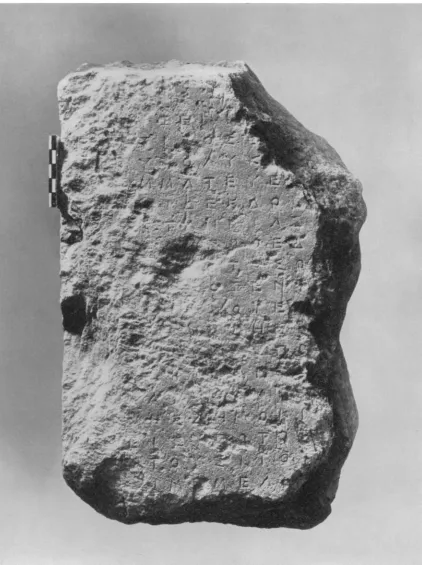
During the summer of 1935 Oliver discovered on the south slope of the Acropolis a fragmentary inscription of the year of Euxenippos (305/14). He has now deposited the stone in the Epigraphical Museum at Athens, where it bears the iinventory number EM 12825, and has very generously turned over the text to me for publication.
The stone is part of a stele of Hymettian marble, with the left side and the original thickness preserved. It is broken away at the bottom and at the right, and the surface is badly weathered; the original pedimental top seems to have been cut away by someone who wished to squiare the stone for building purposes. The maximum height of the new piece is 0.32 m.; its thickniess 0.095 m. The height of letters is 0.007 m., and alpha throughout is cut withotut the cross-bar. Ten lines vertically occupy a span of 0.145 m., and seven letters horizontally a span of 0.103 mn. A photograph is given in Figure 1, and the restored text (stoichedon 27) reads as follows:
305/4 B.C. Y TOIX. 27 ['Eir' E] 'ie6vt'[z7rov N'8o 'rro rfjttS* [. . v] tu[Y]oQ -[08xdarg 7rQVTaV8iag]
[H,] AiYT'TXV[og [zhov @44wzr-6xlO8v 8']
5 [lt ?zd] Jza g y [dilt Xat 6?X&rUt 'r] [g irQ]y VP-t'C(g- [8?7Xra1'a 16V 4topv'] [oov' TCiV] roQOcJ [Qwv r8p't( l .V . .. [.* *o*],?o 0[ivarog Xal ffv&1UQo6]
10 [g Etfov'X] ov 'E[X-vuvt'og ?l7v?'
[uzYi) . *] hb5 [U(Vovg &L 'zl dtiuwt X] [a t]v ?uAtOV] ire [oUOV x6V(ewt xaQ vIi]
[IV] EavTO' # [C p ont8O4svoV Vm]
15 [88] Tg dr,uoXQ [ariag C a; x;,8QoToV]
[r,Ojlg 1fr6o ToVi [diYuov UlTiV?g X7rq]
[i]5
~
Tov u&cov [xopiudfi "X Trs U4o?a][S cff] Sl8dX>Al[,at?] - - - _ ]
14*
American School of Classical Studies at Athens is collaborating with JSTOR to digitize, preserve, and extend access to
Hesperia
"n i
t'll II
w I I I . . - I .1 - , - , , ,, rl
THE SEVENTH METONIC CYCLE 203
The restoration of the decree proper is uncertain, especially in lines 11-14. One thinks of aucotvs1n for line 16, for a board of autvorat appear in I. G., JJ2, 792.1 It is possible that Euboulides, who proposed a decree in 304/3, was the orator here as well (lines 9-10). In lines 17-18 the phrase ex g Ulaicag has been supplied on the analogy
of I. G., I12, 401; a less colorful restoration would be Ex rCov idhov.
The secretary's name in line 3 may be supplied in full from I.G., 112, 703, 796, and 797, and these three inscriptions are thus shown to belong also in 305/4 instea(l of 250/49, as I have argued in Hesperia, IV (1935), pp. 553-555. The reading of the archon's name
in each of them should be ['E7r& Et':mv:r - - -] in place of [TE7;r Kvd51>'soog - - -] and there are now left no kiown decrees of the year of Kydenor. The calendar equations of I.G., 112, 796, 797, and 703 are as follows: 2
Prytany II, 21 Metageitnion 21 Prytany III. 30 Boedromion 30 Prytany IX, 30 Elaphebolion 29.
These equations show that the year of Euxenippos was ordinary, and that the new fragment must also be restored to allow a close correspondence between the day of the month and the day of the prytany. If no uninscribed space is assumed in line 4,
the equation should be [0aoynkXt6vog Y%dott `'] dixa, 3y[JO4rt Xca J&cjt | g
btut since an uninscribed space apparently followed the formula of date it is possible also to assume a similar punctuation at the beginning, and to allow the equation [v 0aeyrft7ogr Ogy o'lri `u'] 6^z'xa, 6y[do'-ri xac deaurit tl TrQ]j aP8vdag. The fourth calendar equation of the year is, therefore
Prytany XI, 18 (or 17) -Thargelion 18.
The discovery of this new fragment thus enables us not only to assign to their proper historical setting in the late fourth century three decrees in praise of foreign states, which have generally been dated in the third century, but also to offer some new evidence on the complicated chronological problems of the seventh Metonic cycle. During the past year Dinsmoor and I have both published calendar studies on one year of this cycle,' but a satisfactory solution of the problems presented by the inscriptions of 307/6 has not, I believe, as yet been attained. The fact that 305/4 is now known to have been ordinary casts doubt upon my interpretation of 307/6 as an ordinary year, for there would thus be four such years in succession, an anomaly which occurs other- wise only once, as far as I know, from 413/2 to 410/09.4 On the other hand, Dinsmoor's
1 See Hesperia, IV (1935), p. 564, footnote. For the oavt-&vu ef. Busolt-Swoboda, Gr. Staatsaltertirnter, pp. 1067 and 1121. Apparently the avT6ivut were chosen by the Demos.
2 See Hesperia, IV (1935), p. 555.
3 Dinsmoor, in Hresperia, IV (1935), pp. 303-310; Meritt, ibid., pp. 536-544.
reconstruction of 307/6 as an intercalary year rests upon a very serious assumption of error, which seems to me inadmissable, especially in the present state of our knowledge, and upon a forward count in the last decade of the month in I. G., JJ2, 458, although the backward count, especially in the late fourth century, was the normal method of reckoning.-
There are also certain historical considerations which Dinsmoor has advanced in favor of his interpretation, which calls for an intercalated Anthesterion (as well as the extra Gamelion which is known to have been intercalated), the omission of Mounichion, and the creation of the two new Macedonian tribes relatively late in the year.2 The evidence lies principally in Plutarch's Demetrius (?? 10-12). But, so far as Plutarch's account is concerned, the fall of Megara (and of Mounichia too) may be dated rather more appropriately in the first prytany than in the sixth,3 for although Demetrios' journey-beginning late in Thargelion-from Athens to Megara and on to Achaea and back may well have taken the greater part of two months, it is difficult to see how it could have taken the greater part of eight. And the " honors " which Plutarch says the Athenians voted for Demetrios may just as well have been granted at frequent intervals throughout the year as all more or less at one time in the spring, of 306.
The renaming of the month Moitmichion as Anthesterion and then as Boedromion, which Dinsmoor wishes to attribute to the year 307/6 to account for the supposed " second " Anthesterion, is an event which both Plutarch (Dewjietrius, ? 26) and Diodorus (XX, 110) attribute to the year 302 at the time of Demetrios' third sojourn in Athens. It is hard to believe that these obsequious honors affected in any way the official calendar record. If they did, it is the year 302 and not 307/6 which should show signs of the disturbance; but so far as we know the calendar of 302 is perfectly regular. If the story belongs really in 307/6, then Anthesterion II (according to Dinsmoor's scheme) should follow and not precede Elaphebolion. Furthermore, there is nothing in the story to account for the second Gamelion, which we know to have existed in 307/6. I prefer to see in the omission of Mounichion, if indeed it was omitted, a deliberate effort (with no reference to Deinetrios one way or another) to correct the anomalv of the calendar introduced by the intercalated Gamelion. The real problenm of 307/6 is to discover why the Athenians decided to have a second Gamelion. On this point the story of Diodorus and Plutarch offers no help, whether it be attributed to 302 or to 307/6,
1 On the backward cotunt, see Hesperia, IV (1935), pp. 529-561. In spite of the niumerouLs documrnents preserved from the year 307/6 there is only one equation before the tenth prytally where the calendar implications do not depend on restoration. This is fotund in IG., 112, 456 and shows that somne day in the twenties of the fifth prytany fell in Maimakterion. Sinice Dinsmoor's scheine brings the twenties of the fifth prytany well on into Posideon, he assumes that the scribe wrote on the stone either ' fifth " when h-e should have written " fouirth," or " aimakterion " when lhe should have written " Posideon." Cf. Hlesperia, IV (1935), p. 308 and footnote.
2 Hesperia, IV (1935), pp. 304-305.
THE SEVENTH METONIC CYCLE 205
and aii explanation can only be conjectured. Perhaps the omission of Mounichion is not hard to understand, once Gamelion had been intercalated, for if 307/6 was an ordinary year the Metonic cycle had already received more than its share of intercalary years in proportion to the time elapsed until then,' and a year of twelve months was necessary to keep Hekatombaion of 306 from falling too late after the summer solstice. One must suppose, of course, that the Athenians were concerned to prevent this late beg,inning of the civil year, which in my opinion is somewhat doubtful. But why a second Gamelion was intercalated we still do not know, and the story of Demetrios' initiation into the Mysteries offers no help toward a solution. One wonders whether it had some- thing to do with the severity of the winter and a desire to postpone the festivals of Anthesterion and Elaphebolion to a more equitable time of year. Plutarch's account
(Dernetrius, ? 12) teaclhes us that the winter of 307/6 was more than usually severe.
I With 307/6 ordinary, there were left onily two intercalary years in the last eight years of the cycle
(303/2 and 301/0).