*Address for correspondence E-mail: [email protected]
Development and Validation of a HPTLC Method
for Simultaneous Estimation of L-Glutamic Acid and
γ
-Aminobutyric Acid in Mice Brain
J. S. SANCHETI, M. F. SHAIKH1, P. F. KHATWANI2, SAVITA R. KULKARNI2 AND SADHANA SATHAYE*
Departments of Pharmaceutical Science and Technology, Insitute of Chemical Technology, N. P. Marg, Matunga, Mumbai-400 019, 1Department of Neuroscience, Brain Research Institute, Jeffrey Cheah School of Medicine and Health Sciences, Monash University Sunway Campus, Petaling Jaya, Selangor 46150, Malaysia, 2Departments of Pharmacognosy and Phytochemistry, Bombay College of Pharmacy, Kalina, Santacruz (E), Mumbai-400 098, India
Sancheti, et al.: HPTLC of Amino Acids in Mice Brain
A new robust, simple and economic high performance thin layer chromatographic method was developed for simultaneous estimation of L-glutamic acid and γ-amino butyric acid in brain homogenate. The high performance thin layer chromatographic separation of these amino acid was achieved using n-butanol:glacial acetic acid:water (22:3:5 v/v/v) as mobile phase and ninhydrin as a derivatising agent. Quantitation of the method was achieved by densitometric method at 550 nm over the concentration range of 10-100 ng/spot. This method showed good separation of amino acids in the brain homogenate with Rf value of L-glutamic acid and γ-amino butyric acid as 21.67±0.58 and 33.67±0.58, respectively. The limit of detection and limit of quantification for L-glutamic acid was found to be 10 and 20 ng and for γ-amino butyric acid it was 4 and 10 ng, respectively. The method was also validated in terms of accuracy, precision and repeatability. The developed method was found to be precise and accurate with good reproducibility and shows promising applicability for studying pathological status of disease and therapeutic significance of drug treatment.
Key words: HPTLC method, neurological disorder, excitatory and inhibitory amino acids, L-glutamic acid, GABA
Central nervous system (CNS) operates via keeping a fine balance between both excitatory and inhibitory
neurotransmission[1]. γ-Aminobutyric acid (GABA) works as major inhibitory neurotransmitter and it is now very much clear that at least 40% of the
inhibitory synaptic processing in the mammalian
brain uses GABA as their neurotransmitter[2]. Dsyfunctioning of GABAergic system is known
to be associated with various disorders such as
epilepsy, anxiety, Parkinson’s disease and Huntington’s
disease[1]. Glutamate is the principle excitatory
neurotransmitter in the brain, which is involved in cognitive functions, neurotrophic activity and
synaptic plasticity (both LTP and LTD)[3]. Glutamate by activating on NMDA, AMPA, Kainate or on mGluR1 receptors may contribute to acute brain
damage after status epilepticus, cerebral ischemia or traumatic brain injury. It may also contribute to chronic neurodegeneration such as amyotrophic
lateral sclerosis and Huntington’s disease[4]. Therefore, simultaneous and precise quantification of these amino
acids in biological samples is essential to study the pathological status of the disease and to investigate the possible therapeutic involvement of these amino acids.
Different analytical techniques such as high-
performance liquid chromatography (HPLC)[5], gas chromatography (GC)[6], fluorimetry [7] and capillary
electrophoresis[8] have been used for the estimation of GABA in biological samples. Similarly, variety of analytical methods such as UV[9], HPLC[10] and
microdialysis technique[11] were used for estimation of L-glutamic acid in biological samples. The
experimental procedure, volume and complexity of biological samples for the abovementioned technique
make these procedures very tedious. Therefore, there
is a continuous demand for new analytical methods, which are simple, feasible, rapid, reproducible, precise and cost effective[1]. The current study presents
simultaneous determination of GABA and L-glutamic
acid in biological samples with the help of high
performance thin layer chromatography (HPTLC)
technique.
MATERIALS AND METHODS
L-Glutamic acid and GABA were purchased from Sigma-Aldrich, St. Louis, MO, USA. Precoated HPTLC aluminium sheet silica gel 60 F254 plates were
obtained from Merck, Mumbai. All the chemicals and
solvents used were of analytical grade, procured from
Hi-Media Chemicals, Mumbai, India.
Adult male Swiss albino mice (20-25 g) were procured from Haffkins Institute, Mumbai, India
and were acclimatised in the animal house of the
Institute of Chemical Technology, Mumbai. Young
healthy mice were grouped, housed and maintained
at 23±2° under 12:12 h light/dark cycle with free
access to rodent chow and tap water. The animal
study was approved by the Institutional Animal Ethics Committee (ICT/IAEC/2010/PH35).
Preparation of standard solution:
L-glutamic acid and GABA standards were prepared in 0.1 N HCl in 80% ethanol. Stock solution of L-glutamic acid and GABA (1 mg/ml) solution were prepared by dissolving 10 mg of L-glutamic acid and GABA in 10 ml of 0.1 N HCl in ethanol. From this stock solution, the working standards of concentration ranging from 5 to 50 µg/ml were
prepared by transferring appropriate volume to
10 ml volumetric flasks and volume was made with
ethanol. A 2 µl of each solution was applied to afford 10-100 ng per spot[12].
Preparation of 0.2% ninhydrin solution:
Two hundred milligram of ninhydrin was dissolved in small amount of acetone. One millitre of pyridine was added to this solution and volume was made up to 100 ml with acetone[3].
Preparation of brain tissue samples:
Mice were fasted overnight and euthanised, the brain was removed and washed with cold 0.9%
saline to remove adhering tissues and blood clots. The brain tissues was homogeniaed with 0.1 N HCl
in 80% ethanol (for every 100 mg tissue, 1 ml of ethanol) using a tissue homogenizer. The homogenates were centrifuged at 4500 rpm for 20 min at 25°.
The clear supernatants were then transferred into microcentrifuge tubes and used for analysis.
Chromatographic conditions and method validation:
Applicator-Linomat V (Camag, Muttenz, Switzerland); Scanner-Camag TLC scanner III (Camag, Muttenz, Switzerland); Software-winCATS ver 1.3.4; Stationary phase-Precoated TLC silica gel F254 plates; Mobile phase-n-butanol:glacial acetic acid:water (22:3:5 v/v/v); developing chamber-twin trough glass chamber (20×10, Camag, Muttenz, Switzerland); developing mode-ascending mode; chamber saturation time-45 min; Detection reagent-0.2% w/v ninhydrin in acetone; Scanning wavelength-550 nm; Environment condition-25º/65% RH. Validation of the developed method was carried in terms of linearity, specificity, sensitivity, accuracy,
precision and repeatability[13,14].
Calibration curve:
Two microlitre each of standard solution of
L-glutamic acid/GABA (5-50 µg/ml to afford 10-100 ng/spot) was applied as a band on precoated TLC plate. Spots were dried in hot air oven at 60-65° for 2 min. The plate was developed using the
mobile phase. After the solvent reached the top of
the plate (80 mm), the plate was removed and dried at 60-65° for 4-5 min in hot air oven. Then the plate was sprayed with 0.2% ninhydrin and placed in oven at 60-70° for 4-5 min. The spots were scanned
at 550 nm using Camag, Switzerland, scanner and were analysed using winCATS planer chromatograph. The calibration curve was plotted using applied concentration versus areas[12].
Sensitivity:
Sensitivity of the method was determined with respect
to limit of detection (LOD) and limit of quantification (LOQ) from calibration curve. The LOD and LOQ
were determined at a signal-to-noise ratio of 3:1 and 10:1, respectively[13-15]..
Specificity:
The specificity of the developed method was established by analysing the sample solutions from
the brain homogenate (containing L-glutamic acid and GABA). The spot of the L-glutamic acid and GABA were confirmed by comparing retardation factor (Rf)
Precision:
Precision was evaluated in terms of intraday and
interday precisions. Intraday precision was determined
by analysing sample solution of L-glutamic acid and GABA at three dose levels covering low, medium and high concentrations (40, 60 and 80 ng/spot)
of the calibration curve three times on the same day. Interday precision was carried using same
concentrations over a period of 3 days. The peak
areas obtained was used to calculate mean, standard
deviation (SD) and relative standard deviation (RSD) [16].
Repeatability of measurement of peak area was
determined by analysing different amount of mixture
of L-glutamic acid and GABA samples covering
low, medium and higher concentration ranges of the calibration curve three times without changing the position of the plate. Repeatability of sample application was assessed by spotting mixture of
L-glutamic acid and GABA covering similar range
of calibration curve three times and analysing them at one time[12].
Recovery and accuracy:
The accuracy of the method was determined by performing the recovery studies at two levels. To
100 mg of the rat brain tissue, 50 ng of L-glutamic acid and 50 ng of GABA were added and the percent
recovery was evaluated as a parameter to study the
efficiency of the method[3].
Application of the developed method:
The developed method was used to analyse the
L-glutamic acid and GABA levels in pentylenetetrazole (PTZ)-induced kindling model of epilepsy. In this,
mice were divided into three groups of six animals
each. Group I served as vehicle control (saline treated group), Group II served as negative control group (PTZ with saline) and Group III received diazepam (2 mg/kg). Diazepam and saline were given 30 min prior to each PTZ injection. For PTZ kindling, a subconvulsant dose of PTZ, i.e. 35 mg/kg body weight (i.p.) was injected every alternate day. The PTZ
injections were administered till the animals in the
negative controlled group showed adequate kindling (24th injection of PTZ, i.e. total 46 days). After the
study, animals were euthanized and the brain of each animal were obtained, homogenised and analyzed
for levels of L-glutamic acid and GABA using the
developed method[17].
RESULTS AND DISCUSSION
Selection of mobile phase for simultaneous estimation
of L-glutamic acid and GABA was carried out on
the basis of polarity and ratio of different solvents.
Different ratios of mobile phase (n-butanol:glacial acetic acid:water) were evaluated. Among these, n-butanol:glacial acetic acid:water at (22:3:5 v/v/v)
gave good separation of various amino acids in brain homogenate. It was also observed that
chamber saturation time of 45 min at 25° and
solvent migration distance of 80 mm were crucial in chromatographic separations.
Linearity of any analytical method defines its ability
within a given range. The test results thus obtained are directly or through mathematical transformation, proportional to the concentration of analyte[13].
This developed method was found to be linear for
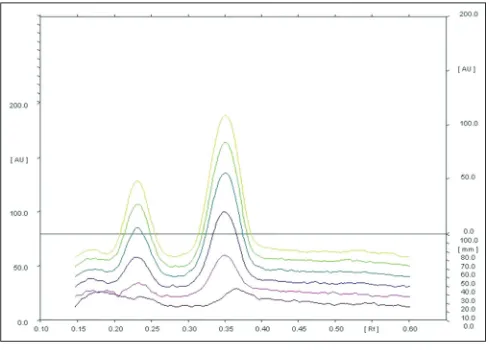
L-glutamic acid and GABA in a concentration range of 10-100 ng/spot for each amino acid (figs.1 and 2). Fig. 1, displays three dimensional overlay of HPTLC densitograms of the calibration spots of L-glutamic acid and GABA at 550 nm. The regression data are
reported in Table 1.
LOD and LOQ for L-glutamic acid were found to be 10 and 20 ng, respectively and for GABA were found to be 4 and 10 ng, respectively. The specificity
is the ability of any analytical method to calculate unequivocally the analyte in the presence of test mixture[13,14]. L-glutamatic acid and GABA were
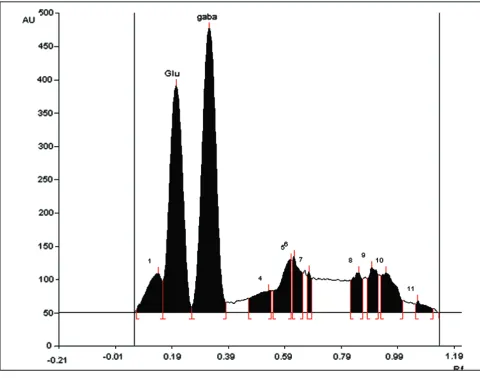
determined in brain homogenate with Rf 0.22±0.05
and 0.34±0.05, respectively (fig. 3).
Fig. 1: 3D HPTLC desitogram.
values were less than 5% confirming the precision of the method (Table 2)[15,16].
Repeatability of measurement of peak area was analysed (40, 60, 80 ng/spot) by scanning one spot without changing the position of the plate (n=3). Whereas, precision of automatic spotting device was evaluated by spotting and analysing the same amount several times (n=3). %RSD was consistently less than 5% (Table 4) ensuring the repeatability of the developed method.
Accuracy of the given analytical method can be defined as the closeness of test results to the true
value[13,14]. It was determined by spiking a known
amount of standard (L-glutamic acid and GABA; 50 ng each) into the preanalysed brain homogenate solution. Results of recovery method (Table 3) indicated that the average recovery of L-glutamic acid and GABA was more than 97% indicating accuracy of method.
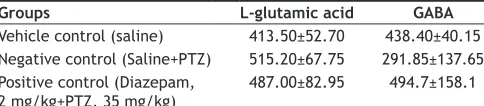
The developed method was used for the analysis of the L-glutamic acid and GABA in brain of mice used in kindling study. The analysis showed L-glutamic
Fig. 2: HPTLC desitogram of standards.
HPTLC chromatogram of standard L-glutamic acid and GABA at 40 ng/spot concentration.
Fig. 3: HPTLC desitogram of sample.
HPTLC chromatogram of amino acids in mice brain homogenate.
TABLE 1: LINEAR REGRESSION DATA FOR THE CALIBRATION CURVE
Parameters L‑glutamic acid GABA
Linear range (ng/spot) 10-100 10-100
Slope 18.542 41.324
Intercept −87.660 139.401
Regression coefficient 0.999 0.990
Retardation factor 0.22 0.34
GABA=g aminobutyric acid
TABLE 2: PRECISION STUDIES
Amino acid Amount of
drug spotted Amount of drug detected % RSD
Intraday
L-glutamic acid 40 38.26±1.72 4.49
60 59.80±2.43 4.07
80 79.47±2.33 2.93
GABA 40 38.36±0.44 1.51
60 57.85±1.97 3.39
80 80.28±1.99 2.48
Interday
L-glutamic acid 40 37.43±0.92 2.46
60 58.43±1.22 2.09
80 79.27±1.00 1.26
GABA 40 38.57±1.13 2.93
60 58.94±1.00 1.71
80 78.82±3.02 3.83
The values are given in ng/spot, n=3. GABA= g aminobutyric acid, RSD=Relative standard deviation
The precision of the given analytical method states the degree of dispersion between a series of measurements obtained from multiple sampling of the same homogenous sample under prescribed conditions[13,14]. Intraday precision defines the use
acid levels were increased and the levels of GABA
were decreased in mice brains compared with control
animals, with the continuous treatment of the PTZ
indicating the induction of the epilepsy in the animals.
The increase levels of GABA and decreased levels of L-glutamic acid found in diazepam treated animals indicated the alleviation of epileptogenesis (Table 5).
This study indicates the application of the developed method for estimation of the amino acids in the brain of the mice without any interference from
the biological matrix. Thus the developed HPTLC
method can be used in future to study altered level of neurotransmitters in various neurological disorders.
HPTLC is a sophisticated analytical instrument
based on the full capabilities of thin layer chromatography. It is powerful analytical tool for
obtaining chromatographic information of complex mixtures of biomolecules, organic and inorganic
compounds because of its properties like automation,
scanning, full optimisation, selective detection and minimum sample preparation[18]. The levels of GABA and glutamate in mice, in this method, brain (approximately 400 ng/mg of the brain tissue of each amino acid) were found to be more or less
similar to that reported a normal levels in mice
brain (approximately 500-1000 ng/mg of brain tissue)[19]. However, the method is sensitive up to 100 ng/mg of brain tissue of individual amino
acid suggesting that this method can be helpful in determining the pathophysiological conditions of various disorders associated with altered levels of these neurotransmitters. Apart from that, the developed method provides other advantages of being simple, robust, cost effective and less time consuming for large number of sample analysis.
ACKNOWLEDGEMENTS
The authors would like to thank UGC-SAP for funding the
research.
REFERENCES
1. Saravanababu C, Kesavanarayanan KS, Kalaivani P, Ranju V, Ramanathan M. A simple densitometric method for the quantification of inhibitory neurotransmitter Gamma-aminobutyric acid (GABA) in rat brain tissue. Chromatogr Res Int 2011;2011:1-5.
2. Bowery NG, Smart TG. GABA and glycine as neurotransmitters: A brief history. Br J Pharmacol 2006;147:S109-19.
3. Saravana Babu C, Sunil AG, Vasanthi HR. Development and Validation of an HPTLC method for simultaneous estimation of excitatory neurotransmitters in rat brain. J Liq Chromatogr Relat Technol 2007;30:2891-902.
4. Meldrum BS. L-glutamicacid as Neurotransmitter in the brain: Review of Physiology and Pathology. J Nutr 2000;130:1007S-15.
5. Khuhawar MY, Rajper AD. Liquie chromatographic determination of γ-aminobutyric acid in cerebrospinal fluid using 2-hyrdoxynapthaldehyde as derivatizing reagent. J Chromatogr B 2003;788:413-8.
6. Pearson J D, Sharman DG. A method for the estimation of γ-aminobutyric acid using gas liquid chromatography and electron capture detection. J Neurochem 1975;24:1225-8.
7. Lindgren S, Anden NE, Grabowska Anden W. A fluorimetric method
TABLE 5: RESULTS OF PENTYLENETETRAZOLE- INDUCED KINDLING MODEL
Groups L‑glutamic acid GABA
Vehicle control (saline) 413.50±52.70 438.40±40.15 Negative control (Saline+PTZ) 515.20±67.75 291.85±137.65 Positive control (Diazepam,
2 mg/kg+PTZ, 35 mg/kg)
487.00±82.95 494.7±158.1
n=6, values are expressed as ng/mg of brain tissue, PTZ=35 mg/kg, i.p., every alternate day for 25 injections. PTZ=Pentylenetetrazole, GABA= γ aminobutyric acid
TABLE 4: REPEATABILITY STUDIES
Parameters Amount of drug detected
40 60 80
L‑glutamic acid
Repeatability of peak area 38.93±0.48 58.36±0.410 78.78±0.89
% RSD 1.23 0.70 1.13
Repeatability of sample
application 37.95±0.38 57.93±1.54 77.13±1.78
% RSD 1.00 2.66 2.31
GABA
Repeatability of peak area 37.46±1.35 58.84±0.74 76.61±0.94
% RSD 3.60 1.25 1.22
Repeatability of sample
application 37.40±0.54 58.18±1.53 76.48±3.03
% RSD 1.44 2.64 3.97
The values are given in ng/spot; Mean±SD for n=3. GABA= γ aminobutyric acid, RSD=relative standard deviation
TABLE 3: RECOVERY STUDIES OF L-GLUTAMICACID AND GABA
Sample Amount present/mg of brain tissue Amount added Amount found % recovery Average % recovery (mean±SD)
L‑glutamic acid 439.54 50 480.34 98.12 97.70±2.33
430.04 50 456.98 95.20
419.87 50 468.95 99.80
GABA 408.48 50 444.87 97.03 97.37±0.29
410.64 50 449.43 97.57
425.98 50 464.13 97.51
for determination of GABA in tissues following cation exchange
chromatography and condensation with o-phthalaldehyde. J Neural Transm 1982;55:243-52.
8. Baldacci A, Theurillat R, Caslavska J, Pardubsk’a H, Brenneisen R, Thormann W. Determination of γ-hydroxybutryic acid in human urine by capillary electrophoresis with indirect UV detection and confirmation with electrospray ionization ion-trap mass spectrometry. J Chromatogr A 2003;990:99-110.
9. Lund P. UV-method with glutaminase and glutamic acid dehydrogenase. In: Bergmeyer U, editor. Method of Enzymatic analysis. Weinheim: VCH Verlagsgesellschaft; 1986. p. 357-63.
10. Bert L, Robert F, Denoroy L, Stoppini L, Renaud B. Enhanced
temporal resolution for the microdailysis monitoring of catecholamines and excitatory amino acids using capillary electrophoresis with laser
induced fluorescence detection. Analytical development and in vitro validation. J Chromatogr A 1996;755:99-111.
11. Moghaddam B. Stress preferentially increases extraneuonal levels
of excitatory amino acids in the prefrontal cortex: Comparison of
hippocampus and basal ganglia. J Neurochem 1993;60:1650-7. 12. Dixit RP, Barhate CR, Nagarsenker MS. Stability-indicating HPTLC
method for simultaneous determination of ezetimibe and simvastatin.
Chromatographia 2008;67:101-7.
13. ICH, Q2A (R1), Validation of Analytical Procedures: Text and Methodology, In: Proceedings of International Conference on Harmonization, Geneva, November 2005. Available from: http:// www.ich.org/fileadmin/Public_Web_Site/ICH_Products/Guidelines/
Quality/Q2_R1/Step4/Q2_R1__Guideline.pdf [Last accessed on 2013 May 7].
14. USP 29/NF 24, The United States Pharmacopoeia, 29th Rev. and the National Formulary, 24th ed. Rockville, MD: United States Pharmacopoeial Convention Inc.; 2006. p. 1964-6.
15. Desai NS, Barhate CR, Biyani SO, Kulkarni SR, Nagarsenker MS. Quantification of rutin and isoquercitrin from leaf extract of Annona squamosa and its pharmaceutical dosage form by HPTLC. J Planar Chromatogr 2011;24:306-11.
16. Patel R, Patel M, Bhatt K, Patel B. HPTLC method development and validation: Quantification of paliperidone in formulation and in vitro release study. Anal Methods 2010;2:525-31.
17. Atilla I, Mustafa I, Suat KY. Pentylenetetrazol-induced kindling seizure attenuated by Ginkgo biloba extract (EGb 761) in mice. Prog Neuropsychopharmacol Biol Psychiatry 2006;30:1504-10.
18. Srivastava MM. High Performance Thin Layer Chromatography. New York: Springer-Verlag, Berlin: Heidelberg; 2011. p. 3-22. 19. Paik M, Cho I, Jung I, Lee G, Kim K. Altered free amino acid levels
in brain cortex tissue of mice with Alzheimer’s disease as their N(O,S)-ethoxycarbonyl/tertbutyldimethylsilyl derivates. Biochem Mol Biol Rep 2008;41:23-8.