IJEDR1904099 International Journal of Engineering Development and Research (www.ijedr.org) 554
Securing the implementation of openings in deep
concrete beams
1Mahmoud Hosny Mahmoud Soghair, 2Ali Gamal Abd elshafy, 3Mouhamed Mahmoud Ahmed, 4Mohamed Fathy Fahmy 1Assistant Lecturer, 2Professor, 3Assistant Professor, 4Assistant Professor
Assiut University
_____________________________________________________________________________________________________
Abstract - Many times it can be needed to make an opening in the shallow beams, for example, works of air conditioning
pipes and the transgression of electricity cables. But it was more complicated in deep concrete beams because the large size of the beam can accommodate the dimensions of the openings and different use may be a door for people to cross or ventilation window may be up to the corridor in the garage and so. Therefore, it should be paid attention to the openings in the deep concrete beams, not only for the large dimensions of the opening but also for the safety of the deep beam means the safety of the whole building because it usually carries more than floors. This, unlike shallow beam which carries loads from one roof. Hence, researchers began to conduct studies of deep beams with openings on both sides design as a new structure and strengthen the openings to increase durability. In this paper, we will study the effect of opening on a deep concrete beam and develop a practical solution to compensate for the shortage in the resistance of the beam. Eight beams were saluted by using the associated program, one of them was solid, one of them was with two opening and six beams with strengthening with steel jacket at the tie area. The results of this paper are that the selected opening reduced the resistance of the beam by an approximate 20% and we proposed a suggestion to make up for this shortfall of resistance to make it easier to create opening in deep concrete beams safely.
keywords - Deep beams, opening, strengthening, steel jacket
_____________________________________________________________________________________________________
I. INTRODUCTION
In the late of the seventy of last century, the great Kong [1,2] began researching the openings in deep concrete beams. Together with others, he conducted a study of the effect of size and place of openings on deep lightweight concrete beams. In the other article, they developed solutions to reinforce the beams with holes based on the shape of the cracks that appeared on the beams in the first article. Not only that, but they matched the results with large-size beams and set an equation to calculate the shear strength of the deep concrete beams with holes. In addition to the impact of different solutions to these beams they concluded also that If the opening is reasonably clear of the natural load path, the ultimate shear strength may be calculated as though there were no openings.
In the mid, the eighty of last century and with the advent of fibers additives for reinforced concrete scientists began to study deep concrete beams made of concrete with fibers. M.A.Mansur* and W.A.M.Alwis [3] through 12 deep beams they studied the influence of both volume fraction of fibers, opening location, shear span to effective depth ratio and the amount of web reinforcement. They concluded that the volume of web reinforcement and location of opening are the two principal parameters that affect the behavior and strength of deep beams with web openings. The effect of an opening on the behavior and strength of deep beams depends primarily on the degree of interruption of the natural load path joining the loading and support reaction points. N.E.Shanmugam and S.Swaddiwudhipong [4] studied the effect of fiber content, positions of openings, and different types of loadings on the behavior of deep beams. They are noted that the increase in strength with the increase of fiber content. The significance of the natural load path joining the edge of loading and supporting plates is exemplified through a drastic reduction in strength when it is intercepted by the opening.
IJEDR1904099 International Journal of Engineering Development and Research (www.ijedr.org) 555 reinforcement distribution on the beam capacity was studied and the stress distribution in reinforcing steel has been monitored. A reduction, ranging from 0.3% to 12% in the beam capacity, was observed when the tension reinforcement distribution depth was increased from 0.1H to 0.4H.
Through this history of research, we will find that the following most of the researches that have been presented have studied the effect of openings and their locations and dimensions on the behavior of deep concrete beams with web openings. As well as the effect of continuity spans and strengthen the openings internally and externally using fibers and many other ideas. Through the paper of. Ashraf Ragab Mohamed et al. [16] and Based on other research we have done [17] a currency and it shows the effect of increasing the local stiffness of tie on the behavior of deep concrete beams we tried to clarify steps to implement an openings in deep concrete beams already exists with no effect on the safety of the beam and structure.
II. VERIFICATION OF THE PROPOSED FINITE ELEMENT MODEL
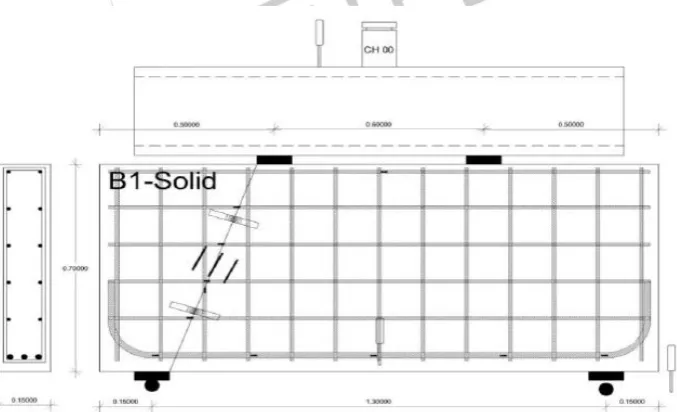
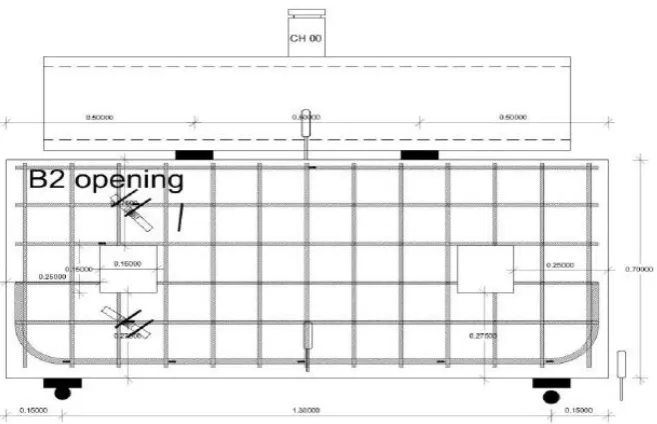
The aim of simulating the finite element model is to make sure that the suggestion type of elements, properties of material, real constants, and criteria of convergence are Enough to make the behavior of the model like the real beam. To make the verification of the model, two beams with cross-section 150 x 700 mm and length of 1600 mm was made in the laboratory of reinforcement concrete at Assiut university. One of them had two rectangular openings with dim 150*150 mm and far from edges 275 mm from the bottom and 250 mm from the vertical sides. The beams were designed according to ACI code and that after making a comparison between the codes. The beams were designed to be simply supported throughout 1300 mm and loaded by two concentrated loads. The spacing between the load and support is equal to 350 mm {a/d = 0.54} where a/d ratio is shear span to beam depth ratio this number achieves the beam to be deep. The tie represents the longitudinal reinforcement of the beam chosen to be three bars with 18 mm. diameter. The minimum web reinforcement was token it consisted of stirrups with 10 mm. diameter and longitudinal bars with 10 mm. diameter with spacing 125 mm. in two directions. Fig. (1) and Fig (2), shows the geometry, reinforcement details, and loading of the analyzed beams. The steel had average yield stress of 490 MPa , and the concrete had an average compressive strength was 42 MPa and the strength was determined by testing concrete cubes of dimension 150 mm x 150 mm x 150 mm made in the laboratory. The maximum size of the coarse aggregate was 20 mm at the time the beam was formed.
IJEDR1904099 International Journal of Engineering Development and Research (www.ijedr.org) 556 Figure (2) Geometry, Loading, and Reinforcement of Beam (B2) Tested in laboratory
The finite element model by the associated program was set up and the model was processed. The load with the med span deflection curve obtained from the finite element model with the experimental plots are presented and compared in Fig. (3).
Fig. (3) Load deflection curve for numerical and excremental beam B1 solid beam and beam B2 opening beam
From the figures, we can note that the numerical model gives good agreement with the experimental beam. The effect of the openings is evident here, as both the maximum load and the stiffness decrease. Accordingly, the program was used to model different cases of beams under study.
III. PROGRAM OF ANALYZED BEAMS
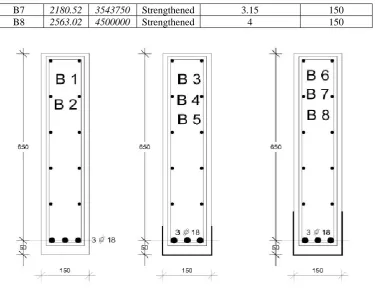
A program consisting of eight bars has been developed and modeled by using a finite element method to study the effect of installing a jacket of steel sheets to support and strength the tension zone in the deep concrete beams. One of the beams was with a solid beam there are no openings. The remaining 7 beams have two rectangular openings with dim 150*150 mm and far from edges 275 mm from the bottom and 250 mm from the vertical sides as shown in fig (2). The composition of the steel jacket at the bottom was studied with different height and thickness in six beams. Table (1) & Fig (4) illustrate the different shapes of the beams under study. Where (As) equal summation area of main reinforcement and area of jacket cross-section, ( I ) moment of inertia for main reinforcement and jacket and type of beam.
Table (1) Details of the Analyzed Simply-Supported Beams
Beam no. As mm2 I mm4 type S jacket thickness mm H jacket height mm
B1 762 15451.16 solid - -
B2 762 15451.16 opening - -
B3 1813.02 1345770 Strengthened 3 100
B4 2163.02 1750582 Strengthened 4 100
B5 2513.02 2148748 Strengthened 5 100
IJEDR1904099 International Journal of Engineering Development and Research (www.ijedr.org) 557 Fig. (4) The difference between studded cases
For beams B3, B4 and B5 had the same height of jacket but with different thicknesses, the same applies to beams B6, B7, and B8. B3and B6 had the same total area the same applies to beams B4, B7 and the same applies to beams B5, B6. To ensure the jacket can withstand tensile strength, the jacket should be closed on all sides, as shown in Fig. (5).
Fig. (5) The shape of the steel jacket
IV. RESULTS AND DISCUSSION
The outcomes of the numerical study are presented to evaluate the influence of strength of the tension area for deep concrete beams with openings.
load-deflection curves
IJEDR1904099 International Journal of Engineering Development and Research (www.ijedr.org) 558 Figure (6) load deflection curves of all analyzed Beams
Crack patterns and stresses distribution
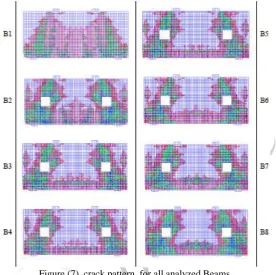
Figure (7) crack pattern for all analyzed Beams
Fig. (7) show the distribution of the crack in different cases of beams under study. The presence of an opening in the deep beams increased cracks in the area between the side of the beam and under the opening. The steel jacket at the tensioning zone at the bottom of the beam worked to reduce the cracking density at the bottom of the opening. Increasing the height of the jacket branch worked to increase the load of the beam, and this was accompanied by an increase in cracks on the sides of the deep concrete beams.
Steel jacket design proposal
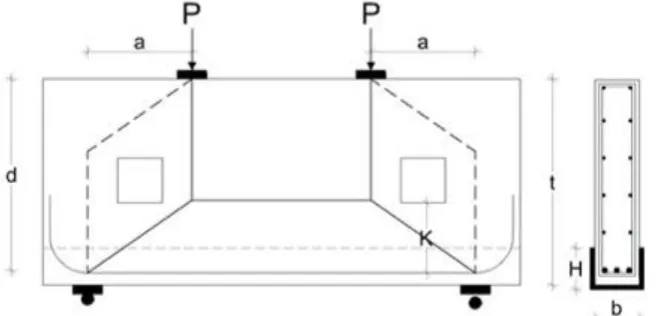
Based on our understanding of the behavior of deep concrete beams, we find the following creating an opening in a deep concrete beam changes the shape of the proposed truss and follows a decrease in the height of the truss as shown in Fig (8). As a result of this deficiency, there is an increase in the force acting on the tie, which leads to the arrival of steel to the yielding point and there is lead to the collapse of the oblique side of the truss. After that, the load begins, taking a new path to reach the support, which is the path between the edge of the beam and the opening. As a result, there is no reinforcement at this zone, which serves the movement of the load, the collapse is achieved with an increase in the load. Thus, adding the steel jacket to the beam works to strengthen the tie and by reaching the Perfect Bond between the jacket and the beam, as well as taking the jacket closed box, so the jacket works to curry tension with the tie. By calculating the increase in tension force over the tie we can design the steel jacket as equation (1).
IJEDR1904099 International Journal of Engineering Development and Research (www.ijedr.org) 559 Figure (8) idolization truss for deep concrete beam with openings
Conclusions
Creating an opening in the deep concrete beams significantly reduces the load of the beam. According to the theoretical study, the installation of a steel jacket in the tensile area of the deep concrete beams is a very effective solution for strengthening the beams. Accordingly, if you want to create an opening in deep concrete beams, then you should design the steel jacket and then fabricate and install it, and you must verify the strength of the bond between the jacket and the beam by using epoxy and nails. When designing a steel jacket, the height of the branch should belong as much as possible, and the thickness of the plate used in making the jacket should not be less than 2 mm.
REFERENCES
[1] Kong, F. K., & Sharp, G. R. (1977). Structural idealization for deep beams with web openings. Magazine of Concrete Research, 29(99), 81-91.
[2] Kong, F. K., Sharp, G. R., Appleton, S. C., Beaumont, C. J., & Kubik, L. A. (1978). Structural idealization for deep beams with web openings: further evidence. Magazine of Concrete Research, 30(103), 89-95.
[3] Mansur, M. A., & Alwis, W. A. M. (1984). Reinforced fiber concrete deep beams with web openings. International Journal of Cement Composites and Lightweight Concrete, 6(4), 263-271.
[4] Shanmugam, N. E., & Swaddiwudhipong, S. (1988). Strength of fiber reinforced concrete deep beams containing openings. International Journal of Cement Composites and Lightweight Concrete, 10(1), 53-60.
[5] Maxwell, B. S., & Breen, J. E. (2000). Experimental evaluation of the strut-and-tie model applied to deep beam with opening. Structural Journal, 97(1), 142-148.
[6] Chen, B. S., Hagenberger, M. J., & Breen, J. E. (2002). Evaluation of strut-and-tie modeling applied to dapped beam with opening. Structural Journal, 99(4), 445-450.
[7] Tan, K. H., Tong, K., & Tang, C. Y. (2003). Consistent strut-and-tie modeling of deep beams with web openings. Magazine of Concrete Research, 55(1), 65-75.
[8] Guan, H., & Doh, J. H. (2007). Development of strut-and-tie models in deep beams with web openings. Advances in Structural Engineering, 10(6), 697-711.
[9] Brena, S. F., & Morrison, M. C. (2007). Factors affecting strength of elements designed using strut-and-tie models. ACI structural journal, 104(3), 267.
[10] Ashour, A. F., & Rishi, G. (2000). Tests of reinforced concrete continuous deep beams with web openings. Structural Journal, 97(3), 418-426.
[11] Yang, K. H., Eun, H. C., & Chung, H. S. (2006). The influence of web openings on the structural behavior of reinforced high-strength concrete deep beams. Engineering Structures, 28(13), 1825-1834.
[12] Hu, O. E., & Tan, K. H. (2007). Large reinforced-concrete deep beams with web openings: test and strut-and-tie results. Magazine of Concrete Research, 59(6), 423-434.
[13] El Maaddawy, T., & Sherif, S. (2009). FRP composites for shear strengthening of reinforced concrete deep beams with openings. Composite Structures, 89(1), 60-69.
[14] Hawileh, R. A., El-Maaddawy, T. A., & Naser, M. Z. (2012). Nonlinear finite element modeling of concrete deep beams with openings strengthened with externally-bonded composites. Materials & Design, 42, 378-387.
[15] Hussain, Q., & Pimanmas, A. (2015). Shear strengthening of RC deep beams with openings using sprayed glass fiber reinforced polymer composites (SGFRP): part 1. experimental study. KSCE Journal of Civil Engineering, 19(7), 2121-2133.
IJEDR1904099 International Journal of Engineering Development and Research (www.ijedr.org) 560 [17] Ali Gamal Abd elshafy, Mouhamed Mahmoud Ahmed, Mohamed Fathy Fahmy, and Mahmoud Hosny Soghair.( Effect
of axial stiffness and area of main tension reinforcement on behavior of deep beams) unpublished. [18] ANSYS (2005), ANSYS User’s Manual Revision 5.5, ANSYS, Inc., Canonsburg, Pennsylvania, US.
[19] ACI Committee, & International Organization for Standardization. (2008). Building code requirements for structural concrete (ACI 318-08) and commentary. American Concrete Institute