PERFORMANCE ANALYSIS OF WDM PONS BASED
ON FP-LD USING RZ-OOK AND NRZ-OOK
Mukesh Kumar
1, Dr. Ajay Pal Singh
2Department of Electronics and Communication Engineering,
Sant Longowal Institute of Engineering and Technology (Deemed University), Punjab (India)
ABSTRACT
Transmission medium used for communication of signal from one point to another point are copper wire,
coaxial cables, wave-guides and radio links. All these mediums have their own advantages and disadvantages.
Wavelength Division Multiplexing Passive Optical Networks (WDM PONs) is optical based communication
which introduces a good data transmission rate and large bandwidth. WDM PON is bidirectional PON system
based on a Fabry-Perot laser diode (FP-LD) with two cascaded array waveguide gratings (AWGs). The
downstream data rate equals to 10 Gbps and the upstream data rate equals to 2.5 Gbps. In downstream, CW
laser with frequency (193.1 THz) is modulated by AM modulator using 10 Gbps non-return to zero (NRZ)
downstream data to generate the desired downstream signal. The generated signal is sent over the bidirectional
Optical Fiber. A circulator is used in the CO to separate the downstream and upstream traffic. The modulated
signal is sent to ONU. At the ONU, using optical splitter/coupler, portion of the modulated signal is fed to a
balanced receiver. For upstream other portion of the downstream modulated signal from the splitter/coupler is
re-modulated using 2.5 Gbps NRZ upstream data by FP-LD in the ONU. The re-modulated OOK signal
repasses through the bidirectional Optical Fiber. Performance of WDM PONs system using different
modulation techniques such as NRZ-OOK, RZ-OOK has been analyzed and in the last comparison between
different modulation techniques has been done. The performance of the system is analyzed by calculating bit
error rate and quality factor.
Keywords: FP-LD, RZ-OOK, NRZ-OOK, AWGs, Colorless Transmission
I. INTRODUCTION
WDM PONs is optical based communication which introduces a good data transmission rate and large
bandwidth. WDM PON is bidirectional PON system based on a Fabry-Perot laser diode (FP-LD). FP-LD is
considered as low cost optical source, it is less costly than other sources like distributed feedback (DFB) laser,
vertical cavity surface emitting lasers (VCSELs) and reflective semiconductor optical amplifier (RSOA).AM
Modulator is used at central office and AWGs are used at CO and ONU. Our proposed systems are low cost
system and the injection locked FP-LD is used as low cost colorless transmitters for high speed optical access
exploiting WDM technology. WDM PON architecture is categorized into three main parts which are Central
place of convergence where data arrives from one or more directions and is forwarded out in one or more
directions. Optical network unit (ONU) is the user side equipment.
Fig.1 WDM-PON architecture
II DESIGN OF WDM PONS BASED ON FP-LD USING RZ-OOK
The first proposed PON architecture includes two cascaded AWGs at both CO and Remote Node RN with
RZ-OOK as shown in Fig.2. In downstream, CW laser with 193.1 THz frequency is modulated by AM modulator
using 10 Gbps NRZ downstream data to generate the desired downstream signal. The generated signal is sent to
the first AWG at CO which multiplexed it and is sent over the bidirectional Optical Fiber. It passes through the
second AWG at RN which multiplexed the input signal again. The multiplexed signal is sent to ONU. At the
ONU, using optical splitter/coupler, portion of the multiplexed signal is fed to a balanced receiver. For
upstream, other portion of the downstream multiplexed signal from the splitter/coupler is re-modulated using 2.5
Gbps NRZ upstream data by FP-LD in the ONU. The re-modulated signal repasses through the AWG which
demultiplexed the upstream signal then it is sent over Bidirectional Optical Fiber. The upstream demultiplexed
signal passes through the first AWG then it is received by CO. Circulator is used to avoid influencing the
downstream signal, the upstream signal is sent to a PD is used to receive the upstream signal in the CO.
2.1 Central Office
Fig.3 CO part in WDM PON with RZ-OOK
Transmitter includes PRBS generator, RZ generator, CW laser and AM modulator. Receiver contains PD,
LPBF, 3R regenerator and BER analyzer.
2.2 Bidirectional channel Part
Fig.4 Bidirectional channel in WDM-PON with two cascaded AWGs
The channel includes bidirectional optical fiber as shown in Fig.4. A bidirectional single mode fiber of 10 km is
used to forward the signal and to backward it with an optical delays of 1 unit in order to separate the upstream
and downstream signals. The fiber cable has an attenuation loss of 0.2dB/km and length of 10 km, this means
2.3 ONU Part
The transceiver at ONU includes two parts, first part is used to receive the signal from CO and second part is
used to send signal to CO as shown in Fig.4. ONU includes many components for receiving downstream signal
and for transmitting upstream signal. Received signal components include Splitter, optical attenuator, PIN PD,
LPBF, 3R regenerator and BER analyzer. Transmitted signal components include FP-LD, NRZ generator and
PRBS generator.
Fig.5 ONU part in WDM PON network
III DESIGN OF WDM PONS BASED ON FP-LD USING NRZ-OOK
The second proposed PON architecture includes two cascaded AWGs at both CO and RN with NRZ-OOK.as
shown in Fig.6. In downstream, CW laser with 193.1 THz frequency is modulated by AM modulator using 10
Gbps NRZ downstream data to generate the desired downstream signal. The generated signal is sent to the first
Fig.6 Block diagram of first bidirectional PON system model with NRZ OOK
Fig.7 CO part in WDM PON with NRZ OOK Modulation
Bidirectional channel and ONU part used here is same as Fig.4 and Fig.5 and also working principle is same.
IV SIMULATION AND RESULTS
OptiSystem software is used for simulation. Optisystem software is an innovative optical communication system
simulation package that designs, tests, and optimizes virtually any type of optical link in the physical layer of a
broad spectrum of optical network.
4.1 Comparison on the results of the two proposed models with CW laser power variation
Effect of variation in CW laser power on the BER at CO and end user (ONU) for the two systems when the
signal. First model “WDM PON System based on FP-LD with RZ-OOK” have minimum BER of downstream
signal equals to 2.35371e-011while second model “WDM PON System based on FP-LD with NRZ-OOK” have
minimum BER for downstream signal 2.85646e-017. Also for first model minimum upstream BER is
3.3747e-009 and for second model minimum BER with upstream is 1.7609e-013.
Table 1 Comparison between two proposed PON models
S.No. CW
Laser
Power
(dBm)
WDM PON with
RZ-OOK
WDM PON with
NRZ-OOK
Downstream BER Upstream BER Downstream
BER
Upstream BER
1. 0 2.35371e-011 3.3747e-009 2.85646e-017 1.7609e-013
2. 1 3.03521e-015 1.4251e-012 1.25056e-021 8.66847e-017
3. 2 1.17618e-016 6.24379e-014 5.51024e-024 7.07996e-018
4. 3 1.51232e-019 1.01232e-018 5.03655e-029 2.15411e-023
5. 4 8.9804e-023 1.1805e-022 2.62801e-033 2.11451e-025
6. 5 7.78229e-024 2.79583e-026 2.88596e-030 1.057e-029
7. 6 8.35113e-025 2.85363e-027 8.7651e-036 1.71036e-030
8. 7 4.65699e-030 4.80838e-029 4.74592e-041 1.51062e-031
So second proposed model “WDM PON System based on FP-LD with NRZ-OOK is better than first model “WDM PON System based on FP-LD with RZ-OOK” because the downstream and upstream BER values are
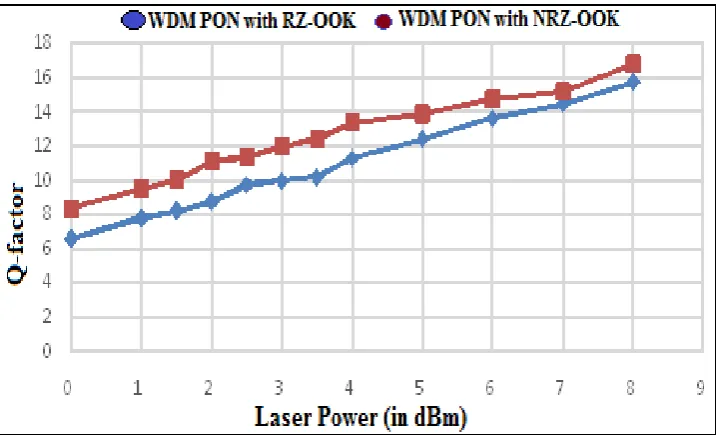
good in second proposed system. Fig. 6 shows variation of Quality factor with different value of laser power.
There is rise in the value of quality factor when laser power increases but NRZ gives better result.
Fig.8 Graph shows variation of Quality Factor at ONU with different value of Laser Power for RZ-OOK and
4.2 Comparison on the results of the two proposed models with fiber length variation
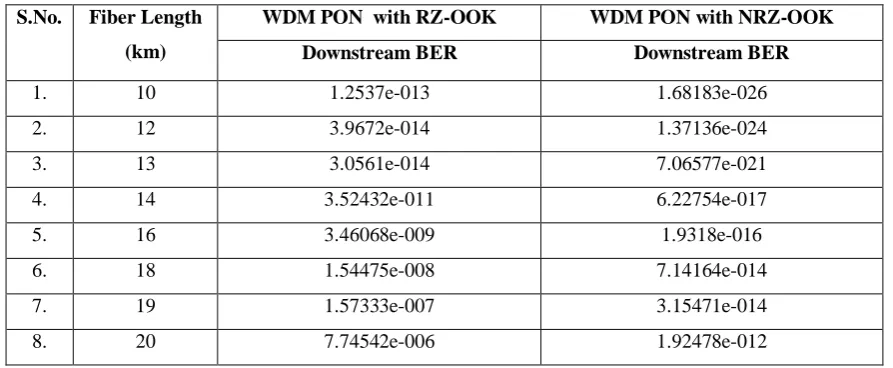
Effect of variation in fiber length on the BER at end user (ONU) for the two systems when parameter of FP-LD
is fixed.. First model “WDM PON System based on FP-LD with RZ-OOK” have minimum BER of downstream
signal equals to 1.2537e-013 while second model “WDM PON System based on FP-LD with NRZ-OOK” have
minimum BER for downstream signal equal to 1.68183e-026. Table 2 shows required comparison. Table 2 Comparison between two proposed PON models
S.No. Fiber Length
(km)
WDM PON with RZ-OOK WDM PON with NRZ-OOK
Downstream BER Downstream BER
1. 10 1.2537e-013 1.68183e-026
2. 12 3.9672e-014 1.37136e-024
3. 13 3.0561e-014 7.06577e-021
4. 14 3.52432e-011 6.22754e-017
5. 16 3.46068e-009 1.9318e-016
6. 18 1.54475e-008 7.14164e-014
7. 19 1.57333e-007 3.15471e-014
8. 20 7.74542e-006 1.92478e-012
So second proposed model “WDM PON System based on FP-LD with NRZ-OOK is better than first model “WDM PON System based on FP-LD with RZ-OOK” because the downstream BER values are good in second
proposed system.
V CONCLUSION
Optical fiber based communication is modern medium of transmission which provide high bit rate that fulfill the
demand of high speed internet. Performance of WDM PONs system using different modulation techniques such
as NRZ-OOK, RZ-OOK has been analyzed by Optisystem software and in the last comparison between
different modulation techniques has been done. First model “WDM PON System based on FP-LD with
RZ-OOK” have minimum BER of downstream signal equals to 2.35371e-011while second model “WDM PON
System based on FP-LD with NRZ-OOK” have minimum BER for downstream signal 2.85646e-017. Also for
first model minimum upstream BER is 3.3747e-009 and for second model minimum BER with upstream is
1.7609e-013.So second proposed model “WDM PON System based on FP-LD with NRZ-OOK is better than first model “WDM PON System based on FP-LD with RZ-OOK” because the downstream and upstream BER
values are good in second proposed system than first model .Also by using FP-LD cost of Optical Network Unit
REFERENCES
[1] F. El-Nahal and A. Husein, Bidirectional WDM-PON architecture using a reflective filter and cyclic AWG,
Optik–Int. J. Light Electron Opt., 122(19), 2011, 1776-1778.
[2] H. Bakarman, S. Shaari, and M. Ismail, Simulation of 1.25 Gb/s Downstream Transmission Performance of
GPON-FTTx, International Conference On Photonics, 2010, 1-5.
[3] A. Banerjee, Y. Park, F. Clark, H. Song, S. Yang, G. Kramer, K. Kim, and B. Mukerjee,
Wavelength-division-multiplexed passive optical network (WDM-PON) Technologies for broadband access: a review,
Journal of Optical Networking, 4(11), 2005, 737–756.
[4] C. Arellano, C. Bock, and J. Prat, RSOA-based Optical Network Units for WDM-PON, Optical Fiber
Communication Conference, 2005, 1-3.
[5] J. Yu, B. Kim, N. Kim, Wavelength Re-use Scheme with Reflective SOA for WDM-PON Link, 10th
International Conference, 2008, 1704–1710.
[6] L.Y. Chan, C. K. Chan, D. T. K Tong, E Tong and L.K. Chen, Upstream traffic transmitter using
injection-locked Fabry-Perot laser diode as modulator for WDM access networks, electronics letters, 38(1), 2002,
43-45.
[7] Nguyen QT, Bramerie L, Girault G, Vaudel O, Besnard P, Simon JC, Shen A, Duan GH, Kazmierski C.,
16x2.5 Gbit/s Downstream Transmission in Colorless WDM-PON based on Injection-Locked Fabry-Perot
Laser Diode using a single Quantum Dash mode-locked Fabry Perot laser as multi-wavelength seeding