IJEDR1801086
International Journal of Engineering Development and Research (
www.ijedr.org
)
499
Comparative Finite Element Analysis of different
materials for Bike Chassis to reduce weight
1 Ms. Priyanka Pandit Kore, 2 Prof. H. D. Lagdive 1 Student, 2 Assistant Professor
Mechanical Engineering Department,
N B Navale Sinhgad College of Engineering, Solapur, Maharashtra, India
________________________________________________________________________________________________________
Abstract— In this work, different analysis techniques for automobile frame are studied under different loading conditions.
The loading may be static or dynamic and studied analytical techniques available for automobile frame analysis. This overview will help to study how to reduce weight of automobile chassis. It contributes around 14% in the total weight of vehicle. It is thus significant to improve the design of the chassis to provide good balancing and improved fuel efficiency. The proposed work deals with the performance improvement of the existing chassis with certain design changes. In this, Displacement and Stress analysis is done for material Mild Steel and aluminium alloy by using software. The parts are developed with Computer Aided Design software (CATIA) & analysis is done using Hypermesh & ANSYS software.
Keywords— Automobile frame, Static & dynamic Load conditions, Material, Hypermesh, ANSYS.
________________________________________________________________________________________________________
I. INTRODUCTION
The history of motorcycling like a sport start in 1896, it was held the first motorcycle race, France. At the beginning the motorbike reaches 18 km/h and the engine developed 0.5 horse power. At the beginning of the eighties the chassis weren’t stiff enough and during some years designers were looking to increase stiffness. In a few years they arrived to a point in which the chassis were too much stiff. Then the objective was to find the optimum stiffness values. Currently we are going into a new stage in which vehicle mass and weight reduction, economy consideration, efforts to reduce emissions and therefore save the environment are playing a more important role. Vehicle weight reduction is a well-known strategy for improving fuel consumption in vehicles, and presents an important opportunity to reduce fuel use in the transportation sector. By reducing the mass of the vehicle, the inertial forces that the engine has to overcome are less, and the power required to move the vehicle is thus lowered. In this section, weight reduction as a strategy to reduce fuel consumption will be explored, primarily on the vehicle level. Engineering fields are constantly improving upon current designs and methods to make life simple and easier. Likewise bikes are effective transportation vehicles, which results in bikes becoming increasingly popular. Hence, bike manufacturers are willing to produce more high-tech and user friendly bikes, which makes low-cost, high-quality bikes an important issue.
A variety of weight reduction strategies are adopted by different automakers to minimize weight in automobiles. Using lightweight materials such as aluminum and carbon-fiber or optimizing existing vehicle designs are some of the key strategies adopted by manufacturers in the automotive industry.
This work deals with study of a two wheeler chassis which serves as a skeleton upon which parts like gearbox and engine are mounted. It contributes around 14% in the total vehicle weight. It is thus significant to improve the design of the chassis to provide good balancing and improved fuel efficiency. This work deals with the performance improvement of the existing chassis of a two wheeler with certain design changes (trying different materials).The parts are developed with Computer Aided Design software (CATIA) & analysis is done using Hypermesh & ANSYS software. Aluminum alloy 6063 is used to replace the existing Mild Steel material and study the results. Analysis is done under static loading conditions. The loads studied are tank load, engine load, rider load & pillion load. From this proposed study, it is expected that the chassis with alternate material is performing better with a satisfying amount of weight reduction and the weight reduction will hence lead to better fuel efficiency of the vehicle without disturbing strength of chassis.
II. LITERATUREREVIEW
D. Nagarjuna et al, [1] This paper deals with design of chassis frame for an all-terrain vehicle and its optimization. Various loading tests like Front Impact, Rear Impact, Side Impact, Roll over test etc. have been conducted on the chassis and the design has been optimized by reducing the weight of the chassis. Material used for optimization is IS3074. There has been considerable decrease in weight of roll cage which helps it in moving faster. Optimization has been achieved by reducing the diameter of chassis bar wherever less load is acting and where there are less deformations. In this way the weight of chassis has been reduced from 84 kg to 64 kg by performing various loading analysis test on roll cage.
IJEDR1801086
International Journal of Engineering Development and Research (
www.ijedr.org
)
500
PRO–E 5.0 for modeling, ANSYS 12.0 for analysis. He observed that By employing a polymeric composite heavy vehicle chassis for the same load carrying capacity, there is a reduction in weight of 73-80%, natural frequency of polymeric composite heavy vehicle chassis are 32-54% higher than steel chassis and 66-78% stiffer than the steel chassis. Based on the results, it was inferred that carbon/epoxy polymeric composite heavy vehicle chassis has superior strength and stiffness and lesser in weight compared to steel and other polymeric composite materials and other cross sections considered in this investigation. From the results, it was observed that the polymeric composite heavy vehicle chassis is lighter and more economical than the conventional steel chassis with similar design specificationsDr.R.Rajappan et al, [5] In this present work static and dynamic load characteristics are analyzed using FE models. From this work, high stress area, analyzing vibration, natural frequency and mode shape are identified by using finite element method. Modal updating of truck chassis model was done by adjusting the selective properties such as mass density and Poisson’s ratio. Predicted natural frequency and mode shape will be validated against previously published result. Finally, the modifications of the updated FE truck chassis model were proposed to reduce the vibration, improve the strength, and optimize the weight of the truck chassis. Software used in this work is PRO–E 5.0 for modeling, ANSYS 12.0for analysis.The material used is AISI 4130 alloy with quenched and tempered treatment. The paper has looked into the determination of the dynamic characteristic the natural frequencies and the mode shapes of the truck chassis, investigating the mounting locations of components on the truck chassis and observing the response of the truck chassis under static loading conditions. For the linear static analysis, the stress distribution and deformation profile of the truck chassis subjected to two loading conditions: truck components loading and asymmetrical loading had been determined. Maximum stress occurred at the mounting brackets of the suspension system while the maximum translation occurred at the location where the symmetry and asymmetry load is acting. The maximum stress of the truck chassis is 16KN while the maximum translation is 2.013mm. These values are acceptable as compared to the yield strength of the chassis material and the tolerance allowed for the chassis.
III. PROBLEMSTATEMENT
Mass or weight reduction is becoming an important issue in automotive industry. Weight reduction will give substantial impact to fuel economy, efforts to reduce emissions and therefore, helps to the save environment.
A. OBJECTIVE
• Weight reduction of vehicle while maintaining strength. • Prepare a CAD model from input parameters.
• Study of Static behavior of chassis using FEM analysis..
B. SCOPE
It is necessary to study optimization methods for weight reduction of two wheelers. Use of advance techniques like Finite element analysis in Automobile field will be definitely very beneficial. In this work finite element analysis is used for study of mechanical properties of pulsar 180 bike chassis which will be manufactured by using one of the alternative material Al 6063 alloy. And deformation, strength of chassis can be studied by using ANSYS software.
IV. METHODOLOGY
It is necessary to select a proper methodology for any research work. Experimental approach along with numerical approach gives verified results. In this paper work the advanced numerical method called as finite element analysis is done. Literature survey is done initially to find the scope for work and objective is finalized.
The prototype of a pulsar 180 bike chassis is tested for varying load and deformation is calculated. A 3D model of pulsar 180 bike chassis under test is simulated using finite element method and deflection is calculated. Strength and deflection of chassis with existing material and selected Al 6063 material are compared in this work.
A. ANALYTICAL PROCEDURE 1) Modeling:
IJEDR1801086
International Journal of Engineering Development and Research (
www.ijedr.org
)
501
Fig. 1 3-D model of chassis in CATIA V52) Meshing:
For finite element method it is necessary to discrete the model. The geometrical model in this needed to be meshed. The meshing processes generate the elements on geometrical model. Hypermesh software is used for meshing of geometry. Following are the steps for meshing geometry in Hypermesh.
• The CATIA model in IGES format is imported in HyperMesh for the preparation of FE model.
• Then geometry cleanup was done by using options like ‘geom. cleanup’ and ‘defeature’ to modify the geometry data and prepare it for meshing operation.
B. RESULTS OF FEA ANALYSIS
1. Displacement plot of chassis with M.S. material in ANSYS
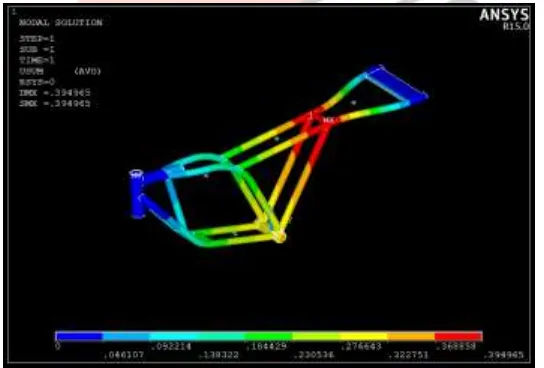
In the results shown in fig. 2 chassis is observed with different color counters. This will tell you what it is that you are looking at. Not all red in a plot is bad. And just because it is not showing as red does not mean that things are good either. It all depends on the settings of the contours scale. This is assure adjustable scale and can be set to any range to show what you want to see. The plot in following figure shows the displacement plot of the results. The contour scale is at its default setting which will take the maximum and the minimum displacement and evenly divide the stress contours based on the number of colors that you want to use. In this case, nine colors are used. Blue usually represent the lowest stress and Red the highest. But, this scale can be adjusted to show more of what we want to see.
Fig. 2 Displacement Plot for M.S. material
From above result it is observed that maximum displacement of 0.3949 is developed upper tubes of chassis where maximum load of 1400 N is applied on chassis which is indicated by red color. As compared to engine and tank load, load of rider and pillion is more as well as at red counter indicated in above figure it creates fulcrum point due to which maximum displacement is developed.
2. Stress plot of chassis with M.S. material in ANSYS
Fig. 3 shows stress plot for bike chassis for existing material i.e. for steel. Maximum stress of 49.06 N/mm2 is generated at the
IJEDR1801086
International Journal of Engineering Development and Research (
www.ijedr.org
)
502
Fig. 3 Stress Plot for M.S. material3. Displacement plot of chassis with Al 6063 material in ANSYS
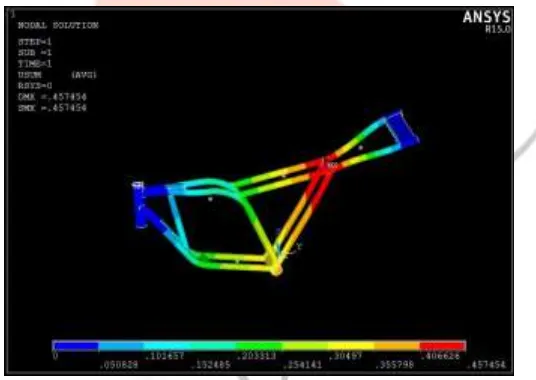
Fig. 4 shows ANSYS displacement plot for chassis made up of Al 6063 material. From this figure it is observed that maximum displacement of 0.4574 is generated in chassis at the same point as it is generated in chassis made up of steel material. As difference in both results for steel and Al 6063 material is very small also it is produced at the same point as in existing material chassis the design is safe.
Fig. 4 Displacement Plot for Al 6063 material 4. Stress plot of chassis with Al 6063 material in ANSYS
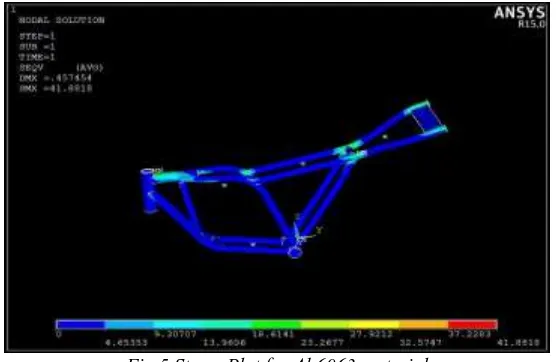
Fig. 5 indicates result of stress for chassis made up of Al 6063 material. It is observed that maximum von misses stress of 41.88 N/mm2 is generated. As we know that
Allowable stress = Yield Stress / Factor of Safety = 325/2 [Yield strength of Al 6063 = 380 MPa]
= 162.5 MPa
IJEDR1801086
International Journal of Engineering Development and Research (
www.ijedr.org
)
503
Fig.5 Stress Plot for Al 6063 materialC. Comparison of Steel and Al 6063 material from FEA analysis
TABLE 1. Comparison of Steel and Al 6063 material from FEA analysis
Material Displacement Stress (MPa)
M.S. 0.3949 49.06
Al 6063 0.4574 41.88
5. CONCLUSION
From the above results it is observed that the stressin Al 6063 is less than the M.S. and the weight of chassis is reduced. Which give huge cost saving in material used for chassis. Also it may change the future of automobile industry.
REFERENCES
[1] D.Nagarjuna, Junaid Mohammed Farooq, A.S.N.Saiteja, P.Siddhartha Sri Teja, “Optimization of Chassis of an All-Terrain Vehicle”, International Journal of Innovative Technology and Exploring Engineering, January 2013. pp. 55-57.
[2] CH.Neeraja, C.R.Sireesha, D.Jawaharlal, “Structural Analysis of Two Wheeler Suspension Frame”, International Journal of Engineering Research and Technology, August 2012.
[3] K.S.Sunil, Jaya Christiyan, “Integration of Reverse Engineering and 3D Printing for Development of Bike Chassis”, Journal of Mechanical Engineering Research and Technology, 2014. pp. 405-411.
[4] M.RaviChandra, S.Sreenivasulu, Syed Altaf Hussain, “Modeling and Structural analysis of heavy vehicle chassis made of polymeric composite material by three different cross sections”, International Journal of Modern Engineering Research, August 2012. pp. 2594-2600.
[5] Dr.R.Rajappan, M.Vivekanandhan, “Static and Modal Analysis of Chassis by using FEA”, International Journal of Engineering and Science, 2013. pp. 63-73
[6] Mikel Burgui Oyaga, Alfredo Ursúa Rubio, “Analysis and design of a motorbike chassis” Pamplona, 27 de julio de 2011 .[7] Jakub Smiraus, Michal Richtar, “Design of Motorcycle Active Chassis Geometry Change System”, Technical University of Ostrava, Number 5, Volume VI, December 2011. pp. 279-288.
[8] Chien-Ping Chung, Ching-Fang Lee, “Parameter Decision on the Product Characteristics of Bike Frame”, Asia Pacific Business Innovation and Technology Management Society, 2012. pp. 107-115.